From the “worse than we thought” department comes this new climate model, but at least they acknowledge the pause.
The next few years could be “anomalously warm”, according to a new study.
Researchers have developed a mathematical model to predict how average global surface air temperatures will vary over the next few years.
The results suggest that the period from 2018 to 2022 could see an increased likelihood of extreme temperatures.
The findings are published in the journal Nature Communications.
The warming caused by emissions of greenhouse gases like CO2 is not increasing at a perfectly steady rate.
In the early years of the 21st Century, scientists pointed to a hiatus in warming. But several analyses show that the five warmest years on record all have taken place since 2010.
These variations from year-to-year do not affect the long-term trend in warming temperatures.
Now, a new method for trying to predict global temperatures suggests the next few years will be hotter than expected.
Rather than using traditional climate simulation techniques, Florian Sévellec, from the CNRS in Brest, France, and Sybren S Drijfhout, from the University of Southampton, developed a statistical method to search through simulations of climatic conditions in the 20th and 21st Century and look for situations that are comparable to the present day.
Future possibilities
The team then used these climatic “analogues” to deduce future possibilities.
In particular, the anomalous warmth predicted over the next few years is due to a low probability of intense cold climatic events.
Once the algorithm is “learned” (a process which takes a few minutes), predictions are obtained in a few hundredths of a second on a laptop. In comparison, supercomputers require a week using traditional simulation methods.
Gabi Hegerl, professor of climate system science at the University of Edinburgh, who was not involved with the study, said: “The authors have tried to predict whether global climate variability will make the next years warmer or cooler overall than the mean warming trend. They have skilfully used worldwide climate model data for previous years to calculate probabilities for the next few years.
“The findings suggest it’s more likely we’ll get warmer years than expected in the next few years.
Full article here
As noted further in the article, the result is “purely statistical”, so take it with a grain of salt, because I suspect the “learning” part of the algorithm doesn’t handle long-term natural variation well at all, just like the short term memory of humans often can’t recall the intensity of weather events in the far past. Of course, humans programmed this, so…
UPDATE: Here’s the paper:
https://www.nature.com/articles/s41467-018-05442-8
A novel probabilistic forecast system predicting anomalously warm 2018-2022 reinforcing the long-term global warming trend
Abstract
In a changing climate, there is an ever-increasing societal demand for accurate and reliable interannual predictions. Accurate and reliable interannual predictions of global temperatures are key for determining the regional climate change impacts that scale with global temperature, such as precipitation extremes, severe droughts, or intense hurricane activity, for instance. However, the chaotic nature of the climate system limits prediction accuracy on such timescales. Here we develop a novel method to predict global-mean surface air temperature and sea surface temperature, based on transfer operators, which allows, by-design, probabilistic forecasts. The prediction accuracy is equivalent to operational forecasts and its reliability is high. The post-1998 global warming hiatus is well predicted. For 2018–2022, the probabilistic forecast indicates a warmer than normal period, with respect to the forced trend. This will temporarily reinforce the long-term global warming trend. The coming warm period is associated with an increased likelihood of intense to extreme temperatures. The important numerical efficiency of the method (a few hundredths of a second on a laptop) opens the possibility for real-time probabilistic predictions carried out on personal mobile devices.
Maybe this has been prominently mentioned in another thread before, but a BIG problem with all these alarmists predictions, prognostications, modelings, and lies is accountability – there isn’t any. Somehow we need to hold people that make these wild claims to account. If only we had a wager system, some way to weight the claim. They put $X behind their claims, and anyone can take a bet against their claim up to the $X. If the claimant is not willing to wager $$$, then it is rightly assumed their claim is specious – no veracity. Of course a BIG problem with my wager idea is that some of the claims are for decades out when we’d all be dead. To me – those kinds of claims are automatically specious, and therefore should have no relevance to society. But this thread’s topic, “…next few years…”, is viable for wagering. So, put up, or shut up. 🙂
Dear Clay,
You are under the wrong impression. They make the predictions, they control the data. You’d loose no matter what.
Freedom of the Press can also be interpreted as freedom from fact checking, freedom from reality, and freedom from bias assessment.
You heard it here, first, stock up on snow tires, cold weather gear, and hot chocolate. If Al Gore shows up, bring a heavy coat.
EDIT – This is the perfect sort of report, so dumb it’ll be forgotten, so if true, they can point to it and say “See? Told ya”. And if not, it will never be mentioned.
I look at real factors I say layer the coats on and consider a backup generator. An unreliable grid combined with wrong way prediction can kill.
Tossing a coin the academic way just takes a lot more coin.
GIGO.
And if it is not GI?
Then it can still be GO. Then it’s the model that is garbage.
Where is the evidence it is not GI?
All the data shows that it is GI.
Well I, for one am gobsmacked that Warmist “scientists” have “discovered” a new, “better” model, based on the same, failed CO2 “forcing” idiocy, predicted more warming, and oh, of course, the obligatory “it’s worse than we thought” meme gets included, no extra charge.
I do hope this study is right. Warmer is better. I hardly ever enjoyed a warm summer more than this one. Even with temperatures close to 40° C, I got along well. Adaptation, you know…
I am so glad they forecasted the warmth because the exact opposite is going to happen. In the meantime overall sea surface temperatures keep treding down and so to will the global temperatures. This year being the transitional year to cooling.
Very low solar equates to lover overall sea surface temperatures and a slight increase in albedo due to an increase in global cloud /snow coverage and major explosive volcanic activity.
What a wrong article. 100% wrong! Their cluelessness shines through.
“could be” anomalously warm
So they don’t really know.
Has anybody pointed out to these clowns that the Sun has gone into a minimum?
Somebody should let them know.
Swe
We have here a short term prediction which can be checked out quite soon!
Yes, a welcome change from Thermaggedon in AD 2100.
Hmm, must mean that a new round of “adjustments” are coming !! LOL
The whole purpose of these “predictions” is to keep the charade going, even if for just a short while. The short-term value of these “predictions” outweighs any possible consequences of being proved wrong in the future. They know that humans memories and attention spans are short. Oh look, squirrel!
Keep in mind this “prediction” is actually a probability distribution. Therefore, there is some probability of cooling. As a result the “prediction” can never be wrong.
The benefit of this approach is that media can claim *scientists* are predicting warming when they really didn’t and the scientists can always say they got it right no matter what happens. The model just needs some tweaking to be even more accurate. More money please.
Garbage studies like this are not even worth commenting on.
I thought they learned their lesson and stopped making shorter predictions , this will be fun to track
Just another forecast that if it doesn’t go right, no one will bring it up, Hotter than expected? Does that mean you expect it to be that which means if you expect it, it cant be not expected. In addition… could be? could be cool too. By the way “could be” is not a forecast, A forecast predicts what will happen in an assertive way, with a metric that can be defined. Could be is not a forecast
But aren’t all forecast like that now, probabilities, so they can never be wrong?
Even if it isn’t warmer, they will adjust the figures until they are.
I have been forecasting lower overall sea surface temperatures for well over a year now.
It is funny when a prediction is wrong you hear from everyone when one is right there is silence.
with a title like that, how could Nature NOT publish it?
Yep, key word choice in the title was the most critical part of the effort.
What else could it be except warmer? It’s settled science! As if they have to tell us. But what if it isn’t? Well then little absent minded troll, we’ll just have to fix that. It just might be the hottest year EVER!!
The BBC tend to get punished when they try to forecast weather / climate a few years out.
‘Researchers have developed a mathematical model to predict how average global surface air temperatures will vary over the next few years.’
Weather predictions. 2018 to 2022 is too short a time period to be climate.
Predicting weather 4 years out is preposterous.
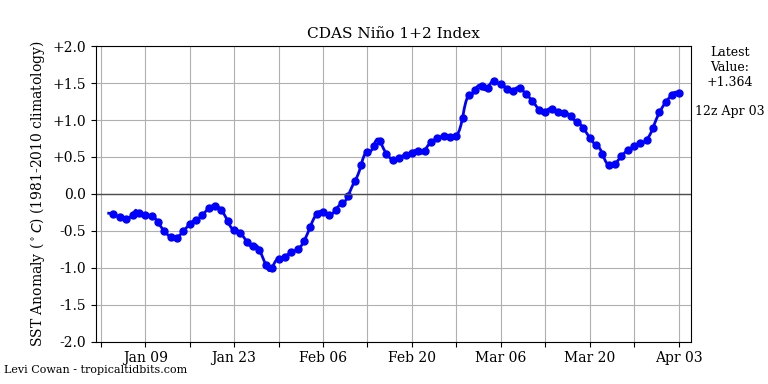
The paper was received back in January. The model includes 2018 as part of the prediction. Doesn’t look like they are doing to well. CFSR has shown a fair amount of cooling this year.
Looks like they may be hoping for an El Nino and that is not looking good either.
Certainly not during the winter in the southern hemisphere.
With all the warming predicted here short term and long term, the BBC might as well go ahead and advocate for a ban on fossil fuel home heating systems in new and existing homes. Let’s see them put some skin in the game.
What could possibly go wrong?
It sounds like their method uses data from models that have been wrong. Predictions based on wrong data and wrong models at the very least cannot be trusted. Garbage in, garbage out.
“Predictions based on wrong data and wrong models at the very least cannot be trusted.”
Maybe they are using the theory that two wrongs make a right… wrong data + wrong models = right answer (/sarc)
‘may be ‘ heads you lose , tails I win’ , is there any job has easy as climate ‘science ‘ where you can never be wrong and only be ‘right ‘ no matter what you do or say ?
In other news, researchers have looked for patterns in old game simulations, like Pong, space invaders and concluded that that the next successful blockbuster game will be Super Mario Pong Kong Elite tetris civ
For the statistical model to have found a basis for possible warming over the next 4 years in the past records of comparable (analogous) climate patterns would mean the coming predicted warming is not different than past warming periods, likely pre-1950. The analogous period would have to be 1938-1942 as my guess. And the IPCC clearly indicates its “consensus” that slowly rising CO2 levels were not high enough pre-1950 to be of consequence.
Thus, “Anthropogenic CO2 not required” is the message they do want to acknowledge.
CO2 levels were high enough in 1958 to make a difference at 10%. and 1993 at 25%… .. the trip from 10% to 25% was never interrupted by any downturns in the co2 that was accumulating the the atmosphere. It should have been warm and getting warmer from 1958 on wards.
And any amount of co2 should have been steadily warmer weather/climate… there is a feed back system according to the IPCC.