Study review by Kip Hansen
 This essay is about coyotes!
One of the odd things about this blog — WUWT — is the broad range of interests of the readers here. Perhaps I shouldn’t be surprised by this as readers here tend to be better-than-average educated, well read, interested in all things Science, concerned about the environment and tend to have more open minds.
At least three times in the last couple of years, I have written about some topic, only to have the comments section overwhelmed by discussions of coyotes — their habitat, range and behaviors — with lots of interesting stories of personal sightings and experiences.
We hear and read so much news about the threat of species extinction and shrinking ranges of species that I though a modern success story was in order.
The publishing of a brand new study about North American coyotes and their historic ranges has presented this opportunity to write about coyotes and allow readers to share their stories — this time on topic!
The new study comes to us from James W. Hody (North Carolina State University) and Roland Kays (North Carolina Museum of Natural Sciences) in a paper published in the open-access journal ZooKeys, titled Mapping the expansion of coyotes (Canis latrans) across North and Central America.
The paper is a major effort exploring this statement:
“The geographic distribution of coyotes (Canis latrans) has dramatically expanded since 1900, spreading across much of North America in a period when most other mammal species have been declining. Although this considerable expansion has been well documented at the state/provincial scale, continent-wide descriptions of coyote spread have portrayed conflicting distributions for coyotes prior to the 1900s, with popularly referenced anecdotal accounts showing them restricted to the great plains, and more obscure, but data-rich accounts suggesting they ranged across the arid west.”
Hody and Kays dug into biological history using “archaeological and fossil records, museum specimens, peer-reviewed reports, and records from wildlife management agencies” to determine the true historical range of the coyote as far back as 10,000 years before the present. What they found was that “coyotes have been present in the arid west and California throughout the Holocene, well before European colonization. Their range in the late 1800s was undistinguishable from earlier periods, and matched the distribution of non-forest habitat in the region.” Here’s the primary map they offer:

While we see that there are a few outliers, it is clear that, historically, coyotes have been mainly found in grasslands and arid lands of the North American west. The authors conclude:
“These data indicate that that coyotes’ range in the late-1800s reflected a longstanding geographic distribution that formed well before the 1700s, not a recent westward expansion. This contradicts widely-cited descriptions of the historical distribution of coyotes (Figure 1), which suggest that California and the Rocky Mountains as areas that were colonized by coyotes as recently as the 19th and 20th centuries ….. Instead, the historical distribution of coyotes matches areas where non-forested habitats (e.g., grassland, prairie, desert) dominate the climax vegetation, more closely corresponding to earlier range descriptions by Nowak … and Young and Jackson …. The Holocene distribution of coyotes in Mesoamerica remains unclear due to the relatively small number of published historical specimens available from this area.”
Using contemporary reports from the literature and various state wildlife agencies, Hody and Kays construct the following map of the expansion of the coyote’s range in North America to occupy all of the contiguous United States, all of Mexico as well was expansion into much of Canada, Alaska and Central America as far south as the Panama Canal.

This extensive colonization of new territory is hypothesized to have been facilitated by a variety of circumstances:
- The extirpation of other apex-level predators throughout North America, mainly the wolf and the cougar (mountain lion) in Eastern North America and the cougar and jaguar in Central America reducing predation of coyotes by these species and increasing available prey for the coyotes.
- The conversion of forested landscapes into agricultural landscapes opening up familiar ecosystems (similar to grasslands) to the coyotes and offering new prey — farm animals such as lambs, goats, chickens etc. This is believed to be the case in North America and in Central America.
- “Hybridization of coyotes with wolves and domestic dogs in eastern North America introduced new genotypes that may have promoted colonization and survival in eastern habitats” (see the story of the “Red Wolf”). In the southeastern United States and in Central America, hybridization is primarily with domestic dog breeds. (Oddly, hybridization with wolves and dogs does not appear to be happening on the northwestern front of the coyote’s expansion.)
All-in-all, this mid-level predator is gaining territory (and genetic content) through its incredible adaptability to modern conditions and the environmental changes being made by the continued and changing human influences on landscapes.
 The paper’s authors express fears of what effects the coyote may have on South American ecosystems when the coyote manages to cross the barrier currently presented by the Panama Canal and the dense forests of the Darién Gap in southern Panama and northwestern Columbia. “If coyotes reach South America, it is likely that the grassland and agricultural habitats in Colombia and Venezuela could support viable populations, unless competition with native carnivores restricts them….. its potential effects on native wildlife is entirely unknown.”
The paper is available in pdf format from the publisher.
# # # # #
Author’s Comment Policy:
North American native cultures commonly contain myths and stories revolving around the coyote, where it is often portrayed as “The Trickster”. For the Navajo, “coyote is an irresponsible and trouble-making character and he is one of the most important and revered characters in Navajo mythology.”
I currently live at the foot of the Catskill Mountains in Central Hudson Valley of New York State. The Catskills comprise 1,120 square miles (716,800 acres or 290,000 hectares) of wooded hills and valleys with an average altitude of about 3,000 feet (~1000 meters). Coyotes live and breed here and are a pest species for ranchers and farmers — one of my sons hunted them for a local farmer. In the winter, the mountain population moves downslope into the Hudson Valley which is much more densely populated. It is believed that the presence of coyotes keeps down the feral cat population (a plus).
Throughout New York State, there is a long tradition of scary stories being spread about “coy-dogs” and “coy-wolves”, often used as a “boogeyman” to prevent children was straying too far from home after dark. “Don’t go too far from the house, the coy-dogs’ll get ya!”
The American coyote is the true winner in the competition for America’s Most Successful Predator (second to Man, of course).
If you want me to respond specifically to a question or comment, address it to “Kip…” so I am sure to see it.
# # # # #
I’ve lived in SoCal for almost 70 years, The coyote population has definitely boomed during that time. It used to be they were mainly in the foothills and now they inhabit all zones from the mountains to the sea. I live by the beach and coyote sightings are common despite the high human density. Cats are fair prey but a local well done investigation of their stomach contents (culling in an over run area) showed very little cat remains. Mostly rodents, birds, and garbage/throw away food. They are good scavengers. I attribute the increase in coyote population to two things …. 1. As mentioned, reduction of predators, and 2. They stay away from humans and really don’t bother them (other than an occasional pet meal) with their nocturnal lifestyle.
markl ==> Thanks for the report from Southern California (where I was born and raised).
Lots of coyote attacks on humans, especially children in CA:
https://en.wikipedia.org/wiki/Coyote_attacks_on_humans#On_children
Besides the girl in CA, this promising young adult was killed in a coyote attack in Nova Scotia:
https://en.wikipedia.org/wiki/Taylor_Mitchell
If anyone would like to read a funny story about a young bear.
http://www.pantrychronicles.com?_id=690
It’s a true story–I was there and wrote it up last year for a friend that has a food blog.
Thanks for the story and the link.
Ooops–it is under Our Friends
Then scroll down to “Lunch in the Shade”
Long time ago.
I think coyotes understand the pecking order.
We’ll let them eat around the edges, just as long as they don’t get too aggressive.
Is killing girls and adult women too aggressive?
Yup, and those genes won’t live long enough to reproduce.
I don’t know whether the coyotes involved in those attacks had already reproduced or not. The Canadian coyote was big enough to kill a woman.
Unlike wolves, all coyotes get to breed.
I live SE of Seattle, in an area that is rural-going-suburban. I have seen coyotes both day and night here. In one case, I arose at home around 3am to use the facilities. Glancing out a window, I saw a coyote trotting right down the middle of the road, swinging its head left to right continuously in a suburban adapted hunt.
On another occasion a few years back, I was elk hunting and camped up in the Cascades, south of Mount Stuart by the north fork of the Teanaway River. It was a very cold night (15F or so) and I had crawled into a double layer of sleeping bags early. In the wee hours of the morning, I was startled awake to the chilling sounds of a major ‘dog’ fight. It had the hair on the back of my neck standing straight up! As I sat there chilled and listening, I realized it was a pack of wolves killing a coyote. After less than a minute, it concluded with a harsh death cry… and the normal night sounds returned. It took me a bit to get back to sleep…. even after verifying my firearm was in the tent with me.
When I lived in Leschi neighborhood of Seattle, I spotted this coyote.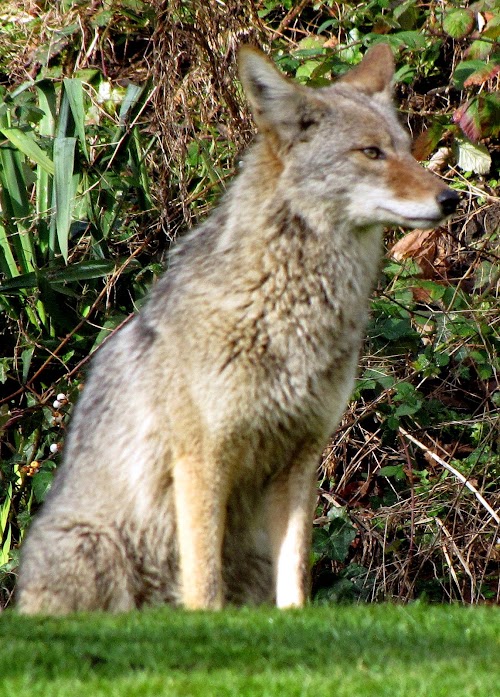
This neighborhood is pure city, right where the 1-90 floating bridge across Lk. Washington enters Seattle via the tunnels. We often saw racoons, but this is the first and only Coyote, and I only saw him once.
Dan Davis ==> Terrific photo (nice lawn too!). Thanks for sharing.
Let me put it this way, if I was a coyote, I might raid the garbage cans or mouse hunt near civilization, but always keeping in mind my cousins that never returned.
Those flat shooting rifles would give me pause.
Flat shooting rifle, (I promise to stop now).
Good shot. Not sure it was 400 yards, though.
With a .243, the coyote would have run a fur piece if shot in the guts.
Wow! that is good shooting.
And i would entirely believe the 400yds
They’re all over the place here in southwest Ohio. Several months ago one killed a small dog that my mom occasionally takes care of in Montgomery. It’s a very well-developed area. It’s right next to Indian Hill though which is much less developed and more of a safe haven for all kinds of wildlife. We’ve even spotted potential Coywolves running around too.
Related item: About 20 miles from my place.
May 19, 2018 Snoqualmie/North Bend cougar attack kills one and injures a second bicyclist.
http://www.foxnews.com/us/2018/05/19/cougar-attack-in-washington-kills-1-biker-injures-another.html
A cougar killed a Bay Area jogger, too.
Cougar human kills are more common than coyote.
J Mac ==> Yes, read that report. Very sad and unusual.
Commenter “Felix” has been posting a lot of comments about “coyote attacks” — one
very rare instance of a fatality due to blood loss from multiple bites. Coyote “attacks” usually involve simple bites and scratches and are not attempts to kill or eat people.
Coyote “attacks” are extremely rare compared to attacks by domestic dogs.
More than one fatality,
Comparison with dogs isn’t very instructive. There are more dogs and they live in closer association with humans and our pets and livestock.
Hundreds of thousands of coyotes are killed every year due to attacks on people, pets and livestock, yet their numbers are increasing.
And of course there would be a lot more lethal coyote attacks if family members weren’t able to rescue the kids in time.
South of Silicon Valley you will find the small town of Coyote and Coyote Creek. They’ve been there a long time… The notion that there are not / were not Coyotes in California is just silly. Just drive out there in the evening and listen to them howling in the hills…
From the wiki:
https://en.wikipedia.org/wiki/Coyote_Creek_(Santa_Clara_County)
So was full of coyotes when the Spanish first explored California.
As shown in Kip’s first figure.
E.M.Smith ==> Good point!
Kip: I’m originally from the plains in Canada but in 1971 moved to Ottawa, and then bought a farm east of the city to raise a big family on. At that time we could hear howling, particularly on a winter’s night, which I was told were “brush wolves” by the locals. I began to see them run across the road or the fields. They were blonde furred and were considerably larger than what I knew to be coyotes. The municipality would occasionally hire hunters to thin them out once sheep and other domestic stock were reported killed. I (like the locals) thought they were a type of wolf from the size but later learned they were a hybrid.
We get wildlife in and around Ottawa that seem to find their way here along the forested banks of the Ottawa river. Weve even had a moose jump a fence and land in a swimming pool and needed to be rescued. A cow moose walked along the rwy tracks with her calf to forest around the International airport. They had to put up moose signs along the airport parkway. This year a fox moved into our neighborhood which is only 20 minutes walk from the Canadian House of Parliament. He runs by people walking their dogs and seems to be preying on mice – you see him (?) with two or three mice in his mouth at a time which makes me think he has a family nearby. He doesnt seem to be bothering cats and squirrels. Deer, too, are common, occasionally looking bewildered in a shopping center parking lot.
Gary ==> Yep — London has urban foxes too.
Kip– Just read the article, great science, still a lot around, but appreciate you putting it out.
HD ==> You are welcome. Like good solid science like that.
Have seen coyotes in PA that looked more like a wolves though smaller than wolves I have seen, but not much. In Ohio have seen multicolor coyotes like some here in Wyoming and also quite large. Here I have seen and shot large 40+ lb coyotes and full grown ones more like 30 lbs all different color patterns. Problem is they interbreed with dogs back east, in particular, and they will eat everything from grasshoppers to deer and elk and will pack up if need be. Watched a family group of 5 try to take a lion kill from the lion sitting on it. The lion hangs on my wall. He did run off the coyotes though.
If a coyote can chew it, it will eat it. If it’s not food it will puke it up and eat it one more time just to make sure it’s not food, just like a dog. That is why they are so successful. Sneaky like a cat and just as good a mouser. Two small ones will take a large dog. Quite a critter, in my book.
I have a lot of respect for them, but have to kill them anyway.
Besides packing up with each other to bring down deer and even elk, they also cooperate with badgers. The combo is death to red diggers, aka Columbian ground squirrels.
Felix,
I hunted them for years but not so much anymore as long as they don’t come around my place as I have a cat I really like and some dogs who are not so smart that they wouldn’t give chase. Once helped with cows on my friend’s ranch and shot lots of coyotes in the process but I do have a grudging respect for the critters
They also pack up to try to kill bear cubs:
http://www.krdo.com/news/bear-protects-cubs-from-coyotes-at-garden-of-the-gods/743375124
Jim ==> Thanks for the story (from Pennsylvania?)
I’m in wyoming, now, for the last 22 years. Lived in Ohio for 49 years and never saw any coyotes until anout 25 years ago.
about
“Goddess of Kip” just finished 2nd in the 8th race at Arlington Park.
Paid $6 to place, $3 to show.
Made me $2.
u.k. ==> Well, see….I’m worth something!
Can I say it please?
Wile E. Coyote.
C’mon, someone had to!
Meep meep!
We do have a few roadrunners here in the Hill Country, but they don’t look much like the cartoon.
I love roadrunners. My brother lives in AZ and they come into his house.
The coyotes in Nebraska are skinny, lucky to weigh 40lbs. and travel in small packs or alone. In the Ozarks I have a place where they’re huge. 70lbs. wouldn’t surprise me and also where I got to see a “Red Wolf” up close and personal. In the Ozarks the packs number much higher than in Nebraska.
Coytes moving eastwards wiped out all ground dwelling birds along the way, each of which were known to eat up to 10000 ticks a day. Wonder why tick population in the east exploded?
Stan Jakuba, victim in Connecticut
Turkeys and grouse on the nest make quick easy meals. With the loss of the hens as well as no recruitment and in a very few years there is a complete population collapse. I personally watched the hen population of grouse and turkeys virtually vanish over just a couple of years. Young birds were non-existent. The experts as usual called it a bad hatch. Where did the hens go?????? Answer: BAD HATCH! Same answer year after year. Imagine being known as “xxxxxx “bad hatch” xxxxxx”.
I see coyotes running down the streets of my town all the time – though usually they stay in the grassy areas. We have had two attacks on our chickens in 3 years as well. (For various reasons the chickens managed to survive.)
Not that in Southern US a coyote is also the term for people who smuggle others over the border for money and or extortion.
Another note – if you pronounce the “e” it is more of a Spanish pronunciation which is probably why we got Wiley E Coyote – because of the Spanish influence in CA. Rest of US the “e” is silent.
It certainly is among natives of the interior PNW, but we are overrun with immigrants from other states who pronounce the final “e”.
The Spanish “coyote” comes from Nahuatl (Aztec) “coyotl”.
Coh-YOH-tay is more a California Spanish pronunciation, while pure Anglo is Kye-Oh-tee.
Maybe in CA, but in the Real West, it’s “kayoat”.
For “Kay”, please read, “keye”, as in “eye”.
Marque2 ==> The Cambridge Dictionary offers two pronunciations (US and UK) here. For Spanish pronunciation, try this 32 second YouTube.
That Spanish pronunciation works for Mexico, which has zheismo, ie LL and Y are pronounced “zh” or even “ch”, rather than standard “Y” as an English vowel. The opposite is yeismo.
Zheismo is even more pronounced in Argentina, and to a lesser extent in Chile. It’s spreading. It’s now even advancing in parts of Spain.
Nova translates its programs into both Castillian and American Spanish. In Argentina, “estrella” (star) is pronounced “estrezha”. Many TV shows also dub Spanish in two versions. Ditto Portuguese and Brazilian Portuguese.
Next up a paper on the chupacabra? 😉
….ya never know.
We have lived in a house near Sarasota Florida since 1978 and watched the transition from zero coyotes to having occasional sightings on our street… [The feral cats are all gone now.] They scared the daylights out of me when they started a loud confab outside my window!…..Would like to hear it again……
I wish my neighbors would stop shooting coyotes for one year to let them rid us of feral cats.
…go coyotes!
Russell ==> This is the second first-hand report from Pinellas County…thanks.
Kip…Sarasota County is about 30 miles South of Pinellas County.
Gads….mixed my Florida geography up…..I once had a work assignment that involved driving every mile of every road of Pinellas County —
It has been several years ago since I researched the coyote issue in Virginia. I spent too much time and effort to rehash it again so I’ll call it as I best remember it.
USF&W captured about 450 so-called “red wolves” from Texas / Louisiana swamp/coastal regions beginning about 1970 or so (too many alligators?). Then they declared them extinct in the wild. They picked a couple of dozen for breeding using criteria that “that one looks best”. Western Virginia shortly thereafter got big coyotes and in the form of packs or family groups as they say. Go figure.
Now the BIG QUESTION is: What did they do with the other original 425 or so? Did they euthanize the lot of rejects of the few remaining so-called “red wolves” or turn them loose? To euthanize some of the “extinct in the wild” wolves would be a serious crime especially if there were only 450 in the world. According to the VA DGIF it would have been unlawful to release them in VA without the approval of the DGIF. Biologists that I spoke to claim that none were ever released as far as they know. Pal/colleague effort? They sure don’t want to discuss it.
What did they do with 425 so-called “red wolf” rejects?? And then what about puppies and puppies’ puppies and so on that were being bred in captivity in zoos and breeding farms all over the country?? Do the numbers with litters of 8 – 12 each for 30 years or more. It would be a big many!
A hybrid coyote-wolf is declared extinct in the wild and the entire eastern US becomes overrun in with them in 15 years. Something stinks. Are there any in the original regions where man made them extinct?
I hit the DGIF with multiple inquiries as well as sports writers and various wildlife organizations and when the “cat was let out of the bag” web sites began disappearing faster than I could try to recall them. My efforts were around the year 2000. I sincerely believe there are many that have a lot of skeletons in their closet, but they gave us the plague of big coyotes and don’t want to talk about it. A biologist with an agenda and a big ugly secret, what could be worse?
I could go on more about the issues with this invasive species of coyotes and biologists with an agenda but I would need to write a book.
The sad fact is that there never, ever was such a thing as a “red wolf”, just US FWS rent-seekers.
The supposed “red wolf” is a coyote, as has been known from genetic studies for decades. But still the federal trough-feeding circus moves on.
eyesonu ==> You have the story basically right. Both Rud Istvan and I have written about the saga of the “Red Wolf”. My essay here at WUWT and (Istvan covered this in a chapter in his book “Blowing Smoke“)
@Kip
I have heard of 2 seperate sightings here in Fairbanks, AK this spring, about 30 miles apart. So either passing through headed west or 2 seperate coyotes. One was from an avid game hunter so pretty reliable source.
AKSurveyor ==> The paper claims that coyotes have arrived in Alaska but yours is our first personal report from up North.
Coyotes would be fairly similar to foxes. Foxes do well in urban settings and every country they’ve been introduced to they have thrived. In Australia Foxes are everywhere. The population of Red Foxes in Australia is about 6.2 million. They were introduced into Australia in the 1840’s for fox hunting, along with the rabbit.
J.H. ==> Stupid foxes failed to eat all the rabbits though…..
Kip
About 2011, Oceanside,CA, February, in a Del Webb gated community not far from a brushy arroyo. Out walking the 50lb dog about 5:30 am. We have been down to the arroyo and are now back in the development, walking uphill towards our side street. Here comes a pack of coyotes, around 12 or so of them, spread out over a couple hundred yards, running full out. My hackles go up, and we stop. They rush past us and turn into the adjoining street and rush on. They have been hunting cats, dogs, rabbits, whatever, and it is time for them to exit the development. A close encounter I do not wish to repeat. Now in NW AZ and have seen one in the last 16 months, but folks in nearby Mesquite NV report hearing them regularly, likely a function of the availability of small pets and an exploding rabbit population this year.
Terry ==> Great story about coyotes in Oceanside…used to have relatives there.
When I lived in California (in the San Gabriel mountains right next to a huge area designated as national forest) I’d hear several coyotes howling and yipping as they ran thru the streets of Lake Hughes, the tiny no-stoplight town of my then residence. This happened quite often on many nights out of the year. I also saw one during the day in a field – at first I thought it was a small German Shepherd mix but then I realized there were no homes for miles and that it really did not look or run like a dog.
Now since I’ve moved back here to Maryland, I have, once in a blue moon, heard a coyote yip or bark (there is no way the sound can be confused with that of a dog, even a small dog) off in the distance. I live in a semi-rural area with lots of farms. But I’ve never seen one, though I know of people who have. It seems to me they are more secretive here on the east coast then the ones in CA in that they (at least around here) are less vocal. IMO it is likely they are seen less simply because of the landscape – areas of forest and brush broken by farms and fields rather than open deserts and sparse scrub. But still they are pests of livestock even though they are little seen and seldom heard. There is a farmer down the road who wanted to know if I would be interested in trapping some of them because they are killing his chickens. I trap raccoons and other small furbearers when the fur is worth harvesting (in fall and winter) so there is really no incentive for me to kill a coyote in summer time because its hide is worthless then. BTW it is open season year round on coyote in most of Maryland, as is the case in many states where they have emigrated to in the last few decades.
And speaking of cats and coyotes, on my street there were two families who moved in at the end of last year, and both foolishly had outdoor cats. Well, it is now only a few months later and I’ve not seen either cat running around at night for some time. It is quite possible that they met their demise in the jaws of local coyotes – maybe they couldn’t find any more cats and so went after the farmer’s chickens…..
Schrecken ==> Thanks for the report on San Gabriel and Maryland — one of my sons quit hunting coyotes Upstate NY after many seasons producing only one or two decent skins.
Kip. I saw a PBS documentary that claimed coy wolves are moving from Canada to the northeastern US. I think I have seen some in central VA.
From a Smithsonian magazine: https://www.smithsonianmag.com/smart-news/coywolves-are-taking-over-eastern-north-america-180957141/
“The hybrid, or Canis latrans var., is about 55 pounds heavier than pure coyotes, with longer legs, a larger jaw, smaller ears and a bushier tail. It is part eastern wolf, part wester wolf, western coyote and with some dog (large breeds like Doberman Pinschers and German Shepherds), reports The Economist. Coywolves today are on average a quarter wolf and a tenth dog.”
thomaskennedy2 ==> The paper under discussion here confirms that in the Northeast US/Canada coyotes have been interbreeding with dogs and wolves — but interesting also reports that this phenomena is not seen at the Northwestern front of coyote expansion into BC and Alaska.