Study review by Kip Hansen
 This essay is about coyotes!
One of the odd things about this blog — WUWT — is the broad range of interests of the readers here. Perhaps I shouldn’t be surprised by this as readers here tend to be better-than-average educated, well read, interested in all things Science, concerned about the environment and tend to have more open minds.
At least three times in the last couple of years, I have written about some topic, only to have the comments section overwhelmed by discussions of coyotes — their habitat, range and behaviors — with lots of interesting stories of personal sightings and experiences.
We hear and read so much news about the threat of species extinction and shrinking ranges of species that I though a modern success story was in order.
The publishing of a brand new study about North American coyotes and their historic ranges has presented this opportunity to write about coyotes and allow readers to share their stories — this time on topic!
The new study comes to us from James W. Hody (North Carolina State University) and Roland Kays (North Carolina Museum of Natural Sciences) in a paper published in the open-access journal ZooKeys, titled Mapping the expansion of coyotes (Canis latrans) across North and Central America.
The paper is a major effort exploring this statement:
“The geographic distribution of coyotes (Canis latrans) has dramatically expanded since 1900, spreading across much of North America in a period when most other mammal species have been declining. Although this considerable expansion has been well documented at the state/provincial scale, continent-wide descriptions of coyote spread have portrayed conflicting distributions for coyotes prior to the 1900s, with popularly referenced anecdotal accounts showing them restricted to the great plains, and more obscure, but data-rich accounts suggesting they ranged across the arid west.”
Hody and Kays dug into biological history using “archaeological and fossil records, museum specimens, peer-reviewed reports, and records from wildlife management agencies” to determine the true historical range of the coyote as far back as 10,000 years before the present. What they found was that “coyotes have been present in the arid west and California throughout the Holocene, well before European colonization. Their range in the late 1800s was undistinguishable from earlier periods, and matched the distribution of non-forest habitat in the region.” Here’s the primary map they offer:

While we see that there are a few outliers, it is clear that, historically, coyotes have been mainly found in grasslands and arid lands of the North American west. The authors conclude:
“These data indicate that that coyotes’ range in the late-1800s reflected a longstanding geographic distribution that formed well before the 1700s, not a recent westward expansion. This contradicts widely-cited descriptions of the historical distribution of coyotes (Figure 1), which suggest that California and the Rocky Mountains as areas that were colonized by coyotes as recently as the 19th and 20th centuries ….. Instead, the historical distribution of coyotes matches areas where non-forested habitats (e.g., grassland, prairie, desert) dominate the climax vegetation, more closely corresponding to earlier range descriptions by Nowak … and Young and Jackson …. The Holocene distribution of coyotes in Mesoamerica remains unclear due to the relatively small number of published historical specimens available from this area.”
Using contemporary reports from the literature and various state wildlife agencies, Hody and Kays construct the following map of the expansion of the coyote’s range in North America to occupy all of the contiguous United States, all of Mexico as well was expansion into much of Canada, Alaska and Central America as far south as the Panama Canal.

This extensive colonization of new territory is hypothesized to have been facilitated by a variety of circumstances:
- The extirpation of other apex-level predators throughout North America, mainly the wolf and the cougar (mountain lion) in Eastern North America and the cougar and jaguar in Central America reducing predation of coyotes by these species and increasing available prey for the coyotes.
- The conversion of forested landscapes into agricultural landscapes opening up familiar ecosystems (similar to grasslands) to the coyotes and offering new prey — farm animals such as lambs, goats, chickens etc. This is believed to be the case in North America and in Central America.
- “Hybridization of coyotes with wolves and domestic dogs in eastern North America introduced new genotypes that may have promoted colonization and survival in eastern habitats” (see the story of the “Red Wolf”). In the southeastern United States and in Central America, hybridization is primarily with domestic dog breeds. (Oddly, hybridization with wolves and dogs does not appear to be happening on the northwestern front of the coyote’s expansion.)
All-in-all, this mid-level predator is gaining territory (and genetic content) through its incredible adaptability to modern conditions and the environmental changes being made by the continued and changing human influences on landscapes.
 The paper’s authors express fears of what effects the coyote may have on South American ecosystems when the coyote manages to cross the barrier currently presented by the Panama Canal and the dense forests of the Darién Gap in southern Panama and northwestern Columbia. “If coyotes reach South America, it is likely that the grassland and agricultural habitats in Colombia and Venezuela could support viable populations, unless competition with native carnivores restricts them….. its potential effects on native wildlife is entirely unknown.”
The paper is available in pdf format from the publisher.
# # # # #
Author’s Comment Policy:
North American native cultures commonly contain myths and stories revolving around the coyote, where it is often portrayed as “The Trickster”. For the Navajo, “coyote is an irresponsible and trouble-making character and he is one of the most important and revered characters in Navajo mythology.”
I currently live at the foot of the Catskill Mountains in Central Hudson Valley of New York State. The Catskills comprise 1,120 square miles (716,800 acres or 290,000 hectares) of wooded hills and valleys with an average altitude of about 3,000 feet (~1000 meters). Coyotes live and breed here and are a pest species for ranchers and farmers — one of my sons hunted them for a local farmer. In the winter, the mountain population moves downslope into the Hudson Valley which is much more densely populated. It is believed that the presence of coyotes keeps down the feral cat population (a plus).
Throughout New York State, there is a long tradition of scary stories being spread about “coy-dogs” and “coy-wolves”, often used as a “boogeyman” to prevent children was straying too far from home after dark. “Don’t go too far from the house, the coy-dogs’ll get ya!”
The American coyote is the true winner in the competition for America’s Most Successful Predator (second to Man, of course).
If you want me to respond specifically to a question or comment, address it to “Kip…” so I am sure to see it.
# # # # #
I wonder how the people compiling the first map define “woodland”. The Hill Country of Texas, where I live, is open oak and mesquite woodland, or is it something else? Just how many trees, and how close together for it to be classified as “woodland”?
Tom ==> The term they use is “forest cover”. I have traveled through Texas and would not have ranked much of the Hill Country as having “forest cover”.
Interesting. I traveled over much of the Texas hill country before it was so highly developed (circa 1964) and also more recently. Also lived for two decades on the central Texas coast on 7 acres of mostly live oak forest with dense understory (also true of adjacent property). Despite opening up some of it for habitation (about an acre) we never found any evidence of a coyote. It was sand and easy to detect footprints and we heard them in winter some distance away in mesquite prairie with little understory, more like the density of the hill county.
We did have deer, bobcats, fox, and very rarely cougars. Feral cats were also rare. The interesting thing was that rattlesnakes were common in the adjacent mesquite areas, but we only found evidence of two, maybe only one, a female who desposited a baby at the front step.
I have also seen coyotes in many states and habitats, and have long suspected that they are a prairie animal that doesn’t like much undergrowth, which often gets removed even when keeping the trees. Harvey opened up a lot of it. There was an old hunter from Rockport who used to hunt “wolves,” probably large coyotes.
We live on the southern edge of Texas Hill Country, right on the Balcones fault. The land to the south and east is mostly open plains extending to the Gulf of Mexico. We are on a ridge in what could be called “forest cover”, which extends hundreds of miles to the west and north. “Forest cover” is in quotes since the dominant tree that is seen all around is called a “cedar” by the locals. (Remember pictures of President Bush cutting “cedars” on his nearby ranch.) It is actually the Ash Juniper. When these “cedars” are removed, a Live Oak forest still remains, though the Live Oaks are barely noticeable when they are among the “cedars”.
I come from Michigan where I lived near a large recreation area and would hear coyotes all the time, especially on winter moonlit nights. I only saw one once. In Texas, I have seen several coyotes, including several times in our front yard. That’s enough that I carry pepper spray whenever I’m walking in the woods. I never did in Michigan.
Tom ==> Good report from Texas.
In middle Tennessee, they have been moving in along with the people. Lots of the typical reports of pets going missing. 30+ years ago when I moved in, I never thought about them. Now I hear them at night regularly.
Tregonsee ==> Thanks for the Tennessee report.
I saw and heard them regularly in KY and southern Indiana…and heard them in TN. People would tell me stories about coyote attacks on pets in Nashville, but I couldn’t find anything in the papers. I’ve always had small dogs, and they’ve always kept their distance. I have the same scare stories now in FL. I’ve seen some around, but just a bark scares the @ur momisugly$#@ur momisugly# out of them.
They make beautiful music…especially the pups.
To me, the prettiest is when the moms are calling in their cubs at dusk.
In Indiana they have been considered vermin. They used to pay a bounty for each tail brought into the DNR. To this day one can shoot them year around on their own property outside city limits or where the hunter has permission when hunting elsewhere. Despite that the population has increased. And yes they do take small dogs. Took two on different nights within a 1/2 mile radius of my house a couple years ago.
About 12 mile south of my house there is a small animal rescue farm. It sits on the short chute of an “S: Turn. About 10 years ago my wife was driving to work one dark morning and came around the first turn of the “S” and ran right into a pack of coyotes that had dragged a goat over or under the fence of the rescue farm and had the carcass in the middle of the road. She took two of them out before running off the road onto the grass shoulder and down an incline. Scared the hell out of her when the three or four other remaining coyotes got vicious. They’ll do that when they’re in a pack. She was driving a jeep Cherokee so had no problem getting out of there.
I like having them around personally and understand the benefits. So when driving the big truck I do my best not to hit the occasional one that gets in front of me. Never took one out.
RAH == Great story — glad your wife was alright!
That’s 1/2 mile
I live just south of Memphis TN in the suburbs and I have seen coyotes in our subdivision and have occasionally heard them calling during the night.
Rick ==> Thanks for the first-hand report from Tennessee.
If only the exploding coyote population would eat the exploding whitetail deer population.
Felix ==> Coyotes are thought to attack and kill fawns, but seldom full grown deer. Coyote hybrids (such as the “red wolf”) have been known to take deer.
See my comment below.
Coyotes are the main predator of deer fawns. Or were before the big increase in cougar populations, thanks to laws making it hard to hunt them and bears. But laws against poisoning coyotes have increased their numbers, too.
“Red wolves” are barely hybrids. They’re just a large local population of coyotes.
Which is why the totally wasted breeding program in NC, using TX coyotes, is and will remain a failure. As soon as the “red wolves” are released, they breed with coyotes. Because they are coyotes, with very little grey wolf admixture.
No wonder NC’s local human population so hates the FWS program. An ideal target for budget cutting.
Kip Hansen May 25, 2018 at 1:51 pm
Kip, no thinking about it, ….. a pack of coyotes (coy-dogs) will “search” every square foot of ground if they think a WT fawn is “hiding” in the vicinity. They can’t smell it, but they will look until they find it.
Samuel,
Back in the 1970s and ’80s, 75% of fawns in NE Oregon were killed by coyotes. I don’t know what the figure is now.
When I lived in Indiana, they definitely used to take down full grown deer. They pack up, the more densely populated they are after they’ve started to eliminate a lot of the smaller game.
Kip Hansen, when the “eastern coyote” crosses with the Canadian red wolf, it’s called the tweed wolf or bush wolf, first discovered in 1907 near Tweed, Ontario.
They are all over the place in Lake County the other collar counties around Chicago. They run loose in Chicago. A research team from Ohio started tracking their movements by radio collar, and found that a hunting female will cover as much as 90 miles in one night of hunting. That is one busy coyote.
They are extremely aggressive around here, because no one is hunting them. Too many suburban developments make it nearly impossible to hunt them. They will chase and attack your dogs in your own backyard and leap the fence, chasing them into the house, especially if it’s a pack of coyotes with females in heat. They get hit by cars and trucks, chase and nip at children who don’t know that they aren’t pet dogs, and in general are a freaking nuisance.
I’m feeding a stray calico cat that has been bumming food off me for about a year now. So far, she’s safe and I think she’s aggressive enough to take down a black bear (also moving eastward from DeKalb) and there is a record of a young male cougar who got lost in Chicago and was cornered, shot and killed by 8 Chicago cops, because they couldn’t wait for the DNR people to get there. Idiots!
Basically, they are here to stay. Not going away. And they will kill your dog as a territorial move.
Sara ==> Thanks for the coyote news from Chicago (?).
Kip,
I would not say that coyotes “seldom” attack adult deer. In the snow, it’s common, but even in good WX, they can pack up to rip vital bits out of deer, then eat them alive. Even mature bucks:
Felix ==> The buck in the (tediously put together) video appears to have been wounded even in the first frame….the fact that it beds down might support this. To me this looks like a wounded deer bleeding out internally — with coyotes following the blood scent and harassing the dying animal. Interesting video though.
Looks like a pair of the dreaded glowing eyed chupacabra
Oh, noes!
The dreaded chupacapra has invaded North America!
And is now the chupavenado!
Felix ==> or maybe the “coy-capra” if they hybridize.
EJ,
Thanks!
Great pix.
Kip,
Coyotes don’t kill just the old, sick and young. When they pack up, they can kill healthy adult white tails and even mulies. One darts in and takes a bite out of a vital or sensitive area, or wherever it can. Then the pack trails the victim, taking more bites when opportunity arises.
Please see the video posted above.
Felix ==> I commented on the video and in the Epilogue on this issue.
Above posted out of place.
But it shows how coyotes kill healthy adult deer.
The wound on the deer at the beginning was inflicted by the coyotes. That’s how they worry their prey to death.
I’ve seen deer carcasses where there are no wolves or dogs, and the teeth marks aren’t from cougars.
Granted, the carcass could have been scavenged, but while cross-country skiing, I’ve come across the scene of an obvious attack in the snow, with tracks and blood trail associated with one set of remains. It also appeared in that case that the coyotes had returned to scavenge the bones.
See my comment below for much more.
Coyote are not big enough and don’t pack hunt well enough to take down deer (typically). You need a wolf for that.
Jeff ==> Mostly correct — they do take fawns however — and the sick and wounded. Further south, where there are larger wolf/coyote hybrids, there is some concern for first year deer.
Coyotes are the main control on deer population:
https://gameandgarden.com/sustainability/land/do-coyotes-affect-deer-populations/
It’s possibly worse in Alberta, where due to snow in winter, coyotes can more easily kill adults, too.
Felix ==> The link you give (from a gardening site with recipes, in 2013) is not dependable. It depends on only two other articles which can not be located on the web today (not real studies or journal articles). Many of the comments under the original piece are contradicting the main point.
In the larger environmental field, coyotes are not considered to be the main control on deer populations.
Coyotes are not much of a check on deer in this part of Texas, as the deer are numerous enough to be a road hazard.
Tom ==> Yeah — I don’t think the coyote-as-deer control idea flies very far.
PS: I’ve killed hundreds of coyotes since the 1960s, without noticeable effect on their population.
To include denning, I’ve probably killed thousands.
Kip Hansen May 25, 2018 at 3:08 pm
They are where I live.
How many more studies do you want? What wild animal do you suppose is the main control on coyotes? Humans are doing a piss poor job of controlling both deer and coyotes.
http://www.mlive.com/outdoors/index.ssf/2012/04/experts_surprised_by_which_pre.html
Western UP of MI: Coyotes #1 cause of deer mortality, followed by bobcats, a three-way tie among hunters, unknown predators and undetermined causes, and #4 wolves.
Again, snow might be a contributory factor.
Every study I’ve read or participated in has found coyotes the main predator of fawns, but their effect on overall deer population is disputed.
https://www.realtree.com/deer-hunting/articles/how-coyotes-killed-deer-hunting
https://www.livescience.com/27976-coyotes.html
From the U. of MI’s Animal Diversity Web:
http://animaldiversity.org/accounts/Canis_latrans/
“Hunting deer, on the other hand, calls for teamwork. Coyotes may take turns pursuing the deer until it tires, or they may drive it towards a hidden member of the pack.”
Felix ==> “…found coyotes the main predator of fawns, but their effect on overall deer population is disputed.” Yes — that is correct — coyotes prey on fawns — but are not believed to have a major effect on overall deer populations when weighed against other deer population limiters.
Tom Halla May 25, 2018 at 3:18 pm
Almost everyone around here (inland PNW) has hit deer, whose population has exploded. But it would be worse without coyotes.
Visiting my daughter and son-in-law outside of Fort Collins Colorado I saw a coyote of German Shepard size ( 90-120 lbs.) and speed that I believe could easily take down the average Pennsylvania Whitetail Doe-not so much a Colorado Mule Deer or Elk. The coyotes we have in Pennsylvania are not much bigger than 40-50 lbs. but they are everywhere in our state.
Carbon Bigfoot ==> The German Shepard sized animal could well have been a wolf there in Colorado. 40-50 lbs is BIG for a coyote.
Kip I had my son-in-law with me , a serious hunter in Colorado who corrected my view that it had to be a wolf—-it was within 50 yds. and I would trust his assessment as he has harvested many coyotes over his 40 year hunting career.
The two largest coyotes I ever shot weighed over 50#, after losing a lot of blood and in one case guts. I weighed them because they were noticeably larger than average.
The record is from WY, at 75#, IIRC.
Felix ==> These larger specimens are, in all probability, wolf/coyote hybrids.
Some obviously might be, now that wolves have been reintroduced in my area, but I shot those two decades ago.
That may be true where you are, Jeff, but where I am, they hunt in packs and they will go after and take down adult deer.
Many of you will have seen this story: –
http://www.bbc.co.uk/news/world-us-canada-44243644 ;
https://globalnews.ca/video/4234468/strange-wolf-like-creature-shot-in-montana-leaves-wildlife-experts-baffled ;
And other URLs.
Any relation?
To my – thoroughly inexpert – eyes, the dead beast has something of the Irish wolf-hound about it.
Maybe.
DNA sampling is promised, and that may clarify. Perhaps.
Auto
Coyote ugly has many manifestations, Auto.
Auto ==> I’m voting with the wildlife experts there who suspect that that animal is a wolf/dog hybrid — and as dogs come in an astonishing variety of shapes and sizes the results of these hybrids do too.
Coyotes are replacing foxes…..foxes have a much higher density than coyotes….because of their higher density, foxes kill a lot more small prey…even though they both tend to eat the same prey
Studies are looking at what effect this will have on the spread of lyme disease and other diseases
These things amaze me….using the same criteria that’s used when they claim some animal is going extinct….coyotes would be considered an invasive species
Latitude said:
.. I can envisage the next headline (elsewhere): Climate Change affects Red Foxes, < panic, panic, panic> Soon, Red Foxes will disappear from their traditional habitat. Without XYZ millions of tax dollars, Red Foxes will extinctify …
One could almost write the rest of the article without any further ado, and there would be no word at all about a competing genus.
Redd Foxx is extinct (1991). Probably due to rising COyo2. More research is needed.
John C ==> RIP Redd Foxx…..
Latitude ==> Do you have a link or reference for the fox-coyote linkage? I’d be interested to see it.
West Virginia DNR: https://wvdnr.gov/hunting/CoyoteResearch.shtm
“Red and Grey Fox
Although coyotes and foxes share a common range throughout much of North America, there appears to be an inverse relationship between the densities of coyotes and that of foxes. High densities of coyotes tend to limit the distribution of fox territories and their numbers. Biologists have noted the decline of foxes following the colonization of coyotes into an area. Foxes apparently avoid core home ranges of coyote to avoid contact with the stronger predator. The territory of the grey fox occupies more interior woodland and apparently encounters are less common than in the more open land territory of the red fox. Most studies have concluded that foxes are not eliminated but become less common when coyotes invade their territory.”
No references provided in that htm… suggest contact wvdnr.gov for possible supporting info.
J Mac ==> Thanks for the data.
They are thriving because they are too low to the ground to be chopped up by subsidized windmill blades or fried by subsidized solar CSP towers, and too smart to be run over by silent EVs.
Additionally, the ‘environmentalist’ don’t own guns, and would never shoot anything. Even if it threatens Mittens the cat.
Some 20 years ago, the coyote started to appear in residential areas in Vancouver. They have learned to live in the city. Over on the North Shore next to the local mountains, wild critter intrusions include black bears and the rare mountain lion.
So the plagues of city life now include:
Urban mountain lions, urban bears, urban coyotes, urban raccoons, urban skunks and urban socialists.
Bob Hoye
Urban Socialists are the nasty ones, the others are quite harmless in comparison.
Yes, and the urban socialists are expanding their territory to the suburbs and countryside. Faster than the coyotes, it seems.
Leonard Lane ==> Yes, a true plague on the land it is too.
subtle2 ==> Unfortunately, coyotes don’t prey on urban socialists.
This is too sad to be flip, and I have no idea of her politics, but coyotes will prey on people if they are in the mood:
https://www.thestar.com/news/canada/2009/10/28/toronto_singer_killed_by_coyotes.html
Could genetic engineering be a solution to your problem ?
Growing up in central Wisconsin during the late 1950s to 1970s, we never heard coyotes yipping or calling. Now, you can often get a response if you imitate a coyote howl around dusk.
Probably the late night calls of students in Wasau, calling your bluff.
That would be a ‘long distance call, from Green Lake County where I grew up!
J Mac ==> Thanks for weighing in from Wisconsin — where i spent summers with my maternal grandparents on their German dairy farm.
Hey Kip, keep up the good work.
Too bad Andy Revkin stopped his blog. One of the few from MSM which tolerated dissenters, fomented some level of dialogue and attempted to call out the alarmists when the shark jump was too large even for the gullible. Other sites merely censor any dissent.
I still think a Dot Earth wine & cheese party on the banks of the Hudson someday would be a great idea.
P.S. A few coyotes can scare the bejeesus out of you when you’re lying in your sleeping bag under a starry night and the yelping increases in volume and proximity.
Kurt ==> The coyote sounds much scarier than it really is. They are very skittish and flee at the slightest movement under normal circumstances. There are reports of urban coyotes becoming much less shy — even bold.
KIp – When coyotes become acclimated to people they are potentially dangerous. Over a decade ago, I read a study of 90 coyote attacks on people in California. As I recall most people got bit trying to protect their pets, but there were also attacks on children, campers in sleeping bags, and visitors to national parks (presumably due to feeding). A young woman hiking alone in a Canadian park was killed by coyotes a couple of years ago and there are a very large number of recent reports of attacks on people, especially children. When I lived in Alberta and walked to work in the predawn across the North Saskatchewan Valley I saw coyotes regularly – and nothing skittish about them. Several times I was shadowed by one or two and it made me feel uncomfortable, but watching 7 of them, one by one, break cover and run across the frozen river towards my direction was distinctly disturbing. The urban myth that coyotes won’t attack people is just another misconception about wildlife. We have the same myth here in Queensland about dingoes, that is until some poor kid gets killed by a dingo, and then the media is full of excuses like ‘it must have been starving’. I notice the same ’emaciated’ excuse already has been floated about the cougar that attacked two bicyclists the other day. Yeah, yeah, you are more likely to be bitten by a domestic dog than a wild predator, but people and dogs interact several orders of magnitude more than people and wild predators. You need to treat wild carnivores with respect.
DaveW ==> ” You need to treat wild carnivores with respect.” and that’s line — never forget that a wild animal, no matter that it looks like a cute long-eared doggie, is a wild animal and operates mostly on instinct.
The very cute ground squirrels in California might carry Yersinia pestis, AKA black plague. It’s not just carnivores.
That’s why you need to beware of ‘coyote ugly,’ Kip.
Tom,
The sylvan reservoir of Black Death is rodents of all types, but especially squirrels in the US West.
Not to mention hantavirus in mice.
Followed by the screams of their prey being eaten alive ….
We have seen coyotes in Pinellas county Fl, one of the most densly populated areas in the state. They travel in power line corridors which give them an undisturbed path through the county and good access to city and county parks. They have been frequently reported in my neighborhood, which is adjacent to a large transmission corridor. I saw my first one in the early 90s which corresponds nicely to the map shown. Very interesting, and thanks for the post.
Coyotes do well living at the edges (and sometimes in the middle of) human civilization
James ==> The study reports that highways (and this would include power transmission corridors) have provided the coyote with expansion routes through areas it otherwise would not have been able to pass through, especially in Central America.
I recall reading a long while ago that they are territorial and cover about 12,000 acres per pack. All I can tell you is when I hear them near my neighborhood (rural, but large), within a few days the lost cat signs go up from the irresponsible owners who let them out at night.
ossqss ==> The coyotes say “Thanks for the free meals. Keep those cats coming!”
Cats allowed to roam free are FAIR GAME for coyotes. People should keep their pets in their homes or at least confined to their own yards.
When I moved to north Florida in the 1990s there were still people, including some environmentalist, that refused to accept coyotes were here. They either didn’t notice or refuse to accept that the pointy nosed, reddish dog like carcass on the side of the road wasn’t a dog. Now the signs of coyote are obvious, especially when one’s cat or small dog goes missing shortly after letting them out in the evening. We live a half mile for a lake that regular goes down a sinkhole. When it disappeared altogether for a while in ca 1996 coyotes moved into a park along the shoreline of the lake. We would see fresh footprints crossing the exposed bottom of the lake along with white tail deer almost every morning. Now we have coyotes and white tail deer a mile away in the small park.
Kip, I would note, there was a paper discussing how coyote populations change when hunted and how they affect white tail deer populations and fawn survival. I don’t remember the reference and no longer have the paper. What I remember is that if the local dominate coyote that is predating fawns is killed several in the pecking order will actually end up taking more fawns than when the dominate coyote was still around. I don’t know what it would mean for sheep, goats and chickens. The paper also discussed changes in white tail deer populations and behavior. When coyotes first arrive in an area white tail fawn morality goes up. After the coyotes have been around a while the white tail fawn mortality declines. The authors honestly admitted that they didn’t understand the mechanism or what changed in deer behavior.
Not only coyotes eat pets. I remember once in Ocala forest when I was breaking camp at dawn in a Forest Service Campground a bobcat walked by quite calmly carrying a dead cat.
equal opportunity predatory carnivores.
tty ==> Go bobcats!
cat is a bobcat favorite.
one of the best way (from what I’ve heard … I would not do it) to trap bobcat is to use crying house cat as bait.
DonM ==> What an interesting idea! use perhaps a local feral cat?
“Pusscat” is also a favorite of Australian Aborigines.
And of course in Chinese restaurants.
tty – cougars too. David Barron’s book ‘The Beast in the Garden’ does a very fine job of exploring the interactions of people and wildlife encroaching on each other’s territory:
https://www.amazon.com/Beast-Garden-Predators-Suburban-America/dp/0393326349
News report from Bainbridge Island in Washington State was about a big old diseased tree that had a large bald eagle nest. The tree had to be cut down as it was rotting and dangerous. The eagle nest includes a large collection of cat collars… more than two dozen IIRC.
….go eagles!
James ==> I brief look didn’t turn up this report — do you have a link? It is mentioned in a few blogs but may be an urban legend.
I know folks who have lost cats to hawks….
Cougars kill livestock for fun, when they’re not hungry, just as house cats do birds. They’re programmed to kill.
Cougars will eat just the udder of a cow as a dairy snack and leave her to bleed to death, without eating any other part of her. Cats like milk. They’ll kill her calf just for giggles, too.
““Pusscat” is also a favorite of Australian Aborigines.”
Yes, and the virtual disappearance of small native mammals in most of Australia is probably due to the decline in pusscat hunting which previously kept down the number of cats. Pusscats was apparently favored as prey because of their habit of climbing into trees when chased, which made them easy to kill.
Edwin are you describing Lake Jackson by chance in Tallahassee which often disappears and reappears?
Unrepresented, in this case yes, But many lakes in Florida depending on the rainfall and drought cycle also will disappear. Lake Jackson and another half way between Tallahassee and Jacksonville were the only two lakes of many that “disappeared”, especially in Central Florida, not plugged that year by emergency permit. Emergency permit because of concerns with polluting the aquifer. Now they are dumping die down several “sinkhole” lakes around Tallahassee trying to determine where the water goes, though it shouldn’t be a “secret.” The concern is now about downstream springs like Wakulla.
Edwin are you describing Lake Jackson by chance in Tallahassee which often disappears and reappears?
Edwin ==> I’ll take a look for that paper. Thanks for the tip.
Edwin – May 25, 2018 at 1:29 pm
Shur nuff, ….. Edwin, …. I experienced the same “mindset” in the local residents when I moved back to central West Virginia from upstate New York in 1983, ….. bout 35 years ago.
I told the “locals” they were “coy-dogs” because that was what the NYS DNR was referring to them as and the “fact” that I had personally “shot n’ killed” 3 or 4 of them when living in NYS.
Most all Northeastern and Eastern “coy-dogs” (coyotes) resemble a German Shepard in size and color, ….. except they have a “bushy” tail and “beady” eyes and “pointy” nose, …. in other words, a “Fox face”.
And the White Tail deer here in central WV, which used to be “scarce as hen’s teeth” when I was a teenager, has increased exponentially after I-79 was constructed in the mid-1970s, to become a “public nuisance” causing vehicle wrecks and other property damage. Black Bears have also returned to central WV.
Cheers, Sam C
“I had personally “shot n killed” 3 or 4 of them when living in NYS”. Why? I have walked and bicycled amongst them without ever feeling threatened (Fish Creek Park, Alberta) Sounds like your are on a big ego trip. Maybe it’s time you put down your gun and did your shooting with a camera.
Art – May 25, 2018 at 4:02 pm
I believe, I believe, …..shur you have, …… Art, ….. shur you have.
The invisible man on the invisible bicycle …… walking amongst all the wild animals in the Alberta bush.
Art, do those wild animals “talk back” when you talk to them?
Alas, the 51 cat collar eagle tree seems a likely urban myth, but there is at least one valid eagle cam video of Bald Eagles dismembering a cat and feeding it to their chicks – it made a big splash in April 2016. If I had to bet on a bird being a regular hunter of cats, I’d go for the Great Horned Owl – they hunt when cats prowl and are known to take skunks. The StarTribune article has a decent overview of eagles, cat collars and brassieres:
http://www.startribune.com/eagles-and-ospreys-are-flying-pack-rats/87805702/
Here is some footage of an eagle taking a fawn that was swimming along the shore of a lake. The eagle held the fawn under water until it drowned. Then he dragged it to shore and ate off of it for four days. This is about 45 min from my house in northern WI. https://www.youtube.com/watch?v=oieLD8APS5g
Ray ==> Incredible footage.
Coyotes are common in Eastern Ontario where I live. In my immediate region they are forest animals, but seem capable of adapting to almost any environment. A few years ago we had deep snow that froze hard on the surface so that coyotes could run over it but the heavier deer broke through the surface and were fatally slowed down. For several weeks we heard coyote packs bringing down deer almost every night (a rhythmic yipping sound as they chased the deer, followed by a crescendo as the deer were brought down, and then abrupt silence since it’s difficult to yip with your mouth full). The coyote population exploded with all the available food. However, the following spring there were too many coyotes for the readily available food supply, so they migrated into suburban areas and fed from garbage, cats and small dogs. A very adaptable species.
Roger ==> “A very adaptable species.” They are certainly that!
They don’t compete for seats in the classroom, or beds in the hospital, or jobs in the economy. Although, they do share more than one native American species, individual and diverse, for breakfast, lunch, and dinner.
A similar development goes on in Germany, but it’s not coyotes but wolves…
https://www.thelocal.de/20180419/wolf-population-germany
Reminds me of a Siberian restroom: Two sticks. You lean on one and keep wolves away with the other.
Just don’t carry a red hood, and everything will be fine :=)
Here’s a likely Wolf-Dog hybrid shot in Montana recently. Biologists are waiting on DNA analysis to tell them what it was.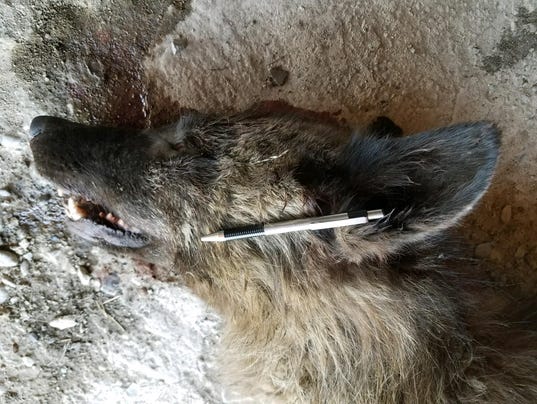
story at:
https://www.greatfallstribune.com/story/news/2018/05/24/wolf-dog-dogman-some-mysterious-creature-montanans-look-answers/634379002/
Joel ==> Lots of wolf-coyote and coyote-dog hybrids around — a very well known and acknowledged phenomena. The “endangered” Red Wolf is a coyote-wolf hybrid mistakenly identified as a wolf species and now wildlife officials struggle to keep it from going “extinct”.
Thanks for the story and link.
We introduced “red wolves” to several barrier island in the Florida Panhandle. The environmentalist were shocked to find out that they dug up and ate loggerhead turtle eggs, a threaten species.
That’s called a Tweed wolf (for Tweed, Ontario) or bush wolf up in Canada.
Kip: This story http://www.cbc.ca/news/canada/nova-scotia/coyotes-kill-toronto-singer-in-cape-breton-1.779304 from 2009.
Think there was another attack and killing of a young woman – just can’t find the link right now. Then we got the: Gov reminders – when in the woods don’t wear ear buds, make noise and best not to go alone and etc.
We live in eastern Ontario, closer to the US border we have coyotes and they are far bolder than what I’m use to from my home turf, which is northern Ontario. Wolves and bears concerned me there, coyotes not so much but now I think differently due to hybrids that are now part of the scene and I do love my forest walks.
Few years ago, 2 rather big coyotes starting hanging around our property, after the deer, wild turkey and other forest creatures since we’re in a forested area among farm lands. They were very bold – not acting afraid of us when we yelled at them, they only walked quicker when we’d shot the .22 at them. Then they killed our little dog – sneak attack right at the bottom of the deck stairs one early evening. Later they attacked our neighbours dogs- but they are bigger and survived with some needing stitches for injuries, then farmer a few concessions over reported that 2 coyotes had attacked their cow giving birth – they too had to get the gun to scare them off. They lost the cow and the calf.
Locals went and hunted them – got some and at least no rabies thus far.
It was then that I did look up and found out that they may have been hybrids – looked a lot like a German Shepard, size was as well, but with very plush tails.
Kip, I used to live in Saugerties, Clintondale, and eventually graduated from Highland in 1973. I lived right on the Hudson for a while (I was almost a troll…our house was almost under the Mid-Hudson Bridge across from Poughkeepsie). Never saw a coyote there.
Now I live in a holler in Central Kentucky, on the edge of the Dripping Springs Escarpment. Lots of trees and springs. Karst region. Mammoth Caves is about a half hour drive south, Lincoln’s Birthplace is the next wide spot up the road 9 miles to the north, in Hodgenville. Just to give you an idea of where we are. Some open areas where there’s farms, but give it a chance and the trees will come back fast.
We moved here in 1983. Locals talked a lot about how they never had coyotes until about 5 years before that, so late 70’s, when the Ohio River froze over for a while and they moved across it and they are here to stay. This jives real nice to that map you provided. Solid red (1900) along the Mississippi, then the cold winters in the 70’s and there you are.
They seem to have adapted well to forests vs grasslands. I hear them now and then, moving through the trees, but not often. We have wild cats and black bears around here in these forests and the local wisdom is that they don’t hang around when there are wild cats and bears. Ever hear that?
Thanks. Good article.
Grandpa- coyotes are definitely in the Shenandoah Valley of Virginia- so are bears and wild cats- so I think the “wisdom” isn’t true- or maybe the coyotes just pack up more to protect themselves from the bigger creatures.
Granpa ==> The study authors hypothesize that coyotes move in when larger apex predators move out (or are hunted out). Bears do not compete with coyotes, but cougars/mountain lions do — and they prey on coyotes as well.
We have them in nice suburbs north of Detroit; Rochester Hills Michigan.
John ==> Thanks for the report from Michigan — home to my paternal grandparents.
Saw one today…about 10:00 AM ….it ran across the road , carrying its’ lunch …. a cat from the farmstead there on the edge of the road…. rural Ks .
Old Bob ==> Nice eye-witness account. (PS: Go coyotes! Eat them cats.)
In Kansas, and elsewhere in the Midwest, feral cats have decimated quail populations. Coyotes are their primary predator, but eradication programs aimed at coyotes are still being pushed at the state level. One those idiotic “catch -22 situations.”
Interesting article.
John D. Smith ==> are you saying that coyotes are the primary predator of feral cats or quail?
Coyotes prey on feral cats, very successfully. My experience with coyotes is that they carefully choose their battles. Their primary diet is small mammals.
Thank you again for the interesting article. Coyotes are certainly adaptable creatures.
I don’t think that “Hody and Kays” spent enough time on the ground researching these sites.
I came across my first ex-coyote in the mid 1960s in Pennsylvania; it was a carcass. That was along the Delaware River just north of Trenton.
Over the decades, hunters regularly reported coyotes where coyotes were not supposed to live. Game Wardens were often frustrated by an inability to get reliable photographs and other evidence, to prove to their researchers that coyotes really did exist.
Since, moving to Virginia, back in the early 1990s; one often hears the coyotes roaming along the Rappahannock River; usually between 1:00 AM and dawn.
According to the “peer reviewed research” map above, those coyotes did not arrive till after 2000.
Coyotes are masters at keeping a low profile. “Hody and Kays” need to get out more.
One does wonder why “Hody and Kays” are worrying about coyotes in South America? Or is that worry, solely for alarmist effects?
ATheoK ==> You may be seeing a difference between occasional transient animals and a well-established breeding population.
The same situation exists today with the mountain lion in NY State — the DEP/Wildlife people insist that no breeding population exists but I have personal acquaintances that have seen them more than once in their Catskill foothills-Hudson Valley back yards.
Numerous cougar (big cougar!) sitings in central PA mountains.
Please tell them they cannot go north across the PA-NY statelion without registering in with the NY DEP authorities.
RACookPE1978 ==> The Ny DEP may have posted signs to that effect — but possibly the cougars are crossing at night and can’t read the signs in the dark.
ATheoK ==> The “fear” about coyotes invading South America is simply that it would be a major biological event — a invasion of a highly adaptable predator species — the results of which can not be predicted.
If they’re looking for food in Venezuela, the coyotes will have to provide proof of a valid voter ID card.
On the other hand, those who are starving may see them as a food source, themselves. Hmmm….. the possibilities….
Studied up on this for the ‘red wolf’ example in essay No Bodies in ebook Blowing Smoke, plus personal interest in the many coyotes (and recently the occaisonal visiting grey wolfpack) roaming my uplands Wisconsin dairy farm in Iowa county just south of the river. Easy to tell the difference—coyotes yap at the moon at night, wolves howl.
The removal of apex predators like wolves and eastern mountain lioms did not IMO facilitate the growth in coyote range, because coyote prey is stuff like field mice and rabbits, not large game like white tail deer. Coyotes hunt solitary, not in packs, and are not large enough to tackle white tails except as winter kill. Range speead is more likely change in habitat. For example, southwest Wisconsin was largely prairie savannah (evidenced by the old burr oaks) supporting deer and buffalo, or hardwood forests supporting wild turkey and ruffed grouse and squirrels when the original fsrm cabin was built in the 1880’s. Now it is ideal mixed habitat for mice, rabbits, grouse, squirrel, turkey, and whitetails given the mix of hardwood lots, pasture, and contour cropland. Apex preditors are fox, coon, redtail hawks, and coyotes for the small game, and humans for the ‘big’ game turkey and whitetails.
Interestingly, the ‘red wolf’ (a fertile coyote/eastern grey wolf hybrid) can pack hunt whitetails and calves, which is why it was hunted almost to ‘extinction’. The eastern grey wolf was in fact extirpated from the US and southern Canada, but the smaller ‘red’ wasn’t because it could revert to coyote prey.
ristvan ==> I think the apex predator/wolf/mountain lion connection is not competition for game but the fact that both the wolf and mountain lion will prey on coyotes.
In the Pacific NW, coyotes are the main predators of deer fawns, more so than cougars.
ristvan – I don’t know about the coyotes way down south in Wisconsin, but in central Alberta packs are common enough. I’ve seen 7 at a time on something’s trail and they commonly hunt in pairs. I watched a pair trying to catch a large farm dog on a frozen slough – one laid in ambush while the other feinted towards the dog until it gave chase. The dog was not quite dumb enough, but almost made coyote dinner. I’ve been told that packs can take adult white tails, but never saw it happen.
And they do, at times, hunt in packs. There was on evening where I listened to them, for more than an hour, taking a white tail (not a juvenile). They had it trapped in a creek bed about 700 yards from my office. Not many pieces were left the next day, but it was obvious it was an average sized doe.
It seems a little weird, but they prefer to poop on the concrete, rather than the gravel, and hardly at all in the grass, as they moved through at night. The poop was usually deer hair … not much else there.
Their least favorite part of the deer seemed to be the forearm (? the double bones) … they always left these laying around for my dog to play with. And again, these were from adult deer.
I live about 8 miles from Illinois Beach State Park. There is a pack of coyotes up there which will take down an adult deer. They may have a bit of wolf in them, but they are hunting in groups, not solitary. South of me in the collar counties, there may be enough edible trash for them to scavenge what they need without hunting, but they are not solitary critters around here, at all.
Here in North Carolina, I hope they develop a taste for Canada Geese and goose eggs.
fhhaynie, Don’t know about coyotes eating Canadian Geese but alligators love them.
One place where coyote numbers have fallen recently is around Yellowstone park. The newly reintroduced wolves seem to consider them competition and a reasonable snack.
DMA ==> Yes, I believe that is correct – the wolves will eat coyotes if they can catch them.
Kip, my wife, the Coyote Lady, thanks you.
The downside? She is hectoring me with arcane coyote facts.
[The mods must ask: Is that better, or worse, than being badgered by all canine facts? .mod]
Dave ==> ….and all my best to the Coyote Lady. I don’t believe there are “arcane coyote facts” — all coyote facts are preeminently important.
She agrees with you. Normal people don’t.
Additionally, she is all about anything canine. When we met, she said she liked dogs. I missed hearing the ‘s.’
Anybody want an old, blind and lame Pug, a huge, goofy Dalmatian and B.B. King’s leftover German Shepard with bad hips?
Dave==> I was lucky enough to see B.B.King live on January 19, 1970 at the Whisky-A-Go-Go in West Hollywood, CA . It was a Monday night for the early show — patrons under 21 were allowed as it was a “dinner club” at that hour. The place was empty with the exception of myself and my college friend (down from UCSB), two prostitutes at the bar, and Stephen Stills, Neil Young, and Richie Furay (then the major part of the band Buffalo Springfield) who had stopped in to catch BB without all the nonsense of rock-and-roll fans. BB did not disappoint — he performed his whole stage act as if the house were packed to the rafters — an unforgettable musical moment for me.
When I moved east about fifty years ago I was surprised to find coyotes. Out west they are very shy of people. I had seen a coyote once only. My buddy the wildlife biologist hadn’t seen them much more often.
In southern Ontario (Canada) I have seen them on numerous occasions. It seems that they are able to adapt their behaviour.
Arctic Foxes also seem to be able to adapt. They approached our campsites in the Arctic and seemed to know how far each of us could throw a snowball.
One year we were visited by wolves. I skied past their lair one day, I didn’t stop and stayed a hundred yards away. We never saw them again. It seemed to me that they were much shyer than the foxes.
Some critters, raccoons being a prime example, seem quite happy in human environments. Others aren’t. It will come as a surprise to some people that our urban and suburban neighbourhoods host wildlife in densities greater than the surrounding countryside. link
commie ==> Foxes — London, England, had a problem with urban foxes in people back gardens! Very adaptable, yes.
Kip
Make that……….London, England, HAS a problem with urban foxes in people back gardens!
They are vermin, and as common as muck.Regularly see one sauntering up our garden path, and the breeding and whelping seasons are a nightmare with screaming during the night.
@commieBob – must be the north western coyotes. They’re not at all shy down here in the southwest. Although the closest I have come was when two playing pups literally ran across my feet up in the Catalina foothills; they aren’t shy, but they have other business to deal with, you know, so don’t hang around? Like chasing and failing to catch roadrunners (yes, I have seen that many, many times – the locals have apparently never heard of this Acme Corporation…).
On crossing the Darien Gap – that will be some trick, although I wouldn’t put it past them. One of the nastiest environments to be found on this planet.
There are already a lot of canid species in South America:
http://www.canids.org/species/region/PREKDB770131
WO ==> On the Darien Gap — if they push through the hiway, the coyotes will have a ready made path…so far,so good, though.
Hire ex-FARC narcoterrorists to shoot any coyotes on sight.
They’ve been unemployed since last year.
Oh, I’m fine with the four-legged kind, so wouldn’t start a vendetta on them. Now the two-legged “coyotes” – extermination is the best solution.
I have friends on the Border who are doing their bit.
Shoot, shovel, shut up.
If they’re armed, they go down.
Felix ==> Making public statements of personal knowledge of murders is not really a good idea.