There is nothing we can do about it, except to build dikes and sea walls a little bit higher.
By Fred Singer, WSJ, May 15, 2018
Of all known and imagined consequences of climate change, many people fear sea-level rise most. But efforts to determine what causes seas to rise are marred by poor data and disagreements about methodology. The noted oceanographer Walter Munk referred to sea-level rise as an “enigma”; it has also been called a riddle and a puzzle.
It is generally thought that sea-level rise accelerates mainly by thermal expansion of sea water, the so-called steric component. But by studying a very short time interval, it is possible to sidestep most of the complications, like “isostatic adjustment” of the shoreline (as continents rise after the overlying ice has melted) and “subsidence” of the shoreline (as ground water and minerals are extracted).
I chose to assess the sea-level trend from 1915-45, when a genuine, independently confirmed warming of approximately 0.5 degree Celsius occurred. I note particularly that sea-level rise is not affected by the warming; it continues at the same rate, 1.8 millimeters a year, according to a 1990 review by Andrew S. Trupin and John Wahr. I therefore conclude—contrary to the general wisdom—that the temperature of sea water has no direct effect on sea-level rise. That means neither does the atmospheric content of carbon dioxide.
This conclusion is worth highlighting: It shows that sea-level rise does not depend on the use of fossil fuels. The evidence should allay fear that the release of additional CO2 will increase sea- level rise.
But there is also good data showing sea levels are in fact rising at an accelerating constant rate. The trend has been measured by a network of tidal gauges, many of which have been collecting data for over a century.
The cause of the trend is a puzzle. Physics demands that water expand as its temperature increases. But to keep the rate of rise constant, as observed, expansion of sea water evidently must be offset by something else. What could that be? I conclude that it must be ice accumulation, through evaporation of ocean water, and subsequent precipitation turning into ice. Evidence suggests that accumulation of ice on the Antarctic continent has been offsetting the steric effect for at least several centuries.
It is difficult to explain why evaporation of seawater produces approximately 100% cancellation of expansion. My method of analysis considers two related physical phenomena: thermal expansion of water and evaporation of water molecules. But if evaporation offsets thermal
expansion, the net effect is of course close to zero. What then is the real cause of sea-level rise of 1 to 2 millimeters a year?
Melting of glaciers and ice sheets adds water to the ocean and causes sea levels to rise. (Recall though that the melting of floating sea ice adds no water to the oceans, and hence does not affect the sea level.) After the rapid melting away of northern ice sheets, the slow melting of Antarctic ice at the periphery of the continent may be the main cause of current sea-level rise.
All this, because it is much warmer now than 12,000 years ago, at the end of the most recent glaciation. Yet there is little heat available in the Antarctic to support melting.
We can see melting happening right now at the Ross Ice Shelf of the West Antarctic Ice Sheet. Geologists have tracked Ross’s slow disappearance, and glaciologist Robert Bindschadler predicts the ice shelf will melt completely within about 7,000 years, gradually raising the sea level as it goes.
Of course, a lot can happen in 7,000 years. The onset of a new glaciation could cause the sea level to stop rising. It could even fall 400 feet, to the level at the last glaciation maximum 18,000 years ago.
Currently, sea-level rise does not seem to depend on ocean temperature, and certainly not on CO2. We can expect the sea to continue rising at about the present rate for the foreseeable future. By 2100 the seas will rise another 6 inches or so—a far cry from Al Gore’s alarming numbers.
There is nothing we can do about rising sea levels in the meantime. We’d better build dikes and sea walls a little bit higher.
Mr. Singer is a professor emeritus of environmental science at the University of Virginia. He founded the Science and Environmental Policy Project and the Nongovernmental International Panel on Climate Change.
Note: a typo was corrected after publication, accelerating was changed to constant, with a strike-through added. -Anthony
I have no data available, but I could read elsewhere that during the peak of Holocene optimum, about 8 to 9 Kyear from now, the seal level was a few meters higher than in our times, while the global average temperature was about 3°C more than now.
Am I right ?
Yes. It is all a bit like measuring the level of water in a wobbly balloon. ….Slow time! (sarc.
On a serious note:
We all know here on WUWT etc. that this is the case. The problem is : How on earth do we get this over to those in power, riddled as they are in their machinations. Meanwhile we indulge in our frustrations and hang on to common sense.
A couple of other considerations: as noted by others, the volumes of each of these basins is also changing through time. To genuinely have a shot at understanding sea level, each basin within the larger Atlantic (and each other ocean) would have to be studied for deltas in:
1. Rainfall and total river input budget (changes in water input will change over time)
2. Changes in sedimentation rate and location will change the volume a basin can hold
3. Coastal subsidence and emergence based on both tectonic and ground water withdrawal causes
4. Sea floor subsidence and emergence based on tectonics and local volcanism
5. Ice effects
Just as a for instance, the 40,000km long mid-Atlantic ridge enlarges the Atlantic basin by 2.5cm per year, or, volumetrically:
40,000,000m x .025m x 5,000m ( the last is a wild guess at average water column above the ridge)
Which would mean that just from mid-ocean tectonics, we are increasing the volume of water that could be held by the Atlantic basin by 5 billion cubic meters *each year*.
This is just a thought experiment, but you see how complex the issue becomes. Is that balanced by contraction of the Pacific basin? I have no idea.. But we’re kidding ourselves if we think this is as simple as just measuring thermal expansion and rainfall. It is probably worthy of some careful study.
In addition to run-off of sediment from land to ocean, the wind also contributes. For example, it is estimated (by NASA) that around 180 million tons of Saharan sand dust are transported over the Atlantic each year. About 50 million tons are lost over the Atlantic and a further 43 million tons drop into the Caribbean sea.
https://www.nasa.gov/content/goddard/nasa-satellite-reveals-how-much-saharan-dust-feeds-amazon-s-plants
Singer is right to report there’s no correlation between temperatures and sea level rise except for cherry-picked decades of the 20th century.
Sea level should have fallen dramatically , but didn’t during the Little Ice Age as ocean temperatures cooled by almost 1 degree and glaciers grew to their greatest extent in 12,000 years. That paradox can only be explained by a source of water not accounted for in the models. I have shown there is good evidence to suspect ground water discharge.
http://landscapesandcycles.net/groundwater-and-sea-level-rise.html
Like global warming theorists, Singer resorts to the default suggestion of Antarctica to explain that unexplainable sea level rises, simply because so little is known there, But there is ample evidence to suggest there is a net gain in land ice in Antarctica.
There is an excellent paleoclimate paper examining why sea levels oscillated millions of years ago when there were no glaciers.
They concluded that it was the change in groundwater levels. Based on the premise that fluctuating lake levels were indicators of aquifer levels, and using pollen and sediments to estimate lake level changes, they basically found that sea levels rose as lake water levels fell and vice versa. They concluded “water mass exchange between land and ocean reservoirs is a missing link for reconciling geological records and models for sea-level change during non-glacial periods.”
And that same dynamic exists today!
https://www.nature.com/articles/s41467-018-03454-y
I tend to favor tectonic control when it is eustatic changes occurring over million year timescales.
Jim,
And humans are pumping aquifers at an unprecedented rate as well.
Many flood control systems work by evacuating precipitation to the sea at the maximum rate that can be achieved. This includes artificially increasing flow velocity by forcing rivers to be more linear and less sinusoidal. The effects include increased erosion of the bed in some areas (and the opposite in others). That impacts on the physical level of the river surface. So river control has an effect on groundwater levels over vast areas, even when there is no abstraction of groundwater for human use. I suspect the overall result is a reduction in groundwater storage.
I have read through all the comments but no one has suggested an outside source of water.
The earth is the gravity well, everything falls in but nothing is getting out. The ocean level works similar to a bathtub, settlement will cause it to rise, earth tectonics will cause it to fall. The source of a consistent ocean level rise in a closed system indicates that it’s not as closed as we think.
2 1/2% of earths 3% fresh water is found on the continent of Antarctica. After 60 years since the south pole base was established, the old buildings are under approximately 60 feet of ice giving an average of 1 foot per year new ice without any measurable precipitation. (The polar vortex does not allow clouds to Pass over the 3 miles of ice, average height over 10,000 feet) This makes the continent one of the driest deserts on the planet.
The new buildings have Jack’s that they can raise the buildings up when they need to prevent them from being covered. It’s not a coincidence that the new ice appears about the same time as the “O-Zone hole” in September when the sun returns and the frozen gases of stratospheric clouds melt away.
When intergalactic clouds from supernovas pass through our system, they are pulled into our gravity well and oxidized in unexpected displays of northern lights while their mass is added to our ocean levels. The same is true during X class flares were large amounts of material is thrown at escape velocity from under the surface of the sun to react with our upper atmosphere with a fire so bright, you can see it from 50 miles away, lighting up the entire sky with millions of tons of new water being created. All adding to our oceans.
I suggest that the answer to why the sea level is rising is found at http://www.plateclimatology.com/, and in particular, the “Polar Regions” section of the site.
I’ve favored that theory since I was an undergrad geology student. It’s supported by the correlation of marine carbonate chemistry oscillations and iceage/hothouse climate.
http://www.geomuseum.uni-goettingen.de/archive/downloads/Kritische%20Intervalle%20WS_2016-2017%20Duda-Reitner/Ausgangsarbeiten/C%2001%20Stanley%20&%20Hardie%201998.pdf
Until we can accurately measure the container – the ocean basins – along with its fluctuations, all talk of the ’cause’ of sea level change is GROSS speculation.
Critical data is missing.
Until you have the data, the size of the container, all analysis is premature. I’m rather surprised that Dr. Singer would assume a fixed container.
Fred says there’s nothing that can be done except building sea defences. But a certain amount of engineering could be done – eg filling the Qattara depression in Western Egypt (desert land of no value), and refilling the Dead Sea and introducing water to other areas which are below sea level. Such projects can have other benefits besides the lowering of sea level. Of course the amount of lowering would be very small, but maybe worth doing nevertheless.
Andrew,
And the cost of such large-scale pumping?
Andrew,
what is the cost of such projects vs the cost of building traditional sea defenses? I suspect the former is considerably more expensive than the later, hence why we have plenty of examples of the later being done across the world but few (if any) of the former.
Is there any data for tide levels from the late 18thC to the mid 19th? Glacier Bay lost a lot of ice in a short period and it would have to show up.
Jim @9:43AM and one other responder have the correct answer to sea level rise. It is produced ground water from no or slow to recharge aquifers. The amount of this water is 1100 cubic kilometers per year. 22% of the water is used for domestic, 11% for industry and 67% for agriculture primarily for growing food and fodder. It amounts to 3.0 mm per year. Additionally 6% comes from burning hydrocarbons where oxygen is combined with the hydrogen in the process to form water vapor that goes up the flue.
I sent a report on this the Administrator of EPA in 2009 and never heard a word. I got a signed delivery receipt back. I also got my congressperson to be sure it arrived. It did.
“the ice shelf will melt completely within about 7,000 years”
We should worry about the return of the Ice Age at that time frame, not warming.
I liked Fred’s article.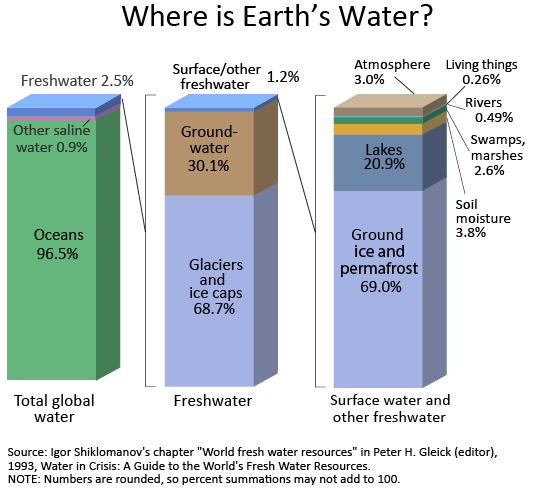
A few thoughts about sea level rise.
Tide gauge data from around the globe does not show a consistent story. Many show a varying amount of rise, many show little to no change over a long time and many show a varying amount of decrease in sea level. I don’t buy the calculated sea level from the satellite data. Like most things related to climate science – the data is a dumpster fire – not adequate for any scientific endeavor. No engineer with any credibility would ever undertake a design project of any consequence using data as shoddy as the data climate science is based upon. Would you want to fly on the first test flight of the climate-science-airplane?
On the subject of sea level rise I like the work of Nils-Axel Morner. Nyborg Denmark is the place he prefers to use as the benchmark for sea level changes as it was the “hinge” of plate movement during the last glacial period. This location does not experience any isostatic rebound and provides a stable place to measure sea level over a long time without having to compensate for plate movement. Morner’s assessment is that the eustatic sea level rise is closer to 1mm/yr.
It is helpful to remind ourselves that ground water accounts for 30% of fresh water on Earth.
So, ground water is ~ 40% of the water in the ice caps. We know from other analysis that Greenland has 99.7% of its ice mass from 100 years ago, and despite any changes to the Ross Ice Shelf, Antarctica is unchanged or perhaps has more ice mass now than 100 years ago. We know humans have a huge impact on ground water, yet this gets ignored by alarmists – and the focus is always on the ice caps. Here is an interesting paper claiming that man’s extraction of groundwater globally, makes its way to the seas and might contribute 0.8mm of sea level rise annually. That would be 80% of Morner’s 1mm/yr – but the paper adheres to the orthodoxy of 3.1mm/yr total.
https://www.waterworld.com/articles/wwi/print/volume-25/issue-5/groundwater-development-flow-modeling/groundwater-depletion-linked-to-rising.html
Sea level rise is not a new thing. Choices to site cities along the coast have been made because of the common human temptation to deal with the current situation and ignore future threats. If we go out far enough in time, then every coastal asset was from the beginning at risk of being drowned – the only variable was how long it would take. I did an extensive Google search a while back and I could not find one city in the US that has a moratorium on building near the sea due to sea level rise fears. Just look at Miami Beach – a bad idea when it was founded in 1915 if you think long term. The building has not subsided. Governments have not intervened. People still shell out money to be near the sea. Insurance companies still write policies for coastal properties. So, I call BS on any claimed panic about sea level rise. When alarmists start to act in alignment with their fears and claims then maybe I’ll pay attention to them.
William
https://ssrn.com/abstract=3023248
https://ssrn.com/abstract=3023248
“But there is also good data showing sea levels are in fact rising at a constant rate. The trend has been measured by a network of tidal gauges, many of which have been collecting data for over a century.”
Fred Singer, WSJ May 15, 2018.
I wrote Dr. Singer an email, with my comments on his article:
http://sealevel.info/email_to_Dr_Fred_Singer_about_his_2018-05-16_op-end_in_the_WSJ_on_sea_level.html
It’s quite long, so here’s just the first of four points that I made to him:
Dear Dr. Singer,
Thank you for your excellent WSJ op-ed on sea-level! I have a couple of comments on it.
First, all, or nearly all, of the supposed “acceleration” in sea-level rise actually occurred before the mid- or late-1920s. Many (though not all) sites saw a small measurable acceleration before 1930, which added between zero and 1.5 mm/year to the rate of sea-level rise, though it wasn’t evident everywhere.
The most striking example was at PSMSL tide gauge number 1, Brest, France, which has more than 200 years of sea-level measurement data. Sea-level at Brest rose at a rate of 0.00 ±0.22 mm/year during the 19th century (1807-1900), but has risen at about 1½ mm/year since then.
http://sealevel.info/190-091_Brest_1807-1900_vs_1900-2016.png
Sea-level acceleration at Brest since 1900 = 0.00434 ±0.01175 mm/yr² (i.e., negligible and not even statistically significant):
https://www.sealevel.info/MSL_graph.php?id=brest&boxcar=1&boxwidth=3&c_date=1900/1-2019/12
[…snip]
…continued here.
We have explored more of Mars than the mid ocean ridge. We view sea level at its surface, but know little of its bottom.
“Physics demands that water expand as its temperature increases.”
Thing is though, the change in overall ocean temperature since 1950 is barely measurable at all. the OHC estimates are little better than guesswork. And before 1950 we have almost idea what happened.
Frankly, the only thing less believable than air temperature trend predictions are sea level trend predictions.
Something showed up over at Earth Systems Science Data. Perhaps you might bring it to the attention of Dr Singer and your readers.
https://www.earth-syst-sci-data-discuss.net/essd-2018-53/essd-2018-53.pdf
“Ocean thermal expansion, glaciers, Greenland and Antarctica contribute by 42%, 21%, 15% and 8% to the global mean sea level over the 1993-present. We also study the sea level budget over 2005-present, using GRACE-based ocean mass estimates instead of sum of individual mass components. Results show closure of the sea level budget within 0.3 mm/yr. Substantial uncertainty remains for the land water storage component, as shown in examining individual mass contributions to sea level. “
And now for some actual science (hat tip to Eli Rabbett): “Global Sea Level Budget 1993–Present” (WCRP Global Sea Level Budget Group, Earth Syst. Sci. Data Discuss., https://doi.org/10.5194/essd-2018-53, in review, 2018)
Abstract. Global mean sea level is an integral of changes occurring in the climate system in response to unforced climate variability as well as natural and anthropogenic forcing factors. Its temporal evolution allows detecting changes (e.g., acceleration) in one or more components. Study of the sea level budget provides constraints on missing or poorly known contributions, such as the unsurveyed deep ocean or the still uncertain land water component. In the context of the World Climate Research Programme Grand Challenge entitled “Regional Sea Level and Coastal Impacts”, an international effort involving the sea level community worldwide has been recently initiated with the objective of assessing the various data sets used to estimate components of the sea level budget during the altimetry era (1993 to present). These data sets are based on the combination of a broad range of space-based and in situ observations, model estimates and algorithms. Evaluating their quality, quantifying uncertainties and identifying sources of discrepancies between component estimates is extremely useful for various applications in climate research. This effort involves several tens of scientists from about sixty research teams/institutions worldwide (http://www.wcrp-climate.org/grand-challenges/gc-sea-level). The results presented in this paper are a synthesis of the first assessment performed during 2017–2018. We present estimates of the altimetry-based global mean sea level (average rate of 3.1 ± 0.3 mm/yr and acceleration of 0.1 mm/yr2 over 1993–present), as well as of the different components of the sea level budget (doi:10.17882/54854). We further examine closure of the sea level budget, comparing the observed global mean sea level with the sum of components. Ocean thermal expansion, glaciers, Greenland and Antarctica contribute by 42 %, 21 %, 15 % and 8 % to the global mean sea level over the 1993–present. We also study the sea level budget over 2005–present, using GRACE-based ocean mass estimates instead of sum of individual mass components. Results show closure of the sea level budget within 0.3 mm/yr. Substantial uncertainty remains for the land water storage component, as shown in examining individual mass contributions to sea level.
Sorry Tom, you mean you couldn’t even bother to read it yourself and write your own comment on the contents? You simply re-posted a lengthy something the Wabbit fed you, and expect readers here give it the attention you didn’t?
Hint: In “actual science” as you term it, people often don’t read (or write) abstracts so long. I’ve given it about as much time as you did.
When you add up all the acre feet of water pumped out of the ground world wide and fill from mass wasting ice melt is nothing in modern times.
Singer’s Nonsense – there are perched heavy mineral deposits on both sides of continental Australia that clearly indicate the sea level was at least 2 metres above the current LWM. Estimated time for these deposits about 8,000 years BP.