From Keele University and the “It’s like deja vu all over again” department with the leader of the “ship of fools” thrown in for comic relief. Long-time WUWT readers surely remember the single “Most influential tree in the world” from the Yamal fiasco, where the “signal” in one tree (YAD06) biased an entire paper with a hockey stick shape, making it worthless. Well, here we are again with another single tree used to define the entire globe. Obviously they’ve learned nothing, then again, it’s Chris Turney.
Loneliest tree in the world marks new age for our planet
An international research team, including Professor Christopher Fogwill from Keele University, has pinpointed a new geological age, the Anthropocene.
When humans first set foot on the moon in 1969, the people of that decade thought the world had changed forever. Little did they know the world had already laid down the precise marker of a far greater global change four years earlier, signalling our planet had entered an entirely new geological epoch, a time period defined by evidence in rock layers, the Anthropocene.
That new epoch began between October and December 1965 according to new research published today in Scientific Reports by members of the Australasian Antarctic Expedition 2013-2014, which was co-led by co-author Professor Christopher Fogwill from Keele University.
The researchers were able to mark this profound change so precisely because of a “golden spike” found in the heartwood of a strange and singular tree, a Sitka Spruce found on Campbell Island, a World Heritage site in the middle of the Southern Ocean The spruce is locally referred to as ‘the loneliest tree in the world’ with the next closest tree over 200km away on the Auckland Islands.

The radioactive carbon spike was created by the culmination of mostly Northern Hemisphere atmospheric thermonuclear bomb tests in the 1950s and 1960s. The signal was fixed in the wood of the Campbell Island Sitka spruce by photosynthesis.
Professor Fogwill, Head of the School of Geography, Geology and the Environment at Keele University, said:
“The impact that humanity’s nuclear weapons testing has had on the Earth’s atmosphere provides a global signal that unambiguously demonstrates that humans have become the major agent of change on the planet. This is an important, yet worrying finding. The global atomic bomb signal, captured in the annual rings of this invasive tree species, represents a line in the sand, after which our collective actions have stamped an indelible mark, which will define this new geological epoch for generations to come.”
Various researchers from around the world have been talking about declaring a new geological epoch called the Anthropocene, indicating the point where human influence on the planet fundamentally changed the natural world. However, for a new epoch to be officially declared there must be a clear and precise “global” signal that can be detected in the geological forming materials of the future. This radiocarbon spike is that signal.
Lead author Professor Chris Turney, from University of New South Wales, said:
“We were incredibly excited to find this signal in the Southern Hemisphere on a remote island, because for the first time it gave us a well defined global signature for a new geological epoch that could be preserved in the geological record. Thousands of years from now this golden spike should still stand as a detectable marker for the transformation of the Earth by humankind.”
In the Northern Hemisphere, the atmospheric radiocarbon peak occurred in 1964 where the signal is preserved in European trees. That same peak took until late 1965 to reach the Southern Hemisphere atmosphere. With that, the signal became global, precise and detectable in the geological record, meaning it fitted the requirements as a marker for a new epoch.

The 100-year-old tree itself is an anomaly in the Southern Ocean. It is naturally found along the North American Pacific Coast but it is credited with being planted on Campbell Island by the Governor of New Zealand in 1901. The oceanic climate has had an unusual effect on the spruce. Although it has grown to 10m tall, the tree has never produced cones, suggesting it has remained in a permanently juvenile state.

Co-author Professor Mark Maslin, from University College London, said:
“It seems somehow apt that this extraordinary tree, planted far from its normal habitat by humans has also become a marker for the changes we have made to the planet, it is yet further evidence, if that was needed, that in this new epoch no part of our planet remains untouched by humans.”
The study:
Global Peak in Atmospheric Radiocarbon Provides a Potential Definition for the Onset of the Anthropocene Epoch in 1965
Abstract
Anthropogenic activity is now recognised as having profoundly and permanently altered the Earth system, suggesting we have entered a human-dominated geological epoch, the ‘Anthropocene’. To formally define the onset of the Anthropocene, a synchronous global signature within geological-forming materials is required. Here we report a series of precisely-dated tree-ring records from Campbell Island (Southern Ocean) that capture peak atmospheric radiocarbon (14C) resulting from Northern Hemisphere-dominated thermonuclear bomb tests during the 1950s and 1960s. The only alien tree on the island, a Sitka spruce (Picea sitchensis), allows us to seasonally-resolve Southern Hemisphere atmospheric 14C, demonstrating the ‘bomb peak’ in this remote and pristine location occurred in the last-quarter of 1965 (October-December), coincident with the broader changes associated with the post-World War II ‘Great Acceleration’ in industrial capacity and consumption. Our findings provide a precisely-resolved potential Global Stratotype Section and Point (GSSP) or ‘golden spike’, marking the onset of the Anthropocene Epoch.
Open access here: https://www.nature.com/articles/s41598-018-20970-5
So who says 1965 is the beginning of a new Epoch? There’s no consensus, and they can’t even decide if that’s the name. From Wikipedia’s definition of the Anthropocene:
As of August 2016, neither the International Commission on Stratigraphy nor the International Union of Geological Sciences has yet officially approved the term as a recognized subdivision of geological time,[3][5][6] although the Working Group on the Anthropocene (WGA) voted to formally designate the epoch Anthropocene and presented the recommendation to the International Geological Congress on 29 August 2016.
…
In January 2015, 26 of the 38 members of the International Anthropocene Working Group published a paper suggesting the Trinity test on 16 July 1945 as the starting point of the proposed new epoch.[20] However, a significant minority supports one of several alternative dates.[20] A March 2015 report suggested either 1610 or 1964 as the beginning of Anthropocene.[21] Other scholars point to the diachronous character of the physical strata of the Anthropocene, arguing that onset and impact are spread out over time, not reducible to a single instant or date of start.[22]
A January 2016 report on the climatic, biological, and geochemical signatures of human activity in sediments and ice cores suggested the era since the mid-20th century should be recognised as a distinct geological epoch from the Holocene.[23]
Turney is just looking to get his name listed as the identifier of the Anthropocene, nothing more. Fortunately, it won’t be decided by him.
The study is nothing but a headline grabber posing as science, just like Chris Turney’s original “Spirit of Mawson” aka “ship of fools” fiasco.
stromatolites emitted a precursor 2 CO2
The title is misleading
they didnt use a single tree to DEFINE global CLIMATE change.
read harder why a tree in the SH was needed to meet the criteria of a global change
“We were incredibly excited to find this signal in the Southern Hemisphere on a remote island, because for the first time it gave us a well defined global signature for a new geological epoch that could be preserved in the geological record. Thousands of years from now this golden spike should still stand as a detectable marker for the transformation of the Earth by humankind.”
And of course selecting one of the most inaccessible trees in either hemisphere as stratotype is just normal “climate science” logic.
You read harder. They just assert their pre-existing conclusions. And then make bizarre claims about the future based on their ore-existing conclusions. All the opposite of science.
“the Working Group on the Anthropocene (WGA) voted to formally designate the epoch Anthropocene”
Well of course they did. If they didn’t they would be voting against their business model.
The only question is: did any Russians meddle in this vote?
There is something I don’t get why do they need the tree at all the background radiation has been measured by some sites since 1948 and by a global network of sites since 1955 as it forms part of Carbon dating.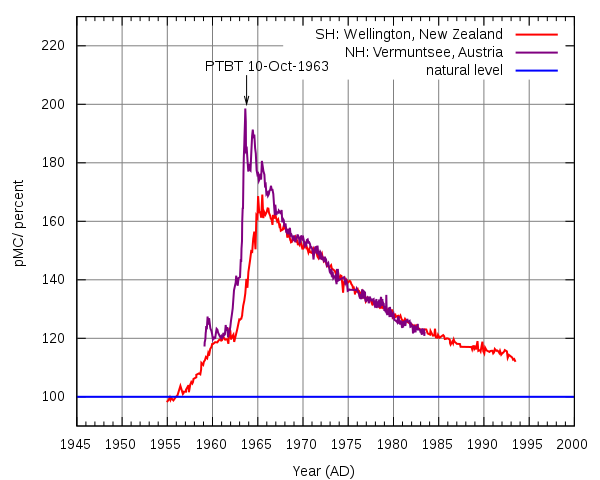
https://en.wikipedia.org/wiki/Carbon-14
So the tree is simply reflecting background radiation because it respires, what would be surprising is if it didn’t.
I don’t get why the research was even needed?
Well that graph sort of looks like a tree. Maybe that’s where they got the idea for this useless and redundant project and ‘research.’
Hope they enjoyed their vacation on that island and now their ‘tree of fools’ celebrity status.
Heritage Expeditions does a very nice cruise around the Subantarctic Islands every summer. I guess they needed some kind of excuse to get the taxpayers to pay for the tickets, they don’t come cheap.
Since the “Anthropocene” starts with man effecting the climate then it is logically the last geological epoch or age. Unless all civilisation falls the Anthropocene will never end.
Think of the money we will save since we won’t have to have anyone researching epochs ever again.
What about the Post-Rapture Epoch?
How do they know coring a tree like that doesn’t harm it? It provides a ready made entrance for insects.
Another animal and plant molester. Just leave the damn things alone!
“After Present” is already defined as starting in 1950, so why this new definition?
Instead of Anthropocene, perhaps we can call it “Manncene.” Then the period after the inflection point in the Hockey Stick can be called the Helter Skelter.
Too bad Mann’s name isn’t “Charlie.”
perhaps his middle name is Ob?
“the tree has never produced cones, ”
Maybe it’s a male tree?
check for cojones !
Nope, Sitka spruce is monoecious and non-self-incompatible (or bisexual and incestuous to use better known terms)
Perhaps Chris Turney has missed his true calling as a Merchant Banker.
Then again.
I’m pretty sure the whole tectonic plate thing us still affecting the Earth more than we are. We might be altering the biome but those subduction zones are eating crust!
Campbell island is actually continental crust, the southernmost exposed land on the Zealandia plate. By the way the K/Pg-limit is preserved and accessible there. Some years ago real scientists went there to study the effect of the Chicxulub impact at high southern latitudes. It was devastating there too.
Cowcene. More cows than humans by weight. Imagine all the fossilized cow bones millions of years from now
Christian S. M. Turney is Professor of Ignorance at University of New South Wales
A case study in dysfunctionality.
1) Just like a small child would do on finding a beetle crossing the side-walk, they’ve found something unusual. =A single tree where there are otherwise none
2) As a child would do, they’ve anthropomorphised it – poor ickkle tree, it must be soooo lonely.
3) As a child would also do, they simply cannot ‘leave it be’ – they simply *have* to bother it =drilling holes into it= same as pulling legs off spiders etc etc
4) After Herculean effort (Carbon dating), they find something unusual and give it an impressive sounding name= The Golden Spike. Its not as if any sentient human could expected it NOT to be there given it location.
5) They come rushing home, all excited, yelling and shouting
Mummy smiles, “Yes dear, it’s very nice’ and hands over a Kinder Egg
But these are supposedly grown up, well educated and intelligent adult people.
What Went Wrong
Er, I am not at all sure it is the tree that’s in a permanently juvenile state!
Permanently juvenile forms of conifers do exist, e. g. the ‘Conica’ variety of white spruce which is often seen in gardens. This is however a normal Sitka Spruce (I’ve actually seen it), but it does not produce cones because the climate is unsuitable.
Arbitrary nonsense from the Ministry of Self-Importance!
Earth’s carbon cycle contains 46,713 Gt (E15 gr) +/- 850 Gt (+/- 1.8%) of stores and reservoirs with a couple hundred fluxes Gt/y (+/- ??) flowing among those reservoirs. Mankind’s gross contribution over 260 years was 555 Gt or 1.2%. (IPCC AR5 Fig 6.1) Mankind’s net contribution, 240 Gt or 0.53%, (dry labbed by IPCC to make the numbers work) to this bubbling, churning caldron of carbon/carbon dioxide is 4 Gt/y +/- 96%!!!!!! (IPCC AR5 Table 6.1)
Seems relatively trivial to me. IPCC et. al. says natural variations can’t explain the increase in CO2. With these tiny percentages and high levels of uncertainty how would anybody even know?
BTW fossil fuel between 1750 and 2011 represented 0.34% of the biospheric carbon cycle, one tenth of the 3.6% uncertainty band.
Besides which all these carbon balance numbers were just pulled out of some PhD’s intern’s left ear.
There are a lot of places where there is a one tree forest.
Yep. I remember a case in North Dakota where there is a single tree in the middle of a huge treeless prairie where someone had put up a sign “North Dakota National Forest”.
The North Dakota State Tree is the windmill pump. The State Bird is the B-52.
Doesn’t carbon-14 vanish from the geologic record within a few thousand years? What kind of geologic marker is that?