
Guest essay by Eric Worrall
h/t JoNova – South Australia and the Australian State of Victoria learned the hard way that when power demand surges, you can’t turn up the solar panels.
Melbourne hospitals switch off lights as mercury rises
Grant McArthur and Aleks Devic, Herald Sun
January 19, 2018 7:36pm
PATIENTS were left in the dark after one of Melbourne’s biggest hospitals switched off its lights and non-essential equipment as temperatures soared on Friday.
The Alfred turned off the lights on wards, in corridors and cafeterias about midday in a bid to conserve power.
The dramatic move followed a Department of Health memo to hospital chiefs on Thursday night asking them to ensure back-up power supplies were effective, prompted by the increased risk of disruption in the heatwave.
“Hospitals within Alfred Health have taken the initiative to act as good corporate citizens and reduce the use of electricity that is not directly needed for patient care. This is consistent with the advice provided by Australian Energy Market Operator,” she said.
“Hospitals within Alfred Health have strong backup and emergency power supply capacity and in the event of a power outage expect clinical services to continue without interruption.”
Department of Health spokesman Tim Vainoras said no directive was issued for hospitals to switch off equipment or conserve energy, however hospitals were advised to prepare for the impact of extreme heat including preparations for possible energy disruptions.
A memo reiterating the state’s extreme weather protocols was sent to hospitals at 8pm on Thursday.
“With increased temperatures across the state, demands on Victoria’s electricity supplies are likely to increase. This may lead to electricity disruptions in some parts of Victoria,” the DHS memo states.
“It will be important to ensure your backup power is effective for the maintenance of critical services and that you have access to fuel supplies to support extended periods of power outages.”
…
JoNova provided a link to a site which at the time of her post showed Queensland feeding NSW, which was passing the power to Victoria – though this changes hour to hour (see the live feed here).

Intermittent renewables are sometimes contributing, for example at one point when I looked at the feed it showed net power coming from South Australia, as opposed to South Australia sucking power in JoNova’s screenshot. But as the Victorian hospital shutdown demonstrates, the renewable contribution simply isn’t reliable. Businesses and emergency facilities throughout the affected states were required to switch off lights and “unessential” systems, so the politicians who created this mess could avoid vote losing mass blackouts.
Greens were quick to blame coal for this terrifying brush with mass blackouts during the middle of a heatwave.
Loy Yang B failure sends prices soaring, triggers supply safeguards
JANUARY 19 2018 – 2:18PM
Cole Latimer
The Australian Energy Market Operator has kicked off emergency measures to protect power supply after Victoria’s Loy Yang B brown coal-fired power station failed on Thursday afternoon, sending electricity spot prices soaring.
As temperatures rose around southern Australia Loy Yang B’s generators failed at around 4pm, instantly taking around 528 megawatts of energy out of the state’s grid.
The outage ahead of a major heatwave on Friday came despite assurances by its owner Alinta Energy that the ageing power station had the capability to continue providing power in the heat.
“There are no issues expected ahead with the forecast hot weather,” Alinta Energy chief executive Jeff Dimery told Fairfax Media on Monday.
…
This greensplaining ignores the central issue – the shortage of reliable, dispatchable power capacity. Despite billions of dollars worth of investment in Aussie renewables, a shortfall of a few hundred megawatts was enough to trigger a multi-state emergency.
The system as it stands is not fit for purpose.
One new coal plant, or a decent size zero CO2 emission nuclear plant, maybe even one new generator at an existing plant, is all that would have been required to avert this dangerous shortfall, all it would have taken to provide a sufficient supply buffer so the failure of one decrepit old coal plant couldn’t bring the whole system to its knees.
But nobody wants to invest in new dispatchable capacity in Australia.
Renewable mandates supported by Australian Federal and State Governments have made dispatchable energy unprofitable. Worse, power companies have no grounds for hope that any investment in dispatchables will become economically viable in the foreseeable future. The deeper green Federal opposition party wants more aggressive renewable targets, 50% renewables across the board in Australia in the next decade.
The takeaway lesson for Australian politicians and people throughout the world should be that you can’t run hospitals and businesses on unreliable electricity. Next time turning off the cafeteria lights might not be enough; people will die if this renewable energy idiocy continues. Lets hope enough politicians learn this lesson quickly enough to avert a major disaster.
The main problem with coal in a country like Australia is that it tends to cut out during a heat wave because the cooling systems can’t handle the required cooling load using surface water. Pretty obvious reason to invest in something other than coal in Australia.
Where did you read that garbage? Coal reliably ran Australia all through the thirties, when temperatures were just a high as today.
Snort!! Really benben, how do you think the country managed to run on coal-fired electricity generation through all the previous heat waves? That is, almost totally and entirely on coal-fired electricity generation, allowing for the minuscule contribution of hydro when viewed nation-wide. Really, it’s as if the CAGW enthusiasts and evangelists have forgotten that we humans have managed to exist without the marvels of inefficient, unreliable, intermittent, baseload-incapable so-called renewables over the preceding decades. Grow up, son, and get your head out of where you’ve stowed it.
“the cooling systems can’t handle the required cooling load using surface water”
Which is the reason power plants in hot and/or dry countries (like Australia and the Loy-yang plant that tripped) use cooling towers instead:

oh tty.. Look at all that EVIL CO2 !!!!!
Benben will have nightmares. !
Actually- Hazelwood had a very large cooling pond. The warm water was stocked with tropical fish species. Now the conservationists are worrying about their demise as the waters cool!
Make it up as you go along Benben. fantasy is your thing !!
Coal provides 85% of Australia’s electricity, and coal power stations work in places far warmer than the ancient Loy Yang power stations.
Strange. Really, really strange.
benben demonstrates that climate propaganda dulls the mind.
“benben January 19, 2018 at 11:38 pm”
Ahhh…like Griff, you don’t live in Australia. Well done! Sure it has been hot last few days, putting together flat-pack furniture in a 40c, even with air con, it hard yakka. But it’s not unusual fo summer, in Australia. If you like to melt, come try it.
Is that a traditional summer activity in Oz, Patrick?
‘Throw another IKEA shelf on the Barbie!’
“Griff January 20, 2018 at 6:20 am”
Unless you and benben have experienced an Australia summer, which, surprise surprise, is HOT, neither of the two of you have any idea what you are talking about. A request to you Griff; Stop talking about Australian weather based on your armchair science.
And I will add, this w/e was predicted by all authorities in Australia (BoM) to be a record breaker, hottest evah etc. Penrith, west of Sydney, is always hotter in summer and colder in winter than Sydney (Sydney is near the sea). Penrith reached 47.3c a few weeks back, almost breaking the 1939 record (When there was no weather station until 1995) of 47.8. Yesterday (Saturday) was predicted to be hotter than 47.3c and while it was hot it was not that hot. Today (Sunday) was predicted to be hotter than that breaking all records. It was not. And what do we hear in the MSN about a normal Australian summer? Crickets chirping!
My first experience of 40c+ heat in Australia was Jan 1st 2006. I had been in Aus just under 6 months. I lived in a suburb called Ashfield. Reached 47c, with humidity at about 25%. Sure it was hot, but was actually quite nice.
There is no link between CO2 concentration and temperature.
All sources of reliable power require cooling water in order to operate.
Not hydropower. Water, yes, but not cooling water.
No Mark they don’t all need water – another failure 101. You get dry cooling towers in both fossil plants that operate in desert areas and in Ormat plants. The aren’t as efficient as conventional plant, especially in hot weather, but they work.
Natural gas turbines don’t use cooling water. You can get more energy out of them by using the exhaust to power a secondary steam turbine, but the primary unit does not need water. It makes a fair amount though.
Where is Australian coal being exported to?
Please, do not raise this point again. The answer (China) makes us look even more stupid.
At this stage let us remember, that for years in public the Greens said energy was ‘to cheap’ and ‘to available’. Now although they may not do this anymore, do you think that position has actually change?
‘ too cheap’ etc
You can certainly avoid blackouts due to overload with a Tesla battery: as the said battery has already proved, twice…
A battery responds massively faster than any other means of compensating for lost power or a surge in demand.
You can certainly avoid blackouts in a heatwave by installing more solar power: solar works best when demand from aircon is at it highest.
Coal is no solution here.
As long as the outage doesn’t last more than 3 minutes.
It stops it tripping and should last long enough for something else to be brought online…
Well it might help to give you time to start up gas turbines. As I understood it South Australia more or less surreptitiously bought five modular gas turbines together with the battery and discreetly installed them in existing power plants.
Griff, as has been demonstrated, there was nothing else to be brought on line, thanks to years of devotion to renewables.
Even when the Loy Yang unit went down, Victorian coal was operating at 85% of capacity
This is something wind and solar just cannot do,
And sometime our hottest days are when there is a cloud layer, oops , solar down.
and the power requirement spike is when people come home in the late afternoon and early evening
Solar is ABSOLUTELY USELESS when its cloudy or in the early evening
Solar is NO SOLUTION…. EVER..
I read here daily, but respond rarely. Griff and Stokes used to be amusing in their ignorance. Now they are boring and predictable–are they really worth it??
So you won’t be catching me on tour?
I’ll have to send you the DVDs…
“Predictable” is an understatement at least in Griff’s case. “Robotic” might be a better word.
Moronic would be the more appropriate adjective.
Both Griff and Nick started out trying to argue facts, now both have just resorted to outright lying.
The fact is the whole situation was totally predicted when Hazelwood was closed that any problem with any power station in peak summer demand was going to mean power outages. Anyone who denies that as a fact is lying pure and simple.
” both have just resorted to outright lying”
I made one 7-word comment on this thread. And it was obviously correct.
And Griff is his normal straightforward self.
If you have enough reliable generation you don’t need batteries. As proven by the fact that power systems has managed quite well without Tesla batteries for a century. Ever heard of “rotational inertia” Griffie? It is something rather like a built-in battery that all reliable power plants, including hydropower have, but not wind, solar or batteries. It could easily enough be built into wind power plants as well, but it would hurt their profits, so it isn’t done.
“You can certainly avoid blackouts in a heatwave by installing more solar power”
That is yet another of your manic FANTASIES. ! ie its a load of utter BS !!!
“Griff January 20, 2018 at 2:38 am”
You have no idea what you are talking about, I mean, really, you have no clue.
No, the battery did not prevent a blackout. It made an almost irrelevant contribution on each occasion. Grid inertia that kicked in entirely automatically as a consequence of basic physics provided much more energy, and did so long before the battery was triggered to act. The battery did manage to switch on rapidly once a trigger low frequency was hit, but it only supplied 7MW for a couple of minutes on the first occasion, and about 16MW the next time around. It was other spinning reserve and hydro power that provided the real backup and blackout prevention.
Here is the performance of the Musk battery before and during the first trip that Griff claims prevented a blackout:
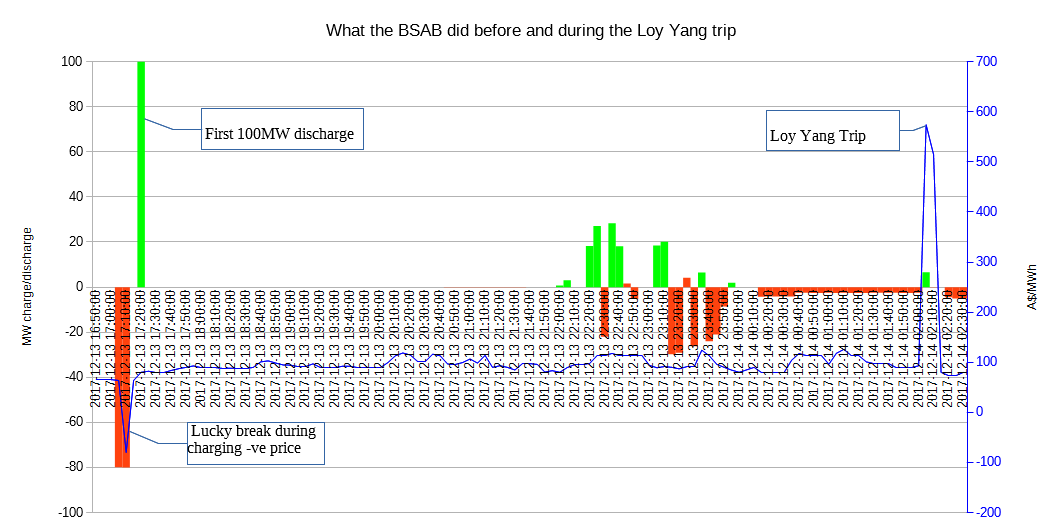
The contribution is that insignificant green bump under the price spike that the trip caused, The battery had stopped supplying the grid before the price spike was over (i.e. while other generators were still ramping up to replace the loss of several hundred MW). It did not even start its paltry contribution for 20 seconds after the Loy Yang unit tripped.
The term “renewable” should never be used in connection with energy. There are two types of energy; reliable and unreliable. Coal, oil and nuclear are obviously in the reliable category. Hydro-electricity straddles the divide. Electricity markets placing excessive reliance upon hydro, for example Ghana and Tasmania have been caught short, but in fairness to hydro its shortfalls are accurately predictable, usually in time for alternative arrangements. Windmills and solar panels have no place in any serious grid as their wild unreliability compromises the whole grid, imposing unprofitability upon the reliable energy contributors without delivering any compensating benefit. Unreliables are forcibly incorporated by authoritarian governments into the energy mix to the immense detriment of consumers, especially consumers who are also producers of useful products such as aluminium, rail transportation, public health, illumination, temperature control and manufactured goods. The beneficiaries of such anti-market imposition are the cynical officially approved fraudsters. Excessive retail electricity prices are demonstrably proportionate to the degree of govt-sponsored infiltration by unreliables.
We should all clearly understand what is really meant by “pumped hydro”. Where the energy source is reliable, pumped hydro can be usefully employed, at the cost of around 30% in losses, to shift the timing of the delivery of some of the power which has been reliably generated. This works very well by pumping water around 100 metres upward from S Queensland’s Wivenhoe Dam to the adjacent Splitters Creek Dam. The concept quickly loses economic sense as the distance between the lower dam and the higher dam increases.
Most important of all is that whereas pumped hydro can be effective in boosting the utility of reliable energy, pumped hydro makes no sense whatever when its purpose is to conceal the dramatic shortcomings of unreliable energy sources. Readers of the wonderful WATTSUP, please spread this important message far and wide. Prime Minister Turnbull is threatening Australians with the energy equivalent of the Maginot Line.
Best word is dispatchable.
ie can be available on demand.
Wind and solar ARE NOT
Dispatchable is not a well known word.
Reliable is well known.
If I was advising the coal, natural gas or nuke industry, the advice would be to start groups that woukd demand reliable power, to fund documentaries on how stupid so-called “renewables” really are.
How “green” insiders and politicians have a lucrative relationship that costs regular people money.
Find comedians and writers to mock the faux greens.
And lawsuits against green orgs fir RICO,
damages, defamation, etc. The public square has been hijacked by green con artists and hustlers pretending to have science on their side. They have never had the science on their side. It is long since time for the industries and people targeted by those extremists to push back vigorously.
The age of stupid is upon Australia.
+100
Poor fellow, my country.
What can one expect from a dill, who can not even tell the difference between “power” and “energy”. Mr Cole Latimer writes: “528 megawatts of energy” . Megawatt (or watt, kilowatt) is unit of power. Energy is measured in megawatthours (or kilowatthours as in domestic usage).
Eric Worrall, please explain this comment: “Renewable mandates supported by Australian Federal and State Governments have made dispatchable energy unprofitable.”
How do mandates for one type of plant have any impact on dispatchable generation? Seems like there is a variable missing in the equation.
“SkepticalWarmist January 20, 2018 at 6:01 am”
Simply put, it means RET’s penialises fossil fuel energy investment/supply, so there is none. It’s all “renewable”, which, not only do we have the example of South Australian faliure, we now have the example of medical services affected in Victoria to demonstrate it’s not the “solution”. Check out what AGL is doing.
Australia is leading the race to the bottom! There will be only two industries left in Australia, politics and aged care.
Patrick MJD
Thank you. I’d be pleased if someone can you point me to some sources which lay out the case about RET’s in more detail. If you don’t know then please say. I need to put the case to “true believers” so I don’t take anyone’s word on it. I’m an American struggling to figure out the interactions of policy and technology in this country much less in others.
Can you be more specific about “what AGL is doing”? If they want to replace a coal plant in the future with a gas one I don’t see the problem.
“SkepticalWarmist January 20, 2018 at 8:36 am Patrick MJD
Thank you. I’d be pleased if someone can you point me to some sources which lay out the case about RET’s in more detail.”
The Australian Federal Govn’t.
Fossil fuel power plants are most cost effective when they are being run all the time at near full power.
Addition of renewables forces the fossil fuel plants to constantly ramp up and down the amount of power being generated.
The costs of a power plant are for the most part fixed, the amount paid for fuel is one of the smallest expenses. When they have to ramp down their power output, they are selling less power, but their costs do not change by anywhere near the same amount.
Finally these plants were not designed to be load following units. Forcing to operate in this mode result is lots of extra wear and tear on the plants.
“The costs of a power plant are for the most part fixed, the amount paid for fuel is one of the smallest expenses. ”
Fuel costs are the largest cost factor for fossil plants, something like 75%.
“Finally these plants were not designed to be load following units.”
All steam plants, even nukes, are designed to load follow. The only time you would see SSGT load following is when all steam plants are running at full load.
MarkW
Where do you get these ideas? How do you think the grid worked before there was any wind or solar?
And Hydroelectric is not renewable. Just ask a politician.
Are These Coal Plants “tripping off” because of over heating?
It seems like several news reports I’ve read are written in a way that suggest that the coal plants are overheating. Poster benben seems to think similarly. The second quote below indicates that a) the answer is yes and b) the media suffers from lousy standards of clarity in it’s reporting.
For example:
http://reneweconomy.com.au/coal-unit-trips-in-heatwave-as-tesla-big-battery-cashes-in-85623/
Is that largely related to the high electricity demands during a heatwave or because the plants are thermally stressed? (Sort of like a overheated car on a hot day).
A certain irony in this context of the idea of a “reliability obligation”!
————————————-
http://reneweconomy.com.au/nsw-coal-fleet-feels-heat-state-risk-system-black-96770/
Refers to a report by the Energy Security Taskforce.
And maybe they struggle in normal hot weather too!
A reasonable working theory is:
1) The issue with “extreme heat” and coal plants has been known for decades.
I1) A failure of all the recent Assie administrations to deal with the conditions of the climate that we have now and have had for some decades if not the entire history of the Australian electrical grid.
2) That politicians and campaigners can point fingers at coal plants and warming is a bonus in a game of denial and diversion.
Key Unanswered Questions
1) A missing piece of data are the recent trends in summer electricity demands. Do the recent peak demands come as any surprise?
2) Is this a case of undersized cooling towers or heat exchangers? If so, one assumes this has been a know issue for decades. What have been the recommendations of the Energy Security Taskforce or other watchdog agencies about this issue?
Of course. The efficiency of any heat engine will decline with rising temperature. Carnots law:
µ = 1 – Tc/Th
where Tc is the temperature of the cold reservoir of the system and Th the temperature of the hot reservoir.
Transmission loss and just about every other type of loss in the system will also increase. All this should be, and in former less politically correct times was, taken into account when calculating the needed operating reserve.
Skeptical Warmist
Yes, as the ambient (outside) air and water temperature go up, thermal power plant (fossil AND nuclear – were any nuclear plants running down south) efficiencies go down. They require the high pressure steam to be condensed in the condensers below the turbines. Warmer cooling water means less efficient overall plant efficiency. But that’s been known since the early 1800’s. And has been overcome since the early 1800’s by simply not generating as much power: You run a 400 MegWatt power plant at 380 MegWatt for a few hours each day. But you DON’T need to to shutdown the 400 MegWatt power plant entirely!
Unless.
To a state bureaucrat in a state political bureaucrat agency, the “laws” become absolute. “If water temperature exceeds 42 deg C, the plant will shutdown to prevent possible harm to the buried eggs of the Florence Nightingale butterfly located within 100 km of the salt water crocodile easternmost habitat.” Now, the mere fact that a power plant can continue operating just fine with cooling water exit temperatures of 43-44-45 degrees doesn’t mean anything. The Laws of Physics and Thermodynamics are irrelevant. Any power plant who outlet water might exceed 42 degrees C must shutdown until the Florence Nightingale butterly’s eggs are hatched. (Gas turbine power plants in California cannot operate if their air filters could trap the moths nearby either.)
The press release above is not clear: The press release cautioning 800 Meg capacity loss might also refer to some “future CAGW” catastrophe where gloobal average temperatures have risen by 10 or 15 degrees C. And where the Hudson River is overflowing NY city streets – in other words, only in Jim Hansen’s imagination.
I strongly question the “motives, methods, and opportunity” for this self-called Australia Institute “Energy Security Taskforce” in its propaganda “research” for their self-promoting “renewables energy” battery program. See, if the “Energy Security Taskforce” cannot find a problem with the existing thermal plants (fossil-fuel power generators), then it cannot force the state to support the extremely expensive battery program.
“that there should be a reliability obligation for coal and gas plants.”
There should be a reliability obligation for WIND and SOLAR.
They MUST operate at over 60% of nameplate when required to.
As one of the electricity peaks is in the early evening.. how is solar going to manage to meet their “reliability obligation”
The Australia Institute is an ULTRA far-left lobby group. Nothing more.
Previously I made reference to two different reports. The second was from the Energy Security Taskforce. a state government report from the state of New South Wales (NSW).
NSW Energy Security Taskforce releases Final Report 19 Dec 2017
http://www.chiefscientist.nsw.gov.au/latest-news/nsw-energy-security-taskforce-releases-final-report
Australia has six states—New South Wales (NSW), Queensland (QLD), South Australia (SA), Tasmania (TAS), Victoria (VIC) and Western Australia (WA)—and two major mainland territories—the Australian Capital Territory (ACT) and the Northern Territory (NT). In most respects these two territories function as states.
Skeptical Warmist,
That report is a frightening mishmash of double talk.
So coal plants will be saddled with reliability demands that wind and solar will never have placed on them. And could never comply with.
Even as the Australian climate madness destroys the ability of finance, construction and operation of coal plants.
Another milestone in Australia’s age of madness.
hunter writes:
[blockquote]Skeptical Warmist,
That report is a frightening mishmash of double talk.[/blockquote]
It might be. But I don’t trust naked, unsupported opinions, especially ones full of emotionally laden verbiage, even from people on “my side”. It helps me not at all with the general public.
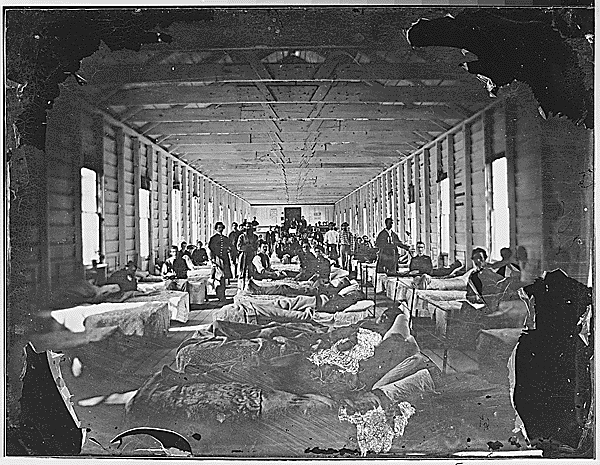
We already have the technology to build green hospitals and all alarmists should pledge to use them. Make them single story building so you don’t need elevators. Make the rooms large with multiple bed wards for efficiency and painted white with lots of windows for pure natural light and plenty of fresh air.
That also sounds like LEED certified buildings that the Clintons touted for years despite double the cost for government and nonprofit organizations adopting them. Sticker shock for utility bills is the unreported outcome since glass walls have low R values.
It is pretty clear that there is no learning going on. The response will be more wind turbines , solar panels, batteries and smart grid load shedding. Reliable electricity will be a thing of the past and it will not be rebuilt.
There is no political will for that.
I was going to ask how the folks down under could be so gullible as to fall for all of this non scientific nonsense and government socialistic control in the name of supposed environmentalism, then I looked around here, in the US, and saw the same thing. Here it is in the bigger cities where the problems are and I suspect it is the same in Australia. Evidently we have more rural, small town folks, for now, who are more comfortable not having government bureaucrats, or at least less of them, to look after us. Even Mao Tse Tung understood the problems of ignorance in the big cities and periodically had purges to chase people out of the cities, or in his case shoot them. Dependence is a powerful force for holding back progress and stirring up discontent.
Like all country’s vote for lemons and you get unpalatable drinks! Wake up aussies and remember you survival desires!
Aussies are asleep at the wheel all the while some dumb soap opera, cricket and tennis are on TV.
Primitive countries like Australia tend to have unreliable grids and limited redundancy while exporting the resources that could solve their problems with the right investment and planning. See Venezuela as another example. Ever heard of combined cycle natural gas plants and the gas pipelines to supply them?
Melbourne , rainy today, so that will ease things a bit
But looking at forecasts, next Friday/Saturday could be a real crunch day for the electrical system.
I wonder, how many politicians and high-level bureaucrats are receiving treatment in hospitals that are leaving people in the dark to demonstrate that they are “good corporate citizens”?
Errr…that would be none.
Any Green dictatorship would be wise to ban air conditioners and their energy problems would be solved.
Its hot in Australia?? Who new. And they have heatwaves !
Would that be like 1960 2 January – Oodnadatta, South Australia hit 50.7 °C (123.3 °F) degrees, the highest temperature ever recorded in the Southern Hemisphere and Oceania or 1923–1924 – During a period of 160 such days from 31 October 1923 to 7 April 1924, the Western Australian town of Marble averaged 100 °F (38 °C).
An extraordinary heatwave occurred between October 1895 to January 1896 that impacted nearly the entire continent but especially the interior. PerilAUS records 435 deaths, 89 per cent of them within New South Wales.
Deaths also occurred in South Australia, Western Australia, Victoria and Queensland. Bourke, in NSW, lost 1.6 per cent of its population to the heat. Temperatures of 40 degrees Celsius in the shade were already being recorded in October, mid-spring.
During the disastrous 1939 Black Friday bushfires, 71 people died in Victoria. But at least 420 people died in the heatwaves which preceded the fires, largely in New South Wales.
Don’t worry about the past temperatures. Those inconvenient tidbits of history will be dealt with when the BOM finishes “adjusting” the historical records.
Love it!
Poster It doesn’t add up… January 21, 2018 at 3:27 am showed a graph
Please anyone have a link to it’s source??
SW,
Do you ask equally probing questions of warmist claims?
Husband has serious heart failure issue and needs air-con, specialist Dr’s recommended we invest in air-con, without it he slips into congestive heart failure, where you lungs start to fill with fluid.
We run our air-con day and night in our home to keep him out of hospital, solar panels in the day-time power our air-con, I am only too aware that we are using base load power at night, and the power bill reflects that.
I fear that if our electricity goes down in a heatwave I will have no choice but to take him to the local hospital, even better if I could get him to the Heart hospital about 45 mins drive away where his consultant specialist works, he will be admitted.
Here in Australia we have a taxpayer funded universal health system, but that doesn’t mean I am unaware of how much it costs to admit him to the hospital about $3500.00, and then $1500.00 a day to keep him there, these figures given to me by hospital worker.
And then what, take him home to another heatwave a few days later, air-con goes off again, and round and round the circle we go again, back to the hospital.
Has no one in the govt thought about the numbers of people in nursing homes that are going to die for lack of air-con’s at are they all going to present at the hospital at the same time, all costing the health system multiple thousands of $$$$.
Just a few days ago I was at the local hospital, for unrelated issue, on the same day we had a heat wave, in the 40’sC, and the ER room had a number of older people presenting with heat stroke, dehydration, the ER staff were later in the day very busy with these people struggling to survive.
[We understand your struggles. .mod]
I am so sorry for the struggle you all are facing.
That the climate extremists, with no regard or compassion, are content to see this sort of suffering inflicted in the name of saving the world is so predictable.
A practical solution might be to ask the medical authorities for assistance with a back up generator of sufficient kws to run the AC and other basic appliances.
It would seem a very wise way to save money.
Don, do you have a link for that data?
Why So Little Australian Gas?
Across Australia in 2015-16 gas powered plant supplied only 7 per cent of output.
Any Aussies know why this is. Not much of this type of natural resource? Ban on fracking?
————————————————
https://www.aer.gov.au/publications/state-of-the-energy-market-reports/state-of-the-energy-market-may-2017
STATE OF THE ENERGY MARKET MAY 2017
Australian Energy Regulator
(See breakdown of supply in Figure 1.9, page 31)
NEM = National Energy Market (see page 22)
SC why do post this political BS?
“Gas is often described as a transition fuel towards a lower carbon economy….”
Life Cycle Assessment (LCA) is a tool to help reduce the environmental impact of doing something (i.e. making electricity).
If you want a reliable grid and low ghg emission (and other environmental impacts), there is only one choice, nuclear.
LCA like all models need to be validated against a actual performance. Nuclear out performs the models and has 99% availability.
Wind and solar are epic fail.
SW,
Australia, like other climate committed countries, is limiting access to natural resources.
In Victoria, our hopeless Labor government has banned fracking because it is worried it will lose crucial inner city electorates to the Greens.
And so much of our Liberal (conservative) party is just pathetic when it comes to taking up arms against the Green Blob due to a combination of sheer lack of talent, appeasement cowardice and, of course, venality.