From the UNIVERSITY OF ARIZONA and the learn Liebigs Law before you make unsupportable claims department, comes this laughable paper that was conceived by the author, Valerie Trouet, at her parents house while reading the weather section of the newspaper. The headline of the press release says it all; alarmists trying once again to make a case for “extreme weather” in the present. But, this paper has at least two fatal flaws, read on to see why.
Jet stream changes since 1960s linked to more extreme weather
Increased fluctuations in the path of the North Atlantic jet stream since the 1960s coincide with more extreme weather events in Europe such as heat waves, droughts, wildfires and flooding, reports a University of Arizona-led team.
The research is the first reconstruction of historical changes in the North Atlantic jet stream prior to the 20th century. By studying tree rings from trees in the British Isles and the northeastern Mediterranean, the team teased out those regions’ late summer weather going back almost 300 years — to 1725.
“We find that the position of the North Atlantic Jet in summer has been a strong driver of climate extremes in Europe for the last 300 years,” said Valerie Trouet, an associate professor of dendrochronology at the University of Arizona Laboratory of Tree-Ring Research.
Having a 290-year record of the position of the jet stream let Trouet and her colleagues determine that swings between northern and southern positions of the jet became more frequent in the second half of the 20th century, she said.
“Since 1960 we get more years when the jet is in an extreme position.” Trouet said, adding that the increase is unprecedented.
When the North Atlantic Jet is in the extreme northern position, the British Isles and western Europe have a summer heat wave while southeastern Europe has heavy rains and flooding, she said.
When the jet is in the extreme southern position, the situation flips: Western Europe has heavy rains and flooding while southeastern Europe has extreme high temperatures, drought and wildfires.
“Heat waves, droughts and floods affect people,” Trouet said. “The heat waves and drought that are related to such jet stream extremes happen on top of already increasing temperatures and global warming — it’s a double whammy.”
Extreme summer weather events in the American Midwest are also associated with extreme northward or southward movements of the jet stream, the authors write.
“We studied the summer position of the North Atlantic jet. What we’re experiencing now in North America is part of the same jet stream system,” Trouet said.
This winter’s extreme cold and snow in the North American Northeast and extreme warmth and dryness in California and the American Southwest are related to the winter position of the North Pacific Jet, she said.
The paper, “Recent enhanced high-summer North Atlantic Jet variability emerges from three-century context,” by Trouet and her co-authors Flurin Babst of the Swiss Federal Research Institute WSL in Birmensdorf and Matthew Meko of the UA is scheduled for publication in Nature Communications on Jan. 12. The U.S. National Science Foundation and the Swiss National Science Foundation funded the research.
“I remember quite vividly when I got the idea,” Trouet said. “I was sitting in my mom’s house in Belgium.”
While visiting her family in Belgium during the very rainy summer of 2012, Trouet looked at the newspaper weather map that showed heavy rain in northwestern Europe and extreme heat and drought in the northeastern Mediterranean.
“I had seen the exact same map in my tree-ring data,” she said. The tree rings showed that hot temperatures in the Mediterranean occurred the same years that it was cool in the British Isles — and vice versa.
The part of an annual tree ring that forms in the latter part of the growing season is called latewood. The density of the latewood in a particular tree ring reflects the August temperature that year.
Other investigators had measured the annual latewood density for trees from the British Isles and the northeastern Mediterranean for rings formed from 1978 back to 1725.
Because August temperatures in those two regions reflect the summer position of the North Atlantic jet stream, Trouet and her colleagues used those tree-ring readings to determine the historical position of the jet stream from 1725 to 1978. For the position of the jet stream from 1979 to 2015, the researchers relied on data from meteorological observations.
“There’s a debate about whether the increased variability of the jet stream is linked to man-made global warming and the faster warming of the Arctic compared to the tropics,” Trouet said.
“Part of the reason for the debate is that the data sets used to study this are quite short — 1979 to present. If you want to see if this variability is unprecedented, you need to go farther back in time — and that’s where our study comes in.”
With the discovery of much older trees in the Balkans and in the British Isles, Trouet hopes to reconstruct the path of the North Atlantic jet stream as much as 1,000 years into the past. She is also interested in reconstructing the path of the North Pacific jet stream, which influences the climate and weather over North America.
###
The paper: https://www.nature.com/articles/s41467-017-02699-3 (open access)
Recent enhanced high-summer North Atlantic Jet variability emerges from three-century context
Abstract
A recent increase in mid-latitude extreme weather events has been linked to Northern Hemisphere polar jet stream anomalies. To put recent trends in a historical perspective, long-term records of jet stream variability are needed. Here we combine two tree-ring records from the British Isles and the northeastern Mediterranean to reconstruct variability in the latitudinal position of the high-summer North Atlantic Jet (NAJ) back to 1725 CE. We find that northward NAJ anomalies have resulted in heatwaves and droughts in northwestern Europe and southward anomalies have promoted wildfires in southeastern Europe. We further find an unprecedented increase in NAJ variance since the 1960s, which co-occurs with enhanced late twentieth century variance in the Central and North Pacific Basin. Our results suggest increased late twentieth century interannual meridional jet stream variability and support more sinuous jet stream patterns and quasi-resonant amplification as potential dynamic pathways for Arctic warming to influence mid-latitude weather.
Below are a few of of the figures from the paper and press release.
First the press release showing the author coring a tree. Maybe you didn’t notice the scientific dysfunction going on in full display but I did.
Note which side of the tree she’s taking a core from, and note the branches above her are either non-existent or growth stunted.

Why that tree? Maybe it’s because this “climate scientist” doesn’t understand the most basic bit of science about plant growth known as Liebigs Law of the Minimum. It’s not referenced in the paper at all.
I covered this law before on WUWT in relation to the Yamal “tree ring circus” of Briffa, Mann, and company claiming that trees (and tree rings) are accurate thermometers of the past, they aren’t and the reason is simply explained by Liebigs Law of the minimum:
A look at treemometers and tree ring growth (excerpts)
I touched on the idea of trees used for dendroclimatology being rain gauges before: Bristlecone Pines: Treemometers or rain gauges ? There has obviously been years of drought when trees also did not grow as much, so how do we separate temperature and moisture in the growth analysis?
But, right now what I really want to introduce readers to is Liebig’s Barrel.
…
Liebig’s Law of the Minimum, often simply called Liebig’s Law or the Law of the Minimum, is a principle developed in agricultural science by Carl Sprengel (1828) and later popularized by Justus von Liebig.
It states that growth is controlled not by the total of resources available, but by the scarcest resource (limiting factor). This concept was originally applied to plant or crop growth, where it was found that increasing the amount of plentiful nutrients did not increase plant growth. Only by increasing the amount of the limiting nutrient (the one most scarce in relation to “need”) was the growth of a plant or crop improved.This principle can be summed up in the aphorism, “The availability of the most abundant nutrient in the soil is as available as the availability of the least abundant nutrient in the soil.”

Liebig used the image of a barrel—now called Liebig’s barrel—to explain his law. Just as the capacity of a barrel with staves of unequal length is limited by the shortest stave, so a plant’s growth is limited by the nutrient in shortest supply.
Liebig’s Law has been extended to biological populations (and is commonly used in ecosystem models). For example, the growth of an organism such as a plant may be dependent on a number of different factors, such as sunlight or mineral nutrients (e.g. nitrate or phosphate). The availability of these may vary, such that at any given time one is more limiting than the others. Liebig’s Law states that growth only occurs at the rate permitted by the most limiting. For instance, in the equation below, the growth of population O is a function of the minimum of three Michaelis-Menten terms representing limitation by factors I, N and P.

It is limited to a situation where there are steady state conditions, and factor interactions are tightly controlled.
…
The point I’m making with all this is: If “the total growth response of a tree is the product of all environmental factors”, and forest modelers have to separate temperature and precipitation diameter increments, plus create different models for different forest regions, how can then one accurately divine temperature over millenia from width analysis of tree ring growth from trees in a single region?
Or for that matter, how could anyone disentangle all the elements (temperature, precipitation, solar, shade, nutrients, etc.) and tell us it’s a proxy for the jet-stream position? The answer is: they can’t.
The task is hugely full of uncertainty. And when the lead researcher cores a tree that has one side that has obviously been shaded by another adjacent tree, as seen in the press release photo, that introduces a bias that has absolute nothing to do with the jet-stream, temperature, and precipitation. If Truett pre-selected trees that looked like, which she seems to be doing in the photo, she’s no better than the flawed science of the Yamal fiasco where a single tree biased the entire temperature record.
Further, it seems she didn’t pay attention to recent literature, such as Briffa and Melvin, 2011 and Brienen et al., 2012a,b
Basically, older trees grow slower, and that mimics the temperature signal paleo researchers like Mann look for. Unless you correct for this issue, you end up with a false temperature signal, like a hockey stick in modern times. Separating a valid temperature signal from the natural growth pattern of the tree becomes a larger challenge with this correction.
…
Dendrochronologists observed that the older a tree was, the slower it tended to grow, even after controlling for age- and time-driven effects. The result is an artificial downward signal in the regional curve (as the older ages are only represented by the slower growing trees) and a similar artificial positive signal in the final chronology (as earlier years are only represented by the slow growing trees), an effect termed modern sample bias. When this biased chronology is used in climate reconstruction it then implies a relatively unsuitable historic climate. Obviously, the detection of long term 15 trends in tree growth, as might be caused by a changing climate or carbon fertilization, is also seriously compromised (Brienen et al., 2012b). More generally, modern sample bias can be viewed as a form of “differing-contemporaneous-growth-rate bias”, where changes in the magnitude of growth of the tree ring series included in the chronology over time (or age, in the case of the regional curve) skew the final curve, especially 20 near the ends of the chronology where series are rapidly added and removed (Briffa and Melvin, 2011).
Or this one:
A likelihood perspective on tree-ring standardization: eliminating modern sample bias
J. Cecile, C. Pagnutti, and M. Anand
University of Guelph, School of Environmental Sciences, Guelph, Canada
NONE of those papers are in her list of citations which you can view here: https://www.nature.com/articles/s41467-017-02699-3#Bib1
It seems she was as good at selecting references as she was trees.
With this kind of incompetence, she ends up with garbage data, and the output becomes little more than a statistical coswallop based on her own beliefs and uncorrected biases.
It’s science, but not as we know it.
Here’s the “output” of her paper:


There is surely another big reason why this research is nonsense – why use dendrochronology when instrumental data exist for the same period. More than 40 years ago H H Lamb in the U.K. was able to construct daily pressure charts for Europe back to the 18th Century because data on air pressure have been measured at many locations for long period. Surely it should be possible to infer/estimate jet stream positions much more accurately from that source, rather than attempt something very dubious with an unproven connection to tree rings?
First you have to list everything that affects tree health. Then you have to disprove all of them being dominant in your analysis. Then you get to your signal as the last step. If nothing else is discussed but what you want for a signal, then the paper is junk. For example, prove that it is rainfall from jet streams and not west coast U.S. upwelling and morning coastal fog giving the tree moisture, or forest humidity, or canopy coverage preventing desiccation. Broad leaf trees grow faster than pines and provide canopy coverage/shade, so the amount of broad leaf trees in the canopy has to be studied. The flip side of rainfall is desiccation, so soil fertility and slope and shade all have to be determined. You just show up and find a jet stream signal means you don’t have the concept of what a forest is.
Which explains why evergreens and pines are first to colonize open land and grow.
The evergreens are eventually overgrown by a procession of broadleaf species as each crowd out their predecessors.
Young conifers easily outpace broadleaf trees.
Tree deformation shown is most likely from snow and winter glaze blown in winter prevailing winds. and not indicative of rainfall and going to affect the ring growth other than a preference for larger rings with the strike of the dominant foliage direction. Trees are affected by dozens of things, one of them grossly correlated in 80 years of literature is rainfall, and that is about it. If you want to get extreme weather, you are competing with sunlight competition, bug infestations, fungus, soil fertility, duration of snow melt for soil moisture, forest humidity, fires, terrain slope angle and direction of tilt, and on and on it goes affect tree health and growth.
The tree behind the coring lady is bare to branches for significant height.
My first thought, considering younger nearby trees were fully branched 360°, is that that area is subject to occasional avalanches. Occasional serious wind storms are possible.
In spite of assumptions, one never knows who/what or it has fertilized/watered/abused that tree.
https://youtu.be/AihvuZiDhsg
“Only by increasing the amount of the limiting nutrient (the one most scarce in relation to “need”) was the growth of a plant or crop improved.” by Liebig´s law of the minimum
This database demonstrates that most tested plants improve growth at increased the CO2 levels:
http://www.co2science.org/data/plant_growth/dry/dry_subject.php
(See the 300 ppm column for results where CO2 is increased by 300 ppm)
By Liebig´s law, that database kind of demonstrates that CO2 is currently a limiting nutrient for plant growth.
Fossil fuel seems to be the greenest energy source – it actually makes the earth greener:
Carbon Dioxide Fertilization Greening Earth
“An international team of 32 authors from 24 institutions in eight countries led the effort, which involved using satellite data from NASA’s Moderate Resolution Imaging Spectrometer and the National Oceanic and Atmospheric Administration’s Advanced Very High Resolution Radiometer instruments to help determine the leaf area index, or amount of leaf cover, over the planet’s vegetated regions. The greening represents an increase in leaves on plants and trees equivalent in area to two times the continental United States.
It’s worse than that. She assumes that the he jet stream controls the he “extremes” but nowhere can she prove that, since we have no record of the jet stream other than the “extremes”.
So she is measuring nothing. She is begging the question, assuming get conclusion to prove her conclusion.
The high quality instrumental record is unfortunately off-message showing an incontrovertible decrease in frequency of extreme weather events and hurricanes. So what to do for a snowflake millennial ecofasc1st not wanting their pure and simple minds polluted by scientific facts? Answer – ignore the instrumental record in favour of a cooked-up tree ring proxy that gives reassuring confirmation of the only acceptable view – climate is deteriorating and its worse than
weout dear leaders thought.In order to determine that what is happning is unpresidented one would have to compare the tree ring data with tree ring data from the Medieval Warm Period the Roman Warm Period and other warm periods during the Holocene. One would also need accurate weather reports for those same periods. The data to make such comparisons does not exist.
“Unprecedented”. “Unpresidented” is what America was during Obama.
If a tree falls in the forest and lands on a dendrochronologist, and kills them, will anybody notice?
Many moons ago, I lived/worked in Essex. A fairly ‘dry’ part of South East England.
My flat was next to a fairly busy road, bang-next-door to a filling station. The road sloped downhill, I was ‘below’ the fuel station.
Having always been hateful of waste (farming folk *never* throw anything away), I came upon 8 little Leylandii hedging plants at the town market, just as it was closing. I got a Good Deal on those baby trees.
I planted along the low wall that defined my garden from the pavement alongside the busy road then shortly afterward, moved away – renting out the flat. I came back to 10 years later to clear it all out when I sold it.
The little trees, being Leylandii (triffids by any other name) were then not so little but very noticeable that the uphill (top) one was about 8ft tall. The lower downhill one was only about 4ft tall and the ones in between formed a beautiful ‘rising trend. (The guy renting the flat had dared not touch them. Remember, these are all identical clones of each other. Leylandii are hybrids and only grow true from cuttings)
I mentioned this to my mother (the gardener of the family) and straight away said it was (rain) water running off the forecourt of the filling station that caused the effect. The top tree got loadsa water and the bottom tree hardly none.
This was 8 trees, planted about 4ft apart alongside a busy main road and being watered by the (doubtless pollution filled) rain water coming off a petrol station.
I suspect Mademoiselle Trout would have kittens should she have seen that.
She still could, they are nicely visible on the satellite images – go find Rainsford Lane, Chelmsford, Essex.
The fuel station is now a Tyre depot & Domino Pizza, my trees are just above right of the bus-stop marked on the road. There’s another big shrub in the garden, an ultra slow growing prostrate conifer of a name I can’t recall right now.
“…She still could, they are nicely visible on the satellite images – go find Rainsford Lane, Chelmsford, Essex.
The fuel station is now a Tyre depot & Domino Pizza, my trees are just above right of the bus-stop marked on the road….”
What a small world. Chelmsford being my hometown, I know exactly where you mean and will have a wander next time I’m down visiting.
Peta
Nice story.
I thought we had all learnt by now that trees are prisoners of their micro climate. Those that get more water, sun, shade, warmth, wind, crowding etc etc will grow very differently to close neighbours.
Tonyb
It does seem that her tree based methodology is inadequate since it fails to capture reduced jet stream meridionality during the late 20th century warming period.
The jets were indeed more meridional in the cooler period up to the climate shift in the mid 70s but from then until 2000 the jets were more zonal and only since 2000 have they become more meridional again which resulted in the recent temperature pause.
If the jets stay more meridional or indeed become even more meridional then my hypothesis should be confirmed by a commencement of cooling.
If the jets become more zonal then warming would resume.
http://joannenova.com.au/2015/01/is-the-sun-driving-ozone-and-changing-the-climate/
Still, nice to see the jet streams getting more attention after my going on about them for the past ten years or so.
‘….my hypothesis should be confirmed by a commencement of cooling.’
It has already begun in the Southern Hemisphere and extreme mid latitude weather is proof of your theory.
‘If “the total growth response of a tree is the product of all environmental factors”, and forest modelers have to separate temperature and precipitation diameter increments, plus create different models for different forest regions, how can then one accurately divine temperature over millenia from width analysis of tree ring growth from trees in a single region?’
You chop down the trees and saw them up into staves and make a barrel out of them and confirm which one is the shortest. Then rinse repeat with lots of trees and barrels and feed them all into the computer to make a hockey stick out of them. This is Dendro101 stuff.
Quote from article:
“Or for that matter, how could anyone disentangle all the elements (temperature, precipitation, solar, shade, nutrients, etc.) and tell us it’s a proxy for the jet-stream position? The answer is: they can’t”.
I believe that the author is correct in stating that it is very unlikely that tree ring widths can be used to measure the meanderings of the jet stream – particularly if multiple tree species are used in multiple geographic locations. It is is even more likely, if other limiting factors upon tree growth, other than precipitation and/or air temperature, are not definitively ruled out.
However, there are circumstances where one major limiting factor to tree-growth can be identified and it is almost a dead certainty that that this factor has not changed over millennial time scales. One such case is when the trees growth rates (i.e. tree-ring widths) are used to measure minimum air temperature in coastal mountainous regions near the tree-line. It is possible to identify tree species at a specific altitude whose growth is severely limited by changes in nearby sea-surface temperatures.This can be achieved for the simple reason that sea-surface temperatures affects the height of the tree-line – which is itself a proxy for the temperature-limited rate of tree growth at a given altitude.
Use of tree ring widths to measure minimum air temperature at a given altitude and then using this to infer nearby sea-surface temperatures can be shown to be valid by using modern instrumental records. Provided the trees are carefully selected and bench-marked using modern sea surface temperature data, there is no logical scientific reason why these tree ring widths cannot be used a sea-surface temperature proxies in the past.
Please do not throw the baby out with the bath water! Tree ring widths can be used a temperature (or precipitation) proxies if due diligence is carried out.
Who is it that wrote this article and what ar the two fatal flaws precisely?
Was the author actually consulted for her views on the criticism?
This reads like an anonymous and nasty piece of baseless bullying.
The author name is right at the top, under the headline.
Setting aside the nasty and apparently unjustified condescension and patronizing evident in your article ad criticisms, did you contact her and offer her the opportunity to address the “fatal flaws”in her paper?
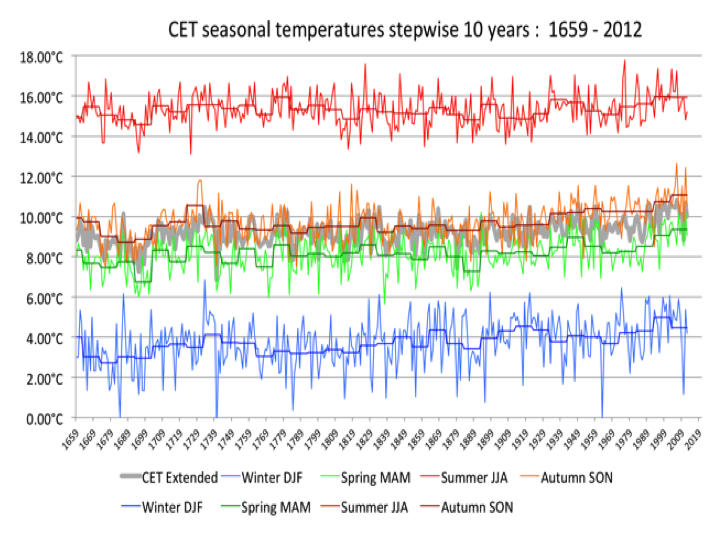
Why would one try to resonstruct the British climate for the last few hundred years from tree rings when we already have the CET extending back further than that?
Stephen I make that point below and link to the data. We know all this so why try to reconstruct using tree rings?
tonyb
Hmmmmm. . . . Without even questioning the correlation that may (or may not) be identified in this paper this is still terrible “science” that does not consider other factors which may be influencing the jet stream and therefore the weather of the northern hemisphere.
Could it be the sun? We know that the sun was far more active than its historical norm over the second half of the 20th century. And given the somewhat brief historical period covered, it would certainly be well out of the norm. That is a well acknowledged fact. Could the solar activity be influencing the jet stream? I am not smart enough to figure that out, but I would wager bigly on the sun impacting the jet stream long before I would consider wagering on mankind’s contribution to CO2 levels in the atmosphere.
Yet this scientist doesn’t even consider that solar activity could explain not only the jet stream shifts, but it could also impact temperatures, cloud cover and therefore precipitation which all have huge impacts on. . . . Wait for it . . . Trees!!!!
Lord help us if this is the future of scientific study.
It’s a tree ring circus with these climate clowns.
I am somewhat bemused at the elaborate methodology of this paper.
 ?w=300&h=225
If the author wanted to know British temperatures they are available from the met office back to the 1600’s.
Rainfall records, for what they are worth, are available from Phil Jones, recently retired from UEA. His mentor hubert lamb in the 1970’s worked out wind directions and speeds back to the 1500’s.
The periods of changeable wind direction can be clearly seen in this data presumably as the jet stream oscillates annually.
There is certainly no sign in any of that of much more severe weather these days
Wind direction is a fundamental driver of weather and climate which we can observe through the mwp and Lia to the modern day.
Incidentally according to Phil Jones and the data, the 1730’s were the warmest uk decade until the 1990’s so this reference to the 1960’s seems misplaced
Tonyb
” the 1730’s were the warmest uk decade until the 1990’s ”
It’s even “worse” in Sweden. In the Uppsala series starting in 1722 the warmest year ever is still 1724.
This is about planting trees. If a person plants 2 trees same size same type, 40 feet apart, they do not grow the same. If a person plants 2 trees, both maples, one 15′ & one 4′, the 4′ will grow faster than the 15′, 4′ will reach the 15′ stage quicker than the 15 reaches a 20′. Eventually they both will be the same size and the 4′ has more of a chance of making it than the 15′, bc of growth requirements. Less water for the 4′ than a 15′, first couple of years to grow. A person will find while digging that Every few feet under ground either horizonal or vertical the conditions change. I landscape, have been watching this for 30 years.
My understanding is that it used to be common practice that when your paper was using data from an area outside your area of expertise you consulted with experts in that field and gave them credit on your paper.
It seems that climate scientists consider themselves to be experts in all areas of science so they don’t need to such consultations anymore.
Here is the reason they did not use instrumental data:
http://onlinelibrary.wiley.com/doi/10.1029/2000JD900300/pdf
A paper based on long instrumental series that shows that temperature variability in Europe has decreased by about 10% in recent times compared to the eighteenth-nineteenth centuries.
Incidentally Phil Jones is one of the authors.
The idea that English summers are getting more extreme in terms of rainfall or drought is laughable.
The long running England & Wales Precipitation Series shows no such thing:
https://notalotofpeopleknowthat.wordpress.com/2018/01/09/is-arctic-warming-influencing-uks-extreme-weather/
That rather invalidates the whole paper I would have thought.
Scaremongering such as this is proof that no real “climate change” problem exists. Endless scrounging around for scraps & even those aren’t there, so just make things up.
When I tapped Maple trees for sap I always put the spike on either south-east or South-West side of the tree. Would go out in the morning or at noon and, on a clear day in March, collect the sap from the buckets on the south-side … they were full. Back out in the late afternoon, around 5PM and the south-west buckets were full, hardly a dribble in the south east buckets. I’ve also felled many trees and looking at the stump it’s clear that the center rings are off-center relative to the circle of the stump … if that makes sense. Let me try again. The stump is round (a circle) but the tree ring center is displaced toward the north. Rings are wider on the south side vs rings are narrower on the north side. I know nothing of dendrochronolgy, but surely this basic feature of growth in my area (Ottawa Ontario Canada) and even more so north of here, has been taken into account in this study? BTW this observation applies more to White Pine than Maple, but the effect is visible in both. Of course White Pine is distinctive being being somewhat lopsided in branch growth — more on the south side of the tree, or in many cases on the Lee side of the tree, or sometimes when near water on the wet side of the tree, or where insulation is an issue on the sunnier side of the tree, or while the tree is growing under the Maplecanopy pretty even all around then when it breaks through the canopy more branches on the south side, …
Or maybe I’ve spent too much time in the bush? 🙂
How many trees did these scientists use in their study? Using tree rings as a proxy for the historic annual temperature of a country or a continent seems foolish to me. Using tree rings to determne the historic jet stream pattern over a country or a continent seems absurd. “A tree ring circus” is a good way to put it, Bruce Cobb.
Though it has been nigh unto 10 yrs since this was published, it appears the Dendrites still haven’t absorbed the implications of it
wattsupwiththat.com/2008/06/13/surprise-leaves-maintain-temperature-new-findings-may-put-dendroclimatology-as-metric-of-past-temperature-into-question/
“The assumption in all of these studies was that tree leaf temperatures were equal to ambient temperatures,” lead researcher Brent Helliker told AFP. “It turns out that they are not.”
http://www.nature.com/articles/nature07031
From the Abstract
We show a remarkably constant leaf temperature of 21.4 ± 2.2 °C across 50° of latitude, from subtropical to boreal biomes. This means that when carbon assimilation is maximal, the physiological and morphological properties of tree branches serve to raise leaf temperature above air temperature to a much greater extent in more northern latitudes.
Since the foliage provides the only interface for the tree, it would be very hard for the tree record any temperature related data since the leaves are kept within tightly bound limits.
Its been shown convincingly that the jet streams moved as a result of ozone depletion.
http://science.sciencemag.org/content/early/2011/04/20/science.1202131?sid=b660ea02-3901-4c11-b4d5-a391e8880825
and here
http://search.columbia.edu/search?q=sciencemag.org&btnG=Go&num=20&filter=0&as_dt=&as_sitesearch=&as_eq=&as_oq=&entqr=0&output=xml_no_dtd&sort=date%3AD%3AL%3Ad1&client=Engineering&ud=1&oe=UTF-8&ie=UTF-8&proxystylesheet=Engineering&site=Engineering&year=2017&template=search&op=Search
hope the links came through.
This has been in the public domain for more than 5 years so should have been assimilated by anybody dealing with jet streams. More sloppy research!