From PRINCETON UNIVERSITY:
Princeton University researchers have found that the climate models scientists use to project future conditions on our planet underestimate the cooling effect that clouds have on a daily — and even hourly — basis, particularly over land.
The researchers report in the journal Nature Communications Dec. 22 that models tend to factor in too much of the sun’s daily heat, which results in warmer, drier conditions than might actually occur. The researchers found that inaccuracies in accounting for the diurnal, or daily, cloud cycle did not seem to invalidate climate projections, but they did increase the margin of error for a crucial tool scientists use to understand how climate change will affect us.
“It’s important to get the right result for the right reason,” said corresponding author Amilcare Porporato, a professor of civil and environmental engineering and the Princeton Environmental Institute. “These errors can trickle down into other changes, such as projecting fewer and weaker storms. We hope that our results are useful for improving how clouds are modeled, which would improve the calibration of climate models and make the results much more reliable.”
Porporato and first author Jun Yin, a postdoctoral research associate in civil and environmental engineering, found that not accurately capturing the daily cloud cycle has the sun bombarding Earth with an extra 1-2 watts of energy per square meter. The increased carbon dioxide in the atmosphere since the start of the Industrial Age is estimated to produce an extra 3.7 watts of energy per square meter. “The error here is half of that, so in that sense it becomes substantial,” Porporato said.
Yin and Porporato undertook their study after attending a seminar on cloud coverage and climate sensitivity. “The speaker talked a lot about where the clouds are, but not when,” Yin said. “We thought the timing was just as important and we were surprised to find there were fewer studies on that.”
Clouds change during the day and from day-to-day. Climate models do a good job of capturing the average cloud coverage, Yin said, but they miss important peaks in actual cloud coverage. These peaks can have a dramatic effect on daily conditions, such as in the early afternoon during the hottest part of the day.
“Climate scientists have the clouds, but they miss the timing,” Porporato said. “There’s a strong sensitivity between the daily cloud cycle and temperature. It’s like a person putting on a blanket at night or using a parasol during the day. If you miss that, it makes a huge difference.”
The researchers used satellite images from 1986-2005 to calculate the average diurnal cycles of clouds in each season worldwide. Yin analyzed the cloud coverage at three-hour intervals, looking at more than 6,000 points on the globe measuring 175 miles by 175 miles each.
Yin and Porporato compared the averages they came up with to those from nine climate models used by climate scientists. The majority of models have the thickest coverage occurring in the morning over the land rather than in the early afternoon when clouds shield the Earth from the sun’s most intense heat. “A small difference in timing can have a big radiative impact,” Yin said.

The researchers plan to explore the effect different types of clouds have on climate-model projections, as well as how cloud cycles influence the year-to-year variation of Earth’s temperature, especially in relation to extreme rainfall.
Gabriel Katul, professor of hydrology and micrometeorology at Duke University, said that “the significance is quite high” of accurately modeling the daily cloud cycle. Katul was not involved in the research but is familiar with it.
The cloud cycle can indicate deficiencies in the characterization of surface heating and atmospheric water vapor, both of which are necessary for cloud formation, he said. Both factors also govern how the lowest portion of Earth’s atmosphere — known as the atmospheric boundary layer — interacts with the planet’s surface.
“The modeling of boundary-layer growth and collapse is fraught with difficulties because it involves complex processes that must be overly simplified in climate models,” Katul said. “So, exploring the timing of cloud formation and cloud thickness is significant at the diurnal scale precisely because those timescales are the most relevant to boundary-layer dynamics and surface-atmosphere heat and water-vapor exchange.”
When it comes to clouds, climate models have typically focused on mechanisms, spatial areas and timescales — such as air pollution and microphysics, hundreds of square kilometers, and seasons, respectively — that are larger and more generalized, Katul said. “There are practical reasons why data-model comparisons were conducted in a manner that masked the diurnal variation in clouds,” he said. “Diurnal variation was somewhat masked by the fact that much of the climate-model performance was reported over longer-term and larger-scale averages.”
By capturing the timing and thickness of the daily cloud cycle on a global scale, however, Yin and Porporato have provided scientists with a tool for confirming if climate models aptly portray cloud formation and the interaction between clouds and the atmosphere.
“The global coverage and emphasis on both ‘timing’ and ‘amount’ are notable. As far as I am aware, this is the first study to explore this manifold of models in such a coherent way,” Katul said. “I am sure this type of work will offer new perspectives to improve the representation of clouds. I would not be surprised to see this paper highly cited in future IPCC [U.N. Intergovernmental Panel on Climate Change] reports.”
###
The paper, “Diurnal cloud cycle biases in climate models,” was published online Dec. 22 by Nature Communications.
Alright if climate modeling is way to much on the high side why don’t realists start creating models that look more accurate than the current mess? Wouldn’t that give the first modeler to do that some instant cred?
realists know that climate modeling just produce garbage, because chaos.
Okay, who can tell me how the GCMs “handle” clouds? Is cloud cover calculated from first principles, based on temperature, pressure, wind velocity and humidity? Or is it estimated stochasticaly, using historical cloud data, and then imposed on the grid? Or somewhere in between?
GCM handle clouds like they handle everything:
Remember it is just impossible to calculate climate, this sort of chaotic things run amok in no time. Even a perfect model would only result in something observed in recent time, like a really green Greenland or frozen Thames most of winters, depending on the run. Useless for the purpose.
That’s were “anomaly” enter: we know the whole thing is not linear, but let’s use the linear tool nonetheless.
You take recent historical data (clouds or whatever), add some forcing, pretend you know how it turns into more of this and less of that (” temperature, pressure, wind velocity and humidity”, and voilà: you get, among other things, a new cloud cover, slightly different from the historical data you began with.
Really all this talk to say ‘climate models are currently not fit for purpose’ or in the vernacular:
Climate Models Suck.
I wonder how long it will be before this study is dismissed because it was done by engineers not climate scientists who will say leave it to the “experts”?
So if they include this new data in the models and rerun them backwards from matching current measured temperatures won’t the models be running cool at the original start point as at that point there was already elelvated CO2?
This Nature paper fits well with my Energy and Environment paper:
DOI: 10.1177/0958305X16686488
Blog version at http://climatesense-norpag.blogspot.com/2017/02/the-coming-cooling-usefully-accurate_17.html
See for example Fig 11
Fig.11 Tropical cloud cover and global air temperature (29)
“The global millennial temperature rising trend seen in Fig11 (29) from 1984 to the peak and trend inversion point in the Hadcrut3 data at 2003/4 is the inverse correlative of the Tropical Cloud Cover fall from 1984 to the Millennial trend change at 2002. The lags in these trends from the solar activity peak at 1991-Fig 10 – are 12 and 11 years respectively. These correlations suggest possible teleconnections between the GCR flux, clouds and global temperatures.
By contrast, the lag between the solar activity peak at 1991 and the Arctic sea ice volume minimum is 21 years (30). It is simple and natural to correlate the cycle 22 low in the neutron count (high solar activity) in 1991 with the millennial temperature peak and trend inversion in the RSS in 2003 with the solar activity 1991 Golden Spike, and to project forward a probable general temperature decline for the coming decades and centuries. Lags differ between data sets because of the real geographical area differences, proxy data point selection differences and instrumental differences between different proxy time series. ”
See also Fig10
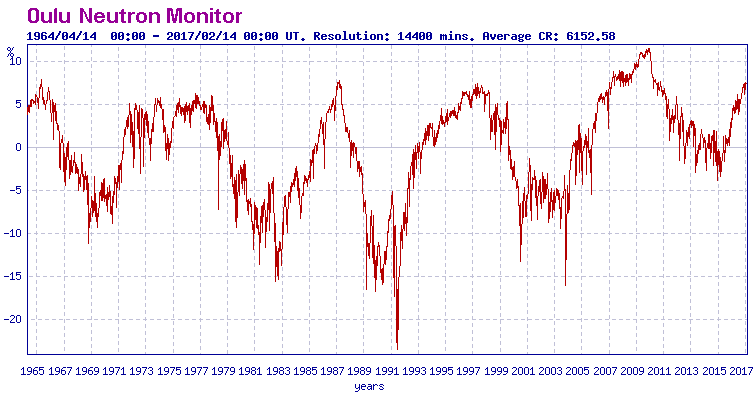
.”……….it is reasonable to conclude that the solar activity millennial maximum peaked with a solar activity “Golden Spike” in Cycle 22 at about 1991.
Fig. 10 Oulu Neutron Monitor data (27)
The connection between solar “activity” and climate is poorly understood and highly controversial. Solar “activity” encompasses changes in solar magnetic field strength, IMF, GCRs, TSI, EUV, solar wind density and velocity, CMEs, proton events, etc. The idea of using the neutron count and the 10Be record as the most useful proxy for changing solar activity and temperature forecasting is agnostic as to the physical mechanisms involved. Having said that, however, it seems likely that the three main solar activity related climate drivers are the changing GCR flux – via the changes in cloud cover and natural aerosols (optical depth), the changing EUV radiation producing top down effects via the Ozone layer, and the changing TSI – especially on millennial and centennial scales. The effect on observed emergent behaviors i.e. global temperature trends of the combination of these solar drivers will vary non-linearly depending on the particular phases of the eccentricity, obliquity and precession orbital cycles at any particular time convolved with the phases of the millennial, centennial and decadal solar activity cycles and changes in the earth’s magnetic field. Because of the thermal inertia of the oceans there is a varying lag between the solar activity peak and the corresponding peak in the different climate metrics. There is a 13+/- year delay between the solar activity “Golden Spike” 1991 peak and the millennial cyclic “Golden Spike” temperature peak seen in the RSS data at 2003 in Fig. 4. It has been independently estimated that there is about a 12-year lag between the cosmic ray flux and the temperature data – Fig. 3 in Usoskin (28). “
Isn’t this essentially Richard Lindzen’s “Iris” Theory?