From the University of East Anglia, home of Climategate, comes this press release claiming a good portion of the world will become drier due to global warming. Just a little over a year ago, at the other climate alarmist outfit in Australia, the UNSW ARC Centre of Excellence for Climate System Science, they said a good portion of the world would get wetter:
Global warming will increase rainfall in some of the world’s driest areas over land, with not only the wet getting wetter but the dry getting wetter as well.
This part made me laugh:
“With precipitation climate models and observations don’t always tell the same story regarding regional changes, but we were very surprised to find that our results turned out to be highly robust across both,” said Dr Donat.
Climate Science, robustly telling two different stories from climate models. Below is UEA’s press release today.
Study predicts a significantly drier world at 2ºC
Over a quarter of the world’s land could become significantly drier if global warming reaches 2C – according to new research from an international team including the University of East Anglia.
The change would cause an increased threat of drought and wildfires.
But limiting global warming to under 1.5C would dramatically reduce the fraction of the Earth’s surface that undergoes such changes.
The findings, published today in Nature Climate Change, are the result of an international collaboration led by the Southern University of Science and Technology (SUSTech) in Shenzhen China and UEA.
Aridity is a measure of the dryness of the land surface, obtained from combining precipitation and evaporation. The research team studied projections from 27 global climate models to identify the areas of the world where aridity will substantially change when compared to the year-to-year variations they experience now, as global warming reaches 1.5C and 2C above pre-industrial levels.
Dr Chang-Eui Park from SusTech, one of the authors of the study, said: “Aridification is a serious threat because it can critically impact areas such as agriculture, water quality, and biodiversity. It can also lead to more droughts and wildfires – similar to those seen raging across California.
“Another way of thinking of the emergence of aridification is a shift to continuous moderate drought conditions, on top of which future year-to-year variability can cause more severe drought. For instance, in such a scenario 15 per cent of semi-arid regions would actually experience conditions similar to ‘arid’ climates today.”
Dr Manoj Joshi from UEA’s School of Environmental Sciences said: “Our research predicts that aridification would emerge over about 20-30 per cent of the world’s land surface by the time the global mean temperature change reaches 2C. But two thirds of the affected regions could avoid significant aridification if warming is limited to 1.5C.”
Dr Su-Jong Jeong from SusTech said: “The world has already warmed by 1C. But by reducing greenhouse gas emissions into the atmosphere in order to keep global warming under 1.5C or 2C could reduce the likelihood of significant aridification emerging in many parts of the world.”
Drought severity has been increasing across the Mediterranean, southern Africa, and the eastern coast of Australia over the course of the 20th Century, while semi-arid areas of Mexico, Brazil, southern Africa and Australia have encountered desertification for some time as the world has warmed.
Prof Tim Osborn from UEA said: “The areas of the world which would most benefit from keeping warming below 1.5C are parts of South East Asia, Southern Europe, Southern Africa, Central America and Southern Australia – where more than 20 per cent of the world’s population live today.”
###
This work forms part of a partnership between between the University of East Anglia (UEA) and The Southern University of Science and Technology (SUSTech).
‘Keeping global warming within 1.5C constrains emergence of aridification’ is published in the journal Nature Climate Change on January 1, 2018.
https://www.nature.com/articles/s41558-017-0034-4
BONUS! MORE ROBUST UNCERTAINTY:
NASA asks: Will the Wet Get Wetter and the Dry Drier?
“With precipitation climate models and observations don’t always tell the same story regarding regional changes, but we were very surprised to find that our results turned out to be highly robust across both,” said Dr Donat.
Reminds me of that great business advice: “Sure, we lose money on each individual sale, but we make it up in volume.”
Dr Su-Jong Jeong from SusTech said: “The world has already warmed by 1C. But by reducing greenhouse gas emissions into the atmosphere in order to keep global warming under 1.5C or 2C could reduce the likelihood of significant aridification emerging in many parts of the world.”
******
So let me see if I have this straight: a CHINESE university has teamed up with the loons over at UEA to now predict a drastically more arid globe if we don’t take drastic action? Isn’t the world supposed to become wetter/more humid if the AGW theory is correct? Isn’t the lions share of amplification that’s built into all of the GCM’s based on increased water vapor?
You gotta give the Chinese some serious credit for this…they certainly know how to look out for their national interests.
Think about it: they team up with the UEA to produce this rubbish so the UEA (and other moonbats) can say “look, even the Chinese agree that we’re heading for disaster” with what result?
The global warmists in the West use this study to push for more green/economically inefficient energy production and additional CO2 limiting regulations which accomplish nothing other than further decreasing their economic competitiveness with China.
And who is the winner? Seeing as China isn’t going to do anything other than think or talk about reducing its own CO2 emissions their competitive edge becomes even greater as a result of all that cheap non-green energy they’re relying upon to fuel their industries.
Am I wrong or just completely daft?
Over here in the UK we could do with some of that drier weather
credit: By Terry Scholey, published on 2nd January 2018 10:00am
vukcevic ==> They don’t still have a Light House Keeper in there, do they?
Not anymore!
Fortunately not, all of those employment places of splendid solitude were surrendered to automation, the last one some 20 years ago.
“Climate Science, robustly telling two different stories from climate models.”
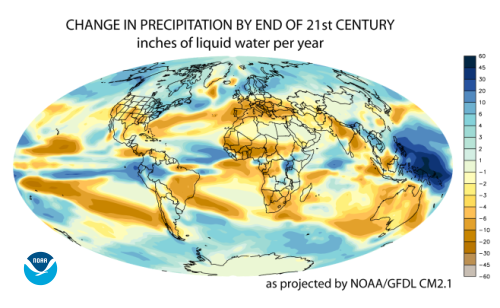
No, they are telling just one story, and it has been consistent for at least forty years. Some places will get wetter, some drier. It can happen. This study says
“Over a quarter of the world’s land could become significantly drier if global warming reaches 2C”
So what happens to the other three quarters? Some gets wetter! The paper linked at the end has the relevant map:
It’s science fiction. Any resemblance to actual climate is purely coincidental.
First you have to believe that they are actually capable of predicting changes in precipitation by the end of 21st century. Then you have to believe that all the other conditions necessary for the prediction will also take place.
Be serious, Nick..
Do you REALLY “believe” that climate models are in any way accurate..
…. and anying more than a computer game???
Nick,
You still believe climate models are sensitive or specific enough to be relied upon any more? You know, I know and everybody on this site knows, the models are crap, quantitatively and qualitatively. Manipulation is the key and you just keep playing the Warmies game.
Alternatively, we can just flip a coin twice to see if the region you live in will be wetter, dryer, or stay the same. You need double heads or double tails for the first two possibilities.
It sure save a lot of time and money.
Nick Stokes ==> For heaven’s sake…”Some places will get wetter, some drier. It can happen. ” Trivially true.
It already happens, has happened, and will happen…that’s called Earth Climate History.
Sahara Wet, Sahara Dry…Just recently (comparatively) “The Neolithic Subpluvial, or the Holocene Wet Phase, was an extended period (from about 7500–7000 BCE to about 3500–3000 BCE) of wet and rainy conditions in the climate history of northern Africa. It was both preceded and followed by much drier periods.”
Note that the global average surface temperature is believed to have been higher during that period than it is today.
There are other examples of great regional change in the historical record — we don’t need no stinkin’ global warming to produce climatic changes — it changes all by itself.
So according to you Nick, a warmer climate will weaken monsoons. Do you have any theory why this should work in the opposite way now compared to the last several million years?
It isn’t according to me. It’s according to the folks at GFDL Princeton, as linked by WUWT. It generally accords with what I had expected, except for some of the monsoon areas. Northern Australia is generally expected to get wetter, and this seems to be happening somewhat.
As to the past, there may have been greater monsoons, but were they in the same places?
They’ve got all the existing dry areas wrong. This is where we are getting the galloping greening that this klatch have chosen to ignore- 15% expansion of forests etc in 30 years and bumper crops elsewhere.
“This is where we are getting the galloping greening”
I’m not convinced that is true. But it is irrelevant to the predictions of rainfall. The point of CO2 induced greening is that plants can do better when water is in short supply. It doesn’t mean that it is wetter.
I’m’ 100% sure that, even without any further increase in CO2 at all, “Some places will get wetter, some drier.” It’s called natural variation.
Every conceivable future outcome has now been “robustly” projected by climate models.
Now all they have to do is wait, and then ex post facto pick the correct ones.
Such is the state of today’s climate psuedoscience.
In the world of equity trading there is a name for such confidence schemes.
Mind explaining to me why northern Australia for example would get drier in a warmer climate? Southern Australia yes, but the north it makes no sense with expanding and stronger tropical convection zone. This is why models are seriously flawed.
When the World was warmer, it was a lot wetter.
Latitudinal Gradients in Greenhouse Seawater d18O: Evidence from Eocene Sirenian Tooth Enamel
Mark T. Clementz and Jacob O. Sewall
The Eocene greenhouse climate state has been linked to a more vigorous hydrologic cycle at mid- and high latitudes; similar information on precipitation levels at low latitudes is, however, limited. Oxygen isotopic fluxes track moisture fluxes and, thus, the d18O values of ocean surface waters can provide insight into hydrologic cycle changes. The offset between tropical d18O values from sampled Eocene sirenian tooth enamel and modern surface waters is greater than the expected 1.0 per mil increase due to increased continental ice volume. This increased offset could result from suppression of surface-water d18O values by a tropical, annual moisture balance substantially wetter than that of today. Results from an atmospheric general circulation model support this interpretation and suggest that Eocene low latitudes were extremely wet.
http://science.sciencemag.org/content/332/6028/455.short
They rely on proxy data to support an Eocene much wetter than today.
The Eocene epoch represents an extremely warm interval in Earth’s climate history. Greenhouse gas concentrations were up to five times as high as present-day levels, and annual global temperatures during the Early Eocene Climatic Optimum (EECO) at ~50 million years ago (Ma) were as much as 12°C higher than modern values.
…
The persistence of the enhanced hydrologic cycle across the Eocene simulations and its match to the sirenian enamel-derived latitudinal gradient in d18Osw suggest that, despite falling atmospheric pCO2 and widespread cooling, the atmospheric circulation and hydrologic cycle of the Eocene greenhouse world were broadly stable.
…
Our results, thus, suggest that the Eocene tropics were not only wetter but may have been cooler than foraminiferal d18O data have previously indicated.
At least one of the projections they looked at (3.7%), is 100% correct, 60% of the time.
If you are a called variable in a climate computer simulation, CO2 warming must be a terrifying reality!
Fortune comes to mind, cookie and telling. This may be unfair but so have been long term predictions supporting a theory.
Note the precision. The world has warmed by 1 degree, and that’s ok. We can warm by another 0.5 degrees and that’s ok, but another 0.5 degrees beyond that is catastrophic.
These “forecasts” are as useless as my local weather bureau when it forecasts a 50% chance of showers for the weekend ahead.
Both studies were published in the journal Nature Climate Change. The first one in the 2016-03-16 edition and this study in the 2018-01-01 edition. Since both studies were on the same topic in the same journal but reached opposite conclusions, you’d think the second study would have at least referenced the first one. You’d also think the journal editor would have solicited comments from the UNSW group (lead author Dr. Markus Donat from the ARC Centre of Excellence for Climate System Science).
Key findings from the UNSW study:
From the just published study (a collaboration between Southern University of Science and Technology (SUSTech) in Shenzhen China and the University of East Anglia):
Is it possible that the second study could have been published without at least acknowledging the first one? Come time for AR6, which one gets cited?
They are pairing them up so they can show they were right when the time comes! Better collect screen shots. The ARC Centre for Ex Climate Science could win in this pair.
If more surface area is wet on earth would this increase evaporative cooling and everything else being equal cool the planet ?
So we have a study that is hyped by the university for people to take notice in the real world and do something. This is the thing that gets me about climate scientists. They are using hypothetical data sets, because the necessary data uncertainty has never been achieved with real measurements. Then they run parameterised models which are just X-box playing around with a half theory, because they don’t and can’t model CO2 in the whole atmospheric system. And once they get their results they think that they are unique and those results can be acted upon. As if the whole idea of verification and qualification of data to be safe to use is not applied to them.
The output of ‘robust’ models appears to be indistinguishable from the output of ‘wonky’ models. NASA’s Earth photographs are clear evidence of global greening, and it is the only observable manifestation of increased atmospheric CO2 that has yet been put before us. The University of East Anglia is the home of ‘Wonky’ Science.
Here is something to dive into
Ocean Bottom Deformation Due To Present-Day Mass Redistribution causes the ocean bottom to subside elastically
Therefore, barystatic sea level rise is larger than the resulting global mean geocentric sea level rise, observed by satellite altimetry and GPS-corrected tide gauges.
free access at : http://onlinelibrary.wiley.com/doi/10.1002/2017GL075419/full
They apparently forgot one thing: the volume of the Earth is constant, so as the ocean bottoms sink, the continents must rise in proportion.
I believe the term for that is Isostacy”.
become significantly drier if global warming reaches 2C
So, just how is water vapor going to go up then ?
Doesn’t a rise in CO2 beget higher water vapor in the “signature” 18km about the Tropics ?
For Southern Australia, the prediction of increased aridity goes against the observed increases in precipitation in the 20th Century. At least according to Al Gore’s 2006 graphic in the book of the film.

Maybe the UEA are too influenced by the severe drought that ended six years ago?
https://manicbeancounter.com/2018/01/02/noaa-future-aridity-against-al-gores-c20th-precipitation-graphic/
There is no issue with North Africa. Yet according to Al Gore, in the 20th Century precipitation in parts of West Africa and Ethiopia decreased by 50%. Compare the Nobel Laureate’s graphic with the UEA’s forecast for 2C of warming.

According to the IPCC, 2C of warming will be reached with another 1000 GtCO2e of emissions from Jan 2012, and emissions are over 50 GtCO2e a year.
https://manicbeancounter.com/2018/01/02/noaa-future-aridity-against-al-gores-c20th-precipitation-graphic/
And now it’s CHOCOLATE!!!!! GASP!
See many articles about this using any news source you wish.
We are gonna lose our candy bars in 30 years because the temperature will be higher and the climate will be drier. Oh, wait! Other models say it will be hot amd wet.
Somehow I think the “experts/scientists” talking about the end of chocolate as we know it are getting grant $$$ because they included the term “climate change” in their proposals. The new administration may surprise them when the gravy train departs without them.
I also question how those tender cacoa trees ( cocoa is the bean) survived the MWP and the Little Ice Age, as they need temperatures above 60 deg F and lottsa rain. Ditto for many spices and hot peppers from the Americas.
When will the constant doomsday insanity end?
Gums…
Drought severity has not been increasing on the east coast of Australia over the 20th century. They simply made this up for the sake of the article.
Meanwhile all the arid areas are experiencing galloping greening. The fringes of the Sahara are being encroached upon by new vegetation. It is exponential and endothermic, ie: natural sequestration and cooling! Over 15% of expansion of forest cover plus fattening of existing stock, shrub, grasses , food crops and then there’s plankton and other increased production in the seas.
This fact was mentioned a couple of years ago and then basically ignored because it’s implication is that only good will come of this molecule. It coincides with the Pause and, if a factor in causation, it will continue after the el nino decays to a la nina, already deepening. The panic over chocolate, being laughably in counterpoint to Sharks freezing in the sea off Massachusets along with record continental cold and snow. The cocoa cuckoo’s even fly in the face of their own theory that global warming occurs outside the tropics, mainly in the… errr… Arctic where all the record cold is coming from.
It doesn’t matter what the latest models predict, it’s always “bad”
Warmer = worse
Colder = worse
Wetter = worse
Drier = worse
Windier = worse
Calmer = worse
More heterogeneous = worse
More homogeneous = worse
The message is “things were perfect in 1850 (or was it 1750?, darn it, wish I could remember) and any change from that is (a) caused by human activity and (b) a Bad Thing”
Any hint of a favourable result of increased atmospheric CO2 is invariably outweighed by a corresponding downside “Oh yes, vegetables might grow faster and bigger, but they will be less nutritious” (I think I saw that one recently).
Never mind that we’re in the middle of an ice age and global temperatures have been up and down like a (yoyo – toilet seat – hoor’s knickers) for at least 4 million years, change MUST be caused by humans and change MUST be a Bad Thing. It’s so anthropocentirc, so pathetically dismissive of earth history. It would be comical if it wasn’t taken so seriously by our leaders.
Nicely done.
Any change is ….. Indeed
Yes but how is that a deviation on “normal”? Oh wait! Silly me, it;s worse…either way.
I’ve been told by several so called environmentalists that any change, if it is caused by man, is evil.
If the world warms 20 degrees, but it’s natural, it’s a good thing.
If the world warms 0.1 degrees, but it’s caused by man, it’s evil and must be fought with everything at our disposal.
Okay, I’m confused. I’m only interested in accurate weather forecasts. Accuweather is NOT the most accurate of spots, and worse, they change their forecasts by the hour at times. I could make a TV game show out of “Spot the Wrong Forecast”, couldn’t I?
I saw (and photographed) sundogs yesterday around 2:30PM local time. That usually means a storm in two to three days, depending on how much water vapor (ice at that altitude) is in the atmosphere. So I’d say, based on that and what’s happened before in my kingdom, we’ll have a storm by Wednesday, and I’ll have to shovel again. And Accuweather is still forecasting “other”, but that changes with the time of day. Oh, well.
So does this “study” take into account the grasses and weeds growing in the Sahara? The snows engulfing people living in the Atacama Desert in up to three feet of snow? Snow sticking to dunes in the Sahara for several hours? Snow in Kuwait, where it has never been seen in recorded history? Is this one of those stay-tuned moments, or should I just start a warm, toasty fire, get a good book (or movie) and put my feet up?
Seriously, the more of these silly, unrealistic pronouncements I see, the less I trust the people who make them. They fail to take unexpected variables into account – always a fatal error. When they tell me they can detect a single degree difference in temperature by feel, not by mechanical readings, I might listen to them. But I simply cannot give credence to people who think they can forecast the weather or the economy for 50 to 100 years ahead.
That is simply loony, in my view.
They re-run the models hourly, with the latest data, and update the forecasts accordingly.
Whenever I see “robust” in these articles I think of Demi Moore in “A Few Good Men” strenuously objecting.
The modeling this study is based upon is really just a form of make believe. The reality is that the climate change we have been experiencing is caused by the sun and the oceans over which mankind has no control. Mankind does not have the power to change the climate.
They mentioned the fires in California which is coming off of one its wettest years on record. Such fires have always plagued California and it has had nothing to do with mankind. There are even some plant species in the state that through evolution require such fires for their propogation. In Southern California where I live most plant species are acustomed to having only a brief rainy season followed by a long dry season and will still survive if successive rainy seasons are missed. The LA basin was known as the valley of the smokes because of all the fires that took place during the long dry season.
If the climate changes, people will adapt.
The climate was warmer than today’s climate during the Roman Warm Period, when human CO2 emissions were much less than today’s emissions. If a warming climate produces drought in southern Europe, the Roman Empire adapted by building aqueducts hundreds of miles long to transport snowmelt from the Alps to thirsty coastal cities, some of which are still standing 2,000 years later.
If we are heading toward another Roman Warm Period, why can’t we do as the Romans did?