
Guest essay by Eric Worrall
A PNAS study claims that crop yields will fall by up to 7% for each degree celsius of global warming, assuming no CO2 fertilisation and no adaption measures.
Climate change will cut crop yields: study
August 15, 2017
Climate change will have a negative effect on key crops such as wheat, rice, and maize, according to a major scientific report out Tuesday that reviewed 70 prior studies on global warming and agriculture.
…
“Each degree Celsius increase in global mean temperature is estimated to reduce average global yields of wheat by six percent,” said the report.
Rice yields would be cut by 3.2 percent, and maize by 7.4 percent for each degree of Celsius warming (almost two degrees Fahrenheit), it added.
“Estimates of soybean yields did not change significantly.”
…
Read more: https://phys.org/news/2017-08-climate-crop-yields.html
The abstract of the study;
Wheat, rice, maize, and soybean provide two-thirds of human caloric intake. Assessing the impact of global temperature increase on production of these crops is therefore critical to maintaining global food supply, but different studies have yielded different results. Here, we investigated the impacts of temperature on yields of the four crops by compiling extensive published results from four analytical methods: global grid-based and local point-based models, statistical regressions, and field-warming experiments. Results from the different methods consistently showed negative temperature impacts on crop yield at the global scale, generally underpinned by similar impacts at country and site scales. Without CO2 fertilization, effective adaptation, and genetic improvement, each degree-Celsius increase in global mean temperature would, on average, reduce global yields of wheat by 6.0%, rice by 3.2%, maize by 7.4%, and soybean by 3.1%. Results are highly heterogeneous across crops and geographical areas, with some positive impact estimates. Multimethod analyses improved the confidence in assessments of future climate impacts on global major crops and suggest crop- and region-specific adaptation strategies to ensure food security for an increasing world population.
Read more (paywalled): http://www.pnas.org/content/early/2017/08/10/1701762114
This is a good example of climate hype.
The authors of the study did the right thing, they explained their study ignored real world factors such as adaption, genetic improvement and CO2 fertilisation. There is a place in science for careful studies which seek to adjust just one factor, to study the impact of that adjustment. But their study has been spun into a narrative of failing crop yields.
In the real world, any deficit is more than compensated by the factors the study excluded.
CO2 fertilisation has a dramatic effect on plant growth. The slight rise in CO2 levels to date has measurably greened the world. Commercial greenhouses take this a lot further; they burn vast quantities of natural gas and discard the heat, just to produce enough CO2 for their plants to maximise growth – usually around 1000ppm, more than double current atmospheric levels.
Genetic improvement, production of species such as dwarf rice, can have a huge impact on yield. The world may be on the cusp of truly decoding the genetic blueprint, of an unprecedented level of understanding and control over crops and farm animals. There is plenty of scope for further advances.
As for adaption – down here on the edge of the tropics, we have a simple adaption we use to grow temperate vegetables which can’t tolerate our tropical Summers; We plant them in Autumn. The vegetables grow happily through our very mild winters, and fruit in Spring, before the Summer heat kills them.
I suspect a lot more global warming would be required to allow temperate Northern Hemisphere farmers to plant tomatoes unprotected outdoors in Autumn.
Edit (EW): The following image demonstrates the dramatic effect of CO2 fertilisation on plant growth.

Rubbish.
IPCC assumes that warming causes more water vapor to enter the air, hence more rainfall. A warmer world is less windy, as well, leading to less evaporative loss of soil moisture.
But even if yield fell, growing seasons would be longer at higher latitudes, producing more wheat.
Yields won’t fall, however, thanks not just to more moisture but from CO2 fertilization and less water lost to transpiration.
“There is a place in science for careful studies which seek to adjust just one factor” Caeteris paribus. Goes nicely with controlled experiments. Unfortunately, you can’t do such experiments with Earth. You have no control Earths and cannot vary one factor only to see what happens. Those are some reasons why climastrology is a pseudo science.
in the title . . . Adaptation
Well, it isn’t the only study on those lines, is it?
I think this one featured on ‘Watts’ recently?
http://timesofindia.indiatimes.com/home/environment/global-warming/Climate-change-will-make-food-less-nutritious-Study/articleshow/36202909.cms
So how much did this comedy routine cost?
Priests Need Absolution – Seriously.
Yes, adaptation is an important consideration and those plants that have not fully adapted to the historically low CO2 levels (at least compared to when those plants evolved), will benefit greatly from increased atmospheric CO2. I’ll say it again, once we run out of fossil fuels, our biggest concern will be how to boost atmospheric CO2 levels in order to prevent agriculture from crashing. I foresee the solution being many thousands of cement kilns across the world liberating CO2 from limestone. Of course, we’ll still need cheap electricity to run them …
This article utilizes the “stupid people hypothesis” while simultaneously ignoring fertilizer value of CO2. All that remains is propaganda.
The first negative feedback loop is warmer oceans means more clouds that cool the planet.
The clouds that we see in the sky
is really the reason for why
we will not overheat;
Shields us from solar heat.
A feedback on which we rely.
The second negative feedback loop is organic. More CO2 means more plant growth. According to NASA there has been a significant greening of the earth, more than 10% since satellite measurements begun. This results in a cooling effect everywhere, except in areas that used to be treeless where they have a warming effect. The net effect is that we can now feed 2 billion more people than before without using more fertilizer. Check this picture from NASA, (now they can publish real science again) showing the increased leaf area extends nearly everywhere.
In addition, more leafs changes the water cycle, increases evapotranspiration, and more trees and vegetation reduces erosion and unwanted runoff. Good news all around.
In short, taking into account the negative feedback occurring the earth will warm up less than 0.5 degrees from now, not at all in the tropics, and less than 3 degrees at the poles. Without the Paris agreement there will be no increase in the death rates in the cities, except from the slight increase of city temperatures due to the urban heat effect. With the Paris agreement we will have to make draconian cuts in our use of electricity, meaning using much less air conditioning and even less heating, and life expectancy will decline.
More https://lenbilen.com/2017/07/20/rising-co2-more-clouds-a-blessing-or-a-curse-a-limerick/
The authors forecast declines in crop yields due to future warming if other real world factors are ignored. Do they at least note that the real world effect of past warming has been the opposite?
Meanwhile in the real world crop yields continue to inexorably increase. Better methodology, better equipment, better tech’, better practices. How inconvenient.
OT, but saw this today, another benefit of anthropogenic CO2, : “Tsar Bomba had other effects. Such was the concern over the test – which was 20% of the size of every atmospheric test combined before it, von Hippel says – that it hastened the end of atmospheric testing in 1963. Von Hippel says that Sakharov was particularly worried by the amount of radioactive carbon 14 that was being emitted into the atmosphere – an isotope with a particularly long half-life. “This has been partly mitigated by all the fossil fuel carbon in the atmosphere which has diluted it,” he says.
Isn’t there a term in agriculture called: “growing degree days” where higher temperatures are a GOOD thing? By this model, higher temperatures would imply that crops would mature a few days earlier.
http://www.farmwest.com/node/936
Under the heading of “weather is not climate, but…”
I, as are most people in the south central United States, are living through a big, real world example of why most average people don’t take weather predictions very seriously anymore. 3 days ago, the forecast for today was sunny and 95 degrees f. But instead, its 71 degrees f and raining – hard! And the thing is it’s been cool and rainy all month long – this is about to be the coolest August in anyone’s living memory.
So here we all are, supposed to be suffering from ever increasing “Global Warming” that’s going to make it “too hot for humans to live!” and what do we see when we look out our windows? The coolest, nicest summer that most of us have ever seen. Hot Summers? Oh yeah, we had that 6 years ago, and then it cooled back down. Almost like these things are cyclical, imagine that.
Oh I know, some warmist is about to jump up and say “Weather is not Climate! IN fact Global Warming is what Makes it Wetter and Cooler!!!” And then he will proceed to prove it by a lot of “uhm”, “don’t you see”,
“errrr”, and “the statistics say”. This will be accompanied by a great deal of waving of hands in the air.
Thank you, I’ll believe in what I can see.
That sounds like the same thing Lobell & Field did: they assumed farmers are idiots.
Lobell & Field claimed that a 0.7°F (0.39°C) increase in temperature over the period 1981-2002 should be expected to have reduced crop yields, not overall, but compared to what the yields otherwise would have been, everything else being equal. They admitted:
Read that again. It means that their estimate is not based on any measured reduction in crop yields. It’s based on their assumptions about what a +0.7°F temperature change would do to productivity in the absence of other factors, like CO2 fertilization, improved crop varieties, changes in cultivar choices by farmers, etc., etc..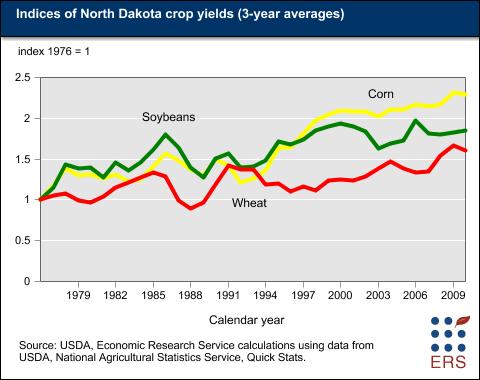
In the meantime, in the real world, farmers are not idiots, so they grow the crops which grow best in their local climate. In the real world agricultural productivity is soaring. According to World Bank data, global crop yields have almost tripled since chilly 1960. One of the reasons is CO2 fertilization. For example:
U.S. Wheat:
https://www.ers.usda.gov/topics/crops/wheat/usda-wheat-baseline-2015-24/
Wheat, soybeans & corn in ND:
Here’s a recent article:
http://brownfieldagnews.com/news/2016-u-s-corn-soybean-crops-biggest-ever/
Excerpt:
1 °C of warming is roughly equivalent to moving about 50 miles south, in the United States, or about 500 feet lower in elevation. If you think that could be a problem, then ask yourself this: are the farms 50 miles south of me less productive than the farms at my latitude? And are the farms 50 miles north of me more productive than the farms at my latitude?
The chronic shortage of CO2 is the primary factor limiting plant growth on planet Earth. It is possible to contrive growing conditions in which something other than CO2 limits plant growth and health, or in which a shortage of some soil nutrient causes better crop yields to be accompanied by reduced levels of some micro-nutrient, but such contrived conditions are easily avoided through normal fertilization practices. Under real-world conditions, additional CO2 is dramatically beneficial for agriculture, even to CO2 levels far beyond what we can ever hope to reach in the outdoor atmosphere, and the nutrient value of crops grown with extra CO2 is not significantly different from other crops.
Eric, your post is especially ironic given the one I’ve scheduled to go live in 10 hours. Check back for the joke.
[edit]Nevermind. It’s published now[/edit]
Reduce CO2 and see what disasters are certain, not merely theoretical.
Notice that many of these studies require that you pay to read their lies.
You’d think that these studies would be available at no charge, just as a measure of transparency to allow the largest possible audience to assess them.
How clever — keeping the detailed methodologies of the lying process behind a pay wall.
IMO , it is time to call out these kinds of “studies ” as the lies they clearly are .
Propaganda . ” Pure ” and simple…
Do they say if yields would improve if temperatures fell?
So called experts report global warming will be caused by anthropogenitic co2 emissions resulting in additional growth. CO2 is a fertilizer used to increase growth of plants. If warming trend is supported by nature that would open additional land for farming. No reason to expect a reduction in overall farm productivity.
Global warming alarmists have a frightening future to sell supported by invalid climate models that has made the bell ringers wealthy and society poorer.
Macpherson
In the spring farmers try to plant crops the earliest they can without the emerging plants being damaged by frost. In the fall they plant so that the crop is up and hardy prior to the first frost. If climate warms, farmers will plant earlier in the spring and later in the fall. A warmer climate would make it easier for temperate climate farmers to make two crops in a single growing season.
If you are fond of the term “green blob”, then I might suggest the term “blobaganda” to describe this particular kind of propaganda.
Climate change will cut crop yields…


http://i90.photobucket.com/albums/k247/dhm1353/RiceFAO.png
http://i90.photobucket.com/albums/k247/dhm1353/CornFAO.png
http://i90.photobucket.com/albums/k247/dhm1353/worldcereals.png
http://i90.photobucket.com/albums/k247/dhm1353/FAOSTAT.png
Climate change will cut crop yields… When this happens again:
Climate models do not regionally downscale. Therefore any crop impact esrimates are pure speculation. That statement is true for all 72 papers. I dug into corn, where there are two prominent negative impact papers. One uses a glaringly faulty statistical model to analyze US county level data. The other analyzed CIMMYT data for Kenya on test plots trying to develop drought resistant corn. Its flaw is that none of the test plots had optimum conditions, so the null hypothesis is flawed.
Total nonsense with respect to their conclusions and implied risks to agriculture. Models and limited field warming studies do not account for the expansion of arable land with warming as agricultural belts expand toward the poles, the increased water efficiency of crops with increased CO2 or the increased growth rate of plants with increased CO2 and longer growing seasons. The study also seems to ignore real world experience which suggests just the opposite conclusions. Such a report gives the distinct impression of a scary conclusion around which they tried to build a study.