Guest Essay by Kip Hansen

Contrary to the common mantra that we must turn the thermostat up on our air conditioners to cut down on electrical energy usage — in order to save the planet from sure destruction — a recent article in the New York Times offered a different perspective.
“If You Fix This, You Fix a Big Piece of the Climate Puzzle” by Lisa Friedman (July 13, 2017) offered us a little one-question quiz:
“There’s no single solution for climate change, but there is one that would be more effective than others. What do you think it is?”
The multiple choice answers were:
Build more wind farms
Eat less meat worldwide
Improve air conditioners
Switch to mass transit
If you picked “Improve air-conditioners” you were rewarded with a cheery message (and the rest of the article, hidden until this point):
“You’re right! Curbing 87 percent of the climate change pollutants found in air-conditioners by 2050 could eliminate 89.7 gigatons of emissions.”
“New research from the Lawrence Berkeley National Laboratory in California indicates that adding improved efficiency in refrigeration and phasing out fluorinated gases used for cooling, as mandated by international agreement, could eliminate a full degree Celsius of warming by 2100.”
The new research is this paper: “Opportunities for Simultaneous Efficiency Improvement and Refrigerant Transition in Air Conditioning” by N.K. Shah and others. [The 108-page paper is available for viewing online or as a free downloadable .pdf].
The thrust of the paper is that if we do two things, we will save a lot of energy and emit fewer GHGs. And if we do, these actions alone could eliminate a full degree Celsius of warming in 2100. That is of course great news, since it is believed by many now that the temperature rise from a doubling of CO2 would be somewhere around 1 to 1.5 degrees total, a figure which, if we start our counting in 1880, we have already reached, we could totally forestall all global warming by fixing the air conditioner problem!
Despite my somewhat lighthearted description, there is actually something important here — one of those rare opportunities for policy action that is Win-Win, No-Regrets, and helpful to both the developed world and the developing nations — sensible pragmatic choice that doesn’t cost much — maybe nothing if actual savings cover increased cost.
The solution is to accomplish two things:
1. Transitioning to low-global warming potential (GWP) refrigerants
According to the Wiki , the refrigerants currently in use are: “chlorofluorocarbon (CFC), hydrochlorofluorocarbon (HCFC), or hydrofluorocarbon (HFC) refrigerant. The refrigerant names include a number indicating the molecular composition (e.g., R-11, R-12, R-22, R-134A). The blend most used in direct-expansion home and building comfort cooling is an HCFC known as chlorodifluoromethane (R-22).
Dichlorodifluoromethane (R-12) was the most common blend used in automobiles in the US until 1994, when most designs changed to R-134A due to the ozone-depleting potential of R-12. R-11 and R-12 are no longer manufactured in the US for this type of application, so the only source for air-conditioning repair purposes is the cleaned and purified gas recovered from other air conditioner systems. Several non-ozone-depleting refrigerants have been developed as alternatives, including R-410A. “
The problem with most of these is two-fold: CFCs and HCFCs are believed to “deplete the ozone layer” of the atmosphere and are thus being phased out for that reason. The second is that the newer refrigerants are said to have high Global Warming Potentials — their action as Greenhouse Gases when they eventually end up in the atmosphere.
There are newer alternatives until consideration, each with lower GWPs but individual problems. For instance, the “Greenfreeze” refrigerant developed by Greenpeace is a mixture of propane and butane. Highly flammable, potentially explosive, and only approved in the USA is very small charge loads — ruling it out for air conditioners of 5kW or less. Similar is R-290 (straight propane).
The paper contains a detailed discussion of current and future refrigerants.
However, the outlook is good that suitable materials will be developed that are not harmful to the environment, not flammable nor explosive, not toxic (like ammonia) and which will have substantially lower GWPs.
These alternatives, if they come without too much of a cost penalty, will replace existing refrigerants, probably through a combination of social pressure for consumers and corporations to produce and buy “greener” air conditioners, and through international environmental agreements.
2. Efficiency Improvements for Air Conditioners
The major change will be to inverter air conditioners. The benefits of inverter units are claimed to be:
“At least 30% – 50% cheaper to run as it consumes less power
Far quicker to achieve desired temperature
The start up time is reduced by 30%
Much quieter
No temperature fluctuations, maximising comfort level
No voltage peaks from compressor”
Inverter air conditioners run at variable speeds, depending on the degree of cooling necessary to reach the desired room temperature. In addition to being variable speed, many inverter air conditions are in effect heat pumps (as are all air conditioners, strictly speaking) but in this case, they can be run “backwards”, pumping heat from the outside air into the room, thus act as heaters as well as coolers. The heating ability of these inverter/heat-[pump ACs is limited to outside temperatures with a lower limit of 40 degrees F — below that, they don’t function efficiently. However, this is a great benefit in many applications where HVAC (heating, ventilation, air conditioning) systems need to maintain a narrow room temperature in temperate climates, such as Los Angeles, California, where air conditioning can be needed nearly every day, and heating only occasionally when temperatures drop below 50 degrees.
We Could All Use a Break
We could all use a little break from our energy bills. But where this really matters is everywhere else — what we call The Rest of the World, ROW.
To quote the New York Times — “That’s because from India to the Philippines to South Africa, air-conditioners are increasingly a must-have item. Less than 10 percent of homes in India have units, but air-conditioning makes up 40 percent to 60 percent of the country’s electricity demand in major cities like New Delhi. Businesses and homeowners in Asia and Africa are expected to buy an estimated 700 million air-conditioners by 2030, and 1.6 billion by midcentury.”
As energy access increasing in the developing world, the world in which most humans live, the demand for air conditioning will increase — and efficiency will matter a very great deal as their developing electrical grids ramp up to meet the needs and desired of the people.
This is One Useful Thing
Switching refrigerants to less-harmful options and improving the efficiency of air conditioners is a sensible pragmatic action that can be supported and taken now, without having to wait for climate science to get its head straight and policy makers to find the right PC correct political yoga-pose that will get them re-elected.
What’s not to like?
# # # # #
Author’s Comment Policy:
I am always anxious to read your ideas, opinions, and to answer your questions about the subject of the essay, which in this case is how improvements in air conditioning equipment and refrigerants can be a win-win action that has a perceived positive effect on potential global warming.
As regular visitors know, I do not respond to Climate Warrior comments from either side of the Great Climate Divide — feel free to leave your mandatory talking points but do not expect a response from me.
If we have HVAC professional, building engineers or architects reading here, I’d love to read your take on the suggestions made in the LBNL paper.
# # # # #
The other solution is to have less children. Unless your religion tells you to have more.
Jimmy ==> While “have less children” is another popular mantra, history has shown that the only thing — other than war and devastating plague — that reduces population growth dependably is raising the standard of living in rapidly growing populations to near that of developed western countries, many of which now have negative growth rates due to births (total populations in EU grow due to immigration).
Kip, haven’t you come to the realization yet that the “have fewer children” mantra has now shifted to the forefront since climate crisis appears to have lost its political power? Of course, population reduction has ALWAYS been the reason behind climate crisis, but you have to understand that if you can’t get people to willingly die through killing the energy generation system, then you have to find another reason for world government. Nations, nor people, will go into population reduction without an overriding world government to force the issue. Having less children can be forced by the government, as was the results of the Chinese experiment. But to get that done world wide will require the world government that was going to come about by climate crisis. If only Mother Nature had cooperated, but no! The Beatles got it partly right, “Here comes the Sun,” but it came without enough heat too early to make everyone fall in line and give up cheap energy, even though the brainwashing was ferocious!
Don’t worry, Jimmy, alternative sexual orientation will most surely help push down the number of those babies you don’t want!
Fewer children is the equivalent of cultural suicide. In extreme forms it is xenocidal.
It is a fool’s way to deal with problems of environment and resources and has never been shown to be necessary, much less effective.
Agree hunter. It is cultural (and I think civilization’s suicide). All in the name of global warming which has been shown over and over to not exist to any measurable level (except by changing the historical data).
Those who want population control never seem to lead by example. Less population of you and your kind, not for me or my kind.
The racist core of environmentalism is the belief that there are too many brown babies. The fact is that nowhere in Europe or North America are white populations increasing by reason of births.
What if we just ate our children instead? Does this offset the “eat less meat” thingie..?
Jimmy, I read somewhere that the ideal family would have one and a quarter children (Paul Ehrlich maybe). Now I would like to see that.
Wouldn’t this efficiency also apply to fridges and freezers?
I see you mentioned refrigerments. Is that properly spelt?
Nevermind, my editor is mis-red squiggling.
Few people I know have an air conditioner in their home.
I rely on an air conditioned (cooled) Starbucks during my daily summer bike rides, that often include 3 to 4 hours of bike riding to reach.
Beer. I want a beer.
“Up to one degree by 2100” is almost certaily some deep fable. It is a stretch to get one degree more. And there is a Paris agreement which limits warming to 1.5 C. It all depends on Trump now. Should Trump say we’ll gonna do that, and go to negative emissions by 2030, the climatariat would be happily waiting for their money.
(may contain traces of sarcasm)
Garymount ==> Yes — and No. Refrigerators are on the top five first-buy modern products when the poor finally are hooked up to a dependable 24/7 electrical grid — but they do not suck power like A/C. Frigs in EU have nearly all switched to the new propane-based refrigerants.
And people in the UK are having their kitchens explode. It is a huge mistake to populate a country with such potent bombs. As these products age and start to leak propane, this will become even more common.
Getting down to the facts now. CFCs DO NOT break down ozone. That was a scam perpetrated by Dupont Chemical to get their out-of-patent refrigerant banned in favor of their new, more expensive refrigerant. Now, 20 years later, we have the admission from the scientist, who “discovered” and then claimed that CFCs broke down ozone, that he fabricated the results and the claims. Unfortunately, people still believe in this scam.
We know now that it is solar radiation and nitrogen gas in the atmosphere that, at very cold temperatures, breaks down ozone. There is nothing we can do about that and it is not our fault.
And, the whole concept of greenhouse gases is bogus, particularly as they are applied in climate models in which there is no night-time.
First, no gas at any concentration in the atmosphere can warm the climate, particularly in sunlight.
Second, these “radiative gases” (their real descriptor) are saturated in sunlight, converting IR to heat and heat to IR, having no net effect, zero effect, nada.
Third, the upper tropical troposphere is supposed to be where these gases “trap” IR and send it back to Earth’s surface. Two problems here, (1) that part of the atmosphere, dubbed “the hotspot,” is not warm and, according to NASA, has been cooling for close to 40 years and (2) that part of the troposphere is -7 deg C and the surface is 15 deg C, such that the IR send down is reflected and not absorbed; no heating. It is thermodynamically impossible for a cool object to heat a warmer object.
Fourth, CO2 and water vapor are by far the dominant radiative gases, with all others being pathetically small regardless of fantastic claims of their “power” as greenhouse gases. Methane may be 20 times the radiative gas compared to CO2 but it is in 1/400th of CO2’s concentration and, thus, it is dwarfed by its own scarcity in the atmosphere.
Fifth, while CO2 and water vapor have no net effect in sunlight, it is during the night that these radiative gases are influential. With no solar energy input, they convert heat energy in the atmosphere to IR which is lost to space. That is why the air chills down so quickly after sunset and why small breezes kick up so quickly on a sunny day with scudding clouds as the air cools in the moving cloud shadows.
Sixth and most important. Water vapor is part of the water cycle, in which huge amounts of heat energy go to breaking hydrogen bonds between water molecules to form water vapor. This gas makes air less dense and, on a sunny day, this now much less dense air, being warm as well as humid, rises. As it rises, the air cools via adiabatic cooling and eventually the water vapor condenses out at altitude, releasing the latent heat energy from the water vapor. The now-condensed water, then coalesces to droplets and the cool rain or snow falls back to the surface.
The water cycle is known to all elementary school kids, but “climate scientists” prefer (or must) to ignore this huge, global, heat engine that exerts a powerful negative feedback on global warming. They simply cannot let it be part of their system (models) as their pathetic, non-existent CO2 “effects” would be laughable in the face of real world negative feedbacks, such as the water cycle.
Did you notice what started the fire in Grenfell Tower? An exploding fridge…
To be fair, the Grenfall fridge was of a brand/model that had a known defect that the maker had publicized. Other models are less problematic. (Although they may leak as they age. I’ve just had two fridges wimp out on me—I was told that the tubing becomes permeable with age.)
Highley7 – spot on, every single point!
BC
I would like to have a link to “the admission from the scientist, who “discovered” and then claimed that CFCs broke down ozone, that he fabricated the results and the claims.”
PS: one of those fridges was used and 20 years old.
Having your pipes leak as you get older.
A lot of us know what you are talking about.
higley7,
Several points which don’t fit reality…
The chlorine in CFC’s does break down ozone. The only point where Solomon and others were wrong is the speed of one of the reaction steps, which was far slower than expected. That means that other reactants in the real atmosphere (including natural chlorinated like meythylchloride – from fungi and algue) have at least as much or more influence. That also doesn’t exclude the role of Dupont to watch their profits with the new patented refrigerants…
Then:
no gas at any concentration in the atmosphere can warm the climate, particularly in sunlight
Reference? Water vapor does have absorption areas already in the visible spectrum…
Second, these “radiative gases” (their real descriptor) are saturated in sunlight, converting IR to heat and heat to IR, having no net effect, zero effect, nada.
Something called “conservation of energy” does contradict that: if the satellites measure less transport of IR in the CO2 bands to space, that energy is conserved somewhere else… Namely the atmosphere. See:
http://citeseerx.ist.psu.edu/viewdoc/download?doi=10.1.1.131.3867&rep=rep1&type=pdf
Third, the upper tropical troposphere is supposed to be where these gases “trap” IR and send it back to Earth’s surface. Two problems here, (1) that part of the atmosphere, dubbed “the hotspot,” is not warm and, according to NASA, has been cooling for close to 40 years
Less warming of the hot spot region than at the surface is not the same as cooling… See:
http://www.drroyspencer.com/2015/05/new-satellite-upper-troposphere-product-still-no-tropical-hotspot/
(2) that part of the troposphere is -7 deg C and the surface is 15 deg C, such that the IR send down is reflected and not absorbed; no heating. It is thermodynamically impossible for a cool object to heat a warmer object.
Sorry Highley, you are completely wrong on that point: it is perfectly possible to melt steel by a laser beam that comes from a CO2 laser cooled with water. A receiving object doesn’t know what the temperature of the sending object was. It simply absorbs the energy contained in it.
What is right is that a warmer object emits more radiation energy per m2 than a cooler object. Thus overall, more energy is received by the cooler object than by the warmer if they are in each neighborhood. But still the warmer object will cool down less fast in space if a cooler object is near it.
Thus please, check your facts before jumping to conclusions which are, to say the least, are a little biased…
That’s because a refrigerator is a closed system (while the door is closed) whereas an A/C system is anything but!
Roger Knights comments
That is probably correct. I have noted in recent years that there is a combination of aluminium and copper tubing in modern refrigerators. Copper and Aluminium set up an electrochemical cell, the result of which is corrosion. The wetter the condition of the cell the faster will be the corrosion. My cynical mind suggests that around 10 years might be a suitable period for “planned obsolescence”.
Gary Kerkin ==> The situation ismuch worse on boats like mine — the salt air eats nearly everything, including refrigeration tubing.
Ferdinand Englebeen writes: “Something called “conservation of energy” does contradict that: if the satellites measure less transport of IR in the CO2 bands to space, that energy is conserved somewhere else… Namely the atmosphere. “
Let me guess; you an inorganic chemist? Engineer (not of the biological kind)?
Ferdinand, is it your opinion that trees, dogs, people and other organic life on this planet simply “grow” magically without consuming any energy?
Seriously?
Aren’t these refrigerants in a’ sealed’ system?
It is fully and permanently sealed, until it isn’t and fails…
Perhaps we should ask the surviving former residents of the Grenfell Tower in London how mandating “green” refrigerants in domestic refrigerators have affected their lives.
Air conditioning literally saves lives… From a Warmunist perspective, that’s bad for the climate.
I suspect we are going to need more of it in the future.
http://www.independent.co.uk/Weather/iran-ahvaz-hottest-temperature-ever-recorded-world-record-extreme-death-valley-california-a7815771.html
It just needs to be efficient and renewably powered.
Hey Griff,
July 4, 2017 : Coldest July Temperature Ever Recorded In The Northern Hemisphere
“Greenland just set the record for coldest July temperature ever reported in the Northern Hemisphere at -33C.”
https://realclimatescience.com/2017/07/latest-from-the-greenland-meltdown/
This is like a fun game of ping pong
July 4, 2017 : Coldest July Temperature Ever Recorded In The Northern Hemisphere
https://realclimatescience.com/2017/07/latest-from-the-greenland-meltdown/
Ha too funny hotscot. Same wavelength.
But Scot, that means they won’t need any aircon up there!
I’m pointing out you can’t live in 129 degree heat – and that there will be more heatwaves like this coming in the Middle East etc.
(By the way, you do know why its so cold in Greenland and there’s snow falling right? That cold spot in the ocean from melting ice off S Greenland. Where did that come from??)
“you can’t live in 129 degree heat”
Of course people can. I’ve worked in 140 F before (greenhouse during summer).
btw, that article is bogus. It got up to 134 F in parts of the western US in the 1930s.
How does meltwater from glaciers produce a temperature that is 33 degrees below freezing? I am not being sarcastic, but serious, since I know so little about this topic. For a non-scientist like me, it is confusing when both sides make contradictory arguments with great passion and conviction.
Correction: I confused the heat wave of 1934 with the 134 F temp in CA in 1913.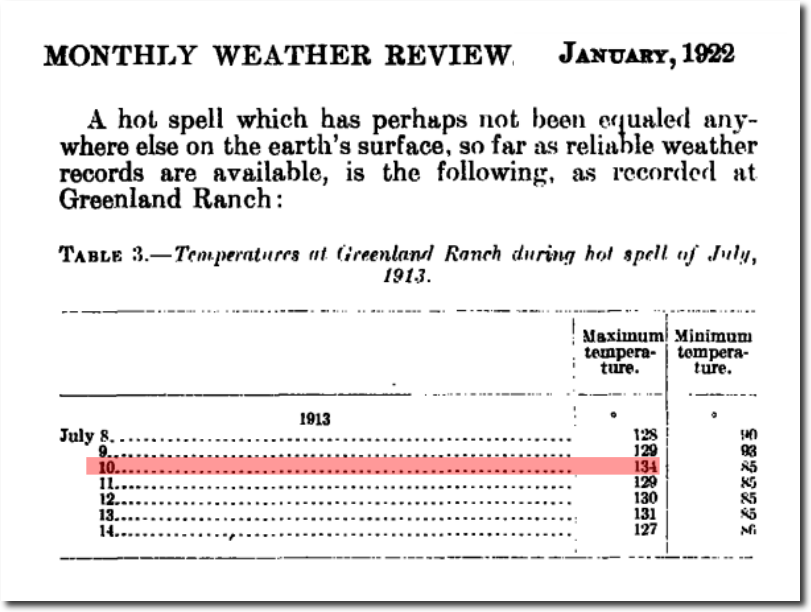
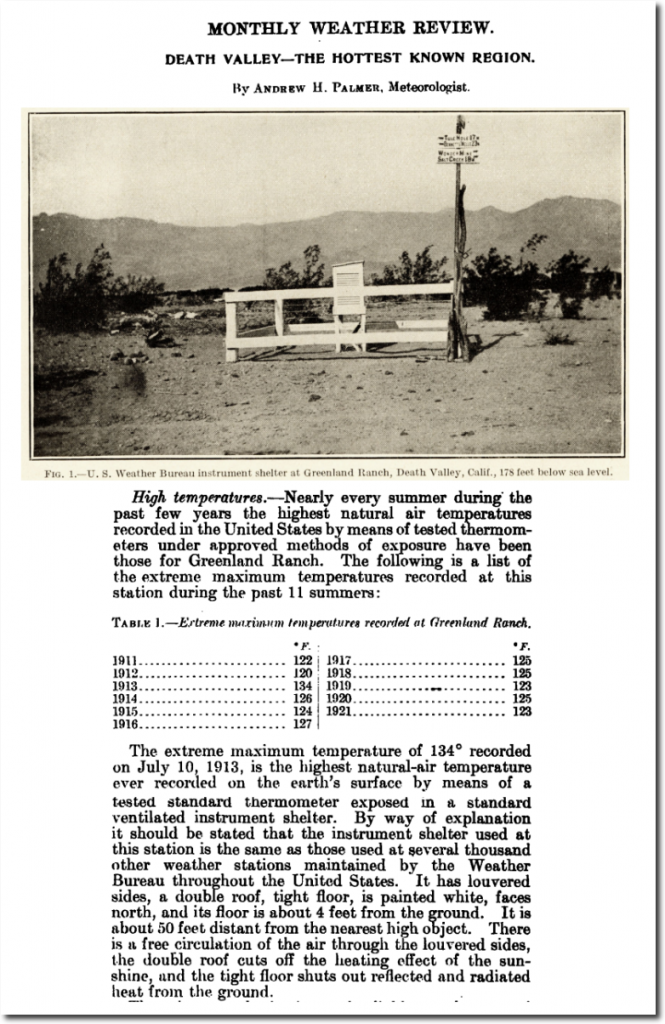
That CA location experienced maximum temps above 120F for a decade.
The local prediction is for temperatures above 100 degrees F for the next few days. Hidden in the article is that the record high local temperature was 107 in. . . .1937.
ICISIL – Don’t you know that NOAA adjusted those temperatures downwards due to [put lame reason here] and that the temperature in Death Valley was actually only 47 Deg F on that date? Get with the narrative, [snip]!! [/sarc]
[Your sarcasm is noted, and is fine. “Skeptic” is the preferred tag here, though. -mod]
… efficient & renewable … renewable & efficient …
That’s easy to type and easier to say. What does it mean?
Efficient with respect to what?
What is renewable? Hydro power?
Is the Tonopah solar heater a good example of renewable? Is it a good example of efficient?
It “just” needs to be … something that does not exist.
Hey Griff
The Greenland icecap just recorded the first July day ever with a positive mass balance:
This is from Griff’s link
Apparently the next trick of Climate Science DeJour is to make current high temperatures seem like records (the hottest Evah) simply by having the prior record discredited as “errors”
“I’m pointing out you can’t live in 129 degree heat”
Telling porkies again, Grifter?
Of course you can, you can work in it too.
In fact, you can work in a lot hotter if the humidity isn’t high.
The things he is talking about, these better AC units, the air source heat pumps are great. I have 2 of them on my house in CT USA. I use them when the ambient air is above 35F or so as that’s the break even cost point for them supplying heat to my house versus my oil furnace. Natural gas lines are more than 3/4 a mile from my home, and thus not available. They have saved me 500 gallons of oil this past winter, since I can avoid using oil for most of the spring and fall, and even some winter days. Obviously they cool my home well, and are as quiet as one would want.
The big thing for me is that using them has saved me hundreds of dollars this past winter in oil costs while cooling my house better than wall/window units. I am a huge fan.
That helps, too.
Mike ==> Thank you for weighing in on the residential heat-pump HVAC units. Your situation is exactly where the most benefit is found — those spring and fall days where temps require just a bit of warming in the house — heat that is available from the ambient outside air which can be pumped into the house.
In New York’s Central Hudson Valley, we often have chilly nights and hot days — heat pump/inverter a/c units handle the situation perfectly at reduced cost. Like your home, firing up our furnace to warm the ancient hot water radiators costs too much.
Health is what matters. We live in central Arkansas, quite hot & quite humid in summer. I maintain relative humidity at or just under 40% all year long. Maintaining this low humidity costs money but we spend on health care only for annual checkup.
Besides saving lots of money there, it’s rather pleasant to feel good. I don’t even have flu shots, maybe have a cold once every 8 years. My HVAC is an in-ground geothermal, 3 speed heat pump, uses R-22, makes low cost or free hot water, has a dehumidification cycle, and I also have a sizable dehumidifier as well. Lastly, we also have some air change so the home air isn’t stale.
Yes, we spend a little more on electricity, but I think we save lots & lots on health care.
Science has just recently shown that refrigerants had little or nothing to do with the ozone hole, so those changes of refrigerants were a waste of money. I think that perhaps a subsidy for high quality dehumidification would save a lot of money spent on health costs.
Exactly right. Mold spores are nasty things and propagate rapidly in living spaces with higher humidity levels.
I think Jimmy Haigh must mean fewer children, rather than children of small stature. He should note that the birthrate Worldwide has been dropping for decades, with the significant exception of equatorial Africa. As the free market economy takes hold there, it will have the same effect of reducing the birthrate it has had in the rest of the developing World. The data suggest that religion does not enter the equation.
Right! The hottest place on the whole planet and they’re having the most kids! Don’t they know people can’t live in that kind of heat? Laughably ludicrous conclusions from laughably ludicrous AGW “science”!
Birth rates are falling in Africa as well. They just haven’t fallen as far as the rest of the world.
There seem to me to be a range of ways of reducing air con energy use/impact…
Solar power is often at its most effective at the times when aircon is in use. Solar on your roof means you power (at least in part) your aircon renewably. And perhaps the rest of the grid has solar farms attached.
Insulated houses – like passivhaus designs – don’t need cooling anyway (or as much)
The UK uses demand management, where central control over aircon/refrigeration/water pumping city wide allows the control of when aircon fires up and how many sytems fire up at once… massively reduces demand
There are aircon designs I’ve seen where ice is produced and used in cooling
The UK uses demand management …
Say what? References please, as I’ve never heard of such a thing.
Sounds like: if the UK says AC isn’t needed at a certain time, you can’t use yours or they’ll turn it off for you
The best way to reduce energy use is to use network analysis to identify all climate extremists and to have all their power cut off in all aspects of their lives. this way the Griffs of the world can demonstrate for us all the wonderful merits of a low carbon lifestyle.
And if our climate extremists wish to live a negative carbon lifestyle, they can [ snipped — Author. Violates WUWT commenting policy. Please refrain yourself.]
Steve
Well its a complicated subject… and in the time I have I’ve not found a particularly clear explanation to link to..
But look here in section 2.3.3..
http://www.element-energy.co.uk/wordpress/wp-content/uploads/2012/07/Demand-Side-Response-in-the-non-domestic-sector.pdf
I’m really referring to these 2 items under ‘automated devices’ section:
Direct load control – involves installing devices on certain types of plant that
enable the electricity supplier to (remotely) control consumption. This form of DSR
is typically applied to loads that can be turned off or cycled for short periods
without a noticeable loss of service (e.g. air conditioners, water heaters). Remote
control of electric storage heaters is the most familiar example.
Dynamic demand control – devices which can be used with any time-flexible
electrical load (refrigeration, air conditioning, heating etc.). They can turn devices
on and off in response to changes in the frequency of electricity supply.
UK has firms which contract with firms using electricity and with National grid, to use devices described to reduce demand. The key is ‘is typically applied to loads that can be turned off or cycled for short periods
without a noticeable loss of service (e.g. air conditioners, water heaters)’
So they shut off your electricity when it gets really hot. That’s what this means.
The article is basically propaganda. Two speed compressors are almost as efficient as variable speed and much cheaper as they don’t need the inverter electronics. The problem is that home and light commercial A/C uses sealed body compressors that rely on returning refrigerant to cool the compressor windings and mechanical and entrained oil for lubrication. At reduced speed the compressors are much more prone to failure from poor oil return and insufficient cooling. Bottom line is, they aren’t used much in these applications because they are expensive and don’t work very well. pretty much defines Green devices in my experience.
The amount of power saved never makes up for the extra cost and higher failure rate at lower capacity ratings. Pretty marginal even at 20 tons capacity.
-Refrigeration and HVAC tech and system designer
Big Brother
Griff
The only way anyone could shut off anything in my house is to cut the power lines. I won’t buy anything that can be controlled remotely. So those Demand Management people can go suck eggs.
Smart meters can shut off your house completely, depending on the model.
Griff — You say: “Solar power is often at its most effective at the times when aircon is in use.”
Not really true. Outside air temperature peaks several hours after peak sunlight due to thermal capacitance of the ground. Inside air temperature peaks later than outside air temperature due to the building’s thermal resistance and capacitance.
So peak air conditioning loads often occur late afternoon and even early evening when there is little help from solar.
You would have to get much fancier to have solar support air conditioning fully. Such systems exist — you can freeze water late morning and early afternoon, then melt it to cool the air later, but these are expensive and temperamental systems.
Beyond that, many homes are empty during the middle of the day. Peak energy use occurs closer to 5pm as people come home and start cooking dinner.
This has been explained to Griff many times, but like the lies about German renewable generation and arctic ice, he prefers to tell untruths rather than deal with the world as it is.
“Not really true. Outside air temperature peaks several hours after peak sunlight due to thermal capacitance of the ground. Inside air temperature peaks later than outside air temperature due to the building’s thermal resistance and capacitance.”
From my experience temperatures typically fall just before sunset and gradually fall all night long. I have only seen them go up due to change in wind direction or an increase in cloud cover. So the hour of peak temperature is strongly affected by the weather and location.
Other factors are the amount of insulation, air infiltration rating of the exterior walls, and weather or not the roof is vented. If you have a well insulated home, low air infiltration and a vented roof you only need a couple of hours of cooling during the day to get the inside temperature down to a comfortable level. Once there the air conditioner can be turned off for most of the late evening or or night. Once the outside air temperature cools enough you can open your windows and night to provide additional cooling if needed. Solar power in this case can easily supply all of the air conditioning power needs.
My home is 11970s construction and it was very drafty when I got it. I sealed all gaps in the interior walls doors and windows to stop the air leaks. Now if the interior air temperature is 70 in the morning on a very hot day the interior temperature typically reaches 78 by sunset. IF the outside air cools off fast enough i can use fans and open windows to cool it off to 73 by morning. Obviously I don’t need a lot of AC to maintain a comfortable temperature inside.
“Griff July 20, 2017 at 5:17 am
There are aircon designs I’ve seen where ice is produced and used in cooling”
That’s just a box with a fan on it that blows air across some ice, that’s NOT aircon being discussed. Does not address dehumidification either.
“Insulated houses – like passivhaus designs – don’t need cooling anyway”
My house doesn’t need cooling either, and it isn’t any sort of “Green” design.
Mind you, it is around 350 years old and the walls are a minimum of three feet thick.
Plus, in the winter, once it warms up, it acts like a space heater, so doesn’t take a lot of heating.
Better and safer refrigerants have been a form of Grail for a while. If you live in Ontario, the land of excess power to be sold cheap and at a loss to America, shouldn’t you want to use AC?
You didn’t explain well the reason the inverter based system is more efficient. It has to do with duty-cycles. Say you need your A/C (or heat) to run 1/3rd of the time, the traditional approach is a thermostat with warm and cold set points a degree or two apart. The cycling on and off is very inefficient. The inverter approach allows variable drive motors to run at 1/3rd speed (etc.). Continuous operation is much more efficient.
Thank you! I was just about to throw the BS flag on energy savings via inverter based systems. However, can you explain why and/or how energy is wasted starting and stopping the A/C system? How much of these gains do you lose during very low load conditions (say, nighttime temperatures of 78 with the thermostat set to 76 degrees)?
I would assume the surge currents on the compressor and fan motors starting repeatedly is what makes them less efficient.
But what’s not being considered is that cycling a motor will increase its lifetime compared to running one constantly (assuming the winding insulation is adequate to handle repeated surge currents).
For airconditioners that’s exactly backwards. Running an airconditioner constantly is better for it than having it turn on and off all the time. The extreme of on-off is called short cycling and is very damaging to the airconditioner. link
Lots of equipment does have a maximum duty cycle. If you run it too long it will overheat and, if you insist on pushing it, burn out. That’s not usually the case with airconditioners.
CB, that only applies to an improperly sized unit where the duty cycle is too high.
commie and I Came ==> My understanding is that the variable speed units do not necessarily run constantly .. when the room temperature is low enough, consistently, they can shut off altogether — like at night. When running, they vary the motor speed according to the temperature differential between the desired temp and the room air temp. This helps to eliminate the “freezing blast of really cold air” that plagues many a/c installations, one secretary positioned under a cooling vent forced to wear a sweater, while others complain it is still too hot.
Variable speed compressors save power because the compressor is more efficient at lower compression ratios ( low speed). Variations on that theme have been used on bigger systems for decades. The present “green mania” has manufacturers applying the principle to systems where it is not a good choice. Lots and lots of “Green” stuff is sold on the basis that it is reliable and cost effective when it is actually the opposite! Solar power, wind energy, etc.
ICISIW, the size of the winding doesn’t matter all that much. It’s the extra heat generated while the motor is starting up, plus the extra torque during startup that causes the wear and tear.
Ronald, I don’t know all the details, but the industry claim is about a 40% reduction in electricity usage. (I have no first hand knowledge).
At my house my blower unit is in non-conditioned space, so whenever the unit turns off, the whole blower assembly starts warming up. The next time it is turned on, first the blower unit has to be cooled, then the ducts have to cooled and finally house gets its turn.
And then it only runs for a few minutes and shuts down just to do it all over again another few minutes later.
I _assume_ it is the whole blower/ductwork assembly being cycled like that which wastes so much energy.
At night, I assume it must do some kind of duty cycle, but when it kicks on, it kicks on at some minimal power.
FYI: Assuming the claim is true, an inverter based system is perfect to tie into a solar panel with battery backup. When an inverter system is pulling power from the mains, the first thing that happens is the mains power is converted to DC, then the inverter creates the appropriate frequency AC.
greg ==> Thank you for expanding the explanation. I kind of short-changed readers with “Inverter air conditioners run at variable speeds, depending on the degree of cooling necessary to reach the desired room temperature. ” hoping that those really interested would click through to the link.
Kip:
Not an HFAC professional, but have them in the family. (1) saying the “outlook is good” that better refrigerants will be developed is a long way from actually having them. And unless the new ones are lubricant- and seal-compatible with R134, they won’t be used to convert existing systems. Propane is a drop-in replacement for R12; R134 is not.
(2) The variable-speed AC motor controllers have improved drastically in cost and power capacity in the past 15 years and will no doubt find their way into more AC compressors in the near future. I don’t think existing compressors can be retrofitted, so market penetration will be limited to new and replacement systems. Variable speed motors are widely used for furnace circulation fans already.
R-134A can be a “drop in replacement” for R-12. I have it running in 3 old Mercedes as a conversion.
The “trick” is that you must flush the system and then replace the mineral oil with ester based oil. Oh, and change the filler valves with an adapter for the Schrader valve to match the R-134A valve. A little crew on thing with the two different thread sizes on opposite ends.
I’ve also had 2 other cars converted over the years, but those cars have now gone to car heaven… I’ve used this conversion for many many years now 😉
“New research from the Lawrence Berkeley National Laboratory in California indicates that adding improved efficiency in refrigeration and phasing out fluorinated gases used for cooling, as mandated by international agreement, could eliminate a full degree Celsius of model-based warming by 2100.”
Fixed.
Amazing, attacking even a common sense based proposal.
I’m attacking the ridiculous notion that this could somehow “prevent” 1C of warming by 2100. It’s not based in reality, at all. Nowhere did I attack the continued improvement of refrigeration efficiency.
And it is much more complicated than you realize and decidedly not a common sense based proposal. It is leading edge and as much about marketing as it is about a viable technology. People could save easily twice as much money just by keeping their condensers clean!
It’s only common sense if the cost of the changes is less than the energy saved.
deebodk ==> The real world point is that no matter how electricity is generated in the future, there will be only a set amount available on/to the grid and more demand means more generation base load needed.
Any approach that reduces peak-time demand benefits society. Reducing electric bills benefits the end user. Reducing pollution from HCFCs and HFCs — suspected of “harming” the ozone layer (in my opinion, the science is still out on that) and both powerful GHGs can only be good, even if they have a negligible effect.
All of these are things that have only positive effects — with no downsides.
There is a small increase in the cost of inverter A/Cs, which might be off-set by the savings in electricity spread over the lifetime of the unit.
Again, where did I attack the continued efficiency improvement of these technologies or even the reduction of real pollution? It’s amazing how so many people have reading comprehension problems. I made one correction to a statement that improved its accuracy 100-fold, and that correction was about future warming abatement and that alone. Then I get folks all over my case about something else entirely. Strawman much?
If these changes save money, there is no need for them to be mandated by government. They will happen on their own.
BTW, the jury came back on HCFCs and HFCs effect on the ozone a long time ago. There isn’t any.
In 1917, there were no air conditioners at all. What are the chances that we will be making much more efficient air conditioners in 2117, even without a climate change incentive? I would put it around 100% (barring all out nuclear war or a leftist new world order).
The future will be far better at dealing with the problems of the future than we are, especially if we don’t hog-tie the present with restrictive carbon mitigation taxes.
jclarke341 asked, “What are the chances that we will be making much more efficient air conditioners in 2117?”
I don’t know but they’re more efficient today than they were 25 years ago.
… new air conditioners today use about 50 percent less energy than they did in 1990.
https://energy.gov/articles/history-air-conditioning
Energy for HVAC systems are a large expense for commercial and residential buildings. The supplier with the lowest energy cost (among several factors) will get the business.
That is good news given the way energy prices have rocketed in Europe.
And Richard it is why Germans don’t complain about electricity unit prices and use 35% less electricity per household than Us households -efficient appliances
Germany has moderate climate. Neither too hot nor too cold. Even so, living in a property, without air-conditioning, heater switching on at 10 pm and off at 6 am can test anyone’s manners. Naturally newer constructions are better equipped, but not everyone can afford them.
I installed a 2 ton unit in my house in 1984. The Rated Load Amps were mid 20’s. I installed a 2 ton unit in my ex-wife’s house last week and the Rated Load Amps were 27! Don’t believe everything you read!
As always, driving the German’s into energy poverty is declared a good thing by Griff.
I don’t think that your energy.gov link is lying, but there is NO support for a 50% better EFFICIENCY on that site. It says they use 50% less power. It may be like “let’s ban vacuum cleaners over 1600W” or arbitrary limitations on power for hair dryers or tea kettles.
@Curious George
Exactly. If the cooling load is reduced by better insulation, low-E glass, vented roofs, etc, then sure, you can probably see a 50% reduction in power used to maintain the same interior conditions. At some point you wind up running into the thermodynamic law of diminishing returns. There is a minimum amount of work necessary to transport heat from point A to point B that’s set by the Carnot cycle.
“And Richard it is why Germans don’t complain about electricity unit prices”
Making stuff up again, Grifter?
I bet these 350,000 households complain very loudly indeed.
The electricity was shut down around 350,000 households
The social problems in the energy sector are increasing: last year the electricity has been disconnected as never before. The reason for this is the rising price of electricity.
http://www.spiegel.de/wirtschaft/service/strom-350-000-haushalte-mit-stromsperre-a-1062889.html
But hey, what does the comfort of 350,000 low-income households matter to you Climate Warriors when you’ve got the planet to save (and especially when you’re being paid to do it)?
Let’s see:
Step one; Support good “green” energy, and punish evil fossil fuel energy, raising electricity costs to exorbitant levels.
Step two; Once electricity costs are sufficiently high, support expensive, energy-saving planet-saving technology by offering rebates, tax incentives, etc.
Step three; ignore that steps one and two have already occurred, further ignoring that the higher initial cost of the new, energy-saving planet-saving technology will more than likely still outweigh the artificially increased cost of electricity.
Step four; Crow loudly about your “accomplishment” and virtue-signal to your heart’s content.
Pass.
The biggest problem I have personally encountered with the newer refrigerants is that when the “old” refrigerants are made illegal (like R-12), what might normally be a relatively minor repair turns into a full system replacement.
I think its all wrong:
1. Refrigerants don’t cause any detectable global warming.
2. The ozone hole is the same size it has always been. CFCs don’t make any difference to it.
3. An inverter air conditioner is no more efficient than a good quality new non-inverter air conditioner.
4. Nothing discussed in the article will make any difference to the world’s climate. Its just more green c**p.
I think you’re right! Also, you spell crap funny!
Berniea ==> You should read the paper concerned. Inverter/variable speed a/c units are far more energy efficient.
By “the paper concerned”, you mean claims in a commercial for inverters?
Curious ==> If you are really curious, read the essay first, then read the paper the essay is about:
“The new research is this paper: “Opportunities for Simultaneous Efficiency Improvement and Refrigerant Transition in Air Conditioning” by N.K. Shah and others. [The 108-page paper is available for viewing online or as a free downloadable .pdf].”
Kip, sorry, I just clicked through that paper. It is thoroughly non-technical, repeating the mantra of “efficiency” hundreds of times. Nowhere does it offer a number, other than “we want to achieve a 30% efficiency improvement in 2030”, without a hint how to do it. A total waste of time.
BTW, how should I interpret Table 38, China, 2030 Efficiency Improvement, 118-277?
Curious ==> The paper, pdf here, is 108 pages of very technical detail about refrigerants, economies, market predictions, etc. The study is to try and predict the effects of a “from 30% efficiency improvement” in air conditioning technology, thus the phrase is repeated.
Table 38. Range of estimated peak load reduction (GW) in 2030 and 2050 from 30% efficiency improvement and low-GWP refrigerant transition
If you do not understand the table, I suggest actually reading the associated text — in this case “estimated peak load reduction (GW)” resulting from a 30% increase in efficiency of air conditioners is expected to reduce peak load by 118 –277 GW.
Really though, you have asked me to do your homework for you while you sling nonsense complaints about a paper that you have not really read with the intention of understanding — a first requirement for learning anything.
Bernia
All true except
“3. An inverter air conditioner is no more efficient than a good quality new non-inverter air conditioner.”
As the load increases evaporator temp goes down and condenser temp rises. Pumping continuously at a lower load up a lower temperature difference uses less power.
Since the global warming and ozone depleting effects of CFCs are grossly exaggerated, the correct response is to use the one that is most efficient in cooling.
Is there any significant difference in the efficiencies of the various refrigerants? You did not address that in the article.
[Comment rescued. -mod]
scarletmacaw ==> The original paper under discussion is 108 pages long. It exhaustively discusses refrigerants, their Global Warming Potentials, and their efficiencies.
The basic answer is that only refrigerants within a certain efficiency band are even considered commercially viable.
A/C is a technology that has advanced to the point where the easy savings have already been achieved — but mostly in the motors and compressors. Switching to variable speed inverter air conditioners — already in use in many applications — moves the technology into a lower energy consumption band.
Changing refrigerants is a matter of the cost of the refrigerant — the new propane and butane based refrigerants being very inexpensive — and the considerations of what happens when old a/cs are disposed of the the gases leak into the atmosphere.
once again they steal 1st, 2nd and 3rd base with the implicit assumption that a tiny amount of a trace gas can raise the global temperature …
Several years ago i had them install a new AC unit in a house i own in Texas, asked them to put in an huge oversized condenser with a variable speed fan, with extra large hoses, put in a lot more glass wool, double pane glass, and made sure everything was well sealed. The electric bill got cut in half. Today I’m sitting in my condo and I’m running two fans, we don’t even run the AC unless it’s above 28 degrees C. It’s nicer to hear the birds and the dogs than sitting in a closed house.
Our original thermostat did not have “circulation” as an option. Thus, we set the AC to come on at 25°C (77° F). Once it had cycled a time or two we let it go up a couple of degrees. A new thermostat has the option of the fan coming on a bit every hour. This reduces the stale/stuffiness. Windows are open during the night and closed when outside air reaches the lower inside temperature.
Hultquist ==> Sounds like you would benefit from a new “split” inverter a/c unit, maybe even one with heat-pump capabilities. consider it when replacement time comes around.
We replaced our old modified roof with a TPO membrane installed on 2″ of industrial insulation. My highest bill so far this summer, with my wife home full time, has been $66.35. Our house is 2496 sq ft. There are more tech fixes than simply AC. Our AC is a 22 year old builders grade system. If the heat doesn’t much get in it is cheap to get it out…..
As far as Ozone: https://realclimatescience.com/2017/07/the-ozone-hole-never-mattered/
“However, the outlook is good that suitable materials will be developed …” Really? They’ve been looking for continuously and there isn’t one on the horizon.
Coach ==> On the contrary, the newer refrigerant gases are already in use in Europe in nearly 100% of refrigerators — R290a (basically propane). In the US, R290a and other propane/butane mixtures are approved for use in small units only because of the flammability of the gas itself — which is an issue if/when it leaks.
There are other gases under consideration which are not flammable.
The truth is most homes are at greater risk from their gas cook stoves and their BBQ grills than they would be from the tiny (2-3 ounces) of propane sealed in their A/C units.
Regulation will come around on R290a and/or other hydrocarbon gases will be used.
Kip “The truth is most homes are at greater risk from their gas cook stoves and their BBQ grills than they would be from the tiny (2-3 ounces) of propane sealed in their A/C units.”
Tell that to the people in that apartment building in London. The Propane/Butane refrigerator that exploded really warmed up their homes. 🙁
Matt ==> There is no evidence that UK refrigerators explode or did explode in this instance. There is a lot of anti-Green propaganda (which I like no better than the pro-Green propaganda).
Note that there are literally millions of frigs in Eu using R290.
If you find any official finding that flammable refrigerant caused Grenfell, please post a link, we’d be interested.
Actually, you’re both wrong. Next gen fluorocarbon refrigerants are now being sold which are non-ozone depleting and have lower GWP. 134a in automotive use is being replaced by 1234yf, and HFO blends including R449A, R454A and R513A are being sold to replace HFC blends such as R410A and R404A. Conversions of grocery store systems, some of which still use R22 are also accelerating. In grocery refrigerator applications these blends also reduce energy use 7-10%.
And Kip the refrigerant charge for a home a/c system is not 2-3 oz.
Doug ==> You seem knowledgeable enough to benefit from reading the original research. at 108 pages it is exhaustive.
the trompe, just water and air compressed, refrigerates
My take away from this is an old idea. If we don’t artificially hobble our economy, and allow technological innovation we will invent our way right out of this made up crisis. A hundred years from now homes will use a fraction of the current energy they now do, and we will have safe clean, and cheap, means of producing an abundance of that energy.
Now if we can just stop throwing money at three hundred year old obsolete tech we might even do it sooner.
Peter ==> Do you work in an office building? Visit a friend in high-rise apartments? Can you imagine the air quality without modern HVAC units circulating, exchanging, and heating/cooling that air?
Have you ever lived in the tropics? Lived where humidity and temperature (°F) both approach 100 daily? (I have, and it is not pleasant).
“not toxic (like ammonia)”
The amount of ammonia in a domestic refrigerant unit would be inconsequential. Refrigerators used to be cooled with ammonia.
I Came ==> Yes, absolutely right — and with propane. The circle has come around and propane and other hydrocarbons are being used.
Ammonia has downsides when leaking into homes and office buildings — even small leaks into enclosed spaces unacceptable.
Sure it’s unacceptable, but it can be smelled at levels well below its toxicity level, and I doubt the type of leak that typically would develop in a domestic refrigerator would release gas a rate that would be dangerous. Propane is more dangerous and we use it all of the time indoors..
The problem with ammonia refrigeration is that it always leaks. I don’t know what it is about them, but if you’ve ever worked around industrial units based on ammonia you’d know that.
It is still used in camper fridges. It operates in solution with water for the most part so leaks are more messy than dangerous.
John ==> You refer to the RV and motorhome style Dometic electric/propane refrigerators. They do use a water/ammonia refrigerant mixture. These units all have the heating portion of the frig open to the outside, not the inside, so when they are left to rot (a sad but common occurrence), the mess goes outside too. .
A chance to refer to Seichi Konzo …
[ Seichi “Bud” Konzo (1905 – 1992) was a professor of engineering at the University of Illinois at Urbana-Champaign from 1929-71 and a pioneer in the field of home heating and cooling. He lived in the first air-conditioned house in North America in 1933.
Konzo published more than 100 technical papers and books as author or co-author, including:
Summer Air Conditioning, 1958.
Winter Air Conditioning, 1958.
The Quiet Indoor Revolution, 1992. ]
Speaking of HVAC:
Is space cold or hot? There are no molecules in space so our common definitions of hot/cold/heat/energy don’t apply.
The temperatures of objects in space, e.g. the earth, moon, space station, mars, Venus, etc. are determined by the radiation flowing past them. In the case of the earth, the solar irradiance of 1,368 W/m^2 has a Stefan Boltzmann black body equivalent temperature of 394 K. That’s hot. Sort of.
But an object’s albedo reflects away some of that energy and reduces that temperature.
The earth’s albedo reflects away 30% of the sun’s 1,368 W/m^2 energy leaving 70% or 958 W/m^2 to “warm” the earth and at an S-B BB equivalent temperature of 361 K, 33 C colder than the earth with no atmosphere or albedo.
The earth’s albedo/atmosphere doesn’t keep the earth warm, it keeps the earth cool.
****************
https://science.nasa.gov/science-news/science-at-nasa/2001/ast21mar_1/
“The first design consideration for thermal control is insulation — to keep
heat in for warmth and to keep it out for cooling.”
“Here on Earth, environmental heat is transferred in the air primarily by
conduction (collisions between individual air molecules) and convection
(the circulation or bulk motion of air).”
Oops! WHAT?! Did they forget to mention RGHE “theory?” Global warming? Climate change? Bad scientists!
Oh, wait. These must be engineers who actually USE science
“This is why you can insulate your house basically using the air trapped
inside your insulation,” said Andrew Hong, an engineer and thermal
control specialist at NASA’s Johnson Space Center. “Air is a poor
conductor of heat, and the fibers of home insulation that hold the air still
minimize convection.”
“”In space there is no air for conduction or convection,” he added. Space
is a radiation-dominated environment. Objects heat up by absorbing
sunlight and they cool off by emitting infrared energy, a form of
radiation which is invisible to the human eye.”
Uhh, that’s SPACE NOT EARTH where radiation rules.
“Without thermal controls, the temperature of the orbiting Space
Station’s Sun-facing side would soar to 250 degrees F (121 C), while
thermometers on the dark side would plunge to minus 250 degrees F
(-157 C). There might be a comfortable spot somewhere in the middle of
the Station, but searching for it wouldn’t be much fun!”
121 C plus 273 C = 394 K Ta-dahhh!!!!!
Shiny insulation keeps the ISS COOL!!!! Just like the earth’s albedo/atmosphere keeps the earth COOL!!! NOT hot like RGHE’s BOGUS “Theory.”
In this vein, have many here read this article on how CFCs almost certainly could not account for any stratospheric ozone depletion?
http://www.larouchepub.com/eiw/public/1989/eirv16n24-19890609/eirv16n24-19890609_018-cfcs_are_not_depleting_the_ozone.pdf
A ‘Duck Duck Go’ search for ‘ozone not depleted by cfcs’ puts it at second place in the search results. The data and evidence it presents seem sound.
Any comments would be appreciated. I aim to convince ‘well educated’ family and friends of our need to be more critical of popular but false environment notions, and I think the CFC scare could lead the way.
Thank you. O3 is very reactive – it’s biggest enemy is another O3 molecule. CFCs are inert. UN Vienna Convention and Montreal protocol are based on false premises and should be dissolved.
Thanks jaakkokateenkorva. Specifically, the paper makes the claim that sea water evaporation, volcanoes and biomass burning produce chlorine and fluorine in amounts that far exceed those produced by humans with CFCs. So, human impacts here would be negligible, if any at all.
The paper also underscores the theoretical underpinning of the concern, noting specifically that:
1) CFCs are too heavy to reach the upper atmosphere, so any chlorine liberated due to UV light would if anything reside in the lower atmosphere, well away from stratospheric ozone
2) the photochemical process put forward (CFC + UV light = Cl + other stuff) has never been observed in the upper atmosphere (at least at the time of writing, 1989), it was produced in a laboratory only
3) a single chlorine atom could not destroy nearly countless O3 molecules, or the ozone layer could not exist since chlorine is in such high abundance
Is the paper to which I refer a good tool to describe what appears to be a hoax?
Sounds good to me DMH.
building homes with windows that open and that have verandahs to shade walls n precool air as well as greenery around the home is a FAR nicer cheaper and affective option over using power and sharing everyones bugs via aircon.
a simple fan and a spray bottle of water for the 40C days suffices.
That doesn’t work for me at 40C…I need a bit of AC though not set too cool.
Building homes with white roofs would help in areas with intense sunshine and heat.
That is probably the best idea on this thread.
I installed a white membrane on my roof. It is so white you want to wear sunglasses when walking on it on a cloudless day.
But the membrane never gets hot to the touch…
A lot depends on the humidity levels.