Guest essay by Larry Hamlin

California’s renewable energy policy pushing huge mandated increases in wind and solar so the state’s globally irrelevant greenhouse gas emissions reduction targets can be met has it’s citizens providing and paying millions of dollars for unusable renewable energy to be sent to other states – and this problem will likely only grow in the future.
An article in the L A. Times headlines:


Nor does the Times article expect such renewable energy dumping to stop in the future:
“Solar and wind power production was curtailed a relatively small amount — about 3% in the first quarter of 2017 — but that’s more than double the same period last year. And the surge in solar power could push the number even higher in the future.”

The Times article suggests one reason for this bizarre outcome is as follows:
“The answer, in part, is that the state has achieved dramatic success in increasing renewable energy production in recent years. But it also reflects sharp conflicts among major energy players in the state over the best way to weave these new electricity sources into a system still dominated by fossil-fuel-generated power.”

The Times article notes that environmental and renewable energy advocates claim state regulators and utilities are approving and building more fossil plants which is contributing to these problems and demand that this be stopped.
However regulators and utilities note that:
“the transition from fossil fuel power to renewable energy is complicated and that overlap is unavoidable.
They note that electricity demand fluctuates — it is higher in summer in California, because of air conditioning, and lower in the winter — so some production capacity inevitably will be underused in the winter. Moreover, the solar power supply fluctuates as well. It peaks at midday, when the sunlight is strongest. Even then it isn’t totally reliable.
Because no one can be sure when clouds might block sunshine during the day, fossil fuel electricity is needed to fill the gaps. Utility officials note that solar production is often cut back first because starting and stopping natural gas plants is costlier and more difficult than shutting down solar panels.”
However elsewhere in the Times article the complex issues of California’s electric system grid reliability and stability are finally but only briefly acknowledged:

The Times article fails to adequately address many electric system grid reliability and stability issues that must be provided by dispatchable fossil, hydro and nuclear generation resources to maintain effective, dependable and continuous electric system operation.
Furthermore the Times article also fails to mention key limitations of renewable energy resources that are critical to electric system grid operation including regulating margin, spinning reserves, standby reserves, frequency stabilization and black start capabilities all of which are mandatory for successful and reliable operation of an electric system grid.
These unmentioned electric system grid requirements unprovided by renewable energy resources will be definitive in dictating that under times of energy surplus renewable energy resources must be curtailed or shutdown to preserve electric system reliable operation capabilities.
A recent study published in the Proceedings of the National Academy of Sciences (PNAS) addressed electric system grid requirements which renewable energy resources fail to provide and noted the following with regard to these limitations:
“Reliable operation of the grid involves myriad challenges beyond just matching total generation to total load. Its role in cascading failures and blackouts illustrates the important role of the transmission system (22). Reliable grid operation is further complicated by its ac nature, with real and reactive power flows and the need to closely maintain a constant frequency (23). Margins for generator failures must be provided through operational and planning reserves (24).”
California’s need to dump millions of dollars of excess renewable energy now and in the future is the result of the politically contrived climate alarmist schemes lead by Governor Brown and Senate Leader Kevin de Leon that reflect ignorance of how the state’s electric system grid reliability and stability must be maintained and the key fact that renewable energy resources are unable to provide these ignored requirements.
Selling California solar power to Arizona…. Coal to Newcastle?
Yeah, I’m going to have to call BS.
Arizona has both Hoover and the nuke plant that power California. California still has rolling brown outs, and if they are selling electricity out of state it’s like due to graft on the politician’s part there.
There is zero way they are running fully self-sustaining, much less on “green” energies.
Yes, we in AZ do have those power sources. Which can be dialed back much more easily than solar and wind. CA does have a surplus at times (always when they don’t need it), and has to get rid of the excess before it destabilizes their grid completely. So – they pay other States to take the power. Then they pay other States to get the power they need when the sun doesn’t shine and the wind doesn’t blow.
Actually, it’s a really good deal that CA is going “green.” Unless you live in the State, of course…
Hoover and Palo are less than half of the demand in AZ. Not sure what you think you’re trying to say.
California’s brown outs (source please?) are more likely due to the NIMBY problems they have with transmission development. The S15/N15 path limits a significant amount of power transfer and almost ALL of the power referenced in this article is a result of Arizona and Nevada entering the CAISO Energy Imbalance Market which allows power to flow based upon 5 minute optimization. The EIM is what is saving California’s ass because they’ve painted themselves in to a corner.
I expect hydro-electric can be spun up and down fairly fast. Nuclear (at least current deployed tech), however, has a problem with that. You can dial it down quickly, but when you do you have several hours to wait for a Xenon radioisotope to decay before you can dial it back up again.
Solar, especially Roof Top Solar, could be quite easily “Tuned” as needed during the day. Utilities have a new type of fuse that acts like a recloser. Numerous Reclosers and Switches can be operated remotely by Radio signal or a process similar to a cell phone call, the control device is called SCADA (Supervisory control and data acquisition). All that is needed is for a smaller scale reclosing fuse to be installed at every roof top solar project on the utility side of the meter so that the ISO can curtail energy supplied from that source at a moment’s notice with a simple phone call
Easily Brian? on the utility side of the meter? on millions of sites? with a phone call? think it through , I dont think you will find its easy at all
I work in the utility industry and easily is what it is. We have Smart Meter technology which sends signals carrying usage info and potential outage information (should the meter indicate no power) from the meter to collection sites every 15 minutes. We have more than 10,000,000 such meters installed throughout our service area over a 5 year period and they operate just like cell phones making a 1/2 second phone call every 15 minutes transmitting usage information 96 times a day from every meter. So, absolutely easy. And the retrofitting installations could be completed in less than a single year.
The rolling brown-outs stopped shortly after Davis was forced from office. Since then, we’ve built a lot of gas-powered plants, some of which are already being forced into retirement as new ones come on line. But your comment “much less on “green” energies” is spot on. It’s not the windmills or solar arrays that are carrying the day – it’s our new gas-powered plants.
BryanA — apparently it wasn’t easy enough to have done it already, or they wouldn’t have this problem. Installing those in every existing solar installation, plus writing new grid software to turn them off and on… open question whether it’s cheaper to just pay AZ to take it.
Brian A:
Can you imagine the tumult created if “Big Energy” suddenly started shutting down all the suburbanites roof top solar panels, and they subsequently started noticing an increase in their electricity bills due to the fact that they weren’t “selling” their excess power to the grid. It would wreak havoc to any “pay-back” (ROI) calculations.
I agree that IS probably the correct solution. From an engineering viewpoint it makes perfect sense to curtail the most unreliable sources when excess is an issue.
I do not foresee the great innumerate masses understanding this issue however, because they do not understand the issue of reliability or how it is maintained. For the vast majority, their understanding of electricity is that it magically comes from a socket in the wall.
Rocket
They wouldn’t be shut off, just the tie in with the Grid would be Opened/Closed as needed. They would still be producing energy for their home owner just not overpowering the grid. And YES, the Smart Meter information could indicate the ammount of energy being backfed into the system as to allow for a`specific ammount of generation to be temporarily opened from the grid.
Kalifornia Kook June 27, 2017 at 7:07 am
The brownouts had very little to do with Davis; he was only a governor and nowhere near a PITA that Brown is in the same position, and lots to do with carryover from ENRON-linked problems – they were enthusiastically building “peaker-plants” all over the state to “reduce the probability of brownouts” – and the fact that even then Ca was selling electricity to out-of-state utilities who then sold it back at a serious markup, which was also tied in to ENRON and its competitors who lobbied like mad to deregulate California energy producers so that instate users now have to compete with out-of-state users for power produced locally. One clear proof is the change in your energy bill over the last 20 years. PG&E was always comparatively low-cost compared to MUDs, but they have all gone up. You could argue that PG&E’s rates were artificially low due to suppressed maintenance.
It’s like paying Alaska to take excess snow in winter, then paying again to buy it back in summer.
Can’t they just plug a wire into the ground?
I really wish there were more engineers in all levels of government.
So many bad ideas would be killed before they ever got off the drawing boards.
In government, bad ideas only get killed off if they are politically ‘bad’, not technically or economically bad. Otherwise there would not be so many government screw ups.
Engineers in government won’t solve the problem. I would remind everyone that Howard Dean was a medical doctor – and all in for destroying the best health care system in the world.
The congress critter allegedly representing my district is also allegedly an MD, and is siding with the abomination of law that is destroying the medical service in this country.
In reference to the Writing Observer and hanelyp comments – the current healthcare system isn’t bad for doctors, its bad for patients. Not sure more engineers in government would do better for engineering projects either. Most “professions” take care of themselves, not those that they care for.
There are good engineers and bad engineers. Once they switch over to the dark side where they tell people what they want to hear as opposed to what they need to hear, their credibility drains away.
Jimmy Carter was a nuclear engineer, yet he still wanted everyone in America to have an above average income. Obviously his math skills were questionable.
In engineering we have a saying for ideas that are being politically pushed against their obvious shortcomings. We call them, “A bad idea whose time has come.”
As an engineer in a large bureaucracy, I observed it was the good engineers that made bad supervisors and managers. The marginal engineers hopped around to find advancement into management where the existing managers understood the limitations of good engineers.
Obviously you have never heard of bureaucrats and politicians.
Engineers can design the power system, implement and maintain it, and provide plentiful, cheap and reliable power. The politics and pompous politicians and environmental lawyers screw it all up, as they know not what they are doing.
Thing is the politicians depend on the fact that the average person doesn’t have a clue or at least has not thought through these bizarre schemes. The politicians do not want people to connect the dots. They want them to believe that when driving around in a plug-in car they are not producing carbon emissions that it is all coming from solar, wind, etc. What amazed me about this article is that California is actually permitting fossil fuel plants at all. California will soon run out of money partially because they have been paying for such unnecessary “feel good” schemes. They will then demand that the rest of us bail them out.
Don’t let the magic trickery of statistics fool you. California is a net importer of all power. If they are export it’s due to graft, and them short changing Arizona and Nevada for power generation.
They do export – during renewable glut. And they do import, during late afternoon peak in the summer. But prices go negative QUITE often in the spring and fall – less so in the winter. You just need to pull up the CAISO LMP map to see it.
As renewable generation capacity increases, so does the late afternoon to early evening dispatchable ramp.
California imports a third of its electricity.
“Thing is the politicians depend on the fact that the average person doesn’t have a clue or at least has not thought through these bizarre schemes. ”
I think you’re over estimating your politicians. I think they’re just as clueless as the public. If they notice the issues at all, they assume that these things are teething problems and it’s only a matter of time before they’re solved. They assume that if the system gets big enough all the peaks and troughs will smooth out.
Climate “science” says we can’t predict weather a month out, but we can predict climate 100 years out. The bigger it is, the easier to predict. It’s not surprising that politicians would assume if the system got big enough, the peaks and troughs would smooth out.
Think about this for a min…..California, bigger than most countries….and even they can’t find anything but nitwits to run their country
California still has some working class, but also a plenty of welfare class – and growing. The welfare class dominates elections, and naturally votes for Democrats with their safety net and a bullet train from Fresno to Bakersfield.
I guess Arizona has managed to dodge a bullet train. They look like winners in this situation.
Norway is similar, in that they get paid money by Germany and Denmark to sometimes take excess electricity into their hydroelectric system when those countries have a short term surplus (handsomely paid for by Danish and German taxpayers). and the Norwegians still sell shedloads of oil and gas to the rest of the world. They must be pi$$ing themselves with laughter.
Go Norway.
It’s complicated.
Well said!
Getting paid to take someone else’s electricity is good for consumers, but bad for generators.
The latter miss out on business and their economic viability is eroded.
Getting paid to produce, no matter who pays for it, is great for generators. Terrible for ratepayers of California because they are paying the generators.
If they are producing too much electricity, they need to either turn off enough of that source to balance or to decrease the amount of other generation. It seems that California is bent on producing as much solar as possible, devil take the hindmost.
This is true in the EIM for the generators that don’t have a “must offer” obligation – they have the luxury of deciding whether to play in the incremental market or not. It’s working well there. The must offer / commitment units in the CAISO are getting screwed.
If that is really what is happening, they need to build pumped water storage with some mountain top reservoir and low valley reservoir and when they are producing too much in the fall and spring, use it to pump water up the mountain. Then they can use that pumped water to provide peaking assistance at short notice on summer afternoons – at least until all the water gets moved down to the valley. Repeat this with as many reservoirs as it takes to soak up the excess power.
Problems with this setup: Greens will scream about building reservoirs on the mountains; The cost of acquiring enough land to set up the reservoirs; inherent system losses in pumping water up the hill and using gravity generation down; potential blight of the wilderness – but the bird choppers and solar farms are already accomplishing that, so what’s a little more?); others that I am not seeing
Bob,
We have that system in Belgium, where the current excess of wind (and some solar) or nuclear at low demand is stored in a pumped store / generation facility, good for about 10% of (winter) peak load during 5 hours, thus that works fine for peak shaving.
Still far from working for a substantial part of the total input or demand over a single day if one want to expand the average wind and solar power generation.
Worse if you want seasonal storage, e.g. solar at our latitude the winter yield is about 10% of the summer yield. If you want to store the necessary 90% extra energy from summer to winter, you need a gigantic storage…
If you want that Europe-wide for (only) 40% of average intermittent (wind and solar) power, you need about 800 times the current available pumping storage… I don’t think there are even enough available valleys and mountains to realise that, no matter the aversion from green – and other – groups…
Alternatives? Hydrogen production? Same problem: enormous storage under extreme pressures, as it is an extreme light energy carrier. Overall power-to-gas-to-power (PGP) is around 40%. Batteries are better (currently around 80%), but still gigantic in power/weight and power/volume compared to fossil fuels… Hydrocarbon synthesis (like via methanol) is -theoretically- possible, but I haven’t seen the overall yield of that pathway…
Greg, California’s publicly regulated utilities get a guaranteed rate of return on the cost it takes for them to build new generation as well as produce the electricity. The more things cost, the more money they make. California’s power rates are among the most expensive in the 48 contiguous states.
California’s power dumping is destroying the economic viability of the generators in the surrounding states. California policymakers see this as a feature, not a bug.
Not really – the CAISO doesn’t compensate for capacity adequately, and the CPUC knows it. It’s killing the IPP model for generators and forcing them to sell them at a significant loss because they can’t get enough back from the market to pay for the fixed costs. (See Calpine). When you have a sale on a 500 MW combined cycle with a kick ass heat rate that is less than 100 million, its damn hard to build ANYTHING with that price point in the market. NV Energy and Calpine had to walk away from a deal on a plant in Arizona last year – it was killed by the PUC – supposedly due to issues with Nevadan’s approving the first step for deregulation. (Fools!)
Basically, the market design is shit. No where (except in ERCOT or MISO) is renewable economic in a regulated market. Renewables are POLICY decision, not an economic one. The CAISO has a horrible market design due to Enron-Post-Trauma-Disorder and we’re getting stupid stuff like this.
Ontario (Canada) is similar to California in that it to needs to dump its renewable produced energy on occasion. I think here most of our renewable is wind generated and I believe they get some small amount for it. Otherwise the article could have been written about Ontario.
Hydro is counted as a renewable, so that’s where over 85% of Ontario’s renewable energy comes from. Niagara Falls alone produces several times as much power as all the wind generation in the province.
Wait, so the Canadians count Hydro as renewable – but here in the States we don’t – despite the power coming from the same water?
Except that the idiots are required to shut Niagara down on occasion because the wind contracts demand they take the power whether it’s needed or not. Nuclear supplies most of the base power, Niagara at high demand, but is shut down on low demand because it’s the easiest to quickly turn off. On a windy Sunday we give power to Ohio, NY and Michigan at a loss
I think it depends on the context. As far as I can tell, hydro does not get the ridiculous 80 ¢/kWh subsidy that wind turbines and solar panels do, even though ostensibly all three are low-CO2 energy sources.
When the press speak of renewables, it’s wind and solar. I have read that hydro is not counted because there are no subsidies for it. When speaking of power that is generated with “free fuel”, hydro counts. It does depend on the context.
Here’s a recently published assessment of Ontario’s situation: https://ottawawindconcerns.com/tag/wind-concerns-ontario/
California seems incapable of learning, even from their own experience. There were the Grey Davis/Enron blackouts, and the sheer complexity of running an electric grid made no impression on the political class.
There is a bit of untold history about this. The true crisis in California’s electric grid and its utilities was actually created by the introduction of legislative term limits. Prior to that time, electric and gas utilities were under the legislative watch of long time experienced legislators. It really does take years to begin to understand the requirements for a reliable, economic electric grid. Term limits meant all of those old guys in the legislature who knew what was what in the electric industry were replaced as soon as their terms were up.
The 2000 era utility and power problems in California were created by newly elected folks taking positions in the various legislative committees, including those that legislated utility operation. At that time, a draft piece of legislation for Deregulation of components of the electric utility business was nearing completion. This was a “Green” based idea to allow individual customers to specify, at a small price premium, that their power would be sourced from renewable generating units. Years of studies and negotiation went into that legislation. Without the extensive background of prior study, the new legislators rewrote the draft.
The problem was that the new legislators believed was that the three investor owned utilities in California were gouging their customers and making huge profits. They saw that California’s electric prices were high compared to many states (typically the coal fired generation states) and that some times of the year those utilities were putting huge amounts of money in the bank. Without knowing the actual situation, they made some really poor changes to the Deregulation bill.
First, investor owned utilities in California were working as cheaply and efficiently or better than most in most states. Less than a third of customer utility bills went to the utilities. Some of the rest went to paying for power to distribute, typically in the 2 to 5 cents per kilowatt hour range. The rest went to franchise taxes, wheeling fees, and a host of other local and state fees. Second, investor owned utilities, primarily Pacific Gas and Electric, were coordinating statewide generation and distribution. This involved setting up long term contracts at low fixed prices and coordinating generation maintenance outages to maintain a reserve generation capacity throughout the year. Third, California’s rules required utility prices to remain constant throughout the year though usage and thus utility income varies greatly over the course of a year. The price was calculated to come out even at the end of the fiscal year. The legislature did not allow utilities to maintain a cash reserve sufficient to cover the price of power during the high usage time of year when power prices from independent generating was high. The utilities annually borrowed and paid back the necessary money to cover income shortfall. Of course getting low interest rates on those loans depended upon the utilities having AAA credit ratings. Without knowing all this, the new legislator set out to punish the evil profit making investor owned utilities.
So, at Governor Davis direction, the CPUC created the California Independent System Operator (CAISO) to take over grid scheduling and operation. Some university economics professors got together and came up with a wonderful scheme for dynamically scaling moment by moment power prices that involved paying every generator on the grid the same price as most expensive price bid and excepted onto the grid. (The idea was that cheap generation would bid on early, being confident they would get the going price if it went up while they were on line.) Long term power contracts were voided and electric generation prices bounced around hourly. With coordination of the grid turned over to the CAISO, generation unit outages were no longer coordinated and generation companies (not the three investor owned utilities) found it financially advantageous to schedule their own outages so as to force power from older, more expensive operating plants to bid in to the grid at high prices (sometimes 35 cents per kilowatt hour).
The utility companies lost their AAA credit rating and Pacific Gas and Electric was forced into bankruptcy (reorganization). When the utilities announced that their cash reserves were gone and that occasional area blackouts might happen when they could not pay the generators. Davis rushed a rule through making it a felony for those utilities to shut of power to anyone. The state was forced to use up its cash surplus paying for the over priced power.
Anyway, the California “Deregulation” was anything but. It added new rules for Investor Owned Utilities, effectively without removing any previous restrictions.
Gary, an absolutely outstanding summary of the sad history of CA deregulation. BTW, prices hit over $7,000 per kWh at a few points. The large, independent municipal utilities having untouchable purchase power contracts (LADWP, SMUD), among other advantages over the IOUs, remained unscathed.
The rules meant that an IOU could not increase its sales price, but had to pay whatever the insane market charged. As you said, bankruptcy ensued.
Maybe they should start shutting down coal burning plants.
Problem solved
Yeah, then they could go down the crapper even faster.
Yeah, we could start to count the shutdown coal burning plants in California negatively and then charge negative sums for the power they don’t produce.
That’s some good thinking there.
You mean shut coal plants like South Australia? They suffer blackouts when the wind doesn’t blow, and have trouble dumping the wind excess when it does. However, they have this great obvious solution. Batteries!
So they are talking pumped hydro or Tesla type batteries. The estimated cost done by independent engineers is only in the trillions of dollars. As the Australian nation does not have that sort of money, there will be a few tokenistic projects storing a few minutes energy for the State. Only a few billion dollars, which South Australia does not have.
Well now Peter, no need to exaggerate. The cost for SA is estimated to be about $60-90 billion for a battery-based energy storage system.
http://joannenova.com.au/2017/03/battery-powered-sa-could-be-100-renewable-for-just-60-90-billion/
So, about what you might pay for 60 1,000 MW power plants. What’s not to love? /sarc
$90 billion in a state of 2 million people with a decaying industry base due to the most expensive power in the country, a state where a 38 year old plastics recycling company is closing its doors because its electricity bill has gone from $80,000 to $180,000 per month in the last 2 years A state on the Federal teat.
There are no more coal plants in California. There are a few outside of CA that are imported in, but they are a very very very SMALL portion of the power supplied to the state. They already killed coal with policy mandates and the greenhouse gas market. Ironically, I think Rocky Mountain Power is selling a fair amount of coal power to CA through the EIM. ha ha ha ha
Sadly, the need of a business to make money allows the illusions of using “only” renewables and the shutting down of coal plants to be pulled off. If states like California that refuse to use coal were denied energy from coal produced anywhere, the whole house of cards would tumble instantly. If only we could get utilities to suspend the sales to California and other such states long enough to bring down renewables. Unfortunately, money and profits affect all sides and this will not happen. Sad, because the whole “renewables” and “no coal” movements could be over in a week. We have the abiltiy, but lack the will.
Indeed California is. And every megawatt of coal rotating reserve they lose, it’s one more step towards the cliff they so deserve to fall over. Californians will soon understand that their new smart meters have a hidden remote turn off feature… for “demand management”. They will learn as South Australia has, the green power doesn’t do dark grid starts. In the UK, the government is paying companies to install huge multi-hundred megawatt diesel generator farms to keep the green lights on… using one of the most expensive and polluting source of power known to man.
Funny, all that gas under the North Sea and they insist on using diesel.
You can run diesels on natural gas. It has a high autoignition temperature, but you can do it.
No different than Germany/Norway or SA
/NSW. Usually one example of stupidity suffices. Re intermittent renewables, three doesn’t yet.
Rud
Assume you mean Denmark?
Norway has it fair share of politicians preaching wind and solar, but actually has next to no solar or wind power production, but produces more hydro than it can consume without export, in addition to being a major exporter of oil and gas.
Germany and Denmark just reached a deal on grid connectivity to ensure excess Danish wind can get into the German grid.
Because that’s the way it is supposed to work on connected grids with renewables.
solar output for the next day is perfectly predictable (in Europe there’s a joint day ahead market, so prices drop when a sunny day is expected).
They know how much solar they’ll be getting next day. what is this ridiculous idea about clouds? They don’t cause variation on the grid…
“Griff June 27, 2017 at 12:46 am
They know how much solar they’ll be getting next day.”
Really?
Griff, I am amazed that Europe has reached 100% accuracy with it’s weather forecasts for the next day. I would have thought this would be front page news.
It happened recently, just after the BBQ summers.
Ah, for the return of the good old days, old44. You know, when you did the BBQ to the meat, not when the climate did the BBQ to you.
Griff,
If Denmark has (too) much wind, Germany has too, as their main wind production is (or will be with the new installations) in the North Sea not far from the Danish coast… Most of Denmark’s and Germany’s excess power at high wind goes off to Sweden (nuclear + hydro) and Norway (hydro). And reverse (for Denmark) if they have less wind and solar. Germany still has 100% backup in the form of coal and browncoal plants. Nuclear still is about 10% in Germany.
Excess solar (and part wind) is mainly dumped in all neighbouring countries, to the anger of Poland and the Czech Republic, which already treated to cut off the connections…
Indeed solar is better predictable than wind at stable weather, but at intermittent weather, that is as difficult as for wind…
Griff, this time, was being a little bit sarky.
Give him a (bit of a) break.
Auto
“solar output for the next day is perfectly predictable”
No Skanky, it is nothing of the kind.Why oh why do you keep telling such gargantuan porkies?
Oh, sorry, I forgot – that’s what you’re paid to do by the spivs you propagandise for, isn’t it?
Have you apologised to Dr. Crockford for maliciously attempting to damage her professional reputation yet?
It’s fairly common to pay other jurisdictions to take excess electricity. Ontario, Canada, has done it for years as has Germany.
Lately, folks have been blaming Ontario’s electricity woes on renewable energy. That sure hasn’t helped but Ontario’s electricity system has been badly managed by governments of all stripes going back into the mists of history. link
If one single issue brings down Ontario’s Liberal government, it will be the mishandling of the electric utilities. Their love of renewables will cost them dearly. Sadly, even if the province manages to completely get rid of renewables, the electricity system will still be a mess.
+1.
I think there should be severe penalties for political interference in a public utility. (But I know that will never happen, of course.)
Key quotes:
“California has this tradition of astonishingly bad decisions,” said McCullough, the energy consultant. “They build and charge the ratepayers. There’s nothing dishonest about it. There’s nothing complicated. It’s just bad planning.”
Some of the excess capacity, he noted, is in preparation for the retirement of older, inefficient power plants over the next several years. The state is building many new plants to try to meet California environmental standards requiring 50% clean energy by 2030, he said.
Some??? More like 80% of the excess capacity is due to the RPS…
https://energyathaas.wordpress.com/2017/02/21/breaking-news-california-electricity-prices-are-high/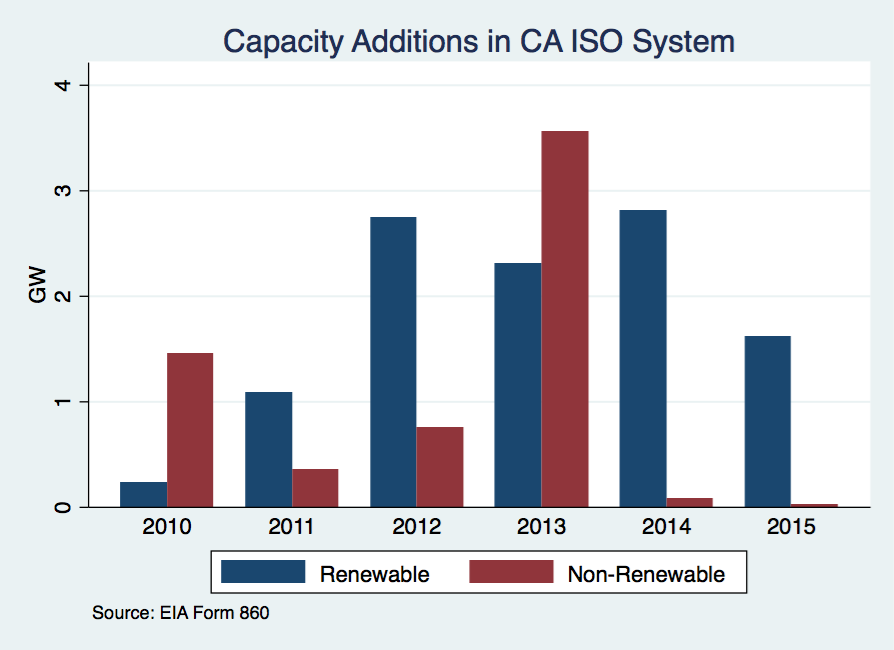
I’m thinking that California should mandate that all golf carts in the state be plugged in (charged) during peak production time. That should help balance things out.
I don’t get it. Doesn’t AZ have the same generating restrictions? What if it’s a low day there? How do they take the excess power better than CA can?
They shut off their own solar panels.
It’s a smaller portion of the total load. The reason California has such a big problem is #1 – they don’t has aggressive and RPS, and #2 – Rates are low, so there’s not as much economic incentive to put rooftop solar on your house. In California it takes 3 years to pay for itself. In AZ and NV, its closer to 10 or 15 because the power is so much cheaper (because….say it with me, there were fewer renewable standards required, so the utility was able to install ECONOMIC generation as load grew, not expensive renewable.)
I wonder what goes through the minds of green politicians when they ignore engineering advice about grid stability.
Do they think the engineers are shirking, too lazy to work out a solution? Or do they think the engineers are hidebound, too stuck in their ways to think outside the box?
Because this problem likely isn’t solvable.
Everyone knows that you ignore engineers because they are Republican.
Until regular people who pay the bills become angry and active such that the politician sees the benefit of cost cutting.
We have angry power consumers here in Australia now, esp in SA. And what do we get? Why an across the board ~20% rise in prices! That’s their solution to cheaper power costs and reliability.
That is part of their thinking, yes. Another part is they think that the problems will go away if the system was bigger. One region supplying renewable power at one time and another receiving and then swapping over when conditions change. There’s always somewhere sunny or windy. Right? Wrong. Wrong simply because you can’t have enough generating capacity in each location to supply that region, let alone half a dozen others that might want some because conditions aren’t good there. And then, what about if you have too much power? All that power sloshing from one grid to another is bound to do some damage and you get what happened in Australia.
They’re also pinning their hopes on batteries. Ignoring the almost continuous search for better batteries for over a century now. Progress has been steady but not meteoric, which is what is needed to solve the renewables problem. Most plans ignore the power it takes to create the batteries in the first place, let alone dispose/recycle them. Or maybe some of the lumpier parts of the US will generously flood itself to act as a giant pump storage system? I know that Switzerland and Noray have rejected that role for the EU.
Basicly they’re hoping that if they make the perpetual motion machine big enough, it will work.
Not to worry, it is absolutely solvable. Unstable systems inevitably converge to a stable state. Usually, that state is “off”. Sometimes accompanied by beautiful fireworks. If I lived in California, I’d be looking into a nice 10-20 kW natural gas-fired backup generator.
Where I live in Pennsylvania we have been putting “backup” generators for people that get a lot hours on them, strangely enough.
In PA you probably get a lot of weather-related interruptions. It’s not like it’s due to perfidious, planned public policy. [Wow, channeling Spiro Agnew now. :-D]
We been putting them in for general use, running separate wiring so their water pumps, freezers/refrigerators, computers and modems/routers and other electronics are not dependent on power company, especially Central Electric Cooperative which has ruinously high rates compared to WestPenn Power and others. Thanks to the Evil Marcellus Shale many people are getting separate gaslines run to their properties as part of their long term lease agreements, so NG fired generators are quite the rage. In certain circles. 😉
Rather than pay Arizona to take excess energy why not just dump it into a dummy load? Or better yet spin up some fly wheels or pump some water uphill and retrieve the energy later when there is no sun or wind.
“Oh baby there ain’t no mountain high enough,
Ain’t no valley low enough,
Ain’t no flywheel big enough
To keep ‘leccy getting to you babe”
With apologies to Marvin Gaye
Dummy load is not big or expensive.
The CA dummy load already exists! Hollywood.
Because energy storage systems are ‘kin expensive. Greens always say ‘oh, we will smooth out fluctuations with storage’, but never calculate what that will cost. Pumped storage is the cheapest, but it is ‘kin expensive, it triples the total power supply infrastructure, and you can be sure it will be flooding some rare habitat.
The UK did this with Dinorwig, as 2.5 mw pumped storage system. But the Greens decided it had to be built INSIDE a mountain (because it was in a nature reserve), so it was the most expensive power station in the history of man.
Ralph
“I wonder what goes through the minds of green politicians when they ignore engineering advice about grid stability.” ~ Eric Worrall June 26, 2017 at 5:46 pm
I don’t think politicians understand that reality and nature are not effected by their wishes and dreams. Once the politicians are in agreement via group-think that something would be wonderful — I don’t see how reality, much less a lowly engineer, could dissuade them from their mission.
You can not use logic to convince people who use only emotion to make decisions.
I think it is worse than that. They simply do not care. They blunder on ensuring their own positions and simply leave the running of the Universe up to God, or a blind clockmaker, whatever.
Only when they face an existential crisis like WWII/Cold war do people of competence get employed to build systems that work.
Politicians are not unable to see the truth, the simply do not care what it is. That is not what politics is about. Its about the acquisition and use of power in human terms. And for that all they need is the ability to spin dreams.
We will stagger on until the lights start to go out, and then they will blunder about some more till they hit on something that sorta works, and then they will forget the whole issue…
Wow. So it is possible to support the grid on renewables. Not all the time, now, but some of the time. Wow. So so much of the BS here at whatsup might be wrong. Who would think.
Of course its possible. Given unlimited money anything is possible.
>>Of course its possible. Given unlimited money anything is possible.
I would disagree with even that. It is NOT possible to generate wind and solar power, at night when there is no wind. And nobody has come up with a storage system that is economic and works.
R
Given unlimited money, one could conceivably build a coupled solar – pumped storage system which could pump 10^16 acre-feet of water to an altitude of 30,000 feet to use as nighttime/calm cloudy backup, but it would cost the GDP of the world for the next thousand years to build and who knows how much to maintain!
In other news, science fiction is one of my favorite literary forms.
“support the grid…..not all the time now” great example of the magical thinking that gets trotted out. Not like a grid in a first world country needs to run 24×7.
Wow! So it is a certainty that the grid won’t be supported by intermittent renewables, when you need them most. Wow! And other times, intermittent renewables provide too much marginal power and you have to pay other states to save you from your intermittent renewables stupidity! A ReallySkeptical person would recognize that for the economic folly it is. You would think…..
RS, I was an electric power system engineer. I assure you wind and solar cannot physically “support the grid.” You sound like the B.S.-er at WUWT.
No, it is not possible to support the grid on renewables – unless we mean hydro or burning wood. or electricity at $1 per kwh.
ReallySkeptical: Until we reach “all of the time” rather than a day or two, it doesn’t count. A day or two means little to nothing in the overall scheme of things. When energy from weather supplies all the electricity and no more evil fossil fuels are needed, THEN and only then, can a claim be made that these work. Since we do not control weather (only climate, it’s claimed) that’s going to be some feat.
Sheri – of COURSE we can fix things so that renewables work! All you have to do is remove the majority of the power-using population! (And there seem to be some ‘progressives’ that would like to do exactly that!)
Do I have to add /sarc ?
Good point! I guess I should have noted we needed the power “all the time” and at the same level or greater than we have now. 🙂
California should go with renewables and take non-essentials, like the entertainment industry, offline when the wind isn’t blowing/sun isn’t shining. I’m sure Hollywood progressives would be happy to do their part in saving the planet.
When we perfect batteries and storage, we can all use lightening to power our homes. I just got an emailing inviting me to participate in this free energy of the future. Can’t wait to check it out!
It sounds fine to me. It will help other states reduce greenhouse gas emissions.
It might if wind and solar actually reduced greenhouse emissions.
Why do they dump the extra power at loss rather than just open circuit the excess solar collectors?
I’m guessing the connection between the residential solar systems and the grid, stupidly, doesn’t allow the power feed to be slowed.
I think it is OK for Californians to turn out there lights at night. It’s their choice.
Their not there.
* They’re not there
(sorry, couldn’t resist, I know what you meant 🙂
Really? If they have excess electricity why are they spending millions of dollars BUYING electricity from the neighboring states? Some f*cking body is lying here.
2hotel9==>because they have electricity at the wrong time, and there is no practical way to store it. Having excess power at 1 PM does no good at 8 PM.
OK, so who is the moron that screwed up their electric generation system? They did not have these problems before all this renewable horsesh*t was forced on people. Time for the guilty parties to be dragged out and punished, then rip down all this renewable crap and rebuild hydro, coal and nuclear electric generation.
Fittingly enough, the troubles started during Jerry “brownout’s” first iteration, 2hotel9. We told the CA PUC and Energy Commission in the late 1970’s that they were on a path to electric energy system collapse in 1999. Davis hid it for one year, then every thing collapsed in 2000.
I have no firm date for the 2nd CA collapse, but it is surely coming.
So, we have extensive and accurate lists of the guilty, time to start prosecution and incarceration. Drop their asses in general population of the worst and most violent prisons in California and walk away.
Sigh. This logic is why politicians are idiots. It’s not a constant stream. Some hours California has too much, some it has too little. IT relies on the market signals to help the supply equal the demand. Demand is dynamic. People think that google and apple and all the other little cities in the world that are 100% renewable use no fossil. Nope. They simply total how many MWHs they use annually (like miles on your car) and they make sure that at some point they bought the same MWH annually from a solar plant or a wind farm. The electrons they used are not necessarily (And highly unlikely) related to the output of the plant in real time.
Yes, sigh, politicians created this nightmare and it is high time they were punished for their willful malfeasance.
Because CA power is so much more costly than in the surrounding states, 2h9.
Yep, and that is not a technical or engineering issue, it is purely political. Time for those responsible to be sitting in prisons getting banged by their cellmates on an hourly basis.
What happened to the “Smart Grid” ?
It got run over by “Dumb Politicians”; but I repeat myself.