Guest Post by Willis Eschenbach
In my peripatetic meandering through the CERES satellite data, I’ve been looking at the correlation between the temperatures in the NINO3.4 region and the temperatures of the rest of the planet.
The NINO3.4 region is an area in the equatorial eastern Pacific Ocean. It covers five degrees north and south of the Equator, from 170° West to 120° West. Temperatures in that area are used to measure the strength of the El Nino / La Nina phenomenon.
Now, people often discuss procedures like “removing the effects of the El Nino from the global temperature record”. What they mean is that they have noted the similarity between the temperature of the NINO3.4 region and the global temperature. Figure 1 shows that relationship as seen in the CERES data.

Figure 1. Surface temperature of the globe (blue) and of the central Pacific ENSO3.4 area (red). Note the large “El Nino” event at the end of 2015. Both datasets are normalized (set to a mean of zero and a standard deviation of one).
Seeing this relationship, people have “removed” the NINO3.4 temperature variations from the temperature record. They have done this by subtracting out, in one form or another, the variations that are “caused” by the El Nino swings. However, I have disagreed numerous times with this procedure. Let me propose a more encompassing way to understand the relationship shown in Figure 1.
This is to note that although there are areas of the surface which show a good positive correlation to global temperatures, there are also areas that show a good negative correlation to global temperatures. Figure 2 shows this relationship on a gridcell by gridcell basis. It displays how well the temperatures in each gridcell agree or disagree with the global average temperature variations shown in Figure 1.

Figure 2. Correlation of each gridcell with the global average temperature. Note the large areas of negative correlation (green and blue)
Looking at that, I ask you to reconsider the idea that we can simply subtract out the temperature variations in the NINO3.4 area (blue box) from the global temperature … clearly, the relationships are far from simple. Is the fact that certain areas correlate well with the global variations a sufficient reason to “remove” them from the temperature record?
And if so, why limit ourselves to the ENSO3.4 area of the Pacific? Why not use a much larger area of the Pacific and “remove” half of the Pacific from the temperature record?
Setting those questions aside, the overall pattern in the Pacific is clearly related to the heat which is moved by the El Nino / La Nina pump. These two phenomena act together to pump warm Equatorial water across the Pacific in a westward direction. Once this warm surface water hits the Asian mainland/islands it splits and moves toward the two poles.
Now, many people say that this shows that the El Nino / La Nina is causing the global temperature changes. I say that the causation is going the other way. When the earth warms and excess heat accumulates in the eastern tropical Pacific, it triggers a cycle of the El Nino / La Nina pump. This pump moves warm water to the poles, where it is lost to space. Overall this cools the planet. The results of this pumping action can be seen in Figure 2 as the green areas in the western Pacific heading towards the north and south polar regions.
In other words, the El Nino doesn’t control the temperature—the temperature controls the El Nino.
We can look at this from another perspective. Rather than comparing gridcells to the average global surface temperature as in Figure 2, we can compare gridcells to the average NINO3.4 area temperature. Figure 3 shows that result.
 Figure 3. As in Figure 2, but comparing ENSO3.4 area temperatures with gridcell temperatures. Note different color scale than that used in Figure 2.
Again, a most interesting result. It makes the El Nino pattern even clearer. Note that both the Western Pacific and the North Atlantic move in opposition to the NINO3.4 area.
The source of the pattern seen in Figure 3 is clear. It is driven by the El Nino / La Nina pump. When enough heat has accumulated in the eastern Pacific, the El Nino / La Nina pump pushes warm water first westward, then poleward. This cools the eastern Pacific and warms the western Pacific. In the South Pacific, you can see how it goes around Cape Horn at the south end of South America.
The oddity from my perspective is the North Atlantic. It moves in opposition to the NINO3.4 area, but the physical nature of the connection (or teleconnection) between the two is not clear to me.
In any case, I wanted to look at how temperatures in the areas in blue changed with respect to changes in the NINO3.4 temperatures. I restricted the analysis to the areas with a correlation more negative than – 0.3. Those areas are outlined in Figure 4 below. It is the same as Figure 3, but with the most negative areas outlined by the gray contour lines.

Figure 4. As in Figure 3, but with the gray contour line at a correlation of – 0.3.
Note that the North Atlantic is included among the areas with a strong negative correlation to the NINO3.4 area. To see the difference between the positively and negatively correlated areas shown in Figure 4, I graphed them up in Figure 5.

Figure 5. This shows the two areas outlined in Figure 4 above. The red line shows the average of the NINO3.4 area, shown as a rectangle in Figure 4. The blue line shows the average of the areas shown in blue and outlined with a gray contour line.
Dang … I certainly didn’t expect that nearly perfect mirror-image. When the NINO3.4 area warms up the North Atlantic and the other areas cool down, and vice versa.
So this highlights the problem. Given that we have an alternating phenomenon wherein the North Atlantic cools down when the Eastern Pacific warms up, and vice versa … just exactly how should we “remove” this phenomenon from the global record?
And more to the point, why should we remove it? The El Nino / La Nina pump is a central part of the natural thermoregulatory mechanisms that keep the temperatures within a very narrow range (e.g. ± 0.3°C during the 20th Century). The Nino pump kicks into gear whenever excess heat accumulates in the equatorial Pacific waters and moves that warm water to the poles.
As such, “removing” the El Nino / La Nina / North Atlantic signal from the global signal is cutting out a vital emergent climate heat-removing mechanism … I don’t even have a name for what remains once that radical surgery is performed.
=================
Here, I’m putting the finish touches on this post and getting some needed hydration before going back to my current fun … driving a 1.5 tonne excavator, leveling an area on our tilted patch of dirt in order to make a level patio garden … big boys do love our big toys.

A summer’s day, an excavator, and red-tailed hawks circling in the distance … what’s not to like?
Best to all,
w.
PS: If you comment please QUOTE THE EXACT WORDS THAT YOU ARE DISCUSSING, so we can all be clear about your subject.
Just a thought. Is it possible that the thermal expansion in the Pacific drives water North into the Arctic ocean and pushes cold Arctic water out into the Atlantic . I immediately see problems with the idea but I’ll throw it out there anyway.
This pattern is certainly driving warm surface air, and likely warmer surface waters into the Arctic from the Bering Sea region. ..https://earth.nullschool.net/#current/wind/surface/level/overlay=temp/orthographic=110.92,83.39,819
https://youtu.be/S3D69cIMOx4
As it happens i animated a years worth of nullschool ssta aug 14 to october 15.
Primarily i was interested in the cooling NA at the time but the perspective captures the building El Nino at the time.
As has happened every year since (though last year was a weaker effect), my opinion is the labrador current gains additional energy april/may which overpowers the Gulf Stream.
Its usual track should be to flow south west down the US coast….a south east component i belive flows under the north east bound GS/North Atlantic drift.
This results in a dissection of the usual NE flow of warm water.
33% or more of all the fresh water that flows into the arctic circle emits from the Hudson Bay. I have tried to find runoff volumns of rivers that supply this but drawn blanks.
Due the time of year that this overpowering effect occurs, i feel icemelt can be discounted as the greatest melting occurs later yet by june july, the maximum cooling appears to be met.
Snowmelt into Hudson Bay would be very seasonal,probably peaking in June.
Yes, but i imagine the lab current would be fed by some arctic ice and that small bit of ice to its east called Greenland…..
The cooling of NA is also seasonal as i observed the last 3 years.
Not sure how much data there is though? Osnap is too new….Rapid array, too far south…
At the Earth Nullschool website there is a small word located at the bottom of the settings:
Click it and one is taken to a page that has this explanation, and warning.
Earth Nullschool is a magnificent tool; but not all of nullschool is actual data.
Their SST is calculated from the daily average (1981-2011) and updated, daily; using data from the “Marine Modeling and Analysis Branch“.
Which has this current note:
Defining a change in source data March 14th, 2017. Only the data source may have changed November 1, 2016.
Following the trail, one comes to another list of data sources and problems, finally one comes to a page with this tidbit:
The Real Time Global RTG-SST-HR description includes this:
Where model ends and actual observations enter are very unclear.
Your animation is of Earth nullschool presentation, not necessarily that of actual Earth SST.
As various NOAA/NASA products get better at collecting real time information and allowing user’s download of same, then Earth nullschool’s truly impressive display will increase in accuracy.
Right now, Earth Nullschool is hobbled by the data they have access to and the frequency it is updated. SST data is modeled first, then possibly updated later; with a frequency of once per day.
Exept i use the ssta not sst?
Plus bear in mind the animation was primarily a retrospective one, i guess i took most of the images off the site starting august 2015. Almost a years worth of images were copied well after the date they represent.
Thermal expansion is much too small to make these movements happen. The IPCC likes to pretend that ocean temperature changes occur from the surface to the bottom, but, in fact, there are ocean layers and surface temperature changes only cover the first ~100-200 m of the surface waters.
higley7 search this site for “ocean upwelling”. Numerous articles on deep ocean upwelling contradict that assessment.
I calculated expansion of the ocean top 100m 1F would expand about 8″. But it would actually be only need to be about .3F for the 300m thermocline.
the El Nino / La Nina pump pushes warm water first westward, then poleward
Try as I may, I don’t see any red flow towards the poles near the Asian mainland. I see green and blue. What am I missing?
The Kuroshio Current.
The warm Kuroshio runs into the cold, counterclockwise Oyashio Current from the Arctic Ocean off Hokkaido, where the Kuroshio turns east to form the North Pacific Drift, which heads south off North America as the cold California Current.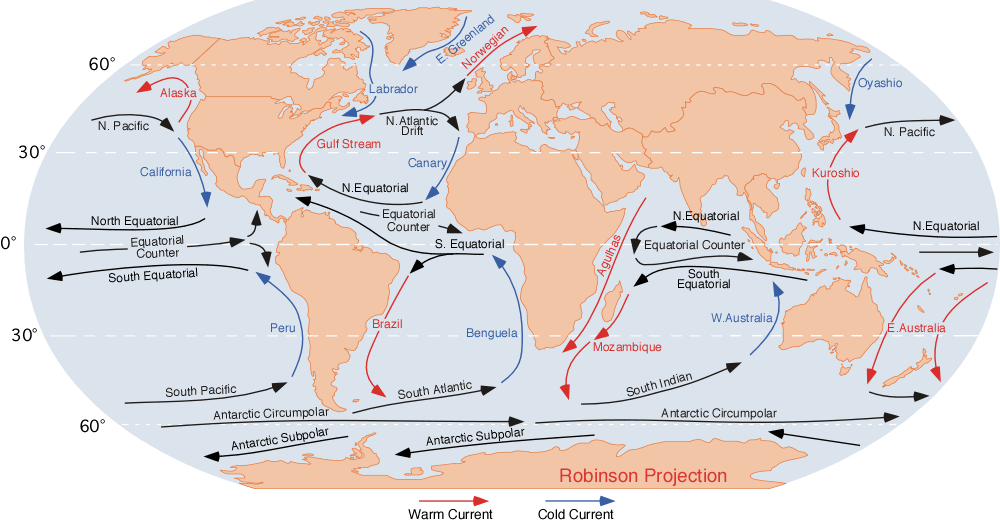
Much the opposite happens on the other side of the Pacific, where the (relatively) warm, counterclockwise Alaska Current flows north along BC, then west in the Gulf of Alaska. It can slop into the Bering Sea, bringing famously horrible WX to the Aleutian Islands.
Here is my problem:
If the Kuroshio Current is what brings the warm ENSO water towards to pole [and similar in the SH] then one would expect its temperature to be positively correlated with the equatorial ENSO temps, but Fig. 2 and 3 show the temperature to be negatively correlated, i.e the warmer ENSO is, the colder Kuroshio is.
The Kuroshio, like the Gulf Stream, is a Western Boundary Current.
lsvalgaard June 24, 2017 at 12:35 pm
The more heat blown off in an El Nino, the less there is available to be carried northward by the Kuroshio.
Also, in La Nina years, the heat stays in the WestPac instead of moving eastward, thanks to the strong winds from the east, leaving more warmth available to feed the Kuroshio.
Besides the great loss of heat to the atmosphere over the West Pacific warm pool, there is considerable transit time for parcels of water from the Nino3.4 area to reach the Kuroshio off the coast of Japan. Willis’ graph shows only the correlation for zero-lag, thus displaying the negatively-correlated phases of the hemispheric circulation subject to ENSO oscillations.
I agree with Dr. Svalgaard’s confusion here, the negative correlation means that the water is relatively cooler during El Nino and warmer during La Nina. I just assume Willis was describing where the heat went during the waning of El Nino.
I don’t like the pump analogy or describing the entire ENSO process in a way that ascribes it to any one phenomenon during a single phase. ENSO is a continuous complex oscillating system. Just one such process on the entire global climate oscillating system.
http://www.nonlin-processes-geophys.net/17/431/2010/npg-17-431-2010.pdf
That paper is a must read.
I find the correlation with the Amazon and a lesser extent the Congo to be interesting. This probably stresses the importance of clouds in this relationship. Doing this analysis with MSLP (mean sea level pressure) rather than temperature could be extremely insightful.
http://shadow.eas.gatech.edu/~kcobb/seminar/reason00.pdf
Robert,
Regrettably, GCMs don’t do clouds.
Robert Turner:
The confusion here patently arises from the mistaken premise that, in hemispheric gyres that take many months to complete a circuit, monthly temperatures anomalies throughout the circulation should should be uniformly positively correlated (i.e., in phase) with those in the Nino3.4 region.
Such a phase relationship would require the circuit transit time to be shorter than a month. Because of the greatly longer transit time, there are parcels of water from the previous cooler phase in the Nino3.4 region that show up well downstream of that region in the snapshot view presented in the figures here. There is no need to resort to anything more sophisticated than the material (Stokes) derivative of temperature anomalies to clear up this confusion.
Such a phase relationship would require the circuit transit time to be shorter than a month.
I stuffed up my post but in essence it was that the similar period in anti-phase relationship may be better explained by completely different approach or it may be coincidence and unremarkable. The two vast water bodies (Pacific and Atlantic) do not appear to be significantly connected directly. But I suggest people are looking in the wrong place for the wrong connection. If you consider them as separate systems there is another connection. Both are heated by the same sun, they have different patterns in time in cloud formation that effects the distribution of insolation at the water surface, and the currents generated in each are constricted differently by their underlying and surrounding land. These differences may not actually be significant determinants of the period of the observed circulations. They are each dynamic systems with a natural frequency in one or more modes of oscillation under the same driver, the sun. It is quite possible that a natural frequency of one equals one of the other. The small constricted direct connection of the water bodies, if not enough to force the oscillations in the other may still be enough to influence the phase of the oscillations such that at least for a substantial period of time they are anti-phase as observed. Such a result would not be a surprise to an engineer dealing with vibrating systems that are tenuously connected.
BTW, no matter the inverse zero-lag correlation with the Nino3.4 region, the Kuroshio nevertheless is quite consistently warmer than the waters surrounding it off Japan.
Here is an example of why I think that solar variability is more likely the control knob on climate than CO2, if there even be such a thing. ?w=625&h=413
From Solar Cycle 22 to 24, sunspot area fell by a factor of two. Still a small part of the sun’s surface, but the climate system amplifies solar effects. As does time. Eleven years of fewer photons of all energies striking earth adds up.
The most energetic photons fluctuate the most, ie those which make and break ozone and penetrate farthest into the oceanic depths.
but the climate system amplifies solar effects
This is a baseless assertion unless you can tell us how that might work.
Reams of research show not only how it might work, but how it does.
Amplification of insolation by feedbacks is how ice ages work.
https://experts.umich.edu/en/publications/amplification-of-obliquity-forcing-through-mean-annual-and-season
Amplification of insolation by feedbacks is how ice ages work.
Your link says:
“(1) Local reductions in air temperature enhance precipitation as snowfall. (2) An intensification of the winter meridional insolation gradient strengthens zonal circulation (e.g. the Aleutian low), promoting greater vapor transport from ocean to land and snow precipitation. (3) An increase in the summer meridional insolation gradient enhances summer eddy activity, increasing vapor transport to high-latitude regions.”
So you claim that this is the explanation for global warming due to the sun.
I claim what I plainly said I claim, which is that the climate system on earth can and does amplify tiny variations in insolation with important climatic effects, indeed in solar activity in general, not necessarily just with reference to incident radiation at the surface.
You still have not specified a viable physical mechanism for you claim, which then is still just an assertion.
But I have. And it’s not a controversial statement.
The climate system of Earth does obviously amplify slight changes in solar activity.
Insolation is solar energy arriving at the surface. Axial tilt and other orbital and rotational mechanics affect insolation, even assuming constant solar radiation and magnetic effects, which is not in fact the case. Albedo is a positive climatic feedback effect. I don’t see how you can d@ny the fact that phenomena on Earth affect the impact of solar activity on climate.
The sun is a variable star, but in most wavelengths, not much. But the effect of the slight variability in TSI yields huge changes, as is evident in the geological record.
But the effect of the slight variability in TSI yields huge changes, as is evident in the geological record.
You have to be clear about what TSI is. There is a difference between what the Sun intrinsically puts out [TSI] and what actually falls upon the Earth in different regions [insolation]. There are no indications in the geological record of any changes in TSI.
“What am I missing?”
The NE Pacific ‘Warm Blob’.
lsvalgaard “What am I missing?”
Phase relationships.
Nino34 has positive anomaly when the warm water built up in west Pacific warm pool flows east. This puts the WPWP in negative anomaly though it is still the hottest water on the planet.
What Willis has plotted in CORRELATION not hot water.
The major, Coriolis driven, ocean gyres drive the warm equatorial waters polewards, “the El Nino / La Nina pump” modulates that flow via wind driven surface currents.Coriolis forces are a key part of that too.
The maps show correlation not temperature. So when hot NINO3-4 occurs the last pulse of heat heading towards the poles is exhausted, ie, inversely correlated with the new hot pulse building in NINO3-4.
The maps show correlation not temperature
correlation with temperature. If positive, it means that the flow is warmer, if negative, the flow is colder.
Correlation is correlation, not “correlation with warmer”. So if Nino34 is cooler red would mean cooler. You seem to have trouble understanding what correlation is. Or you just goofed and will now spend three days arguing the toss instead of admitting your mistake. As usual.
La Nina is at stronger version of the normal SST pattern. Warm water in the western Pacific fed into higher latitudes by western boundary currents. La Nina is cool over Nino 3.4 region versus warm West. = -ve correlation. Nino reverses this.
Majority of time western boundary currents transfer ocean heat to higher latitudes, but in Ninos the heat gets trapped at the tropics causing anomalous warming.
Willis’s graphic is consistent with this and I am not sure why you are confused?
Leif, during an El Nino, the North (and South) Equatorial Currents in the Pacific slow and can reverse direction, basically starving the Kuroshio Current of its normal amount of warm water. During the trailing La Nina, the leftover warm water from the El Nino (its residuals) are returned to the West Pacific Warm Pool and carried north to the Kuroshio Current. Thus the surface temperatures of the Kuroshio Current are negatively correlated with NINO3.4 temperatures.
Hope all is well with you. Cheers.
Willis, the negative correlation between the North Atlantic and NINO3.4 temperature anomalies looks odd. What coordinates are you using for the North Atlantic? (0-70N, 80W-0 ??) Or are you using a small portion?
Cheers
Yes, ENSO is not a pump. The trade winds are pushing warmed surface water east to west all the time, and Ninos are substantially failures of the trades. The trade winds are the pump.
And the tradewinds are just a result of the dominant average mean sea level pressure.
Yes. We have a surface pressure index for south of the equator. Methinks we could use one for north of the equator too.
NH trade winds strengthen during the winter and the warm phase of the Arctic oscillation (in sea-level pressure).
The diagnosis of the ultimate driver is always complicated when there is a circular chain of reactions in a system. While the slackening of trade winds indeed precedes the onset of El Ninos, the Southern Oscillation of surface pressure (the SO part of ENSO), which drives the trade winds, is itself seemingly driven by SSTs off Darwin and Tahiti. The disentanglement of all these factors requires far more penetrating dynamical analyses than any of those attempted here.
Sky,
And as I noted, the strength of trade winds in the NH seems to be associated with the phase of the Arctic Oscillation. The cause and effect situation in ENSO is so complicated that it might well have a simpler solution.
Gabro,
That “simpler solution” is far from apparent and has escaped dynamical oceanographers for well nigh a century. Mere phenomenological “association” is not enough!
Indeed. Nullschool can help.
I try to check this every day. This is not the Pacific, but it was handy, and it shows MSLP vs Surface Temperature (not anomaly). It illustrates what I see in the Pacific which is that the correlation between surface temperature and surface pressure is much better over land than ocean.
Furthermore, even the correlation over land seems limited to the tropics. Subtropical surface pressure certainly plays a role in the trade winds.
Bottom line: even the correlation between Darwin/Tahiti pressure and sst is not convincing.
I should have speculated as to what the simpler cause might be, so as to sound less phenomenological.
As our data have improved, at least in quantity if not quality, over the past century, it has IMO become apparent that insolation is the predominant driver, in so far as there is one, of climate change on the time scales under consideration here.
There is a simpler solution(well), a collection of simple physical response to the local environment, collectively have the operation of a heat driven water pump in a global temperature averaging system. It also operates on a daily, and annual or longer time scales.
There are vast quantities of solar and rotational energy applied at the equator, and that to normalize with the poles where there is little of each of those.
P.S.- Glad to hear you have summer for your garden. Here in Western Canada I’ve had the heat on the last two nights when we would expect lows in the 50’s and daytime highs in the 80’s.
I have noticed the cooling across most of Canada in recent months. If that holds in place through the entire summer, then I would imagine that this next winter could arrive early across Canada. …https://earth.nullschool.net/#current/wind/surface/level/overlay=temp/orthographic=-87.83,53.14,819/loc=-97.801,49.509
Now that was interesting! A huge gyre about 3000 miles across covering the Eastern 2/3 of NA! Separately, I have been saying that this year’s weather reminds me of the 70’s as we have had wind like was common when I was younger and has been much reduced since the 80’s.
I recall the 1950s/60s/early70s as being similar to now. The smell of the air matches old memories as it brings the old memories forth. I would even hazard that there is likely a change in the incoming solar spectrum(?). I have been out getting lately spending several hours doing things outside. Temps have been in the low 100s, and for some reason do not feel as (hot) as similar or even slightly lower temps in past years, 2015 and prior.
60’s were much colder winters and hotter summers. I think humidity was an important factor in those differences.
When looking at historic temp data for my area I have noticed that record highs and record lows sometimes fall in the same year. Most of the record lows are from the 1950s/60s.
goldminor this may be down to personal misperceptions but i can remember going hours with no clothing on my top half in summer during the early 80’s on the east coast of scotland and not picking up much of a tan. come the late nineties and later i felt the sun actually felt different and sunburn occurred more readily.
of course this is something that may be due to aging skin,no doubt someone on here will know . i have also noticed an increase in the strength of the wind with a significant change in direction for the time of year over here . the last two years we have had more easterly winds into summer than we have seen for a long time.
the old lobster fishermen used to say wait until the end of may when the last easterly wind has passed for the summer before putting the pots out. that changed just past the mid 90’s when the early summer winds appeared more benign and more often from the west. the mackerel have also arrived later this year and last ,whereas in the same period mentioned in the 90’s they began arriving up to a month earlier than we would expect in the 80’s (i lived in iran as a kid in the 70’s so have no personal knowledge of that period where i live now).
1969’s summer, July and August was unusually cool in Pennsylvania with frequent cloudy skies.
Yes, there were the normal runs of hot humid weather; but there were long stretches of overcast days with lower temps.
Teaching swimming and lifeguard duties that summer included a lot of darn cold days. Getting a class of kids to enter the water when half of them are shivering is hard. Telling the kids the water is warmer than the air only works once.
So far June reminds me greatly of that summer. July and August will soon be upon us.
40+ years of global warming and nothing to show for it!
Very nice Willis; and your last post too.
I agree with your reasons for not removing Nino3.4, and ‘the El Nino doesn’t control the temperature—the temperature controls the El Nino.’
My work on F10.7cm & TSI ties in with ‘why the temperature goes up’ to cause an ENSO.
Much of the excess equatorial heat is evaporated off. Another tie-in…
Will there be a video of you excavating?
Bob Weber June 24, 2017, at 11:55 am
Naw … it would be too embarrassing.
w.
Not if you scraped the Mattel sticker off and painted it Cat yellow.
“I don’t even have a name for what remains once that radical surgery is performed.”
Lobotomy?
Even in my early years of following the AGW story line it never made sense why a scientist would think that removing the ENSO signal from the global temp record would be of benefit in understanding the climate system. It is too large a driver of weather patterns and climate in the longer term. They may as well have tried removing the effects of the Sun on the Earth.
My work on F10.7cm & TSI ties in with ‘why the temperature goes up’ to cause an ENSO.
They have nothing to do with ENSO.
In the classic sense of the word Leif: you’re ignorant of the relationship.
it is easy to be ignorant of a non-existing relationship.
“a non-existing relationship”?
You mean like your non-existing reasons to doubt the effect of high solar activity?
You’re going to find out otherwise. ENSOs occur under specific solar conditions.
You and everyone else is going to understand and know it as I do.
There’s so much to talk about but again you’re not a constructive workshop participant today.
Willis’ work directly ties in to parts of my work. You don’t have to like it Leif.
You mean like your non-existing reasons to doubt the effect of high solar activity?
Something that doesn’t exist does not need reasons for not doing so.
Willis’ work directly ties in to parts of my work
“ties in” is very vague. In what way does Willis’s work tie in? Perhaps that ENSO is causing TSI and F10.7?
Willis,
I’d like to suggest that you create a scatterplot of the global temperatures and the Nino3.4 temperatures. Do a linear regression and note the r^2 value, which tells us how much of the variance in the y-axis variable is explained or predicted by the x-axis variable. Do the same for your Figure 5 raw data. It is better than eyeballing the apparent correlation. If you can’t assign numbers to a problem then it is little better than hand waving.
I don’t see any vultures in your future-garden picture. Have they forsaken you?
Clyde Spencer June 24, 2017 at 12:13 pm
Call:
lm(formula = tempmon ~ nino34rem)
Residuals:
     Min       1Q   Median       3Q      Max
-0.34856 -0.08227  0.02547  0.09463  0.42749
Coefficients:
              Estimate Std. Error t value Pr(>|t|)
(Intercept) -2.308e-17  1.021e-02    0.00        1
nino34rem    1.190e-01  1.175e-02   10.12   <2e-16 ***
---
Signif. codes:  0 ‘***’ 0.001 ‘**’ 0.01 ‘*’ 0.05 ‘.’ 0.1 ‘ ’ 1
Residual standard error: 0.1415 on 190 degrees of freedom
Multiple R-squared:  0.3504,	Adjusted R-squared:  0.347
F-statistic: 102.5 on 1 and 190 DF,  p-value: < 2.2e-16
.
Willis,
So, it looks like you are telling me that only about 35% of the variance in one variable can be explained by the other variable. That isn’t what I would call a high correlation.
Well , with significant parts of the globe in anti-phase with the Nino34 region the correlation with the global average is not going to be that high. I think that the point Willis was making.
The whole problem here is the unscientific paradigm that mainstream climatology is based on: they “know” that any long term change is due to AGW and they are now trying to explain the wiggles.
This defective, a priori, assumption is why they never get anywhere.
Leif, Bob: I get a lot out of these exchanges except when the ad hominem are flying. Keep it civil, dudes because it is important debate. Cheers, and thanks Anthony, Willie, and all the rest.
Who is Willie?
You rang?
I am not Willis! Or Spartacus.
Leif, Bob: I get a lot out of these exchanges except when the ad hominem are flying. Keep it civil, dudes because it is important debate. Cheers, and thanks Anthony, Willie, and all the rest.
Let us hope that Bob takes that to heart.
Please stop projecting. I’m trying to be constructive, are you? As long as you keep interfering with my message no one is going to learn the truth about how the sun warms and cools.
Please take that to heart.
Ah well, you didn’t.
Well worth repeating
As I have understood this oscillation, the heated water moves slowly Eastward before being drawn Northward by currents toward the Arctic. The North Atlantic cool spot seems to appear concurrently or rather without any time lag if I understand correctly.
in addition i wonder if the warm pool of water in the eastern pacific drives the weather that creates increased cloud/storm levels in the north east atlantic that contribute to surface cooling ? i am hopeless at archiving the various snippets i come across around the web,but i remember noting a series of very low pressure storms in that area of the atlantic in recent years.
i also like the post by acid ohm .in addition or alternatively to the above in periods dominated by el nino this mechanism could be part of what drives the wax and wane of arctic sea ice and the approximate residence time of 30 years of the top 1500m of water in the arctic ocean. that in turn i suspect could drive the amo. if this all sounds nonsense feel free to let me know. my imagination knows little bounds, unfortunately more often than not it is not backed up with enough of the smarts :).
Troubleshooting a misbehaving feedback control system is miserable. The only way to deal with it is to break the feedback loop and deal with each of the blocks in terms of its own expected behaviour. Otherwise, you literally, and mathematically, can’t tell where in the system the problem is. Problems in all parts of the system can produce a problem with the same symptoms.
The climate is about a zillion times as complex as any control system I can think of. There is no way to isolate variables. Everything affects everything else.
I fully agree with Willis.
Some/most folks are treating the climate as a system of resultant behaviours. It is a system of emergent behaviours.
We don’t have tools to deal with emergent behaviours whereas we have wonderful tools to deal with nice well-behaved linear systems. It is those tools that are applied to the problem. It’s like the drunk looking for his keys under the streetlight. It’s not where he lost his keys but it is where the light is.
Or there is another “thing” causing both the effect in the North Atlantic and El Nino.
Aye! There’s the rub! Is it one thing, ( or set of things)? Or is it two separate things with two separate causes? That’s why I offered up Pacific thermal expansion. Whatever it is, it’s worse than we thought!
Running underneath the North American continent, there’s a large underground conduit between the Pacific and North Atlantic!
That is a more logical interpretation IMO. Willis’ figure 5 does not seem to support the idea that the Atlantic variation is a phase delayed consequence of ENSO.
Willis could probably establish this fairly easily but from that figure it seems pretty obvious that you would not get a stronger magnitude ( positive ) correlation by lagging NINO34 than he has shown with zero lag.
That suggests that there is a common driver rather than one being the result of the other.
Exactly right. The climate system is driven by spatio-temporal chaos as it strives to achieve MEP. I expect all celestial bodies do exactly the same.
I’m experiencing a ‘misbehaving feedback control system’ as a develop my own nonlinear flight model extended from the NASA F-16 subsonic model. Everything affects everything else and it is very hard to debug. I feel your pain with the climate system.
What is interesting with a nonlinear flight model those those aircraft without static stability, if you perturb the steady state flight and don’t put any correcting inputs you can end up in any state. The system is deterministic yet chaotic, it is impossible to predict in the future the state the system will be in – and that is neglecting turbulence. No wonder the weather modellers have such a hard time, and the climate modellers don’t even approximate reality to within a whopping factor of 3.
Robert Turner in an earlier comment referenced a paper http://www.nonlin-processes-geophys.net/17/431/2010/npg-17-431-2010.pdf and called it a must read. This might be the mathematics required to deal with non linear climate and emergent phenomena.
The paper deals with stochastic resonance. It is a mathematical method of dealing with a complex system with feedbacks where a small periodic forcing combined with noise can result in oscillation between two different states. This method has been applied in multiple disciplines from amplifier design to neurophysiological systems. The paper deals with applying the method to climate.
The paper deals with an energy balance model with two feedbacks, albedo and infrared emissions dependent upon temperature. The Milankovitch cycles provide the periodic forcing that is not large enough to cause the state transitions that are observed ie a 10C difference in temperature between the two states with a 100,000 year period for the last 2 million years. The weather is treated as noise which when combined with the small periodic forcing can result in abrupt state changes.
“it is important to remark that abrupt climate changes, such as those observed during the Milankovitch cycle or over the last 100,000 years are hard to explain without the idea of transition between multiple equilibria triggered by noise, which is the basic feature of stochastic resonance”.
“it is not trivial that adding noise to a system we can enhance the deterministic periodic behavior.”
Wow, dynamics. Somehow I doubt that is grant worthy as the potential to upset decades of dogma is clear..
Tiny typo in the comments below figures 2, 3, 4: ‘rectange’ in each case.
More than 97% sure this means ‘rectangle’.
Indeed, 100% sure.
Don’t worry – I certainly do typos [by mistake] too.
Auto, hoping for more rain in South London.
Dived across to France, to further empty the European Wine Lake, today – it was grey, cool, say 19C, and light showers. Ideal for me.
“I say that the causation is going the other way. When the earth warms and excess heat accumulates in the eastern tropical Pacific, it triggers a cycle of the El Nino / La Nina pump.”
When Earth is warmer there are less frequent and weaker El Nino episodes.
http://www.co2science.org/subject/e/summaries/ensogw.php
“The oddity from my perspective is the North Atlantic. It moves in opposition to the NINO3.4 area, but the physical nature of the connection (or teleconnection) between the two is not clear to me.”
El Nino episodes drive some of the largest warm anomalies to the North Atlantic, with a lag, look through e.g. 1998, 2010, and 2016:
https://www.esrl.noaa.gov/psd/data/correlation/amon.us.data
Note that there is no apparent time lag between the 2 areas. What mechanism can operate so quickly over these large distances and (preferably) take very little energy to act?
The candidate that immediately comes to my mind is cloud cover. It easily has the capability to change W per sq m rapidly, it takes very little energy to start and maintain different areas of cloud cover.
Why, though, would cloud changes select these 2 regions? First, they are both over sea not land, so many concepts like land use are out. To me with no data to support this proposition, a possible answer is changes in oceanic biota moderated perhaps by nutrient availability. There are several paths that could be proposed for testing, one involving cold Arctic water moving south to the N Atlantic and slowing biotic growth with the opposite happening equatorially influenced by wind strength. Assumes a reasonable link between growth rate and T. I have no references relating biotic activity to cloud cover. Indeed, reverse causality might be the case for much of this scheme.
But if as Willis postulates for reverse causation, high temperatures initiate his process, one has to explain why the temperatures become high, where when and why. Clouds again?
Geoff
possibly not slowing but creating cooler conditions that favour different species ? levels of calanus finmarchicus in the north east atlantic appear to be directly tied to the north atlantic oscillation. these are one of the very important species for recruitment of the gadoid species in the north east atlantic. recent years have seen an increase in recruitment ,particularly of species like cod in the north and irish seas. this suggests an upturn in the level of “good” plankton. the data for the last 5 years from the plankton monitoring program around the uk is not freely available though.
the drop off in calanus finmarchicus production when the nao is in the positive for the majority of consecutive years can be seen in past data though.
“Note that there is no apparent time lag between the 2 areas.”
Yes there is, inspect the monthly AMO data above, and also note where it does not agree with Willis’ figure 5, because that all his blue areas and not just the North Atlantic.
Yogi, you are apparently very gifted at being able to draw such conclusions by “inspecting” a table of numbers. Either that or you are just asserting something that you have not taken the time to check and maybe read elsewhere but cant’ remember where.
Willis’ fig 5 does not seem to suggest that there is lagged relationship which would produce a larger magnitude correlation than the obvious negative correlation with zero lag.
If you can produce a stronger correlation with a particular lag that back up your assertion and would certainly be worth posting.
How about a top down mechanism stating with ozone in the upper troposphere and stratosphere?
If look very closely at the graph, there is a phase difference. It is especially apparent in the early years and less apparent in latter years. X axis is years. It would be informative to see a graphic emphasizing phase difference on the order of weeks.
Greg goodman writes:
“Yogi, you are apparently very gifted at being able to draw such conclusions by “inspecting” a table of numbers. Either that or you are just asserting something that you have not taken the time to check and maybe read elsewhere but cant’ remember where.”
Crikey! do you not have the wherewithal to scan through a couple of decades of monthly anomalies and note where the nigher values occur?
https://www.esrl.noaa.gov/psd/data/correlation/amon.us.data
“Willis’ fig 5 does not seem to suggest that there is lagged relationship”
Because it is dominated by the blue regions in the Pacific which obviously would not have a lag. Willis should have plotted Nino 3.4 against just the North Atlantic.
Crikey don’t you have the wherewithal to realise that just eye-balling a table of figures is about the most unreliable way to analyse a set of data.
That’s not amateur, it’s just plain dumb. A pretty good way to ensure you see whatever you expected to see and conclude you are right. Not only that you’re dumb enough to double down on this being a good idea and rudely refer to me as Goodman.
Great science fella.
“A pretty good way to ensure you see whatever you expected to see and conclude you are right.”
The idea is to not expect anything, but to pay attention to actual values, hello?
“Not only that you’re dumb enough to double down on this being a good idea and rudely refer to me as Goodman.”
Just because you fail to perform a very simple task does not make it a bad idea. Rudely refer to you as Goodman? why have you changed your surname in the last few hours Greg? I actually copied and pasted your name as you posted it. So you now owe me an apology.
“Dang … I certainly didn’t expect that nearly perfect mirror-image. When the NINO3.4 area warms up the North Atlantic and the other areas cool down, and vice versa.”
Or perhaps you shouldn’t be too surprised. You did specifically identify areas with strong negative correlation. That is essentially a filter that says “only show me areas with mirror-image behavior”.
Other than that, I haven’t a clue as to what this correlation means — especially the stuff in the North Atlantic.
Willis,
A short comment, as I am still travelling in hot South Spain…
I think the reason may be quite simple: during an El Nino, the trade winds are silent or reversed, so there is no upwelling from the deep ocean along the coasts of Peru and Chili. As that is the pulling part of the large deep ocean overturn, the pushing part on its own is driving less hot equatorial waters from the Saragossa Sea towards the North Atlantic and the deep ocean downwelling there, thus less heat is dissipating in the N.A. than in non El Nino conditions…
If there are recent figures of the Gulf Stream current flux you my find some correlation…
Ferdinand, i’m not quite following your logic. How is it (exactly) that upwelling in the eastern pacific is affecting currents in the atlantic? thanx…
BTW, i think it’s Sargasso Sea (funny how the english goes once you cross the border into spain… ☺)
Cooling N Atlantic is driven by interuption of the Gulf Stream by the Labrador current.
This may be a function of weakening GF flow or increased Lab flow.
The Gulf of Mexico has often had reduced ssta whereas the GF has been elevated (perhaps water ‘backing up’ as not exhausting into NA effectively)
The cold blob in the NA can quite easily be seen to originate from the point where the lab current intersects the GF.
This can be seen in the vid i postex earlier, and current nullschool images as this effect is strong again this year.
Last year it was not so much.
Apologies, for GF read GS (bit early on a sunday!)
Fonzie,
Indeed, not much English in Spain, or any other language for that matter and the rest of my geographic knowledge sits in my home computer…
The THC (thermohaline circulation) is pushed by winds over the Gulf Stream and the increasing density of colder and saltier waters near the ice edge in the N.E. Atlantic. These waters sink there into the deep and circulate around half the world to be pulled up by off land trade winds along the coasts of South America. That is the pulling part. The latter to the joy of the fishermen there.
If the pulling part stops (and the fishermen weep) during an El Nino, the law of communicating vessels may work and the sink rate at the N.E. Atlantic may be reduced as there is no pulling at the other side of the world.
I am just speculating a bit, but propagation of flux changes in liquids is extremely fast, even over half the world…
O.K., gotcha (i just needed a few more dots to connect the big picture)… So, in essence, el ninos slow down the gulf stream and la ninas speed it up(?)
I suspect the force of winds, the absence of winds, and the direction of the winds play a role in the amount of heat ejected into the atmosphere from the oceans.
Nino3.4 (& 1-2) evaporated water vapor, and resultant precipitation and weather disasters, and in general the speed of the hydrological cycle are factors relating to Willis’ work, affecting warming and cooling during ENSOs that flows north-easternly sometimes all the way to Greenland and Europe, affecting snow accumulation and heavy rain events.
The lack of direct correlation of Nino34 and the NA isn’t a problem when you consider the time it takes for the transport of OHC to the NA region. The longest time-dependent trek for sub-surface OHC is to the poles. The repeated melting of arctic ice through the decades coincides with several years after periods of higher solar activity, and vice versa.
The higher WV heat content during ENSOs results from higher evaporation from the warmest areas in the equatorial Pacific. The OHC-SST-atmosphere energy exchange is driven energetically like a pump by the variable amount of incoming solar energy at the top of the ocean.
TSI is cyclical yet aperiodic, like a highly variable frequency and amplitude modulated heater, due to changing sunspot magnetic activity. The energy entering the ocean is also a function of the cloud cover over the area, a function itself of prior incoming solar energy, adding a short-term time element.
One of the most interesting phenomenon I found is that the Nino3.4 region seems to never exceed about 3.5 in it’s min-max spread, something I think is associated with the overall min-max range of TSI over time.
http://climate4you.com/images/PacificEquatorialSSTanomaly.GIF
http://climate4you.com/images/NOAA%20SST-Nino3-4%20GlobalMonthlyTempSince1979%20With37monthRunningAverage.gif
I track TSI and the ENSO regions daily and have found matching trends, sometimes perfectly in phase daily, but usually an imperfect 7-14 days coherence.
When TSI drops during a solar rotation, and the last clouds generated from the previous solar blast are gone, the skies clear, UVI and insolation in general increase on the ocean surface, warming it.
The whole system is super sensitive to variable solar activity.
I think Willis captured parts of the response to it.
I’ll answer any sensible question.
“that the Nino3.4 region seems to never exceed about 4.5 in it’s min-max spread”, re: second image, ie, 1983-85, 1988-89, 1998-99, 2010-11, and 2016
One ENSO during the SC rising phase and one after the cycle peak, except 1991, muted by Mt. Pinatubo.
I track TSI and the ENSO regions daily and have found ….
Sensible question : how do you “track” that, can we see some evidence of that claim, either a graph or some correlation figures.
Greg, great question. All my plots and analysis are in a 70MB spreadsheet and dplot folder, which I am eager to give out when I’m done documenting it. “It” is a lot of work. In the interim I’ll describe my process and give out a practical way to keep up on it.
Plot daily SORCE TSI and NOAA DSD to compare to each other and ocean data product images.
Scale TSI from 1359 to 1362.5, scale the NOAA daily F10.7cm, SSA (area), and SSN numbers on the other axis to 3000. Make an updating plot for the most recent 90-days, with TSI trendline.
Collect every day the following images and post against the 90-day solar plot, adjust the solar plot size until the time scales are perfectly aligned. The daily CDAS data is posted by Levi Cowan at tropical tidbits as product images, shown below.
Now you’re in business for ongoing visual observations. At some point I’ll secure the actual daily CDAS data and make my own plots and correlations – CDAS is not as simple as a text or json file.
http://www.tropicaltidbits.com/analysis/ocean/global.png
http://www.tropicaltidbits.com/analysis/ocean/nino12.png
http://www.tropicaltidbits.com/analysis/ocean/nino34.png
http://www.tropicaltidbits.com/analysis/ocean/gomssta.png
http://lasp.colorado.edu/data/sorce/total_solar_irradiance_plots/images/tim_level3_tsi_24hour_3month_640x480.png
Beyond 90 days I use annual plots, 2003-2017, and one Oct 2015 to June 2017 to compare against NCEP CFSv2 Global 2 meter Temperature anomaly charts made by WeatherBell’s Dr. Ryan Maue.
The bigger picture question is where did the heat come from for the ‘super El Nino’ of 2015-2016?
http://www.bom.gov.au/climate/enso/monitoring/nino3_4.png
It came from the overall 7 year rise in TSI through the solar cycle, but specifically it was directly caused by the TSI peak of early 2015:
The SC24 TSI peak occurred in February 2015, exactly 12 months after the monthly peaks in 2014 of both F10.7cm flux and SSN, due to the transport time of the sunspot plasma to the poles.
2015 1 1361.5359
2015 2 1361.8859
2015 3 1361.6749
2015 4 1361.6690
The high solar energy peak deposited a huge amount of heat under the ocean surface:
http://www.cpc.noaa.gov/products/GODAS/mnth_gif/xz/mnth.anom.xz.temp.0n.2015.04.gif
The temperature rise from that F10.7-TSI-OHC-SST process peaked in February of 2016, in one year.
Two one year lags, one from the sun, one from the ocean. Hence the 1-2 year spikes in Nino3.4 a few years after the cycle sunspot peak:
http://climate4you.com/images/NOAA%20SST-Nino3-4%20GlobalMonthlyTempSince1979%20With37monthRunningAverage.gif
The high solar energy peak deposited a huge amount of heat under the ocean surface
This is what the Earth actually received from the Sun:
http://www.leif.org/research/TSI-SORCE-Received-by-Earth.png
The variations you are overinterpreted are not even visible on this scale.
due to the transport time of the sunspot plasma to the poles
No, that is not how it works.
The very large [and dark] sunspots in 2013-2014 depressed TSI. As the spots decayed, their magnetic flux hung around for a couple of years [this is normal] which led to an increase in TSI and in the mean field of the Sun [upper curve]:
http://www.leif.org/research/TSI-SORCE-Cycle-24.png
But those changes are so minuscule and so short-lived [less than 1/1000 of what we get from the Sun every day] as to have no measurable effect on the climate.
To put the variations in even better perspective:
http://www.leif.org/research/TSI-SORCE-Received-by-Earth-2.png
A pretty good example from earlier this year.
Thanks for the reply Bob. The latter part does seem similar, the rest not so much.
I suggest you look at correlation coeff, it’s easy to shift things back and forth mentally and convince oneself that is more of a match than there is really. Also try inverting TSI and see whether the early part still seems to match.
It’s certainly interesting. Is that typical of just a hand picked one which look quite good to illustrate the point?
Greg the coherence varies with conditions. I had earlier posted a longer comment that’s in moderation, explaining the process I use involving 90-day TSI with a trendline. There are irregular periods of coherence that seem to operate upon a few basic rules, with very strong directly linear correlation when there are sharp sustained changes in TSI up or down, where the impacts depend on time of year and location. It’s a recurring series of self-similar events that takes practice to evaluate, that as you can see isn’t perfect.
Leif the message I’m getting here from you is TSI changes are not registered at the earth, but yet you’ve still claimed there’s a 0.1C solar cycle influence (it’s higher IMO).
Annual TSI changes are correlated with annual SST changes. This was crucial in my forecasting within 3% the Had3SST drop in 2016 from the annual drop in TSI.
SORCE TSI in SC24 peaked annually in 2015, after seven years of increase.
Year 1au TSI
2015 1361.4321
2014 1361.3966
2013 1361.3587
2012 1361.2413
2011 1361.0752
2003 1361.0292
2016 1361.0073
2004 1360.9192
2010 1360.8027
2017 1360.7926
2005 1360.7518
2006 1360.6735
2007 1360.5710
2009 1360.5565
2008 1360.5382
The TSI peak in Feb 2015 happened only one month after the solar perihelion, giving the peak months nearly the maximum possible effect for the year, negating your seasonal variation argument.
2015 1 1361.5359
2015 2 1361.8859
2015 3 1361.6749
2015 4 1361.6690
2015 5 1361.4732
2015 6 1361.3152
2015 7 1361.4622
2015 8 1361.1664
2015 9 1361.1063
2015 10 1361.3139
2015 11 1361.3646
2015 12 1361.2527
The real solar cycle influence.
Study this to learn about TSI and solar activity:
http://www.leif.org/research/EUV-F107-and-TSI-CDR-HAO.pdf
The anomaly in 2015 has an explanation:
http://www.leif.org/research/Non-Conforming-SC24-x.pdf
Note that the it is possible that SORCE TIM has a calibration problem [see the other link]. We are looking into that at the moment. The problem is not important for the overall explanation [the dip
Leif,
“No, that is not how it works.
The very large [and dark] sunspots in 2013-2014 depressed TSI. As the spots decayed, their magnetic flux hung around for a couple of years [this is normal] which led to an increase in TSI and in the mean field of the Sun [upper curve]”
We practically mean the same thing. I added the times and conditions defining the events.
The decayed flux from the sunspot peak in 2014 took a year to transport to the poles (your ‘hanging around’). The magnetic flux that decayed from the sunspot peak in 2014 flowed to the poles and by early 2015 provided the maximum magnetic potential for TSI.
http://wso.stanford.edu/meanfld/mf.long.gif
Looking at the flow plots below, notice the gray areas. They start after a sunspot area decays at lower latitude, and thereafter the flux moves to the higher latitude pole. For SC24, the gray area began after the 2014 SSN peak, and when the flux reached the high latitude in early 2015, the second SC24 TSI peak happened. If you go back through each solar cycle the pattern repeats at alternating poles every the time the flux reaches high latitude.
http://wso.stanford.edu/gifs/all.gif
The magnetic flux that decayed from the sunspot peak in 2014 flowed to the poles and by early 2015 provided the maximum magnetic potential for TSI.
No, we do not mean the same thing. The polar fields are not controlling TSI and have nothing to do with TSI.
Leif the message I’m getting here from you is TSI changes are not registered at the earth, but yet you’ve still claimed there’s a 0.1C solar cycle influence (it’s higher IMO).
The message you should have been getting is that TSI received at the Earth [this is the solar energy the Earth and the climate system actually get] varies like this:
http://www.leif.org/research/TSI-SORCE-Received-by-Earth-3.png
The lower panel shows the top of the upper panel magnified. You can see there is a tiny variation [THIS is the message]. That is what caused a 0.05 degree variation [0.9/1361/4*288] of global temperature over the solar cycle [from 2008 to 2015]. What is below this portion raises the global temperature by some 250 degrees.
“But those [TSI] changes are so minuscule and so short-lived [less than 1/1000 of what we get from the Sun every day] as to have no measurable effect on the climate.”
and
“That is what caused a 0.05 degree variation [0.9/1361/4*288] of global temperature over the solar cycle [from 2008 to 2015]”
Note this is a THEORY that these small TSI changes matter so little according to one formula. Where is the real world test for such claims? I’ve completely tested my solar theory formulas and models.
I have real world data as evidence that the earth’s ocean is very responsive to changes in TSI. I present my evidence. Where’s your evidence that it doesn’t other than repeating the same old unproven dogmatic canards based on theory based on one mathematical formula?
The sun provided all the entire energy for the great 2008-2016 SST spike, all 0.6C.
“Note that it is possible that SORCE TIM has a calibration problem [see the other link]. We are looking into that at the moment. The problem is not important for the overall explanation”
I noticed the variation in correlation of TSI to F10.7cm in 2015 and account for it in my 90-day model. The problem was not important for the overall explanation of my works either.
***
“‘The magnetic flux that decayed from the sunspot peak in 2014 flowed to the poles and by early 2015 provided the maximum magnetic potential for TSI.’
No, we do not mean the same thing. The polar fields are not controlling TSI and have nothing to do with TSI.”
It is a matter of solar data and observational fact that the sunspot number peak in every solar cycle generates the maximum plasma flow to the pole, observable below, that generates the maximum TSI when the plasma reaches the pole. It’s in the data. All you have to do is go through the data to discover a basic temporal relationship: TSI peaks after SSNs and F10.7 peak. It has to do with sunspot decay and plasma flow time.
http://wso.stanford.edu/gifs/all.gif
I did not say “The polar fields are controlling TSI” – I said the cycle TSI peak happens when the SSN peak plasma gets to the pole, a fine distinction. The whole sun electromagnetic field, TSI, is at it’s max right at that time. It’s in the data. You can’t credibly say the process has nothing to do with TSI. It has everything to do with TSI.
There are no perfect cyclical trend regarding climate, as changes in one place and time will have a multitude of knock-on effects in other places in varying aperiodic time frames. Lack of fine granularity in our measuring systems only makes detecting any coherent signal more difficult.
Well I have to say I prefer that description to the usual idea that it “piles up”. Water does not pile up .
This is contrary to the usual explanation and I think it requires more than a simple assertion.
A lens of lighter, warmer water accumulates in the west Pacific warm pool ( NB it’s not ‘piling up’ it is lighter ) and at some point the westward trade winds along the equator collapse and Kelvin waves , a form of soliton wave, propagate eastwards along the equator bringing the notably warmer waters back accross to the east Pacific.
Warmer waters lead to atmospheric convection either side of the equator and the return path of these Hadley convection cells cause surface air to move towards the equator. The Coriolis force acts to deviate this air flow in a westerly direction, thus leading to a restoration of the trade winds which push warm surface water back to the WPWP.
The question is : what triggers the collapse of the trade winds and start of an El Nino event?
Westward and eventually poleward circulation is the norm, driven by both atmospheric and oceanic Coriolis drive currents. The temporary El Nino events are the exceptions. The real question is what triggers them.
Mainstream thinking on this seems to be basically “they create themselves”. As if that was an answer.
I suggest that it is long period tidal patterns acting on the top of the thermocline.
Greg, if i’m not mistaken (it’s been a while), it’s the slackening of walker cell “trade” winds that trigger an el nino. It seems these winds slow down after a solar max due to less of a pressure differential between the cool upwelling waters in the east and the warmer waters to the west. While you may be correct, water doesn’t so much pile up in the west, warm water does get forced downward by the trades. Once those trades lessen, the warm water springs back up and east over cooler water, hence an el nino…
i also think that there may be two things running here. You can only have so much warmer, lighter water sinking down in the western pacific before it all springs back up anyway. The lessening of walker cell “trades” just triggers that happening at a certain time…
One more thing… Once an el nino has been triggered (and waters begin moving back east), the cool upwelling in the east also ceases. Hence no pressure differential from east to west (and thus no walker “trades”)…
Variation in solar radiation also affects air pressure directly, but expanding or contracting the atmosphere.
No, it forms a lens : both deeper and above mean sea level. You can compare it to a ship. The ship as a whole is less dense than sea water and thus floats but part of it is above water and part of it below.
The slackening ( and later strengthening ) of the Walker cells is what gives a positive feedback leading to the collapse of the trade winds. It tends to make snap into one state or the other, like the positive feedback of the spring in a light switch.
Saying this is the cause seems to be confusing cause and effect. It is a feedback but it is not the trigger: the underlying cause.
Greg, i think it is more than just a “lens”. The water in the western pacific is forced down by trades (walker and hadley) into the thermocline. All that lighter warm water being pinned down into the depths until the walker winds slacken and the whole mass of warm water springs back up (and then shoots east along the equator)…
Fonzi,
That’s how I see it, and the sun is in on every step of the process, from heating the water less or more, to decreasing or increasing atmospheric pressure, affecting surface pressure and winds. Then there’s the effect of highest energy UV on the ozone layer.
It’s the sun, (Stupid to imagine otherwise)!
i also might add that the slackening of the walker “trades” slows down the upwelling in the east. The slowing down of the THC creates a situation where you have a mass of warm water in the depths (in the west) sitting beside a mass of cool water. At that point, there’s no place for the lighter, warmer water to go but up and over…
(Gabro, thumbs up… ☺)
Fonze: “All that lighter warm water being pinned down into the depths until the walker winds slacken and the whole mass of warm water springs back up”
It is not ‘pinned down’ by trades it is the weight of the water column which pushes it down. Like I posted above somewhere, it’s like a ship being, as a whole, less dense than sea water; yet part of is deeper than the mean surface and part of it is above the surface.
When there is a volume of less dense warm water, it displaces some cooler water ( pushed down ) and the sea level is locally higher. All else being equal the mid height of the warmer lens will be at the same height as mean sea level.
In the case of ENSO there will also be barometric pressure also causing differences in height.
“It is not ‘pinned down’ by trades it is the weight of the water column which pushes it down.”
Correct. However, it is the trades which add to the weight of the water column by pushing water west. Should the trades suddenly cease, then what you have is a column of warmer, lighter water than the cooler, denser water to the east (which in turn will cause the warmer water to upwell)…
Still don’t know where you’re going with your lens analogy here. You’ve got to remember that the waters in the western pacific form the beginning of the thermohaline circulation. They are not forming a lens, rather, they are sinking into the depths of the ocean. This due to the upwelling in the eastern pacific (also caused by trades)…
When the walker “trades” slacken/ cease, the whole THC process reverses. Cooler denser water heads west, warmer lighter water heads east (and we get an el nino)…
The heat precedes the trade winds by 1-2 months, h/t Bill Illis
http://s32.postimg.org/do08t5xlh/EEUOHC_vs_Trade_Winds_Apr16.png
Thanks, I think that supports what I just posted above: that the trade winds are a feedback not the cause.
“Water does not pile up .”
It certainly does. That’s how we get waves. Very strong cyclonic winds cause sea water to “pile up” against a coastline sometimes several metres above normal tide height. ENSO conditions lead to variations in sea level at Kiribati and the Marshall Islands- see my analysis of this at https://kenskingdom.wordpress.com/2015/11/01/pacific-sea-levels-warming-enso-or-wind/.
In the recent El Nino, sea levels in Indonesia and the Great Barrier Reef were lower, exposing coral to the sun and (IMO) a greater cause of coral bleaching than the higher sea temperatures.
Planet Earth is not perfectly spherical and the gravitational force around the globe is not perfectly uniform. As I understand it, the globe’s largest deviation from a sphere occurs southeast of India where it is around 300 feet lower; and the highest deviation is around Indonesia. So evidently under the influence of gravity, water can “pile up” with respect to a sphere; but then there is no gain in potential energy from doing so since gravity sustains that deformation.
cyclonic winds are caused by a cyclonic depression, it is the cyclonic depression ( deep barometric low ) which causes the sea level to rise. That can indeed be several metres high and does not need the presence of land to happen.
Greg: I think Bob Tisdale deals with this rather well.
“Water does not pile up.”
Ah, but it does. As Bob points out, the El Niño is a time when particular wind conditions exist. Sometimes the winds push water west towards Indonesia. The channels into which it pushes are far smaller than the open ocean channels. This creates a local ocean level rise of about 18″ in the W Pacific east of Indonesia.
This ‘bump’ provides the impetus for the flows north and south, involving the water than can’t make it through to India. It is quite possible therefore than the El Niño is the result of the ‘evacuation’ of the E Pacific, with water pulling up (see excellent flow charts of the sub-surface waters).
When the winds blow the other way, the sea level in W Pacific drops 18″ and we get the current situation: El Niño conditions, Great Barrier Reef sea level way below normal bleaching the coral, and several inertial water flywheels continuing their merry way in the oceans.
The flows are not rigidly connected because wind and inertia does allow water to pile up for a time. The alarm that said some Pacific Islands were ‘sinking first’ was merely reporting on the wind-surge at the West end of the Pacific. When the sea level drops, no one points it out on the BBC. ‘Off message’.
When the GBR water level returns to normal, the bleaching will reverse and the local sea level rise will be ‘unprecedented’! All this conveniently supports the notion that AG CO2 is the cause of everything ‘bad’. The real link between CAGW and CO2 is, of course, ‘grants’.
Should have read ‘flows are NOT rigidly connected’
Crispin in Waterloo but really in Ulaanbaatar June 24, 2017, at 8:56 pm
Fixed. I hate typos.
w.
Crispin, the ocean gyres are not inertial flywheels, they are the result of the “fictitious’ Coriolis forces. These apparently rotational forces are an illusion of the way we look down on the map or a globe as static object and expect it be an inertial , non accelerating frame of reference when in fact it is a rotating body. It is indeed the inertia of the water which wants to continue travelling in a straight line which causes it to circulate in opposite directions in the northern and southern basins in the Pacific ( and other oceans ).
The rotation of the gyres is driven by the rotation of the earth and the continents interacting with the water. It is not a body of water acting as a flywheel, though it is ultimately an inertial effect.
Kuroshio current is part of that circulation.
Greg
I was not considering the Coriolis at all. I was really referring to wind and inertia.
When the Pacific is driven West there is considerable wind pressure and water inertia that is visible in the form of a rise in sea level. It is not a large amount as a % of height, but is does cause the seal level to ‘appear to rise and stay there’ for a while.
A storm surge is nothing more than that so I am not describing something novel. So I am providing two mechanisms: the source of the (temporary) rise in sea level in the W Pacific at the choke point, and a mechanism for increasing the flow rate to the north and south.
A third and speculative point is that the sea level will drop in the E Pacific so it is possible that, water wanting to flow downhill, the El Nino upwelling may be powered in part by the wind and elevation in the West. Bob Tisdale has charts showing the flows of warm water involved.
Chrispin.You should consider Coriolis. Hadley convections is in N/S direction, it is Coriolis force which turns this into a E-W trades, which in turn drive the surface currents along the equator. The deeper movement : the ocean gyres are also Coriolis. Not to be swept aside when thinking about all this .
In addition to atmospheric winds tidal currents also move water. In normal years both the wind and the tidal current travel from east to west. When the warm water hits land in the west pacific it does two things. It moves north or south, or it goes down. If you look at temperature depth profile of the West pacific the water water isn’t just at the surface warm water goes down to about 300ft.
So in a sense the water dies bile up in the west pacific during normal years.and sea level can be a little higher but most of the warm water piles down. In contrast on the east pacific cold water is pushed to the surface and then moves west By the time it has reached land in the West pacific it has warmed up substantially.
So what triggers an el nino? Simple the the tidal current is not constant. from time to time it weakens. When that happens the deal warm water in the west pacific moves up and spreads out. The current is no longer strong enough to pull it back down . Eventually this warm water spreads out enough too interact with the wind causing the winds to to change from east to west direction o west to east direction. and you get a el nino. Note also that in periods of high solar activity enough warm water my build up that tidal currents will not be able to contain it which could also trigger a el nino.
Tidal currents are governed by the orbits of the moon and earth. The Moon has a 18 year orbital cycle with matches nicely with the approximate 17 to 20 major E nino cycles. The sun also have a 11 year sunspot cycle which affects surface weather. So when you factor in the orbits, solar activity and the tidal currently the timing between el ninos nines makes sense
The cooling of NA is also seasonal as i observed the last 3 years.
Not sure how much data there is though? Osnap is too new….Rapid array, too far south…
Yet another good article, but I had a question about one sentence, which is a conclusion of your article:
“In other words, the El Nino doesn’t control the temperature—the temperature controls the El Nino.”
I had always thought El Ninos were part of the oceans’ effect on moderating the climate — slower warming than the land, and slower cooling than the land, and regular releases of excess heat into space as a negative feedback to warming.
It made sense that the more warming there was in the years before an El Nino, the more heat would be released during an El Nino.
I always assumed the 1998 El Nino was so big due to the warming in the 1990s
… but then the equally big 2015/2016 El Nino was puzzling, since there was supposedly no warming in the prior dozen years.
Whatever causes climate change, the climate has been getting better and better in my 60+ years so my only wish is “give me more of that CO2” !
When I started reading about global warming online in 1997 I immediately did not believe the predictions of runaway warming … and still don’t … but now I can’t believe after minimal global warming since the early 2000s that so many people still believe in runaway global warming.
A kid who was watching The Day the Earth Stood Still movie the other day asked me why so many people report seeing UFO’s, but none of the aliens flying them ever want to meet us?
My answer was that the aliens probably think we are too stupid to talk to, since we think CO2 is an evil gas that is going to end life on his planet, and we would probably shoot them like in the movie.
He didn’t get my sarcasm about CO2.
It then occurred to me … that is exactly what he was taught about CO2 in elementary school.
And he will probably always believe it !
Climate blog for non-scientists:
http://www.elOnionBloggle.Blogspot.com
Whatever atmospheric warming might have occurred in the 1990s had little to no effect on the super El Nino of 1997-98, just as the lack of warming had little to no effect upon the super El Nino of 2015-16.
What matters is the sun shining on the West Pacific Warm Pool and tropical Pacific in general. During cycles of greater solar activity, the Pacific stores more heat. When the warm water progresses east and is released, El Ninos are stronger after more powerful solar cycles.
It’s the sun.
http://www.drroyspencer.com/2016/01/what-causes-el-nino-warmth/
Gabro, this link is a gem by dr roy… Often overlooked is the fact that the equatorial pacific acts like the earth’s air conditioner. During el nino conditions that a.c. breaks down. Much of the warmth that we experience during an el nino is just simply the atmosphere not being adequately cooled by the ocean…
Fonzi,
I hate it when the air conditioner breaks down in the tropics.
If so-called “climate scientists” bothered to look at the globe, even they might be struck by the vastness and depth of the tropical Pacific. They might, if they actually were scientists, go on to imagine the gigantic capacity of those waters, covering half the planet’s circumference, to absorb the heat of incoming sunlight, then to move it around and release it.
The turning of the earth, the sun shining on it, the power of water and wind, these titanic forces show a fourth molecule of CO2 out of 10,000 dry air molecules to be as nothing. Nothing at all. Less than nothing. Contemplate the whole system, not the radiative effect of a tiny component of the mighty evaporative, current, convective liquid, solid and gas, wet and wonderful hydrological, oceanographic, atmospheric system.
The tropical Pacific Ocean covers about a sixth of Earth’s surface.
As soon as Isvalgaard appears in the posts I leave. An arrogant person.
No – just someone who knows his subject (the Sun) backwards, and refuses to be kowtowed by ignorance.
Toneb, that may be so but the way he responds is highly irritating
Toneb, svalgaard doesn’t even know the meaning of “equilibrium state temperature”. (how can he possibly know the affect of the sun on earth’s temp without knowing that?)
+10
James Fosser June 24, 2017 at 3:06 pm
He’s already appeared. Begone.
w.
Yes, that was a bit like replying to someone’s comment by saying ” I not even going to reply to your comment.”
Not to say that Isvalgaard isn’t a bit too sure of himself a lot of the time. He often gives the impression he thinks he is communicating with freshmen undergrads in his comments. Probably an occupational trait.
“Dang … I certainly didn’t expect that nearly perfect mirror-image. ”
Why not? There’s only so much energy to go around, so when one place warms, another one cools. Isn’t this just the inevitable consequence of Conservation of Energy?
The surface is not a closed system therefore C of E does not apply.
Greg.
In LTE, COE must apply. To/from the surface, to/from the atmosphere and to/from the planet, even over relatively short time scales. There’s no getting around this. Any NET transfer of energy from either the surface to the atmosphere or from the atmosphere to the surface would cause one to cool and the other to warm indefinitely. Since both arrive at a steady state average temperature, the NET energy transfer between the surface and the atmosphere in LTE is exactly zero. Both have stored enough energy to achieve a specific temperature and both are receiving exactly enough new energy to offset what its emitting. The only complication is simple to handle which is that the atmosphere emits both up into space and back down to the surface in roughly 50/50 proportions owing to geometric considerations.
Woweee-wow, that anti-correlation is fascinating! Begs for an explanation….does our “settled science” have any explanation? Seems to me if you can’t identify/ explain phenomena like these, then it’s harder to believe in other “settled” conclusions.
Do climate simulations replicate this result?