A brief summary of the new paper published in Science Direct
Summary by Ralph Ellis
Why do ice ages occur? Surprisingly, even after many decades of paleoclimatic research we simply do not know for sure. Most scientists will agree that ice age cycles have something to do with precession: the slow wobble of the axis of the Earth. The ancient Egyptians and Greeks knew of precession and called it the Great Year, because it gives warm and cool seasons over its approximate 23,000-year cycle. But there is a problem with invoking the Great Year as the regulator of ice ages, because we should really get an interglacial warming every 23,000 years or so. And we don’t – they only happen every fourth or fifth Great Year.
But why should the global climate give a selective response to orbital warming and cooling? (Called ‘forcing’ in the climate trade.) This is one of the great unknowns of modern science. Many suggestions have been made, from interstellar dust blocking sunlight to the weight of the ice sheets depressing the lithosphere and warming the ice. And yet all of these theories share one thing in common – they stretch credulity. The only thing that is certain, is that the science is not settled in this area of climate research.
But a new peer-reviewed theory by independent researcher Ralph Ellis may have unlocked this perennial conundrum of paleoclimatology.*1 And considering the myriad implications that flow from this theory, its mechanism is nevertheless very simple to understand. What we need is a selective feedback system that can act either in concert with or in opposition to, the warming and cooling provided by the ~23,000-year Great Year. At present it is claimed that this feedback agent is CO2, because CO2 is a warming agent and its concentrations do indeed rise and fall with the ice ages. But there is a big problem with this assertion, because when CO2 concentrations reach a minimum in the depths of the ice age, the world warms. And when CO2 concentrations reach a maximum during the warm interglacial period, the world cools. And yet this is the very opposite of what should happen if CO2 was the primary warming feedback agent.
This is where the new theory by Ralph Ellis shifts the paradigm, and the primary character in this new climatic drama is albedo – the reflectivity of the Earth. Obviously polar ice sheets are highly reflective, they have a high albedo, and reflect up to 90% of the incident sunlight during the all-important northern summer. The cooling effect from this high albedo allows the polar ice sheets to slowly grow, year after year, and slowly reflect more and more incident sunlight in the process. And this ice-albedo reflection mechanism is so strong, it can even resist the next Great Summer when northern sunlight (insolation) is once again at a maximum, which is why some Great Summers produce no global warming whatsoever.

But if albedo is so strong that it can shrug off the increased sunlight of a Great Summer, then how does the climate system generate an interglacial warming? The answer is that ice-sheet albedo has a very prominent Achilles heel – dust. If dust gets on ice sheets their albedo is reduced considerably and they can melt very quickly. And surprising as it may seem this is exactly what happens, because every interglacial warming period is preceded by about 10,000 years of intense dust storms. And we know that this dust settles on polar ice-sheets, because the ice-cores taken from Greenland and Antarctica still contain that dust. And in Greenland, the majority of this dust appears to have originated from the Gobi Desert. But rather than being a shifting-sand desert most of the Gobi is currently pastoral steppe grasslands, where the herds of the Mongolian nomads graze. So how and why does this large steppe plateau become a true sand desert?
It has been claimed that desertification at the ice age maximum was caused by a cooling and drying of the climate. But there are many strands of evidence that conflict with this argument, and point towards a cooling of just 3ºc in tropical and extra-tropical regions, combined with only slight reductions in precipitation.*2 And much of the western Gobi was actually much wetter during the glacial maximum era.*3 The answer to this problem is CO2 concentrations, which reduced during the ice ages as the seas cooled and absorbed more atmospheric CO2. They eventually reached as low as 190 ppm, which is dangerously low for much of the world’s plant-life. Most plants suffer severe stress at 190 ppm CO2 and die at 150 ppm, because CO2 is a primary plant-food. And the fact that vegetation was suffering from CO2 starvation during the depths of the ice age was confirmed recently by a study of ancient trees preserved in the La Brea tar pits in southern California.*4
And so now we have the entire ice age forcing and feedback mechanism, laid out and plain for all to see. It begins when a Great Summer turns into a Great Winter, which reduces the sun-strength in the northern hemisphere and allows ice sheets to grow. This is a slow process that takes tens of thousands of years, and appears destined to turn the world into a complete snowball. However, the high albedo polar ice sheets have an Achilles heel – dust. As the ice sheets grow and the seas cool, CO2 also reduces. The concentration finally reaches the critical 190 ppm level where world flora begins to die, especially at higher altitude, and the Gobi steppe-lands turn into a true sand desert. This turns northern China into the equivalent of 1930s Dust Bowl America, and the ensuing dust storms dump thousands of tonnes of dust onto the northern ice sheets each year. And so when the next Great Summer comes along, the dusty polar ice sheets can warm and melt and the next interglacial is born. So CO2 can indeed cause global warming but its effect is much more pronounced at low concentrations, rather than high concentrations.

*1 Academia.edu link:
Modulation of Ice Ages via Precession and Dust-Albedo Feedbacks https://www.academia.edu/20051643/Modulation_of_Ice_Ages_via_Precession_and_Dust-Albedo_Feedbacks
*2 PMIP (2015)
Paleoclimate Modeling Intercomparison Project (PMIP) http://pmip3.lsce.ipsl.fr/
The following map is an average of eleven precipitation models: http://pmip3.lsce.ipsl.fr/share/database/maps/lgm/pr_ann_piControl_diff_lgm_AverageModel.png The following map is an average of eleven temperature models: http://pmip3.lsce.ipsl.fr/share/database/maps/lgm/tas_ann_piControl_diff_lgm_AverageModel.png
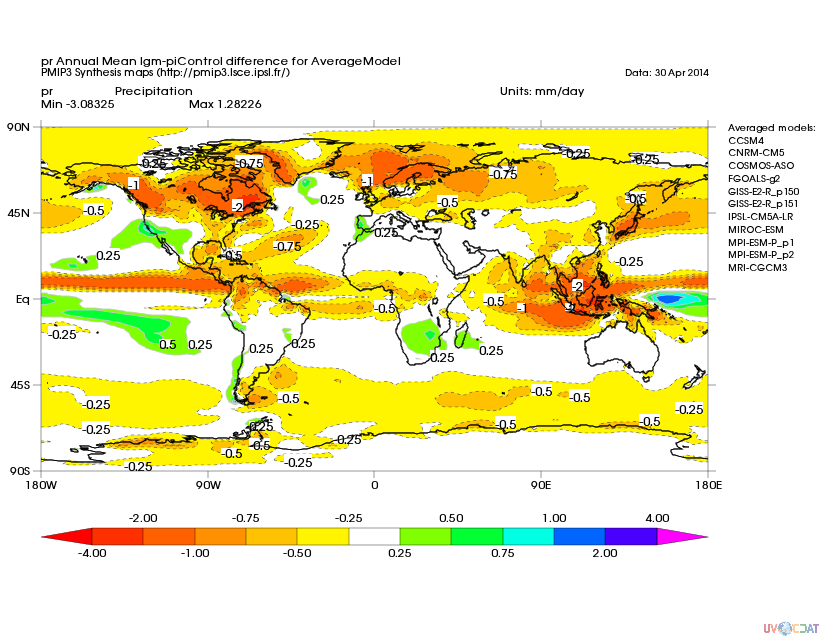
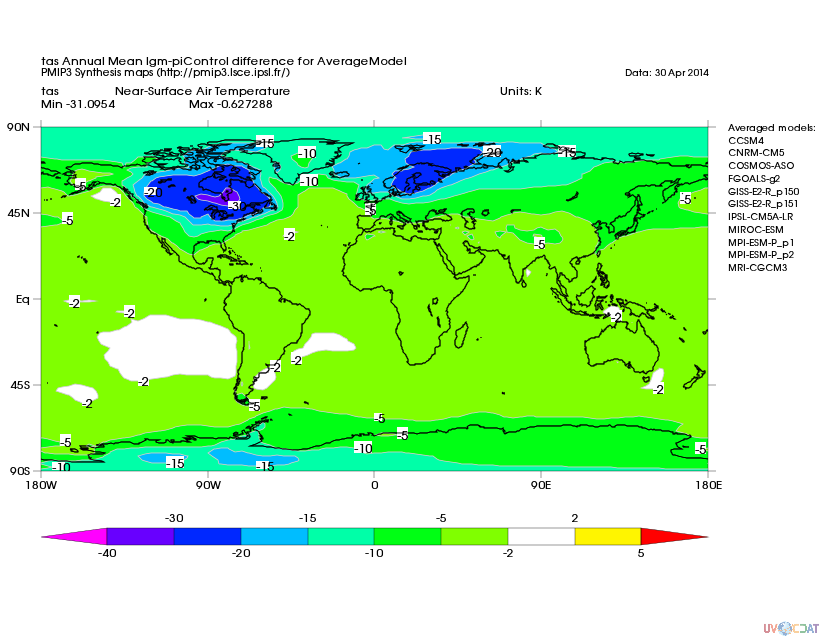
*3 Yu, G. Xue, B et al (2003) LGM lake records from China and an analysis of climate dynamics using a modeling approach. Global and Planetary Change 38-3 p223-256 Sept 2003. doi: 10.1016/S0921-8181(02)00257-6
*4 Ward, J. et al (2004) Carbon starvation in glacial trees recovered from the La Brea tar pits in southern California. Well-preserved wood samples from the tar pits date from the Holocene to 55 kyr ago. http://www.pnas.org/content/102/3/690.full
Figs Laskar, J. Joutel, F. Boudin, F. et al (2004)
The Institut de mecanique celeste et de calcul des ephemerides. http://vo.imcce.fr/insola/earth/online/earth/online/index.php
Epica3 data (2007, 2008, 2015):
For Epica3 dating methodology please see:
Parrenin, F. Barnola, J. Beer, J. Blunier, T. Castellano, E. Chappellaz, J. Dreyfus, G. Fischer, H. Fujita, S.
The EDC3 chronology for the Epica Dome C ice core
http://www.clim-past.net/3/485/2007/cp-3-485-2007.pdf
The end of glacial episodes seems to occur very quickly. I would characterize it as appearing to have momentum. As an inhabitant of a wintry land, I have observed snow and ice that melts slowly and lasts into summer. A common characteristic of this ice and snow is its ” dirtiness”. It seems that as deep stands of ice/ snow melt, much of the dirt seems to stay on top, such that the surface gets darker. I have always thought that this was a result mainly of sublimation from sunlight and evaporation from wind. Regardless, I believe this may be a powerful accelerant to melting
The question now, beyond the obvious nonsense of CO2 panic, is what can we do to ensure we don’t start the slide to another 20,000 year cold snap. It’s starting to look due!
I think so far we’ve been saved by the positive AMO and PDO. But what will happen when they are concurrently negative as in the late seventies might prove interesting when coupled with the rise in atmospheric water vapor lately. Are noctilucent clouds a harbinger of fresh snow year-round to come?
>>The question now, beyond the obvious nonsense of CO2
>>panic, is what can we do to ensure we don’t start the slide
>>to another 20,000 year cold snap.
See my post above.
The next ice age is not really due for another 70 kyrs, due to low orbital eccentricity. And if this theory is correct, we can easily dodge this by spraying the growing polar ice sheets with soot.
R
So under this theory it’s the lack of CO2 which causes cancer temperature to rise? Not because of its effects in the atmosphere, but because of starving plant life? This isn’t even remotely close to what we have been told concerning CO2 being a driving force in global temperature change. According to this ,CO2 levels are driven by temperature changes not the case other way around.
So under this theory it’s the lack of CO2 which causes cancer temperature to rise? Not because of its effects in the atmosphere, but because of starving plant life? This isn’t even remotely close to what we have been told concerning CO2 being a driving force in global temperature change.
_________________________________
Indeed. But then I get Royal Society reviewers telling me: “Oh, but we have known about all of this for decades. So the paper is not novel, and should be rejected….”
Seriously, that is what they said.
R
It would be funny if CO2 turned out to have a dangerous cooling effect through plant fertilization.
What? An ice age cometh? I thought the sun had no effect on climate, it’ll all due to CO2!!
http://www.news.com.au/technology/science/space/the-sun-has-gone-blank-twice-this-month-this-is-what-it-means/news-story/d775ecf894ab68415ed0108ced31a4e2
Rubbish.
They may have known about the cycle, and may have called it the Great Year, but they knew about warm and cool over a 23,000 year period? Nonsense.
https://wattsupwiththat.files.wordpress.com/2012/10/cp-8-1473-2012.pdf
Ellis’s theory will be laughed into obscurity. Not a single point helps progressives to achieve the Great Socialist Convergence that the current vapid meme of climate change is able to do.
True.
I think the angle for the warmists to play is that co2 could keep us in an ice age longer. Of course they’d have to abandon the current thermageddon meme.
Here in Finland and the Nordics they quarry rock and crush it for grit.
You can see the effects of winter gritting in the summer, the dust is immense. I mean literally, 3 to 4 days and the apartment is covered in Dust, no doubt Russia Iceland Finland Denmark Norway Sweden ect do this every winter and the dust from the total gritting must be huge amounts.
I have just been home to Ireland, and the dust just does not compare to what we see here in Helsinki. That’s just gritting in the Nordics and Scandinavia and Eurasia, never mind all the other sources
Excerpted from above article:
Well now, I will have to say, the above is the best explanation I have ever read that sensibly explains the “rapid melting” of glacial ice that is portrayed by this Post Glacial Sea Level Rise proxy graph, to wit: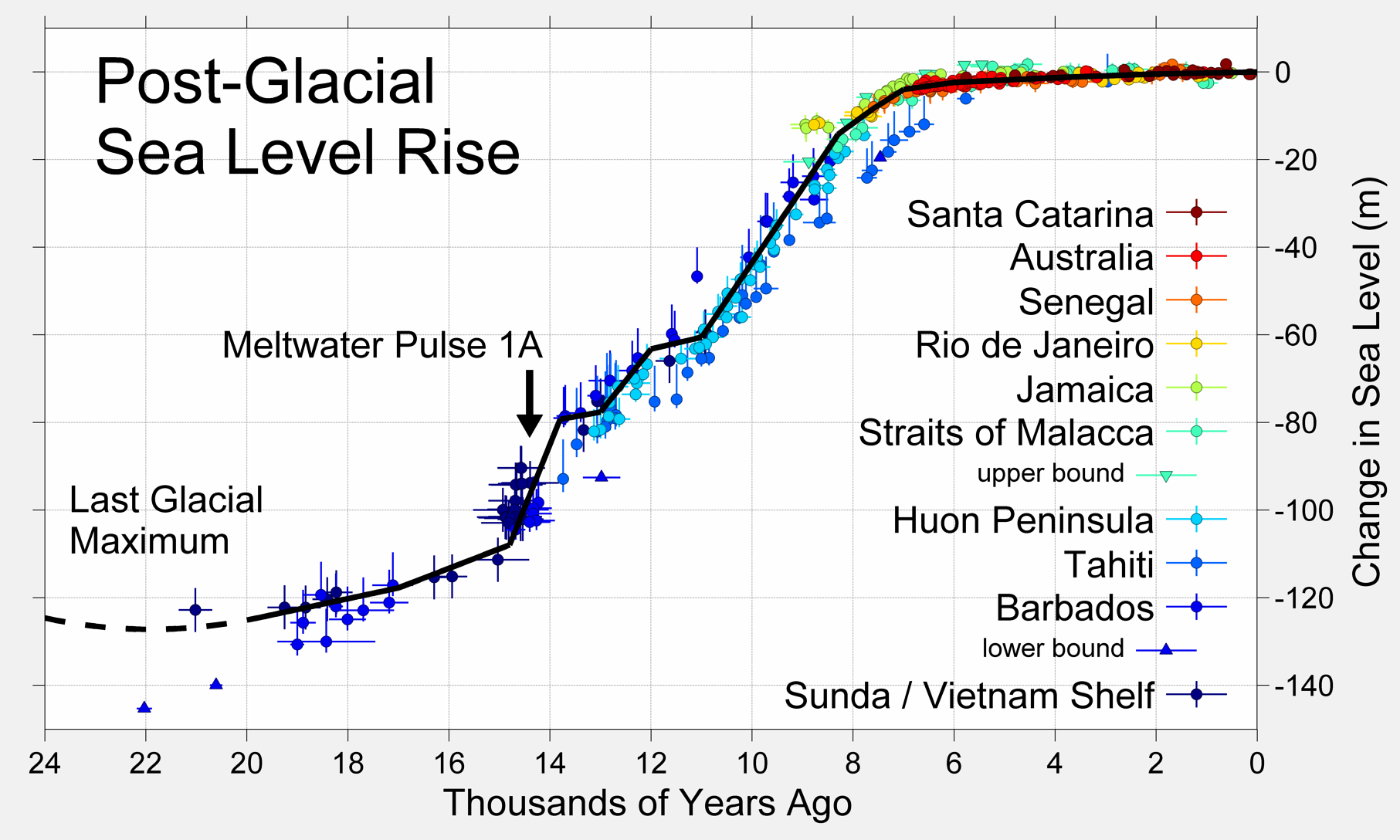
Now, all I need is confirmation that circa 20,000+- years ago was the start of a Great Summer,
>>Now, all I need is confirmation that circa 20,000+-
>>years ago was the start of a Great Summer.
Take a look at fig 3 in the paper, and you will see that it does indeed coincide with a Great Summer in the northern hemisphere.
The full paper is linked at the top of this article, and is also linked here:
http://www.sciencedirect.com/science/article/pii/S1674987116300305
Ralph
Thanks Ralph, ……. I somehow overlooked the 1st graph presented in the above commentary.
After I looked at fig 3 in the paper as you suggested …. I went back to the start of the commentary and there it was.
Now I know the actual, scientific reason that the 1 mile+- thick glacial ice resting atop what is now NYC, Connecticut and Long Island melted down and flowed into the ocean.
Ralph Ellis
I like your theory but there are problems:
1) Looking at the last chart, 130 kya there’s a big drop in ice but no large dust storms. 275 kya there’s big dust storms but no decrease in ice. 700 kya drop in ice but big dust storms came almost 50 ky earlier
2) Plants don’t die at 190 ppm CO2. Alpine plants thrive at 14,000 ft elevation equivalent to 180 ppm CO2 due to low air density
3) Deserts are dry land and dust comes from dry land because the soil particles are not held by water. Assuming all plants die. Without decrease in rainfall, the land will not be arid. It will even increase soil moisture because of loss of plant transpiration
Quote:
1) Looking at the last chart, 130 kya there’s a big drop in ice but no large dust storms. 275 kya there’s big dust storms but no decrease in ice.
130 kya, the dust storms (purple) occurred immediately before the melt. As soon as the melt and warming starts, CO2 is released, plants recover, and so the dust immediately stops. Continued warming occurs because there is 10,000 years of dust layers already in the ice sheets.
275 kya there was no strong Great Summer, to give increased insolation. You need both dust and insolation together. And when the Great Summer did come along, 250 kya, the ice melted and an interglacial was created. (The dust was still in the top 20,000 years of ice layers. And there was another dust peak, just before the interglacial.)
.
Quote:
2) Plants don’t die at 190 ppm CO2. Alpine plants thrive at 14,000 ft elevation equivalent to 180 ppm CO2 due to low air density.
Indeed. But when the surface has 190 ppm CO2, the partial pressure at 1500m altitude will be 160 ubar (an equivalent of 160 ppm). Now 160 ppm is very much a critical CO2 concentration for plants. See Table 4 in the paper.
Quote:
3) Deserts are dry land and dust comes from dry land because the soil particles are not held by water. Assuming all plants die. Without decrease in rainfall, the land will not be arid.
The Gobi is pretty arid anyway, whatever the CO2 concentration is doing. (Precipitation approx 110 to 130 mm a year.) So even if the Gobi did receive a bit of extra moisture during the LGM, as the evidence suggests, it is still an arid location. So once it is stripped of its C3 grasses, due to low CO2 levels, there will be nothing to stop the land becoming a dust desert. And we know this happened, because the Loess Plateau in China records layer after layer of the dust stripped from the Taklamakan and Gobi, during each and every major ice age post the MPT. There is a complete dust record of the region, which equates with the glacial cycle.
The full paper is here:
http://www.sciencedirect.com/science/article/pii/S1674987116300305
Ralph
More problems Ralph:
3) Peaks of dust storm are always thousands of years ahead of glacial meltdowns. If dust storm is just 100 years ahead, dust will be buried under ice and no effect on surface albedo. Also maximum insolations do not always coincide with start of meltdown. Maximum insolation was delayed in 700 kya, 420 kya and 130 kya
4) Air pressure at 1500 m elevation is 840 millibars. You cannot get 160 microbars. That’s three orders of magnitude lower. 570 mbar is more like it
5) Gobi desert is already arid. Not much plants there to kill due to low CO2. Your proposed mechanism works in lush rain forests
6) Die out of plants due to low CO2 leads to mass extinction of land animals. Herbivorous animals die and carnivorous animals eat the herbivorous ones. They all die. There should be mass extinctions every glaciation. But we are still here as well as the cows, sheep, goats, horses, deer and grasshoppers
“due to low CO2 levels, there will be nothing to stop the land becoming a dust desert.”
Gobi desert is a “dust desert” even at 400 ppm CO2. It is today one of the world’s most abundant sources of dust. Dust storms in the Gobi are not limited to glacial periods.
“due to low CO2 levels, there will be nothing to stop the land becoming a dust desert.”
Gobi desert is a “dust desert” even at 400 ppm CO2. It is today one of the world’s most abundant sources of dust. Dust storms in the Gobi are not limited to glacial periods.
On the contrary, I believe Gobi has less dust storms in the glacial periods than interglacials. This is because Gobi has more permafrost in glacial periods preventing the soil from being blown by the wind.
“Relict permafrost structures are present in the Gobi of southern Mongolia… These data show that there was a phase of permafrost development during the latter part of the Last Glacial”
http://onlinelibrary.wiley.com/doi/10.1002/(SICI)1099-1417(1998110)13:6%3C539::AID-JQS390%3E3.0.CO;2-N/abstract
The Appalachian rainforest is higher than Gobi desert. It should have lower CO2 during the glacial period and worse mass extinction. Yet it had high biodiversity of plants and animals.
“In the Last Ice Age, ice did not cover the south Appalachian Mountains. Uncovered area was a refuge for animals and plants which lived in northern area. After the ice receded, some species spread back to north, while some of them stayed in this area. This is one of the reasons why there is a high biodiversity in the temperate rainforest”
https://en.wikipedia.org/wiki/Appalachian_temperate_rainforest
3) Peaks of dust storm are always thousands of years ahead of glacial meltdowns. If dust storm is just 100 years ahead, dust will be buried under ice and no effect on surface albedo.
___________________________
You have not read the paper, have you?
The buried dust becomes a latent feedback agent. It comes to the surface during melting, and enhances the albedo reductions, creating more and more warming and melting.
Please read the paper, before coming up with more objections.
R
An exercise of common sense is helpful here. Let’s say the dust is buried under one meter of ice. You say if you melt one meter of ice, the dust will be exposed and decrease surface albedo. But that’s exactly the problem your theory is supposed to solve – how to break the cycle of increasing ice thickness during glacial periods. Your theory says it’s dust that breaks the cycle. But now you say the cycle must be broken first before dust will have an effect on surface albedo
So sayith: Dr. Strangelove – June 30, 2016 at 4:09 am
HA, it might have been helpful if it had actually been …. “an exercise in common sense thinking”, ….. but it wasn’t, …. nor was it an exercise in logical reasoning or intelligent deductions.
And to insult your injury, ….. your above stated … “Let’s say” verbiage is nothing more than weazelworded “piffle n’ tripe” simply because you defined a situation therein that was directly contrary to what the above published commentary stipulated was a specific requirement, to wit, read it and weep for lack of common sense thinking:
“DUH”, it could very well take 10,000 years for your “Lets say …. one meter of glacial ice” to be deposited ……. but in your brilliant reasoning you placed those denoted “10,000 years of intense dust storms” DEPOSITS underneath that ice.
Samuel you don’t understand the problem. If all that’s needed to melt the ice sheet is continuous deposition of dust, then you cannot predict the interglacials because dust storms happen all the time throughout the glacial periods. For the theory to be useful, the peak dust storm must coincide with the start of glacial meltdown. Or else it does not explain why the meltdown did not happen earlier when you have multiple peaks of insolation before the actual meltdown.
So sayith: Dr. Strangelove – June 30, 2016 at 6:13 pm
GEEEZUS, your common sense reasoning has failed you again when you “put the cart before the horse” ….. in that silly arsed attempt to prove that ralfellis’s commentary is in error.
Or maybe it’s a “reading comprehension” problem that is afflicting your reasoning?
“DUH”, there is no start of a glacial meltdown until after, ….NOT BEFORE, ….. there has been thousands of years of peak dust storms that conjoined with a strong Great Summer.
And “DUH, DUH”, iffen a glacial meltdown had already started….. just how in ell could those peak dust storm start a 2nd glacier meltdown while the 1st meltdown is/was in progress?
Nice narrative but chart does not support it. There are multiple “great summers” and the “greatest summer” does not always coincide with the start of glacial meltdown, sometimes it’s thousands of years delayed. So these are all good narratives but chance alone could explain the coincidences that are not consistent anyway
97% of the female population will never admit they were wrong about anything.
Doc — thanks for your critical comments.
First, to the CO2. Having spent some time poring over the literature myself, I can report that opinion is divided about the relative contributions of aridity and of CO2 to the decline of vegetation cover in the last glacial maximum; and I feel unsure about it myself. However, it is accepted that low CO2 and aridity potentiate each other’s effect on vegetation. Levels of CO2 dropping below some critical threshold for sustaining plant life would seem to explain the very steep (roughly exponential) increase of dust with declining temperatures.
Secondly, the delayed effect of dust on ice albedo. Yes, there may well be a layer of untainted snow/ice on top of the dirty stuff, and this would have to be melted off first. Consider that during each glacial stage the ice sheets underwent multiple partial retreats and then advanced again. Those partial retreats (interstadials) were not typically preceded by major dusty periods, so the ice melt must have been driven by increased insolation alone. However, during interstadials, melting was slower and did not reach completion, and the ice quickly recovered when the insolation maximum subsided.
What Ralph is saying is that, once exposed, the accumulated dirty ice melts faster and may melt completely during a single insolation maximum. Is it true? I don’t know, but it is a plausible hypothesis.
So climate control boils down to albedo control. Earth does it with dust during a great summer. But that warmup destroys the dust producing mechanism (which is too little CO2 to allow the plants to grow) and so the earth descends into another glaciation which lowers CO2 again which causes dust and so the whole cycle repeats.
This is great. All we have to do to control climate is control the albedo of the earth. How about an array of space parasols that can be raised and lowered as the great summers and great winters occur keeping the earth climate relatively stable? We can probably even choose how much glaciation we would like. We could thaw out Antarctic and provide us with another usable continent (if the Greenies won’t object to us destroying all that penguin habitat).
>>So climate control boils down to albedo control.
Which is why there has not been, and cannot be, a runaway warming event. Warming peaks when all the polar ice has melted, and albedo reaches a minimum.
However, there can be a runaway cooling event, where ice continues to grow. Had CO2 deserts not been formed at the glacial maximum, causing dust, the ice would continue to grow. because its albedo is too high for effective insolation absorption and melting.
And the easiest way to control temperature, and prevent another ice age, is to spray the ice sheets with soot.
R
Which China is kinda doing now, remotely…
>>Steve
>>Which China is kinda doing now, remotely…
Indeed they are. And this is one significant reason why the northern glaciers and ice sheets are in retreat. It has been demonstrated that their albedo has been lowered significantly, by industrial polution.
Ralph
Don’t forget the volcanoes.
There are no CO2 deserts when in a “Snowball Earth” condition but there were surely volcanoes that spewed enough dust to terminate those big freezes.
Samuel: Ralf clearly stated that this hypothesis only applies to glaciasions post Mid-Pleistocene Transition (MPT). Snowball Earth does not apply.
Jeff In C: But, but, but ….. dust particulate from volcanic eruptions are to this very day …… affecting the rate of glacier melting.
too funny…
clive best.. what a hoot.
You have gone all cryptic again Mosher.
R
Glacial advance grinding causes dust (creates loess soil which is basically very fine rock powder). Therefore dust should be at a maximum when ice sheet extent is also growing. “The formation of loess packets is correlated with the cold, dry climatic phases of the Pleistocene glaciations in regions marginal to the ice.”
http://hugefloods.com/Lake-Missoula-Rock-Flour.html
https://www.britannica.com/science/loess
Albedo should be hazy due to this airborn dust. The one thing that can wash this out is rain. To do that you need to employ the water cycle which brings evaporated ocean water to the air. To get evaporation of the kind that could do that on a large scale, and quickly, you need a large change in the oceans from wind blown piles of warmed water to the spread out layer (think oil slick-like) of risen to the top warm water that evaporates everywhere. We have a known mechanism for short term anomalies in ocean evaporation. We don’t have long term observations. But what if we did? Would our current wiggles show long term cycles? Tens of thousands of years long? Plausible.
Ergo: ENSO.
The author fails to take into account the entirely plausible long term recharge, discharge function of Earth. It is primarily a water planet, and the current set of land distribution interacting with ocean currents and the Coriolis effect on atmospheric/oceanic modes could explain the past 800,000 years if there is a tens of thousands of years cycle as well as lesser cycles. Given the total water volume of the planet, I believe this could be at least part of the cause of cycles examined by the post’s author.
I don’t fully understand what you are saying here.
It is certainly true that advancing ice produces dust. However, this “glaciogenic” dust is not the whole story. The rate of production of glaciogenic ice should correlate with the rate of ice sheet advance, not total ice sheet extent; but the dust storms are maximal when the ice sheet extent is.
As to the “tens of thousands of years cycle” of “atmospheric/oceanic modes”, are you referring to something widely known and accepted, or are you speculating? If the former, can you provide a name for that cycle, so that we know what we are talking about?
typo – “glaciogenic ice” -> glaciogenic dust
The extent of glacial “flour” produced depends on what the glacial advance is grinding up. Otherwise we would have a fairly uniform layer in front of ice extents. We don’t.
And yes, I am speculating. I speculate because short term oceanic/atmospheric recharge/discharge mechanisms are known in the literature (see link for an earlier article on this proposed ENSO mechanism, something Bob Tisdale has expounded on regularly and continues to be held as the primary hypothesis in the literature). I am simply using common scientific method deductive reasoning that the first encountered pathology is to be given superior consideration in terms of mechanisms for underlying disorders and needs to be ruled out before other causes are considered. I don’t think climate science has adequately ruled out ENSO as a mechanism for long term change seen in the 800,000 year reconstruction.
http://www.soest.hawaii.edu/met/Faculty/jff/1997_02a-%20Jin%20An%20equatorial%20ocean%20recharge%20paradigm%20for%20ENSO.%20Part%20I%20Conceptual%20Model.pdf
Addendum: Determining how much solar energy is absorbed and stored in the oceans over short, long and millennial long terms is an incredibly complex mathematical problem that can only be definitively solved by assigning parameter boundaries. The ocean does no such thing. So the boundaried answer is not very informative.
We might possibly be able to pseudo-calculate total stored energy versus evaporated energy over the past 30 years but only with a very complex model using greatly smeared grid data coupled with made-up data coupled with known solar heating parameters of a variably veiled globe variably titled towards a heat source coupled with a complex clear here and cloudy there total set of water columns. That would tax super computers of which only alarmists can apparently use.
Or we could simply admit that we don’t have enough information to meaningfully constrain such calculations. The whole paleoclimate discussion is as polluted with computer-assisted speculation as the study of current climate, or more so. I much prefer “back-of-the-envelope” estimates or purely qualitative arguments that don’t bamboozle people with fudge factors in fancy dresses.
>Glacial advance grinding causes dust (creates
>>loess soil which is basically very fine rock powder).
>>Therefore dust should be at a maximum when ice
>>sheet extent is also growing.
This was Ganopolski’s idea and paper.
In addition to Michael’s comment, the isotopic analysis of the glacial dust in Greenland demonstrates that it did NOT come from Canadian glaciogenic dust. It is Gobi dust. And Ganopolski’s idea further demanded that all of the underlying silts were removed by the ice sheets, which is why the ice sheets were able to progress further each ice age. However, this demonstrably did not happen, as ancient silts still remain in the ice sheet regions.
So Ganopolski’s idea fails on both counts.
R
Au contraire. I live in Oregon and have spent time collecting loess soil in the South Central and South East corner of Washington. Wind blown loess soil deposition is a key component of glacial advance documentation as well as carbon dating evidence. The Washington scab lands are a veritable notebook of observations, capable of dating loess soil deposition as well as when floods washed exposed depositions down to older basaltic bedrock.
http://web.gps.caltech.edu/~mpl/Ge121a_Scablands/McDonald%20et%20al%202012%20old%20flood%20evidence.pdf
Loess windblown deposition (versus washed out silted deposition) confirms timing and locations of cold regime glacial advance.
Pamela… Do you know if Gobi dust has been detected in Washington ?
Loess soil is windblown and can be identified chemically as to its origin. Depositions have a well-identified connection to ice sheet advancing edge location and the grinding of rock located there. Its windblown location can even provide information regarding wind direction and speed, which then can identify plausible atmospheric pressure patterns that could produce such wind.
I have not read that Gobi desert dust is in Washington deposits, so my answer would be a qualified no.
http://www.environnement.ens.fr/IMG/file/DenisPDF/DDR-PDF-papers/DDR_Loess_mineral-dust_Springer_Muhs2014.pdf
By the way, it is easy to identify loess soil from lake sediment. Loess soil is devoid of mixed composition in terms of size, mass, and weight. Everything in it is light enough to be carried by the wind and lands in dune like fashion and caught in basaltic crevices. It also has a predominantly mineral content as opposed to carbon content. Lake sediment settles out in a much more consistent way and is composed of a variety of materials of different sizes, mass, and weights. It also has a much higher carbon component. In some cases, loess soil layers can be found in lake sediment cores. Depending on other correlated parameters, the lake bed was dry when inundated by blown in loess, or the lake was not dry and served as a collection point for glacial flour.
Au contraire. I live in Oregon and have spent time collecting loess soil in the South Central and South East corner of Washington. Wind blown loess soil deposition is a key component of glacial advance documentation as well as carbon dating evidence.
_____________________________________
I do not doubt it. But the dust in Greenland is from the Gobi, not Washington State. So it would appear that the greatest contribution to ice sheet albedo reductions, was from the Gobi.
I imagine that if your Washington loess is at low altitude, it would be quickly bound and consolidated by vegetation. The Gobi could not do that, because it had become a CO2 desert.
R
ralfellis, you make the common mistake of assuming albedo is confined to surface reflection. It is not. Atmospheric reflection is by far the stronger factor in planetary albedo.
“The vast majority of the observed global average planetary albedo (88%) is due to atmospheric reflection. Surface reflection makes a relatively small contribution to planetary albedo because the atmosphere attenuates the surface contribution to planetary albedo by a factor of approximately 3.”
http://www.atmos.washington.edu/~david/Donohoe_Battisti_Albedo_2012.pdf
RoHa referenced http://www.nature.com/news/cloud-seeding-surprise-could-improve-climate-predictions-1.19971 which can be merged with this CO2-dust theory:
Low enough co2 in great summer -> less plants -> less aerosols -> less cloud seeding -> more sunlight -> more chances to end glaciation albedo ratchet effect this time.
Now the only way l believe that a ice age can form is if there is a marked increase in blocking weather patterns across the NH. Because for a ice age to form there needs to be a major slow down in the amount of change going on in the weather. What l think is a large part of the cause in warming between the ice ages is down to the amount of change that’s taking place in the weather. l understand that during the last ice age the jet stream split into two at least over North America. Now am beginning to think that if this splitting of the jet stream was taking place during the summer months in the NH. lt could be a important factor into why there is move towards an ice age. Because this splitting of the jet looks to have the important effort of keeping the Arctic cooler during the summer months.
Shows how close we are to CO2 starvation. Could be a wake up call for the minority of warming alarmists who think they have been following legitimate science, in contrast to those who are motivated by anti-capitalist ideology and are immune to reason and evidence.
Also confirms my longstanding advice that we need to be dotting the great white north with soot-maximizing dirty coal-burning plants. Electricity production would be secondary and strictly local (makes no sense to build transmission lines in the middle of nowhere). To maintain local power generation in summer when there is no no snow to melt the soot plants could have a clean burning mode.
We are due for cooling and it could begin quickly or slowly. That will be determined essentially by weather, by the extremity of random fluctuations, and we need to be ready to nip an ice-initiating season or three of cold winter weather in the bud.
The Gobi did it. 🙂
It is interesting that enough literature has explored Ice Age oscillations and ENSO parameters (as possible agents in the past 800,000 years of temperature reconstructions based on flora/fauna marine deposition cores and chemical as well as aerosol deposition in polar ice core proxies) that dissertations now explore this arena. Dissertations rarely propose and conduct original research with entirely new results.
So with that base, I propose that when zoomed out, oceanic discharge/recharge could be the cause of the up and down nature of our current Ice Age temperature swings. My suggestion is rather simple, that the vast ocean is capable of building energy reserves that eventually top off and then is discharged, comparatively smoothly and quickly, in contrast to the recharge process that is rather noisy.
http://www.o3d.org/jeg/climate/texts/JEG_dissertation_web.pdf
Finally, I do not dismiss Milankovitch cycles. Indeed, the correlation between temperature reconstructions (which by nature, would be a dependent variable), and orbital mechanics (which by nature, would be an independent variable) cannot be dismissed.
http://www.climatedata.info/forcing/milankovitch-cycles/
But what I see in that correlation is an apparent Earthly energy recharge/discharge which points a finger at the oceans as the only Earth-bound substance with such capability. Else the temperature reconstructions would match the orbital cycles in excursions from baseline. As it is, the match is directional only (when insolation is high/low, temperature is high/low), not anomaly extent. The sudden rise of proxi temperature and the jerky step function back down does not match the orbital cycles, which by nature are far more symmetrical.
Conclusion: Because of the oceanic parameters at play over the past 800,000 years, zoomed out discharge/recharge thermo-fluid dynamics unique to our voluminous oceans in concert with Milankovitch orbital mechanics in the presence of a constant solar source may explain it.
The orbital eccentricity varies with a cycle much longer than precession, and is the only orbital parameter which actually changes the total annual insolation reaching the earth: obliquity (the angle of the earth’s axis of rotation to the orbital plane) and precession (the rotation of the axis itself around the normal to the orbital plane) plainly make no difference. If you do the sums you can see that varying eccentricity does: as eccentricity varies, the semi-major axis remains constant, so at high eccentricity the earth is a little closer to the sun.
Here is a paper I wrote on the linear fit of orbital parameters to Antarctic ice core temperatures, showing the separate eccentricity, obliquity, and precession orbital parameter time series, and how they fit with temperature trends.
http://www.robles-thome.talktalk.net/Milank1.pdf
Very good graphics. And you identify the obvious directional fit between your two parameters as well as issues with different anomaly excursions between the dependent and independent variable.
Caution. Using polar cores should be used with the caveat that the Northern Hemisphere is +60% covered by ocean while the Southern Hemisphere is +80% covered by ocean. One also needs to take into consideration that land volume is a poor and very shallow energy absorber while ocean volume is a very good and deep one. One also needs to take into consideration the difference in peak insolation between the polar caps.
But back to your graph and data. I would use an average of all the cores at both poles to compare with eccentricity to control at least a bit for hemispheric differences in ice core data.
Here is an excellent example of autocorrelation. There is evidence that suggests CO2 lags temperature. There is also some evidence that CO2 leads or at least overtakes and then drives further temperature increase. At the very least the two are connected at the hip, knees, toes, and everywhere else. So to create a psuedo-earth model of the current ice age oscillations between stadial and interstadial temperature changes using CO2 proxies and then publish the amazing feat of producing temperature output is similar to drawing an outline around someone’s foot and then say they have discovered a foot.
While the paper is an interesting use of models that use psuedo-earth parameters, it begs the question, what caused the CO2 to rise. The only way CO2 rises in a steady fashion is if the Earth is warm enough to green it up, and to continue to green it up over a long period of time. That takes a lot of heat to spread over the land, along with the necessary rain to grow green stuff which leads to more animals that eat the green stuff and more other animals who eat the animals that eat the green stuff. So lots of stuff leads to more CO2. More green stuff every year and decade and century, repeatedly. Moist heat has to drive it. Where would that seemingly unending source of moist heat come from when it appeared to have disappeared from the globe during the previous extreme cold plunge so identified in the record? It would have to be from a huge wet, warm source. I leave it unanswered in order to drive thinking.
http://www.clim-past.net/10/2135/2014/cp-10-2135-2014.pdf
hmmm……additional thought. Has anyone figured out just how far the greening needs to progress before it reaches a latitude it cannot survive in? Sort of akin to the “treeline”. I will call it the “greenline”. Would it be the current 10 degrees Celsius isotherm? Is there more buried forage under the ice yet to be exposed?
https://nsidc.org/cryosphere/arctic-meteorology/arctic.html
This article is a refreshing development that Anthony includes research of goodwilled
independent researchers, which do not belong to climate institutes, which only simulate
around with their CMIP3,5… models, and with little success…. Also, Anthony does not start
the title with the previous “CLAIM” (“beware of”), but now with “NEW PAPER”! so to say:
LISTEN!”, which is an honour to the author!.
The question is: What are the real climate drivers, that move global temps up or down……?
(1) Albedo. There recently (3 weeks ago) was a detailed Albedo-article here with Anthony,
showing measurement data for 30 years, proving that the Earth Albedo is a quasi-constant,
deviation +/-0.02% and this with 1 ONE MILLION sqkm less ice surface TODAY as back in 1980!
We see that global albedo into space has not changed although open waters, by logical thinking,
should take up more solar energy
I reckon that a dusty ice surface probably absorps the same energy as a dark
open water surface……but, albedo observations showed that this logical idea did not
materialize…..
. Since observations count more than calculations, the dust effect has herewith been answered.
(2) Those terrible Milankovitch cycle diagrams…. Forget this crap, because the flight of Earth
around the Sun is not a simple Kepler´s ellipse, on which ALL those Milankovitch cycle
calculations are based on. The Earth orbital line is different, it is a 3-D-flight, with the true
flight winding around its ellipse path, therefore, changing the distance Earth-Sun significantly,
thus containing changes in solar energy reception on Earth from Sun. Beware of authors of
Milankovitch diagrams, they all belong to the AGW-gang, keeping the spiral flight of Earth
from view and knowledge of the public. For this reason, with crooked Milankovitch input, the output will
not be better.
(3) There are five important climate drivers, now applied in a series of Holocene time spans,
see under http://www.knowledgeminer.eu/climate/papers.html. They cover the entire
Holocene in 8 parts of Pattern Recognion and explain EACH AND EVERY temp. spike
of the Holocene, starting 8500 BC (outstanding remain 1 AD to 2100 AD following within
this year).
.
Hopefully Anthony encourages independent thoughts with moor room. Regards JS
ralfellis June 30, 2016 at 12:04 am
Thanks, Ralph. I’m sorry, but I’m not following the logic. You say the icecaps melted thousands of years after the dust storms peaked, because of buried dust which only came to the surface once the icecaps were melting … what am I missing here? Isn’t that circular?
w.
>>Willis
>>Isn’t that circular?
I don’t think so. The reasoning is:
Low CO2 causes CO2 deserts and dust storms.
Dust piles up, annual year after annual year on the ice sheets.
But melting and warming cannot happen, because of a Great Winter and low insolation.
So 10,000 years of dust builds up, contaminating the top 1/3 of the 2-3km thick ice sheet.
Then a Great Summer increases the insolation significantly.
Dusty ice now begins to melt.
And 10 year-layers of ice melt, increases surface dust by an order of magnitude.
This concentration of surface dust accelerates the melting process.
Temperatures and Co2 concentrations begin to rise.
The Gobi returns to being pastural steppelands.
Dust storms stop., and skies clear.
This increases insolation absorption even more.
But the ice sheets continue to melt, because of ancient dusty ice layers.
Every year-layer of ice melt, increases surface dust, even though there is no more aeolian dust.
And the ice sheets melt.
All within one Great Summer of 5,000 years.
(Most interglacial warmig events last about 5,000 years.)
I think that makes sense.
Cheers,
Ralph
See my latest comment to you with a link to atmospheric dust and planetary albedo. Atmospheric dust is a response to windy dry air. No dust is a response to precipitation. The former suggests an ocean that is not evaporating much and wind is keeping water piled up against continents with a cooler surface elsewhere, think cold. The latter suggests the ocean is evaporating more which suggests that the oceans have calmed, the warm water is spread out, and is sitting idle on the top, sending water vapor into the atmosphere in copious amounts, think warm.
ralfellis June 30, 2016 at 7:19 am
The part you left out is the thousands of years between the peak of the major dust storms and the start of the melt. This is particularly true given that the dust storms were raging earlier but the ice did NOT melt.

I was hoping that your theory would explain why the world came out of the various glacial eras. However, here’s the difficulty, exemplified in the most recent deglaciation:
OK, so the red line shows the ice area per Huybers, and the dashed purple line is insolation at 60°N. Note that ice area peaks at about 16,000 years BP, when the deglaciation began. The difficulty is, look at the period around 63,000 years BP. There was the same rising insolation and MORE dust than when deglaciation actually began 16,000 years BP, but no deglaciation. Why?
This is the recurring puzzle of the glacial/interglacial cycles … there is no obvious ~ 100,000 year cycle in the Milankovich variation of high-latitude insolation. I suspect that as you say, dust plays a part … but as is usual, the details are unclear.
Nature is always a step ahead …
Thanks for the continued discussion,
w.
The 10,000-year dust build up is a nice narrative but the chart shows there can be 25,000 years of dust build up and multiple peak insolation within a glacial period. The theory does not predict when and when not an interglacial is supposed to happen. If we accept the narrative, then we can always blame dust and insolation for all interglacials. It’s inevitable because all glacial periods have multiple dust storms and multiple peak insolation. That’s the beauty of this theory. It’s not falsifiable. It’s not wrong, it’s not even wrong.
However, the non-extinct plants and animals in the Appalachian mountains and relic permafrost in the Gobi desert despite supposedly increasing wind erosion of dry soil in the last glacial have falsified the theory. Let’s give more weight to nature than to metaphysics.
>>Pamela.
>>Atmospheric dust is a response to windy dry air.
>>No dust is a response to precipitation.
See the PMIP precipitation map in the paper, where precipitation remained largely the same in the critical tropical regions. See also the Chinese paper I linked, that demonstrates that the Gobi was slightly wetter in the LGM. And yet a great deal of extra dust was created by the Gobi at this time. Why? Because it became a CO2 desert.
Cheers,
Ralph
Willis.
The difficulty is, look at the period around 63,000 years BP. There was the same rising insolation and MORE dust than when deglaciation actually began 16,000 years BP, but no deglaciation. Why?
_________________________________
I see no difficulty here.
60 kyr ago there was a smaller dust event, and a small NH Great Summer, and the ice sheet volume did indeed attempt to decrease. But there was insufficient dust and insufficient insolation, for a full interglacial.
And since an interglacials can NEVER happen (has never happened) during a NH Great Winter, the world had to wait for two complete Great Year cycles, before the conditions were right for another attempt. This time there was more dust (plus the old dust), and much more NH Great Summer insolation, and suddenly we get an interglacial. And as soon as the warming begins, CO2 is released from the oceans, plants begin to grow on the Gobi, and the dust storms immediately cease.
.
And from this, we can deduce that the conditions required for an interglacial are finely balanced.
The first two NH Great Summers on your graph were very strong but only produced small dips in the ice volume, because there was no ice-sheet dust contamination and no albedo reductions.
The next NH Great Summer had some dust, but it was weaker, and so it still could not produce any more than a dip in ice sheet volume.
The next NH Great Summer was extremely weak, and produced no effect at all.
But the last NH Great Summer, the Holocene Summer, had just enough dust and just enough insolation, to produce an interglacial. But only just, I think.
Now that is quite a finely balanced climatic system. But then there are many finely balanced systems in climate and weather, like the critical surface temperature for convention and cloud formation. Depending on the adiabatic lapse rate, a degree or two of warming stands between clear skies or widespread cumulous. See a T-phi diagram, for the criticality of cloud formation.
See also glider pilots anxiously watching the morning temperature rise, looking for that all-important extra degree of warming that will signal the time for takeoff. The temperature-ice sheet response on your graph, is no different to a glider pilot waiting for convection (but each pilot-day is represented here by a 23 kyr cycle). The first four ‘days’ on your graph produced no convection, so the pilots retired to the bar to spin aviation yarns of good gliding days. But the fifth ‘day’ was a stonking thermic day, and everyone was rushing to launch. (But Gaia works on different time scales to glider pilots….)
Cheers,
Ralph
The Gobi desert dust storm story is really problematic. It is soot that has low albedo that is causing ice melt. But soot comes from forest fires and Gobi is a desert, not much trees to burn there. Soot-free dust will even cause more snowfall and increase glacier thickness.
“Earlier this month, researchers from the Scripps Institution of Oceanography and the University of California, San Diego, found Asian dust storms were causing the Sierras to be regularly doused with snow.
‘In order for water to condense out of the water vapor and into a droplet, it has to have a surface to condense on,’ said Doug Collins, a chemist at the University of California told the New York Times.
‘Sand particles provide that surface.’
http://www.dailymail.co.uk/news/article-2302322/Sandstorm-China-ends-California-west-coast-wakes-hazy-skies-clouded-sand-Gobi-Desert-6000-miles-away.html
Here’s an alternative theory that’s more consistent with the data. Dust storms in the Gobi feeds snowfall to the glaciers. Look at your chart. Large dust storms always coincide with high ice sheet extent and no or small dust storms coincide with the ‘valleys’ (low points) in the ice sheet graph. There is no time lag. The correlations are in real time.
I postulate that no or small dust storms are caused by formation of permafrost in the Gobi. There is evidence for this. The formation of the relic permafrost found in Gobi was dated 22 kya to 15 kya. Your chart shows little dust storms and large decline in ice sheet during that period. What triggers formation of permafrost in Gobi? I postulate the advance of Siberian glacier to northern Mongolia during glacial periods cools the Gobi desert thus starting permafrost formation.
Develop this theory further and you can call it “Ellis-Strangelove theory” 🙂
I find this all very interesting, especially coming off the heels of Patrick Moore’s paper which was posted here recently on the recent danger of CO2 levels dropping too far (with us coming along at precisely the right time to push things in the other direction). Here we have a dependable and natural (read: non human) mechanism for upping the CO2 and allowing the re-greening of the Earth. It’s a wonder no-one’s thought of this prior (atleast I haven’t come across this idea before).
Thanks Ralph and Michael – hope you or others can refine things and make a compelling case for your theory.
Cheers!
Here is an article using land-based flora temperature/precipitation proxies. From these proxies suggested atmospheric/oceanic conditions are proposed. From the spread of cold=dry signs mixed with, for example, opposite signs in other locations, jet stream position with deep sloping sides can be inferred. These suggestions appear to describe deep, large blocking systems, sending polar cold air towards Southern latitudes in some locations, and equatorial warm air towards Northern latitudes in other locations.
Proxies that show opposite signs at the same time are often averaged out aka Mann’s hokeystick. But in fact he may have uncovered a goldmine that may suggest past atmospheric/oceanic patterns that can predict whether or not we are sliding down to the next stadial. Or at least what to look for. Or at least tell our great-great-great-great-etc-grandchildren what to look for.
http://citeseerx.ist.psu.edu/viewdoc/download?doi=10.1.1.727.4892&rep=rep1&type=pdf
I find this explanation very suspect. The reasoning starts off sound and I particularly like the part about CO2 not behaving as if it is the primary agent. I have always looked at the charts and said they disprove that CO2 is the main agent because we can see clearly that warming and significant cooling both occur without co2 levels being precursor. It is quite apparent something else is forcing the temperature more than CO2. The fact our graphs don’t have other data doesn’t mean that co2 can be the only explanation.
We now know that CO2 TCS at most is 1.2 or 1.5 which means it can’t explain at least 50% of the ice ages. This explanation fails on a number of fronts. There is another theory not mentioned which has to do with underground fissures. I have explained all this in my blog https://logiclogiclogic.wordpress.com/category/climate-policy under the title of another big failure for climate science.