WUWT reader Susan Corwin writes:
Because it would work as CO2 became plentiful!
All the academic articles say: “and then agriculture happened”.
The “accepted wisdom”/consensus is:
….here was no single factor, or combination of factors, that led people to take up farming in different parts of the world.
But It is simple: it occurred because it Started Working.. 13,000 years ago.
People are clever, resourceful, adaptive, looking out for the best for their kids.
If it doesn’t work, it won’t happen.
If it will work, someone will figure it out and their kids/tribe will be successful
The Greenland Ice Chart for 9000 to 21000 years before present shows why agriculture arose:
(as presented on WUWT by Andy May)

So, my conclusion is that over 4,000 years or 160 generations, things improved and they tried, and tried, and tried again until it worked: people are smart.
…and animals actually could be pastured.
Starting 14,000 yag, the sparse, scraggly growth started getting thicker and slightly more abundant. It wasn’t very good, but is was much better than 16000 yag.
=> and clever people could keep various animals alive in a herding lifestyle.
Source: http://www.mochaexpress.com/Commentary/Elucidate/AgricultureBecamePossible/
Wow.
Wow indeed.
I’m totally gobsmacked with awe.
Someone understand something.
Don’t be too go smacked- the basic premise of this story is false. While it is true that many plants need an atmospheric concentration of at least 150 ppm during the growing season, not all plants have that requirement. In particular, most of the grasses on which agriculture depend can survive at atmospheric CO2 levels as low as 10 ppm.
The 1992 article in Nature by Ken Caldeira and James Kasting “The lifespan of the biosphere revisited” corrected the same misconception in a 1970s article by James Lovelock and Mike Whitfield in the same journal.
Higher CO2 and genetic engineering can help solve the problem of feeding nine to ten billion people:
http://www.climatechangenews.com/2016/04/05/super-co2-sucking-crops-could-save-the-world-from-starving/
Leo,
Which C3 crops do you suppose can survive at 10 ppm?
You really need to re-read what you wrote, Leo G, and when you realise how stupid it is, come back and apologise all-round. Grass may be able to survive at 10ppm CO2 (I can’t imagine it but it might be true) but grass can also survive in deserts and at polar latitudes.
There’s a big difference between keeping stock where stocking rates of one animal to two square miles is possible and where stocking rates are one to the acre or less.
Optimum CO2 level for winter wheat is 890 to 970 ppm, depending upon which metric you use:
http://www.ncbi.nlm.nih.gov/pubmed/26253981
gnome, Grasses such as rice, wheat and maize do not die at CO2 levels below 160ppm as the article claims, and they are relatively insensitive to CO2 levels.
I doubt that agriculture started because CO2 became adequate in concentration. In fact agriculture appears to start because the human predator has inadequate prey and excess numbers, but, being adaptable, we can shift to lower grade diets – I know every vegetarian reading has spiking blood pressure but the facts are the facts. We are not obligate predators but we can survive as pure predators. Except in ideal environments – which excludes most of the planet – we cannot survive as pure vegetarians. We don’t have the teeth, nor do we have the digestive capability, or the patience (there’s a reason we have civilizations and our nearest relatives spend most of the day chewing). Cooking plants – and meat for that matter makes a huge difference to its digestibility – but to be a vegetarian we absolutely need all the dietary basics in the plant environment and – unlike most animal species – much of the plants we survive on lack on or more essentials (Vitamin D is the big one) and are often toxic without treatment or specialized breeding (acorns, maize, nightshades, cassava, etc.).
Leo,
You’ve offered not the least shred of evidence that C3 crops and trees can survive at 10 ppm. Your assertion, I’m sorry, is laughable.
Higher CO2 has led to record crop yields and tree growth. More would be better. Much more. At least another doubling from 400 to 800 ppm. But 800 to 1000 ppm would be even better. Beyond that, there are diminishing returns.
Duster,
Agriculture allowed there to be more, but inferior, humans. From stunted size to tooth decay, early agriculturalists were inferior to their hunter-gatherer ancestors. But there were more of them.
Agriculture allowed people to settle down more. Hunter-gatherers need to be on the move. So do slash and burn cultivators, but less often.
Why so shrill, gnome? Leo G did leave more than a shred of evidence, he left the title of an article easily googled that has an additional two references for the contention in question. Link: http://www.nature.com/nature/journal/v360/n6406/abs/360721a0.html
Sure, it may be completely mistaken, but screaming “stupid” and “laughable” while ignoring it is not in the highest tradition of WUWT.
Mandrake.
Leo’s link doesn’t say what he imagined it did. He still can’t or won’t answer the question about C3, C4 and CAM plants.
His link talks about the biosphere, not the ability of plants to support agriculture and human population.
Yes, a biosphere could exist with only C4 and CAM plants, but humanity could not. Nor much of the rest of the plant, animal and fungus kingdoms, ie multicellular life.
He clearly doesn’t get the distinctions among CAM, C4 and C3 plants. Agriculture supportive of human life cannot exist without C3 plants. In fact, hunting and gathering wouldn’t work, either. Leo fails to grasp the importance of C3 plants.
As I indicated, I’m not surprised Leo G’s reference didn’t pan out, but I was waiting for a substantive reply, such as you have provided (thanks!), rather than screamed insults.
PS:
On Planet Leo there would also be no trees, along with most of crops that sustain humans and many other animals.
Indeed, there might not be enough oxygen for any animals.
Oh . . an article in Nature . . shiver me freakin’ timbers . .
How ’bout a link to some actual experiments of some kind, that we can examine and consider for ourselves, O Siants worshipers?
I think the problem with Leo G’s position is his insistence that grasses can “survive” at very low CO2 levels. That may be true, but that is not the question. There is a difference between surviving and thriving. Grasses may survive but to support herds of grazing animals and growing populations of humans, grasses and other plants (man does not live by grass alone) have to grow like weeds (pardon the pun). Early agriculture booms when the conditions are such that in the morning you spit out a watermelon seed and by nightfall you have a fully mature plant with nice big fat fruit.
“You’ve offered not the least shred of evidence that C3 crops and trees can survive at 10 ppm. Your assertion, I’m sorry, is laughable.”
You are offering a straw man as rebuttal. The premise under test was one that NO plants could survive atmospheric CO2 levels below the “red line” on the chart, which seemed to be just below 160 ppm. The premise is FALSE.
My reply mostly addresses contributions by Duster, partly it’s to others
Human teeth are evolved to live on a diet of fruits and nuts, full stop. We can survive as pointed out, eating meat only under certain conditions but this is rare and requires a complete change in the gut bacteria. We are poorly constructed as carnivores. As pointed out in the book on our water-based evolution ‘The Aquatic Ape’, we are also not evolved to live on savanna as is frequently asserted. We require far to much water.
All that considered, once humans roamed out of the tropics and survived as largely hunters of meat in the temperate regions, a health catastrophe began when farming began. Farmers, based on skeletal remains, were in much poorer general health than temperate zone hunters. The farming societies were not eating a healthy balanced diet as did their tropical cousins. Health and longevity are associated with an almost totally vegetarian diet with very little meat. But almost monocropping a few plants is a poor substitute for a proper diet, especially with a lack of nuts and a surfeit of beer. A lot of agricultural produce is and was devoted to getting drunk or stoned.
All things considered, hunter-gatherers did very well with little effort, a couple of hours a day, in the places favourable to it. Those who had to herd and plant worked a lot harder and had to learn to cooperate a lot more. That led to the social advances described. Societies that learned to herd but never engaged in agriculture were socially stunted. Agriculture is artificial gathering but requires large scale collaboration, greater as one leaves the equator. Once we have developed enough socially, we will all be able to re-engage our healthier vegetarian roots. At the moment it is too soon. That said, every little bit of additional CO2 helps.
The trouble with C4 grass agriculture, is that C4 grasses are thick-walled and indigestable to most ruminents. Pastoral agriculture without C3 plants would be very poor, and perhaps not viable. However, C4 maize does produce a viable seed product.
“A lot of agricultural produce is and was devoted to getting drunk or stoned.”
You write that as though it were a bad thing.
LeoG said:
“Grasses such as rice, wheat and maize do not die at CO2 levels below 160ppm as the article claims, and they are relatively insensitive to CO2 levels.”
Leo, rice and wheat are C3 plants, not C4. They require CO2 levels above ~160 ppm to survive, and more to thrive. These are the two leading food crops in the world. The current population of Earth could not survive without rice and wheat.
C4 plants can allegedly survive at lower CO2 levels, although one does wonder about their growth rates, which likely suffer at low CO2. Corn and maize are C4, as is sugarcane – are you suggesting that the current world population could survive on Corn Flakes? Much of current corn production goes to manufacture fuel ethanol, as does much of sugarcane production.
I suggest that your above posts are generally false and/or misleading.
http://www.cropsreview.com/c3-plants.html
Examples of C3 plants:
– most small seeded cereal crops such as rice (Oryza sativa), wheat (Triticum spp.), barley (Hordeum vulgare), rye (Secale cereale), and oat (Avena sativa); soybean (Gycine max), peanut (Arachis hypogaea), cotton (Gossypium spp.), sugar beets (Beta vulgaris), tobacco (Nicotiana tabacum), spinach (Spinacea oleracea), potato (Solanum tuberosum); most trees and lawn grasses such as rye, fescue, and Kentucky bluegrass.
Further LeoG:
Corn (aka maize, a C4 crop) is a New World crop, first cultivated in the Americas about 10,000 years ago.
In the Old World, writer Susan Corwin’s hypothesis could indeed be correct, since Old World grains such as wheat and rice (C3 crops first cultivated in Asia) require at least 160ppm to survive and more to thrive and produce good crop yields.
Readers may be interested to know about the C4 Rice Project:
http://c4rice.irri.org/index.php/component/content/article/19-about/55-why-c4-rice
“Converting the photosynthetic system in rice to the more efficient, supercharged C4 one used by maize would increase rice yields while using scarce resources (land, water, fertilizer) more effectively. However a technological innovation of this magnitude requires the skills and technologies of a global alliance of multidisciplinary partners from advanced institutions. In 2008, IRRI formed the International C4 Rice Consortium.”
I wrote about CO2 starvation in 2009 or earlier, and I suggest this 2009 post still has validity:
https://wattsupwiththat.com/2009/01/30/co2-temperatures-and-ice-ages/#comment-79524
(Plant) Food for Thought (apologies – written too late at night)
Background:
http://www.planetnatural.com/site/xdpy/kb/implementing-co2.html
1. “As CO2 is a critical component of growth, plants in environments with inadequate CO2 levels – below ~200 ppm – will cease to grow or produce.”
http://en.wikipedia.org/wiki/Carbon_dioxide_in_the_Earth's_atmosphere
2. “The longest ice core record comes from East Antarctica, where ice has been sampled to an age of 800 kyr BP (Before Present). During this time, the atmospheric carbon dioxide concentration has varied by volume between 180 – 210 ppm during ice ages, increasing to 280 – 300 ppm during warmer interglacials…
… On longer timescales, various proxy measurements have been used to attempt to determine atmospheric carbon dioxide levels millions of years in the past. These include boron and carbon isotope ratios in certain types of marine sediments, and the number of stomata observed on fossil plant leaves. While these measurements give much less precise estimates of carbon dioxide concentration than ice cores, there is evidence for very high CO2 volume concentrations between 200 and 150 myr BP of over 3,000 ppm and between 600 and 400 myr BP of over 6,000 ppm.”
Questions and meanderings:
According to para.1 above:
During Ice ages, does almost all plant life die out as a result of some combination of lower temperatures and CO2 levels that fell below ~200ppm (para. 2 above)? If not, why not?
Does this (possible) loss of plant life have anything to do with rebounding of atmospheric CO2 levels as the world exits the Ice Age (in combination with other factors such as ocean exsolution)? Could this contribute to the observed asymmetry?
When all life on Earth comes to an end, will it be because CO2 permanently falls below 200ppm as it is permanently sequestered in carbonate rocks, hydrocarbons, coals, etc.?
Since life on Earth is likely to end due to a lack of CO2, should we be paying energy companies to burn fossil
fuels to increase atmospheric CO2, instead of fining them due to the false belief that CO2 causes dangerous global warming?
Could T.S. Eliot have been thinking about CO2 starvation when he wrote:
“This is the way the world ends
Not with a bang but a whimper.”
Regards, Allan 🙂
Agriculture allowed people to settle down more. Hunter-gatherers need to be on the move.
=======================
No, agriculture *forces* people to settle down. They may not necessarily want to.
Hunter-gatherers don’t necessarily need to be on the move. It totally depends on the environment where they live.
For example, Indians on the California coast or in the Pacific Northwest, were always hunter-gatherers but were able to live in large permanent villages they had plentiful resources year-round
Campesino:
“No, agriculture *forces* people to settle down. They may not necessarily want to.
“Hunter-gatherers don’t necessarily need to be on the move. It totally depends on the environment where they live.
“For example, Indians on the California coast or in the Pacific Northwest, were always hunter-gatherers but were able to live in large permanent villages they had plentiful resources year-round”
When I studied prehistory (too long ago now!), the (new but accepted) theory was that the development of agriculture was all a bit of an accident. (I pass no comment on the importance of atmospheric CO2 concentrations, other than to say these things are rarely attributable to single causes – except, of course, for CAGW (sarc off)).
As others have pointed out, it takes a labour input of only about 4 hours a day for a hunter-gatherer to subsist – even in the Kalahari Desert (as Sahlins and Sahlins found – if memory serves). Why would people engage in settled agriculture, which required around 12 hours a day? Not because they knew that this would eventually lead to cities, writing, and civilisation! (That took many years).
It was found that a family could gather enough wild emmer wheat for a year in about three weeks. That meant they could become sedentary and cease practices to limit population – that often included infanticide and the infirm elderly ‘doing the decent thing’ when they heard the owl call their name, as it were. So the ease of harvesting wild grain led to a population boom, which eventually required some actions to ensure the next year’s harvest – and eventually agriculture had to intensify. Grain had to be stored, seed had to be retained, etc. (None of this was necessary on the Pacific Northwest – but they did not develop agriculture, because they did not need to because of the abundance of resources, but I seem to remember the Kwakiutl had some practices that limited population).
There was a similar story with the domestication of animals, which was thought to be a difficult achievement – until someone found that you could domesticate a wild musk ox in about three weeks.
In the case of both, it is the context that evolves and develops. There is no great strategic, ‘lightbulb’ moment, but rather a series of micro decisions that each make sense and lead eventually to fundamental change.
I googled “CO2 starvation” and found 483,000 hits including numerous papers – below is one from the Royal Society published in 1998 and entitled “Carbon dioxide starvation, the development of C4 ecosystems, and mammalian evolution”.
The very real threat to humanity and the environment of CO2 starvation has been carefully ignored by warmist fanatics. As I stated in my 2015 paper (below):
“4. CO2 is the feedstock for carbon-based life on Earth, and Earth’s atmosphere and oceans are clearly CO2-deficient. CO2 abatement and sequestration schemes are nonsense.”
https://wattsupwiththat.com/2016/05/28/greens-blame-donald-trump-for-crumbling-paris-climate-accord/comment-page-1/#comment-2225245
[excerpt]
We have known since about 1985 that global warming alarmism was scientifically wrong – a false crisis.
We have known with greater certainty since about 2002 that it was a deliberate fraud.
Regards to all, Allan
*************************
Carbon dioxide starvation, the development of C4 ecosystems, and mammalian evolution
T. E. Cerling, J. R. Ehleringer, J. M. Harris
Published 29 January 1998. DOI: 10.1098/rstb.1998.0198
http://rstb.royalsocietypublishing.org/content/353/1365/159
Abstract
The decline of atmospheric carbon dioxide over the last 65 million years (Ma) resulted in the ‘carbon dioxide–starvation’ of terrestrial ecosystems and led to the widespread distribution of C4 plants, which are less sensitive to carbon dioxide levels than are C3 plants. Global expansion of C4 biomass is recorded in the diets of mammals from Asia, Africa, North America, and South America during the interval from about 8 to 5 Ma. This was accompanied by the most significant Cenozoic faunal turnover on each of these continents, indicating that ecological changes at this time were an important factor in mammalian extinction. Further expansion of tropical C4 biomass in Africa also occurred during the last glacial interval confirming the link between atmospheric carbon dioxide levels and C4 biomass response. Changes in fauna and flora at the end of the Miocene, and between the last glacial and interglacial, have previously been attributed to changes in aridity; however, an alternative explanation for a global expansion of C4 biomass is carbon dioxide starvation of C3 plants when atmospheric carbon dioxide levels dropped below a threshold significant to C3 plants. Aridity may also have been a factor in the expansion of C4 ecosystems but one that was secondary to, and perhaps because of, gradually decreasing carbon dioxide concentrations in the atmosphere. Mammalian evolution in the late Neogene, then, may be related to the carbon dioxide starvation of C3 ecosystems.
*************************
EVIDENCE SUGGESTING TEMPERATURE DRIVES ATMOSPHERIC CO2 MORE THAN CO2 DRIVES TEMPERATURE
September 4, 2015
By Allan MacRae
https://wattsupwiththat.com/2015/06/13/presentation-of-evidence-suggesting-temperature-drives-atmospheric-co2-more-than-co2-drives-temperature/
Observations and Conclusions:
1. Temperature, among other factors, drives atmospheric CO2 much more than CO2 drives temperature. The rate of change dCO2/dt is closely correlated with temperature and thus atmospheric CO2 LAGS temperature by ~9 months in the modern data record
2. CO2 also lags temperature by ~~800 years in the ice core record, on a longer time scale.
3. Atmospheric CO2 lags temperature at all measured time scales.
4. CO2 is the feedstock for carbon-based life on Earth, and Earth’s atmosphere and oceans are clearly CO2-deficient. CO2 abatement and sequestration schemes are nonsense.
5. Based on the evidence, Earth’s climate is insensitive to increased atmospheric CO2 – there is no global warming crisis.
6. Recent global warming was natural and irregularly cyclical – the next climate phase following the ~20 year pause will probably be global cooling, starting by ~2020 or sooner.
7. Adaptation is clearly the best approach to deal with the moderate global warming and cooling experienced in recent centuries.
8. Cool and cold weather kills many more people than warm or hot weather, even in warm climates. There are about 100,000 Excess Winter Deaths every year in the USA and about 10,000 in Canada.
9. Green energy schemes have needlessly driven up energy costs, reduced electrical grid reliability and contributed to increased winter mortality, which especially targets the elderly and the poor.
10. Cheap, abundant, reliable energy is the lifeblood of modern society. When politicians fool with energy systems, real people suffer and die. That is the tragic legacy of false global warming alarmism.
Allan MacRae, Calgary
+1!
For another ‘wow’ see Gobekli Tepe (lots of chaff to sift through on YouTube but, some useful introduction is there). Archeological dates of 14,000 years have been put to parts of the site(s).
Long story shortened: Agriculture may have started much earlier due to man’s desire of building stone ‘temples.’ In other words, building temples, at Gobekli Tepe, influenced the development of agriculture. It became logistically necessary to farm the area for the number of people needed to build and worship.
As a tie-in to the posted topic, C02 levels, in what is now Turkey, were high enough to allow for wheat cultivation 11,500 – 14,000 years ago. Those with specialized knowledge may know what minimal CO2 concentration levels (ppm) are required for growing semi-wild wheat found in Turkey/Mesopotamia.
In two parting tangents, CO2 concentration is measured in DRY air, i.e. NO water vapor present. This is supposedly done for accuracy as water vapor tends to skew results. However, wouldn’t it be more accurate to factor the water vapor volume, taken out, back in? Then, a more accurate ‘global average’ concentration could be established in a similar manner to temperatures (note the temperature sarcasm).
Last, is the use of Neanderthal. It is and has always been pronounced: NeanderTal. The modern spelling is ‘Neander’ – place name in Germany; ‘tal’ – German for “valley” thus, Neandertal. “Thal” was the old German spelling for valley but, the “h” was silent. ‘Neanderthal’ represents outdated, misconceived, and just plain wrong ideas. ‘Neandertal’ arguably represents a more enlightened view. “….and now you know the rest of the story…”
Show me the evidence for religious ceremony. It isn’t there.
They always go for the religion angle when there is nothing to support it. Just rampant speculation.
Per Neanderthal: I like old forms, and there is nothing wrong with a sense of history.
a rose by any other name would smell as sweet !
“Show me the evidence for religious ceremony. It isn’t there.”
Do a short bit of research on Gobekli Tepe – if you go into it with an open mind, you will be gobsmacked.
The excavations and research at Gobekli Tepe (still 90% uncomplete) are revealing that everything previously assumed about beginnings of large scale social organization and the ensuing agricultural revolution has been wrong. From age alone, Gobekli Tepe is by far the earliest site of large scale ceremonial construction, indicating sophisticated social organization, ever discovered. It began not after the ice age ended, but while the glaciers were still ruling the north – that is how old it is.
Other evidence of its importance from genetic studies – Einkorn wheat, the first variety of wheat cultivated, began within 100 miles of Gobekli Tepe. Vitus Vinifera, the Eurasian grape from which most modern wines were made, was first cultivated within 100 miles of Gobkli Tepe. There’s an amazing list of early necessities of civilization that can all be sourced to western Anatolia, and Gobleki Tepe predates any other major ruins ever found by an astounding 4,000 years. It is even now proposed that rather than being from the Caucasus, the Indo-European language group had its beginnings in the area of Gobekli Tepe.
There is a very real possibility that this site represents the original flowering of what was to become “civilazation” and it spread out through the world from this starting point.
Ian Hodder of Stanford University has said, “Göbekli Tepe changes everything”.
wws June 26, 2016 at 7:08 am:
“Do a short bit of research on Gobekli Tepe – if you go into it with an open mind, you will be gobsmacked.”
Thanks for that link, wws.
To introduce some real anthropology, ‘civilization’ is born of biological adaptations that permit division of labor. Both the “it’s just agriculture” and “it’s just ceremony” are simply inaccurate lay-reductions.
You can point out the evolutionary paths in ants, bonobos, gorillas, and so on. Once the biological mutation occurs to allow division of labor, you get more and more advanced cooperative structures. Looking at the history of leafcutter ants, which practice agriculture, may be illuminating.
Long story shortened: Agriculture may have started much earlier due to man’s desire of building stone ‘temples.’ In other words, building temples, at Gobekli Tepe, influenced the development of agriculture. It became logistically necessary to farm the area for the number of people needed to build and worship.
=====================
Not necessarily.
Gobekli Tepe is amazing to European archaeologists, but not so much to those of us who work in North America.
Here there are many examples of monument building by hunter-gatherer peoples, the largest and best example of which is the Poverty Point mound complex in Louisiana
https://en.wikipedia.org/wiki/Poverty_Point
They didn’t have stone monuments like Gobekli Tepe, but they didn’t have any large stone nearby to use. Yes, it was later than in Turkey (3500 BP) but was done by people at the same stage of development and would have required a similar level of social organization to achieve.
The Adena Culture was a mound-building prehistoric culture in the midwestern US that was contemporary with Poverty Point and also consisted of hunter-gatherer peoples, who were able to come up with enough social organization to build substantial monuments.
http://www.britannica.com/topic/Adena-culture
Agriculture is not necessary for complex social organization if you live in the right environment. Indians living on the northwest coast of the US and Canada had substantial structures and monuments (though made of wood) and large complex societies and remained hunter-gatherers until European contact
PaleoSapiens,
No, “Neander” is not a place name in Germany, but Neanderthal (now Neandertal) is. The valley of the Düssel river, near Düsseldorf, was renamed in the early 19th century in honor of the beloved 17th-century German hymn writer Joachim Neander, who had found inspiration in that place for for his theology, poetry, and music.
He is best known for “Praise to the Lord, the Almighty, the King of Creation …” (“Lobe den Herren, den mächtigen König der Ehren …”).
“Neander”, by the way, was his grandfather’s rendering of the family name Neumann (“new man”) into Greek, as was sometimes done among educated people during the Renaissance. (Melanchthon, from Schwarzerd, “black earth”, is a better known example.)
By the way, there is nothing “just plain wrong” about the “h” in Neanderthal, as it does represent former German usage, and the designation homo neanderthalensis is still the proper one.
And now you know the rest of the story.
PaleoSapiens
Thanks for the tip.
Deutsches Archäologisches Institut Gobekli Tepe website
Here are Google Translate links to the official Deutsches Archäologisches Institut Gobekli Tepe website.
How old is it? Dating Gobekli Tepe.
Google Maps: Pictures of Gobekli Tepe.
Google Maps: Göbeklitepe, Turkey.
Global warming…saving us with abundance of CO2 making plants flourish. Now the “Changing Climate Deniers” wish to exterminate all life on earth by cutting back the essential to life gas, CO2…
Do you understand the real true in what you just said?
Maybe temperature had something to do with it too?
Ice is not too conducive to plant growth either.
First, the temps rise, then CO_2 rises as a result of the temp increase. The events are coupled.
Henry Bowman & Greg – “spot on”…
Is this a question for Mr. Obvious? It’s so we could have the proper grains and hops in order to make beer! The whole thing about food is a secondary benefit.
They started harvesting grain 14,000 years ago, 13,000 years ago they learned to ferment it to make beer, hence the spike in CO2 starting then.
So….instead of CAGW it should CBGW?
Instead of the “War on Coal” we should be engaged in the “War on Beer”? 😎
I’m already doing my part. I consume every pint I find!
😉
@ur momisugly Gunga Din 🙂
Please don´t give the watermelons any new idea´s! 🙂
And the growth in CO2 after the invention of champagne?
Coincidence? I think not!
Actually, it was 13,999 years ago that they discovered how to make beer.
And the Romans figured out how to chill it. Hence, Pax Romana.
If one created a hermetically sealed, translucent biosphere, with a ‘starter-load’ of moisture, decent soil, normal air but ‘tweaked’ as to initial CO2 content, located at a reasonable latitude, planted it as per a local natural wilderness area, and let it look after itself, I wonder what the results would be.
It’d have to be big enough to be self-sustaining and allow convection currents. Irrigation & humidity would be a problem … I guess one could replicate proximate external conditions (wind, temp., moisture-content) by means of sprinkler, a/c. and fans.
What’d be most interesting is the natural variation of CO2 over months/years, and the graph of bio-mass (and how do you measure that?)
Running some concurrent experiments with local fauna as residents might be interesting, if not essential to properly reproduce the ecology of the area.
Better still might be a long 1/2 cylindrical bio-sphere, partitioned with different starter-loads of CO2, everything else equal, and contrast results.
As a final point, surely such an experiment — if not already extant in labs/greenhouses — could be miniaturized, employing colonies of co-habiting micro-plants as proxies.
As to big biospheres, talk to Singapore … they have huge greenhouses already!
Ross King – Read about Biosphere 2. The building was huge and still exists as an education centre for the University of Arizona. It still needed external power to regulate the temperature of the glass structure. Perhaps with today’s PV technology, it might be able to provide at least some of its power internally. Note that due to a period of “Cloudiness”, the biosphere ran into a lack of oxygen problem due to low photosynthesis and CO2 rose to 18 % (not a typo – 18 percent). The inhabitants were able to function but reportedly had a lethargy problem.
See http://www.armaghplanet.com/blog/whatever-happened-to-biosphere-2.html
[The CO2 problem (too high!) was due to plant deaths (of the wrong kind; not enough survived to consume the excess CO2 and release O2) and too much “decomposition” (plant and vegetation and biologics (microbe) death that increased CO2 as they decayed). .mod]
Definitely a typo.
15% Lethal concentration, exposure to levels above this are intolerable .
http://www.ivhhn.org/index.php?option=com_content&view=article&id=84
The issue with Biosphere 2, was Oxygen levels declining, from 20.9% down to 14.5%.
CO2 reached 1,000ppm, 1%.
Adam, 1000 ppm is 0.1%
My understanding was that the O2 reduction issue was a result of an unforeseen reaction with the structure’s concrete.
Tks Wayne
Just for readers of this blog’s edification (unsolicited, I know,…..):
Atmospheric Co2 is ~400 ppm ( parts per million ) This equates to 0.04%, a trace gas.
Man’s contribution is ~0.038 of that 0.04ppm atmospheric Co2 content. An astonishingly small amount no matter how you dress it up.
Little things like that don’t matter to the gospel of CAGW. Somewhere there is a true believer carrying on the work of AGW supported by peer reviewed papers that’s totally founded on the scientific principle of making it up as you go along. It could be or it might happen!
Someone decided to add more mulch / compost at startup without thinking it through. Decay consume more than budget O2, so more O2 had to be delivered.
It’s always best to ask the Engineer before fiddling the spec…
They also ended up with a huge ant problem…. but that’s a different problem…
You are correct – poor reading comprehension on my part and a fixation on CO2 – seeing what I expect rather than what was really there:
Sorry.
Please get it right.
One percent is ten thousand ppm.
It is hard to believe what you write when you make fundamental mistakes like this and confuse others.
Geoff.
mod. the problem was not excess CO2. The low photosynthesis resulted in a shift from oxygen output to oxygen uptake by the plants. This is seen by satellite very 24 hours in the diurnal O2 output and uptake in the Amazon. At night photosynthesis drops and respiration increases.
Wane,
thanks for admitting a mistake (we all make them), I wish more people would has the ball to acknowledge that their belief or interpretation is not necessarily fact.
I was wrong …again :))
Should read ‘ have the balls’
Modern greenhouse technique ( as practiced in the Netherlands, Ontario and elsewhere) steps this concept up to industrial scale, but controls the inputs for optimum productivity, rather than being a science experiment. When I visited one in Florence, Ontario a number of years ago, the owner explained the entire process, While I was there, the CO2 delivery tanker arrived 🙂
Many tks this, Stev
They are growing tropical fruit commercially in Ontario in Hoop Greenhouses.
https://www.facebook.com/canadabanana.ca/
Well that changes my view of planet earth, with all the green forests and critters running around, into a giant desert… Science marches on…
Eh??????
I think he meant that the green and pleasant land with bountiful game that is portrayed, it wasn’t. It was all scrubby grass, stunted trees etc
i got it.
you’re right, of course.
it was impossible to pasture animals because there were no animals – makes sense to the pathologically co2 obsessed magic gasifists
This might help put the current fixation on CO2 level in context. Bar chart displays graphic emphasis in Figure 5 at http://globalclimatedrivers.blogspot.com
Carbon dioxide levels, ppmv
40,000 Exhaled breath
20,000 No symptoms in healthy young people below this level
8,000 OSHA limit for 8 hr exposure
5,000 OSHA limit for continuous exposure
5,000 Approximate level 500 million years ago
1,500 Artificial increase in some greenhouses to enhance plant growth
1,000 Approximate level 100 million years ago
1,000 Common target maximum for ventilation design for buildings
404 Current atmospheric level
275 Atmospheric level before industrial revolution
190 Atmospheric level at end of last glaciation
150 All plants and animals become extinct below this level.
All plants and animals?
Including biota around smokers in deep ocean trenches?
Geoff
No. Things just get really dicey for land based ecologies below that level. The communities that aren’t based on photosynthesis and oxygen should survive nicely.
I don’t think I’ve ever read of any carbon dioxide induced negative symptoms in UNhealthy recipients of mouth-to-mouth resuscitation, where they were subjected to 40,000 ppm CO2.
Jtom:
In circumstances where mouth-to-mouth is appropriate, healthy is a relative thing. If a person is not breathing, the ambient CO2 is irrelevant. Any mixture which has oxygen is better than nothing.
Or perhaps more land became habitable as the great ice sheets retreated and the warmer atmosphere held more moisture which meant more rain.
Temperature and water supply cannot have been the main limiting reason against an earlier start of systematic agriculture. In the tropics it was always warm and wet enough. So the suggestion that the globally low CO2 content of the atmosphere during the last glacial was the crucial limiting factor sounds rather plausible to me.
See also:
http://www.pnas.org/content/102/3/690.full.pdf
Thank you.
I’ve been looking for research articles like the one you identify.
the money quote:
“As a result, glacial trees were operating at ci values much closer to the CO2-compensation point for C3 photosynthesis than modern trees, indicating that
glacial trees were undergoing carbon starvation.”
Spot on again. Bit hard for “dawn of Agriculture” to dawn in the middle of an Ice Age…. Mankind (even perhaps in the African Tropics) was lucky to survive it and quite probably hominids other than Neanderthals from earlier exodus from Africa to Europe/Asia didn’t make it through the tough times at all, much less being in a position to settle down and become farmers…. No coincidence I think that all of our modern Ag’ history has been during the most recent Interglacial…. If the 11,000 year average for Interglacial periods over the last couple of million years is reasonably accurate, we are due any time to dip back into an ice age… The supposed successively lower warming peaks of recent millennia (Minoan WP –> Roman WP –> current WP….) based on Ice core results and other proxies may be early warnings of this…. The consequences of this give us more to worry about than a bit of extra warming that we may or may not be contributing. Look at some of the histories around the Little Ice Age…. Brrrr…..
Starting 14,000 yag…..
You don’t want to chum your front yard until you can defend yourself
I’m guessing that as the remnants of the last ice age became restricted to high latitudes, so humidity levels would have been rising at about the same time. The people of that time must have thought that they were doing something right for their gods to smile on them so much.
According to Flim-Flam Flannigan, that was when our downfall started, since, in the process of cultivation, we were releasing tons of that nasty, evil, planet-destroying “carbon”. I guess we should have stayed hunter-gatherers.
That is what the Greenies want, you know.
That can’t be right.
If I started hunter-gathering with a preference toward vegan eco-friendly food sources, these same people would call me a serial killer.
Yes Sarcasm.
Cereal killer, John. Cereal killer.
Some like E. Musk still hunt and gather subsidies.
bumper sticker on a car in my town
save the planet
plant a greenie
The consequence of moving from near CO2 starvation to modest supply!
I made this exact comment many years ago on one realclimate.org 10 years ago in 2006.
http://www.realclimate.org/index.php/archives/2006/11/how-much-co2-emission-is-too-much
“Onar wrote:
“Agriculture som 12.000 years ago when CO2 levels got high enough.”
You believe that agriculture wasn’t invented earlier due to a lack of carbon dioxide?
Are you getting this information from a book or website?
Who do you trust, and why, as sources for what you believe?”
Onar:
“Well, duh! As I’m sure a lot of good climatologists here on RealClimate can tell you, summer temperatures, precipitation and stability in the sub-tropics were suitable for agriculture during the previous ice age. (This is where agriculture first emerged) Human intelligence reached its current levels in Eurasia some 30-40.000 years ago. Thus, the only limiting factor was CO2. You have to remember that during the previous ice age, CO2 was from a plant point of view at an all time low. Plants were literally starving and there’s just no way that plants below 200 ppm are remotely close to supporting agriculture. Thus, modern civilization owes its existence to this dreaded gas of horror and destruction, CO2.”
So, is that when they banned you?
It seems likely that extinction of the megafauna left paleo-humans with nothing to eat. One guesses that agriculture was plan B.
Makes sense. We humans always have a plan B, and C if B fails, &c &c . It’s what makes us survive during ice ages and prosper during warm ones.
Megafauna thrives when there are no plants to eat.
Megafauna thrive when the O2 is 30%.
This is very well known in scientific literature since 1995. For example:
Gerhart, L. M., & Ward, J. K. (2010). Plant responses to low [CO2] of the past. New Phytologist, 188(3), 674-695.
https://www.uni-hohenheim.de/fileadmin/einrichtungen/klimawandel/Literatur/Gerhart-Ward-NewPhyt2010.pdf
Yes, the plant response to “low CO2” is very well know.
The novel/new insight is applying that information to the Greenland historical record to see how the really tough ice age environment, started blooming into a much more habitable environment that allowed human creativity (over 160 generations 🙁
‘160 generations’
It is probably more. It depends when one is counting from, and average period between reproduction etc.
But:
What humans have done in so few generations is a completely breathtaking achievement.
Sorry but I fail to see any new insight. Human creativity was already blooming well before the Holocene. Humans had spread over the entire world and learned to live in a great variety of environments, developed very sophisticated cultures, domesticated the dog, learned navigation and started building complex big structures like Göbekli Tepe, before conditions improved enough for agriculture to be discovered.
And I don’t know of any Greenland historical record before the arrival there of the Vikings. I guess you are referring to the Greenland paleoclimatic record from ice cores. When you talk about “a much more habitable environment” are you referring also to Greenland or to other high latitude lands? The world has had a very habitable environment for many millions of years in the Tropics. That’s why there have been so many hominin species.
So apart from the fact that the planet was colder than today by some 6C (~11F), which is a lot, the extreme low levels of CO2 compounded the issue, resulting in low vegetation growth which must have driven many land creatures to extreme situations of famine, low fertility and survival, or even to extinction. Mammoths come to mind. Today, scientists try to blame Neanderthals and Homo sapiens for their extinction, but was it lack of food due to the cold and extremely low CO2 levels? Why are many mammoth carcasses found frozen whole, as if blast-frozen, and not as remains of Neanderthal barbeques?
When you consider the carnivores during the last glaciation: lions, sabre-tooth tigers, short-faced bears, dire wolves, etc., man was very much at the bottom of the food chain. To test is theory, go into the wild armed with a sharp stick and get a grizzly bear for dinner.
People did kill mammoths with sharpened rocks attached to sticks. The big carnivores they kept away with fire or drove off by ganging up on them. Humans coexisted with big carnivores in the Old World for hundreds of millennia.
It was thought that maybe short-faced bears kept people out of the New World, but the best dating so far suggests that they at least briefly coexisted.
PS: Dogs helped warn our ancestors about nocturnal predators, like leopards.
Evidence indicates that humans in groups tackled nearly every animal on the planet. At the Vero site in Florida there is an example of a sabretooth skull with incised designs on on the sabre teeth. Vero was originally considered a debatable site, but isotope analyses indicate the human and non-human bones in the deposits are contemporaneous. We started planning to be top predator probably over a million years ago.
There were saber-tooth cats in Eurasia as well. The Old World boasted cave bears, giant hyenas, lions, tigers and bears, oh my!
Humans from at least 2.5 Ma took everything red in tooth and claw that Mother Nature could throw at us and won.
Our ancestors before that time were indeed threatened by eagles and leopards, but we adapted and overcame.
“o into the wild armed with a sharp stick and get a grizzly bear” – the technique for hunting bears with a sharp stick is to mount a stick firmly into the groud and entice a bear to charge, attack with all its mass. The stronger the bear pushes the better…
Mammoths lived as far south as Mexico and beyond. The purported two species were in fact one, as announced recently based on mitochondrial studies. Their extinction was complex.
Central Americans have been cultivating maize and pumpkins and potatoes for at least 10,000 years, maize I recall, for 13,000. (Long memory, eh?)
As for development in general, Western materialist philosophers have it backwards. Spiritual development, which is episodic, precedes social development which precedes agriculture and the building of villages and large structures. In other words the initial conditions which ultimately favour material advancement arise de novo and are not the result of things like how much CO2 there is in the air. Isolated from the spiritual advances that underlie modern social organisation, primitive societies remain in a pre-agricultural state whatever the CO2 level. The idea that rising CO2 gave rise to civilisation is, like many materialist assertions, a vain imagining crafted to support their world view which excludes Revelation as a source of social advancement. With the mind thus closed, insights are elusive.
Which came first: the ten commandments or the societies that benefited from applying them? Which came first: a willingness to cooperate or an agricultural system that requires cooperation? If one answers the latter, from where did knowledge of it arise? Ultimately it becomes clear that social development precedes material development. Even if both evolve into an ever-advancing civilisation this remains the case.
Crispin, Note this post above: wws June 26, 2016 at 7:08 am
Isn’t it interesting per WWS post that wine making (and civilization) began where Noah landed (Biblical first vintner)?
SR
Interesting post. It is fairly well established that agriculture emerged in ~11 different ‘cultures’ at around the same time beginning about 13000BP, with domestication of animals and founder crops well established by about 8000BC. Example crops include rice and wheat. Example domestications include auroch (cow), boar (pig), sheep, goat, guinea fowl (chicken). So there have to be commonalities because some of these ‘cultures’ were at that time geographically isolated, for example Mesopotamia (wheat) China (rice), and MesoAmerica (potato).
In addition to CO2 fertilization, other speculated commonalities include stabilizing seasonality and precipitation, (both because weather is likely more extreme when colder), and simple population growth as climate milded–making hunter gatherer more difficult and precarious (bigger areas needed, yet travel time same). My view is there was likely a confluence of several factors that allowed agriculture to arise similarly in different isolated places, equivalent to convergent evolution where different species or genera evolve a ‘common’ solution to some fitness problem. Waxy leaves, fish schooling, herding, C4 photosynthesis…
From 113,000 years to 13,000 years ago, the vast majority of the planet looked like this:
http://www.livescience.com/images/i/000/003/626/original/060720_sand_sea_02.jpg
or,
http://il9.picdn.net/shutterstock/videos/12434732/thumb/1.jpg
or,
http://farm4.static.flickr.com/3100/3139418707_dd4d1ce5d3.jpg
But there were a few places that looked like this and that is where we lived. Why? Because that is where the food was. There was no trees, or vegetables or nuts or berries and no agriculture but there was a lot of C4 grass grazing herbivores, especially the wild cattle and bison.
http://www.ducksters.com/science/ecosystems/prairie.jpg
Actually, there were still lots of (C3) trees at low levels in the tropics. Although they may have been stunted by low CO2 conditions, Chinese scientists have demonstrated that the northern China treeline was forced south by 1,000 km during the LGM. But it was still there. And C3 and C4 grasses still grew at low altitude, even though the C3 grasses would have been much less productive. The real problems were at higher altitude, where C3 trees and grasses would have really struggled, and their demise would have created CO2 deserts much like you show in those pics.
I agree that there were still trees around.
How do I know?
Because we have them today.
Many trees and plants cannot grow from old seeds, or seeds which have been desiccated or frozen.
If such a time ever existed that there were no trees, we would not have any of these sorts on the planet today.
https://en.wikipedia.org/wiki/Recalcitrant_seed
And even orthodox seeds quickly begin to lose viability within a short time, often as quickly as two years.
I think being skeptical requires that people do not state questionable ideas or speculations as if they are factual information.
The idea that there was ever any significant amount of time without plant and tree species that now exist would require some very strong evidence to even be considered credible, unless it was so long ago that these species had time to evolve since then.
In addition to the trees and plants themselves, many species rely on very specific insects in order to produce viable seeds. In some cases, that tree or plant is the only thing that a particular insect eats or uses to reproduce itself.
The belief that any of the trees and plants that are now common, and there are many thousands of such species, underwent a period of time in which they all died out for centuries or millennia, as recently as 13,000 years ago, is frankly idiotic.
It is very doubtful that any seeds laying around in the environment could germinate after hundreds or thousands of years of dormancy is doubtful if not ludicrous.
Warmistas have, and have long had, the galling habit of repeating and disseminating speculative ideas as if they are or were facts. As such they demonstrate that they are a credulous lot, or else completing willing to spread disinformation if it helps to convince people that they are correct about their ideas.
No one who considers themselves to be a skeptic, or a scientist, or a credible source of factual information, should engage in this same sort of behavior.
JMO.
Ice age Antarctic and Greenland ice cores are loaded with dust from deserts. Not only because deserts were much more wingspread but it was damn windy. Storms were more violent.
>>Tab
>>Not only because deserts were much more wingspread but it
>>was damn windy. Storms were more violent.
The data does not support that. There were stronger winds in the Gobi, because the Loess Plateau shows an increase in aeolian grain size. But that is not true of either Greenland or Antarctica, so there were not greater winds here.
This makes sense, because the stronger winds will be around the ice sheet termini, where the temperature difference is greatest. But way up on the Greenland ice dome, winds were steady and moderate. So the majority of dust deposition was due to the (CO2) deserts being larger, and not due to stronger winds.
R
Not really. Tropical areas were pretty much like today. There were extensive rain forests, Tropical animal and plant species are much older than the last glacial period. Homo sapiens was a tropical species up to 75 kyr ago. Homo neanderthalensis lived in Northern forests up to the edge of the tundra, very much like the Sami of Laponia.
Yes,
While the plants we current have were around 15,000 YAG, the environment was really, really tough.
Anyone who had an area of their farm where the fertilizer was thin or the water not abundant knows what happens to a plant in a less than good environment.
The entire planet was grim for plants and herbivores (and humans) has to scramble to find enough food.
Are you imagining all that? Of course conditions were very difficult at high latitudes, and of course the land areas of the planet were less productive due to lower CO2, but overall conditions in the tropical areas of the planet were not that different from today. 99% of the species on the planet today were alive before the last glacial period. Except for the megafaunal extinction that Homo sapiens caused, almost all species of plants and animals did fine during the last glacial period. The evidence does not fit what you say. Perhaps you can point to scientific literature where your point of view is supported.
And somewhere between the tropical zone and the frozen high latitudes, there had to have been temperate zones where all the temperate plants and animals survived to recolonize the areas where they are now widespread.
The temperate zones were no doubt smaller, but they had to have been present. One look around proves it.
This is a simplified map of the vegetation at the last glacial maximum. There are more complicated ones (that are just too hard to read) but generally you can think of it
–> forest in green (Amazon shrinks by two-thirds);
–> extreme desert in yellow (humans would have a hard time crossing these);
–> white is either grassland, tundra, or glaciated.
http://www.esd.ornl.gov/projects/qen/lastgla.gif
Except, the northern coastal plains of Siberia, Alaska and Canada are where woolly mammoths flourished.
These areas could not have been either extreme deserts or glaciated.
SR
I don’t believe the North Sea was an “extreme desert” – not for one second.
Yes, plants suffer severe distress at low CO2 concentrations, and they were in distress during the Last Glacial Maximum (LGM). We know this from wood fragments discoverd in the La Brea tar pits in California. See Ward et al 2004.
This was even more so at high altitude, where vast CO2 deserts were formed. And it was these high altitude deserts that caused interglacial warming. A peer-review paper will be published on July 1st.
However, agriculture could have arisen in tropical regions before 13,000 years ago, where C4 maize and sugar cane could have been grown. Tropical C4 plants were not greatly effected by the low CO2 conditions during the LGM. Although ancient maize and canes were les than 10% as productive as modern varieties.
.
Another possible reason for the sudden rise of agriculture about 13,000 years ago might be the sudden demise of megafauna at the beginning of the Younger Dryas, which began about 13,000 years ago. Suddenly deprived of large fauna to hunt, agriculture became a viable alternative.
I am a firm believer that the Younger Dryas cooling (and the megafauna extinctions) were caused by a large meteorite impact on the Laurentide ice sheet, which splashed large slush-balls that impacted all over north America. These imacts created the hundreds of thousands of Carolina Bays, which otherwise have no logical explanation for their existence. And these Bay formations all point to the Great Lakes.
http://cintos.org/SaginawManifold/introduction/index.html
The Cintos explanation has moved away from a Younger Dryas explanation, as geologists were adamant that the Bays could not have been formed 13,000 years ago. However, I think they are mistaken. I think the dating techniques used are dating the original sand strata, and not the age of when these strata were heaped into oval Bay formations by slush-ice impactors.
Perhaps the best evidence for the Bays being linked with meterorite impacts, was a piece of flash-vitrified wood in a Carolina Bay. (Flash melted only on one side.) Wood can only vitrify or melt at 4,000 oc, and that can only be caused by a meterorite reentry, and not a fire.
Carolina Bays and the Destruction of America.
https://www.academia.edu/20051868/The_Carolina_Bays_and_the_destruction_of_North_America
R
There is no valid evidence to support the YD impact hypothesis, and all the evidence in the world against it.
The YD was no different from other such cold snaps before and after it during the last deglaciation and those preceding.
Nor did the megafauna all die out because of such a nonexistent impact. What was different during the YD from other cold snaps was human hunters entering the New World and in the Old World developing improved predation tools and techniques. How else to explain why the megafauna of Caribbean islands survived until humans reached their habitats, while continental megafauna much farther away from the alleged impact site died out when people reached their territories?
More megafauna survived in Africa because the animals there weren’t naive, but had evolved alongside originally less effective hunters for 200,000 years.
I agree that all the evidence indicates that YD was simply a cold relapse, part of the 2500 years solar cycle, very much like the Little Ice Age, that came to an abrupt end due to the last Dansgaard-Oeschger event.
I also agree that all the evidence points that the megafaunal extinction had little to do with climate change and for most animals the extinction is linked to the arrival of Homo sapiens.
Neanderthal could not have caused the extinction of their prey because they were very dependent on them and followed the typical predator-prey relationship. Sapiens was a very resourceful hunter-gatherer, and thus could cause the extinction of their favorite prey as they could support themselves on alternative food sources.
By the time agriculture is invented, the megafaunal extinction is pretty much over everywhere except Australia. It had nothing to do with substituting megafaunal hunting with agriculture. A warmer more productive planet had supported a great increase in human population, and there was a lot of pressure to find alternative food sources to support such population on lean years. Proto-agricultural Göbekli Tepe, right at a site where agriculture was later developed, seems to have supported a big enough hunter gatherer population to sustain megalithic construction.
The first Australians wiped out the megafauna of that continent, too, long before the Holocene extinctions.
Same happened when the first Maori arrived in New Zealand.
>>Gabro
>>The YD was no different from other such cold snaps
>>before and after it during the last deglaciation and those preceding.
The Younger Dryas (YD) was very different to the previous D-O temperature iscillations.
The YD was much longer.
The YD was coincident with a megafauna extinction.
The YD has evidence of extraterrestrial impact debris.
The YD appears to be coincident with hundreds of thousands if impact craters – the Carolina Bays.
Studies by Prof Vance Haynes have demonstrated that the megafauna demise was instantaneous – less than a century. There is no way that man could have extinguished megafauna within a century, while an impact certainly could.
In addition, the megafauna extinctions were pan-continental. Are you really suggesting that man rose up on three or four continents, and extingushed the megafauna simultaneously? That makes no sense. But an impact would do this.
And we have the evidence for this impact, if only people would open their eyes – 500,000 secondary impact craters, spread over most of North America, and all pointing to a primary impact in the Great Lakes.
R
P.S. The D-O warming events were probably caused by soot from forest fires.
Ralfellis, Vance Haynes is wrong, as you are. Megafaunal extinctions are spread over the second half of the last glacial period.
Haynes is not wrong as far as I can see.
Replacement of megafauna with related species is NOT an extinction event. There were many species replacements over the last glacial period. But as Haynes says: “there are megafauna fossils below the black mat layers, and none above. And this represents an instantaneous extinction on geological timescales.”.
Do you disagree with that? Can you show me megafauna fossils above the black mat layer?
R
Of course I disagree with that. He is twisting the concept of extinction to his convenience. If a species goes extinct it goes extinct, and that is an extinction however you look at it.
The bolid impact is marked with a red star in the figure, and there are lots of extinctions before, and quite a few after. In fact by looking just at extinctions it would be impossible to determine the time of the bolid impact.
Your theory doesn’t hold water.
You seem unable to understand the concept of a mass extinction.
An extinction of a species is simply evolution in progress, it happens all the time. A mass extinction is when many species are all terminated at the same time, which is what happened at the Younger Dryas.
So I ask you again, please give us evidence of the megafauna species that existed after the black mat layer. They don’t exist, do they? In which case, Prof Vance Haynes is correct. The YD marks a mass extinction event that was most probably linked to an event.
And you have still not explained how the Carolina Bays were formed, if not from secondary slush-ball impacts.
R
Quoting article:
Now the growing biomass of pre-14,000 BP ….. maybe wasn’t very good or nutritious for the hunter gatherer Homo sapiens that were roaming there n’ about …… but I’m pretty sure is was plentiful, tasted good and was nutritious for all of the herbivores that were ingesting it.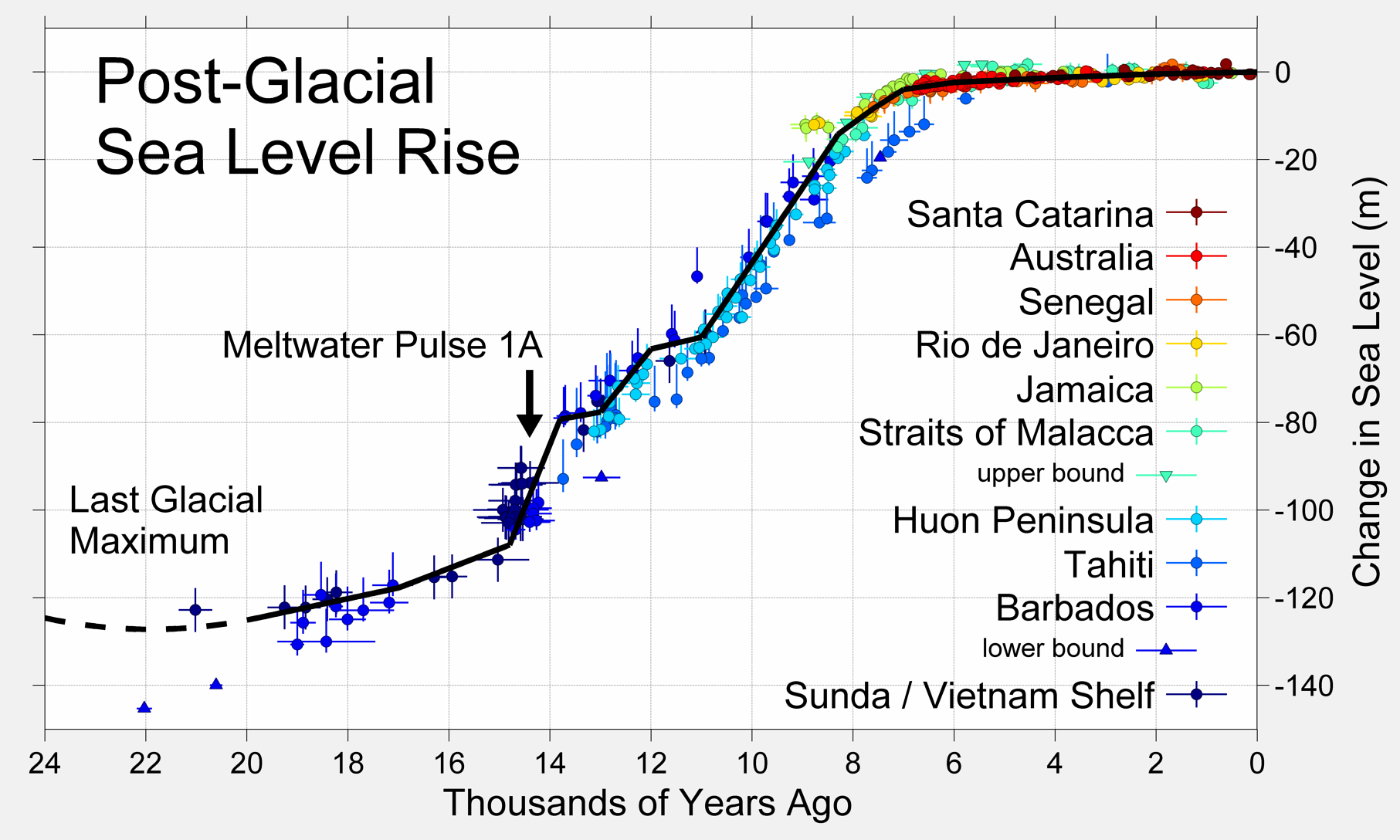
Don’t be forgetting now, there was a lot more real estate available to the grazing herbivores prior to the pre-12,000 BP “time” of the Post Glacial Sea Level Rise.
If you drop the sea level by 60 meters (180+ feet) …. edible growing acreage increases significantly.
Doggerland, for instance, was probably a rich habitat with human habitation in the Mesolithic period. To wit: https://en.wikipedia.org/wiki/Doggerland
A bit off-topic, but….How accurate is the following comment?
“Meat consumption is projected to double from 2014 to 2040. More meat means more greenhouse gas emissions from agriculture, which could triple by 2055, if current dietary trends and population growth continue. Crop yields are already reduced in some parts of the world due to climate change. Elevated ozone levels have caused losses of about 10 percent for wheat and soybeans. Global warming of more than 3 degrees will exceed the agriculture’s adaptive capacity.”
The Global Opportunity Network at EAT Food Forum, Published on June 20, 2016
I have no idea how to rebut…
What a load of complete and total garbage.
More CO2 means more agricultural production, not less, thanks to more plant food in the air. Plants can conserve moisture by keeping their stomata open for less time. Also warmer means wetter, so again more plant drink in the ground.
Where are these crop losses? Wheat and soybean production are up, way up, since 1945, 1975 or 2005, all during the postwar increase in CO2.
Are they afraid of methane from meat production? The trees cut down to make pasture land for livestock also produce methane.
Scientific illiterates. Or liars.
https://wattsupwiththat.com/2016/04/27/nasa-carbon-dioxide-fertilization-greening-earth-study-finds/
https://wattsupwiththat.com/2016/02/16/study-increased-carbon-dioxide-is-greening-deserts-globally/
There are many more here at WUWT..Just type in Greening Planet in the search area up top !
Meat is about right per FAO. China alone is a big factor. See my book Gaia’s Limits, Chapter 3.
Ag does not result in more GHG except for beef (digestive methanogens) and rice (paddy methanogens). Most meat increase will be farmed fish, pork, and chicken. Crops are a net GHG sink. So the GHG statement is flat wrong.
There are no yield reductions anywhere from GHG. There are places where yields have stopped increasing due to full adoption of best practices and plant physiology. China and India potatos are an example. Japanese and Chinese rice another example. See Chapter 3 for specifics.
Ozone has diddly to do with wheat and soy yields. Check their source; it will for sure be funky.
3C degrees will not exceed ag adaptation. Pure BS. For example, rice and corn cultivars are used extensively around the world in growing zones where the average growing temperatures differ by much more than that. Corn in Minnesota versus corn in Georgia versus corn in Kenya. Upland rice versus lowland rice in Laos and Thailand. Wheat in Egypt versus wheat in Russia versus wheat in Montana. See chapter 3 for an expose of the NRDC fr**d perpetrated on US Congress concerning US corn, which is likely where this last falsehood originated. A version was also posted here IIRC back in 2011. My first guest post at WUWT.
From U. of Illinois Urbana-Champaign SOYFACE experiments
http://www.life.illinois.edu/delucia/PUBLICATIONS/GCB_1502.PDF
“How do elevated CO2 and O3 affect the interception and utilization of radiation by a soybean canopy?”
Briefly: CO2 elevated to levels expected in 2050, result 15% increased yield.
Increased O3 resulted in 3% reduction of yield.
When both CO2 and O3 were elevated the effect of CO2 overcame the negative effect of O3.
gabro has it right – more alarmism than the mind can take in ! more CO2 and heat will make this planet a paradise !
One can easily recognize a Church of CAGW true believer if they use the term “carbon pollution” as part of their environmental lexicon to describe anthropogenic CO2 emissions.
Doesn’t everybody know the only decent food is meat. All those people who eat nuts and twigs… same as the animals I eat …. grazers. I never considered spinach as something you actually. .. gag …. eat. And the worst thing I ever ate was grass jelly. The black version is like semi solid motor oil.
Ever heard your mother say ” eat your vegatables”… yep kids know. Nobody had to tell me tomatoes were bad for you. … contrary to the health professionals, all the foods they push are bad for me and my family.
I wonder if your mother wonders how you never grew up…
Tomatoes are fruits, and like most fruits, yummy.
/Mr Lynn
Tomatoes are a fruit that is poisonous to me. Taste is one thing, the desired effect on the body another.
At the core of the global warming con game was the sales pitch that warming is scary and bad , WRONG .
IT is cause for celebration and hope because plants trees and animals do better when not under a mile of ice . If humans make some small contribution to warming well YIPPY !
We should enjoy it while it lasts .
Thanks to all for your comments.
This website says the beginnings can be traced to pre-Holocene.
https://6000generations.wordpress.com/2013/05/04/agricultural-beginnings-were-during-the-pre-holocene-glacial-period/
I had a rather lengthy discussion on Climate Etc about why didn’t agriculture begin during the Eemian.
Related to question I posed to John Hawkes who wrote: “I will note that there is now some evidence of intensive collection of cereals in tropical Africa before the Eemian
http://johnhawks.net/weblog/mailbag/eemian-agriculture-2012.html
I’d say that because Anatomically Modern Humans were restricted to Africa in the Eemian.
Intensive collection isn’t quite the same as agriculture or even simple cultivation, but population densities in Africa before 114 Ka might have sufficed to warrant greater manipulation of the environment.
Even under glacial conditions in Europe and Asia, the dog was domesticated (or domesticated itself), and there is evidence of herd management of wild reindeer and horses, if not of true domestication. Maybe along the lines of Laplander reindeer herders.
Quite possibly domesticated twice. once in Siberia and once in Europe. Fascinating paper on that looking at genetic differences. Came out just a few weeks ago. Another evidence for ‘convergent evolution’ of domestication and agriculture.
The article in the Atlantic on the Oxford and US team’s work said dogs were domesticated once in China and once in Europe, but that the Ancient Western dogs were genetically swamped by inc-coming Ancient Eastern dogs.
Previous work on wolves and dogs had suggested NE Asia, ie Siberia, as the where domestication first occurred.
Modern dog DNA is so homogenized that the team looked at archaeological dog remains to try to unravel the history of canine domestication.
Opportunistic collection of wild cereals is still hunter gatherer culture. Think bears and berries. Still practiced in parts of Africa. Agriculture is when permanent/semipermanent (seasonal) settlements plant, grow, and store foodstuffs seasonally, but do not roam about. The natural selection of better grains/ more productive plants is how MesoAmericans created maise from teosinte. The Plains Indians were hunter gatherers at a time when the Anastazi had been in agricultural settlements for centuries.
If you dig into the more technical archaeological literature, the concept of agriculture will gradually become rather fuzzy around the edges. Most “hunter-gatherers” surviving live in marginal environments, mostly desert, practice a “forager” economy. Deserts (e.g the upper Sonoran desert in the Great Basin) and savanah environments often have abundant grass, and other small, hard seed sources. The Great Basin has abundant Pinyon Pine was well as grass. Deserts also often have abundant bugs and animals that prey on grass (grasshoppers, jack rabbits, antelopes). Hunter gatherers in these environments prey on all of these, but preferentially weight their subsistence toward the more easily acquired and stored foods (seeds, pinyon nuts), followed by jack rabbits, which carry inadequate fat to use as a dietary mainstay (leads to a condition called rabbit starvation), and lastly by antelope, which are by far the most rewarding, but far and away the most difficult to take and thus the most costly in energy – directly, and in terms of energy needed to collect the materials needed to make and employ gear required for the hunt. In the Owens Valley in eastern California the Paiute dug ditches that directed water to “natural” stands of grass. That is, they essentially cultivated stands grass, but did not plant them. These prehistoric ditches were later improved and employed by ranchers to supply water to actual agriculture until Los Angeles stole the water judicially. The point here is that long before agriculture is recognized archaeologically, the elements were in place and very likely being practiced.
Agree, Duster. I thought the same.
Traditional subsistence patterns can’t be broken down into a simple hunter/gatherer or agriculture dichotomy.
Of course, only agriculture can support the large populations of early civilizations.
My argument regarding the Eemian has been that the anatomically modern humans were not totally human. We had to evolve more complex communication mechanisms, reduce aggression, and learn better cooperation.
https://broadspeculations.com/2012/12/22/lost-history-revenge-of-the-nerds/
There is an archaeological, historical question of when agriculture began. My guess is it began well before we had the large scale agriculture of the Holocene but evidence for this is sparse I admit.
Certainly increased CO2 in the Holocene enhanced the ability of early civilizations to support larger populations but so did warming and a reduction in climate extremes. So CO2 was one factor.
However, my question was regarding the Eemian when I believe CO2 reached levels similar to the early Holocene. Regarding whether humans were not out of Africa. I’ll quote John Hawkes in his reply:
“Demographic intensification in Africa and resulting mass migration DID happen in the Eemian, and we call this the out-of-Africa event.”
CO2 was higher in the Eemian even than the Holocene Climatic Optimum.