From the UNIVERSITY OF MINNESOTA and the “any motorcycle or bicycle rider can tell you this” department comes this study on UHI in Minneapolis.
Results provide valuable insights into efforts to reduce heat-related harm in metro areas globally

Some parts of the Twin Cities can spike temperatures up to 9°F higher than surrounding communities thanks to the “urban heat island” effect, according to a new study from the University of Minnesota.
The study, which was funded by the Institute on the Environment and published in the Journal of Applied Meteorology and Climatology, used a network of 180 sensors deployed throughout the Twin Cities metropolitan area in residential backyards and city parks to paint the most detailed picture anywhere in the world of how temperature varies with time and place across pavement-filled metropolitan areas and surrounding communities.
Recording surface air temperatures every 15 minutes from August 2011 through August 2014 across nearly 2,000 square miles and using U.S. Geological Survey data to fine-tune differences at the neighborhood level, the study uncovered several surprises. Among them:
Temperatures in the urban core of Minneapolis, St. Paul and Bloomington average 2 °F higher in summer than in surrounding areas
The differential spiked as much as 9 °F higher during a heat wave in July 2012
Urban heat island effect is stronger at night in summer and during the day in winter
In urban areas during the winter when snow cover is less pervasive, temperatures are higher than rural areas in the daytime by an average of 2 °F.
“We’ve long known that heat radiated by buildings, roads, bridges and other structures keeps surface air temperature higher in cities than in surrounding areas. However, temperature is officially measured at just a few locations in most cities, so awareness of the extent and variability of urban heat island effects was limited,” said lead author Brian Smoliak. “Our study highlights the usefulness of dense sensor networks for urban weather and climate research with practical implications for human health, energy consumption, and environmental quality.” Smoliak began the project as a postdoctoral researcher in CFANS and is now an atmospheric scientist at the Climate Corporation in Seattle, Washington.
The more detailed understanding of urban heat islands provided by the study can help health professionals and others target efforts to protect people and infrastructure from heat-related problems, according to project co-leads Tracy Twine and Peter Snyder, associate professors in the College of Food, Agricultural and Natural Resource Sciences.
“This level of detail in real time can provide specific information to agencies tasked with protecting our citizenry during extreme heat events,” Snyder said. “It can also be used to identify persistently warm areas of the metro where green infrastructure projects could be implemented to offset some of the warming.”
###
The University of Minnesota’s Institute on the Environment seeks lasting solutions to Earth’s biggest challenges through research, partnerships and leadership development. For more information, visit environment.umn.edu.
Paper: Brian V. Smoliak et al. Dense Network Observations of the Twin Cities Canopy-Layer Urban Heat Island*, Journal of Applied Meteorology and Climatology (2015). DOI: 10.1175/JAMC-D-14-0239.1
| Abstract |
|---|
Data from a dense urban meteorological network (UMN) are analyzed, revealing the spatial heterogeneity and temporal variability of the Twin Cities (Minneapolis–St. Paul, Minnesota) canopy-layer urban heat island (UHI). Data from individual sensors represent surface air temperature (SAT) across a variety of local climate zones within a 5000-km2area and span the 3-yr period from 1 August 2011 to 1 August 2014. Irregularly spaced data are interpolated to a uniform 1 km × 1 km grid using two statistical methods: 1) kriging and 2) cokriging with impervious surface area data. The cokriged SAT field exhibits lower bias and lower RMSE than does the kriged SAT field when evaluated against an independent set of observations. Maps, time series, and statistics that are based on the cokriged field are presented to describe the spatial structure and magnitude of the Twin Cities metropolitan area (TCMA) UHI on hourly, daily, and seasonal time scales. The average diurnal variation of the TCMA UHI exhibits distinct seasonal modulation wherein the daily maximum occurs by night during summer and by day during winter. Daily variations in the UHI magnitude are linked to changes in weather patterns. Seasonal variations in the UHI magnitude are discussed in terms of land–atmosphere interactions. To the extent that they more fully resolve the spatial structure of the UHI, dense UMNs are advantageous relative to limited collections of existing urban meteorological observations. Dense UMNs are thus capable of providing valuable information for UHI monitoring and for implementing and evaluating UHI mitigation efforts.
Does anyone remember the “heat-related harm“ that occurred in NYC when some “do-gooders” forced the City to install rubber “mats” on a small playground to protect the children from harm or injury if they fell off of the rides n’ slides n’ other things?
Shur nuff they did.
Only problem was, ….. they created a highly efficient UHI when they installed “black” rubber mats which “burned blisters” on the children when the “mats” became extremely “HOT” in the bright Sunshine.
It would be an interesting experiment to “homogenize” the data from those 180 sensors, and see what the output looks like.
Here’s the IR temperature profile for different materials in my front yard starting late afternoon, ~9:00pm, midnight, and then Sunrise the following morning. I live 30 miles from any city center, next to a national park, but home and roads are all around, and the airport’s temperatures are most of the time 3-5F warmer.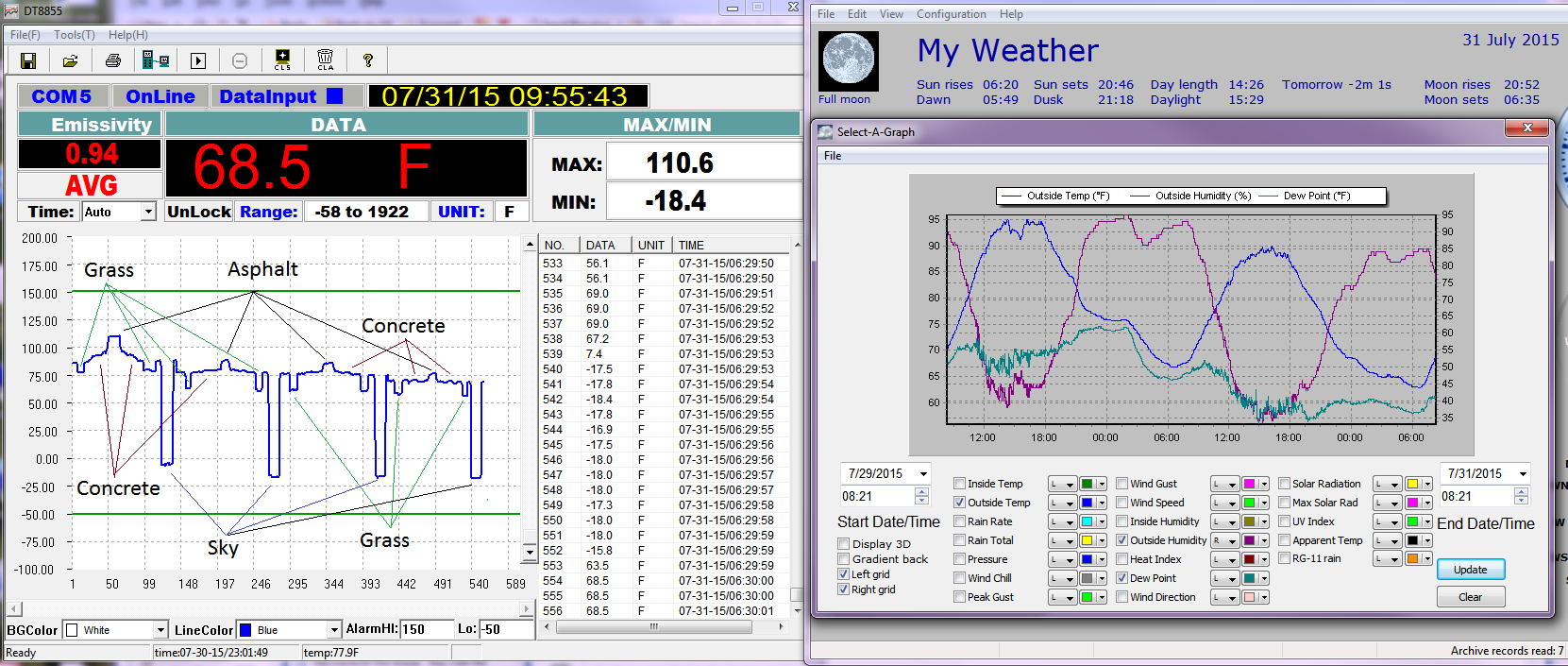
And these swings are easily felt while riding a motorcycle as mentioned.
The slope in the temp of the concrete is from the shadow of the house moving down the sidewalk, by the time I took the first measurement the entire length of the front sidewalk was in shade to the asphalt driveway.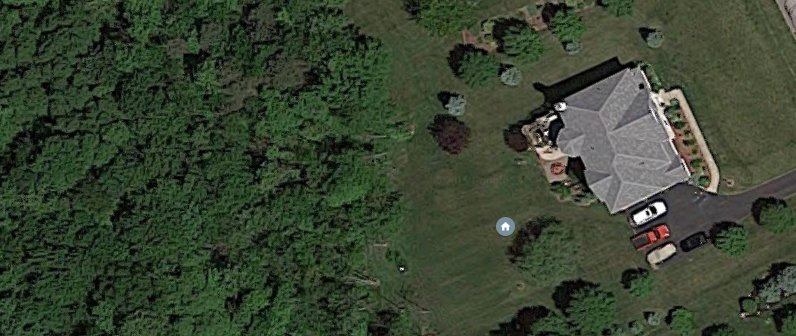
I start measuring from the front door, and then walk out to the driveway. The image is mostly E-W with east to the right.
I am surprised he got any cash to do this study. In the UK two people I know tried to get grants to do it and in one case a “better qualified applicant” got the grant instead even though better qualified equalled a lower class of degree from a low prestige ex poly. Both are no longer in the climate science field from total disillusionment as to its integrity.
The Lovin’ Spoonful
Summer in the City
SUMMER IN THE CITY
Hot town, summer in the city
Back of my neck getting dirty and gritty
Been down, isn’t it a pity
Doesn’t seem to be a shadow in the city
All around, people looking half dead
Walking on the sidewalk, hotter than a match head
But at night it’s a different world
Go out and find a girl
Come-on come-on and dance all night
Despite the heat it’ll be alright
And babe, don’t you know it’s a pity
That the days can’t be like the
nights
In the summer, in the city
In the summer, in the city
Cool town, evening in the city
Dressing so fine and looking so pretty
Cool cat, looking for a kitty
Gonna look in every corner of the city
Till I’m wheezing like a bus stop
Running up the stairs, gonna meet you on the rooftop
But at night it’s a different world
Go out and find a girl
Come-on come-on and dance all night
Despite the heat it’ll be alright
And babe, don’t you know it’s a pity
That the days can’t be like the
nights
In the summer, in the city
In the summer, in the city
Hot town, summer in the city
Back of my neck getting dirty and gritty
Been down, isn’t it a pity
Doesn’t seem to be a shadow in the city
All around, people looking half
dead
Walking on the sidewalk, hotter than a match head
But at night it’s a different world
Go out and find a girl
Come-on come-on and dance all night
Despite the heat it’ll be alright
And babe, don’t you know it’s a pity
That the days can’t be like the
nights
In the summer, in the city
In the summer, in the city
Unsolved Environ Mental Problem 40+ ys.