Heat trapped below the surface will begin moving up kicking off a warming cycle
A new study of ocean temperature measurements shows that in recent years, extra heat from greenhouse gases has been trapped in the subsurface waters of the Pacific and Indian oceans, thus accounting for the slowdown in the global surface temperature increase observed during the past decade, researchers say.
A specific layer of the Indian and Pacific oceans between 300 and 1,000 feet below the surface has been accumulating more heat than previously recognized, according to climate researchers from UCLA and NASA’s Jet Propulsion Laboratory. They also found the movement of warm water has affected surface temperatures. The results were published July 9 in the journal Science.
During the 20th century, as greenhouse gas concentrations increased and trapped more heat on Earth, global surface temperatures also increased. However, starting in the early 2000s though greenhouse gases continued to trap extra heat, the global average surface temperature stopped climbing for about a decade and even cooled a bit.
In the study, researchers analyzed direct ocean temperature measurements, including observations from a global network of about 3,500 ocean temperature probes known as the Argo array. These measurements show temperatures below the surface have been increasing.
The Pacific Ocean is the primary source of the subsurface warm water found in the study, though some of that water now has been pushed to the Indian Ocean. Since 2003, unusually strong trade winds and other climatic features have been piling up warm water in the upper 1,000 feet of the western Pacific, pinning it against Asia and Australia.
“The western Pacific got so warm that some of the warm water is leaking into the Indian Ocean through the Indonesian archipelago,” said Veronica Nieves, lead author of the study and a UCLA researcher with the UCLA Joint Institute for Regional Earth System Science and Engineering, a scientific collaboration between UCLA and NASA’s Jet Propulsion Laboratory.
The movement of the warm Pacific water westward pulled heat away from the surface waters of the central and eastern Pacific, which resulted in unusually cool surface temperatures during the last decade. Because the air temperature over the ocean is closely related to the ocean temperature, this provides a plausible explanation for the global cooling trend in surface temperature, Nieves said.
Cooler surface temperatures also are related to a climatic pattern called the Pacific Decadal Oscillation, which moves in a 20- to 30-year cycle. It has been in a cool phase during the entire time surface temperatures showed cooling, bringing cooler-than-normal water to the eastern Pacific and warmer water to the western side. There currently are signs the pattern may be changing, with observations showing warmer-than-usual water in the eastern Pacific.
“Given the fact the Pacific Decadal Oscillation seems to be shifting to a warm phase, ocean heating in the Pacific will definitely drive a major surge in global surface warming,” Nieves said.
Previous attempts to explain the global surface temperature cooling trend have relied more heavily on climate model results or a combination of modeling and observations, which may be better at simulating long-term impacts over many decades and centuries. This study relied on observations, which are better for showing shorter-term changes over 10 to 20 years.
Pauses of a decade or more in Earth’s average surface temperature warming have happened before in modern times, with one occurring between the mid-1940s and late 1970s.
“In the long term, there is robust evidence of unabated global warming,” Nieves said.
###
Co-authors are Josh Willis and William Patzert of NASA’s Jet Propulsion Laboratory.
quicker the better as we are freezing in Australia http://www.9news.com.au/national/2015/07/17/18/53/snow-descends-on-country-nsw
“A new study of ocean temperature measurements shows that in recent years, extra heat from greenhouse gases has been trapped in the subsurface waters ”
So my question is, just what are these folks using to bait this heat trap in the “subsurface waters”?
“The movement of the warm Pacific water westward pulled heat away from the surface waters of the central and eastern Pacific, which resulted in unusually cool surface temperatures during the last decade.”
How does that work, exactly?
Did the heat start traveling up-gradient in the first known violation of the second law of thermo-dynamics?
Are they claiming some form of convection moved the warmest waters from the central and eastern Pacific, leaving only the cooler water behind?
I do not understand a physical mechanism whereby warm water, leaking through Indonesia and into the Indian ocean, pulls heat (but possibly not actual water) from a cooler part of the ocean into a warmer part.
Is there such a device conjectured in the paper, or did they just ignore the elephant in the room?
The ocean needs to warm in the top 100’s of meters before the energy can be circulated to lower depths. The fact that observations have not shown this while global temperatures failed to warm, show the hypothesis being FALSE that the surface had anything to do with it.
Then a even bigger issue therefore is the energy build up was caused be deeper ocean circulation and not surface warming during this time. They don’t have a clue how this depth of ocean many decades ago behaved and likely just an ocean cycle than in part probably adjusted to contribute to the cooling phase during the 1940’s to 1970’s and contributed towards the warming in the 1980’s to 1990’s.
They can’t always have it one way, all mechanisms give or take. How can they ignore warming near the surface during the 1980’s and 1990’s wasn’t caused by a previous release of energy from the same region in question that has been noticed now?
Matt,
The idea that heat must circulate to the deep ocean is a red herring. The temperature profile of the ocean is dictated by the pressure/density/temperature profile of water under the influence of gravity. Take a look at the temperature profile of the thermocline,
This looks exactly like the temperature profile through an insulated wall, where the outside temperature is 4C and the inside temperature is 24C. While water is not a particularly good insulator, at a sufficient thickness, even iron will act as an insulator between hot and cold. It’s no coincidence that the temperature of the midpoint in the thermocline is the average temperature of the planet (15C -> 288K),
In the tropics, there is more evaporation than precipitation, while at the poles, there is more precipitation than evaporation, This causes ocean levels at the equator to fall as they rise in the polar regions. The hydraulic action results in cold water being pushed up from below in the tropics to offset the latitudinal differences between evaporation and precipitation. The only net heat that the oceans must collect before they can be in equilibrium in response to this hydraulic action is that needed to adjust temperature at the boundaries of the thermocline. Similarly, changes in average temperature only require adjustments at these same boundaries.
It seems like the ocean stores energy much like a capacitor, where energy is stored as a temperature difference, insulated by the thermocline, rather than a potential difference separated by a dielectric. All of the cold water below the thermocline is well below the average temperature of the planet, while equatorial waters are above and the net energy ‘stored’ by the ocean, relative to the average temperature of the planet, is much lower than conventionally considered and it is this that leads to unreasonably long estimates of the time constant in order to explain the high sensitivity which is otherwise contradicted by the data.
Sorry, should be all mechanisms give and take. (just not all at the same time)
co2isnotevil July 17, 2015 at 10:40 am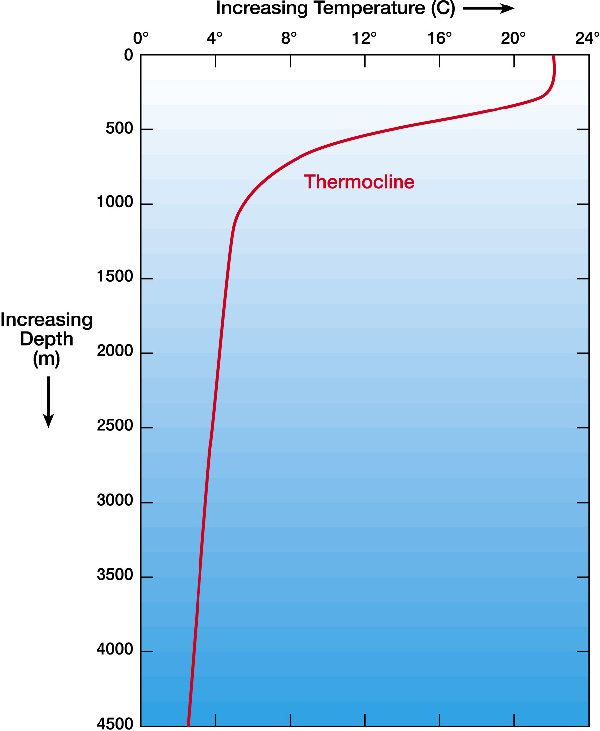
My mistake, thanks for pointing it out. (should have been like this)
“The ocean needs to warm in the top 100’s of meters before the energy can be transferred to lower depths.”
My point is NOT that it can only warm lower depths with circulation. I meant the only way lower depths can warm without the volume immediately above them warming is by circulating ocean caused by salinity changes or wind/waves. If the volume of water above warms then of course it can warm the lower depths roughly like the graph below shows.
Matt,
If the deep waters varied in temperature as the planets temperature changes, what you said describes how those temperatures could change. My point is that the lower depths do not warm or cool even as the surface warms or cools. Relative to the whole, salinity is somewhat irrelevant as there’s not much chance of another cold, freshwater lake many times larger than the great lakes combined instantaneously draining into the ocean. The lowest depths (most of the water in the oceans) will be between 0 and 4C because cold water is denser and sinks while the thermocline insulates it from warm surface waters. This will be the case until the polar regions stop freezing which will probably not happen until the Sun enters its red giant phase. While at a sufficient thickness water can be an insulator, over short distances it’s a relatively good conductor and conduction alone is sufficient to re-organize the ocean heat across the thermocline as the planets average temperature varies. This happens fast enough and affects a small enough volume of water that ocean time constants are on the order of a year or so and not the decades to centuries required to support the hidden heat hypothesis (the slow change hypothesis).
every single time a paper is discussed on here i think it would be prudent to send a link to the authors. they may not care for the discussion, but it would be nice to let them know they are held in contempt by many people that just do not buy the dogma.
co2isnotevil July 17, 2015 at 2:14 pm
I agree with one or two exceptions, but I was describing about lower depths in the thermocline related to this article, not many thousands of meters below the ocean surface where temperatures are close to 0 c. In this depth numerous areas of sinking and upwelling ocean water have been observed with deep ocean circulations. The deeper the ocean the less interaction with the surface and the longer it takes for changes to occur, especially away from these sinking and upwelling zones.
The first exception is solar energy warming the surface if great enough, will eventually warm the deep ocean. It may take many hundreds of years, but 1% increase in solar energy would rise deep ocean temperatures by about 2.4c.
The second exception are fossils found in layers drilled from the bottom of sea bed. These fossils are matched with what these species climate prefer to live in. Some only live in depths of the ocean and have found to prefer different temperature zones. Therefore can estimate the depths of the ocean have varied by few degrees over hundreds of millions of years.
Certainly the temperatures within the thermocline vary as the average surface temperature varies since the average temperature at its midpoint is the average temperature of the planet, which for all intents and purposes is the average temperature of the oceans. The deep ocean cold is exposed to contribute to the average surface temperature, but only towards the poles where there is no thermocline. Ocean levels rise and fall by as much as 100m and land masses rise and fall by kilometers as they migrate all over the globe, all of which can affect the fossil record. I suspect the thickness of the thermocline would vary as the average temperature varies, there being a lesser difference between the <=4C at the bottom and the average on top, although it's possible the water on top isn't much cooler than it is today, it's just that there's a lot less of it and a larger fraction of deep ocean cold contributing to the average.
I don't agree that it it would take 100's of years for a 1% increase in net solar input (all else being equal) to increase the average by 2.4C, but that a 1% increase would increase the average temperature of the planet by 99% of the way there (5 time constants) within a decade at the most. A simple thought experiment is to consider how quickly the planet would become a frozen wasteland if the Sun stopped shining. Proof of concept is when the Sun sets for the polar winter. The planet only needs to get to 80K to be 99% of the way to 0K, starting from 255K (on a W/m^2 basis). Do you think it would take more than a decade to get there?
increase the average temperature of the planet by 99% of the way there
should be
increase the average temperature of the planet by less than 1C and get greater than 99% of the way there
It seemed to think the text between the less than symbol and greater than symbol was html …
Well there’s one pretty relevant point, where she says:
“Previous attempts to explain the global surface temperature cooling trend have relied more heavily on climate model results …………………………. This study relied on observations, which are better for showing shorter-term changes over 10 to 20 years”
How true, actual facts are definitely better than models that don’t work as a basis for a scientific study. It’s tragic, utterly tragic and rather pathetic, that this even needed saying. Of course, the inferences you draw from factual observations aren’t automatically better than inferences from models that don’t work, especially if most of your conclusions have been established in advance.
The facts presented are definitely interesting, probably relevant to oceanography, and needed an airing. Then she ends the media release with a dead giveaway:
“In the long term, there is robust evidence of unabated global warming,” Oh, really?
Here’s a plausible translation: “I think I’ll be getting an even bigger grant next year if I hold my nose, close my eyes, cross my fingers, spout this nonsense and whisper “not” to myself”.
At least, if you publicly supported Lysenko in Stalin’s USSR, you would be avoiding a one-way trip to the gulag for re-education. In the capitalist democracies of the 21st century, it’s just about getting grant money and advancing your career. Progress, perhaps?
Wish I knew how to make those neat boxes to put quotes into……… Wish I knew how to add a graphic, or even a hyperlink. Must be getting old. Good thing too, I won’t have to watch the commoditisation (?) of science much longer. Commodification? Whatever, turning it into a commodity to be bought and sold.
Sounds like the Alarmists are going to blame an El Nino on mythical CO2-generated trapped ocean heat.
co2isnotevil July 17, 2015 at 5:40 pm
i do agree the near surface would warm much quicker, but there is no way the deep ocean would warm at similar time length anywhere as close to near the surface. I do agree the planet can cool very quickly and Ice-ages have been known to occur in a little as 10 years in proxy records, so near the surface certainly can change quickly.