![CMIP5-90-models-global-Tsfc-vs-obs-thru-2013[1]](https://wattsupwiththat.files.wordpress.com/2014/06/cmip5-90-models-global-tsfc-vs-obs-thru-20131.png?quality=75)
Alex Sen Gupta, a biological scientist, has written an article (reviewed by John Cook) which attempts to defend the validity of climate models which can’t predict the climate.
According to Gupta;
To understand what’s happening, it is critical to realise that the climate changes for a number of reasons in addition to CO₂. These include solar variations, volcanic eruptions and human aerosol emissions.
The influence of all these “climate drivers” are included in modern climate models. On top of this, our climate also changes as a result of natural and largely random fluctuations – like the El Nino Southern Oscillation, ENSO and the Interdecadal Pacific Oscillation, [IPO] – that can redistribute heat to the deep ocean (thereby masking surface warming).
Such fluctuations are unpredictable beyond a few months (or possibly years), being triggered by atmospheric and oceanic weather systems. So while models do generate fluctuations like ENSO and IPO, in centennial scale simulations they don’t (and wouldn’t be expected to) occur at the same time as they do in observations.
The problem with this claim is that, as Gupta says, the climate models are supposed to take these random fluctuations into account. Climate models are supposed to accommodate randomness, by providing a range of predicted values – the range is produced by plugging in different values for the random elements which cannot be predicted. However, observations are right on the lower border of that range. The divergence between climate models and predictions is now so great, that climate models are on the brink of being incontrovertibly falsified.
As Judith Curry recently said, If the pause continues for 20 years (a period for which none of the climate models showed a pause in the presence of greenhouse warming), the climate models will have failed a fundamental test of empirical adequacy.
This is important, because it strikes at the heart of the claim that climate models can detect human influence on climate change. If climate models cannot model climate, if the models cannot be reconciled with observations, how can the models possibly be useful for attributing the causes climate change? If scientists defending the models claim the discrepancy is because of random fluctuations in the climate, which have pushed the models to the brink of falsification, doesn’t this demonstrate that, at the very least, the models very likely underestimate the amount of randomness in the climate? Is it possible that the entire 20th century warming might be one large random fluctuation?
Nature is certainly capable of producing large, rapid climate fluctuations, such as the Younger Dryas, an abrupt return to ice age conditions which occurred 12,500 years ago. You can’t use climate models which demonstrably underestimate the randomness of climate change, to calculate how much of the observed 20th century warming is not random.
If current mainstream climate models cannot predict the climate, then scientists have to consider the possibility that other models, with different assumptions, can do a better job. It is no accident that Monckton, Soon, Legates and Brigg’s paper on an irreducibly simple climate model, which does a better job of hind casting climate than mainstream models, has received over 10,000 downloads. As every scientific revolution in history has demonstrated, being right is ultimately more important than being mainstream, even if it sometimes takes a few years to win acceptance.
For now, mainstream climate scientists are mostly hiding in the fringes of their estimates. When they acknowledge it at all, they claim that the anomaly, the pause, is a low probability event which is still consistent with climate models. Hans Von Storch, one of the giants of German climate research, a few years ago claimed that 98% of climate models cannot be reconciled with reality – which still, for now, leaves 2% possibility that climate scientists are right.
Is the world really preparing to spend billions, trillions of dollars, on a 2% bet?
Or you could look at it this way…
* From the mid-1940’s to the mid-1970’s we were suffering from global cooling (remember all the panic about “The Coming Ice Age”?).
* But around the mid-1970’s we hit a “pause in global cooling”.
What Judith Curry says is probably true re the surface data sets, against which model performance is assessed. If there had been a period of 20 years with no warming, then the CMIP5 model range would already be falsified.
As it stands though, all the surface data sets used by the IPCC (HadCRUT4, GISS and NOAA) not only show continued warming over the past 20 years, but since 1995 the warming is statistically significant in all cases. With 2 sigma error margins, the per decade trends since 1995 are:
HadCRUT4: 0.109 ±0.090
GISS: 0.114 ±0.089
NOAA: 0.094 ±0.090
http://www.ysbl.york.ac.uk/~cowtan/applets/trend/trend.html
Could you run that again with the pre-adjusted data?
Claim: Data does not prove that climate models are wrong. Simply amazing!!!!
Consider the 2007 IPCC AR4. That report was hailed as the ‘gold standard in climate science’ – the settled science. That contents of the report related to those charts of rising CO2 scenarios and resulting rising temperature trends, determined by those costly crystal balls known as climate models.
In short, AR4 implied rising Co2 WILL cause rising temperatures … and the rising temperatures WILL be responsible for catastrophic climatic events etc etc etc. But for the last 18 years, nobody disputes rising CO2 yet there has been no discernible rising temperature trend. Shucks!!!!!
This one simple observation has rendered obsolete, the 2007 IPCC AR4. It shows the report was not “gold standard’, it was not ‘settled science’, and it was certainly not worth the paper it was written on!
Channel 7 news. Coldest Autumn in Melbourne ,Australia since 1998. just putting on the record.
regards
I often wonder why, when comparing observations against model performance, people don’t use the IPCC AR5 metric. This, after all, is the measure by which the IPCC will judge CMIP5 model performance.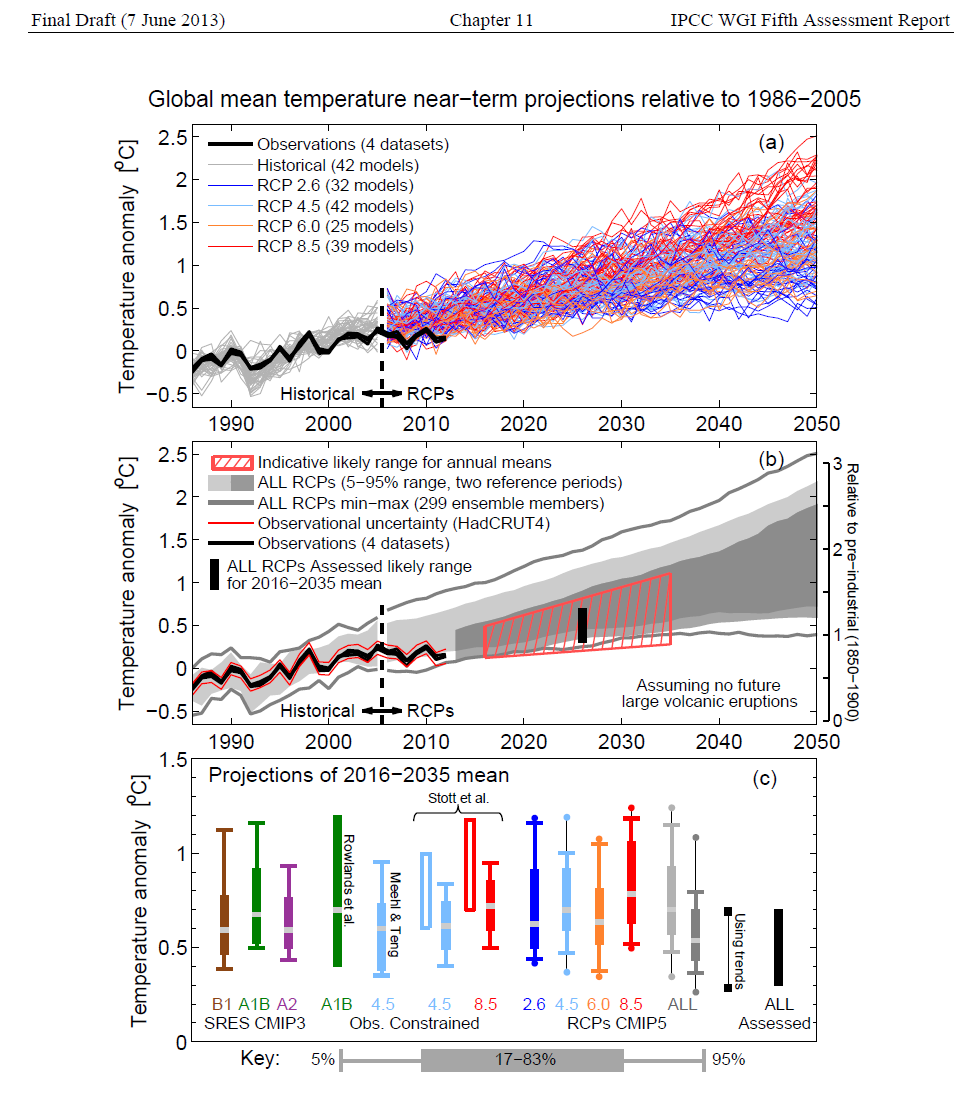
Chapter 11 of AR5 deals with near term projections. Figure 11.25b (page 1011) compares observations against near-term projections (anomalies relative to 1986–2005). All values shown are annual averages, using one ensemble member per model for all RCPs (centre chart here):
UK climate scientist Ed Hawkins has updated this chart annually; the latest update being 2014. http://www.climate-lab-book.ac.uk/wp-content/uploads/fig-nearterm_all_UPDATE_2014.png
As you can see, by the IPCC’s own metric, current observations are on the low side, but within the 5-95% range of projections. 2015 to date is currently aimed towards the upper end of the vertical green line (UK Met Office 2015 forecast range).
“…reviewed by John Cook…”
I’m sorry but “Bwahahahahahahahahahahahahahahahahahahahahahahaha…..”
KevinK: The Wright Brothers did not “invent” the wind tunnel. They made their own, using a bicycle to turn the fan to make the air flow. They recalculated the tables from Lilienthal’s “Der Vogleflung” and found an important systematic error in Lilienthal’s results. There is a STRONG CONNECTION HERE to the “psychology of science orthodoxy” , i.e. Lilienthal was THE academic authority with regard to the physics of flight during the second 1/2 of the 20th century. Taking his work as “definitive” and not challenging any of it, ended with many an academic declaring on the basis of “power to weight” calculations, that a “heavier than air” flying machine was IMPOSSIBLE. Fortunately the Wright Brothers were NOT academics, (8th grade educations both, typical of the era) and fortunately they did not operate on the “voice of authority”.
How we got to this “religious worship” of “climate scientists” and “climate models”, completely baffles me…but I see the precedents clearly. (See Einstein’s “On the Electrodynamics of Moving Media”, 1905, and
the time for general “recognition” (NOT acceptance, being 1911, after the first Solvey conference (http://en.wikipedia.org/wiki/Solvay_Conference). The lesson here? As we get colder and colder in the next 15 years, about 2030, Svensmark well begin to be “looked at and by 2040, he’ll be considered the climate Einstein.
Gupta states:
our climate also changes as a result of natural and largely random fluctuations.
____
Guptas conclusion:
Shame on Nature, beasty complex. Not adopting to our minimiced SuperComputing abilities.