Guest Post by Bob Tisdale
UPDATE: Corrected the percentage of ocean heat loss though evaporation. Update 2: Added a link to a post by Willis Eschenbach at the end, and corrected a typo.
# # #
Ocean heat content and vertically averaged temperature data for the oceans have been the subjects of a couple of recent blog posts. As one might expect, the discussions on those threads tend to shift to the subject of whether or not the infrared (longwave) radiation from manmade greenhouse gases can cause any measureable ocean warming at the surface or at depth. According to the hypothesis of human-induced global warming, the warming of the global oceans to depth and the related ocean heat uptake are a function of the radiative imbalance caused by manmade greenhouse gases. There are a number of arguments for and against the hypothetical anthropogenic warming of the oceans.
So the topic of this post is ocean warming. I’ll present different opinions/arguments on anthropogenic ocean warming.
For a detailed overview of ocean heat content data, please see the post Is Ocean Heat Content Data All It’s Stacked Up to Be? And see the post AMAZING: The IPCC May Have Provided Realistic Presentations of Ocean Heat Content Source Data for another discussion by the IPCC.
INFRARED RADIATION CAN ONLY PENETRATE THE TOP FEW MILLIMETERS OF THE OCEAN SURFACE AND THAT’S WHERE EVAPORATION TAKES PLACE
It is often argued that infrared radiation from manmade greenhouse gases can only penetrate the top few millimeters of the ocean surface and that’s where evaporation occurs. That argument then continues that additional infrared radiation from anthropogenic greenhouse gases can only add to surface evaporation, and cannot heat the oceans. On the other hand, sunlight reaches into the oceans to depths of 100 meters or so, though most of it is absorbed in the top 10 meters. Even so, sunlight’s ability to warm the oceans is many orders of magnitude greater than infrared radiation. One of my earliest memories of this argument came from Robert E. Stevenson’s (Oceanographer Scripps) 2000 article Yes, the Ocean Has Warmed; No, It’s Not ‘Global Warming’. In April of this year, looking for solid answers on this topic, Roy Spencer presented the same arguments and a few counter arguments in his post, Can Infrared Radiation Warm a Water Body?
Field tests reported in the 2006 post Why greenhouse gases warm the oceans at RealClimate are often cited by those who believe infrared radiation is responsible for ocean warming. That guest post by Peter Minnett of the University of Miami includes:
However, some have insisted that there is a paradox here – how can a forcing driven by longwave absorption and emission impact the ocean below since the infrared radiation does not penetrate more than a few micrometers into the ocean?
So this argument was considered by climate scientists. The post then goes on to describe why it’s not an inconsistency and then to present the results of field tests. My Figure 1 is Figure 2 from that RealClimate post.

Figure 1 – The change in the skin temperature to bulk temperature difference as a function of the net longwave [infrared] radiation.
The summary text for the illustration at RealClimate reads:
There is an associated reduction in the difference between the 5 cm and the skin temperatures. The slope of the relationship is 0.002ºK (W/m2)-1. Of course the range of net infrared forcing caused by changing cloud conditions (~100W/m2) is much greater than that caused by increasing levels of greenhouse gases (e.g. doubling pre-industrial CO2 levels will increase the net forcing by ~4W/m2), but the objective of this exercise was to demonstrate a relationship.
That, however, creates a counter argument that has been discussed by others. See the HockeySchtick post RealClimate admits doubling CO2 could only heat the oceans 0.002ºC at most. Let me put this into more recent terms. According to the NOAA Annual Greenhouse Gas Index, infrared radiation has only increased about 1.2 watts/meter^2 from 1979 to 2013. Based on the findings at RealClimate, that rise in infrared radiation could only warm the sea surfaces by a little more than 0.002 deg C since 1979. Yet, looking at the global sea surface temperature data, Figure 2, the surfaces of the global oceans warmed more than 0.3 deg C from 1979 to 2013, leaving about 93% 99.3% of the ocean surface warming unexplained.

Figure 2
A continuation of the Minnett-field-test argument is that manmade greenhouse gases and ocean mixing will cause the warming of the mixed layer of the oceans. The HockeySchtick counter could be applicable here as well. The mixed layer ranges in depth from about 20 to 200 meters. Unfortunately, temperature data specifically for the mixed layer are not available in an easy-to-use format, so let’s assume that the NODC’s vertically averaged temperature data for the depths of 0-100 meters captures the vast majority of the mixed layer. As shown in Figure 2, the warming rate of the top 100 meters of the ocean is slightly less than the surface. In other words, the warming rate based on the field tests presented by RealClimate can’t explain the vast majority of the warming of the top 100 meters.
Further to the RealClimate post by Peter Minnett, see the very recent ClimateConversation post HotWhopper wrong on ocean heat. It includes links to a three part discussion titled “Anthropogenic Ocean Warming?” by Richard Cummings, which covers the Minnett findings and other proposed mechanisms of anthropogenic warming of the oceans:
- Part 1: Skeptical Science Offside
- Part 2: The Improbable IPCC Mechanism
- Part 3: Rahmstorf, Schmittner and Nuccitelli
“AIR-SEA FLUXES ARE THE PRIMARY MECHANISM BY WHICH THE OCEANS ARE EXPECTED TO RESPOND TO EXTERNALLY FORCED ANTHROPOGENIC AND NATURAL VOLCANIC INFLUENCES”
The quote in the heading is from Chapter 10 (WG1) of the IPCC’s 5th Assessment Report.
Richard Cummings comments from Part 2 of his series begins:
That’s it. 25 years and five assessment reports after its 1988 formation, the IPCC has not been able to firm up an anthropogenic ocean heating and thermal sea level rise mechanism. The one they have come up with is only “expected”, indicating that they are unable to cite studies of the real-world phenomenon of non-solar air => sea energy fluxes actually occurring on a scale that would explain 20th century ocean heat accumulation in the order of 18×10^22 J and subjugate a solar-only mechanism.
“…HEAT PENETRATES THE OCEANS FASTER IN A WARMER CLIMATE”
The heading is a quote from the concluding remarks by Stefan Rahmstorf in the RealClimate post Sea-level rise: Where we stand at the start of 2013 (my boldface).
My bottom line: The rate of sea-level rise was very low in the centuries preceding the 20th, very likely well below 1 mm/yr in the longer run. In the 20th Century the rate increased, but not linearly due to the non-linear time evolution of global temperature. The diagnosis is complicated by spurious variability due to undersampling, but in all 20th C time series that attempt to properly area-average, the most recent rates of rise are the highest on record. At the end of the 20th and beginning of the 21st Century the rate had reached 3 mm/year, a rather reliable rate measured by satellites. This increase in the rate of sea-level rise is a logical consequence of global warming, since ice melts faster and heat penetrates faster into the oceans in a warmer climate.
Is this a very simplified rewording of the argument that, although the atmosphere is cooler than the ocean surfaces, greenhouse gases will reduce the rate at which oceans can release heat to the atmosphere?
See Richard Cummings response in Part 3 of his series.
MECHANISMS FOR THE WARMING OF THE OCEANS
Donald Rapp presented a simple model to explain how manmade greenhouse gases could warm the oceans in his guest post at Judith Curry’s blog ClimateEtc, back in May 2014. See his post Mechanisms for the Warming of the Oceans. That post drew more than 400 comments. If you’re going to cut and paste one of your or someone else’s comments from that thread, please leave a hyperlink to it.
INFRARED RADIATION FROM MANMADE GREENHOUSE GASES HAS INCREASED SINCE 1979, WHILE TOTAL SOLAR IRRADIANCE HAS DECREASED. THEREFORE, INFRARED RADIATION CAUSED THE OCEAN WARMING.
This is one of the favorite arguments for anthropogenic warming of the oceans: Infrared radiation has increased since 1979 but total solar irradiance at the top of the atmosphere has decreased. Therefore, according to that ill-conceived argument, the sun can’t explain the warming.
Why is it ill-conceived? We’re interested in the amount of sunlight reaching the ocean surfaces and entering into them, not the amount of sunlight reaching the top of the atmosphere.
There is evidence the amount of sunlight reaching Earth’s surface increased from 1979 to 2013. It comes from a specialized climate model called a reanalysis, and the reanalysis being discussed is the NCEP-DOE R-2. Unlike the climate models used to hindcast and predict global warming, a reanalysis uses data (sea surface temperature data, cloud cover data, aerosol data, total solar irradiance data, and the like) as inputs and calculates variables that aren’t measured directly. It’s a climate model, so we still have to look at it with a skeptical eye, but even so, the sunlight reaching the surface of the Earth increased from 1979 to 2013, according to the NCEP-DOE R-2 reanalysis. See Figure 3.

Figure 3
I’ve added a note to the graph:
Above what value do the oceans accumulate heat?
That was to counter another ill-conceived argument. Someone might look at the graph and see that sunlight at the surface peaked around the year 2002 and has since dropped, expecting the oceans to lose heat during the decline. But that argument would fail to consider many things, including the one noted.
This also brings to mind something written by Carl-Gustaf Rossby in 1959. It is part of the opening chapter of the book The Atmosphere and Sea in Motion edited by Bert Bolin. That chapter is titled “Current problems in meteorology”. In it, Rossby made two suggestions while discussing ocean processes (my boldface):
a) The assumption that our planet as a whole stands in firm radiation balance with outer space cannot be accepted without reservations, even if periods of several decades are taken into account.
b) Anomalies in heat probably can be stored and temporarily isolated in the sea and after periods of the order of a few decades to a few centuries again influence the heat and water-vapour exchange with the atmosphere.
So, assuming the NCEP-DOE R2 reanalysis is correct, how long would the recent increase in the amount of sunlight entering the oceans impact climate? According to Rossby, it could be decades or centuries.
Something else to consider: according to the NODC’s vertically averaged temperature data to depths of 2000 meters, the North Atlantic and the Pacific Ocean show little to no warming since 2005. The other two ocean basins, the South Atlantic and Indian Oceans are showing warming, but they only cover about 1/3 of the ocean surface. See Figure 4.

Figure 4
That lack of warming to depths of 2000 meters for two ocean basins that cover 2/3 of the ocean surface (North Atlantic and Pacific) is hard to reconcile in a world where greenhouse gases are said to be well mixed, meaning they’re pretty well evenly distributed around the globe.
THE OCEANS HAVE THEIR OWN GREENHOUSE-LIKE EFFECT
In his post, The Deep Blue Sea, John L. Daly presented something that must be considered in every discussion of ocean warming: the oceans have their own greenhouse like effect (I’ve added a hyperlink to John Daly’s Figure 1):
A greenhouse effect, by definition, means that the medium through which radiation passes is more transparent at visible wavelengths, but more opaque at infra-red wavelengths, thus letting in visible energy but obstructing the escape of sufficient infra-red energy to maintain thermal equilibrium without a rise in temperature.
The oceans also behave this way.
Reference to fig. 1 shows that the oceans let in visible solar radiation right down to 100 metres depth. However, the oceans cannot radiate from such depths, as infra-red radiation can only take place from the top few millimetres of ocean. Thus, the oceans are also behaving in a greenhouse-like manner, taking in heat and then trapping some of it to cause a temperature rise.
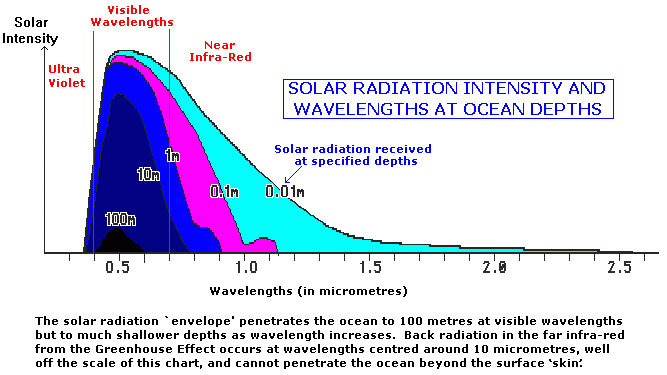
Phrased differently, sunlight can warm the oceans to depths of 100 meters, but the oceans can only release heat at the surface. Now consider that the oceans release heat primarily through evaporation (if memory serves, somewhere in the neighborhood of 90% of the heat loss from the oceans is through evaporation). UPDATE: Sorry, in this instance my memory was off. Of the approximately 180+ watts/m^2 downward shortwave radiation reaching the ocean surface, about half (about 100 watts/m^2) is released through evaporation.
THERE ARE NATURALLY OCCURRING PROCESSES THAT CAN CAUSE THE LONG-TERM WARMING OF THE OCEANS TO DEPTH
The naturally occurring processes that can warm the oceans, of course, are not considered in the climate models used by the IPCC. Climate modelers’ force the warming of the oceans based on their assumptions of how the infrared radiation from manmade greenhouse gases warm the oceans.
We’re going to break the oceans down into ocean-basin subsets, because, for two of the subsets, climate scientists addressed those portions of the oceans in the studies linked to this post.
I’ve presented these discussions in previous posts using ocean heat content data. For a change of pace, I’m presenting the NODC depth-averaged temperature data for the depths of 0-700 meters.
THE WARMING OF THE NORTH ATLANTIC TO DEPTH
As a preface to our first discussion, Figure 5 presents the depth-averaged temperature anomalies (0-700 meters) for the North Atlantic and for the rest of the global oceans. To determine the depth-averaged temperature anomalies for the rest of the global oceans, I area-weighted the North Atlantic data (11.5%, see the NOAA webpage here) and subtracted it from the global data. The units are deg C.

Figure 5
It very obvious that the North Atlantic to depths of 700 meters warmed at a much faster rate than the rest of the oceans, about 3.3 times faster from 1955 to present. That ocean basin only covers 11.5% of the surface of the global oceans, yet it represents about 35% of the ocean warming to depths of 700 meters.
NOTE: It is unfortunate that the outputs of the climate model simulations of depth averaged temperature (or ocean heat content) are not available in an easy-to-use form so that the models can be compared to observations. We know climate models do not properly simulate the warming of ocean surfaces. They double the warming rate of the ocean surfaces over the past 33 years. See the model-data comparison graph here. Also see the posts here and here for additional discussions. It would be interesting to see how poorly the models simulate ocean warming to depth. [End note.]
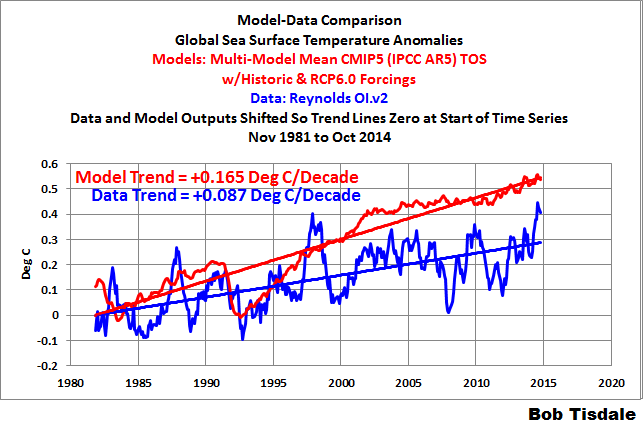
Now consider what I wrote in that introductory portion from my upcoming book: It’s very obvious why the change in the ocean heat content is very important to the hypothesis of human-induced global warming. If the oceans could be shown to have warmed naturally, then the impacts of manmade greenhouse gases are much smaller than claimed by climate scientists.
And that’s exactly what a group of scientists did back in 2008. They determined the warming of the North Atlantic to 700 meters since 1955 was caused by naturally occurring processes, not by manmade greenhouse gases. We’ve discussed this paper a few times in recent years—in blog posts and in books. Here’s a portion of my ebook Who Turned on the Heat?
[START OF REPRINT FROM WHO TURNED ON THE HEAT?]
There is a study that provides an explanation for that additional warming. See Lozier et al (2008) The Spatial Pattern and Mechanisms of Heat-Content Change in the North Atlantic.
First, a quick introduction to one of the terms used in the following quotes: The North Atlantic Oscillation is an atmospheric climate phenomenon in the North Atlantic. Like the Southern Oscillation Index described in Chapter 4.3 ENSO Indices, the North Atlantic Oscillation is expressed as the sea level pressure difference between two points. The sea level pressures in Iceland, at the weather stations in Stykkisholmur or Reykjavik, can be used to calculate North Atlantic Oscillation Indices. Which Iceland location they elect to use as the high-latitude sea level pressure reference depends on the dataset supplier. The other point captures the sea level pressure at the mid-latitudes of the North Atlantic, and there are a number of locations that have been used for it: Lisbon, Portugal; Ponta Delgada, Azores; and Gibraltar. The North Atlantic Oscillation Index is primarily used for weather prediction. The direction and strength of the westerly winds in the North Atlantic are impacted by the sea level pressures in Iceland and the mid-latitudes of the North Atlantic, which, in turn, impact weather patterns in Europe and the East Coast of North America. If you live in those locations, you’ll often hear your weather person referring to the North Atlantic Oscillation. As will be discussed, winds in the North Atlantic can also impact Ocean Heat Content.
I’ll present two quotes from the Lozier et al (2008) paper. I’ll follow them with quotes from the press release that describes in layman terms how the North Atlantic Oscillation impacts the Ocean Heat Content of the North Atlantic. Back to Lozier et al (2008):
The abstract reads:
The total heat gained by the North Atlantic Ocean over the past 50 years is equivalent to a basinwide increase in the flux of heat across the ocean surface of 0.4 ± 0.05 watts per square meter. We show, however, that this basin has not warmed uniformly: Although the tropics and subtropics have warmed, the subpolar ocean has cooled. These regional differences require local surface heat flux changes (±4 watts per square meter) much larger than the basinwide average. Model investigations show that these regional differences can be explained by large-scale, decadal variability in wind and buoyancy forcing as measured by the North Atlantic Oscillation index. Whether the overall heat gain is due to anthropogenic warming is difficult to confirm because strong natural variability in this ocean basin is potentially masking such input at the present time.
In the paper, Lozier et al (2008) note, using NAO for North Atlantic Oscillation:
A comparison of the zonally integrated heat-content changes as a function of latitude (Fig. 4B) confirms that the NAO difference can largely account for the observed gyre specific heat-content changes over the past 50 years, although there are some notable differences in the latitudinal band from 35° to 45°N. Thus, we suggest that the large-scale, decadal changes in wind and buoyancy forcing associated with the NAO is primarily responsible for the ocean heat-content changes in the North Atlantic over the past 50 years.
Based on the wording of the two quotes, the paper appears to indicate that Lozier et al (2008) are describing the entire warming of ocean heat content in the North Atlantic. In other words, it seems that Lozier et al (2008) are not stating that the North Atlantic Oscillation is primarily responsible for the additional ocean heat-content changes in the North Atlantic, above and beyond the rest of the world, over the past 50 years; they’re saying it’s primarily responsible for all of the variability. The press release for the paper, on the other hand, leads you to believe the North Atlantic Oscillation is responsible for the North Atlantic warming above and beyond the global warming.
The Duke University press release for the paper is titled North Atlantic Warming Tied to Natural Variability. Though the other ocean basins weren’t studied by Lozier et al, the subtitle of the press release includes the obligatory reference to an assumed manmade warming in other basins: “But global warming may be at play elsewhere in the world’s oceans, scientists surmise”. To contradict that, we’ve found no evidence of an anthropogenic component in the warming of the other ocean basins.
The press release reads with respect to the North Atlantic Oscillation (NAO):
Winds that power the NAO are driven by atmospheric pressure differences between areas around Iceland and the Azores. “The winds have a tremendous impact on the underlying ocean,” said Susan Lozier, a professor of physical oceanography at Duke’s Nicholas School of the Environment and Earth Sciences who is the study’s first author.
Further to this, they write:
Her group’s analysis showed that water in the sub-polar ocean—roughly between 45 degrees North latitude and the Arctic Circle—became cooler as the water directly exchanged heat with the air above it.
By contrast, NAO-driven winds served to “pile up” sun-warmed waters in parts of the subtropical and tropical North Atlantic south of 45 degrees, Lozier said. That retained and distributed heat at the surface while pushing underlying cooler water further down.
The group’s computer model predicted warmer sea surfaces in the tropics and subtropics and colder readings within the sub-polar zone whenever the NAO is in an elevated state of activity. Such a high NAO has been the case during the years 1980 to 2000, the scientists reported.
“We suggest that the large-scale, decadal changes…associated with the NAO are primarily responsible for the ocean heat content changes in the North Atlantic over the past 50 years,” the authors concluded.
[END OF REPRINT FROM WHO TURNED ON THE HEAT?]
WHAT CAUSES THE WATER TO “PILE UP”, INCREASING OCEAN HEAT CONTENT?
Let’s discuss in more detail that “pile up” from the press release of Lozier et al. (2008). First, a few basics: The trade winds are a function of the temperature difference between the equator and higher latitudes. The warmer water near the equator causes warm air to rise there (convection). At the surface, winds blow from the mid latitudes toward the equator to make up for the deficit caused by the rising air, but the rotation of the Earth deflects that inrushing air to the west. Thus the trade winds blow from the northeast to the southwest in the Northern Hemisphere and from the southeast to the northwest in the Southern Hemisphere.
In the ocean basins, ocean circulation is driven primarily from the trade winds in the tropics blowing from east to west. That is, the trade winds push the surface waters from east to west in the tropics. Those westward-traveling waters warm under the tropical sun. They encounter a continental land mass and are directed toward the poles. In the North Atlantic, the poleward-flowing western boundary current is known as the Gulf Stream. It carries the warm tropical waters to the cooler high latitudes, where that water can release heat to the atmosphere more efficiently. At the mid-latitudes, those waters encounter the west to east winds known as westerlies and are blown eastward toward Europe and Africa. The eastern boundary current along Africa returns those cooler waters back toward the tropics, where they can be warmed again, completing the cycle. That ocean circulation loop is called a gyre.
Now for the “piling up”: Suppose the westerlies in the mid-latitudes slowed or reversed, while, at the same time, the trade winds were pushing the same amount of tropical water to the west and poleward. At mid-latitudes, the change in the strength or direction of the westerlies would resist the poleward transport of warm water from the tropics. That warm water would accumulate as a result. Here’s that quote from the press release again:
By contrast, NAO-driven winds served to “pile up” sun-warmed waters in parts of the subtropical and tropical North Atlantic south of 45 degrees, Lozier said. That retained and distributed heat at the surface while pushing underlying cooler water further down.
Presto. A naturally caused accumulation of heat in the North Atlantic.
Curiously, under the heading of “Beam Me Up, Scotty”, Stefan Rahmstorf of RealClimate presented a similar discussion in his post What ocean heating reveals about global warming. I, of course, commented on that in my post Comments on Stefan Rahmstorf’s Post at RealClimate “What ocean heating reveals about global warming”
Now suppose, at the same time, there were a series of strong El Niño events over a multidecadal period (1976 to the turn of the century for example), so that the tropical waters in the North Atlantic were naturally warmer than normal. Trenberth and Fasullo (2011) explain why some portions of the oceans remote to the tropical Pacific warm in response to an El Niño (my boldface):
But a major challenge is to be able to track the energy associated with such variations more thoroughly: Where did the heat for the 2009–2010 El Niño actually come from? Where did the heat suddenly disappear to during the La Niña? Past experience (Trenberth et al. 2002) suggests that global surface temperature rises at the end of and lagging El Niño, as heat comes out of the Pacific Ocean mainly in the form of moisture that is evaporated and which subsequently rains out, releasing the latent energy. Meanwhile, maximum warming of the Indian and Atlantic Oceans occurs about 5 months after the El Niño owing to sunny skies and lighter winds (less evaporative cooling), while the convective action is in the Pacific.
That additional sunlight during a period when El Niños dominated (1976 to the turn of the century) would add to the amount of accumulating warm water in the North Atlantic…and elsewhere.
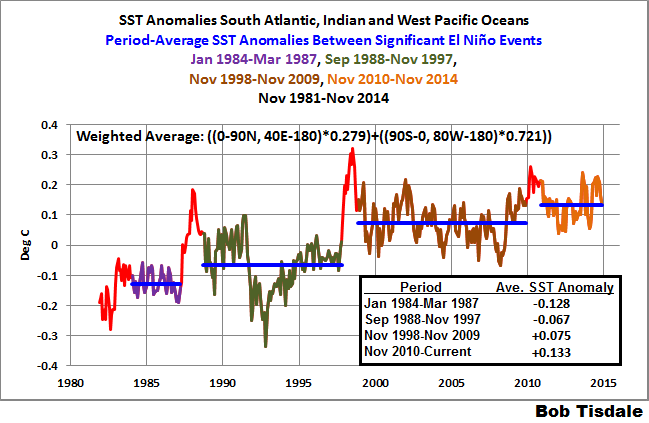
And Trenberth now understands that the heat didn’t suddenly “disappear to during the La Niña”. It shows up as the “big jumps” in surface temperature in response to strong El Niño events. See the posts:
- Open Letter to the Royal Meteorological Society Regarding Dr. Trenberth’s Article “Has Global Warming Stalled?”
- The 2014/15 El Niño – Part 9 – Kevin Trenberth is Looking Forward to Another “Big Jump”
I also present those “big jumps” in the monthly sea surface temperature updates (November 2014 update is here). They stand out quite plainly in the sea surface temperature data for the South Atlantic, Indian and West Pacific Oceans. For a further discussion see the illustrated essay “The Manmade Global Warming Challenge” (42mb).
EXTRATROPICAL NORTH PACIFIC
The next paper to be discussed is Trenberth and Hurrell (1994): Decadal Atmosphere-Ocean Variations in the Pacific. In it, Trenberth and Hurrell were using an index derived from the sea level pressures of the extratropical North Pacific (30N-65N, 160E-140W), called the North Pacific Index, to explain shifts in the sea surface temperatures of the North Pacific. Again, a sea level pressure index reflects changes in the wind patterns. My Figure 6 is Figure 6 from Trenberth and Hurrell (1994).

Figure 6
That same shift appears in the depth-averaged temperature data for the extratropical North Pacific (24N-65N, 120E-80W) for the depths of 0-700 meters. But the shifts are delayed a year in the subsurface temperature data. See Figure 7.

Figure 7
I’ve color-coded 4 periods on the graph. The first period from 1955 to 1988 (dark blue) includes the downward shift in 1978. As a result of that shift in 1978 (that should be related to the shift in the sea level pressures and wind patterns), the depth-averaged temperature data shows a cooling trend from 1955 to 1988. That is, the extratropical North Pacific to depths of 700 meters cooled (not warmed) for more than 3 decades. The second period (red) captures the upward shift in 1988 and 1989 that, once again, should be related to the shift in the sea level pressures and wind patterns. From 1991 to 2002 (light blue), the extratropical North Pacific cooled once again to depths of 700 meters. And since the ARGO floats were deployed (black), the extratropical Pacific shows a slight warming to depth.
It’s blatantly obvious the extratropical North Pacific to depths of 700 meters would show no warming from 1955 to present if it wasn’t for that upward shift in 1988 and 1989. It’s also obvious that the downward shift in 1978 that extends to 1988 also impacts the long-term trend. That is, without the naturally caused downward shift in the late-1970s the long-term warming rate would be less. Obviously, natural variability, not manmade greenhouse gases, dominates the variability and long-term warming of the extratropical Pacific to the depths of 700 meters.
TROPICAL PACIFIC
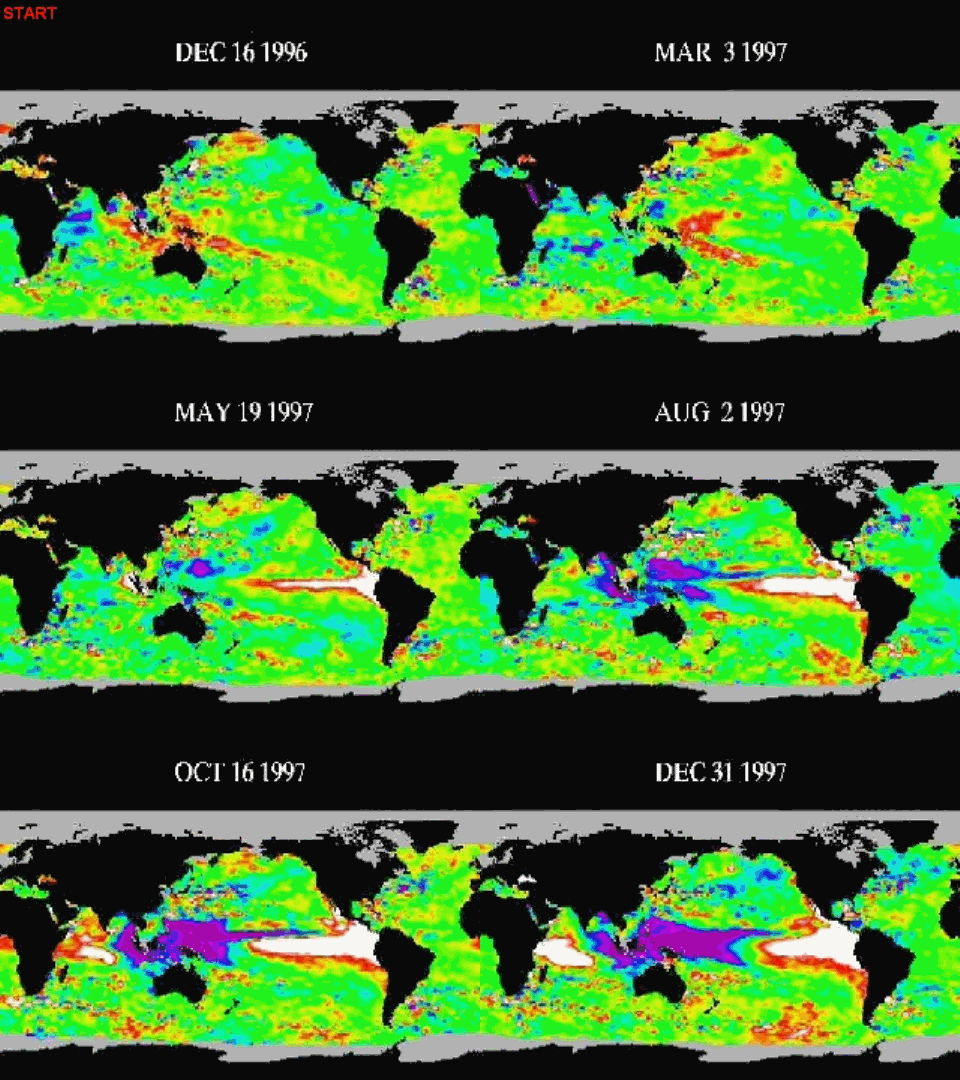
We isolate the vertically averaged temperature data to depths of 700 meters for the tropical Pacific because the tropical Pacific is where El Niño and La Niña events take place, and El Niño and La Niña events, collectively, are the dominant forms of natural variability on Earth. A further clarification: while El Niño and La Niña events are focused on the equatorial Pacific, they directly impact the entire tropical Pacific. See the animation here for an extreme example of the effects of an El Niño on the sea level residuals of the tropical Pacific.
Let’s start with two quotes from (again) Kevin Trenberth. According to Trenberth, El Niño events are fueled by sunlight, not manmade greenhouse gases. In the much-cited Trenberth et al. (2002) The evolution of ENSO and global atmospheric surface temperatures, they stated (my boldface and brackets):
The negative feedback between SST and surface fluxes can be interpreted as showing the importance of the discharge of heat during El Niño events and of the recharge of heat during La Niña events. Relatively clear skies in the central and eastern tropical Pacific [during a La Niña] allow solar radiation to enter the ocean, apparently offsetting the below normal SSTs, but the heat is carried away by Ekman drift, ocean currents, and adjustments through ocean Rossby and Kelvin waves, and the heat is stored in the western Pacific tropics. This is not simply a rearrangement of the ocean heat, but also a restoration of heat in the ocean. Similarly, during El Niño the loss of heat into the atmosphere, especially through evaporation, is a discharge of the heat content, and both contribute to the life cycle of ENSO.
NOTE: That’s the source of my standard description of ENSO as a chaotic, naturally occurring, sunlight-fueled, recharge-discharge oscillator…with El Niños acting as the discharge phase and La Niñas acting as the recharge phase. But La Niñas also help to redistribute the leftover warm waters from the El Niños. [End note.]
Also see Trenberth and Fasullo (2011). They confirm that ENSO is sunlight-fueled during La Niña events:
Typically prior to an El Niño, in La Niña conditions, the cold sea waters in the central and eastern tropical Pacific create high atmospheric pressure and clear skies, with plentiful sunshine heating the ocean waters. The ocean currents redistribute the ocean heat which builds up in the tropical western Pacific Warm Pool until an El Niño provides relief (Trenberth et al. 2002).
Figure 8 presents the vertically averaged temperature anomalies (0-700 meters) for the tropical Pacific. El Niño and La Niña events directly impact the top 300 meters, so this depth captures their direct impacts. I’ve highlighted in maroon the three 3-year La Niña events of 1954 to 1957, 1973 to 1976, and 1998 to 2001. After those 3-year La Niña events, the tropical Pacific shows cooling, not warming. That indicates that the shorter La Niñas that follow El Niños only recharge part of the warm water released from the tropical Pacific by the El Niños. Also, I’ve highlighted in red the 7-month period associated with the 1995/96 La Niña. (See the old version of the NOAA ONI index.) The 1995/96 La Niña created the warm water that fueled the 1997/98 El Niño, which is responsible for the sharp drop in temperature following the heat uptake of the 1995/96 La Niña. The “overcharge” from the 1995/96 La Niña and the recharge during the 1998-01 La Niña obviously caused an upward shift in the subsurface temperatures of the tropical Pacific.

Figure 8
What is also blatantly obvious is the warming of the tropical Pacific to depth is dependent on 4 La Niña events. And according to Trenberth et al. (2002) and Trenberth and Fasullo (2011), sunlight warms the tropical Pacific during La Niñas, not infrared radiation from manmade greenhouse gases. (In the real world, downwelling longwave radiation decreases during La Niña events.)
BOTTOM LINE ON OCEAN TEMPERATURE DATA FOR THE DEPTHS OF 0-700 METERS
Subsurface temperature data (and ocean heat content data) for the North Atlantic, the Extratropical North Pacific and the Tropical Pacific all indicate that naturally occurring coupled ocean-atmosphere processes are the primary causes of ocean warming to depth, not manmade greenhouse gases. In fact, the data for the tropical Pacific and extratropical North Pacific show those oceans can cool for decadal and multidecadal periods between short-term naturally caused warming episodes. Those decadal and multidecadal cooling periods further suggest that manmade greenhouse gases have no measureable impact on ocean warming to depth.
NOTE: Someone is bound to note that I’ve only presented subsurface ocean temperature data for the top 700 meters and only for the oceans of the Northern Hemisphere and the tropical Pacific. If I receive a comment to that effect on the thread, I will refer that blogger to the 2 posts linked in the introduction. Here they are again:
- Is Ocean Heat Content Data All It’s Stacked Up to Be?
- AMAZING: The IPCC May Have Provided Realistic Presentations of Ocean Heat Content Source Data
CLOSING
I’m sure I’ve missed a few arguments for and against the anthropogenic ocean warming. If you introduce others, please provide links where possible.
UPDATE 2: While preparing this post, I overlooked an excellent post by Willis Eschenbach Radiating The Ocean.
Argument 3. The claim is often made that warming the top millimetre can’t affect the heat of the bulk ocean. But in addition to the wind-driven turbulence
Wind driven turbulence affects evaporation. Probably a cooling effect. So even if the wind causes mixing it is also causing cooling which will cool the ocean.
Why is the debate 100 percent one way or the other? Is it possible that some of the DLWIR actually warms the ocean, but not nearly as much as if it was an equal flux of SWR?
Given the known heat losses of the ocean, it would be an ice-cube if it weren’t being warmed by the DLR.
It is an ice cube at the poles. And rather warm at the equator.
AND very cold at depth.
It is wrong to consider that the oceans have an average temperature of about 17 degC (ie., the avergage surface temperature). The oceans more realistically have an average temperature of about 3 deg C, and this is why there are ice ages.
If the oceans truly had an average temperature of about 17 degrees there would be so much stored latent heat that ice ages would not be extensive.
After more than 4 billion years of solar plus DWLWIR (for those that consider DWLWIR has any significant role to play) and such geothermal energy that is inputted from below, the oceans have only reached an average temperature of about 3 deg C.
It’s 105 F air temperature in Phoenix. If air heats water, how come if I don’t run the heater my swimming pool goes to 70 F? Evaporating towards ambient wet bulb.
Air sensible heat capacity = 0.24 Btu/lb -F
Water sensible heat capacity = 1.0 Btu/lb-F
Water latent heat of evaporation/condensation = about 1,000 Btu/lb w/ no temperature change
1 watt = 3.412 Btu/h
Raises one pound of air 14.2 F/h
Raises one pound of water 3.412 F/h
Evaporated into 0.003412 lb/h of water with no change in temperature.
Bob T
“Based on the findings at RealClimate, that rise in infrared radiation could only warm the sea surfaces by a little more than 0.002 deg C since 1979. Yet, looking at the global sea surface temperature data, Figure 2, the surfaces of the global oceans warmed more than 0.3 deg C from 1979 to 2013, leaving about 93% of the ocean surface warming unexplained.”
Where does the 93% come from?
0.002/0.3 = 0.00666 so 99.3% is missing. Was it a typo?
Early morning, no coffee… I am agog! That was supposed to read “Bob T”.
[Fixed. w.]
Crispin in Waterloo, regarding my typo. I’ll use the same excuse. Early morning, no coffee… I am agog!
Thanks. I’d better fix it.
I believe its geothermal heat flux through the ocean floor. No one knows what happening below 2,000 meters. A geothermal hot spot was discovered under that Antarctic ice sheet that floated away a year ago and there was a string of underwater volcanic vents recently discovered. Besides just because 99.3% is unaccounted for doesn’t excuse just making stuff up.
Willis, I liked your list but this has a couple of leaks, of not holes:
“Argument 2. If the DLR isn’t heating the water, where is it going? It can’t be heating the air, because the atmosphere has far too little thermal mass. If DLR were heating the air we’d all be on fire.”
There may be a slight exaggeration there. Vertical transport of moist air can easily handle that much.
This is more to my point:
>Nor can it be going to evaporation as many claim, because the numbers are way too large. Evaporation is known to be on the order of 70 w/m2, while average downwelling longwave radiation is more than four times that amount … and some of the evaporation is surely coming from the heating from the visible light.
The average evaporation – I just worked it out and got a very similar number for the average of all oceans for the year. That is probably not legitimate, meaning it would be better to look at a region where there is ‘that much’ incoming DWIR and see how much of it is turned into evaporation. Perhaps it is a factor of 10 higher. I didn’t check.
I see a problem using high IR in a tropical region then applying a global average evaporation rate saying it doesn’t add up. Well, it shouldn’t.
There is another mechanism which is often overlooked which is that heat can leave the surface by evaporation, but not evaporate water on a net basis.
This is best represented by water boiling in a pot with a lid on it. If you calculate the heat lost from the pot by measuring the mass of evaporated water only, it under-reports the total. There is heat leaving from the lid by convection, conduction and radiation that is not counted if the mass of water evaporated is the only yardstick.
Water evaporates from the bulk and the vapour condenses on the underside of the lid which conducts heat through to the top and it is lost from the lid. The overall effect is that heat lost to evaporation thermalises the air and the water drops back into the pot.
In the ocean this also happens but the ‘lid’ is the supersaturated layer of air just above the surface where the back-and-forth exchange is taking place. This region thermalizes the air and the water drops back into the ocean. Also, water vapour transports heat from the water to the air without itself ‘moving on’. Perhaps the best demonstration is to see what happens if that layer is blown away in the wind: The net evaporation rate increases dramatically and there is net (powerful) cooling far beyond the DWIR.
This layer can be seen by raising a lidless pot of water to the boiling point with low heat in a windless room. An undulating thin layer of white fog forms just above the water surface. That is a supersaturated layer convecting heat (and some water vapour) into the air above the pot, while dropping recondensed water back into the pot – without a lid. If you check the mass loss you will find that the heat lost to evaporation is much less than the total heat lost. Some of it is radiation, but there is still a missing quantity of energy. That is ultimately why mass of water evaporated is a poor measure when calculating the heat transfer efficiency to a pot.
The point repeatedly made is that DWIR can’t heat the water directly, which is true, but evaporated water can heat the bulk by mass transfer if there is some wind (and there usually is). This is a separate process as described well above this message. Warm moist air blowing over a pool of water can indeed warm it, but the mechanism is not DWIR, it is convection heat transfer (or convective, if you prefer). Cold dry air blowing over water can cool it, by evaporation AND ‘mass transfer’, something I have not seen emphasized during these discussions. People are distracted by the evaporation and radiation and built incomplete theoretical worlds. The real world has wind and water moving energy by multiple paths both up and down.
Crispin in Waterloo December 10, 2014 at 8:16 am Edit
I grow weary of handwaving. You need to demonstrate using NUMBERS that a) all of the DWIR goes into the air, and b) that this is totally used up in vertical transport of moist air.
I don’t underatand what you are saying. The global average DWIR is on the order of 340 W/m2, and the energy used in evaporation is about 80 W/m2 … you can wave your hands all you want, but it can’t all be going to evaporation. Period.
Again, that’s a lovely theory. But unless you think there is a metal lid over the ocean, I fail to see the relevance. There is a layer above the ocean that is saturated. There is not a layer that is “supersaturated.
But that layer is very thin. IF all of the DWIR were absorbed in that layer it would become very hot. I know of no one who has demonstrated that there is a very hot layer of air immediately above the ocean.
No, it’s not “supersaturated”, it is condensing … and having spent lots of time on the ocean, I can assure you that in general there is no such condensation immediately above the surface.
Cite? I grow weary of your uncited claims. I know of no scientific studies that show that “DWIR can’t heat the water directly.” It is absorbed by the water … what do you think happens when that absorption occurs? Does it turn into fairy dust? No … it turns into heat.
More handwaving. Provide citations, provide numbers if you want to be taken seriously. Anyone can spin a tale … but the natural world pays not attention, it just does what it does.
Look, Crispin, you are ignoring the following facts. The emissivity of water in the IR region has been measured hundreds of times. By Kirschoff’s Law, emissivity equals absorptivity. So we know for a fact that a) water absorbs IR, and b) it is turned into heat in the process.
Now, how that plays out in the ocean is a good question … but claiming without citation that “DWIR can’t heat the water directly” is just foolishness.
w.
PS—I’ll likely be sorry I asked, but what on earth is cooling by “mass transfer” which you refer to above?
Not to worry Willis; that’s code for “Convection”.
See how that works ?
I think they mean that ocean currents mass convey heat from the tropics to the polar regions, where it is so damn cold that the radiative cooling rate is much lower than it would have been if they had left all that heat down there in the tropics, where they really know how to radiate and cool efficiently.
I never get ice on my car’s radiator.
Willis
This is getting complicated because you did not follow the plot – probably because I am not explaining it well, though I think on rereading I did OK.
Maybe RACook can pitch in. You have several things wrong and I will try to do this efficiently.
>>There may be a slight exaggeration there. Vertical transport of moist air can easily handle that much.
>I grow weary of handwaving.
I grow weary of you calling anything you are not familiar with ‘handwaving’. To me handwaving has another more valuable meaning.
You are asking questions about a field that is not very ‘specialist’ so I had some expectation of you taking what I and probably others consider ‘obvious’ at face value. Thunderstorms can convect massive amounts of energy upwards. That is my reference for vertical transport.
>You need to demonstrate using NUMBERS that a) all of the DWIR goes into the air, and b) that this is totally used up in vertical transport of moist air.
That is not what I said so of course what I wrote is not the answer to that question. I was for an the ability of the atmosphere to dump the heat vertically if there was a mechanism shown for getting it from DWIR into thermalised air/water vapour. You said earlier that 340 watts/m2 was going to heat the air to ‘a high temperature’. We will calculate that in a moment.
>“The global average DWIR is on the order of 340 W/m2, and the energy used in evaporation is about 80 W/m2 … you can wave your hands all you want, but it can’t all be going to evaporation. Period.”
Well, that is not a complete description of what is happening. Sea water and the water vapour in the air immediately above it also radiate IR upwards. That 340 is not a net transfer into the sea surface, it is value of the DWIR. There is UWIR as well. Water and water vapour are powerful emitters of IR. That is why there is DW in the first place – most from water vapour in the troposphere and some from CO2.
Bob T and many others have described how SW radiation reaches the water and reflects off again. So…the same thing is happening with some of the IR which is that it is absorbed and re-emitted. It is not all showing up as an increase in temperature. Your question is expressed in a way that assumes there is a net 340 down. Like… “It is 680 down and 340 up so there is 340 to find and explain.” Not so. It is 340 down and X up and Y thermalised in the air and water vapour and Z transferred by convective heat transfer to the water.
We have a number for Down = 340
You have a number for evaporation = 80
You have no number for IR Up
You have no number for heating the water vapour after evaporation
You have no number for mass transfer to the water
You have no number for mass transfer from water to the air
I provided some numbers in a straw man calculation above to get people thinking about the missing element of energy flow – ‘mass transfer’ from the sea to the air or air to the sea depending on which was the warmer.
You asked what mass transfer was. http://cat.inist.fr/?aModele=afficheN&cpsidt=14751137 is an abstract (you need no more) indicating that ‘a mass of something with heat capacity per unit mass’ can gain heat and physically take it away. Cooling towers are good examples. They do not rely on radiation at all. It is the term used to describe convection of heat away from an object like a warm radiator. The ‘mass’ is the moving air. The heat capacity of air is dependent on the amount of water vapour in it. The shape of the object affects the efficiency of heat transfer by convection.
>>There is another mechanism which is often overlooked which is that heat can leave the surface by evaporation, but not evaporate water on a net basis….
>Again, that’s a lovely theory.
Thank you. I agree. And it is a realistic description of reality. I am not going to complicate the calculation below with it, however. No need to make my point.
>But unless you think there is a metal lid over the ocean, I fail to see the relevance.
Please don’t play games. It was an analogy intended for those who are not familiar with these physical processes.
>There is a layer above the ocean that is saturated. There is not a layer that is “supersaturated”.
Oh yes it is. The exchange between the water and the air is bidirectional because it is supersaturated. If it was saturated, it the exchange would stop in equilibrium. It doesn’t. The region above the surface, say 100mm, is usually saturated. Higher up, it is warmer (heated by DWIR).
>But that layer is very thin.
Correct. You understand the mechanism.
>IF all of the DWIR were absorbed in that layer it would become very hot.
1. You did not put a number on ‘very hot’
2. It is not entirely absorbed in that layer or the surface.
DWIR, the 340 watts, approaches the surface; not all of it makes it to the water. As the humidity increases near the surface the DWIR is captured and re-emitted in all directions. Like a ‘reverse GH effect’. It shades the surface and sends out UWIR. How much? We should find out. There is a great deal of water vapour near the water surface. It is impossible that 100% of the 340 watts reaches the ocean. It might be only 80 watts.
If some GHG alarmist complains that there is no such re-radiation mechanism from the water vapour, point out that it is exactly the same mechanism that is responsible for the DWIR. It is receiving DWIR and sending it back up (and to all sides including down). There is no such corresponding ‘layer’ in the troposphere of course. The near-ocean layer is unique.
>I know of no one who has demonstrated that there is a very hot layer of air immediately above the ocean.
That ‘very hot’ is of course the number you didn’t provide. Now I have to digress because of something else you didn’t understand.
The average of 80 watts to evaporation is not a reasonable approach. It is an average of 80 watts, but in hot places, it is far more. Convective cooling is not nearly the same everywhere, agreed? Thunderstorm hypothesis and all that. DWIR is not 340 everywhere. That is an average. That is why ‘they’ say there will be a tropospheric hot spot. The GHG effect is supposed to be concentrated in the tropics. The DWIR is also concentrated in that same region, and it is not 340 w/m2. It is much more. So you are not looking for a solution to an excess (340-80) you are looking for much bigger numbers in that zone. OK? It is not 340 and it is not 80. This whole process (see my straw man calc above) is highly dependent on temperature.
We should not work with average numbers – it should be a realistic TSI in an important zone, say 20 Deg N or something. All that aside, back to business:
>>This layer can be seen by raising a lidless pot of water to the boiling point with low heat in a windless room. An undulating thin layer of white fog forms just above the water surface. That is a supersaturated layer convecting heat (and some water vapour) into the air above the pot, while dropping recondensed water back into the pot – without a lid. If you check the mass loss you will find that the heat lost to evaporation is much less than the total heat lost. Some of it is radiation, but there is still a missing quantity of energy. That is ultimately why mass of water evaporated is a poor measure when calculating the heat transfer efficiency to a pot.
>No, it’s not “supersaturated”, it is condensing … and having spent lots of time on the ocean, I can assure you that in general there is no such condensation immediately above the surface.
When the humidity is above 70% there is water vapour condensation. You cannot see it. [I can measure it in the lab, however!] The surface layer is thin as you said, and it has a very high humidity. It is where the sea and air exchange H2O molecules. In a sunny, windless, miserably hot environment, say Jakarta, the humidity of the air near the water shoots up because of the evaporation of water. That humidity captures DWIR like the little upside down GH layer it is. How much reaches the surface? I don’t know – but sure as heck it isn’t all of it because water vapour is a GHG and it blocks a lot of it. I would not be at all surprised to find it is only the 80 W that goes into evaporation because what does reach the surface only heats the top few microns.
You didn’t comment on the mechanism. Summary: some of the DWIR never makes it to the surface in a real atmosphere so there is no point in looking for all of it. It is not AWOL, it was reassigned to outer space.
>>The point repeatedly made is that DWIR can’t heat the water directly, which is true, but evaporated water can heat the bulk by mass transfer if there is some wind (and there usually is).
>Cite? I grow weary of your uncited claims. I know of no scientific studies that show that “DWIR can’t heat the water directly.”
I thought there were some good examples but I will not be citing them, I was thinking of the very many claims made on WUWT that it can’t. That is another post.
Technically heating the top 10 microns is heating the water so the bald claim fails, but if that 10 micron heating almost all turns into evaporation and doesn’t heat the water below the, general claim is in practice, true. Given that ‘boiling’ (evaporation is slow boiling) has many problems with definitions and mechanisms http://www.ucl.ac.uk/sts/staff/chang/boiling/index.htm#5 ‘boiling’ by IR emission from above for all practical purposes is going to take place at the surface only.
>It is absorbed by the water … what do you think happens when that absorption occurs? Does it turn into fairy dust? No … it turns into heat.
Only what gets there turns into heated water. See above. Some of it turns into heated water vapour above the water. Some is turned into UWIR. Some of the heat in the water vapour is transferred to air (until they equilibrate). The temperature rise in the air (which contains the evaporated moisture) can be calculated.
http://www.engineeringtoolbox.com/heating-humid-air-d_693.html
The enthalpy (total energy) in the air can be calculated
http://www.engineeringtoolbox.com/psychrometric-chart-mollier-d_27.html
Scenario numbers:
Temperature of the evaporated water vapour = 15 C
Temperature of the heated water vapour by the time it moves vertically 2 metres = 25 C
Enthalpy change according to http://docs.engineeringtoolbox.com/documents/816/psychrometric_chart_29inHg.pdf (unit conversions required) = 14,775 Joules
In Jakarta it is more like 40 C than 25. In Bali, closer to 35. But it depends on the wind, doesn’t it? There is a missing number: the mass of air that is involved in the cooling and transport of the energy. Without that no one can say, ‘the air is going to be hot’.
>>This is a separate process as described well above this message. Warm moist air blowing over a pool of water can indeed warm it, but the mechanism is not DWIR, it is convection heat transfer (or convective, if you prefer). Cold dry air blowing over water can cool it, by evaporation AND ‘mass transfer’, something I have not seen emphasized during these discussions. People are distracted by the evaporation and radiation and built incomplete theoretical worlds. The real world has wind and water moving energy by multiple paths both up and down.
>More handwaving. Provide citations, provide numbers if you want to be taken seriously.
This was not a discussion of numbers it was a discussion of mechanisms. Citations for what? How the whole HVAC industry works? http://www.engineeringtoolbox.com
>Anyone can spin a tale … but the natural world pays not attention, it just does what it does.
Your hot air (literally) story is a tale and not a very good guess. If the evaporation was 80 watts and the rest went be some mechanism into the air and zero into the ocean, the mass transfer needed to collect the remaining 260 is:
Heat capacity: 1.2 kg air, heat capacity of 1252 Joules per m3 per degree C.
That is for saturated air at 15 C (leaving the ocean). As the temperature rises the moisture content remains the same and the relative humidity drops. If there are fog droplets they evaporate (providing cooling). Let’s assume that doesn’t happen and KIS.
http://www.engineeringtoolbox.com/enthalpy-moist-air-d_683.html see the worked example. There is also a worked example of saturated air containing fog. You can skip that.
Velocity: Wind speed 2m/sec, air assumed to be well mixed far above the surface because of the rough surface of the ocean. This gives is we have a time variable. Let’s multiply:
1252 x 2 cubic metres of air = an enthalpy change of 2504 Joules/degree C
Energy transfer capacity of 2 cubic metres of that wet air is 2504 Watts PER DEGREE. With our (25-15) = 10 degree worked example the change in enthalpy (Δ total heat content) is 25,040 Watts at that air flow.
A requisite condition in this example is that all that air interacts with the water surface on that square metre per second, which clearly it will not.
You are looking for 260 watts. Given the example above it would require, on average, 260/25,040 x 2000 litres = 20.7 litres of air to meet and leave the surface, on average, per second and rise to 25 C by 2 metres altitude. That is 2 cc/sq cm/second. That is how easily mass transfer can transport heat from IR to the upper atmosphere. This calculation shows that Little Miss Atmosphere can significantly cool Big Mr Ocean without getting ‘very hot’.
>Look, Crispin, you are ignoring the following facts.
Oh, come on.
>The emissivity of water in the IR region has been measured hundreds of times. By Kirschoff’s Law, emissivity equals absorptivity. So we know for a fact that a) water absorbs IR, and b) it is turned into heat in the process.
That heat is easily carried away in the warmed air and water vapour (much less important) and latent heat of evaporation (not as important as is often assumed – see the enthalpy calc ref above in detail). Air holds a lot of heat. Heat transport works and it is not hot. Most of the DWIR never reaches the ocean surface, that is my conclusion.
“””””…..… and some of the evaporation is surely coming from the heating from the visible light…..”””
First problem: LIGHT, by definition IS visible. (it’s all in your head)
Second problem: Ocean water is MOST highly transparent at the very solar spectrum wavelengths that carry most of the solar spectral energy. The ocean water absorption coefficient at the peak of the spectrum, is about 1E-4 cm^-1.
That means the 1/e absorption depth is 10^4 cm or 100 meters of sea water to absorb 37% of the highest spectral radiance solar energy. Now it is not that deep for all of the visible spectrum, but more than 90% of the solar spectrum energy goes at least 10 meters deep.
The evaporative surface “skin” (it’s NOT a skin) of the ocean is a few microns thick.
Water molecules do not escape from depths of more than a few microns, and I’m being very generous in allowing any escape from more than say a dozen molecular layers deep.
It is ONLY the highest energy tail of the Maxwell-Boltzmann molecular KE distribution that can escape from the surface in evaporation. It is absurd to talk of evaporation from more than a few molecular layers deep.
If as you say, downward LWIR radiation is about 280 W/m^2, while incident solar radiation is maybe 1,000 W/m^2 (when the sun shines), and that LWIR has a spectral peak wavelength of about 10 microns, well the absorption coefficient of sea water in that spectral region, is in excess of 1E3 cm^-1, and as high as 1E4 cm^-1 (at 3.0 microns), then absorption of LWIR in the surface layer is at least 1E6 times that for visible solar radiation and as much as 1E8 times as high.
So nyet on much evaporation due to incident (visible) solar energy, when compared to down LWIR.
I shouldn’t even have to say this, because it has to be rather obvious to anyone, but when the down LWIR gets absorbed all in the top 50 microns or less of the sea water (it does), you do get prompt evaporation from the very surface molecular layer, and local heating of that top 50 microns. Remember it is an exponential decay with depth, so 37% is absorbed in the top 10 microns or less, and 95% in the top 30 microns or less, so the layer of water getting heated is very thin, so its Temperature rise above the deeper water is substantial, so that surface layer expands, and gets less dense, so it tends to convect back to the surface, while at the same time conducting to the deeper layers (we’re talking deep compared to 50 microns).
So even though maybe only 70 out of the 280 W/m^2 is returned to the atmosphere as latent heat of evaporation, and though the remaining 210 W/m^2 is absorbed in maybe only 50 microns of water and maybe more like 30, whatever that surface “skin” (which isn’t a skin) Temperature rise is, the next one millimeter of sea water can not possibly rise in temperature by more than a tiny fraction of whatever the peak surface Temperature elevation is.
So for ALL practical purposes, there simply is no way that that 210 W/m^2 of energy can propagate BY CONDUCTION deeper than ONE mm of sea water.
And it CAN’T propagate deeper BY CONVECTION, because the convection density gradient is UPWARDS.
As for the evaporated water being fresh water, leaving a higher surface salinity behind it, which is denser, the very same sort of argument demonstrates that this too is a butterfly wing beat effect as well. Any salinity gradient due to evaporation is also confined to mere mm at most of surface water. No way is that going to convey by convection, to the ocean depths.
So yes; downward LWIR does heat the ocean; maybe a whopping one mm of it.
Please don’t ignore the CONDUCTIVE component of energy transfer from the heated ocean silly millimeter back up into the atmosphere. I can’t recall if Trenberth puts a number on that.
The oceans do have a cool-skin – the surface is almost always cooler then the centimeter of water below – therefore the net heat transfer goes from below to the surface .
There is no net heat transfer from the surface to the water below no matter how much stirring and mixing one does. This cool skin does not seem to be really mentioned in the above post and it does influence the energy transfer process.
The only way how the ocean could be warmed indirectly by infrared is when the surface would get warmer – thus slowing down the transfer of heat from below – but we do have a relative good measurement of the ocean’s surface temperature.
If backradiation does not provide a measurable effect on the surface, due to the cool skin it cannot warm the ocean. It has first to warm the surface.
Where does the added “backradiation” energy go?
Backradiation is part of the heat energy transfer, it is no net energy transfer. It does not exist without the “first” radiation.
“According to the NOAA Annual Greenhouse Gas Index, infrared radiation has only increased about 1.2 watts/meter^2 from 1979 to 2013.”
How did that affect the net heat transfer is the next question which is not answered. To consider it is a net added heat into the ocean is wrong.
“THE OCEANS HAVE THEIR OWN GREENHOUSE-LIKE EFFECT”
Yes, correct.
Is this greenhouse-like effect considered when the overall “greenhouse effect” is being calculated? (the much touted + xxx°C due to greenhouse)
No, only gases are considered there when calculating how warmer is the planet in comparison with an average rock planet.
“Based on the findings at RealClimate, that rise in infrared radiation could only warm the sea surfaces by a little more than 0.002 deg C since 1979. Yet, looking at the global sea surface temperature data, Figure 2, the surfaces of the global oceans warmed more than 0.3 deg C from 1979 to 2013, leaving about 93% of the ocean surface warming unexplained.”
Big Bear Observatory & Earthshine comes to mind (change in albedo which trumps CO2 greenhouse):
http://www.bbso.njit.edu/science_may28.html
Lars P
“The oceans do have a cool-skin – the surface is almost always cooler then the centimeter of water below – therefore the net heat transfer goes from below to the surface .
That applies only when the water is transferring energy to the atmosphere which is not always the case.
“There is no net heat transfer from the surface to the water below no matter how much stirring and mixing one does.”
Well, there is no net heat transfer BY RADIATION to the water below. In the real world what you wrote is only true if the air doesn’t touch the water, and it does.
“This cool skin does not seem to be really mentioned in the above post and it does influence the energy transfer process.”
Well it is mentioned. What was not mentioned is that ordinary ‘mass transfer’ which is convection heating or cooling, still takes place, even though there are alternative energy pathways. The diversion into discussions of radiative energy transfer only has done this whole argument a disservice because ‘ordinary’ heat transfers are taking place.
Hot wind blowing over a cold ocean definitely warms it, but not by radiation.
Hot wet wind blowing over a cold ocean warms it and wet air is dried by the cold surface condensing and removing water vapour. As it blows across the cold water, the air cools. This can only happen if there is heat transferred to the water. Yes, it is not by radiation, that points is correct. But it is not correct to conclude that because there is no net radiative transfer, there is no transfer by convection.
If there was no additional evaporation driven by wind and cold dry air (convective cooling because of surface contact with the water) there would be no lake-effect snow in Buffalo. There is.
Cold dry air warmed by Lake Erie transfers far more energy out of the lake than is possible by radiation OR evaporation in still air. That is why they got 8 feet of snow in a couple of days and Waterloo didn’t. Because some additional evaporation is attributable to the wind, it is proven that the mechanism is convection, not radiation. All the standard formulas apply.
Crispin said: “That applies only when the water is transferring energy to the atmosphere which is not always the case.”
http://researcher.most.gov.tw/public/tsuang/Data/722815193371.pdf
“[2] It is well known that temperatures at the sea surface are typically a few-tenths degrees Celsius cooler than the temperatures some tens of centimeters below [Saunders, 1967] ”
“The cool skin is recognized as an important feature of the ocean viscous layer as a result of new satellite remote sensing methodologies emerging for air-sea fluxes estimates Chou et al. , 2003].”
The cool skin is typically there, most of the time. Warmer winds warming the ocean is the exception. You are treating the exception as the general case.
Crispin: “What was not mentioned is that ordinary ‘mass transfer’ which is convection heating or cooling, still takes place, even though there are alternative energy pathways. ”
Net heat transfer goes from warm to cold. Stirring a colder surface with a warmer deeper level will transfer heat from depth to the surface and not the other way around.
Crispin: “Hot wind blowing over a cold ocean definitely warms it, but not by radiation.”
It may warm the surface layer, however as long as this surface layer is colder then the water below it will not tranfer net heat to the water below it, it may only slow down the net heat tranfer from the water below, if the surface is getting warmer. Please explain how will a colder surface warm a deeper warmer water layer? How do you implement that heat pump there?
Crispin: “But it is not correct to conclude that because there is no net radiative transfer, there is no transfer by convection.”
See above net heat transfer. Please explain how convection transfers net heat in the ocean from the cooler skin to the warmer deeper water layer.
Crispin: “If there was no additional evaporation driven by wind and cold dry air (convective cooling because of surface contact with the water) there would be no lake-effect snow in Buffalo. There is. ”
I agree, I understand evaporation is the reason for the cool skin feature.
Crispin: “Because some additional evaporation is attributable to the wind, it is proven that the mechanism is convection, not radiation. All the standard formulas apply.”
Radiation looks important if one looks at one factor, one side – which is false. It is the net heat transfer throughout the system which is the reality.
This study seems to point to one mechanism of IR/water energy exchange which they could measure. Not sure if their test included appropriate wavelengths or is applicable.
http://www.amolf.nl/news/news-archive/detailpage/artikel/water-molecules-as-efficient-infrared-antennae/
Fascinating study, DT. The study is paywalled but the full-size images are not, worth looking at. The wavelengths they used are about 2700 cm-1.
w.
This is an interesting subject.
Given we know that the Oceans have not warmed as much as models suggest, if this study could be extrapolated to co2 wavelengths and quantify the effect against ocean water, we could have increasing certainty of co2’s actual if limited impact.
This study, similar in nature is not pay walled.
http://scitation.aip.org/content/aip/journal/jcp/135/2/10.1063/1.3605657
Here’s the part I don’t get in the argument that downwelling infrared radiation (DWIR) can heat the land but not the ocean.
The earth receives (as a global 24/7 average) about a half-kilowatt per square metre of downwelling radiation. Of that, about 170 W/m2 is downwelling solar radiation, and about 340 W/m2 is DWIR.
Now IF the DWIR cannot warm the ocean as some folks claim … then
a) why is the ocean warmer than the land and
b) why is the ocean not frozen?
Regarding a), if the claim is correct then the land is absorbing about three times the radiation that the ocean is getting, and yet it is cooler … why?
And regarding b), we know that on average the ocean loses about a half a kilowatt per square metre, with about 390 W/m2 being radiated away and about 110 W/m2 being the combination of sensible and latent heat loss.
So where is that energy that is constantly being lost being replaced from, if not from DWIR?
If you say DWIR can’t heat the ocean, then you need to explain where the missing ~390 W/m2 is coming from. Geothermal is on the order of a tenth of a watt per square metre, so it’s not coming from that.
So for all of you that do think that DWIR can’t warm the ocean … where is the energy coming from to keep the ocean from freezing?
I gotta admit … I don’t see why what to me is a relatively unexceptional everyday claim, that DWIR warms whatever absorbs it, is so hard for folks to accept.
w.
Willis, I added a link to your post from a couple of years ago, in an update at the end of this one.
Cheers.
Willis
As i frequently point out to you, you cannot properly deal with averages.
The planet is driven by solar energy going into the eqitorial and tropical regions of the planet. This region just happens to be disprortioately populated by ocean. See: http://en.wikipedia.org/wiki/Tropics#mediaviewer/File:World_map_indicating_tropics_and_subtropics.png
That map clearly shows the distribiution of land and ocean. Eyeballing it, it is about 85% ocean to 15% land. And of these land masses, much of that land is either tropical rain forest or desert, or land where seasonal variance in temperature is dominated/controlled by monsoon,
Now the reason why there is such a large diurnal range between day and night temps on land is that the earth/land/ground is not heated to any great depth and retains little in the way of stored latent heat so that the earth/land/ground cannot replenish the heat being lost from the surface as the atmosphere cools and cannot thereby prevent the atmosphere from cooling as the night progresses.
However, the oceans, in contrast, possess (for practical purposes considering the length of a day) an unlimited capacity of stored latent heat and this enables the oceans to continually heat the atmosphere during the night. as the nightime atmosphere would naturally cool, it is being continuously warmed throughout the night by the ocean below. There is very little diurnal range in atmosphere temperature above the oceans.
In your series on ARGO, you suggested that the ocean temps predominantly cap out at 30degC. Now if you look at equitorial/tropical areas, and select those that are not tropical rain forest or desert, you will find many land areas that have a similar average temperature, ie., one which varies between about 28.5degC in the ‘off seasons’ to about 32degC in the ‘prime’ seasons. For example see Jizan (about 16N) that has an annual average temperature of 30degC. Now I accept that that is a cherry picked example, but one has to carry out some selection since deserts and tropical rain forest have different temperature profiles because they have their own micro climate because of what they are, rather than simply because of the amount of solar energy received.
Now the equitorial/tropical ocean receives sufficient solar to drive temperatures well above 30degC, probably more in the region of 40degC plus. In your ARGO post, you (initially) claimed that the reason that temperature caps at 30 degC is due to evaporation. Whilst evaporation certainly plays a part, it cannot be the limiting factor since there are many areas of the ocean with temps of 34 degC plus (I referred you to about half a dozen areas which were currently showing daytime highs/month highs/or yearly highs of 34degs and I have seen many hundreds of entires in ships logs recording temperatures of around 36degC and that would be water temperature drawn from about 8 to 10 metres below surface so surface temperature may well be even hotter).
The prime reason why the equitorial/tropical ocean caps out at 30degC is current, both in the form of ocean over turning where warm surface water is sequested to depth, and of cource the warm currents that distribute the equitorial/tropical heat polewards. It is these currents that carry the water away before it gets an opportunity to warm above 30degC. It is these currents that prevent the mid to high latitute oceans from freezing, and which keep the polar ocean from freezing as long as the polar oceans are additionally heated by Solar (when there is insufficient additional solar, the polar oceans freeze). You can see the effects of these currents for example areas of the Baltic freeze, whereas the sea around Iceland at the same latitude does not freeze.
You state; “So where is that energy that is constantly being lost being replaced from, if not from DWIR?” The crux of this question is how much energy is actually being lost from the ocean.
The ocean is only losing energy consisting of sensible heat of ~ 30 w/m2 and evaporative losses of ~ 70 w/m2 and radiative losses of .~ 70 w/m2. The total energy loss from the ocean is ~ 170 w/m2.
Whilst you may be able to detect a signal (ie., measure the temperature of the surface) of some 390w/m2 that does not mean that the ocean is losing this amount of energy; it is not. The ocean does not want to lose very much energy because the atmosphere above the ocean is nearly the same temperature as the ocean itself. It only wants to lose ~ 170 w/m2 of energy and that is why it gives up only that amount of energy, and no more..
Willis, we went through this on your radiating the ocean post. Most of the energy you are so worried about the ocean losing is going right back into the ocean. You are fixated on the output side, but thanks to resonating gasses most of the energy radiated out of the oceans is radiated right back. This does not “warm” the oceans to a higher energy state than they already were from absorbing solar shortwave to the bottom of the mixed layer. It limits the rate that they can cool, and the net effect is ALWAYS a net transfer of energy from the higher energy state ocean to the lower energy state atmosphere.
It is not that the oceans do not absorb lower energy state photons. They do, but these lower energy photons cannot increase an energy state that is already above their own level. It’s not like throwing another log on the fire.
The ocean is not always warmer than the land. The air over the ocean is usually warmer than the air over land after diurnal variation is anomalied out. The ability of “land” to absorb atmospheric LW depends on the individual properties of the widely ranging materials on the land surface. I frankly don’t know these properties except for ice and snow which oddly have very similar spectral properties to water.
Willis writes “If you say DWIR can’t heat the ocean, then you need to explain where the missing ~390 W/m2 is coming from.”
Its straightforward, it comes from the atmosphere exactly as you imagine it. But there’s a difference between warming and slowing cooling that it appears to me you cant quite grasp.
If a stone at 20C is surrounded by aluminium foil to give it very high DLR, how much warmer does it get?
Ocean warming/cooling is a balance of ULR from the surface, DLR from above and evaporation. Increase DLR and you increase evaporation and the resulting net energy balance over time is not obvious and certainly not scientifically quantified right now, its that simple.
TimTheToolMan December 11, 2014 at 2:34 am
TIm, I’ve been over this dozens of times, but since it appears you “can’t quite grasp” it, I’ll go over it again.
Does DWIR “warm” the ocean? Yes, in exactly the same sense that a coat “warms” you when you go outside in the cold. You are correct in that both of them are only “slowing the cooling” (by very different mechanisms to be sure).
But in common parlance, nobody says “Put on your coat, dear, it will slow your cooling”. We say a coat warms you up.
Now of course, a more accurate statement would be that a coat doesn’t actually “warm” you. Instead, it leaves you warmer than you would be without the coat. And in the same way, CO2 doesn’t actually “warm” the earth, it simply leaves the earth warmer than it would be without CO2.
Do I know that? Yes, and I’ve discussed it for years. Here, for example, is a quote from my 2011 post that is linked in the head post:
So yes, Tim, I do understand that, which you would have known if you were paying attention.
But SO WHAT? It’s just a semantic nit-pick. The end result is the same, it ends up warmer. If you don’t understand what is meant by “CO2 warms the oceans” you’re not following the story.
So … do you “quite grasp” it now?
Regards,
w.
PS—Could you leave the snark, e.g. your fantasies about what I “can’t quite grasp”, out of your future comments? They do nothing for your reputation, they just make you look petty and vindictive.
Willis writes “PS—Could you leave the snark, e.g. your fantasies about what I “can’t quite grasp”, out of your future comments?”
Practice what you preach.
Willis, put your coat on that rock. Does it get warmer?
Now I’m going to add a little heat pump that will cool the rock right past that coat but I’m not going to tell you what setting I’m putting it on. Now does the rock stay warmer?
TimTheToolMan December 11, 2014 at 10:25 pm
Tim, if I wanted to use a rock as an example I would have. We’re talking about objects (the earth, a person) that are WARMER than their surroundings. Put a coat on anything warmer than its surroundings, and it will be warmer than without the coat.
w.
TimTheToolMan December 11, 2014 at 10:18 pm
I’m working on it, Tim, I’m working on it. Your first comment to me in this thread was snarky … but I didn’t snark back. Instead, I quoted your own words back to you so you could see what it sounds like, and I made a polite request. Like I said, I’m working on it.
Now it’s up to you.
w.
Oh..and DSW, obviously.
OMG, I missed this before. Tim is absolutely right. You cannot grasp the second law of thermodynamics, and just went through this whole Al Gore “coat” thing with Stephen/Tony. Greenhouse gasses DO NOT insulate. Insulation is a blockage of conduction and convection, NOT radiation, except in unusual situations which do not apply here.
Willis: “a) why is the ocean warmer than the land and”
Due to the way how the ocean accumulates heat in depth and loses only at the surface
Willis: “b) why is the ocean not frozen?”
Ocean frozen = Falacy of averaging heat transfer.
Does the ocean radiate heat from under the ice? I would think that the ocean is not losing any heat at all in all those 10 million+ of square km from under the ice.
Could the ocean be frozen at the equator with 1000 W per sqm? Obviously not, as long as the sunlight comes down.
So we have a bulk of water that would be unfrozen and we have a bulk of water that is frozen and does not lose heat. Therefore the ocean reaches its own heat transfer equilibrium.
=> tropic is the heat engine
The fact that the oceans are warmer then the earth is telling also about the “ocean greenhouse” mentioned above.
Lars P. December 11, 2014 at 2:44 am Edit
Of course it does. Why would you think otherwise?
w.
Willis Eschenbach
December 11, 2014 at 2:57 pm
Lars P. December 11, 2014 at 2:44 am Edit
Does the ocean radiate heat from under the ice?
Of course it does. Why would you think otherwise?
w.
Why would I think otherwise? Because I thought ice and snow on ice makes a good isolation for an igloo, but what do I know? How much heat does the ocean lose through a 3 meters ice sheet? My guess is that there is a significant reduction in comparison with open sea…
Lars, sorry for the brevity of my answer. Snow is a pretty good insulator, because it contains air spaces. Ice, on the other hand, is not so good.
In fact, the conductivity of ice is about four times as large as that of water (2.18 vs 0.56 W/m-K). Of course, water also moves heat by convection, but even so, ice transfers heat quite well.
Snow, on the other hand, has a thermal conductivity of between 0.05-0.25 W/m-K.
Best regards,
w.
Willis writes “Snow, on the other hand, has a thermal conductivity of between 0.05-0.25 W/m-K.”
And “ice” is typically covered by a layer of snow which eventually compacts to become the “ice”. It is the snow that is at the top that radiates to the atmosphere. Snow/ice is indeed an insulator to the ocean.
TimTheToolMan December 12, 2014 at 1:47 pm Edit
Thanks for the comment, Tim. I fear you are conflating glacial ice and sea ice. Glacial ice is compacted snow. Sea ice is not made out of compacted snow, it’s made out of frozen ocean water.
And because the Arctic is so dry, there is typically very little snow on the sea ice. From the NSIDC:
All the best,
w.
Willis writes “I fear you are conflating glacial ice and sea ice. Glacial ice is compacted snow. Sea ice is not made out of compacted snow, it’s made out of frozen ocean water.”
From an actual paper, “Snow Depth on Arctic Sea Ice”
http://journals.ametsoc.org/doi/abs/10.1175/1520-0442%281999%29012%3C1814%3ASDOASI%3E2.0.CO%3B2
“The ice is mostly free of snow during August. Snow accumulates rapidly in September and October, moderately in November, very slowly in December and January, then moderately again from February to May. This pattern is exaggerated in the Greenland–Ellesmere sector, which shows almost no net accumulation from November to March. The Chukchi region shows a steadier accumulation throughout the autumn, winter, and spring. The average snow depth of the multiyear ice region reaches a maximum of 34 cm (11 g cm−2) in May. The deepest snow is just north of Greenland and Ellesmere Island, peaking in early June at more than 40 cm, when the snow is already melting north of Siberia and Alaska. The average snow density increases with time throughout the snow accumulation season, averaging 300 kg m−3, with little geographical variation.”
Willis writes “Tim, if I wanted to use a rock as an example I would have.”
I used the example in the post you responded to.
And went on to say “Put a coat on anything warmer than its surroundings, and it will be warmer than without the coat.”
It will cool more slowly. Putting a coat on a rock wont make it warmer than it was. Now I agree that there are mechanisms whereby the DLR could make the ocean warm but without trying to be snarky you dont appear to agree that an the cooling effect of evaporation can impact that. Perhaps there is only a very little warming. The point is that DLR might warm the ocean and then again for all intents and purposes it might not.
Bob has made good arguments that it doesn’t (much) simply by pointing out just how uneven the ocean warming is. That’s not the kind of effect you’d expect to see from a well mixed gas imparting the same forcing worldwide.
Willis wrote “Tim, if I wanted to use a rock as an example I would have. ”
I used the rock as an example.
And then used the analogy of a heat pump as the cooling mechanism and you didn’t address that at all. Firstly, do you agree that increased DLR results in increased evaporation or not?
This second post is more or less redundant. My first seemed to disappear…
TimTheToolMan December 12, 2014 at 3:15 am
The difference is that a rock has nothing which is constantly warming it, whereas both the earth and our bodies have a heat source constantly warming each one. As a result, your example was not relevant.
Anything that increases temperature (or wind) increases evaporation.
Regards,
w.
Willis writes “Anything that increases temperature (or wind) increases evaporation.”
Only temperature at the surface. How do you know the net effect if you accept additional energy is lost through evaporation (and radiation) at the higher SST? Energy that could potentially offset any AGW induced DLR increase?
TimTheToolMan December 12, 2014 at 7:45 pm Edit
Thanks, Tim. It’s true that it could work out as
Increased DWIR –> increased temperature –> increased evaporation and UWIR
and that at the end of the day the increased evaporation and radiation losses balance out the increase DWIR.
However … note that the first step in that chain is
Increased DWIR –> increased temperature
or in your words “higher SST”.
Which is what I’ve been saying all along. DWIR is absorbed by the ocean and leaves it warmer than in the absence of DWIR. What happens after that, as you point out, may be one of a number of outcomes … but that’s the start of the chain, “higher SST”.
All the best,
w.
Thank you, all, for your contributions on this thread.
–Now IF the DWIR cannot warm the ocean as some folks claim … then
a) why is the ocean warmer than the land and
b) why is the ocean not frozen?
Regarding a), if the claim is correct then the land is absorbing about three times the radiation that the ocean is getting, and yet it is cooler … why?–
Ocean is 70% of surface area of Earth.
In terms of the sun warming the Earth, the most important region is 40% of the surface of Earth which is called the tropical zone. Or 23 degrees north and south latitude.
In tropical zone the average temperature is well above 20 C, or 60% of rest of earth is below 20 C
in terms of average temperature.
More than 70% of surface area of tropics is ocean area- or somewhere around 10 to 15% is land.
So since we have a thick atmosphere and global oceans, the tropical zone warms warms the rest of the planet to much larger extent, than if we did not have the global oceans or the thick atmosphere.
So if agree with every climate scientist that tropics is the heat engine of earth and warms the rest of the Earth, and you agree that most tropics is ocean surface, then one has to conclude that earth’s oceans do much of the warming of Earth.
The warmth of the tropical ocean should rule out the possibility of a snowball earth ever happening, and believer of such ideas generally concede that the snowball earth’s may have ribbon of open water at the equator- but still want to call it a snowball earth.
It could possible that 10 degree north and south may be the only unfrozen but that is still an large area of earth not frozen. It vaguely possible one had only 10 degree north and south- it’s largely a slight possibility because the possible ways land mass might be configured in some distant past
and other factors- say sun goes very quiet, and etc.
From Lozier et al (2008):
“The group’s computer model predicted warmer sea surfaces in the tropics and subtropics and colder readingshttp://www.cpc.ncep.noaa.gov/products/precip/CWlink/pna/nao.timeseries.gif within the sub-polar zone whenever the NAO is in an elevated state of activity. Such a high NAO has been the case during the years 1980 to 2000, the scientists reported.”
The NAO shifted strongly negative in 1995-98, that accelerated the warming of the AMO and the Arctic.
http://www.cpc.ncep.noaa.gov/products/precip/CWlink/pna/nao.timeseries.gif
As increased forcing of the climate increases positive NAO, it’s a matter of checking which solar metric was reduced in those years:
http://snag.gy/ppB3v.jpg
richard verney December 10, 2014 at 4:46 pm
Thanks, richard. And as I just as frequently reply to you, averages are quite useful for some things, and totally useless for others.The trick is distinguishing between the two situations.
The radiative loss you cite, ~ 70 W/m2, is the NET radiative loss. By that I mean it is something like 390 W/m2 upwelling less something like ~320 W/m2 downwelling radiation, giving about seventy watts per square metre as the net surface loss.
(Different sources give slightly different numbers for these figures. CERES puts it at 345 W/m2 DWIR, 398 W/m2 UWIR, for a net surface loss of 53 W/m2. The Kiehl/Trenberth energy budget puts it at 396 UWIR, 333 DWIR, for a net surface loss of 63 W/m2. There are other values out there, such as your ~70 W/m2.)
In any case, from the fact that you are using the net figure which includes the DWIR, I have to assume that you agree that the DWIR actually IS absorbed by and warms the ocean … so it appears i have no disagreement with you in that regard.
Your comment, as always, is appreciated.
w.
PS—you say regarding the tropics:
Eyeballs are deceiving. The amount of ocean in the tropics (23.5°N/S) is 73.0%, not far from the global average of 68.6%.
Willis
Thanks for your response.
Averages are generally only used to simplify matters so that the human mind has less data to process. In taking such an approach some elements of the data are lost. For example if you take the average height of people consisting of both sexes in a room, you lose the fact that women are generally less tall than men. The one thing you can be fairly certain of is that in real life, the average is rarely ever encountered.
Precisely where on planet Earth, and at what times of the 24 hour day, are the energy flows as set out by K&T in their energy budget cartoon?
One of the problems in the climate debate is a failure to appreciate that climate is regional, not global. We only get the climate (Koppen etc classification for the various climatic zones) that we see today because planet Earth is not energised as depicted in the K&T energy budget cartoon.
I am talking about ‘real’ energy meaning energy capable of performing real work in the environ in which it finds itself. I am talking about the ‘real’ energy flows which are:
Input: 170 W/m2 from solar.
Output: ~ 30 W/m2 (sensible heat) PLUS ~ 70 W/m2 (evaporative losses) PLUS .~ 70 W/m2 (radiative losses).
You would refer to this as the net energy budget..
I agree that other figures are mentioned, from time to time. I merely used the first set of figures that I saw mentioned in your article on Radiating the Oceans. I have not checked, but I may well have used the lower ~63 W/m2 for radiative losss in my comments on your article (I certainly have used that lower figure many times in our discusssions).
You state: “In any case, from the fact that you are using the net figure which includes the DWIR, I have to assume that you agree that the DWIR actually IS absorbed by and warms the ocean … so it appears i have no disagreement with you in that regard”
With respect. that argument is patently disengenuous since you are well aware (i) that I am not accepting that DWLWIR warms the oceans, and (ii) that since I am suggesting that the figure for radiative loss out from the ocean is only 70 .W/m2, I am not accepting that the ~320 W/m2 of DWLWIR has been absorbed by the ocean and forms part of the ‘real’ energy budget.
~320 W/m2
I am sceptical of the claim that DWLWIR warms the oceans; I am not saying that it does not, but I do see major problems with the claim that it does. The fact that there are intelligent people arguing about this is because there is no empirical observational data (the results of real experiments) showing what is going on.
What no one will ever answer (and I have asked you, as well as others, number of times) is to set out precisely what is said to be going on in say the top 1 metre of the ocean on a micron by micron layer for at least the first centimetre or so (thereafter a courser resolution is probably acceptable) I want to know what each molecule in these layers is supposedly doing, what are the physical processes involved, and at what rate are they taking place.
Due to the absorption characteristics of solar in water, there is all but no solar energy being absorbed in the first few microns of the oceans. Those microns may contain the effects of solar that has been absorbed at depth and the energy from which has been conducted upwards to the surface. or brought up to the surface by currents, but they do not contain, on a real time basis, solar absorbed as and when it stikes the surface and penetrates through the very top and through the first few microns (because for practical purposes no such solar is absored).
The is means that the energy in top few microns consists only of upwelling solar energy that had previously been absorbed at depth, and the instaneous absorption of energy from DWLWIR. as you know, about 60% of LWIR is absorbed in just 3 microns. Since DWLWIR is omni-directional such that a significant component of this will have a low grazing angle, it may be that between 70 to 80% of all DWLWIR is fully absorbed within just the top 3 microns.
So what is happening to all that DWLWIR energy? Tell me Willis. I want to hear what you have to say.
60% of the 333 W/m2 of DWLWIR is some 200 W/m2 of energy absorbed into the top 3 microns. How is this dissipated before it would drive copious amounts of evaporation? I want to know the claimed physics of the excited molecules in the top microns and top millimetres and top centimetres of the ocean and what is said to be happening to these.molecules.
It would be intersting to see the results of an experiment verifying the ‘real’ energy of the energy that you claim to be flowing in both directions. For example, why not get 2 identical steel, or copper, or aluminium plates. Paint one side black and well insulate the other side and the edges.
Cool these plates to say about 10degC. Then on a warm 30degC sunny day in the tropics suspend these plates say 2 to 3 feet above the ocean which is also at 30degC; one with the black face pointing skywards and the other with the black face pointing towards the ocean and measure the time it takes for both plates to reach 30deg C.
Then check to see whether the plate that has the black face facing towards the ocean has been heated at the rate of 170 W/m2.[ie., ~ 30 W/m2 (sensible heat) PLUS ~ 70 W/m2 (evaporative losses) PLUS .~ 70 W/m2 (radiative losses)], or whether it has been heated at the rate of 490 W/m2 [ie., ~ 30 W/m2 (sensible heat) PLUS ~ 70 W/m2 (evaporative losses) PLUS .~ 390 W/m2 (upwelling radiative flow)].
Obviously, the figures will be slightly different (and will have to be measured) since we are not dealing with the average K&T energy budget figure. Of course, if you can find a place on planet Earth where the actual energy flows are those of the average energy flows set out in the K&T energy budget so much the better.
I want to see the claimed ~ 390 W/m2 upwelling radiative flow actually doing something, ie., performing some real work.
When one talks of convection for instance there is no “back-convection” in the energy transfer. The same for “back-radiation”.
If one changes the characteristics of the material for convection, adding isolating material, the result is not computed through an equivalent added heat transfer. The same for radiation. It is the net heat transfer that is the real factor.
Crispin in Waterloo December 10, 2014 at 4:51 pm Edit
Thanks for that, Crispin. So … if the DWIR is not reaching the ocean, what is providing the ~300+ W/m2 necessary to keep the ocean from freezing?
w.
Sorry it was so long. Introducing new ideas is not easy and would be best done in a dedicated article. If you see some calculations that do not include what any thermo engineer would have in the default spreadsheet, there is a problem. I’ll bet SolidWorks does a better job on ocean heat than do a lot of climate models.
I hope I haven’t missed too much above. Can’t read it all. I am applying for things 10% of the time while responding here 90%. 🙁
As the DWIR was never heating the oceans except by some heat from mass transfer (only when the air was warmer than the water of course) that leaves the rest of the non-IR DW: visible light, and a varying amount of UV depending on ozone. There is a small amount of EM heating.
We can use Bob T’s examples of how much energy gets into which latitude (did I mention what a genius I think he is?) which shows that there is much more heat entering -20 to +20, and that chart showing where the ‘neutral axis’ is in summer and winter was very useful (my analogies tend to be mechanical). The light shines into the water, the IR does very little, and the oceans go round. The best graphics of that are Bob’s.
The heat is transported up by convection, mostly, and radiates from the putative TOA, mostly by water vapour and the rest by CO2 and CFC’s. When CFC’s go up, ozone goes down and a lot more energy reaches the surface, simultaneously cooling the stratosphere, just like Prof Lu says. As it cools it gets dry just like the balloons say. All that is from measurements of course, with the CFC-ozone effect amplified by CR at the poles.
Do you remember the comment about AGW by Adrian Bejan, the author of so many textbooks on convection heat transfer? He said it is such a simple problem to solve it was “not even interesting”. That is what a real mech eng scientist who writes textbooks on heat transfer says.
I tried to find a worked example for you from his 2005 book (Wiley, 3rd edition) but would have had to stitch together multiple examples and the nomenclature would be very off-putting for this audience. He has wonderful examples showing how a plate heated from below with a ‘fluid’ above automatically breaks into circulation cells with very definite patterns. The math in the patterns is horrific.
I hope your enjoyed the show and I am happy to have given even a tiny morsel to Bob T in thanks for his dedicated and perspicacious efforts to alert and upraise us all.
Sorry to butt in
Nothing is needed since the oceans are only LOSING ~170 W/m2 of energy, consisting of ~ 30 W/m2 (sensible heat) PLUS ~ 70 W/m2 (evaporative losses) PLUS .~ 70 W/m2 (radiative losses).
And the sun is supplying all the energy (~170 W/m2) that is really being LOST by the oceans.
Cosequently, the oceans do not freeze, but the ocean is very cold (average somewhere between 3 to 4degC) notwithstanding some 4 billion (or so) years of Solar and geothermal energy from below (the latter might have been more significant in the early years).
The mysterious point is that if the oceans are being warmed by the claimed DWLWIR why are they not warmer after some 4 billion or so years of all this energy? Don’t forget what the warmists say about the rate at which the oceans are presently being warmed, and do not forget that in the past, Earth has had many periods when CO2 was at concentrations higher than today. .
richard verney December 11, 2014 at 2:36 am
As I said above, the NET ~70 W/m2 radiative loss you are using is the arithmetic sum of the individual flows of upwelling and downwelling radiation. If you use that figure you are agreeing that the ~320 W/m2 of downwelling radiation is absorbed by the surface.
Because if it’s not absorbed, then the NET radiative loss would be just the ~390 W/m2 of upwelling radiation … and you say it’s only 70 W/m2.
How do we know that the ocean emits upward radiation of ~ 390 W/m2? We have measured it, thousands of times in thousands of places, plus measuring it directly from satellites. And if the ocean were NOT absorbing the ~320 W/m2 of downwelling IR, that figure of ~ 390 W/m2 would be the NET radiation loss.
Alternatively, Richard, if you think that the DWIR is not a part of the ~ 70 W/m2 of net radiative loss, then perhaps you could explain why the ocean is radiating so little. Bear in mind that the temperature corresponding to 70 W/m2 of blackbody radiation emission is MINUS 85°C, while the average ocean temperature is ~ 17°C …
Or perhaps you think it’s because of low emissivity, despite the fact that the emissivity of the ocean has been measured thousands of times, and is known to be greater than 0.90 … for a body at 17°C to emit only 70 W/m2, the emissivity would have to be 0.17.
So tell us, richard, why in your formulation is the emissivity of a body of water at 17°C only 70 W/m2?
w.
Why is that the necessary amount? A small flame can heat a very large pot of water, if the residence time of the energy in the pot is very long. (If the pot is very well insulated)
“… if the DWIR is not reaching the ocean, what is providing the ~300+ W/m2 necessary to keep the ocean from freezing?”
So the assumption is ocean water which is one meter square if at 0 C radiates +300+ W/m2. Or in 24 hour period, at 300 watts per second and there is 86,400 second in 24 hours it’s 25.9 million watts seconds. Or in terms of kilowatt hours: 7.2 kW hours per day.
Now if earth had no atmosphere it would receive more than 7.2 kw hours per day at the equator.
At earth distance and always facing the sun: 1360 watts for 24 hours is 32.64 kW per 24 hours.
Whereas on the airless earth surface and pointing at sun on gets about 1/2 of 32.64 kW, or
about 16 kw hours. But because of Earth thick atmosphere you can’t get 16 kw hours of direct sunlight per day. A rather key aspect of this is the term “direct sunlight”- as the thick atmosphere of earth scatters fair amount of sunlight.
Or wiki says: “the value when the earth-sun distance is 1 astronomical unit) then the direct sunlight at the earth’s surface when the sun is at zenith is about 1050 W/m2, but the total amount (direct and indirect from the atmosphere) hitting the ground is around 1120 W/m2”
http://en.wikipedia.org/wiki/Sunlight
And key part of wiki statement is the term, zenith. Which means directly above above. Or the sun only spends about a hour per day at around zenith if at the equator. And if you outside the tropics
the sun is never precisely at zenith. If in say Kansas, at around noon and it’s summer time it
spends about an hour somewhere near zenith. Or if you take hour either side of it when then sun is at the highest point in the sky one get somewhere around 1000 watts per square meter of sunlight- assuming you aren’t living in Sweden or something- and it’s summer.
So when sun is at 90 degree it’s going thru the least amount of atmosphere, and when the sun is at 45 degree angle it’s going through 1.4 times as much atmosphere. So 1.4 times more troposphere and 1.4 times all the other types of atmospheres. Or assuming clouds the same thickness- 1.4 times more cloud.
So in terms of solar power generation, the sun moves 15 degree per hour- so 3 hours is 45 degrees and one gets about 3 hours either side of zenith [or near zenith] of the most amount of solar energy.
So roughly and as is well known one has about 6 hours of power hours with solar energy per average solar day. Or one can get little bit more solar energy if one uses solar panel that tracks the sun, but because one doesn’t get as much solar energy in the other +/- 6 hours of a day it’s generally not economic do this. Though if you have to point the sunlight at central location- you have to track the sun, ie, Power tower designs.
Example of amount sunlight:
CA, Inyokern 8.7 6.97 7.66 kw hours average per day
http://solardirect.com/pv/systems/gts/gts-sizing-sun-hours.html
And wiki: “Inyokern has the highest insolation of any locale on the North American continent, having over 355 days of sunshine each year.”
And without atmosphere Inyokern would instead get about 16 kw hour average per year of direct
sunlight. And in terms of indirect sunlight Inyokern gets significantly more than 7.66 kw hours average per day. But indirect sunlight is generally useless for solar power generation.
But in terms of making something above 0 C, indirect sunlight can’t be ignored.
Inyokern has enough direct sunlight to keep water above freezing, But Inyokern is outside the tropical zone. Or the tropical zone is region marked where sun is at zenith during it’s summer- 23 degree latitude north and south at summer has sun at zenith at noon. And coordinates of Inyokern is 35°38′49″N 117°48′45″W
So Inyokern will get more solar energy as compared to London per year, but tropics should get more solar energy than Inyokern, but instead on average Inyokern gets more direct sunlight than most of the area of the tropics [other than deserts]. And the tropics will tend to have higher average temperature than Inyokern
Or you flip this around and say if need just direct sunlight Inyokern does not need DWIR to keep water above freezing, yet apparently the tropics does?
I would say what Inyokern lacks is warm and moist atmosphere above it and I would say if tropics
had average temperature of 0 C, it too would have a less warm and moist atmosphere above it.
Or if the air was cold in the tropics, the tropics would get more direct sunlight than Inyokern- and Inyokern not a frozen waste land.
So in general keeping with idea of greenhouse effect is more water vapor, the warmer it gets. Rather warmer areas have more water vapor and make it colder.
One way to resolve paradox, is tropics has more water droplets than Inyokern. Or moist air in general has more water droplets.
Perhaps the droplets are scattering more sunlight than gas does.
Maybe the whole issue is related to poor measurement- not counting the energy of indirect sunlight.
I haven’t seen anyone cite actual in-situ observations and derived AO interface energy budget so here’s one
‘Cool-skin and warm-layer effects on sea surface temperature’
Fairall, Bradley, Godfrey, Wick, Edson, and Young (1996)
http://onlinelibrary.wiley.com/doi/10.1029/95JC03190/pdf
Rns 191.5 Fairall et al (1996) tropical west Pacific
-Q = Rnl – Hs – Hl
-168.1 = -57.1 -7.7 -103.3
191.5 – 168.1 = 23.4 W/m2 ocean heat gain (+Q) in the tropical west Pacific
Where:
RnS is solar radiation in the UV-A/B, visible, and IR-A/B spectrum i.e. DSR
-Q is heat loss from the ocean surface
Rnl is net radiation in the IR-C spectrum i.e. DLR – OLR
Hs is sensible heat
Hl is latent heat of evaporation
+Q is heat gain by the ocean sub-surface
In other words, the sun is the source of tropical ocean heat gain.
>Rns is solar radiation in the UV-A/B, visible, and IR-A/B spectrum i.e. DSR
Or SSR – Surface Solar/Shortwave Radiation i.e. measured at surface on average.
From Wild et al (2012) linked below:
Decadal changes in surface SW radiation [DSR]
[pages 42 – 48]
Observed changes at 23 BSRN sites since early 1990s:
23 longest BSRN records (totally 306 years) covering period 1993-2010:
20 stations with increase (11 significant)
3 stations with decrease (0 significant)
SW radiation [DSR]
Change: +2.7 Wm-2/decade
‘Surface radiative fluxes as observed in BSRN and simulated in IPCC-AR5/CMIP5 climate models’
Martin Wild, Doris Folini, Ellsworth G. Dutton
BSRN meeting Berlin, August 1-3, 2012
http://www.gewex.org/BSRN/BSRN-12_presentations/Wild_FriM.pdf
From Wild et al (2012):
http://www.gewex.org/BSRN/BSRN-12_presentations/Wild_FriM.pdf
Observed changes downward longwave [DLR page 37]
Observed changes at BSRN sites since early 1990s:
25 longest BSRN records (totally 353 years) covering period 1992-2011 [20 years]
• 19 stations (76%) with increase in LW down (9 significant)
• 6 stations (24%) with decrease in LW down (3 significant)
• Average change all sites: +2.0 Wm-2dec-1 [DLR]
From Wang and Liang (2008) linked below:
[28] Figure 6 shows that the increases in Ta and atmospheric water vapor concentration are the most important parameters controlling long-term variation of Ld [DLR]
[29] The dominant emitters of longwave radiation in the atmosphere are water vapor, and to a lesser extent, carbon dioxide. The water vapor effect is parameterized in this study, while the CO2 effect on Ld is not. The effect of CO2 can be accurately calculated with an atmosphere radiative transfer model given the concentration of atmospheric CO2. Prata [2008] showed that under the 1976 U.S. standard atmosphere, current atmospheric CO2 contributes about 6 W m-2 to Ld, and if atmospheric CO2 concentration increases at the current rate of +1.9 ppm yr-1 [Intergovernmental Panel on Climate Change, 2007], this will contribute to an increase of Ld by +0.3 W m-2 per decade. Therefore, the total variation rate in Ld is 2.2 W m-2 per decade
[32] We then applied these methods to globally available meteorological observations to estimate decadal variation in Ld. Long-term variation in global Ld under all-sky conditions are reported in this study at about 3200 stations from 1973 to 2008. We found that daily Ld increased at an average rate of 2.2 W m-2 per decade from 1973 to 2008. The increase in Ld is mainly due to the increase in air temperature, water vapor and CO2 concentration.
‘Global atmospheric downward longwave radiation over land surface under all-sky conditions from 1973 to 2008′
Wang and Liang (2009)
http://www.researchgate.net/publication/232784812_Global_atmospheric_downward_longwave_radiation_over_land_surface_under_all-sky_conditions_from_1973_to_2008
Wang and Liang (2008) is SurfRad
Willis, your arguments are convincing — any engineer/physicist knows you have to obey energy conservation (1st Law). I’m willing to concede that the “mixed layer” must be absorbing some/most of the DWLWIR. However, below the mixed layer, I don’t see it warming there — too little “heat” left over to be significant. The temps below the mixing layer that are below the avg local temps are evidence of that, plus other aspects like stratification. Maybe some heat could be “hiding” in the mixed layer, but not underneath.
beng1
>”I’m willing to concede that the “mixed layer” must be absorbing some/most of the DWLWIR.”
Where? And why?
I’ve demonstrated just a few comments above that the source of tropical west Pacific ocean heat gain (23.4 W/m2 1996) is solar radiation at the surface (SSN/DSR).
The reason for this is that solar radiation lays down energy over the “pathlength” (or just “length”) of radiation which is described here: http://en.wikipedia.org/wiki/Radiation_length
“In physics, the radiation length is a characteristic of a material, related to the energy loss of high energy, electromagnetic-interacting particles with it.”
Already much upthread on the “pathlength” of DLR but the tropical PENETRATION depth can be visualized by the simplified graph from Hale % Querry (1973):
http://omlc.org/spectra/water/gif/hale73.gif
The respective spectrum bands and the DSR vs DLR division are:
Solar (SSR/DSR), neglecting UV-A/B and Visible
IR-A: 0.7 µm – 1.4 µm
IR-B: 1.4 µm – 3 µm
Atmospheric air temperature, clouds, water vapour, and other GHGs (DLR)
IR-C: 3 µm – 16 µm [conventional]
Entire infrared C range
IR-C: 3 µm – 1000 µm
http://en.wikipedia.org/wiki/Infrared
The penetration depth of DSR is over the range 1µm – 1m (IR-A/B only)
The penetration depth of DLR is over the range 3µm – 100µm (IR-C)
In other words, the material (sea water) is been energized by the relatively higher energy solar radiation (SSR/DSR) over the 1m “pathlength” which in the tropics is vertical “penetration” depth and by radiation-material “tuning”. DSR will not energize above the level of energization already in the material due to SSR/DSR.
The IR-C/DLR action is confined to the top 100µm of the ocean “cool-skin” (when it actually exists – overwhelmed by solar at noon in the tropics). The net effect of DLR – OLR is -57.1 W.m-2 (Fairall et al, 1996) i.e. the net IR-C action is OLR. This is cooling, not heating.
In addition to OLR (net Rnl), the other heat loss actions at the surface are sensible heat (Hs) and latent heat of evaporation (Hl).
The total heat loss from the surface is by DLR-OLR, Hs, and Hl:
Fairall et al (1996) tropical west Pacific heat loss
Rnl – Hs – Hl = -Qsfc
-57.1 -7.7 -103.3 = -168.1 W.m-2
The total heat gain by the sub-surface is by the solar IR-A/B action after accounting for losses from the surface:
Fairall et al (1996) tropical west Pacific heat gain
DSR – (DLR – OLR) = +Qsub-sfc
191.5 – 168.1 = 23.4 W/m2
In short, the tropical ocean heating agent is SSR/DSR – not DLR.
Same for non-tropical ocean heat gain, see this North-South Pacific transect:
Figure 10. Vertical section of potential temperature (°C) along 150°W from data collected in 1991-1993 as part of the World Ocean Circulation Experiment. Data north of Hawaii were collected in 1984 (Talley et al., 1991). Potential temperature is the temperature a parcel of water would have if moved to the sea surface with no change in heat content, and is lower than measured temperature since temperature increases when water is compressed due to the high pressure in the ocean.
http://sam.ucsd.edu/junk/Fig10_p16theta.gif
Source
http://sam.ucsd.edu/papers/talley_tropical_pacific.html
Correction
The total heat gain by the sub-surface is by the solar IR-A/B action after accounting for losses from the surface:
Fairall et al (1996) tropical west Pacific heat gain
DSR – ((DLR – OLR) + Hs + Hl) = +Qsub-sfc
191.5 – 168.1 = 23.4 W/m2
Correction
[DLR] will not energize above the level of energization already in the material due to SSR/DSR.
richardcfromnz December 10, 2014 at 10:17 pm Edit
Thanks for your comment, richard. Unfortunately, you are making the same mistake made by richard verney above. You are confusing NET heat transfer with the individual energy flows. As you point out, Rnl is the NET radiation, which as the figures show is a loss of about 60 W/m2.
But we are not discussing NET radiation. We are discussing the individual flows. Your NET radiation is the net of the upwelling and the downwelling. Here are some rough numbers.
In tropical waters, call the temperature 25°C, the S-B upwelling radiation would be about 460 W/m2.
Downwelling IR to match your figures would then be about 400 W/m2, which is very near to the figures I gave in the link above.
As a result, your conclusion that “the sun is the source of tropical ocean heat gain” simply isn’t true. In fact, the sun is only providing ~ 190 W/m2, while the DWIR is providing ~ 410 W/m2.
All the best,
w.
>”Unfortunately, you are making the same mistake made by richard verney above. You are confusing NET heat transfer with the individual energy flows.”
Rubbish. No mistake. No confusion.
>”But we are not discussing NET radiation.”
Actually we are Willis. Moreover the entire energy budget including radiation both DSR and DLR, sensible heat, and latent heat. And we’re discussing the difference in effective radiation “length” DSR vs DLR.
>”Here are some rough numbers.”
I don’t care about your rough numbers. Address the in-situ example
>”As a result, your conclusion that “the sun is the source of tropical ocean heat gain” simply isn’t true.
It is true in the Fairall et al (1996) example.
>”In fact, the sun is only providing ~ 190 W/m2, while the DWIR is providing ~ 410 W/m2.”
In fact, in the Fairall et al example, the sun is providing 23.4 W/m2 ocean heat gain (+Q) in the tropical west Pacific.
richardcfromnz December 11, 2014 at 4:39 pm
First, richard, a simple denial means nothing. Saying “rubbish” means nothing. Claiming “no mistake” means nothing. Saying “actually we are” means nothing. Saying “no confusion” means nothing. That’s just a grade-school retort, “Am not! Am not! Am not!” …
If you wish to make a scientific argument you need facts. Logic. Examples. Math. Citations.
Here’s some logic. If we are discussing downwelling radiation, as we are, then we are NOT discussing net radiation. Net radiation at the surface is upwelling radiation minus downwelling radiation. And the question we’re discussing is, does DOWNWELLING radiation leave the surface warmer than it would be without downwelling radiation. The question has nothing to do with net radiation.
And because we are discussing whether the DOWNWELLING radiation can leave the ocean warmer than if it were not there, your citation showing NET radiation is meaningless.
If you wish to participate, you’ll have to up your game, richard, and actually deal with the issues. For example, consider this interchange:
You somehow seem to think that the +Q [net energy flow] of 23.4 is what the “sun is providing” … but your own citation says different. It says:
Which is why I said that the sun was providing about 190 W/m2 … because that’s what your own citation says.
Sorry, my friend, but the sad truth is, it seems that you can’t even understand your own citation …
But I doubt that you’ll listen to any of this. It appears that you are impervious to anyone’s ideas but your own.
Regretfully,
w.
Willis, leave your insults and condescending attitude out of this. We had enough of that during the solar N-D model series at JoNova and here at WUWT. Instead, spend the time actually reading and comprehending the literature presented.
>”If we are discussing downwelling radiation, as we are, then we are NOT discussing net radiation. Net radiation at the surface is upwelling radiation minus downwelling radiation. And the question we’re discussing is, does DOWNWELLING radiation leave the surface warmer than it would be without downwelling radiation. The question has nothing to do with net radiation.”
The “surface” under consideration in respect to DLR is only 10 microns deep. That question is daft because the condition never occurs; there is always both DLR and OLR in differing proportions which varies the size and sign of the long-wave radiative component of the energy budget. That question is also irrelevant to ocean heat gain from the sub-surface heating agent which is DSR, not DLR. Read Fairall et al word-for-word Willis. You will see that consideration for DLR/OLR ceases at 10 microns depth. The only interest is the net DLR/OLR effect which is -57.1 W.m-2 i.e. cooling at the surface in the tropics. This is long-wave radiative heat loss, not long-wave radiative heat gain.
The ocean sub-surface heating agent is DSR. Fairall et al state in 2.4. Solar Radiation Profile:
“Saunders (1967) estimated that 5% of the net solar flux will be absorbed in the nearest 1mm of the water surface and that this heat acts to reduce the cooling effects of Q”.
Then in 3.1. Warm-layer Backgrounds:
“On a clear day the sun deposits about 500 W.m-2 of heat into the ocean over the 12 daylight hours. Roughly half of this heat [50%] is absorbed in the upper 2 m. The details are dependent on water clarity………….Observations [Price et al., 1986; Federov and Ginsberg, 1992] show that the region of significant warming begins near the surface and propagtes downward as it intensifies with increasing solar intensity………Measurable warming occurs as deep as 20 m………….”
Then in 3.5. Morning Onset of the Warm Layer:
“………It is useful to introduce the concept of the “compensation depth” Dc [Woods and Barkman, 1986]. Dc is the depth at which the absorbed solar radiation exactly compensates the surface heat loss Q:
Dc is defined by f(Dc) Rns (t) = Q …………………(27)”
Table 3 gives the values for D at different wind speeds varying between 0.7m @ur momisugly 1 m.s-1 and 19m @ur momisugly 7 m.s-1.
Therefore, conceptually, ocean heat gain is solar radiation penetration beyond those depths in the respective conditions.
>”You somehow seem to think that the +Q [net energy flow] of 23.4 is what the “sun is providing” … but your own citation says different. It says:Rns 191.5 RnS is solar radiation in the UV-A/B, visible, and IR-A/B spectrum i.e. DSR [downwelling solar radiation]”
My own citation, if you actually deign to read it, states in Table 5. “Htot 23.4”. This is the solar energy in excess of the average breakeven of -168.1 W.m-2 (23.4 + 168.1 = 191.5) at the conceptual Dc above i.e. sub-surface heat gain. It (23.4) cannot be DLR given the 0.7 m – 19 m range of Dc, DLR is only effective to 10 microns (Fairall et al 2.1. Cool-Skin Background, Hale & Querry, Segelstein, Wieliczka et al, and a number of others particularly from medical laser physics)
In short, the sun provides the ocean heat gain in the tropics Willis.
Fairall et al (1996)
http://clouds.eos.ubc.ca/~phil/courses/atsc500/code/matlab/cor3_0/95JC03190.pdf
Nobody seems able to understand that the ocean can “absorb” lower energy state radiation without warming, but that is exactly what it does. Warming and “not cooling” are different animals.
Many commenters on this thread seem to be ignorant of (or ignoring) the IR absorbency metrics of water, that is, the depth of penetration of IR into water. In terms of practical effect, water is opaque to IR, which is absorbed at the surface. This absorbed energy does not mix below the surface because it cannot. The reason it cannot is because evaporation removes the absorbed energy within seconds. The surface tension of water creates a film effect that prevents mixing of the upper 100 microns, more or less, with molecules below, while IR is absorbed in the upper ten microns.
It matters not how much IR is incident on the water’s surface. The basic physical process is evaporation, not warming.
As far as conduction is concerned, it is nil.
Concerning IR emittance by the water, it is immeasurable, but it is a function of water temp., not air temp., as some would have us believe.
The great AGW fallacy is that IR somehow contributes to SST or to ocean heat content.
The absorbency character of water makes fools of all who embrace the AGW meme.
mpainter, if as you say IR cannot contribute to ocean heat, then why is the ocean not frozen?
And again, you claim that the IR merely evaporates water from the surface … if so, why is the total evaporation not 320 W/m2, but only 100 W/m2?
Finally, why on earth would you claim that the IR emitted by the water is “immeasurable”? It has been measured literally thousands of times. See for example here, here, and here for a tiny fraction of the scientific measurements of up- and down-welling longwave over the ocean.
Gotta say, the stuff people believe about this subject is mindboggling. Yes, there is both up- and down-welling radiation. And yes, these fluxes have been measured thousands of times.
So when I ask “If the downwelling IR isn’t absorbed by the ocean, where does it go?”, people try to answer by just claiming it’s reflected by the surface … if so, where are the measurements of this effect?
And when I ask “If IR can’t contribute to ocean heat, why is the ocean not frozen”, it is based on real measurements. We know that upwelling longwave is about 390 W/m2, and that the other losses (sensible and latent heat) are on the order of 110 W/m2. So we know for a fact that the ocean on average is losing something like half a kilowatt per square metre.
But we also know that downwelling solar at the surface is only about 170 W/m2, and the downwelling IR at the surface is about 330 W/m2. This totals about half a kilowatt per square metre, which is why in general the ocean is neither heading for freezing nor heading for boiling.
But IF the downwelling IR is not being absorbed by the ocean, then we know from our measurements that the ocean would be steadily losing about 330 W/m2 … which means that very soon it would freeze solid.
So my friend mpainter, or anyone else, I STILL HAVE NOT GOTTEN AN ANSWER TO MY QUESTION—where is the energy coming from to keep the ocean from freezing, if it’s not coming from DWIR? It’s losing half a kilowatt per square metre, and the sun only provides about 170 W/m2 … so where is the rest coming from?
And please, don’t give me anything involving NET radiation. We are talking about the physically separate fluxes of DWIR and UWIR, not net IR.
w.
Willis,
I am not onee who accepts the figures of DWIR and so forth that you cite. Air temp. over the ocean is due to water temp. That seems clear enough, and I regard as idiocy the claim that the atmosphere determines water temperature. This is the fallacy of AGW, as I have said, that the warmer waters of the ocean are heated by the cooler air. Those who accept unquestionably such figures as “390 watts of DWIR” will be forced into error. The theory is all error. The “plateau pause” is the proof.
Or perhaps it has to do with the fact that nothing ever freezes in the tropics.
But, really I fail to see how you imagine that the oceans could freeze.
I would urge all skeptics to disregard theory (and AGW theory will mislead you every time) and to look at the problem on a molecular basis, with particular regard to the absorbency characteristics of water regarding IR.
Given an evaporation rate of one cm/day, a typical rate for the tropics, this works out to about seven microns per minute or one micron/8.5 seconds.
Consider this and you will come to see that the energy of IR is a transient matter and can only translate to latent heat. If one would argue that the energy from IR mixes below the “skin” layer if some 100 microns (at least; some authorities say 500), then it must be shown how, keeping in mind that very little IR penetrates below 20 microns, with most caught within ten microns.
Regarding measurement of IR from the surface of water, there is no air/water interface, if you regard the matter on a molecular basis. Instead there is a water vapor/water interface and this varies according to conditions (wind, temp., etc. Therefore I adhere to the view that IR measurements of the water’s surface to be unreliable as to accuracy, because of this vapor”cloud” which itself is immeasurable. In other words, what exactly is the source of data, the IR reading? I could be wrong on this.
Also Willis, I would propose that net energy flow perforce is from the ocean to the atmosphere. This I would deem as first principle and that which does not tally with this principle is prima facie wrong.
I would also suggest that you consider that about half of the IR emitted at the surface is not subject to ghg capture, but makes it through the atm to space instantly, via the “window”.
I myself am very leery of calculations based on imperfectly understood or misapplied theory. There are too many dubious scientists who present plausible yet still dubious science, when closely examined.
Willis Eschenbach says, December 12, 2014 at 1:38 am:
“(…) why on earth would you claim that the IR emitted by the water is “immeasurable”? It has been measured literally thousands of times. See for example here, here, and here for a tiny fraction of the scientific measurements of up- and down-welling longwave over the ocean.
Gotta say, the stuff people believe about this subject is mindboggling. Yes, there is both up- and down-welling radiation. And yes, these fluxes have been measured thousands of times.”
Pretty ironic, considering how it’s Willis Eschenbach himself who continues to believe ‘mindboggling’ stuff about this subject.
His last source, for instance:
http://www.iag.usp.br/meteo/labmicro/publicacoes/Articles/Bacellar_etal_2008-Assessing_the_diurnal_evolution_surface_radiation_balance_over_the_Tropical_Atlantic_Ocean_using_in_situ_measurements_carried_out_during_the_FluTuA_Project.pdf.pdf
makes it very clear (through Eq. (4)) how the ‘gross LW flux’ from the sea surface is really ‘measured’ – the surface is simply assumed to be a pure emitter (as if in a purely radiative setting) and from this an apparent radiative ‘flux’ is directly calculated from its temperature through the Stefan-Boltzmann equation. This is no secret. The thing that’s actually measured (as in ‘detected’) in all these cases is only the radiative HEAT, what people like Willis call ‘the net radiation’, plus the surface TEMPERATURE. Everything else is merely and strictly inferred from various assumptions and computations based on these.
What about the DWLWIR? How is that ‘measured’? Well, it’s again stated plainly in the paper above, through Eq. (2). It is even more indirectly deduced. You take the actually detected radiative HEAT FLUX and you subtract the purely calculated UWLWIR. What comes out is – voilà! – an apparent ‘atmospheric LW flux’.
–mpainter, if as you say IR cannot contribute to ocean heat, then why is the ocean not frozen? —
You keep asking this question, so I will give you a different answer.
For Ice to form it must form at the top layer of water [it floats]
And DWIR can only heat the top level.
So, it’s DWIR that stops ice from forming
There is problem with that because ice does form on the ocean and other bodies of water in the world, so can you explain why DWIR doesn’t stop all ice from forming on the surface of water on Earth?
I would ask a different question, if DWLWIR heats the ocean, why is the deep ocean so cold?
Given that the oceans (unlike the atmoshere or for that matter the land) acts as a huge storage capacitor, where has all the DWLWIR energy that has been absorbed by the ocean actually gone?
Why after some 4 billion years of DWLWIR heating, has the deep ocean only reached a temperature of about 3 to 4 degC?
Warmists would have one believe (without proper data to back this up due to lack of data length and insufficient spacialm coverage) that the deep ocean is heating at a rate of about 0.02degC per decade. It is claimed that this is due to the claimed present imbalnce/increased levels of CO2. Just imagine what a smaller imbalance would achieve in 4 billion years plus. When considering that do not overlook that there are many periods when CO2 was far higher than today.
-I would ask a different question, if DWLWIR heats the ocean, why is the deep ocean so cold?-
Because it would require thousands of years.
Or if you poured Earth’s ocean into Venus, it would dramatically lower the temperature of Venus.
Or put Earth at Venus distance it would require thousands of years to increase it’s temperature
by any significant amount [such as +10 C}
–Given that the oceans (unlike the atmoshere or for that matter the land) acts as a huge storage capacitor, where has all the DWLWIR energy that has been absorbed by the ocean actually gone?
Why after some 4 billion years of DWLWIR heating, has the deep ocean only reached a temperature of about 3 to 4 degC?–
In last hundreds of millions of years the earth’s ocean have been over 10 C. Or you can’t have Earth without ice cap without having the Ocean significantly warmer- most of Earth’s last 500 million history has been a world without polar ice caps and/or any significant area with glaciers.
Or our cool oceans and large polar ice caps are the reasons why the age we live in is call an ice box climate.
gbaikie
December 12, 2014 at 4:14 am
“There is problem with that because ice does form on the ocean and other bodies of water in the world, so can you explain why DWIR doesn’t stop all ice from forming on the surface of water on Earth?”
//////////////////////////////
I consider the issue with ice to be an interesting question, and one that deserves study.
In high latitudes when ice forms, a number of factors are at play. I suspect that the most significant of these is the lack of solar energy.
As one leaves summer, and autumn onsets, the days become shorter. But not only that, the sun is low in the sky such that the grazing angle at which it intercepts the ocean is low. this means that more solar is reflected than would be the case with noon summer sun. So the amount of energy that the high latitude ioceans absorb is very limuted because the day time hours are less and when even when there is day, much of the solar energy is reflected due to the low grazing angle.
To add on top of that, it is probable that one gets colder winds, and probably more cloud; the latter further exacerbating the reduction ion solar energy being inputted into the high latitude oceans.
Adding on top of that is that the currents which transport heat from the equatorial/tropical oceans begin to run out of steam since mid latitude oceans are cooling and high latitude oceans are cooling soo that when they reach the polar oceans they are carrying insufficient energy to prevent the polar ocean freezing over.
Because the norm in this field of science is to only use the ‘average’ condition, I do not know how much DWLWIR one finds in the Arctic at different times of year day and night but o
bviously if it is absorbed (and most of it would be absorbed in the top few microns of the ocean) it does not provide sufficient energy to prevent the top of the ocean freezing.
–gbaikie
December 12, 2014 at 4:14 am
“There is problem with that because ice does form on the ocean and other bodies of water in the world, so can you explain why DWIR doesn’t stop all ice from forming on the surface of water on Earth?”
//////////////////////////////
I consider the issue with ice to be an interesting question, and one that deserves study.
In high latitudes when ice forms, a number of factors are at play. I suspect that the most significant of these is the lack of solar energy.–
Let’s leave this world and go to Cere [dwarf planet in our main asteroid belt]. We sending a spacecraft called Dawn to Ceres and it’s now arriving- and will in orbit in the new year.
Ceres is thought to have more fresh water in it’s planetary crust than all the fresh water on
Earth. So it’s possible there is water ice on it’s surface.
Ceres gets about 1/10 or solar energy which reaches Earth and is thought to have a thin atmosphere [we will find out soon]. This thin atmosphere is thought to be mainly water vapor.
And since it’s thin it’s not going to interfere with sunlight reaching the surface.. So 136 watts
divide by 4 is 34 watts per square meter of direct sunlight.
Now suppose we could add the DWIR we suppose to have on Earth to Ceres
Would that DWIR melt the ice?
I don’t really know how satellites measure the ocean surface temperature. They can measure the air immediately above it by pinging Oxygen with their microwaves and get close? Scanning IR from the surface through all the intervening stuff seems a real can of worms.
So let’s just say they’ve got it right and total energy loss (O) from the surface film is .5KW/M2. What a lovely hieroglyphic! If you must continue in hieroglyphics to be happy then you write atmospheric DWIR absorbed by the thousand molecule skin (Ilw) as .43KW/M2 (ratio from Trenberth). Doing this makes me feel like I’m stamping clay tablets or something, but we continue the theme and call the outgoing O and the incoming I (short wave and long wave as different terms) and various losses V and write the equation in the style of a chemical equilibrium reaction:
Isw+O(imagine arrows pointed opposite directions here)Ilw+V.
More seriously, the ocean does absorb both solar and atmospheric DWIR in the skin but it is simultaneously losing your .5KW. The atmospheric DWIR component can never EVER “warm” the ocean above its atmospheric emission temperature, but it can, and does where the air temperature is high enough, keep it from freezing.
This silly discussion has continued for years when basically everything argued is true. It is true that atmospheric IR does not “warm” the oceans. It is true that the skin absorbs atmospheric IR. Willis has “gotten an answer”.
More seriously, the ocean does absorb both solar and atmospheric DWIR in the skin
////////////////////////////////
That is not so. There is all but no absorption of solar in the skin. In the top few microns of the ocean, for practical purposes, only LWIR is absorbed. SWIR passes straight through without absorption.
If there is solar energy in the top microns of the ocean, it as a consequence of solar energy having been absorbed at depth and slowly over a long length of time the energy absorbed at depth migrated to the surface through conduction and convective circulatory currents and/or brought up by turbulent mixing by wind and ocean overturning.
Um, you seem to be unaware that somewhere around half of the solar spectrum is longwave. Some of that is absorbed by resonating gasses (1% CO2) in a “top down” “greenhouse” effect that for some reason is largely neglected in the discussion.
You can see that water dominates the absorption bands of the incoming solar spectra and CO2 is utterly marginalized. I apologize for forgetting to color in the water bands at the far right that appear to equal the entire CO2 absorption.
Since you have got me started, I am very interested in the two “black hole” water bands where no solar light reaches the surface. What’s up with those?
–Um, you seem to be unaware that somewhere around half of the solar spectrum is longwave.–
Half of solar spectrum is infrared.
Or more than half total solar energy is IR
And infrared spectrum is a longer wavelength than visible light.
But infrared is big spectrum.
That solar spectrum graph include all of what is called the Near-infrared part of IR spectrum: 750 nm to 1400 nm and most of shortwave infrared: 1400 nm to 3000 nm.
The longer wave infared are called: Mid-wavelength infrared, Long-wavelength infrared, and Far-infrared.
http://en.wikipedia.org/wiki/Infrared
So those three go from 3000 nm to 1,000,000 nm. Or 3 µm to 1000 µm
And it’s usually the 3000 nm or 3 µm and longer wavelengths which are called longwave.
Or things would have to be fairly hot [hotter then sunlight warms things on earth] to emit shorter
lengths than 3 µm. Or as I recall a person body heat emits somewhere around 8 to 15 µm.
Though suppose if one were talking about the Planet Mercury which has higher surface temperature heated by Sun the LW might be regarded as shorter than 3 µm.
Or as wiki says:
Shortwave radiation:
“Shortwave radiation (SW) is radiant energy with wavelengths in the visible (VIS), near-ultraviolet (UV), and near-infrared (NIR) spectra.
There is no standard cut-off for the near-infrared range; therefore, the shortwave radiation range is also variously defined.
It may be broadly defined to include all radiation with a wavelength between 0.1μm and 5.0μm or narrowly defined so as to include only radiation between 0.2μm and 3.0μm”
http://en.wikipedia.org/wiki/Shortwave_radiation
Or for climate, longwave generally refers that what emitted as result of being heated by sunlight- and other fields or uses classify it differently.
–Since you have got me started, I am very interested in the two “black hole” water bands where no solar light reaches the surface. What’s up with those?–
Well one of the “holes” is referred to in first link above:
“Water absorption increases significantly at 1,450 nm. The 1,530 to 1,560 nm range is the dominant spectral region for long-distance telecommunications.”
Or for telecommunications they use longer IR wavelength to avoid that “black hole”, whereas with Microwave oven one could use that wavelength to heat food [it’s heating the water in food].
Also the intensity of sunlight at those hole is not very powerful, so that could part reason
it’s completely blocked by atmosphere, or if you were at higher elevation with less water vapor between you and the sun it could block less.
I would imagine the spectrum is as measured from a sea level elevation [or it should be].
richard verney December 12, 2014 at 7:25 am
Thanks, Richard, that’s an interesting question. The deep ocean is cold because water just above freezing is constantly sinking at both poles. It slowly moves towards the tropics, where over centuries it rises to the surface, is warmed, and moves polewards to complete the cycle. This keeps the bottom water very cold.

As to where all the energy absorbed by the ocean has gone, it’s gone where it came from—upwards.
In order to clarify this, I decided to gather the relevant values for the various fluxes from the CERES data. Here’s what CERES says about the energy budget of the oceans:
On an ongoing basis, all of the energy that flows into the ocean flows back out again … which is why the ocean is neither running off towards boiling nor running off towards freezing.
However, IF (as many folks claim) the downwelling infrared is not absorbed by the ocean, then we have a very big question … since the ocean overall is gaining about 186 W/m2 from downwelling solar, and it is losing about 545 W/m2 from a combination of reflection, radiation, and sensible+latent heat loss, then why didn’t it freeze solid long ago?
Best regards to all,
w.
Willis, your problem is that you believe stuff like the Ceres thing. Down welling solar?
That sort of term does not tickle your feelers?
And 359 W for DWIR vs 186 W for solar? Do you buy that?
Willis
Many Thanks.
The Ceres data is interesting, but like so much of the data, there are (as you recently explained in one of your interesting articles) data issues with this, and corrections made so as to not contradict the consensus meme. That said, I shall take the data at face value.
I understand the position with the bottom ocean waters; this is where the cold water is sinking to as part of the deep thermohaline circulation, and which continuously keeps the bottom ocean very cold.
But when I was referring to the deep ocean (and this was my fault since I was not being accurate enough), I was referring to the ocean below about 1000 to 2000 metres
As you are aware, the drop off in temperature is quite significant at around 150 to 200m.
In the equitorial/tropical sea even at about 100m the ocean is quite warm, but below ~200m it quickly falls to ~ 5 to 6 degC, and in the 1000 to 2000m range it is about 4 degC and below 2000m, it is about 3 degC (where the deep thermohaline circulation deposits the cold polar water), with bottom water in some parts of the ocean being even colder still.
So my question is that given some 4 billion years of DWLWIR heating, why is the ocean so cold below about 200m? .
You say: “As to where all the energy absorbed by the ocean has gone, it’s gone where it came from—upwards.” and that might be right.
There are a number of issues/possibilities.
First, there may be no absorption whatsoever, merely some form of photonic exchange at the boundary layer, such that 359 W/m2 of DWLWIR is ‘exchanged’ at the boundary layer with 359 W/m2 of UWLWIR so that none of the DWLWIR effectively enters the oceans and none of it is absorbed by the ocean. This would leave the oceans to radiate upwards as UWLWIR a further ‘surplus’ 49 W/m2 and this and only this forms part of the ‘actual’ energy lost by the ocean (in addition there is the sensible and latent energy losses of 122 W/m2). In this scenario, DWLWIR does not heat the oceans at all (since it never enters it). No doubt you would suggest that in this scenario, DWLWIR is acting akin to an insulator and thereby slowing down heat loss. You might further argue, by slowing down heat loss, it explains why the oceans do not freeze. Leaving aside that argument, if DWLWIR never enters the oceans then the recent claims by the warmists that the recent rise in GHGs has resulted in heat going into the oceans (which is the subject matter of Bob’s article) is much more difficult to maintain, especially since the ocean below about 150 -200m never aoppears to be warmed by DWLWIR or the oceans at that depth ought after some 4 billion years be far warmer than they are…
Second, 359 W/m2 of DWLWIR actually penetrates through the boundary layer with about 70 to 80% of it fully absorbed in the first 3 microns of the ocean (due to the omni-directional nature of DWLWIR more than 60% will be absorbed since ~50% of the DWLWIR is striking the ocean at a grazing angle below 45 deg). This (>215 W/m2) is too much energy to simply drive the amount of evaporation that is observed, so that means that if this energy is actually absorbed, how is it sequestered and dissipated to depth (thereby diluting the energy) at a speed greater than that which would drive evaporation. All the processes that I have seen put (action of wind/swell/waves/ocean over turning) are slow mechanical processes, so this would seem to raise an issue.
But lets turn away from the oceans. Let us consider crater lakes (ie., lakes in calderas). I pick these for example since they are often surrounded on all sides by hills/mountains such that there is little wind, or swell, or waves on crater lakes. Whilst there are obviously some thermal circulatory currents, they are not subject to the same intensity as that of ocean over turning.
In a crater lake, the mechanical processes that are said to mix the DWLWIR which is absorbed in the top few microns of the ocean and thereby heating the ocean, are not present. That is useful. So the issue here is given that the same mechanisms of mixing are not present: why do crater lakes not freeze, or not boil off from the top diown?
I say boil off from the top down since if about 200 to 300 W/m2 of DWLWIR is absorbed within the top few microns of the crater lake and if there are no mechanical processes that would mix that energy and dissipated it to depth, gradually, micron by micron those lakes would boil off from the top down.
The next example to consider is dew. In winter, one can often see hollows where dew falls. Within 1/2 to an 1 hour of sun up, the dew on the sunny side of the hollow is burnt off, but the dew on the shady side of the hollow may linger all day not withstanding that it has during the course of the day been absorbing all the DWLWIR (if DWLWIR possesses sensible energy and is absorbed). The amound of energy that the dew is subjected to in the shady side of the hollow throughout the day, is far more than the energy that the dew on the sunny side of the hollow received within the first hour of sunrise. So why can the sun burn off the dew in 1/2 hour or 1 hour, but DWLWIR cannot even after 6 to 8 hours?
I look forward to your further explanation and comments
Konrad. December 9, 2014 at 2:22 pm
Konrad, that is an interesting description of an experimental setup. Do you have the actual data of the experiment, such as:
Temperature of the water, start and finish
Temperature of the air, start and finish.
Temperature of the “strong” and “weak” IR sources.
Air speed of the ventilation system
Calculated heat loss vs. measured heat loss
I certainly agree that evaporative loss CAN be greater than IR radiative gain, depending on the situation. However, I (and thousands of actual observations) disagree that this is the case in the ocean.
By “selective surface” I assume you mean that it has a very high emissivity and a very low absorptivity for some combination of IR frequencies. This, of course, brings up some questions:
1) The emissivity of water has been measured literally hundreds of times … do you have a citation for this most unusual claim?
2) Kirchoff’s Law says that absorptivity = emissivity at any given frequency … are you saying that this doesn’t apply to water?
3) If not, what is your exact claim, and which frequencies of IR does it apply to?
Thanks for your answers,
w.
Willis, nothing but hypothesized heat transfer and bald assertions from you so far. You show that you have not studied the IR absorbency of water. The IR is not “trapped in the first half millimeter or so”, but in the first 20 microns, except for a negligible amount that gets a little further. The energy from received IR is translated to latent energy. The coolness of the skin layer proves this. Wind increases evaporation which is simply conversion of IR to latent heat. You have failed to show how the top 20 or so microns retain the heat of incident IR long enough to transmit it to depth. Yet you claim that this micro layer transfers… how much heat to depth? Hundreds of W/m2?
Actually, mpainter, that was nothing but questions, viz:
and
I’ll wait for konrad’s answers, thanks.
As to whether the “energy from received IR is translated to latent energy”, the numbers are way wrong. Downwelling longwave infrared over the ocean is about 360 W/m2, latent energy is less than 100 W/m2 … where is the rest of it going? It certainly doesn’t stay in the skin layer, it would boil it … so where does it go?
Finally, if the heat is NOT mixed downwards, then what is providing the necessary 360 W/m2 to keep the ocean in thermal balance?
Regards,
w.
I wanted to comment on a popular misunderstanding. This is the idea that because on average the ocean skin temperature is typically about a half a degree cooler than the sub-skin temperature, this means that energy absorbed from LWIR, which is absorbed in the first mm or so at the surface, can never be moved downwards. The idea is that because heat will not flow from cold to warm, this energy is trapped in the skin layer.
What this claim overlooks is that the skin layer is not stable. Why? Because cold water is denser than warm water. As a result, the skin layer is constantly cooling, sinking, and being replaced by warmer water. It is overturning constantly.
Now, consider what would happen if there were no downwelling IR. The skin would be much cooler because it would not be getting the IR energy which is absorbed in the skin layer. Perhaps instead of being half a degree cooler than the sub-skin layers, it would be a full degree cooler. And as mentioned above, it would constantly be cooling, sinking, and mixing downwards.
Now consider the condition with the downwelling thermal IR. The skin is still not warmer than the sub-skin. But it is warmer than it would be without the DWIR, because it has absorbed the downwelling radiant energy … and still being cooler than the underlying water, the skin water sinks and mixes with the warmer sub-skin water, taking the absorbed DWIR energy downwards with it.
As a result, despite the fact that heat only flows from warm to cold, the DWIR energy is mixed downwards by constant overturning driven by the temperature difference between the cooler skin water and the underlying warmer sub-skin water.
Nor is this the only mechanism that mixes the surface layer downward. It is also mixed mechanically by the action of the wind. In anything but the weakest of winds, the skin layer is broken up both by the horizontal force of the wind, and by the mechanical action of the waves.
Finally, in some situations in the downwelling IR makes the skin warmer than the sub-skin layer. Remember that the claim that the skin is cooler than the sub-skin is only true on average. Whenever the combination of IR plus any downwelling solar is stronger at the skin level than the evaporation, the skin layer is actually warmer than the sub-skin. In those conditions, heat is conducted directly downwards.
And as a result, the idea that the DWIR energy absorbed by the ocean is somehow trapped in the first half millimetre or so is simply not true.
All the best,
w.
Have you read these comments and criticisms of water vapor and evaporation calc’c from Dame Judith Curry?
http://curry.eas.gatech.edu/currydoc/Curry_JC5.pdf
http://judithcurry.com/2011/09/24/water-vapor-feedback-evaporation/
I’m still working through the “theoretical” for LW radiation, evaporation and convection heat heat losses for Arctic conditions (email me, I’d like to discuss some detailed questions), but she does address several of the assumptions you make above.
Thanks, RA. As always, Dr. Curry’s insights are fascinating. I note that she agrees with me, viz:
However, the downside was that the majority of her comments were about model worlds, not the real world. The papers she discusses say (emphasis mine):
and
Can’t say I’m all that impressed … while computer models have their uses, the current generation of GCM have proven totally unreliable. Which drives me nuts, because while they may be right, they may also be completely wrong.
w.
In due course, please share your comments/views since many would be interested in them.
Please look at my message to Willis (richard verney December 12, 2014 at 6:46 pm). I suggest that one should look at Caldera Lakes, and at dew where one does not get the same amount of turbulence/mecganical mixing as one sees in the oceans,
Eg., on a still winter’s day when dew can hang around all day long in a shady side of a hollow but is burnt off on the sunny side of the same hollow in hours. In this scenario there is no wind, waves, swell, ocean overturning so nothing to mix the incioming DWLWIR . The dew drop may be only about 1/4 centrimetre but is subject to copious amounts of DWLWIR being absorbed in just a few microns, but these microns are not burnt off bit by bit throughout the day even though the energy much accumulate as the seconds go by since there is nowhere else for the energy to go.
The same applies to Crater/Caldera lakes. Usually (ie., for much of the year) there will be no wind, waves or swell on these lakes since being in a crater they are surrounded 360degrees by a wind shield. So the only mixing that takes place in these is convective/circulating currents caused by differening heat profiles throughout the depth of the lake. But this must be a very slow process incomparison with absorption of DWLWIR which comes in second by second and is over 70% of it is fully absorbed in the the top 3 microns.
As I often point out, the oceans would not be here on planet Earth if the absorption characteristics of SWIR was similar to that of LWIR. We are lucky that solar is being absorbed in a million times the volume such that the energy from solar is dissipated and diluted throughout a large volume, not just concentrated in just a few microns.
Odd impressions here:
I’m going to post two photo’s here from the Space Station; The clouds visible over the tropics (-23.5 to +23.5) are ONLY over sea, then ONLY over land! Evaporation and radiation an effect on these “weather” albedo’ s?
http://www.telegraph.co.uk/news/science/picture-galleries/11177032/You-Are-Here-by-Chris-Hadfield-Photos-from-the-International-Space-Station.html?frame=3079875
http://www.telegraph.co.uk/news/science/picture-galleries/11177032/You-Are-Here-by-Chris-Hadfield-Photos-from-the-International-Space-Station.html?frame=3079871
–What this claim overlooks is that the skin layer is not stable. Why? Because cold water is denser than warm water. As a result, the skin layer is constantly cooling, sinking, and being replaced by warmer water. It is overturning constantly.–
But if this was the case, cold water would not be colder. Or in such a small distance it would be mixing nearly instantaneously.
One possible factor is that water has surface tension, which defies gravity in the case of the skeeter bugs:
“Water striders are able to walk on top of water due to a combination of several factors. Water striders use the high surface tension of water and long, hydrophobic legs to help them stay above water. Water molecules are polar and this causes them to attract to each other. The attractive nature results in the formation of a film-like layer at the top of water. This top layer has gravity acting downward in addition to the water molecules below pulling down the upper molecules. This combination creates a touch surface tension.”
http://en.wikipedia.org/wiki/Gerridae
And from post below it:
–Thanks, RA. As always, Dr. Curry’s insights are fascinating. I note that she agrees with me, viz:
I know that skeptics have been talking about evaporation, I think I recall Tallbloke discussing how the shallow IR penetration depth couldn’t possibly warm the ocean, he argued that only the surface layer warms, which then increased evaporation. This is incorrect since turbulence does mix heat in the upper ocean, and the physics of the cool skin layer right at the surface does not preclude heat exchange between the skin layer and the ocean mixed layer.–
If Tallbloke meant it could not warm ocean, maybe that is wrong, but if instead he might have meant is, that it could not significantly warm the ocean. Wind can mix tens of meters of water. Also the ocean is filled with gases which interacting with air above it. And the wind surface might vaguely resemble the surface of the sun, but there is structure to the surface of the Sun.
Also as recall from somewhere molecule at the surface of the water are racing across it having the liquid sort of behaving as gas. Or lots things are happening, but if have structural clumps sticking together [something which allows a bug to defy gravity] in riot of activity, such structure could inhibit convection- delaying convection- and delays 50% or 75% of total of something by seconds, then that going to have large effect.
I also tend to think there structure above the surface- particularly in regards droplets of water.
But as I see it the main problem is the .LWIR is is only does work in models- as compared to any evidence of work done in the real world.
You state: “But as I see it the main problem is the .LWIR is is only does work in models- as compared to any evidence of work done in the real world.”
And that is indeed the point. Trillions of dollars has been spent on cAGW and the GHE theory, but if you were an engineer looking at the K&T energy budget cartoon, would you not home in on DWLWIR in preference to Solar, after all it has twice the energy and operates 24/7 come rain or shine. In high cloudy Northern climes, sureley DWLWIR would have far better potential as an energy source compared to that of Solar.
Now with trillions$, would you not think that some attempt would be made to tap into this useful energy source, if it was useful, ie., was a source of energy capable of performing sensible work in the environ in which it finds itself.
If the enegineer fails to get results, it probably proves that DWLWIR lacks the ability to perform sensible work in the environ in which it finds itself and hence we have nothing to fear. Lacking the ability to perform sensible work, it will be unable to do achieve the marvels claimed off it, eg., heat the oceans, heat the low atmosphere near the ground etc.
If the engineer succeeds and is able to extract power from this source, then he proves the potential of cAGW, but at the same time, he has achieved something that enables us to put aside our concerns, since he will have found a limitless renewable clean energy source that operates 24/7 at all latitudes and solves the Earth’s energy problems in away that will curb CO2 emissions.
So a win win, or a no lose scenario.
The problem is that all of this is just in models based upon assumed facts and processes. Where is the real world empircal observational/experimental data ascertaining the work potential.
We do not know what is happening in the column say 30metres above the ocean to 30metres below the ocean surface. We need to know in great deal what is happening in this column. Towards the boundary layer (say I metre above and 1 metre below), we need to have very high resolution, ie., on a mm by mm basis, and perhaps at the boundary say 10 cm above/below the surface the resolution needs to be on a micron level and preferably much less.
We need to know in great detail the energy of each of these microns, how energy is passing from one layer to the next, the fluid dynamics involved. What processes are going on and at what speed those processes are effected.
Until we know that, there is no prospect of modelling the oceans, and if we cannot model the oceans, there is no prospect of modelling the climate of planet Earth.
The model;s fail we do not know or understand what is going on in a column 30 metres above and below the surface of the oceans. It is all guess work. .
You state: “I also tend to think there structure above the surface- particularly in regards droplets of water.”
/////////////////
I have been pointing this out for years. Essentially, and in very general terms, there are 3 sea states on planet Earth.
First BF3 and below. In this sea stae there is litlle wind and little in the way of waves (and probably little in the way of swell, but that is not always the case since swell is the aftermath of storms).
In this sea state many of the mechanical processes that are said to mix DWLWIR do not take place. The only effective mixing is ocean overturning which is a slow mechanical process and may be a diurnal event at that! Can ocean overturning realistically mix DWLWIR that is being absorbed on a per second basis in the top few microns of the ocean at a rate quick enough to prevent copious evaporation from those teop few miocrons? can it effective dissipate and dilute the energy absorbed into those few microns at a fast enough rate?
Second above BF3 and below BF8. This is the ideal scenario for wind/wave mechanical mixing particular above BF4. It is this sea state where there is some merit in the argument that the action of the wind and the waves performs some mixing. It obviously does. However, whether this mechanical process effectively mixes the energry abssorbed per second at a rate fast enough to prevent rapid and copious evaporation taking place in the top microns is a different amtter. That said, may be it does.
Third above BF8 to BF12. In this scenario the top of the ocean becomes a divorced layer. The very top of the ocean is ravished by the very high winds and there is copious windswept spray and spume consisting of water droplets which are not just a few microns in diametre, but much more. In this scenario the top of the ocean is actually airbourne and these water droplets act as a DWLWIR block preventing the full amount of DWLWIR entering the ocean below. These water droplets absorb the DWLWIR and become energized many of which will be swept upwards and away from the ocean help powering the storm that ravages above. In this scenario it may well be the case that a significant componenet of the DWLWIR never reaches the oceans, it is absorbed in the atmoshere and remains in the atmosphere.
As I see matters, no one has yet put forward a convincing process whereby 200 to 300 W/m2 absorbed and concentrated in just 3 microns is effectively mixed and dissipated/sequestered to depth at a rate fast enough to prevent copius evaporation from the,top microns of the ocean.
Richard Verney,
And no one can formulate such a process because mixing does not occur under such transient states. The micro-layer receiving the IR is evaporated before mixing can occur. The hypothesized mixing is purely imaginary, like so much of climate science.
richard verney, December 13, 2014 at 1:50 am:
“If the enegineer fails to get results, it probably proves that DWLWIR lacks the ability to perform sensible work in the environ in which it finds itself (…)”
OR, it ‘probably proves’ that DWLWIR as a separate thermodynamic flux/transfer of energy is merely a figment of someone’s imagination; it isn’t really there at all. It, after all, is something that has never been physically detected, hence ‘observed’ to be a real physical phenomenon.
“The problem is that all of this is just in models based upon assumed facts and processes. Where is the real world empircal observational/experimental data ascertaining the work potential.”
There is no real-world empirical observational/experminental data ascertaining the EXISTENCE of a DWLWIR ‘flux’ in the first place.
The natural conclusion drawn from such an utter paucity of real observational confirmation of an assumed physical phenomenon should be that it isn’t there to begin with. But, alas, in the ‘climate world’, theory always seems to trump observation. So people will just go on assuming it’s there.
Well, it isn’t. It is but a mathematical construct, from a flawed interpretation of this particular formula:
P/A = εσ (Th^4 – Tc^4)
What you see here on the righthand side is NOT two real, separate, opposing fluxes/transfers of energy. What you see is only two opposing temperature potentials and ONE spontaneously resulting flux/transfer of energy (the lefthand side P/A, the Q, the ‘heat flux’). The righthand side of the equation is merely the mathematical operation needed to estimate the ACTUAL flux/transfer of energy by radiation between the hot and the cold object in question.
P/A (the heat flux) is always the (only) one that is actually detected directly by the instruments in a heat transfer situation and which is therefore ‘observed’ to be a real physical phenomenon. Everything else (except the temperature) is simply derived from various assumptions and computations. The starting point is always the actual flux detected, the heat.
This is exactly equivalent to two voltages (potentials) at different strengths generating ONE electric current between them, from high to low potential. There aren’t two opposing currents flowing in opposite directions, in between them making up a NET current. That’s not how the real world works. It is also equivalent to two air pressure regions at different strengths generating ONE flow of air between them, from high to low potential. There aren’t two opposing winds flowing in opposite directions, in between them making up a NET wind. That’s not how the real world works.
Why is this concept so hard to grasp when it comes to energy flux between hot and cold in a heat transfer?
Kristian 6:39am: “Why is this concept so hard to grasp when it comes to energy flux between hot and cold in a heat transfer?”
Energy transfer. The root cause is that photons don’t interact with each other.
Your macro electric current flows one way because electrons interact with each other, collide. Same for your winds, molecules collide. (On a micro level though there are vibrations&velocities both ways). You are mistaken for photons, they do not collide or otherwise interact so this eqn. for P/A you write is for two real macro photon streams not potentials.
Proof not potentials: when we look down we see the ground & deep water (UWIR real photon emittance absorbed in retina); when we look up we see the clear sky & clouds (DWIR photon emittance absorbed in retina). If our eyes aren’t placed in position, the two streams still exist in all directions we can look (a bath) – our eyes do not suddenly make the streams real. Physics does.
One thing to really be careful about is taking emissivity (epsilon) out of the parentheses as epsilon is not necessarily the same in the two objects. Your math needs to be reasonable assumption. Also, we can see the ground, water, sky whether less T or higher T than our retinas. The emittance photons are still absorbed in retina no matter the T of the emitting (radiating) object.
Photon emittance = emissivity * Planck function; for all real objects & that emittance (energy) is real, always nonzero, for every T and every wavelength.
Trick, December 13, 2014 at 10:05 am:
“The root cause is that photons don’t interact with each other.
Your macro electric current flows one way because electrons interact with each other, collide. Same for your winds, molecules collide. (On a micro level though there are vibrations&velocities both ways). You are mistaken for photons, they do not collide or otherwise interact so this eqn. for P/A you write is for two real macro photon streams not potentials.”
Trick, ‘photons’ aren’t ping-pong ball particles flying along separate highways through a radiation field. They are conceptual energy packets. You completely miss the point. The gist of my equivalence argument with the electric current and the wind was not to be found in the particles/molecules themselves, but in the difference in POTENTIAL between the two opposite ends of the transfer. There is a potential gradient through a radiation field between two surfaces at different temperatures just like there’s a potential gradient between two voltages or pressures at different strengths. That’s why the current flows. The energy in a heat transfer, be it conductive or radiative, by necessity travels DOWN the gradient, not some of it down and some of it up, only a bit more down. Same with objects (like water droplets in a water fall) in a gravity well. They by necessity travel DOWN the well, not a little bit up and a little bit down, only more down so that the NET ends up in that direction.
“Proof not potentials: when we look down we see the ground & deep water (UWIR real photon emittance absorbed in retina); when we look up we see the clear sky & clouds (DWIR photon emittance absorbed in retina).”
You know of course, Trick, that everything we SEE with our eyes is relected light originally from very hot sources. That is, if we don’t look at the sources themselves. So you think that what we see when we look at the sea or the sky is the IR photons they send out. Well, good for you. You keep believing that, Trick …
Kristian 10:52am: Concur photons aren’t ping-pong balls. However, photonic energy does travel both ways in the bath proven by looking up and down and yes, there is a NET energy transfer positive, zero, or negative. Your analogies don’t work for light as photons do not interact with each other. Very private entities while they are born (emitted), live (transmitted, scattered, reflected) and die (absorbed).
“…everything we SEE with our eyes is relected light…”
Relected? Not everything, Kristian. We see reflected, scattered and emitted light as long as not too feeble in visible. A cabbage reflects about 5% of incident light, 95% emitted. Your pupil looks dark in the mirror b/c that reflected light is blocked by your head. Looks red in a camera flash.
While you might argue some light entering our eyes has high degree polarization on clear sky days, some light is seen un-polarized also. Cloudy days are weakly polarized. I can look at then switch on an incandescent light bulb. Where is the filament photon being reflected? Photon is just emitted (born) maybe scattered a bit by the bulb material in life only to die absorbed in my retina.
Here’s another test. Turn on an electric oven range coil in darkened room. See it glow red? That’s emitted visible light. Now turn it off, wait for it to disappear from your direct sight & averted sight. Wait a few moments. Snap a picture (no flash) with your smart phone. What do you know? The range coil appears in your picture even though you cannot see it in real life. (Well, this used to work on certain film, find if still good example.) This is what I mean by feeble.
“I wanted to comment on a popular misunderstanding. This is the idea that because on average the ocean skin temperature is typically about a half a degree cooler than the sub-skin temperature, this means that energy absorbed from LWIR, which is absorbed in the first mm or so at the surface, can never be moved downwards. The idea is that because heat will not flow from cold to warm, this energy is trapped in the skin layer.
What this claim overlooks is that the skin layer is not stable. Why? Because cold water is denser than warm water. As a result, the skin layer is constantly cooling, sinking, and being replaced by warmer water. It is overturning constantly.
Now, consider what would happen if there were no downwelling IR. The skin would be much cooler because it would not be getting the IR energy which is absorbed in the skin layer. Perhaps instead of being half a degree cooler than the sub-skin layers, it would be a full degree cooler. And as mentioned above, it would constantly be cooling, sinking, and mixing downwards.
Now consider the condition with the downwelling thermal IR. The skin is still not warmer than the sub-skin. But it is warmer than it would be without the DWIR, because it has absorbed the downwelling radiant energy … and still being cooler than the underlying water, the skin water sinks and mixes with the warmer sub-skin water, taking the absorbed DWIR energy downwards with it.
I beg to dissagree.
To my understanding the above contains wrong idea heat flow. An virtual inexistent heat flow is put into ecuation.
Slowing down heat flow is not = with additional heat flow input.
It is not the heat from back-radiation flowing into the ocean, but it is the reduction of heat flow from the ocean to the surface that is mentioned in the above sentence.
This is a different process.
Also the skin is warmer than it would be without the DWIR
=> it can be easily measured and gives a good understanding of the impact on the heat flow – again through the reduction of heat flow from the ocean to the atmosphere, whenever the cool skin phenomenon is present.
As we do have a pretty good measurement of the sea surface temperature. How warmer is it getting?
As a result, despite the fact that heat only flows from warm to cold, the DWIR energy is mixed downwards by constant overturning driven by the temperature difference between the cooler skin water and the underlying warmer sub-skin water.
No DWIR energy is mixed and flows down. No heat flows against the first principle of thermodinamics. There is no heat pump at work.
It slows the heat from below to the surface.
This is the heat flow.
And as a result, the idea that the DWIR energy absorbed by the ocean is somehow trapped in the first half millimetre or so is simply not true.
It is the simple reality when looking at the diagram posted and thinking in net heat flows.
the real question is: what happens if the radiation flow is being reduced – changing the heat transfer parameters?
From where to where is that radiation net heat flow exchange that we talk about reduced? From the ocean’s surface to the next 1-2-4-5-9 meters?
Here Lars invokes the first principle of thermodynamics correctly. The heat is in the ocean, not the atmosphere. Willis has it backward because he swallows the AGW misinformation.
The misconception is yours, Willis. Your comment only shows that you forget that 20 microns is only 2/100 mm and that IR energy cannot accumulate in such a minute interval to any significant extent when such an interval is converted to water vapor and latent heat in a minute or so. But in fact, over half of the incident IR is caught in the upper TWO microns and this is converted to latent heat in seconds. The bottom line is there is no energy from incident IR left for mixing downward. The posit of such mixing is untenable in consideration of the actual physics and dimensions.
I have been asking Willis for some years to explain the physics of the top few microns of the ocean.
Unless the energy that is absorbed in the top few microns of the ocean can be sequestered to depth at a speed greater than the speed that that energy in the top few microns drives evaporation, there can be no heating, by DWLWIR, of the oceans, and yet Willis does not want to address the rate of speed at which sequestration to depth takes place..
I do think that many people overlook that we are talking about just a few microns, not many millimetres. Even in this set of exchanges, Willis (December 9, 2014 at 11:37 pm) has incorrectly referred to 1 mm without correcting matters that the absorption is in microns not 1 mm, and you point out, we are taling about a volume 1/20th or 1/30th so energy is extremely concentrated.
.
richard verney December 13, 2014 at 5:24 pm
I have been asking Willis for some years to explain the physics of the top few microns of the ocean.
Here it is for you. The downwelling IR is absorbed in the first few microns, say ~300W/m^2, simultaneously radiation is lost from the surface (~450W/m^2 for a surface at 300K) resulting in the surface being slightly cooler than the layer below it. Conduction/convection transfers heat to the surface.
http://ghrsst-pp.metoffice.com/pages/sst_definitions/sst_definitions.png