Guest Post by Bob Tisdale
UPDATE: Corrected the percentage of ocean heat loss though evaporation. Update 2: Added a link to a post by Willis Eschenbach at the end, and corrected a typo.
# # #
Ocean heat content and vertically averaged temperature data for the oceans have been the subjects of a couple of recent blog posts. As one might expect, the discussions on those threads tend to shift to the subject of whether or not the infrared (longwave) radiation from manmade greenhouse gases can cause any measureable ocean warming at the surface or at depth. According to the hypothesis of human-induced global warming, the warming of the global oceans to depth and the related ocean heat uptake are a function of the radiative imbalance caused by manmade greenhouse gases. There are a number of arguments for and against the hypothetical anthropogenic warming of the oceans.
So the topic of this post is ocean warming. I’ll present different opinions/arguments on anthropogenic ocean warming.
For a detailed overview of ocean heat content data, please see the post Is Ocean Heat Content Data All It’s Stacked Up to Be? And see the post AMAZING: The IPCC May Have Provided Realistic Presentations of Ocean Heat Content Source Data for another discussion by the IPCC.
INFRARED RADIATION CAN ONLY PENETRATE THE TOP FEW MILLIMETERS OF THE OCEAN SURFACE AND THAT’S WHERE EVAPORATION TAKES PLACE
It is often argued that infrared radiation from manmade greenhouse gases can only penetrate the top few millimeters of the ocean surface and that’s where evaporation occurs. That argument then continues that additional infrared radiation from anthropogenic greenhouse gases can only add to surface evaporation, and cannot heat the oceans. On the other hand, sunlight reaches into the oceans to depths of 100 meters or so, though most of it is absorbed in the top 10 meters. Even so, sunlight’s ability to warm the oceans is many orders of magnitude greater than infrared radiation. One of my earliest memories of this argument came from Robert E. Stevenson’s (Oceanographer Scripps) 2000 article Yes, the Ocean Has Warmed; No, It’s Not ‘Global Warming’. In April of this year, looking for solid answers on this topic, Roy Spencer presented the same arguments and a few counter arguments in his post, Can Infrared Radiation Warm a Water Body?
Field tests reported in the 2006 post Why greenhouse gases warm the oceans at RealClimate are often cited by those who believe infrared radiation is responsible for ocean warming. That guest post by Peter Minnett of the University of Miami includes:
However, some have insisted that there is a paradox here – how can a forcing driven by longwave absorption and emission impact the ocean below since the infrared radiation does not penetrate more than a few micrometers into the ocean?
So this argument was considered by climate scientists. The post then goes on to describe why it’s not an inconsistency and then to present the results of field tests. My Figure 1 is Figure 2 from that RealClimate post.

Figure 1 – The change in the skin temperature to bulk temperature difference as a function of the net longwave [infrared] radiation.
The summary text for the illustration at RealClimate reads:
There is an associated reduction in the difference between the 5 cm and the skin temperatures. The slope of the relationship is 0.002ºK (W/m2)-1. Of course the range of net infrared forcing caused by changing cloud conditions (~100W/m2) is much greater than that caused by increasing levels of greenhouse gases (e.g. doubling pre-industrial CO2 levels will increase the net forcing by ~4W/m2), but the objective of this exercise was to demonstrate a relationship.
That, however, creates a counter argument that has been discussed by others. See the HockeySchtick post RealClimate admits doubling CO2 could only heat the oceans 0.002ºC at most. Let me put this into more recent terms. According to the NOAA Annual Greenhouse Gas Index, infrared radiation has only increased about 1.2 watts/meter^2 from 1979 to 2013. Based on the findings at RealClimate, that rise in infrared radiation could only warm the sea surfaces by a little more than 0.002 deg C since 1979. Yet, looking at the global sea surface temperature data, Figure 2, the surfaces of the global oceans warmed more than 0.3 deg C from 1979 to 2013, leaving about 93% 99.3% of the ocean surface warming unexplained.

Figure 2
A continuation of the Minnett-field-test argument is that manmade greenhouse gases and ocean mixing will cause the warming of the mixed layer of the oceans. The HockeySchtick counter could be applicable here as well. The mixed layer ranges in depth from about 20 to 200 meters. Unfortunately, temperature data specifically for the mixed layer are not available in an easy-to-use format, so let’s assume that the NODC’s vertically averaged temperature data for the depths of 0-100 meters captures the vast majority of the mixed layer. As shown in Figure 2, the warming rate of the top 100 meters of the ocean is slightly less than the surface. In other words, the warming rate based on the field tests presented by RealClimate can’t explain the vast majority of the warming of the top 100 meters.
Further to the RealClimate post by Peter Minnett, see the very recent ClimateConversation post HotWhopper wrong on ocean heat. It includes links to a three part discussion titled “Anthropogenic Ocean Warming?” by Richard Cummings, which covers the Minnett findings and other proposed mechanisms of anthropogenic warming of the oceans:
- Part 1: Skeptical Science Offside
- Part 2: The Improbable IPCC Mechanism
- Part 3: Rahmstorf, Schmittner and Nuccitelli
“AIR-SEA FLUXES ARE THE PRIMARY MECHANISM BY WHICH THE OCEANS ARE EXPECTED TO RESPOND TO EXTERNALLY FORCED ANTHROPOGENIC AND NATURAL VOLCANIC INFLUENCES”
The quote in the heading is from Chapter 10 (WG1) of the IPCC’s 5th Assessment Report.
Richard Cummings comments from Part 2 of his series begins:
That’s it. 25 years and five assessment reports after its 1988 formation, the IPCC has not been able to firm up an anthropogenic ocean heating and thermal sea level rise mechanism. The one they have come up with is only “expected”, indicating that they are unable to cite studies of the real-world phenomenon of non-solar air => sea energy fluxes actually occurring on a scale that would explain 20th century ocean heat accumulation in the order of 18×10^22 J and subjugate a solar-only mechanism.
“…HEAT PENETRATES THE OCEANS FASTER IN A WARMER CLIMATE”
The heading is a quote from the concluding remarks by Stefan Rahmstorf in the RealClimate post Sea-level rise: Where we stand at the start of 2013 (my boldface).
My bottom line: The rate of sea-level rise was very low in the centuries preceding the 20th, very likely well below 1 mm/yr in the longer run. In the 20th Century the rate increased, but not linearly due to the non-linear time evolution of global temperature. The diagnosis is complicated by spurious variability due to undersampling, but in all 20th C time series that attempt to properly area-average, the most recent rates of rise are the highest on record. At the end of the 20th and beginning of the 21st Century the rate had reached 3 mm/year, a rather reliable rate measured by satellites. This increase in the rate of sea-level rise is a logical consequence of global warming, since ice melts faster and heat penetrates faster into the oceans in a warmer climate.
Is this a very simplified rewording of the argument that, although the atmosphere is cooler than the ocean surfaces, greenhouse gases will reduce the rate at which oceans can release heat to the atmosphere?
See Richard Cummings response in Part 3 of his series.
MECHANISMS FOR THE WARMING OF THE OCEANS
Donald Rapp presented a simple model to explain how manmade greenhouse gases could warm the oceans in his guest post at Judith Curry’s blog ClimateEtc, back in May 2014. See his post Mechanisms for the Warming of the Oceans. That post drew more than 400 comments. If you’re going to cut and paste one of your or someone else’s comments from that thread, please leave a hyperlink to it.
INFRARED RADIATION FROM MANMADE GREENHOUSE GASES HAS INCREASED SINCE 1979, WHILE TOTAL SOLAR IRRADIANCE HAS DECREASED. THEREFORE, INFRARED RADIATION CAUSED THE OCEAN WARMING.
This is one of the favorite arguments for anthropogenic warming of the oceans: Infrared radiation has increased since 1979 but total solar irradiance at the top of the atmosphere has decreased. Therefore, according to that ill-conceived argument, the sun can’t explain the warming.
Why is it ill-conceived? We’re interested in the amount of sunlight reaching the ocean surfaces and entering into them, not the amount of sunlight reaching the top of the atmosphere.
There is evidence the amount of sunlight reaching Earth’s surface increased from 1979 to 2013. It comes from a specialized climate model called a reanalysis, and the reanalysis being discussed is the NCEP-DOE R-2. Unlike the climate models used to hindcast and predict global warming, a reanalysis uses data (sea surface temperature data, cloud cover data, aerosol data, total solar irradiance data, and the like) as inputs and calculates variables that aren’t measured directly. It’s a climate model, so we still have to look at it with a skeptical eye, but even so, the sunlight reaching the surface of the Earth increased from 1979 to 2013, according to the NCEP-DOE R-2 reanalysis. See Figure 3.

Figure 3
I’ve added a note to the graph:
Above what value do the oceans accumulate heat?
That was to counter another ill-conceived argument. Someone might look at the graph and see that sunlight at the surface peaked around the year 2002 and has since dropped, expecting the oceans to lose heat during the decline. But that argument would fail to consider many things, including the one noted.
This also brings to mind something written by Carl-Gustaf Rossby in 1959. It is part of the opening chapter of the book The Atmosphere and Sea in Motion edited by Bert Bolin. That chapter is titled “Current problems in meteorology”. In it, Rossby made two suggestions while discussing ocean processes (my boldface):
a) The assumption that our planet as a whole stands in firm radiation balance with outer space cannot be accepted without reservations, even if periods of several decades are taken into account.
b) Anomalies in heat probably can be stored and temporarily isolated in the sea and after periods of the order of a few decades to a few centuries again influence the heat and water-vapour exchange with the atmosphere.
So, assuming the NCEP-DOE R2 reanalysis is correct, how long would the recent increase in the amount of sunlight entering the oceans impact climate? According to Rossby, it could be decades or centuries.
Something else to consider: according to the NODC’s vertically averaged temperature data to depths of 2000 meters, the North Atlantic and the Pacific Ocean show little to no warming since 2005. The other two ocean basins, the South Atlantic and Indian Oceans are showing warming, but they only cover about 1/3 of the ocean surface. See Figure 4.

Figure 4
That lack of warming to depths of 2000 meters for two ocean basins that cover 2/3 of the ocean surface (North Atlantic and Pacific) is hard to reconcile in a world where greenhouse gases are said to be well mixed, meaning they’re pretty well evenly distributed around the globe.
THE OCEANS HAVE THEIR OWN GREENHOUSE-LIKE EFFECT
In his post, The Deep Blue Sea, John L. Daly presented something that must be considered in every discussion of ocean warming: the oceans have their own greenhouse like effect (I’ve added a hyperlink to John Daly’s Figure 1):
A greenhouse effect, by definition, means that the medium through which radiation passes is more transparent at visible wavelengths, but more opaque at infra-red wavelengths, thus letting in visible energy but obstructing the escape of sufficient infra-red energy to maintain thermal equilibrium without a rise in temperature.
The oceans also behave this way.
Reference to fig. 1 shows that the oceans let in visible solar radiation right down to 100 metres depth. However, the oceans cannot radiate from such depths, as infra-red radiation can only take place from the top few millimetres of ocean. Thus, the oceans are also behaving in a greenhouse-like manner, taking in heat and then trapping some of it to cause a temperature rise.
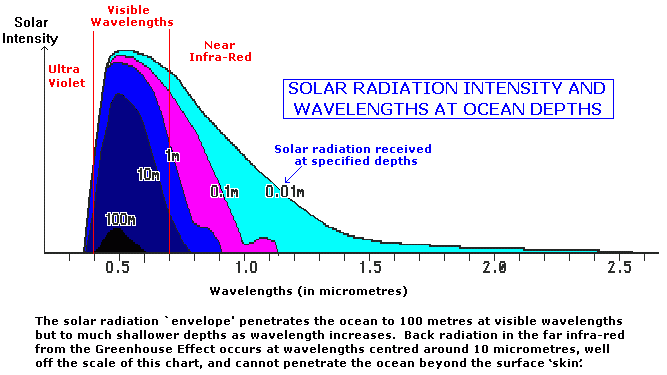
Phrased differently, sunlight can warm the oceans to depths of 100 meters, but the oceans can only release heat at the surface. Now consider that the oceans release heat primarily through evaporation (if memory serves, somewhere in the neighborhood of 90% of the heat loss from the oceans is through evaporation). UPDATE: Sorry, in this instance my memory was off. Of the approximately 180+ watts/m^2 downward shortwave radiation reaching the ocean surface, about half (about 100 watts/m^2) is released through evaporation.
THERE ARE NATURALLY OCCURRING PROCESSES THAT CAN CAUSE THE LONG-TERM WARMING OF THE OCEANS TO DEPTH
The naturally occurring processes that can warm the oceans, of course, are not considered in the climate models used by the IPCC. Climate modelers’ force the warming of the oceans based on their assumptions of how the infrared radiation from manmade greenhouse gases warm the oceans.
We’re going to break the oceans down into ocean-basin subsets, because, for two of the subsets, climate scientists addressed those portions of the oceans in the studies linked to this post.
I’ve presented these discussions in previous posts using ocean heat content data. For a change of pace, I’m presenting the NODC depth-averaged temperature data for the depths of 0-700 meters.
THE WARMING OF THE NORTH ATLANTIC TO DEPTH
As a preface to our first discussion, Figure 5 presents the depth-averaged temperature anomalies (0-700 meters) for the North Atlantic and for the rest of the global oceans. To determine the depth-averaged temperature anomalies for the rest of the global oceans, I area-weighted the North Atlantic data (11.5%, see the NOAA webpage here) and subtracted it from the global data. The units are deg C.

Figure 5
It very obvious that the North Atlantic to depths of 700 meters warmed at a much faster rate than the rest of the oceans, about 3.3 times faster from 1955 to present. That ocean basin only covers 11.5% of the surface of the global oceans, yet it represents about 35% of the ocean warming to depths of 700 meters.
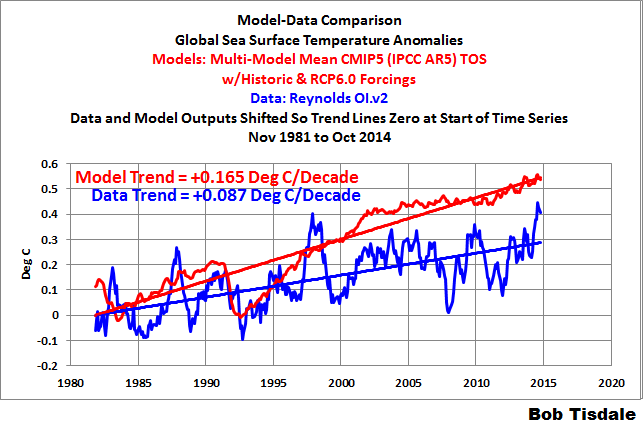
NOTE: It is unfortunate that the outputs of the climate model simulations of depth averaged temperature (or ocean heat content) are not available in an easy-to-use form so that the models can be compared to observations. We know climate models do not properly simulate the warming of ocean surfaces. They double the warming rate of the ocean surfaces over the past 33 years. See the model-data comparison graph here. Also see the posts here and here for additional discussions. It would be interesting to see how poorly the models simulate ocean warming to depth. [End note.]
Now consider what I wrote in that introductory portion from my upcoming book: It’s very obvious why the change in the ocean heat content is very important to the hypothesis of human-induced global warming. If the oceans could be shown to have warmed naturally, then the impacts of manmade greenhouse gases are much smaller than claimed by climate scientists.
And that’s exactly what a group of scientists did back in 2008. They determined the warming of the North Atlantic to 700 meters since 1955 was caused by naturally occurring processes, not by manmade greenhouse gases. We’ve discussed this paper a few times in recent years—in blog posts and in books. Here’s a portion of my ebook Who Turned on the Heat?
[START OF REPRINT FROM WHO TURNED ON THE HEAT?]
There is a study that provides an explanation for that additional warming. See Lozier et al (2008) The Spatial Pattern and Mechanisms of Heat-Content Change in the North Atlantic.
First, a quick introduction to one of the terms used in the following quotes: The North Atlantic Oscillation is an atmospheric climate phenomenon in the North Atlantic. Like the Southern Oscillation Index described in Chapter 4.3 ENSO Indices, the North Atlantic Oscillation is expressed as the sea level pressure difference between two points. The sea level pressures in Iceland, at the weather stations in Stykkisholmur or Reykjavik, can be used to calculate North Atlantic Oscillation Indices. Which Iceland location they elect to use as the high-latitude sea level pressure reference depends on the dataset supplier. The other point captures the sea level pressure at the mid-latitudes of the North Atlantic, and there are a number of locations that have been used for it: Lisbon, Portugal; Ponta Delgada, Azores; and Gibraltar. The North Atlantic Oscillation Index is primarily used for weather prediction. The direction and strength of the westerly winds in the North Atlantic are impacted by the sea level pressures in Iceland and the mid-latitudes of the North Atlantic, which, in turn, impact weather patterns in Europe and the East Coast of North America. If you live in those locations, you’ll often hear your weather person referring to the North Atlantic Oscillation. As will be discussed, winds in the North Atlantic can also impact Ocean Heat Content.
I’ll present two quotes from the Lozier et al (2008) paper. I’ll follow them with quotes from the press release that describes in layman terms how the North Atlantic Oscillation impacts the Ocean Heat Content of the North Atlantic. Back to Lozier et al (2008):
The abstract reads:
The total heat gained by the North Atlantic Ocean over the past 50 years is equivalent to a basinwide increase in the flux of heat across the ocean surface of 0.4 ± 0.05 watts per square meter. We show, however, that this basin has not warmed uniformly: Although the tropics and subtropics have warmed, the subpolar ocean has cooled. These regional differences require local surface heat flux changes (±4 watts per square meter) much larger than the basinwide average. Model investigations show that these regional differences can be explained by large-scale, decadal variability in wind and buoyancy forcing as measured by the North Atlantic Oscillation index. Whether the overall heat gain is due to anthropogenic warming is difficult to confirm because strong natural variability in this ocean basin is potentially masking such input at the present time.
In the paper, Lozier et al (2008) note, using NAO for North Atlantic Oscillation:
A comparison of the zonally integrated heat-content changes as a function of latitude (Fig. 4B) confirms that the NAO difference can largely account for the observed gyre specific heat-content changes over the past 50 years, although there are some notable differences in the latitudinal band from 35° to 45°N. Thus, we suggest that the large-scale, decadal changes in wind and buoyancy forcing associated with the NAO is primarily responsible for the ocean heat-content changes in the North Atlantic over the past 50 years.
Based on the wording of the two quotes, the paper appears to indicate that Lozier et al (2008) are describing the entire warming of ocean heat content in the North Atlantic. In other words, it seems that Lozier et al (2008) are not stating that the North Atlantic Oscillation is primarily responsible for the additional ocean heat-content changes in the North Atlantic, above and beyond the rest of the world, over the past 50 years; they’re saying it’s primarily responsible for all of the variability. The press release for the paper, on the other hand, leads you to believe the North Atlantic Oscillation is responsible for the North Atlantic warming above and beyond the global warming.
The Duke University press release for the paper is titled North Atlantic Warming Tied to Natural Variability. Though the other ocean basins weren’t studied by Lozier et al, the subtitle of the press release includes the obligatory reference to an assumed manmade warming in other basins: “But global warming may be at play elsewhere in the world’s oceans, scientists surmise”. To contradict that, we’ve found no evidence of an anthropogenic component in the warming of the other ocean basins.
The press release reads with respect to the North Atlantic Oscillation (NAO):
Winds that power the NAO are driven by atmospheric pressure differences between areas around Iceland and the Azores. “The winds have a tremendous impact on the underlying ocean,” said Susan Lozier, a professor of physical oceanography at Duke’s Nicholas School of the Environment and Earth Sciences who is the study’s first author.
Further to this, they write:
Her group’s analysis showed that water in the sub-polar ocean—roughly between 45 degrees North latitude and the Arctic Circle—became cooler as the water directly exchanged heat with the air above it.
By contrast, NAO-driven winds served to “pile up” sun-warmed waters in parts of the subtropical and tropical North Atlantic south of 45 degrees, Lozier said. That retained and distributed heat at the surface while pushing underlying cooler water further down.
The group’s computer model predicted warmer sea surfaces in the tropics and subtropics and colder readings within the sub-polar zone whenever the NAO is in an elevated state of activity. Such a high NAO has been the case during the years 1980 to 2000, the scientists reported.
“We suggest that the large-scale, decadal changes…associated with the NAO are primarily responsible for the ocean heat content changes in the North Atlantic over the past 50 years,” the authors concluded.
[END OF REPRINT FROM WHO TURNED ON THE HEAT?]
WHAT CAUSES THE WATER TO “PILE UP”, INCREASING OCEAN HEAT CONTENT?
Let’s discuss in more detail that “pile up” from the press release of Lozier et al. (2008). First, a few basics: The trade winds are a function of the temperature difference between the equator and higher latitudes. The warmer water near the equator causes warm air to rise there (convection). At the surface, winds blow from the mid latitudes toward the equator to make up for the deficit caused by the rising air, but the rotation of the Earth deflects that inrushing air to the west. Thus the trade winds blow from the northeast to the southwest in the Northern Hemisphere and from the southeast to the northwest in the Southern Hemisphere.
In the ocean basins, ocean circulation is driven primarily from the trade winds in the tropics blowing from east to west. That is, the trade winds push the surface waters from east to west in the tropics. Those westward-traveling waters warm under the tropical sun. They encounter a continental land mass and are directed toward the poles. In the North Atlantic, the poleward-flowing western boundary current is known as the Gulf Stream. It carries the warm tropical waters to the cooler high latitudes, where that water can release heat to the atmosphere more efficiently. At the mid-latitudes, those waters encounter the west to east winds known as westerlies and are blown eastward toward Europe and Africa. The eastern boundary current along Africa returns those cooler waters back toward the tropics, where they can be warmed again, completing the cycle. That ocean circulation loop is called a gyre.
Now for the “piling up”: Suppose the westerlies in the mid-latitudes slowed or reversed, while, at the same time, the trade winds were pushing the same amount of tropical water to the west and poleward. At mid-latitudes, the change in the strength or direction of the westerlies would resist the poleward transport of warm water from the tropics. That warm water would accumulate as a result. Here’s that quote from the press release again:
By contrast, NAO-driven winds served to “pile up” sun-warmed waters in parts of the subtropical and tropical North Atlantic south of 45 degrees, Lozier said. That retained and distributed heat at the surface while pushing underlying cooler water further down.
Presto. A naturally caused accumulation of heat in the North Atlantic.
Curiously, under the heading of “Beam Me Up, Scotty”, Stefan Rahmstorf of RealClimate presented a similar discussion in his post What ocean heating reveals about global warming. I, of course, commented on that in my post Comments on Stefan Rahmstorf’s Post at RealClimate “What ocean heating reveals about global warming”
Now suppose, at the same time, there were a series of strong El Niño events over a multidecadal period (1976 to the turn of the century for example), so that the tropical waters in the North Atlantic were naturally warmer than normal. Trenberth and Fasullo (2011) explain why some portions of the oceans remote to the tropical Pacific warm in response to an El Niño (my boldface):
But a major challenge is to be able to track the energy associated with such variations more thoroughly: Where did the heat for the 2009–2010 El Niño actually come from? Where did the heat suddenly disappear to during the La Niña? Past experience (Trenberth et al. 2002) suggests that global surface temperature rises at the end of and lagging El Niño, as heat comes out of the Pacific Ocean mainly in the form of moisture that is evaporated and which subsequently rains out, releasing the latent energy. Meanwhile, maximum warming of the Indian and Atlantic Oceans occurs about 5 months after the El Niño owing to sunny skies and lighter winds (less evaporative cooling), while the convective action is in the Pacific.
That additional sunlight during a period when El Niños dominated (1976 to the turn of the century) would add to the amount of accumulating warm water in the North Atlantic…and elsewhere.
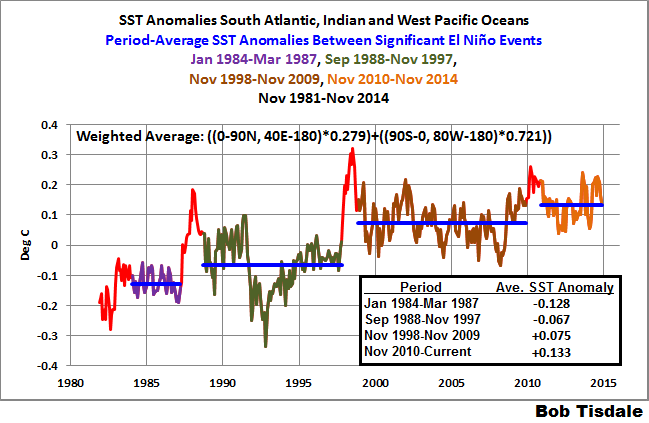
And Trenberth now understands that the heat didn’t suddenly “disappear to during the La Niña”. It shows up as the “big jumps” in surface temperature in response to strong El Niño events. See the posts:
- Open Letter to the Royal Meteorological Society Regarding Dr. Trenberth’s Article “Has Global Warming Stalled?”
- The 2014/15 El Niño – Part 9 – Kevin Trenberth is Looking Forward to Another “Big Jump”
I also present those “big jumps” in the monthly sea surface temperature updates (November 2014 update is here). They stand out quite plainly in the sea surface temperature data for the South Atlantic, Indian and West Pacific Oceans. For a further discussion see the illustrated essay “The Manmade Global Warming Challenge” (42mb).
EXTRATROPICAL NORTH PACIFIC
The next paper to be discussed is Trenberth and Hurrell (1994): Decadal Atmosphere-Ocean Variations in the Pacific. In it, Trenberth and Hurrell were using an index derived from the sea level pressures of the extratropical North Pacific (30N-65N, 160E-140W), called the North Pacific Index, to explain shifts in the sea surface temperatures of the North Pacific. Again, a sea level pressure index reflects changes in the wind patterns. My Figure 6 is Figure 6 from Trenberth and Hurrell (1994).

Figure 6
That same shift appears in the depth-averaged temperature data for the extratropical North Pacific (24N-65N, 120E-80W) for the depths of 0-700 meters. But the shifts are delayed a year in the subsurface temperature data. See Figure 7.

Figure 7
I’ve color-coded 4 periods on the graph. The first period from 1955 to 1988 (dark blue) includes the downward shift in 1978. As a result of that shift in 1978 (that should be related to the shift in the sea level pressures and wind patterns), the depth-averaged temperature data shows a cooling trend from 1955 to 1988. That is, the extratropical North Pacific to depths of 700 meters cooled (not warmed) for more than 3 decades. The second period (red) captures the upward shift in 1988 and 1989 that, once again, should be related to the shift in the sea level pressures and wind patterns. From 1991 to 2002 (light blue), the extratropical North Pacific cooled once again to depths of 700 meters. And since the ARGO floats were deployed (black), the extratropical Pacific shows a slight warming to depth.
It’s blatantly obvious the extratropical North Pacific to depths of 700 meters would show no warming from 1955 to present if it wasn’t for that upward shift in 1988 and 1989. It’s also obvious that the downward shift in 1978 that extends to 1988 also impacts the long-term trend. That is, without the naturally caused downward shift in the late-1970s the long-term warming rate would be less. Obviously, natural variability, not manmade greenhouse gases, dominates the variability and long-term warming of the extratropical Pacific to the depths of 700 meters.
TROPICAL PACIFIC
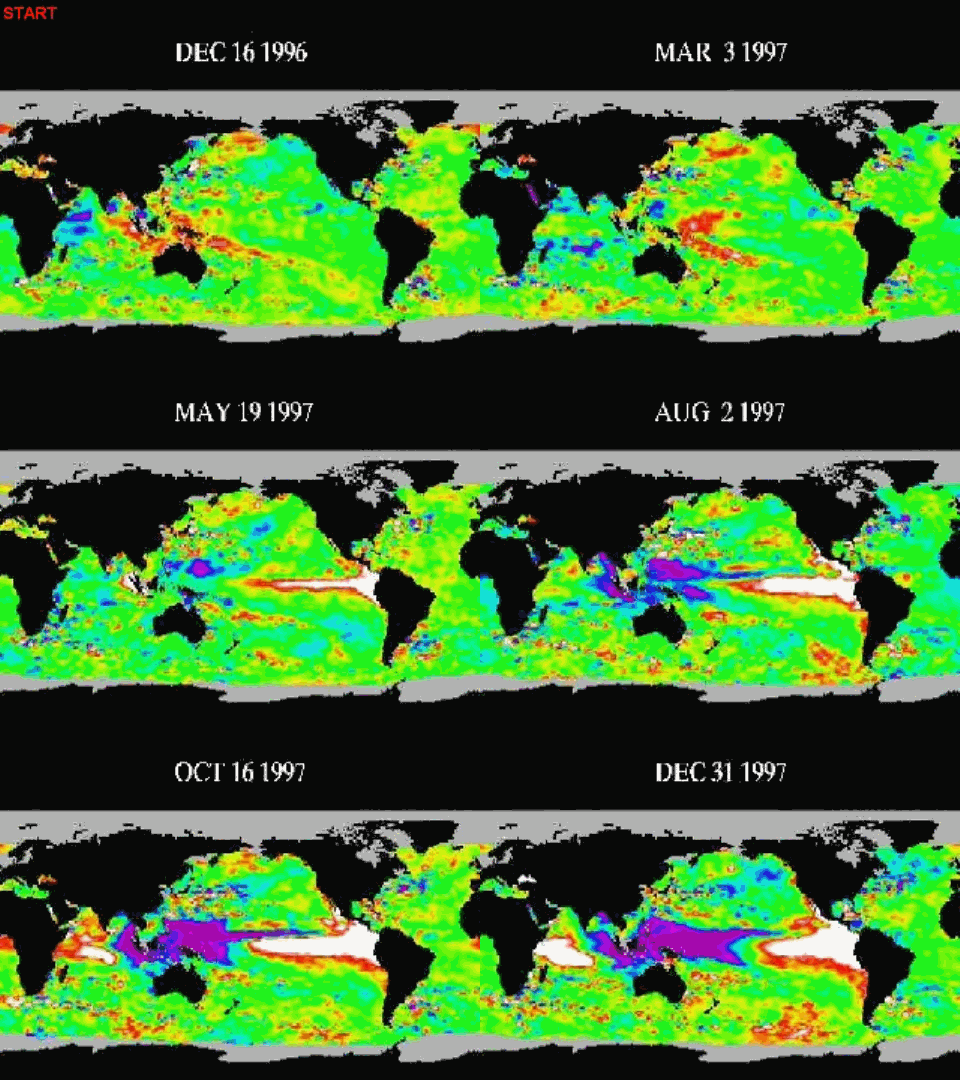
We isolate the vertically averaged temperature data to depths of 700 meters for the tropical Pacific because the tropical Pacific is where El Niño and La Niña events take place, and El Niño and La Niña events, collectively, are the dominant forms of natural variability on Earth. A further clarification: while El Niño and La Niña events are focused on the equatorial Pacific, they directly impact the entire tropical Pacific. See the animation here for an extreme example of the effects of an El Niño on the sea level residuals of the tropical Pacific.
Let’s start with two quotes from (again) Kevin Trenberth. According to Trenberth, El Niño events are fueled by sunlight, not manmade greenhouse gases. In the much-cited Trenberth et al. (2002) The evolution of ENSO and global atmospheric surface temperatures, they stated (my boldface and brackets):
The negative feedback between SST and surface fluxes can be interpreted as showing the importance of the discharge of heat during El Niño events and of the recharge of heat during La Niña events. Relatively clear skies in the central and eastern tropical Pacific [during a La Niña] allow solar radiation to enter the ocean, apparently offsetting the below normal SSTs, but the heat is carried away by Ekman drift, ocean currents, and adjustments through ocean Rossby and Kelvin waves, and the heat is stored in the western Pacific tropics. This is not simply a rearrangement of the ocean heat, but also a restoration of heat in the ocean. Similarly, during El Niño the loss of heat into the atmosphere, especially through evaporation, is a discharge of the heat content, and both contribute to the life cycle of ENSO.
NOTE: That’s the source of my standard description of ENSO as a chaotic, naturally occurring, sunlight-fueled, recharge-discharge oscillator…with El Niños acting as the discharge phase and La Niñas acting as the recharge phase. But La Niñas also help to redistribute the leftover warm waters from the El Niños. [End note.]
Also see Trenberth and Fasullo (2011). They confirm that ENSO is sunlight-fueled during La Niña events:
Typically prior to an El Niño, in La Niña conditions, the cold sea waters in the central and eastern tropical Pacific create high atmospheric pressure and clear skies, with plentiful sunshine heating the ocean waters. The ocean currents redistribute the ocean heat which builds up in the tropical western Pacific Warm Pool until an El Niño provides relief (Trenberth et al. 2002).
Figure 8 presents the vertically averaged temperature anomalies (0-700 meters) for the tropical Pacific. El Niño and La Niña events directly impact the top 300 meters, so this depth captures their direct impacts. I’ve highlighted in maroon the three 3-year La Niña events of 1954 to 1957, 1973 to 1976, and 1998 to 2001. After those 3-year La Niña events, the tropical Pacific shows cooling, not warming. That indicates that the shorter La Niñas that follow El Niños only recharge part of the warm water released from the tropical Pacific by the El Niños. Also, I’ve highlighted in red the 7-month period associated with the 1995/96 La Niña. (See the old version of the NOAA ONI index.) The 1995/96 La Niña created the warm water that fueled the 1997/98 El Niño, which is responsible for the sharp drop in temperature following the heat uptake of the 1995/96 La Niña. The “overcharge” from the 1995/96 La Niña and the recharge during the 1998-01 La Niña obviously caused an upward shift in the subsurface temperatures of the tropical Pacific.
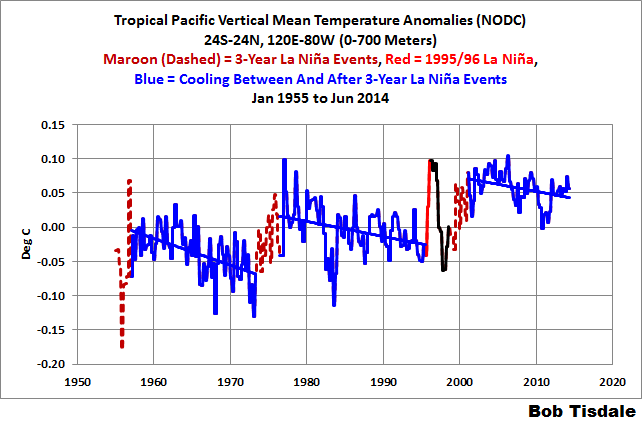
Figure 8
What is also blatantly obvious is the warming of the tropical Pacific to depth is dependent on 4 La Niña events. And according to Trenberth et al. (2002) and Trenberth and Fasullo (2011), sunlight warms the tropical Pacific during La Niñas, not infrared radiation from manmade greenhouse gases. (In the real world, downwelling longwave radiation decreases during La Niña events.)
BOTTOM LINE ON OCEAN TEMPERATURE DATA FOR THE DEPTHS OF 0-700 METERS
Subsurface temperature data (and ocean heat content data) for the North Atlantic, the Extratropical North Pacific and the Tropical Pacific all indicate that naturally occurring coupled ocean-atmosphere processes are the primary causes of ocean warming to depth, not manmade greenhouse gases. In fact, the data for the tropical Pacific and extratropical North Pacific show those oceans can cool for decadal and multidecadal periods between short-term naturally caused warming episodes. Those decadal and multidecadal cooling periods further suggest that manmade greenhouse gases have no measureable impact on ocean warming to depth.
NOTE: Someone is bound to note that I’ve only presented subsurface ocean temperature data for the top 700 meters and only for the oceans of the Northern Hemisphere and the tropical Pacific. If I receive a comment to that effect on the thread, I will refer that blogger to the 2 posts linked in the introduction. Here they are again:
- Is Ocean Heat Content Data All It’s Stacked Up to Be?
- AMAZING: The IPCC May Have Provided Realistic Presentations of Ocean Heat Content Source Data
CLOSING
I’m sure I’ve missed a few arguments for and against the anthropogenic ocean warming. If you introduce others, please provide links where possible.
UPDATE 2: While preparing this post, I overlooked an excellent post by Willis Eschenbach Radiating The Ocean.
Well for the record, I am against human induced ocean warming. Seems like a sheer waste of energy to me, and we don’t have energy to spare just to warm the ocean.
Those who want ocean warming should move to a Caribbean island. The waters of St John,V.I. are my favorite ocean warming spot.
Bob, there is repeated here and there the thought that there are only two mechanisms for ocean cooling: radiation and evaporation. The discussion proceeds as if 90% is lost by evaporation therefore 10% goes out by radiation. Not so fast…
There are four ocean surface cooling mechanisms. Three are common to all objects in contact with an atmosphere: conduction (through still air), radiation and convection (which is a form of conduction but treated separately as ‘mass transfer’). Oceans also cool by evaporation. That makes 4.
If 90% of heat is transferred away from the ocean by evaporation, there is still conduction into the air (very small as air is a good insulator with poor conduction characteristics that vary with humidity). There is radiation which tends to be a small percentage of heat lost from an object. And finally there is convection whereby a mass of air is moved against a warm(er) object and energy is transferred to that air mass making it warmer.
I don’t see conduction and convection covered in the discussion. Having done these calculations I am willing to ignore the conduction portion, but I insist that convection of heat from the surface be given a little credit. Yes a moving air mass evaporates water, but after saturating, a cold, wet air mass can still pick up huge amounts of heat by mass transfer (which is called convective heat transfer).
This energy is transported high into air where it is released by the usual cloud and rain mechanisms. I don’t think the IR transfer rate (net) from the surface is as high as people are saying it is. For one thing, there is a heck of an IR absorber just above the surface in the form of a very wet (GHG) layer of air (with a tiny amount of CO2 in it, of course).
Crispin in Waterloo – Speaking to Bob Tisdale.
(Addressed also to Willis E.)
OK, then.
Let us get the actual (well, calculated numbers for all four at least): I think you will find that the “easy answer” that “everybody uses” is correct, but only for limited times and under very, very limited circumstances.
So: Calculate the 4 heat losses for four situations:
1. Tropic ocean: warm water (25 deg C), warm air (25-30 deg C), medium to high humidity air (65-85% RH), modest winds, scattered clouds with irregular completely clear skies. Very high solar angles, very low air mass, very high insolation.
2A. Gulf Stream or mid and south Atlantic, Mid latitudes: Modestly warm water (15 – 20 deg C), cooler air that will be both hotter or colder than the water temperatures, lower humidity air (45-60 % RH) , modest winds, again clear skies (No clouds, little haze). Medium solar angles, medium air mass => medium insolation values.
2B. Gulf Stream or mid and south Atlantic, Mid latitudes: Modestly warm water (15 – 20 deg C), cooler air that will be both hotter or colder than the water temperatures, lower humidity air (45-60 % RH) , modest winds, but now cloudy skies (Fully overcast clouds, mid-altitude haze). Still medium solar angles, medium air mass => medium insolation values but ALL diffuse radiation.
Less incoming IR. Outgoing LW radiation now ???. Much less radiation loss. Less evaporation loss.
3. Arctic/Antarctic (non-stormy): Cold water (2-4 deg C), Cold air (10 to -10 deg C), low humidity (10 – 25% RH), low winds, very clear skies, very low solar angles = very high water albedos, very high air masses => very low insolation values.
Just for consistency: Assume 2-4 m/sec winds for all cases.
Give sources for your assumed coefficients of convection and conduction heat transfer coefficients.
Show your work.
8<)
RACook
I was well into a reply and lost it (argh).
I have been thinking of things much closer to the surface so I had better explain myself better. There is a supersaturated layer of air just above the water with water vapour condensing and water evaporating continuously. The amount depends on the temperature. When this layer is blown away, evaporation is much more efficient. AS a heat conducting layer, it is quite efficient, far better than dry air.
The swimming pool people have a good set of formulas that are relevant to evaporation involving wind and as evaporation from a pool is ‘a cooling’ (evaporative cooling) it would be helpful when setting up this calculation (which I will not attempt).
There are three methods here http://cwanamaker.hubpages.com/hub/Determine-Evaporation-Rate-for-Swimming-Pool and a table is needed for the saturation vapour pressure http://cwanamaker.hubpages.com/hub/The-Amazing-and-Remarkable-Properties-of-Water about halfway down.
My approach was going to be very different. We are looking for a bounded range for the convective transfer portion (to get an idea of scale).
An alternative is to consider Prandtl’s approach of considering the thin layer at the water surface as ‘different’ and considering the free space above as infinite. This means we might be able to treat wind speed as a temperature change, not ‘cooling by impacting the surface’. Not sure but in the latter case we could treat the first 0.1 or 1 mm of air as saturated, conductive and passing heat to the atmosphere. All convected heat has to pass into the air through a ‘thin’ boundary layer, at least in simplified thinking which is adequate for an otherwise unsolvable problem (Bejan 2005).
How’s this as a start:
Wind speed, 0 m/sec
Water temperature, 18 C
Air temperature 16 C
Emissivity 0.98
Convection coefficient for gases 20 W/m2·K (I am not sure of this value for wet air)
SB Constant 0.0000000567
Convection = (Water T-Air T)*Conv Coeff
Radiation = SB*Emissivity*((Water T+273)^4-(Air T+273)^4)
Loss by radiation 11 watts/m2 = 21.3%
Loss by convection 40 watts/m2 = 78.7%
So it would appear that the convective heat transfer is very important even with only a 2 degree difference in water/air temperature and no wind. If evaporation is 90% (claimed above) and 4/5 of what is left is convection, there is only 1/5 of 10% leaving by radiation – 2% of the total. Wow.
I think the 90% is highly variable. But at a very modest 2 degree difference, convection dominates the non-evaporative portion.
Changing the Delta T to 3 degrees gives a 50% increase in both to a total of 76 Watts/m2
16 degree air over a 21 degree ocean (night) loses 127 W/m2 and the ratio is nearly the same.
-20 C air over a 4 deg ocean transfers 579 W/m2 and the radiation component drops to 17% of the total.
Conclusion: Assuming non-evaporative cooling is 100% lost by radiation is probably not representative of what is taking place. Generally speaking, increasing the wind speed increases the cooling rate. The formula for ‘wind chill factor’ might be incorporated into this. Above a certain speed at the surface, energy transfer would be limited by heat conduction vertically through the water.
Caution: This may be completely wrong – I was unable to locate a fully representative energy transfer function representing large scale air flow over open water that incorporated evaporation and surface cooling.
Crispin in Waterloo & RACookPE1978, I corrected a mistake in my post. It looked very odd to me. I added a correction to the post:
Of the approximately 180+ watts/m^2 downward shortwave radiation reaching the ocean surface, about half (about 100 watts/m^2) is released through evaporation.
Bob,
Ooh, that is interesting. Are you saying that the 100 watts is directly turned into evaporation at the surface?
If so there is 80 W left to ‘get back’.
If 90% is also from evaporation (possible?) then that is 72 W
4/5 of the remainder is convection = 6.4 W
1/5 of remainder is radiation = 1.6 W
That may seem very low, but it should be remembered that there is a gigantic GHG effect in the first few mm of the atmosphere because the air is saturated/super saturated with water vapour. I can’t see CO2 any difference larger that a spit in the ocean.
If the 100 W is evaporation after entering the water to some depth, the adjust the numbers above accordingly.
Given my example above, if I set the water to 16 C and the air to 12.8 the loss is 80 watts, with radiation being 21% of it or 16.8 W.
Interestingly, leaving the water at 16 and raising the air temp to 21, the convective transfer to the water is 100 W/m2 assuming there is not evaporation (saturated air, as in a rain storm).
I found another calculator for swimming pools at http://www.engineeringtoolbox.com/evaporation-water-surface-d_690.html
It says that with 25 deg water and 25 deg air, and the air at 50% humidity, wind at 2 m/sec it will cool evaporatively at 405 W/m2. Dang.
Bob T
I remain worried that the IR from the water vapour at the surface is not being considered. Also the recondensation of water vapour at the surface is a way to increase the IR up without increasing evaporation. I think the 100 watts you have there is ‘net’, correct? The actual amount of energy involved in what amounts to a very short heat pipe mechanism is larger, and increases the IR from the ‘region of the surface’.
This impacts my straw man calculation but I didn’t think deeply about how.
Per my comment to Willis on the ‘average’ evaporation, I get 80 watts global average for 1 metre of evaporation so his 70 is believable with is lower precip number. I read once evaporation is 2 metres but if rainfall is only 1 that can’t be right. Two metres of evaporation average is 160 watts. Your 100 watts is 1.25m evaporation. Still in the ballpark. I don’t like this ‘average’ business. What is DWIR in the major tropical evaporation zones, and what is the evaporation?
The warmer the average T is, the higher the percentage of any increase in DLWIR will go into evaporation. The relationship cannot be linear correct?
David A December 11, 2014 at 5:01 am Edit
It’s not linear, as you suspect it rises faster at higher temperatures. See my post, “Marginal Parasitic Loss Rates“.
w.
lots of theories but no definitive experiments in those studies … if IR can’t penetrate then IR CAN’T heat what it hasn’t penetrated … yes the water that is heated by IR can then heat the next layer … but that dies out pretty fast … its amazing to me that this is being debated when it should be possible to experiment and turn theories into facts one way or another …
Excellent post Bob! There should be a “start here” link to this for anyone who wants to discuss ocean warming.
For people who are still stuck or decoyed by the ignorati think of it this way. (where is Konrad by the way?)
The surface temperature of the oceans is, on average, about 14 degree C. I do not know the exact value, Bob probably does. But I do know that the ocean surface approximates to a blackbody in the infrared region. We see its emission from space and it accords with a blackbody. According to Kirchoff’s Law, this means it will also absorb as a blackbody.
A body at 14 degree C will emit at about 390 watts per square metre (another Law established in the 19th century but seemingly unknown to many here). If it loses heat at the rate of 390 watts per square metre, then how does it maintain its temperature? It can only do that by absorbing at least 390 watts per square metre from somewhere else (or is that to hard?)
The solar radiation absorbed at the surface is about 170 watts per square metre. Obviously, that is not enough to replace the energy lost by radiation alone, is it? Never mind convection and evaporation losses.
OK, there is some heat input from the hot planetary core. This amounts to a staggering 0.08 watts per square metre. Let’s agree this is insignificant.
So how does the ocean maintain its temperature? What is the other heat source? There is only one contender.
Have you worked it out yet?
MIkeB, You are in appropriately clinging to a radiative balance hypothesis and totally ignoring the well known physics of heat sequestration in the ocean that are the important dynamics here. To understand those dynamics, the analyses must be local as each ocean basing, each gyre will store and ventilate heat differently. The saltier Atlantic stores more heat at depth than anywhere else, and that can not be explained by CO2.
Solar heat is absorbed in the tropics to excess, and there solar radiation is more in the range of 500 to 800 W/m2, or more in cloudless regions. Evaporation causes more dense saline warmer water to sink below the surface and thus the heat is now stored, and that heat may remain stored at depth for decades. Tropical rains and summer surface warming stratifies the oceans. Mode waters are warm subsurface waters that are typically ventilated during the winter, when the upper strata cools and sinks, allowing mode waters to reach the surface and ventilate some heat. Winter storms help ventilate that heat but it takes at least 1-3 years to ventilate the initially stored heat. Climate outside the tropics depends on how that stored ocean heat is transported poleward via ocean and atmospheric currents as illustrated here http://landscapesandcycles.net/image/91464625_scaled_495x288.png
As Bob has pointed out. The ocean is virtually opaque to infrared. Once heat is stored below the surface, it is not radiating infrared back t space. So who are you slandering by calling them the “ignorant”? Your blackbox concept is not appropriate in this discussion.
Kirchoff’s law, is only valid for systems that are in thermal equilibrium. And when that is the situation, the absorbed and transmitted radiation must match at every single wavelength. There cannot be a send / receive unbalance at ANY wavelength.
And I don’t believe it applies to any radiation; just thermal (BB like) radiation. It is a thermodynamic macro property, and doesn’t apply to atomic and molecular line spectra, which depend on atomic structure.
Most things that are not actually changing temperature can be considered to be in thermal equilibrium as long as the thermal inputs on them are in a steady state. The ‘thermal equilibrium’ rule allows Kirchhoff’s Law to be proven by a simple mind experiment, logic alone, with no need for experimentation. I think there is such a proof in Wikipedia somewhere.
Even where this is not the case, once it is established that an object can radiate at a particular wavelength in thermal equilibrium it will be able to radiate at that wavelength when not in equilibrium. Or is that a step to far for you?
Kirchhoff’s Law applies to all electromagnetic radiation. It is universal. It also also applies to line spectra.
Here is an image showing absorption and emission spectra in the visible spectrum. See how the emission lines and absorption lines match. ( I don’t know what the intervening gas is for this diagram but the yellow line looks like sodium).
http://nptel.ac.in/courses/105104100/lectureD_19/images/2.jpg
MikeB @ur momisugly December 9, 2014 at 11:05 am
I would quibble with a few of your comments, e.g., “We see its emission from space…” – we don’t, because a big divot is taken out by the atmosphere. But, near surface measures of emissivity typically put it in the range of at least 85%, and generally closer to 95%, across the frequency range. Not, however, from all aspect angles, so there is some reduction from there, too.
But, I agree with the larger point – there is an energy imbalance which cannot be reconciled without considering atmospheric absorption.
This does not, however, address the question of whether IR radiation specifically heats the ocean to depth.
It is also the case that,while atmospheric IR absorption undoubtedly heats the planet beyond what it otherwise would be, it does not necessarily follow that an incremental increase in IR gases will always produce an incremental increase in surface temperatures within the local neighborhood of a particular climate state.
We see its emission from space through the ‘atmospheric window’.. From that we can detrmine its temperature.
You are correcdt we cannot see the surface through the greenhouse gas absorption bands
.
MikeB, not sodium that would have a yellow doublet, without wavelength calibration it’s difficult but it looks most like helium.
http://pmm.nasa.gov/education/sites/default/files/article_images/components2.gif
The heat source is the absorbed solar energy (by the surface, which is ~51% of the incoming at TOA, which is ~340 W/m2). The surface loses heat by evaporation (23%), convection (7%), LWIR to the atmosphere (15%) and LWIR directly to space (6%). These are global averages (land and ocean) and are not very accurate. Oceans only is similar.
Right here laughing at you Mike 😉
The oceans are a SW selective surface not a near blackbody. The sun alone would drive them to 335K were it not for atmospheric cooling. Now how does the atmosphere cool?
Have you worked it out yet?
So why do you think “the ocean surface approximates to a blackbody in the infrared region” refers to SW radiation?
The ocean has evaporation before the additional infrared radiation. Let us call that “Ev1”. The additional infrared radiation causes an additional evaporation which we can call “Ev2”.
This Ev2 causes an additional humidity in the air just above the surface which is leading to a decrease in Ev1. This reduction in Ev1 leads to an increase in the ocean temperature.
It is quite easy to set up an experiment showing that an increase in infrared radiation can increase the temperature in a bucket of water. I hope some of the contributors here can do it. I am more than willing to help in the setup.
/Jan
Then you do it and come back and tell us how you did heating the bucket of water with your hair dryer.
Better yet, try heating that bucket of water using a real near BB radiator that is emitting LWIR about like the atmosphere; such as a 16 [ounce] bottle of water chilled to about 14 deg C. That is what is “beating down” on the oceans like a infrared blow torch to warm the oceans.
Hair dryer give warm wind, not IR.
But an electric terrace heater would do.
Two equal buckets or large glasses with water should be used and one of them should be shielded from the IR.
Like this:
The “downward” LWIR that is supposed to be warming the surface, including the ocean has an equivalent black body Temperature of around 288 K emitting about 390 W/m^2 at a wavelength peaking at about 10.1 microns.
The experiment sources you propose operate at a good fraction of the sun’s surface Temperature and have radiances that are thousands of times higher than the atmosphere.
I don’t know what sort of hair drier you use, but mine has a fan I can turn off when I don’t want hot air, and then it emits near IR radiation. (much higher radiance than the atmosphere, and much higher photon energy).
To do a realistic LWIR heating experiment, you have to use a radiation source that is at 288 K and emitting about 390 W/m^2 at a 10 micron peak spectral wavelength.
To do otherwise is scientific fraud.
As George points out, one has to do one’s best to recreate the 288K IR heat source.
Jan, I would suggest that rather than usuing your electric IR heater, you should use a 1.4m by 70cm flat panel water radiator (ie., one that has an area of about 1 sq.m) which should be painted black and filled with water at 14degC. If you like you should insulate one side of the radiator so as to slow heat loss, leaving exposed only the flat side that is painted black. This panel will then be radiating at 288k such that it will be replicating the equivalent atmospheric DWLWIR.
Get two identical buckets of water at 20degC, one being placed underneath the radiator but with sufficient gap so as not to impede convection, and note the time each takes to cool.
Yes, and to do it even more realistic we should also use a 2000 meter water column instead of the glass and let the experiment go on for three decades.
But that is not very practical. The experiment I sketched is easy to do, and it will answer the question of whether it is possible to heat water with infrared radiation to the surface. If the answer is “No” there is no reason to go further.
If the answer is “Yes”, one can set up a more refined experiment to see whether there is a cutoff on some temperature or frequency or whether there is a linear or non-linear decrease with the temperature of the source.
/Jan
Jan, you would be warming the glass sides, which would be conducting into the water, vastly different then the oceans. Have you looked at Konrad’s experiments?
Thanks David, you are absolutely right.
The setup should be modified to shield the [glass] sides. Tgis could be done with [for] instance a cardboard with hole for the water surface on top of each glass. The reason for having an identical plate on the glass already shadowed by the plywood is to let the glasses be as identical as possible.
first you have to start out with a temperature increase…that’s smaller than what can be measured
..how precious
RE”
————————————————–
Nick Stokes
December 9, 2014 at 6:16 am
Bob,
In a post way too long, you’ve devoted far too much space to some very silly arguments. There is no issue about down IR penetrating sea water. The sea surface is warm and radiates upward more heat than it receives in sunlight. If it were not for down IR, it would cool rapidly. Down IR maintains heat flux balance at the surface. It does not need to penetrate. If down IR increases, the flux from below decreases, at the same temperature. The sea is warmed by that retained heat.
—————————————————-
Unless Nick can provide information from a competent Oceanographer such as Dr. Robert Stevenson to back up his musings, I suggest that they are similar to his pea moving motions he has been exhibiting at CA in the last week. For more information read: http://www.21stcenturysciencetech.com/articles/ocean.html.
The statement “The sea surface is warm and radiates upward more heat than it receives in sunlight” is bunk. The reason land surfaces and sea surfaces increase in temperature is they receive more energy from the sun than they radiate. This can happen when daylight is longer than darkness so there is a net gain during the day which is also cumulative over a summer season when days are longer. When days become shorter there is a net loss. We call that winter. So the northern oceans cool in the winter when they lose sunlight. The amount of sunlight received is decided by the time of year and amount of cloud. Down IR does not prevent the ocean from cooling as it cal only go down millimetres or microns. Oceans close to the tropics do not change much in temperature as the days do not change much in length. The oceans and lakes cool slowly because they radiate IR from a depth of a hundred or so metres. They CANNOT cool rapidly. By the same token as the shortwave radiation has to penetrate a hundred metres or so, they will also warm slowly in the spring and summer. Land surfaces only radiate from the surface so can cool rapidly in one night as well as containing much less energy in those few centimetres of surface. The ground then cools downward by conduction. Similarly land surfaces warm rapidly during the day because the heat is not transferred rapidly downward as the ground is a good insulator.
Gerald, that was a good reply to the nonsense, “The sea surface is warm and radiates upward more heat than it receives in sunlight”. I couldn’t believe that Nick would say something like that.
You couldn’t believe it. Wow!
It’s back to the drawing board then for Science.
Bob,
Another good post. Worth the read. About this coefficient 0.002K/(Watt/m^2) change in surface temperature with increased LWIR — has that been published in a refereed journal. It would be good to have a citation other than a blog.
Nick Stokes December 9, 2014 at 6:16 am
There is no issue about down IR penetrating sea water. The sea surface is warm and radiates upward more heat than it receives in sunlight.
>>>>>>>>>>>>>
Where? And when?
If everything was an average, then the above would be true. But everything isn’t> and average, and the relationship between T and P isn’t linear, which makes averaging an even worse idea.
The oceans in the tropics absorb more energy than they radiate. In the polar regions, the opposite is true. The part in between is fuzzy depending on season and time of day. So Nick’s blanket statement above may be true on some level, but you’ll have trouble finding any specific spot on earth that follows that model.
David,
Poleward heat fluxes are small compared to the radiative fluxes (100s W/m2) described here. Fig 2.17 here puts it at 2 PW max. Divide that by ocean area and it’s about 7 W/m2. OK, some areas will be more affected, but again, it’s 2 PW max. It’s a small and fairly steady imbalance.
Its hard to trust your link in figure 2.17 that argues deep water formation in the North Atlantic is the driver of poleward heat transport. The authors have confuse cause and effect. That poleward transport is wind driven and pushes more mass poleward. Mass balance requires a return but not the depth of that return. It doesn’t matter of there is deep water convection or mid-level feeding the return. The winds will continue to determine the poleward transport, and the winds are driven by solar heating. The paleoclimate evidence is the opposite of what your link suggests.There was higher poleward heat transport during the Roman and Medieval Warm periods and higher insolation . And during low insolation during the Little Ice Age, there was a 10% reduction in poleward heat. http://www.nature.com/nature/journal/v444/n7119/full/nature05277.html
Well here’s a different figure. Oceans absorbing 90 w/m2 more than they radiate in the tropics, and radiating 100+ more than they absorb in the arctic regions.
http://eos.atmos.washington.edu/cgi-bin/erbe/disp.pl?net.ann.
And you don’t divide by the ocean AREA to get the flux in W/m2, you divide it by the CROSS SECTION.
But you still get the same answer. The radiative equilibrium you describe doesn’t exist in any body of water anywhere in the world. Oh some temperate loctions may achieve this for a brief period of time once in the spring and once in the fall…. for a few hours.
Nick,
I looked at your Fig 2.17 some more and thought to myself, assuming this figure is correct, what conclusions could I draw from it? The oddity is that the atmosphere’s pole ward energy transport is so much bigger than the oceans. How could that be? The oceans cover 2/3 of the earth surface, they absorb S/W to hundreds of meters down, they have a heat capacity 1200 times that of the atmosphere, how could energy transport in the oceans be so much less than the atmosphere?
Well here’s a thought. All that LW energy coming down from the GHE hits the ocean surface which responds by saying h*ll no, you ain’t comin’s in here, you’re going right back into the atmosphere and I’m sending some water vapour to escort you out. Poof, the majority of the LW then HAS to be transported poleward via atmospheric processes because the oceans just won’t let the LW in directly.
Note, I said directly. There’s an awful lot else going on of course, its the indirect effects that we don’t fully understand.
David,
“And you don’t divide by the ocean AREA to get the flux in W/m2, you divide it by the CROSS SECTION.”
No, we’re looking for the imbalance the flux creates for each m2 of ocean surface. In fact, poleward transport is a small effect compared with, say evaporation.
I tried your link; it gave six choices of format, but said they were all unavailable.
As to why the atmosphere carries more – well, that’s what the measurements say. I guess winds blow faster and in more organised convection cells (Hadley).
Nick Stokes;
I tried your link; it gave six choices of format, but said they were all unavailable.
>>>>>>>>>>>>>>
Try this one:
http://eos.atmos.washington.edu/erbe/
Then click on net radiation, annual, 2nd from the top, left hand side.
Nick Stokes:
No, we’re looking for the imbalance the flux creates for each m2 of ocean surface. In fact, poleward transport is a small effect compared with, say evaporation.
>>>>>>>>>>>>>>>
Such evaporation would be primarily driven by….?
But that’s beside the point. Your claim was that the oceans are in radiative balance, and that may be true on an annual basis across all the ocean area, but at any given point in space or time that is almost NEVER true. It doesn’t matter if evaporation is bigger or not, it still isn’t true, and treating it like an average is just misleading as there is so much else going on.
jim Steele
December 9, 2014 at 4:32 pm
“The paleoclimate evidence is the opposite of what your link suggests.There was higher poleward heat transport during the Roman and Medieval Warm periods and higher insolation.”
GISP cools in the 1st to 4th centuries, that’s the RWP, GISP then warms ~390-540, that’s the Dark Ages cold period, it then cools in the 8th and 9th centuries, which was some of the warmest of the MWP period for Europe. A number of mid latitude regions show a sharp cooling-drying in the late 10th and parts of the 11th centuries, that’s the next warm spike in GISP. The Minoan [Warm] Period on GISP (1350-1150 BC) is easily verified as a very cool-dry period for the mid latitudes.
I have been trying to explain that to Willis on many occassions, when we have argued the pros and cons of the gross and net energy budget. As you no doubt recall Willis adopts the view that DWLWIR must be heating the oceans otherwise they would freeze, but comes to such conclusion by setting up a circular argument on gross energy flows. The relaitywould appear to be that the oceans are losing the net energy out. .
You cannot deal with averages. The equatorial and tropical oceans receive a huge amount of solar energy, far more energy than they lose, and this excess energy is distributed predominantly polewards keeping high latitudes warm and polar oceans largely ice free in the summer when the poles additionally receive sufficient solar energy. When the poles do not receive sufficient of the additional solar energy, the polar oceans begin to freeze.
What the co2 driven global warming advocates don’t discuss is that if the ocean has started eating global warming since the trade winds changed during the negative phase of the ocean’s ~60 year multi-decadal cycles, they also emitted excess energy during their positive phase from 1975-2005. The implication is that the oceans are capable of storing energy on long timescales, and releasing it on long timescales too. And they store a lot of energy. The top two metres alone contain as much energy as the entire atmosphere above.
We know that the oceans keep the air temperature up over night as the release some of the energy the Sun poured into them during the day. We also know that there is a lag of a couple of months between the longest day of the year and the peak in surface air temperatures near coasts. This is thermal inertia and heat capacity at work. On longer timescales, we have recently confirmed that runs of El Nino events which release a lot of energy from the oceans are initiated on the falling side of the solar cycle, never on the upswing.
So we can go a stretch further and combine what we know. When solar activity falls, energy comes out of the ocean, not just over the period of the decline of a single 11 year solar cycle, but if the Sun stays low in activity terms, for many years. An integration of the sunspot number shows us that the ocean heat content rose all the way from 1934 to 2003. This is the real cause of ‘global warming’. A lot of excess energy is still retained in the upper ocean. We can expect the effect of a couple of low solar cycles to be softened by a proportion of that excess heat returning to space via the atmosphere warming it on the way.
In developing my understanding of the Earth’s systems, I developed a couple of very simple models to help me fathom the way the surface temperature stays fairly constant as the solar cycles wax and wane. Back in 2009, by analysing the data, I found that the global average sea surface temperature, the SST, stays fairly constant when the Sun is averaging around 40 sunspots per month. By calculating the running total departing from this figure in a simple integration I found that combined with the ~60 oceanic cycles (also solar influenced), I could reproduce the temperature history of the last 150 years quite accurately. By adding in a nominal forcing for co2 (or an allowance for the infamous ‘adjustments’ to the data), I was able to get a match to monthly data which has a Pearson R^2 value of 0.9.
The above is part of an article ROG TALKBLOKE wrote from his web-site talkblokes talkshop.
I think this article presents a strong case for solar/ocean connections.
Nick Stokes Dec 9 at 1:58
Nick, it is true the sea is warm enough to radiate up more than the absorbed sunlight, but you have cause and effect backward. The NET radiation up is well less than the absorbed sunlight, so conduction/convection and evapotransporation are needed to balance the outgo with input. The downward IR is absorbed at the surface where the upward radiation emits from, and the effect is exactly like putting a layer of selective insulation that only blocks part of the radiation. If you put a layer of regular insulation on a heater, resulting in the heater running hotter for a fixed power level, you would not call this heating by the insulation. The net radiation is the only quantity important to determine the amount of evaporation and conduction/convection that is needed. It is movement up of the level of radiation out of the atmosphere, and the lapse rate that caused the atmospheric greenhouse heating.
Sorry, that is Nick at 6:16 am, not 1:58
Leonard Weinstein
“but you have cause and effect backward”
Actually, here I’m not concerned about cause, just effect. If the nett flux in the water is upward, there is no need for DWLWIR to penetrate; it just makes up the surface balance (along with, as you say, evaporation and convection).
Nick
Just do the calculation.
According to K&T the average DWLWIR is 333 watts per sq.m. The optical absorption of LWIR in water is such that 60% is fully absorbed in 3 microns. SEE: http://scienceofdoom.files.wordpress.com/2010/10/dlr-absorption-ocean-matlab.png
Due to the omni-direction of DWLWIR it is more like 80% of DWLWIR that will be absorbed in just 3 microns.
One need not take into account the solar energy, since virtually no solar is absorbed within the first 3 microns, so for present purposes it can be ignored..
Accordingly, we have somewhere between ~200 watts per sq.m (ie., 60% of DWLWIR) to ~266 watts per sq.m (ie., 80% of DWLWIR) being absorbed in just 3 microns of ocean.
So what happens to the 200 to 266 watts per sq.m of energy which is absorbed in the first 3 microns?
What are the physical proceeses involved, and the speed/rate at which they occur, which prevent the ocean being boiled off from the top down?
I suggest to you that when you stop and consider what is going on, it is difficult to envisage that DWLWIR (if it possesses sensible energy in the environ in which it finds itself) is being absorbed by the oceans as you contend. May be there is some form of photonic exchange, but absorption of energy (other than solar at depth) there does not appear to be.
As I noted in my previous comment, we are lucky that all but no solar is absorbed in the top dozen microns of the ocean, and that the energy received from solar is dissipated and thereby diluted over a volume at least 10,000 times that in which LWIR is absorbed.
richard verney December 9, 2014 at 4:33 pm
“Just do the calculation.”
No need. K&T have done it. Yes 333W/m2 down, globally, but near enough for ocean. 396 up IR, 161 absorbed solar, 80 evap, 17 convection. 494 down, 493 up. All balanced at that 3μ surface layer. It’s balanced for land too, which really is opaque.
The only difference for ocean is that the 161 W/m2 is absorbed at depth, and returns to the surface via turbulent advection, with a skin effect T differential. Incidentally, that proves that down IR could be absorbed; it’s just a reverse pathway. But it isn’t. There’s nowhere for the heat to go.
Yeah Nick, do the calculation.
I put up a straw man calculation above. Have a look and offer an alternative that drives a different conclusion.
Crispin in Waterloo
Crispin,
Your calc is dependent on 2 dubious numbers:
1. Convection coefficient for gases 20 W/m2?K
I don’t believe there is any single number that would define convection over a wavy surface. And I’ve no idea where you got that one from.
2.Radiation = SB*Emissivity*((Water T+273)^4-(Air T+273)^4
That assumes the same emissivity for air and water. Far from true. Water is fairly black to IR, but air has, apart from anything else, the atmospheric window. K&T set this flux to 396-333. You can’t just assume that away.
As a sanity check, your calc should allow for the known precipitation (evap) of about 950 mm globally.
The alternative is K&T.
Nick, you criticized the straw man but you didn’t show a calculation. Are you going to sit on the sidelines?
Nick re the emissivity of water and air:
The air is supersaturated in the region of interest. The water vapour and or condensed droplets will have an emissivity similar to that of water. I think that is a reasonable approximation. Using the emissivity of dry air would be very misleading.
Nick
I guess that none of us are surprised that you chickened out, and did not do the calculation, and that you were unable to answer the question, and instead sought to duck it..
All you have done is state the gross energy flow. The gross energy flow proves nothing other than if you add ‘X’ to both sides of an equation, the equation still balances.
The heat transfer/heat loss from the ocean is governed by the net energy flow (not the gross energy flow). The reality is that the ocean only wants to give up a very little of its energy because the atmoshere above the ocean is at very nearly the same temperature as the ocean itself.
My question is simple, if approximately 250 watts per sq.m (from DWLWIR) is truly being absorbed in the top 3 microns of the ocean, what happens to that energy?
How much evaporation would that amount of energy drive, unless that energy was dissipated/sequestered to depth, and thereby diluted by volume, at a rate quicker than the energy would drive evaporation?
What are the physical processes and mechanisms involved in dissipating/sequesting that energy to depth, and at what rate do those processes operate?
I await your answers to the actual questions raised.
Richard,
“My question is simple, if approximately 250 watts per sq.m (from DWLWIR) is truly being absorbed in the top 3 microns of the ocean, what happens to that energy?”
The answer is simple and it comes from K&T. And I said it. The top three microns absorbs in total 494 W/m2 from down fluxes and gives out 493 W/m2 in up fluxes (the discrepancy is probably rounding). That 250 W/m2 is part of the 494 and is balanced by other fluxes. That is what happened to it.
There is a wrinkle in that the down solar flux is not absorbed directly in that layer, but lower, from whence the heat returns through the water, mostly by turbulent transport. But it’s the same flux (the heat was conserved), so the layer still balances.
It’s a thin layer, so any imbalance leads to rapid heating or cooling, which brings the fluxes back into balance. Comes a cloud – more DWLWIR. Temp rises, more evap, more emission, and critically, the steep T gradient at the top of the water lessens, reducing flux from below. These negative feedbacks quickly control the temperature rise and restore the flux balance. It’s the same mechanism that enforces Kirchhoff’s rule, say, in circuit theory.
“Phrased differently, sunlight can warm the oceans to depths of 100 meters, but the oceans can only release heat at the surface. ”
So the ocean is not a gas- not a greenhouse gas. So if assume ocean are part of Earth greenhouse effect then the theory of greenhouse effect is wrong:
“The surface temperature of this hypothetical planet is 33 °C below Earth’s actual surface temperature of approximately 14 °C.The mechanism that produces this difference between the actual surface temperature and the effective temperature is due to the atmosphere and is known as the greenhouse effect”
http://en.wikipedia.org/wiki/Greenhouse_effect
Though one modify the Greenhouse effect theory to include oceans as well as the atmosphere. But if so, then one should ask how much of the 33 C is warmed by the ocean greenhouse effect.
As rough guess it seems the ocean works better as greenhouse effect as compared to the atmosphere, so in terms of how much, it could 50% or more of the 33 C added,
And then if consider that water vapor is most of greenhouse effect of atmosphere this is only allowing a small amount warming from all other greenhouse gases.
It also seems to me that much of pseudo science of climate science say water vapor is not a Forcing agent, but the ocean has as much effect as the atmosphere on earth greenhouse effect
then water vapor become a major “forcing agent”.
Anyhow, it seems once you acknowledge the world’s Ocean is also greenhouse effect, one has thrown a huge monkey wrench into Greenhouse effect theory, requiring major overhaul or a simple rejection of the theory.
gbaikie
There is no need to ‘reject’ the hypothesis. It is just incomplete. The 33 degrees is probably not correct. No big deal. We are not endangered by that error. This idea that water vapour ‘is not a GHG forcing’ is a blatant error. If there were no CO2 at all in the atmosphere we would not be 33 degrees colder because even very cold air sublimates water vapour from ice and it would accumulate, creating an H2O vapour Greenhouse effect. But it is O3 (ozone) that would play a very big role (people forget).
Because the atmosphere is strongly self-regulating within temperature limits, probably by adjusting clouds, there is no reason to suppose that removing all CO2 would create snowball earth (which existed in the presence of CO2 at one point). It would kill almost all life on earth, of course were it to disappear.
I remember when water vapour was being touted as ‘only a feedback’. It was always a ridiculous proposition made by people desperate to shore up the untenable hypothesis that CO2 dominates everything to do with earthly temperature.
–There is no need to ‘reject’ the hypothesis. It is just incomplete. The 33 degrees is probably not correct. No big deal. We are not endangered by that error. This idea that water vapour ‘is not a GHG forcing’ is a blatant error. If there were no CO2 at all in the atmosphere we would not be 33 degrees colder because even very cold air sublimates water vapour from ice and it would accumulate, creating an H2O vapour Greenhouse effect. But it is O3 (ozone) that would play a very big role (people forget).–
In terms general understanding, maybe not big deal. But in terms of science, or terms of predicting
the future [which what science does] it is a huge deal. The idea of predicting century in the future is perhaps unwise in any circumstances, but if say trying to predict 10 years it’s a big deal.
Yes I agree that CO2 should not b interpret as controlling the entire 33 C of greenhouse effect and that one has to have some water vapor even at very low temperature.
But there are experts of climate science who do believe everything hinges on the forcing affect of CO2. Which is not too surprising and is related to another false idea that CO2 can cause a runaway effect in warming
Or if believe in potential of runaway warming effect from CO2, it follows “in this logic” that it also runs away in the opposite direction with the lack of CO2.
This shows heat uptake over the past 40 some years and I believe it is from IPCC AR5:
http://wwwf.imperial.ac.uk/blog/climate-at-imperial/files/2014/09/Figure-1-heat-taken-up.jpg
Roughly put, it is says that the CO2 caused the atmosphere to acquire 2.5 ZJs. At the same time the oceans acquired 250s ZJ. That 100 times the effect on the ocean surfaces, as compared to the TOA seems difficult to believe. If the case was the oceans had stayed at the same heat content, then that 250 ZJs likely would’ve passed through the TOA, and if it did not, it would be quite warm. I don’t get how CO2 can trap so much more heat in the oceans than it does in the atmosphere? I think the more likely answer is a decreased albedo and/or a recovery from a cooler time. Thanks Bob Tisdale for this post.
>”INFRARED RADIATION FROM MANMADE GREENHOUSE GASES HAS INCREASED SINCE 1979,”
Yes but only by about 0.3 W.m-2/decade lately (CO2). DLR is about 333 W.m-2 global average according to K&T. There is no consistent rise globally, can be up and down regionally (see BSRN, SurfRad), but about 2 W.m-2 global average increase last 2 decades 1990 – 2010 (Wild – see below).
DLR (global average 333) components from Wang & Liang (2009) – (see below):
Major
1) Air temperature
2) Clouds (liquid H2O), Water Vapour (gaseous H2O)
Minor
1) CO2 (6 W.m-2 @ur momisugly 1976 US Standard Atmosphere)
2) The rest of the GHGs.
DLR rise from GHGs is negligible in the context of total DLR.
Solar Surface Radiation (SSR) change is much greater (Wild – see below) than DLR due to Dimming/Brightening.
>”WHILE TOTAL SOLAR IRRADIANCE HAS DECREASED. THEREFORE, INFRARED RADIATION CAUSED THE OCEAN WARMING”
Incredibly ignorant argument thermodynamically. Yes TSI peaked 1986 but the subsequent decrease is minimal i.e. the ocean (now only the Indian due to currents) is still gaining solar-sourced heat (not so much Pacific and Atlantic) and will continue to until solar levels fall appreciably, say post 2020. And the atmospheric response is not instantaneous. X.H. Zhao and X.S. Feng (2014) find the multi-millennial solar-temperature lag to be 30–40 years. Therefore a millennial solar peak at 1986 should be followed 30 – 40 years later by an atmospheric temperature peak around 2016 – 2026 once oceanic lag (mostly heat transport away from tropical warming) is accounted for and ignoring oceanic oscillations. Once the 40 year lag has elapsed, no more atmospheric warming from the 1986 solar peak, and no GHG warming of the atmosphere either (thermodynamically impossible – a perpetuum mobile otherwise).
Credible solar predictions for 1986 – 2050 in view of current observations vary as follows
W.m-2
-1.26 Krivova et al., (2007)
-2.55 Lean (2000)
-5.70 Abdussamatov (2012), mirrors Shapiro et al (2011) historical.
Much more on all of this in comments at Robin Pittwood’s Kiwi Thinker blog post:
‘An Empirical Look at Recent Trends in the Greenhouse Effect’
http://www.kiwithinker.com/2014/10/an-empirical-look-at-recent-trends-in-the-greenhouse-effect/
Many, many, papers linked including those dealing with the above. Also an in-situ study of west Pacific tropical heat budget (‘Warm-layer, cool-skin’, Fairall et al, 1996). Also citations supporting only 10 micron DLR penetration of water.
Those that venture there will notice the solar scenario at the bottom. Turns out Steinhilber and Beer’s (2013) prognosis is not credible. Neither is the IPCC’s AR5 scenario of course. I’ve put it all together and sent it to Jo Nova. Maybe she will make something of it – watch that space.
This subject seems to be not agreed upon and I wish it could be resolved. Attributing the last 40 years of OHC gains to CO2 means that the next 40 years will be about the same as the CO2 effect is not going to diminish. The problem solves itself or pushes itself quite a distance into the future. We can now avoid 250 ZJs of heat over the next 40 years by doing nothing with CO2 mitigation. CO2 saves us by keeping the heat where it really doesn’t matter for I’d guess a few centuries.
Bob, re:
“AIR-SEA FLUXES ARE THE PRIMARY MECHANISM BY WHICH THE OCEANS ARE EXPECTED TO RESPOND TO EXTERNALLY FORCED ANTHROPOGENIC AND NATURAL VOLCANIC INFLUENCES”
This quote is from the Chapter 10 SOD leaked by Alec Rawls, and which was what I had access to at the time of writing. This passage did not make it to FINAL draft that I can find, now there’s nothing explicit. You have wade through the waffle to even get the slimmest grasp of what they are on about, viz,:
Anthropogenic and Natural Radiative Forcing:
http://www.ipcc.ch/pdf/assessment-report/ar5/wg1/WG1AR5_Chapter08_FINAL.pdf
Page 712 pdf :
8.7.1.3 The Global Temperature change Potential Concept
“By accounting for the climate sensitivity and the exchange of heat
between the atmosphere and the ocean, the GTP includes physical processes
that the GWP does not. The GTP accounts for the slow response
of the (deep) ocean, thereby prolonging the response to emissions
beyond what is controlled by the decay time of the atmospheric concentration.
Thus the GTP includes both the atmospheric adjustment
time scale of the component considered and the response time scale
of the climate system.”
But,
“The GTP values can be significantly
affected by assumptions about the climate sensitivity and heat uptake
by the ocean. Thus, the relative uncertainty ranges are wider for the
GTP compared to GWP (see Section 8.7.1.4). The additional uncertainty
is a typical trade-off when moving along the cause–effect chain to an
effect of greater societal relevance (Figure 8.27). The formulation of the
ocean response in the GTP has a substantial effect on the values; thus
its characterization also represents a trade-off between simplicity and
accuracy.”
Firstly, in their narrative there is only an implicit link between CS and ocean heat but on which they don’t elaborate (no science or citation). Even so they are simply stating “exchange of heat between the atmosphere and the ocean”. That is not an insulation effect because the inference is that if there is anthropogenic forcing of ocean heat it is simply an air-to-sea energy transfer ([problematic even for the IPCC – see Chapter 3 below).
Secondly, their implicit CS-ocean heating link is only based on their “assumptions” anyway.
Chapter 3, is more explicit on page 274 pdf:
Observations: Ocean
http://www.ipcc.ch/pdf/assessment-report/ar5/wg1/WG1AR5_Chapter03_FINAL.pdf
3.4 Changes in Ocean Surface Fluxes
3.4.1 Introduction
“The net air–sea heat flux is the sum of two turbulent (latent and sensible)
and two radiative (shortwave and longwave) components. Ocean
heat gain from the atmosphere is defined to be positive according to
the sign convention employed here.”
Except ocean heat gain is by the heating agent – solar shortwave radiation (DSR) change modulated by cloudiness change – not the atmosphere. Downwelling longwave radiation (DLR) is not the ocean heating agent. DLR enhances evaporation which is the major oceanic heat loss mechanism (i.e. a cooling effect). The IPCC makes the respective major gains and losses clear – solar gain, evaporative loss:
3.4.2 Air–Sea Heat Fluxes
3.4.2.1 Turbulent Heat Fluxes and Evaporation
“The latent and sensible heat fluxes have a strong regional dependence,
with typical values varying in the annual mean from close to zero to
–220 W m–2 and –70 W m–2 respectively over strong heat loss sites”
3.4.2.2 Surface Fluxes of Shortwave and Longwave Radiation
“The surface shortwave flux has a strong latitudinal dependence with
typical annual mean values of 250 W m–2 in the tropics. The annual mean
surface net longwave flux ranges from –30 to –70 W m–2.”
This is all conventional and non-contentious. The problem(s) for the IPCC is that it is impossible to detect a net air-sea flux change – let alone a net air-to-sea flux (an anthropogenic fingerprint):
3.4.6 Conclusions
“Uncertainties in air–sea heat flux data sets are too large to allow detection
of the change in global mean net air–sea heat flux, on the order
of 0.5 W m–2 since 1971, required for consistency with the observed
ocean heat content increase. The accuracy of reanalysis and satellite
observation based freshwater flux products is limited by changing data
sources. Consequently, the products cannot yet be reliably used to
directly identify trends in the regional or global distribution of evaporation
or precipitation over the oceans on the time scale of the observed
salinity changes since 1950.”
# # #
In other words, as I interpret, simply a long-winded way of saying – no anthropogenic ocean heating signal detected.
>”This passage did not make it to FINAL draft that I can find, now there’s nothing explicit”
It did make it. I was looking in the wrong Chapters. See:
Chapter 10, Detection and Attribution of Climate Change: from Global to Regional
http://www.ipcc.ch/pdf/assessment-report/ar5/wg1/WG1AR5_Chapter10_FINAL.pdf
Page 901,
10.4.1 Ocean Temperature and Heat Content
Despite the evidence for anthropogenic warming of the ocean, the
level of confidence in the conclusions of the AR4 report—that the
warming of the upper several hundred meters of the ocean during the
second half of the 20th century was likely to be due to anthropogenic
forcing—reflected the level of uncertainties at that time. The major
uncertainty was an apparently large decadal variability (warming in
the 1970s and cooling in the early 1980s) in the observational estimates
that was not simulated by climate models
[There was no “evidence” in AR4]
Gleckler et al. (2012) examined the detection and attribution of upper ocean
warming in the context of uncertainties in the underlying
observational data sets, models and methods. Using three bias-corrected
observational estimates of upper-ocean temperature changes
(Domingues et al., 2008; Ishii and Kimoto, 2009; Levitus et al., 2009)
and models from the CMIP3 multi-model archive, they found that multi-
decadal trends in the observations were best understood by including
contributions from both natural and anthropogenic forcings. The
anthropogenic fingerprint in observed upper-ocean warming, driven by
global mean and basin-scale pattern changes, was also detected.
[This is a wild assertion – model “forcing” is not empirical or physical proof]
‘Human-induced global ocean warming on multidecadal timescales’
Gleckler et al. (2012)
http://www.atmos.washington.edu/~caldwep/nobackup/research/papers/Gleckler_et12_nat.pdf
[The alternative solar integral is neglected]
Page 902,
An analysis of upper-ocean (0 to 700 m) temperature changes for
1955–2004, using bias-corrected observations and 20 global climate
models from CMIP5 (Pierce et al., 2012) builds on previous detection
and attribution studies of ocean temperature (Barnett et al., 2001,
2005; Pierce et al., 2006). This analysis found that observed temperature
changes during the above period are inconsistent with the effects
of natural climate variability. That is signal strengths are separated
from zero at the 5% significance level, and the probability that the
null hypothesis of observed changes being consistent with natural variability
is less than 0.05 from variability either internal to the climate
system alone, or externally forced by solar fluctuations and volcanic
eruptions. However, the observed ocean changes are consistent with
those expected from anthropogenically induced atmospheric changes
from GHGs and aerosol concentrations.
[“Consistent with” is not proof. OHC is consistent with the solar integral too]
Page 903,
Attribution to anthropogenic warming from recent detection and attribution
studies (Gleckler et al., 2012; Pierce et al., 2012) have made use
of new bias-corrected observations and have systematically explored
methodological uncertainties, yielding more confidence in the results.
With greater consistency and agreement across observational data
sets and resolution of structural issues, the major uncertainties at the
time of AR4 have now largely been resolved. The high levels of confidence
and the increased understanding of the contributions from both
natural and anthropogenic sources across the many studies mean that
it is very likely that the increase in global ocean heat content observed
in the upper 700 m since the 1970s has a substantial contribution from
anthropogenic forcing.
Although there is high confidence in understanding the causes of global
heat content increases, attribution of regional heat content changes
are less certain. Earlier regional studies used a fixed depth data and
only considered basin-scale averages (Barnett et al., 2005). At regional
scales, however, changes in advection of ocean heat are important and
need to be isolated from changes due to air–sea heat fluxes (Palmer
et al., 2009; Grist et al., 2010). Their fixed isotherm (rather than fixed
depth) approach to optimal detection analysis, in addition to being
largely insensitive to observational biases, is designed to separate the
ocean’s response to air–sea flux changes from advective changes.
Air–sea fluxes are the primary mechanism by which the oceans are expected
to respond to externally forced anthropogenic and natural volcanic
influences.
[There’s the quote – but still no elaboration on an actual mechanism]
The finer temporal resolution of the analysis allowed Palmer
et al. (2009) to attribute distinct short-lived cooling episodes to major
volcanic eruptions while, at multi-decadal time scales, a more spatially
uniform near-surface (~ upper 200 m) warming pattern was detected
across all ocean basins (except in high latitudes where the isotherm
approach has limitations due to outcropping of isotherms at the ocean
surface) and attributed to anthropogenic causes at the 5% significance
level. Considering that individual ocean basins are affected by different
observational and modelling uncertainties and that internal variability
is larger at smaller scales, detection of significant anthropogenic
forcing through space and time studies (Palmer et al., 2009; Pierce et
al., 2012) provides more compelling evidence of human influence at
regional scales of near-surface ocean warming observed during the
second half of the 20th century.
[Back to “forcing” again but how does that work? What are the details and quantification of whatever mechanism is operating. Just “forcing” is inadequte]
# # #
There has been no real advance since AR4. There is still no proof, no mechanism, no quantification, no empirical basis, no evidence beyond the inadequate “forcing” of “air-sea fluxes” conjecture.
richardcfromnz says: “In other words, as I interpret, simply a long-winded way of saying – no anthropogenic ocean heating signal detected.”
Bravo for finding that. I’ll have to take a closer look. Thanks.
Cheers.
Can we agree that down IR from resonating gasses, water and a pittance of CO2, is emitted by the atmosphere? If so there is simply no argument that they warm the oceans because the oceans, on average, are ALWAYS warmer than the atmosphere.
So perhaps you wish to imply as Nick does that the one molecule layer of the ocean surface that supposedly donates the enthalpy of vaporization becomes cool enough to receive atmospheric radiation. This is conceivable, but to the best of my knowledge it has never been measured and evaporation is limited by atmospheric humidity and temperature. In order to make this a serious argument one would need to show the distribution of relative temperature and humidity between the atmosphere and the ocean over the entire world ocean surface. Call me when you get this done.
Even granting this shaky proposition, if it is an equilibrium argument, then equilibrium with a one molecule layer should be accomplished in 18 years, no? Resonating gasses must warm the atmosphere BEFORE they can warm the oceans.
Hi gymnos. and others,
I wonder how much human impact might have happened on that mono layer..
Be it due to losses in the mining of crude oil (an oil film would likely decrease evaporation) or nano plastic waste (increased surface might lead to increased evaporation)
Are there any studies about this out there!?
Cheers,
LoN
Can we agree that down IR from resonating gasses, water and a pittance of CO2, is emitted by the atmosphere? If so there is simply no argument that they warm the oceans because the oceans, on average, are ALWAYS warmer than the atmosphere.
No we can not, IR from the atmosphere will be absorbed by water molecules in the surface of the ocean (about 1000 molecules thick), regardless of the temperature of the emitter. The absorbed energy will cause these molecules to increase their temperature i.e warming. For example a photon in the 15 micron band can be emitted by CO2 at temperatures of 35ºC or 0ºC, a water surface has no idea about the temperature of the CO2 which emitted the photon, it gets absorbed regardless.
I disagree. You are defining the 1000 molecule layer as the “surface”. That is the depth IR can penetrate, but relevant question is where does the energy for vaporization come from. I actually doubt the ocean contributes it all. Regardless, in an evaporating condition there must be a gradient through your 1000 molecules such that the ones closer to the top are more able to receive radiation from the atmosphere. Sure, an individual photon can buck the trend, but the net effect is always energy transfer from the warmer to the colder body. This is not my opinion. This is basic physics.
gymnosperm December 10, 2014 at 7:19 am
I disagree. You are defining the 1000 molecule layer as the “surface”.
No I didn’t, others stated the IR was absorbed in about 3 microns and I agreed pointing out that it was ~1000 molecules thick because someone had described it as a monolayer.
That is the depth IR can penetrate, but relevant question is where does the energy for vaporization come from. I actually doubt the ocean contributes it all. Regardless, in an evaporating condition there must be a gradient through your 1000 molecules such that the ones closer to the top are more able to receive radiation from the atmosphere.
The IR is absorbed in this layer, most in the top of the layer until after 3 microns it’s all gone. In a particular section of ocean that could be ~300W/m^2, if that ocean surface is at ~300K then it will emit ~450W/m^2 from the surface itself giving rise to a steep gradient within the first few microns. Thus the heat loss due to radiation will be made good by conduction/convection from the deeper layers.
Surface profile:
http://ghrsst-pp.metoffice.com/pages/sst_definitions/sst_definitions.png
Once again, allow me to invite people to consider the following arguments and questions that I posed in my post Radiating The Ocean, viz:
Argument 1. People claim that because the DLR is absorbed in the first mm of water, it can’t heat the mass of the ocean. But the same is true of the land. DLR is absorbed in the first mm of rock or soil. Yet the same people who claim that DLR can’t heat the ocean (because it’s absorbed in the first mm) still believe that DLR can heat the land (despite the fact that it’s absorbed in the first mm).
And this is in spite of the fact that the ocean can circulate the heat downwards through turbulence, while there is no such circulation in the land … but still people claim the ocean can’t heat from DLR but the land can. Logical contradiction, no cookies.
Argument 2. If the DLR isn’t heating the water, where is it going? It can’t be heating the air, because the atmosphere has far too little thermal mass. If DLR were heating the air we’d all be on fire.
Nor can it be going to evaporation as many claim, because the numbers are way too large. Evaporation is known to be on the order of 70 w/m2, while average downwelling longwave radiation is more than four times that amount … and some of the evaporation is surely coming from the heating from the visible light.
So if the DLR is not heating the ocean, and we know that a maximum of less than a quarter of the energy of the DLR might be going into evaporation, and the DLR is not heating the air … then where is it going?
Rumor has it that energy can’t be created or destroyed, so where is the energy from the DLR going after it is absorbed by the ocean, and what is it heating?
Argument 3. The claim is often made that warming the top millimetre can’t affect the heat of the bulk ocean. But in addition to the wind-driven turbulence of the topmost layer mixing the DLR energy downwards into lower layers, heating the surface affects the entire upper bulk temperature of the ocean every night when the ocean is overturning. At night the top layer of the ocean naturally overturns, driven by the temperature differences between surface and deeper waters (see the diagrams here). DLR heating of the top mm of the ocean reduces those differences and thus delays the onset of that oceanic overturning by slowing the night-time cooling of the topmost layer, and it also slows the speed of the overturning once it is established. This reduces the heat flow from the body of the upper ocean, and leaves the entire mass warmer than it would have been had the DLR not slowed the overturning.
Argument 4. Without the heating from the DLR, there’s not enough heating to explain the current liquid state of the ocean. The DLR is about two-thirds of the total downwelling radiation (solar plus DLR). Given the known heat losses of the ocean, it would be an ice-cube if it weren’t being warmed by the DLR. We know the radiative losses of the ocean, which depend only on its temperature, and are about 390 w/m2. In addition there are losses of sensible heat (~ 30 w/m2) and evaporative losses (~ 70 w/m2). That’s a total loss of 390 + 30 + 70 = 490 w/m2.
But the average solar input to the surface is only about 170 watts/square metre.
So if the DLR isn’t heating the ocean, with heat gains of only the solar 170 w/m2 and losses of 390 w/m2 … then why isn’t the ocean an ice-cube?
Note that each of these arguments against the idea that DLR can’t warm the ocean stands on its own. None of them depends on any of the others to be valid. So if you still think DLR can’t warm the ocean, you have to refute not one, but all four of those arguments.
My best to all,
w.
–Argument 1. People claim that because the DLR is absorbed in the first mm of water, it can’t heat the mass of the ocean. But the same is true of the land. DLR is absorbed in the first mm of rock or soil. Yet the same people who claim that DLR can’t heat the ocean (because it’s absorbed in the first mm) still believe that DLR can heat the land (despite the fact that it’s absorbed in the first mm).–
Obviously DLR can’t heat the land either. And the difference of land heating and ocean heating
is land surface can become 70 C with sunlight and if there is large temperature difference one get higher conduction of heat below 1mm on the land. Therefore a few inches below the surface of dirt can warm up considerable during warmer seasons of a year- without this occuring most crops in the world could not be grown. Or soil temperature is related to when one plants crops.
–Argument 2. If the DLR isn’t heating the water, where is it going? It can’t be heating the air, because the atmosphere has far too little thermal mass. If DLR were heating the air we’d all be on fire.–
Don’t why you claim the atmosphere has far too little thermal mass as each square meter has 10 tons of air above it. It’s true that water has 4 times the heat capacity per ton or the ocean have an enormous thermal mass or terms of joules of heat- similar to Venus’ massive atmosphere.
So in comparison to the ocean the atmosphere is thermal mass is puny, but compared to say the ground [not including the water in it] it’s equal to about 10 tons per square meter of the ground.
So the air in terms the amount the temperature changes per day is massive compared to the ground. And also in terms of daily changes in temperature the atmosphere is larger than the ocean. Or ocean is all about long term storage of heat, whereas the atmosphere is mostly about storing thermal heat for a few days. Or Ocean is climate and atmosphere is weather.
gbaikie December 10, 2014 at 12:24 am
Thanks, gbaikie. Yes, but if it’s not going into the ocean it’s going into the bottom 100 metres or so of the atmosphere … which doesn’t weigh ten tonnes.
And in any case, the specific heat of the air is 1 joule/gram/°C, which is 1MJ/tonne/°C. Downwelling IR is about 340W/m2. This means that in a day you’d get about 29MJ, or enough to warm the total air column by about 3°C per day … doesn’t take many days at that rate to get the air really hot.
And there is a further problem—if you choose “the IR warms the air”, then what keeps the ocean from freezing?
Regards,
w.
-Thanks, gbaikie. Yes, but if it’s not going into the ocean it’s going into the bottom 100 metres or so of the atmosphere … which doesn’t weigh ten tonnes.-
Each day the entire troposphere [80-90% of the atmosphere] changes in temperature- warms during day and cools during night. The changes in daily temperature is greater than say 6″ below the top 1 cm of the soil or at say, below 1 meter under the surface of bodies of water.
And the changing temperature indicate it’s being warmed up and it’s being cooling down.
–And in any case, the specific heat of the air is 1 joule/gram/°C, which is 1MJ/tonne/°C. —
yup.
–Downwelling IR is about 340W/m2. This means that in a day you’d get about 29MJ, or enough to warm the total air column by about 3°C per day … doesn’t take many days at that rate to get the air really hot.–
Since the air warms when the sun is out and cools when it’s night, it’s safe to say direct sunlight is warming the air. And mostly this has to do with sunlight warming clouds or the surface. Clouds are comprised of small droplets of water which scatter sunlight, but overcast cloudy day has warmer air temperature during the day time.
Whereas with DLR one should not have have large differences of day time and night time, assuming it warm anything. But you do indicate a problem with DLR if is does warming what governs the rate of it’s warming. In terms sunlight warming the surface, there a limit that direct sunlight could warm the surface.
For instance on the Moon the 1360 watts of direct sunlight can only warm the surface to about
120 C. With the earth with lower amount of direct sunlight the highest temperature it can warm the
ground is about 70 C. And in turn air above the ground never warms as hot as the surface- it tends to be about 20 C cooler than the hottest the ground surface gets.
And if the sun does get high in the sky [as in the winter or say near the poles [at summer] the sun must go thru more atmosphere and therefore as less direct sunlight. Or anywhere around 5 pm
one has less direct sunlight. So with less direct sunlight the surface can not get a hot as 70 C.
So clear day in winter with say sun never getting above 30 degrees above horizon the sun has less direct solar energy, and is limited to the temperature it can warm any surface.
So we can characterize what the limits of what the powerful sun could do in terms max temperature, but in same sense what can we say about DLR?
Plus of course the sunlight actually does actual work- it can almost fry an egg on sidewalk:)
–And there is a further problem—if you choose “the IR warms the air”, then what keeps the ocean from freezing?–
The guy wrote this article [Bob Tisdale] gives a clue:
“THE OCEANS HAVE THEIR OWN GREENHOUSE-LIKE EFFECT
In his post, The Deep Blue Sea, John L. Daly presented something that must be considered in every discussion of ocean warming: the oceans have their own greenhouse like effect (I’ve added a hyperlink to John Daly’s Figure 1):”
Willis writes “People claim that because the DLR is absorbed in the first mm of water, it can’t heat the mass of the ocean.”
Some people might claim that and you seem to hang on to it but the reality is it adds energy to the top 10um of the ocean. Big difference when you consider the cool skin is warming with increasing depth in that region.
Willis writes “If the DLR isn’t heating the water, where is it going?”
The age old problem you and I have… cold things dont heat warm things. Adding DLR cant make the ocean warmer than it was, all it can do is slow the cooling. Hence the proposition by Minnett for example that the skin temperature increases directly because of increased DLR that is warming it must be wrong.
Yes, DLR energy is absorbed into the top 10um of the ocean. Therefore some proportion of it must increase evaporation. And the rest must be radiated because it cant convect down. Yes, there is an argument that DLR could warm the ocean by reducing the ocean’s rate of cooling but its not a given because increased evaporation is also a cooling effect. Which wins? And under what conditions? Increased DLR may warm the ocean but nobody has ever proven that. Feynman would have been dismayed at the certainty of claims made with no experimental proof.
For what it’s worth, I agree with you Willis, but many here are not up to speed on the basics and don’t like it.
And conversely some of us have looked deeply into the issue and aren’t convinced. I’m quite sure you dont like the fact that without ocean warming AGW has no teeth and the ocean warming principle hangs on a blog post over at RC.
TimTheTool
On the contrary, I think the concept of heat suddenly deciding to hide in the oceans instead of warming the atmosphere as it used to is, in short, a load of tosh.
I am also sceptical that global warming or whatever we call it now poses any problem for the future. But I don’t want to deny science as you do. I think that is counter-productive.
On this topic the science is clear to those who understand it. To argue that IR cannot warm the oceans only plays in to the hands of those who wish to prove that sceptics are science denying fools.
Don’t help them.
MikeB “To argue that IR cannot warm the oceans only plays in to the hands of those who wish to prove that sceptics are science denying fools.”
I didn’t argue that IR cannot warm the oceans. I argued that it might not based an actual scientific argument. If you have a response to that argument I’d like to hear it but suggesting I dont understand it and calling me names is pretty counter productive and amounts to an argument from authority.
Argument 1.
The land is colder than the atmosphere (before the sun hits it) but the ocean is warmer than the atmosphere. You are conflating the entire solar spectrum with atmospheric IR.
Argument 2.
It is never absorbed by the ocean, on average. It is warming the atmosphere, contributing to evaporation near the air water boundary, driving the atmospheric heat engine, and wantonly dissipating to space.
Argument 3.
I agree. Basic “greenhouse” effect, but remember that energy is not created either. In order to continue “warming” the ocean in this fashion, the atmosphere must continue to warm. Ain’t seen much o’ that lately.
Argument 4.
See argument 3.
If Kevin’s energy budget is correct more energy cycles between resonating gasses and the surface than the earth receives from the sun in a photon food fight. This is hard to describe. Both the surface and the atmosphere are warmer for the presence of resonating gasses, but these gasses are not insulation, not a blanket nor a piece of glass. The photon food fight is like a plasma or whirling dervish, but it equilibrates very fast.
This keeps the oceans from freezing.
Willis,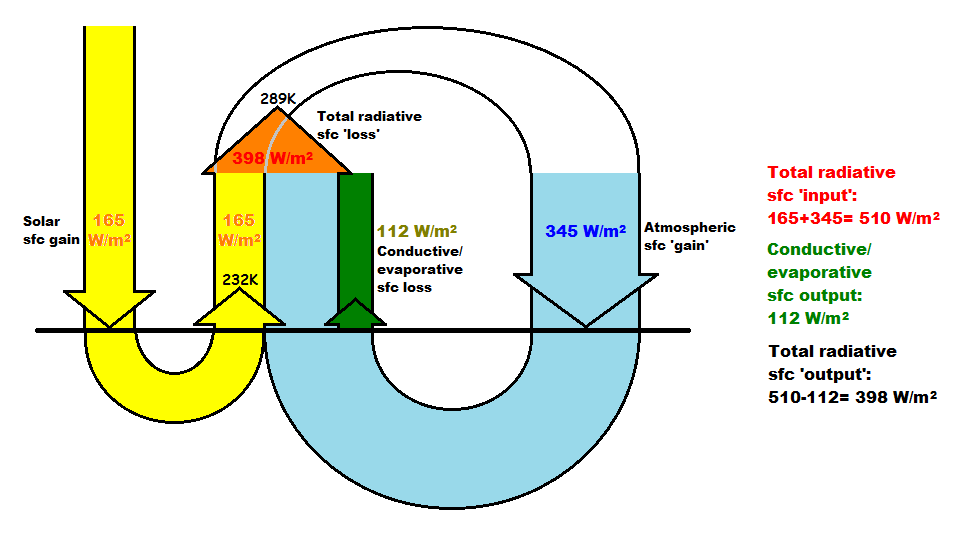
You’re absolutely right! For all the people who believe that there is an actual, separate, thermodynamically working flux/transfer of radiative energy from the atmosphere down to the surface (more than twice as intense as the solar heat flux), your four arguments should be unassailable.
You’re right. In this case, there is no other way for the surface to get from 232K (-41C) (highest possible BB emission temp for a surface absorbing a radiative flux of 165 W/m^2, like the solar one) to 289K (+16C), the actual, measured (averaged) global surface temp, than to absorb an additional radiative flux of 345 W/m^2 coming in from the atmosphere:
(Derived from Stephens et al. 2012.)
Pure solar radiative equilibrium: 165 W/m^2 IN, 165 W/m^2 OUT; temp 232K.
With radiatively active atmosphere added: 165 W/m^2 + 345 W/m^2 = 510 W/m^2 IN, 398 W/m^2 + 112 W/m^2 (combined conductive/evaporative loss) OUT; temp 289K.
An increase of [289-232=] 57K strictly as a result of the additional 345 W/m^2 IN (minus the non-radiative 112 W/m^2 OUT) giving an equilibrated radiative output of 398 W/m^2.
Problem is, a spontaneous transfer of energy from a cooler thermodynamic system to a warmer thermodynamic system, where this transfer of energy ALONE* raises the absolute temperature of the warmer system (in this specific case, from 232 to 289K), constitutes a direct violation of the 2nd Law of Thermodynamics. It can’t and won’t happen in nature.
*It gets no help from the original incoming solar heat flux. It stays at 165 W/m^2. It gets no help from the outgoing radiative flux (your UWLWIR). It is never in any way reduced during warming. It increases during warming, forced to grow for each (re)cycle up to steady state. Thus, the warming is ONLY and wholly accomplished by the absorption of the additional incoming flux from the atmosphere, as if this were directly equivalent to the solar heat flux.
If your explanation of some real-world effect ends up directly violating the 2nd Law of Thermodynamics, you KNOW that there’s something wrong with your explanation. Simple as that. Back to the drawing board.
I’ll leave it to you (and the rest of the people here on this thread) to ponder exactly where and how the “extra surface warming by back radiation” explanation fails …
Willis,
On average (where water is warmer than the air) DRL does not heat the water, it slows net radiation loss up and this requires evaporation and conduction/convection to make up the difference in the balance between net absorbed solar radiation and release of this energy back up to space. There can be short term periods, or local cases where the air is warmer than the water, the DRL can radiate down more than radiation up, so there can be some local net energy absorption at the surface. This results in increased evaporation, or some conduction and convective mixing of the excess energy to a modest depth. Saying the DRL heats the water in general just because it is absorbed energy is exactly the same as saying a layer of insulation on a fixed power resistor heats the resistor. It makes it hotter, but by slowing loss from the resistor, and no heat is transferred from the insulation to the resistor. Also the DRL is always smaller than URL for the sea warmer than the air, and heat transfer (unlike individual energy transfers) can only go from warm to less warm.
Thank, Willis. I was hoping you’d contribute.
Cheers.
Energy Flux is omni-directional at all points. The ocean does not magically want to give up its heat to the air. At the surface film, 180 degrees of flux energy will aim skyward. The other 180 degrees is abyssal. The physics of boundary layers permit confinement and compartmentalization of ocean heat until disrupted by meridional and thermohaline circulations.When conditions favor a well-mixed ocean environment, a more idealized entropic distribution of heat will occur. Even strong boundary or inversion conditions can only aggregate a small portion of ocean heat content. When these conditions weaken, dissipation is accelerated, of which the 180 degree skyward portion will transfer some excess heat into the air via evaporation and radiation. The remainder scatters into the vast heat sink, until such time as their entropic meanderings are once again deferred by another boundary encounter.
Above what value do the oceans accumulate heat?
Above a sunspot number of 40.
Willis:
Argument 1. People claim that because the DLR is absorbed in the first mm of water, it can’t heat the mass of the ocean. But the same is true of the land. DLR is absorbed in the first mm of rock or soil. Yet the same people who claim that DLR can’t heat the ocean (because it’s absorbed in the first mm) still believe that DLR can heat the land (despite the fact that it’s absorbed in the first mm).
Well the ocean evaporates. Do rocks evaporate? Now soil has moisture. So that will have an effect.
The trouble with all this is that it is very complicated. Teasing out cause and effect is difficult.
But you do make a good point. Maybe the effect of LWIR is not as significant on land as is currently thought.
Argument 2. If the DLR isn’t heating the water, where is it going?
Too easy. Into the energy of motion.i.e. it drives convection. Which cools the Earth.