Guest Post by WUWT Regular “Just The Facts” 
While the Pause in Earth’s temperature continues, currently 17 years and 10 months based upon RSS satellite data, it is important to note that Fossil Fuel and Cement CO2 emissions are at their highest levels ever.
We have been told by NASA “that carbon dioxide itself is a potent greenhouse gas (GHG)” and by NOAA’s UCAR that “the current spike in carbon dioxide is sure to result in a rapid increase in global temperature”. Anthroprogenic CO2 emissions have increased by over 60% since 1990;

and “the world added roughly 100 billion tonnes of carbon to the atmosphere between 2000 and 2010.”

“That is about a quarter of all the CO₂ put there by humanity since 1750. And yet, as James Hansen, the head of NASA’s Goddard Institute for Space Studies, observes, ‘the five-year mean global temperature has been flat for a decade.’” Economist
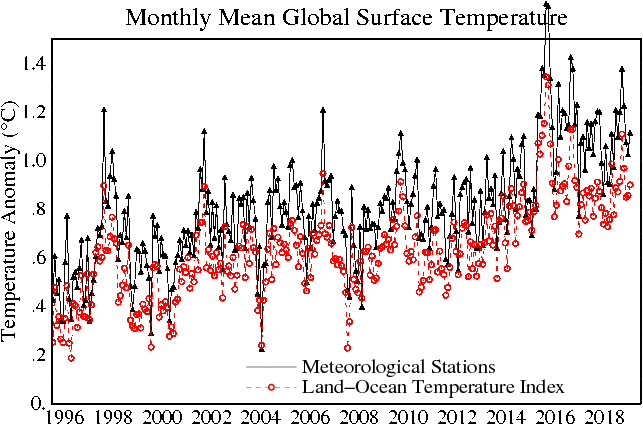
In order to make it easier to watch Atmospheric CO2 levels rise;

while Earth’s Temperature does not, we are pleased to introduce WUWT’s newest addition, the WUWT CO2 Reference Page. The WUWT CO2 Page offers an array of graphs on Atmospheric CO2, Anthropogenic CO2 Emissions and Land Use Change Based CO2 Estimates. In addition to the WUWT CO2 Reference Page. if you have not had the opportunity to our other Reference Pages they are highly recommended:
- Atmosphere Page
- Atmospheric Oscillation Page
- CO2 Page
- ENSO (El Nino/La Nina Southern Oscillation) Page
- “Extreme Weather” Page
- Geomagnetism Page
- Global Climate Page
- Global Temperature Page
- Great Lakes Ice Page
- Northern Polar Vortex Page
- Northern Regional Sea Ice Page
- Ocean Page
- Oceanic Oscillation Page
- Polar Vortex Page
- Paleoclimate Page
- Potential Climatic Variables Page
- Sea Ice Page
- Solar Page
- Spencer and Braswell Papers
- Tornado Page
- Tropical Cyclone Page
- US Climate Page
- US Weather Page
Please note that WUWT cannot vouch for the accuracy of the data within the Reference Pages, as WUWT is simply an aggregator. All of the data is linked from third party sources. If you have doubts about the accuracy of any of the graphs on the WUWT Reference Pages, or have any suggested additions or improvements to any of the pages, please let us know in comments below.
Ferdinand Engelbeen:
Your post at August 3, 2014 at 1:18 pm begins saying
Say What? “Crooked reasoning”?
You wrote
The seasonal variation only last less than a year. Only effects shorter than a year can effect it.
The volcanic effects last less than 3 years. Only effects shorter than 3 years can effect it.
That is NOT “crooked reasoning”: it is reality.
Therefore, I wrote
My post quoted your entire post and gave the answer I have given here together with other supporting information and argument. It was at August 3, 2014 at 6:09 am and is here.
Frankly, Ferdinand, your post I am answering is beneath you.
Richard
Ferdinand says:
Greg, we have been there before…
Ice area is influenced by temperature, as good as vegetation growth and decay. In the case of the seasonal variations it is vegetation which causes the variations:
http://www.ferdinand-engelbeen.be/klimaat/klim_img/seasonal_CO2_d13C_MLO_BRW.jpg
If the variation was caused by the ocean surface / ice cover, the CO2 changes and δ13C changes would parallel each other. If caused by vegetation, CO2 changes and δ13C changes are opposite, as is the case here.
====
And what is exposed when arctic ice melts ? Aquatic “vegetation” in the form of phytoplankton.
http://climategrog.wordpress.com/?attachment_id=996
Greg Goodman:
At August 3, 2014 at 1:38 pm you say to me
The paper is paywalled and I am now on the Editorial Board of ‘Energy & Environment’ (E&E) so I cannot break the publisher’s rules by giving you a free copy.
However, my presentation to the first Heartland conference was on the E&E paper of your interest, and I then provided an accompanying paper which is almost entirely a ‘copy and paste’ from the E&E paper. If you email me at richardscourtneyATaol.com then I will send you a copy of that accompanying paper (which is effectively the same as the paper you want).
Richard
Ferdinand Engelbeen says:
The correlation between total CO2 emissions and CO2 increase is almost perfect… For me it is clear that temperature is not the cause: warming, cooling, warming, flat while CO2 simply follows human emissions without a visible effect from temperature…
Ferdinand, there is much empirical evidence showing that ∆T causes ∆CO2. That cause and effect relationship is seen on time scales from years to hundreds of millennia.
But there is no comparable data showing that changes in temperature are the cause of subsequent changes in CO2. Charts like this do not show cause and effect, they only show coincidental action. That chart is simply an overlay of T and CO2, without any indication of which leads and which lags. As we see in the charts above, CO2 lags T.
The causation is clear: ∆T causes ∆CO2. But the alarmist crowd insists that CO2 causes T to rise. The real world shows they are wrong, since global warming has stopped, despite steadily rising CO2.
The alarmist crowd got causation backward, therefore their conclusion is necessarily wrong. All the evidence shows that ∆T causes ∆CO2. Is there any doubt?
Ferdi: “The 4-5 ppmv/°C can be deduced from the year-by-year variability peaks (1992 Pinatubo, 1998 El Niño). ”
Where do you find that?
I found 8ppm/year/kelvin for inter-annual variation.
http://climategrog.wordpress.com/?attachment_id=233
Note that is a rate of change per K , not a fixed change per K which implies that it is equilibrating on annual timescales. I don’t think that can be justified.
“The alarmist crowd got causation backward, therefore their conclusion is necessarily wrong. All the evidence shows that ∆T causes ∆CO2. Is there any doubt?”
There is a lot of doubt that it is a black and white issue.
Greg Goodman,
For years now I have been asking anyone to post a chart showing that ∆CO2 causes ∆T. So far, no one has. I would be very interested if you have ever found such a cause and effect between changes in global CO2, and subsequent changes in global temperature.
If “there is a lot of doubt that it is a black and white issue”, then post a graph showing that CO2 leads temperature. Please. I’m interested.
dbstealey says: http://www.daviesand.com/Choices/Precautionary_Planning/New_Data/IceCores1.gif
I don’t see any evidence of lag in that graph. Do you?
BTW where is “antarctic ice core data 1” I don’t recall hearing of that core before.
I really don’t think you are helping.
richard verney says:
August 3, 2014 at 8:25 am
Greg Goodman says:
August 3, 2014 at 4:54 am
////////////
I stand corrected that the post 1960 data came sourced from Briffa’s data.
The point I make is that a genuine scientist, not an activist, having discovered that there was a difference between the response between the late 1800s to about 1960 (on which the proxy was tuned), and its post 1990 response had made a discovery of interest. Such a scientist would set out details of the limitations of the proxy data (eg., that the trees are taken from only a small area of the globe and therefore may not represent global conditions more generally, and that they are showing a growth response to environmental conditions generally, not to temperature specifically), but within that limitation and to the extent that trees are considered to be a good proxy for ascertaining temperatures, then the divergence suggested that there were problems with the post 1990 land based thermometer record.
Which is exactly what Briffa did: http://rstb.royalsocietypublishing.org/content/353/1365/65.short
Mann could have written a very good paper, concentrating on the divergence issue, what this may suggest, and highlighting why there may be problems in the land based thermometer record. It is probably no coincidence that the divergence problem coincides with rapid urbanisation, expansion of the road network, more affluent central heating and aircon in homes, the beginning of statioon drop outs etc. If he had not been primarily an activist, one might have expected his paper to concentrate on that aspect.
You’re making the same error again, Briffa was the dendroclimatologist, not Mann, and he did what you are suggesting.
From D’Arrigo, R. et al.
On the ‘Divergence Problem’ in Northern Forests: A review of the tree-ring evidence and possible causes. Glob. Planet. Change (2007), doi:10.1016/j.gloplacha.2007.03.004
“A number of recent tree-ring studies have addressed the ‘divergence problem’ in northern forests. It is defined herein as the tendency for tree growth at some previously temperature-limited northern sites to demonstrate a weakening in mean temperature response in recent decades, with the divergence being expressed as a loss in climate sensitivity and/or a divergence in trend (Jacoby and D’Arrigo, 1995; Briffa et al., 1998a,b; Vaganov et al., 1999; Barber et al., 2000; Briffa, 2000; Jacoby et al., 2000; Wilson and Luckman, 2003; Briffa et al., 2004; D’Arrigo et al., 2004a; Wilmking et al., 2004, 2005; Driscoll et al., 2005; Büntgen et al., 2006a). Divergence-related studies have investigated what appears to be a widespread shift in the ecophysiology of tree growth response to climate, at least for many sites within the higher latitudes of the Northern Hemisphere (Briffa et al., 1998a,b).”
http://rstb.royalsocietypublishing.org/content/353/1365/65.short
Greg Goodman says:
I don’t see any evidence of lag in that graph. Do you?
Yes. Here’s another. And another. Look close. There’s more here.
And here is a peer reviewed paper showing that CO2 lags temperature. And another. And another. Six more peer reviewed papers listed here report that CO2 lags T. None show that ∆CO2 causes ∆T.
Glad to be helping.☺
dbstealey says:
Greg Goodman,
For years now I have been asking anyone to post a chart showing that ∆CO2 causes ∆T. So far, no one has. I would be very interested if you have ever found such a cause and effect between changes in CO2, and subsequent changes in temperature.
===
If there is a cause and effect in that direction it will on a decadal scale. There is so much variability and uncertainty in the SST record that is it not possible to prove one way or the other. Not having a graph to prove it , is not sufficient to refute it.
It seems most likely to me that it is a mix of two , probably 50/50 would be my current guess.
ie about half of CO2 rise is residual emissions, half is out-gassing. But that is gut feel, not proven.
Greg Goodman,
For the record, I have posted nukmerous peer reviewed papers, and charts of empirical data [including one on ‘a decadal scale’], all showing that temperature changes lead changes in CO2.
Your response? You have a gut feeling. You need to do better than that.
dbstealey says:
Greg Goodman says: I don’t see any evidence of lag in that graph. Do you?
Yes.
===
So you can see the 800 y lag on a graph where the scale is in 10^5 years. Good man.
I’m not saying the 800y lag does not exist just try to find graphs that show it rather than ones that don’t. The other graphs with shorter time-scales you just showed are fine.
Greg Goodman says:
So you can see the 800 y lag on a graph where the scale is in 10^5 years. Good man.
Thank you.
Others can see it, too. Try looking closer.
“Try looking closer. ” http://www.daviesand.com/Choices/Precautionary_Planning/New_Data/IceCores1.gif
800y is about the thickness of the plotting lines on that graph. With two sets of noisy data, if you think you can detect a lag like that you are kidding yourself ( so are the acclaimed ‘others’).
http://www.brighton73.freeserve.co.uk/gw/paleo/400000yearslarge.gif
“look close”
I can see several drops where CO2 stays high for a while. I can equally see several rises where CO2 moves first. That makes eye-balling the graph pretty inconclusive. That’s why we invented maths.
I’ve done plenty of work myself showing it is dCO2 that correlates on annual to decadal scales, some of which I’ve linked here. I’m just saying being dogmatic and black and white is not realistic. CO2 will likely be providing a positive feedback during glacial/interglacial transitions. To that extent it is a cause of temp change.
Climate is complex and does not lend itself easily to simplistic black/white explanations.
richardscourtney says:
August 3, 2014 at 1:57 pm
Richard you wrote:
You assume that only the processes of the seasonal variation affect long term changes, and then you apply the effect of only those processes to supposedly show that longer term processes are not involved in long term changes. A more circular argument than that is not possible!
That is crooked reasoning: assuming something that I never assumed or implied.
I only did show that the measured short term processes give not more than 4-5 ppmv/°C, while the measured long term processes don’t show more than 8 ppmv/°C.
Both types of processes can’t be responsible for the 100+ ppmv increase in lockstep with human emissions which are twice the measured increase. Thus the 1°C warming since the LIA can’t be responsible for the increase, except if you know of an observed process which gives such an amount of CO2 (equivalent to burning 1/3rd of all land vegetation) in 160 years time…
Greg Goodman says:
August 3, 2014 at 4:17 am
Can I just clarify, you are saying 60 GtC in/out in 24h period? Where does that figure come from?
Sorry, almost missed that.
The diurnal 60 GtC in/out is over a year and of the same order as the seasonal changes.
Although the amounts over a year are huge and locally measurable (especially under inversion: up hundreds of ppmv at night), in general that doesn’t influence the rest of the atmosphere as most night respiration is taken away during the day and the difference is readily mixed in before reaching the remote measuring stations.
The origin is here:
http://earthobservatory.nasa.gov/Features/CarbonCycle/
Here an example from a semi-rural station (Giessen Germany) during a few summer days under inversion, compared to Mauna Loa, Barrow and the South Pole (all raw data) for the same days:
http://www.ferdinand-engelbeen.be/klimaat/klim_img/giessen_background.jpg
mpainter says: August 3, 2014 at 8:23 am
Please, on your sea level data, please live up to your cognomen and present the facts. Instead of facts, you post the data of the notoriously unreliable NCDC and you really should know better.
If we excluded every graph that has questionable adjustments, the Global Temperature and Global Climate pages would be quite barren without HADCRUT, HADSST, GISS, NOAA NCDC and NODC, etc. The University of Colorado at Boulder Global Mean Sea Level Change graph was given a label after “a “Correction” of 0.3 mm/year added May, 5th 2011, due to a ‘Glacial Isostatic Adjustment (GIA)'”, if you can demonstrate specific issues with the NOAA NCDC graph, we can certainly add a label to it. However, unless a graph is demonstrated to be erroneous, e.g. Mann’s Hockey Stick, it is better to include it on the WUWT references pages so that we can readily monitor it and compare it. It is much harder to manipulate data when there are thousands of eyes on it.
Greg Goodman:
The charts clearly show temperature leading CO2. Can’t understand why you cannot see it
Jan Christoffersen says: August 3, 2014 at 8:48 am

The top graph in the post confuses me. There are five components in the legend but only four components in the the graphical presentation. What am I missing? Gas flaring is so small it doesn’t show up?
Gas Flaring is small, but it is there. If you look carefully at the top line/s of the graph, especially around 1980, you can see that there are three separate lines:
Justthefactswuwt@ur momisugly 3:58pm
This is the issue: sea level is not rising. The SL rise on charts like NCDC is bogus. I have already referred you to the NOAA mean sea level charts which prove this. Please read again my comment above and do a little investigation. To shrug your shoulders on thisissue is no way to start out. Do not be a lazy scientist. I have pointed you the way so go to.
dp says:
August 3, 2014 at 10:08 am
Haven’t had time to read everything but one thing I’d like to see is the lag time between when CO2 level is reached with the human contribution, and when it is reached with the human contribution nulled. Is it a matter of months, years, or decades? Example: When will the volume of “natural” CO2 reach 400PPM? The lag is what our trillions are buying us.
The 400 ppmv never will be reached naturally, except if the world (ocean) temperature increased some 14°C. If humans stopped with all emissions today, next year the CO2 levels would have dropped with ~2 ppmv, because the current sink rate is 2 ppmv/year, caused by the extra pressure of CO2 in the atmosphere. The following years that will decrease, as the pressure in the atmosphere decreases. That leads to a e-fold decay rate of ~52 years or a half life time of ~40 years of the extra CO2 in the atmosphere.
To put CO2 in perspective, here is the concentration in the geologic past [when the biosphere teemed with life and diversity]. Global T did not skyrocket as a result, so the prediction that catastrophic global warming will result from a little more CO2 is falsified.
Here is another chart. The biosphere is currently starved of CO2. Adding more is a net benefit.
The entire “carbon” scare is over the atmospheric CO2 concentration. But as we see, that concentration is on the low side. The very low side! If CO2 dropped much more, plant life would be affected, and as a result, animal life would be affected. We are very fortunate that CO2 is rising. Just ask Ferdinand.☺
mpainter says: August 3, 2014 at 4:08 pm
mpainter says: August 3, 2014 at 8:23 am
This is the issue: sea level is not rising.
I see no evidence to support this assertion. While there does not appear to be any acceleration in sea level rise;
http://wattsupwiththat.com/2014/07/16/latest-noaa-mean-sea-level-trend-data-through-2013-confirms-lack-of-sea-level-rise-acceleration-2/
it appear to be continuing to increase:
http://stevengoddard.wordpress.com/2010/09/04/how-fast-is-sea-level-rising/
NOAA tidal gauge data shows that sea level on US coasts has been steady, not rising, since before the end of the last century, except where there is subsidence. This data can be extrapolated world wide.
The US Coast represents 5.6% or 8.2% of global coastline, depending on how you calculate it:
http://en.wikipedia.org/wiki/List_of_countries_by_length_of_coastline
The NOAA NCDC graph is global, even if NOAA’s “tidal gauge data shows that sea level on US coasts has been steady”, that doesn’t invalidate the NCDC graph. On what basis do you think that “This data can be extrapolated world wide”?
The SL rise on charts like NCDC is bogus. I have already referred you to the NOAA mean sea level charts which prove this. Please read again my comment above and do a little investigation. To shrug your shoulders on thisissue is no way to start out.
There aren’t even links in your comment. If you think you have identified an error with NOAA NCDC Sea Level Rise, do your own investigation, post your findings and we will consider them.
Do not be a lazy scientist.
I’m the one who built the CO2 reference page, is finalizing the Beaufort Sea Ice Page;
http://wattsupwiththat.com/reference-pages/sea-ice-page/beaufort-sea-ice-page/
and has several other reference pages under development. You are the one who is complaining that I haven’t spent enough time chasing down the vague and nebulous aspersions that you’ve cast…