By Viv Forbes, Rosewood Qld Australia
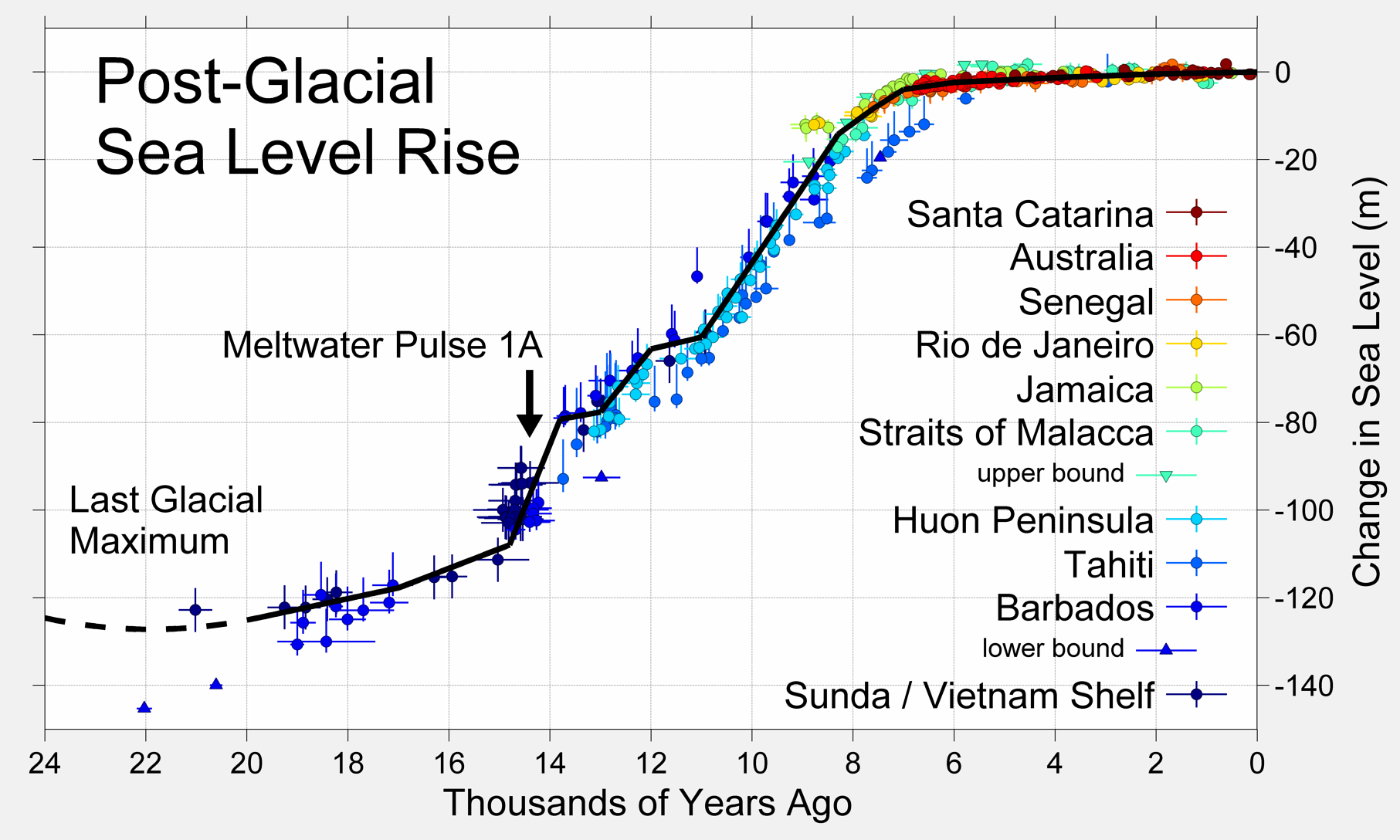 Sea levels have been rising and falling without any help from humans for as long as Earth’s oceans have existed.
The fastest and most alarming sea changes to affect mankind occurred at the end of the Pleistocene Ice Age. Seas rose about 130m about 12,000 years ago, at times rising at five metres per century. Sea levels then fell as ice sheet and glaciers grew in the recent Little Ice Age – some Roman ports used during the Roman Warm Era are now far from the sea even though sea levels have recovered somewhat during the Modern Warm Era.
Many natural factors cause sea levels to rise – melting of land-based glaciers and ice sheets; warming and expansion in volume of the oceans; extraction of groundwater which ends up in the oceans; and sediments, sewerage, plant debris and volcanic ash washed into the oceans by rivers, storms and glaciers. In addition, tectonic forces cause some blocks of land to rise while others fall, hence the paradox of sea levels appearing to rise on one coastline while falling on another.
Currently the world’s oceans are rising at about 1mm per year, which has not changed much with the great industrialisation since 1945. Amongst all the factors moving the restless sea, man’s production of carbon dioxide is obviously an insignificant player.
Sea levels are always changing, at times very destructively. Waves move sea levels by a few metres and at places like Derby, WA, king tides can move sea levels by eleven metres. Then there are rogue waves up to 30 metres high which have sunk oil tankers, and tsunamis which can smash coastlines with a ten metre wall of water moving at over 800 km per hour.
Despite coping with all of the above, climate alarmists say we should be scared to death by the threat of seas rising gently at 1mm PER YEAR. Even a slow-moving sloth could escape water rising at that rate.
King Canute showed his nobles that no man can hold back the rising sea. It’s time the climate alarmists learned Canute’s lesson and focussed on real world problems.
Even if we ceased using all carbon fuels for electricity and transport, no one could measure the effect of that huge sacrifice on global sea levels.
For those who wish to read more:
Rising Seas are Nothing New:
http://carbon-sense.com/2013/11/30/nothing-new-about-climate-change/
History falsifies climate alarmist sea level claims:
http://carbon-sense.com/wp-content/uploads/2013/12/endlich-sea-level-claims.pdf
The Ocean Thermometer:
http://carbon-sense.com/wp-content/uploads/2013/12/ocean-thermometer.pdf
Global Mean Sea Levels:
Tide Gauges show that Average Sea level rise is 0.9m per year:
http://stevengoddard.wordpress.com/2013/12/25/average-sea-level-rise-rate-is-0-9-mmyear/
Rogue Waves – the real sea monsters:
http://www.scientificamerican.com/article/rogue-waves-ocean-energy-forecasting/
High Tides at Derby, Western Australia:
http://www.derbytourism.com.au/useful-information/tides
Tectonic plates movement is slow but relentless. In the Adriatic sea, not far away from my home, roman roads built into rocky hillside are now couple of meters under sea level, while the Italian shore on the opposite side has moved up.
Changing sea level is geology 101. Trying to place current change on thermal expansion & CAGW if folly when viewed through the geologic lens of time. Some links to a couple geologic based sea level curves :
Last 30 MY :
http://www.sepmstrata.org/page.aspx?pageid=164
Last 250 MY :
http://geology.uprm.edu/Morelock/3_image/cretsl.gif
Martin Hovland may be right about the Caspian Sea rising rapidly, but he is absolutely wrong about its cause. He also does not highlight the fact that its level fell equally sharply some decades earlier. The reason? The Russians dammed the Volga in a number of places and diverted its flow. Later on, they let the water pass. In the first place they wanted the water for agriculture and industry, in the second they wanted it to pass through for hydroelectric generation. The majority of the water in the Caspian comes from the Volga, so the changes are as simple as turning the tap off, and then on again. Climate change has nowt to do with it, and (apart from the point that it starts as rainfall to get into the Volga), neither is there any changing rainfall pattern to blame either!
The sea is retreating at the northern end of the Baltic Sea due to the land rising up now that the ice sheets from the last ice age have gone.
Say what? Sea levels are averages over time, so waves and tides are not involved in the calculations. Rogue waves and tsunamis are non sequiturs as far as sea levels go. Tsunamis may travel rapidly out at sea, but slow down dramatically when near shore. This nonsensical paragraph severely degrades this essay and should have been edited out.
richardscourtney says: June 18, 2014 at 12:31 am
“But Viv Forbes essay was NOT making a false claim because the essay very clearly discusses “relative_ mean sea level, ie raw tide gauge reading without taking into account movement of the land on which they are sited nor the geographic sampling these sites represent”. The essay was stating that this is the practical sea level change with which people need to cope.”
I see none of that in the essay. I see just an unqualified statement:
“Currently the world’s oceans are rising at about 1mm per year, which has not changed much with the great industrialisation since 1945.”
No source is given, and as Greg says, it’s wrong.
65% of tide gauges….show sea levels falling
http://scienceandpublicpolicy.org/images/stories/papers/reprint/sea_level_not_rising.pdf
the ruins of Efes
===========
We also visited the ancient Roman port of Ephesus – now many miles inland. We were on a bus tour of Turkey and were amazed at how many famous places in the ancient world were actually in modern day Turkey.
For all the hype about sea level rise, it is amazing how little there is. Docks and sea-walls built 50 to 100 years ago, still perfectly serviceable. You would think they would all be under water given the hype.
Can someone actually point out any place on earth where high tides – not driven by storm surge – not a result of land sinking – are actually higher than the surrounding structures? Because we never saw any evidence sailing around the world. Even at high tide, anything that was built on rock was still above high tide. It was only those structures built on sand or mud that were threatened, which is more the fault of the builders than of sea levels.
Tide gauges are useless for ‘global sea level because of techtonics, isostasy, and groundwater/delta compaction to mention just a few geological problems. Satellite altimetry has existed since 1993. The most recent bird is Jason 2. Excluding the modeled GIA component of 0.3mm/year, the average SLR over that period is 2.8mm/ year. But it was about 3.1 until about 2004, and is only 2.4 from then to the present, probable indirect physical evidence for the pause.
This leads to the so called closure problem. Estimates of ice sheet mass loss (glaciers, Greenland, Antarctica e.g. Via GRACE or ICESat estimates) plus Argo based estimates for thermosteric rise sum to about 2mm/year, not 2.8. There is therefore provable uncertainty, likely in all three values. The world is a big place, and 2.8mm/year is a small number.
But 1mm per year is sufficiently off to raise questions about the rest of the post.
Latitude says:
==========
Sea level is not rising
Professor Nils-Axel Mörner
At most, global average sea level is rising at a rate equivalent to 2-3 inches per century. It is probably not rising at all.
http://scienceandpublicpolicy.org/images/stories/papers/reprint/sea_level_not_rising.pdf
“When the satellite altimetry group realized that the 1997 rise was an ENSO signal, and they extended the trend up to 2003, they faced a problem they had not expected: there was no discernible sea-level rise visible, so that a “reinterpretation” of the raw data needed to be carried out in order to obtain the desired result.”
“The fact of this “reinterpretation”, which turned a near-zero trend in sea-level rise to a trend of 2.3
mm/year (later 3.2), was orally confirmed by a member of the satellite altimetry team in 2005 when I
attended a meeting on global warming held by the Russian Academy of Sciences in Moscow. Exactly what was done remains unclear, as the satellite altimetry groups do not specify the “corrections” they carry out.
page 12:
http://scienceandpublicpolicy.org/images/stories/papers/reprint/sea_level_not_rising.pdf
Gary:
Your post at June 18, 2014 at 6:15 am completely misses the point of the article by Viv Forbes.
In total your post says
The paragraph makes perfect sense and summates the purpose of the article.
The paragraph says there are much larger changes to sea level than mere “averages over time”, and it states some. The argument is that preparation for sea level change needs to accommodate ALL the likely changes at a location, and when that is done then defence against e.g. storm tides would provide defence against foreseeable “averages over time” so they can be ignored.
Richard
I agree with Richard Courtney that Greg Goodman would benefit from reading Miss Manners. I agree with Goodman, though, that all claims in a commentary on sea level rise should be fully documented or provide links to primary sources; also that it’s unhelpful and even counterproductive to present 1 mm/year of sea-level rise as accepted fact when “consensus” science claims the rate is three times faster. Ignoring the 3 mm/year claim is bound to raise suspicion that the ‘skeptic’ either does not know what he is taking about or is trying to confuse the public.
There is general agreement that the current sea level rise is approx 3mm per year and not the 1mm per year as stated in the article above. An error such as that gives ammunition to the climate warmmongers to claim that the skeptics are anti-science. An increase from approx 1mm per year 200 years ago to 3mm per year today would appear to be a drastic increase in sea level rise which would support to a limited extent the AGW theory.
That being said, a rise of 1mm or 3mm per year (which ever you choose to believe tis the more accurate measure) when comparing over a 5,000 year or 10,000 year period is indicative of a very stable sea level and very stable climate.
Assuming for arguments sake that the HS is an accurate reflection of the temps over the last 1,000 years, the recent uptick would support AGW. However, when comparing the last 5,000 to 20,000, even with the claimed spike, is indicative of a very stable climate.
Nick Stokes:
I acknowledge your post addressed to me at June 18, 2014 at 6:26 am . It is plain wrong in every particular and says
I have no method to assist your reading comprehension. I can only quote from the article and ask you to try to understand what it says; e.g. this
I do not understand how you failed to read what I have quoted for you and that you failed to understand what was meant when it says “Even a slow-moving sloth could escape water rising at that rate”.
Furthermore, the reference you missed was mentioned by Greg Goodman in his reply to Steve W at June 17, 2014 at 11:11 pm.
Richard
If you choose to build expensive property and infrastructure in such a way that a 300mm sea level change would be a disaster, you are a fool.
What worries me is that we are this far into the knee. The ride back down will not be fun. We should be telling our grandchildren to pop out as many babies as they can and make sure each and everyone of them are schooled in cold survival skills that they can then pass on to their children. These glacial episodes kill lots and lots of humans who are “generation after generation dumb”.
I think WUWT has taken a big hit on this one. I forwarded the link to my email list and got this response back:
This reference says sea levels are rising about 2.9 mm/yr. Significant difference from the 0.9 mm/yr that your climate change denier site gives.
http://www.star.nesdis.noaa.gov/sod/lsa/SeaLevelRise/LSA_SLR_timeseries_global.php
In 2012 NOAA issued a full analysis of global sea level using all available data for the period of 2005 to december 2011. This official report supports the 1 mm per year claims.
The sum of steric sea level rise and the ocean mass component has a trend of 1.1 ± 0.8 mm/a over the period when the Paulson GIA mass correction is applied, well overlapping total sea level rise observed by Jason-1 and Jason-2 (1.3 ± 0.9 mm/a) within a 95% confidence interval.
The above numbers represent the globally averaged changes in sea level and have magnitudes on
the order of millimeters per year.
For those who want to see the full report just google the title of the report.
The Budget of Recent Global Sea Level Rise
2005–2012
by Eric Leuliette
Jim Butts:
re your post at June 18, 2014 at 12:07 pm.
It does not matter whether you want to have a references battle about 1 or 3 mm per year sea level rise. If sea level rise were 6 mm per year the above essay would still be right.
The essay argues that preparation for sea level change needs to accommodate ALL the likely changes at a location, and when that is done then defence against e.g. storm tides would provide defence against foreseeable sea level rise of a few mm per year. As the essay says
Richard
Greg Goodman says:
June 17, 2014 at 10:30 pm
“Sorry that is an out and out lie……”
=================
Wow,
I’ve been mistaken, uninformed, misinformed, and down right stupid.
To call me a liar though, takes it to a whole other plane.
I think you owe Viv an apology.
Whether right or wrong.
I understand there also are places hundreds of miles from the shore where there are beaches on the sea floor. What once was the coast became the sea floor, way way way out at sea. Changes can be sudden and dramatic.
Whatever you do, do not quote the sea level rise from the satellites.
It is fake, just like almost everything in climate science.
Sea level rise using as many tide gauges as possible (and it appears that something approaching 400 widely-disbursed stations is really required) combined with local uplift/subsidence rates provided by GPS stations which have a long enough record to give a reliable signal, indicate that current sea level rise is between 1.4 mms/ yr to 1.8 mms/yr. This rate has been constant since about 1980 but was lower before this date. Sea level was about 2 metres higher about 5,000 years ago, 120 metres lower 20,000 years ago, 4 to 6 metres higher 125,000 years ago and was 265 metres higher 94 million years which flooded large portions of the continents.
“sophocles says:
June 18, 2014 at 2:26 am”
Interesting. I am not convinced of the accuracy (1.7mm/y) in the quote you make given the nature of New Zealand straddling two tectonic plates. Wellington (And region) in particular has risen upwards due to earth quakes. Evidence for this is on Lambton Quay, the airport, and also if you look out towards Pencarow Head.
Keith
The Dutch king is mythical but the dikes are real. The Dutch have been building dikes since 70 AD. By 1250 they completed a 126-km long dike. They had a long history of taming the sea before King Canute was born.