By Viv Forbes, Rosewood Qld Australia
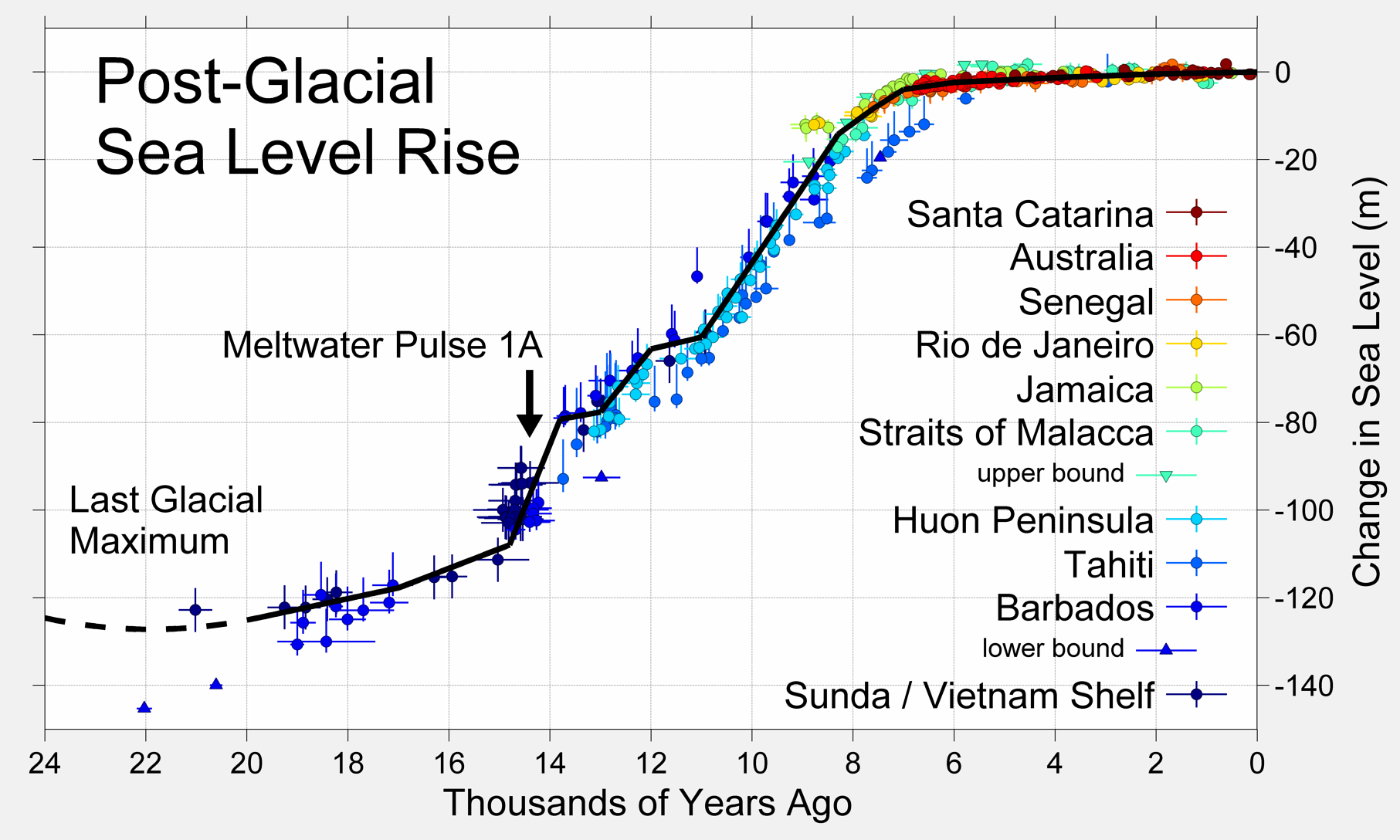 Sea levels have been rising and falling without any help from humans for as long as Earth’s oceans have existed.
The fastest and most alarming sea changes to affect mankind occurred at the end of the Pleistocene Ice Age. Seas rose about 130m about 12,000 years ago, at times rising at five metres per century. Sea levels then fell as ice sheet and glaciers grew in the recent Little Ice Age – some Roman ports used during the Roman Warm Era are now far from the sea even though sea levels have recovered somewhat during the Modern Warm Era.
Many natural factors cause sea levels to rise – melting of land-based glaciers and ice sheets; warming and expansion in volume of the oceans; extraction of groundwater which ends up in the oceans; and sediments, sewerage, plant debris and volcanic ash washed into the oceans by rivers, storms and glaciers. In addition, tectonic forces cause some blocks of land to rise while others fall, hence the paradox of sea levels appearing to rise on one coastline while falling on another.
Currently the world’s oceans are rising at about 1mm per year, which has not changed much with the great industrialisation since 1945. Amongst all the factors moving the restless sea, man’s production of carbon dioxide is obviously an insignificant player.
Sea levels are always changing, at times very destructively. Waves move sea levels by a few metres and at places like Derby, WA, king tides can move sea levels by eleven metres. Then there are rogue waves up to 30 metres high which have sunk oil tankers, and tsunamis which can smash coastlines with a ten metre wall of water moving at over 800 km per hour.
Despite coping with all of the above, climate alarmists say we should be scared to death by the threat of seas rising gently at 1mm PER YEAR. Even a slow-moving sloth could escape water rising at that rate.
King Canute showed his nobles that no man can hold back the rising sea. It’s time the climate alarmists learned Canute’s lesson and focussed on real world problems.
Even if we ceased using all carbon fuels for electricity and transport, no one could measure the effect of that huge sacrifice on global sea levels.
For those who wish to read more:
Rising Seas are Nothing New:
http://carbon-sense.com/2013/11/30/nothing-new-about-climate-change/
History falsifies climate alarmist sea level claims:
http://carbon-sense.com/wp-content/uploads/2013/12/endlich-sea-level-claims.pdf
The Ocean Thermometer:
http://carbon-sense.com/wp-content/uploads/2013/12/ocean-thermometer.pdf
Global Mean Sea Levels:
Tide Gauges show that Average Sea level rise is 0.9m per year:
http://stevengoddard.wordpress.com/2013/12/25/average-sea-level-rise-rate-is-0-9-mmyear/
Rogue Waves – the real sea monsters:
http://www.scientificamerican.com/article/rogue-waves-ocean-energy-forecasting/
High Tides at Derby, Western Australia:
http://www.derbytourism.com.au/useful-information/tides
Steve W. says:
June 17, 2014 at 9:19 pm
> some Roman ports used during the Roman Warm Era are now far from the sea even though sea levels have recovered somewhat during the Modern Warm Era.
Links please?
====
It’s in one of the links provided, though that’s not clear in the article.
History falsifies climate alarmist sea level claims:
http://carbon-sense.com/wp-content/uploads/2013/12/endlich-sea-level-claims.pdf
@ur momisugly Greg Goodman — thanks for that (at 11:11pm) — nice work!
Janice
I can see a Roman tax coming, as they clearly are the cause of rising sea level!
Steve W. says:
June 17, 2014 at 9:19 pm
//////////////////
Actually, I think that it is predominantly Greek Ports that are now stranded far from the sea. I have seen numerous programmes on archaelogical digs that have commented that this place used to be a port in ancient rtimes. I recall that one programme involved a dig of a site that used to be a port of ancient Greece but was now some 50 km from the sea.
Of course, you can also see lower sea level/river levels in the Thames. In Medieval times there was a river entrance to the Tower of London which now has insufficient draft for boats, and some of the docks/wharfs along the side of the Thames suggest that water levels were higher even just a few centuries ago. Whether this has something to do with siltation, I do not know.
I have not researched this so there may be some other explanation, but an example of a place that is now high and dry is:
Priene (Ancient Greek: Πριήνη Priēnē; Turkish: Prien) was an ancient Greek city of Ionia (and member of the Ionian League) at the base of an escarpment of Mycale, about 6 kilometres (3.7 mi) north of the then course of the Maeander (now called the Büyük Menderes or “Big Maeander”) River, 67 kilometres (42 mi) from ancient Anthea, 15 kilometres (9.3 mi) from ancient Aneon and 25 kilometres (16 mi) from ancient Miletus. It was formerly on the sea coast, built overlooking the ocean on steep slopes and terraces extending from sea level to a height of 380 metres (1,250 ft) above sea level at the top of the escarpment.[1] Today, after several centuries of changes in the landscape, it is an inland site. It is located at a short distance west of the modern village Güllübahçe Turun in the Söke district of Aydın Province, Turkey
http://en.wikipedia.org/wiki/Priene
See also: http://www.bodrumpages.com/English/miletus.html
The ancient city of Miletus was once one of Ionia’s most important ports, but is now stranded 10 kilometres inland. It is situated south of Izmir, in the province of Aydin, 20 kilometres north of Didyma
Greg Goodman says:
June 17, 2014 at 10:30 pm /
//////////////////////////////
The TRUTH is that no one knows whether sea levels are rising, and if so by how much.
Measurment of sea levels is notoriously difficult, ripe with errors, and the data taken as a whole is contradictory.
There are many ports all over the world that show no sea level rise. There are some places about 50 miles apart where one place will show a rise, and the other no rise!
Realistically, we cannot measure to millimetres per year. Perhaps we can measure 6 cm over a period of 20 to 40 years.
Put simply, qualative data does not exist for either side of the debate to make out a strong case.
You have to be very cautious using historical examples of sea level change from tectonically active areas such as the Mediterranean. Vertical movements can be very large and rapid. I am familiar with and have visited the coast (mountainous/rias) in closest proximity to the Tohoku earthquake epicentre. Harbour quays that previously had about a metre of freeboard were awash. That’s just one event.
Also, areas responding to ice sheet melting are still going up, and areas peripheral to the ice sheets are still going down as the mantle material flows back to where it was displaced from. For example, in the UK, land north of a line going approximately from the Humber to the Severn is rising, and land south of that line is sinking.
Comments from known facts due to exvavation analyses and dating of sedement layer on land and in sea together with basic knowledge in geology and Natural procedure:
Sea levels ARE NEVER an EXACT fixed VALUE.
SEA LEVEL VARIES:
* During a day (between a high and a low mark not only due to tides) less seen in the Baltic Sea than in oceans. Examples from the Östergötland’s Baltic Sea coast, of yearly high-year low results in a difference in water with 1 m. In open sea the distance from a fix GPS-point to the Earth’s mid point can vary up to 50 meter/day.
* During a year. The moon and the sun’s position relative to the earth gives in
the difference in the form of spring and neap tides. Sea streams speed and density variations (saltination)
Season shown variations. Not only do our Earth have season variations from winter, spring, summer and autumn due to moon and sun’s position visa vi a specific point. There are also dry resp. rainy periods under any chosen thousand year period.
This is due to three main factors:
1. Water in any form always tries to reach the lowest point relatively the mid of the Earth. This is due to water’s chemical form as well as gravidity; temperatures in air and water changing drastic after major vulcano eruption/-s.
Example: After a serie of vulcan eruptions in 1341 from Greenland to Iceland the temperature level fell more than 4 degrees Celsius within a twenty year long period. (Please look up The farm beneath the sand, archeurope.com where you will read about a farm that saw this happening suddenly between 1341 and 1360. The farm wasn’t seen again before late 1900’s. It wasn’t even possible to dig the farm before 1990.
2. Landrise. All ice on land and in water “act” in accordance to Archimedes principle Please note: Ice in water never ever will make the sea level rise when melting!
When ever land ice weighted down land, the ice melting first is where the land first will rise. Please observe than landrise is a retarding movement. The rise is faster in early stage than in later. Thus there always are differences within short distances. (normally a place 800 meters from an other point doesn’t have same rising speed neither in early period nor in later. Alike but never the same.)
3. Different types of soil species and mountain formations causes a varying reception capability over larger areas as well as over time.
These factors are seen and needs to be taken into every calculation where sea levels are calculated. Due to wind-; temperature- and water erosion these factors’ importance wary around the world and also within a country; a state or a larger town.——
As for the major uplift in sea level refered to in the article it was during a period
11570 BP to 10800 BP the rise occurred. Main reason for this was that a hugh inland-sea had been formed in the area we today call the Baltic Sea due to melting Inland Ice. Östersjöns utveckling, landhöjning English translation: “Baltic Sea development landrise. The sealevel rised 151 meters before withdaweing due to landrise.
Same occurred in two other areas in the Northern Hemisphere during same period short after the break thru of water out to the Ocean causing major effects around what then was the sea we today call Atlantic. Land between Norway-Scotland and Denmark was overflooded with effects over on the other side of the Atlantic as well as quickly melting ice at that time covering parts of northern Atlantic from Alta in Norway over to northern Canada.
As for rising sea levels !! do you know the history of Harlech Castle ??
When it was built in 1283, the sea washed up at the base of the outcrop of rock. Fresh supplies were sent from Ireland by sea, arriving via Harlech’s water gate as the artistic reconstruction below shows.
http://upload.wikimedia.org/wikipedia/commons/thumb/f/fe/Reconstruction_of_Harlech_Castle.jpg/250px-Reconstruction_of_Harlech_Castle.jpg
http://en.wikipedia.org/wiki/Harlech_Castle
Since then, the sea has receded to form a broad sandy shoreline, about a mile away.
http://upload.wikimedia.org/wikipedia/commons/thumb/a/ab/Harlech_Castle_-_Cadw_photograph.jpg/330px-Harlech_Castle_-_Cadw_photograph.jpg
http://en.wikipedia.org/wiki/Harlech_Castle
http://www.british-towns.net/attractions/castle/harlech-castle
If you look around you will find numerous examples of sea rise & fall, read your history, study geology. Climate, tectonic plates, sea levels, temperature have all been constantly changing (usually violently ) for 4+ billion years, we’ve only been here for a few million, (some believe only 6,000 !!).
Nature does what nature does, we can’t control it, IT controls us.
Greg Goodman:
I write to ask the intended purpose of your series of posts in this thread which seem to be pure ‘knocking copy’.
The first is a long rant at June 17, 2014 at 10:30 pm in which you write
That is strong stuff. It accuses Viv Forbes of “an outright lie” which is “non factual” and “totally unsubstantiated” that “He appears to have just made it up”.
But your accusations are completely false and they demonstrate you were more eager to attack the essay than to read it. This is proven by your subsequent post at June 17, 2014 at 10:54 pm where you write
In other words, when you read the essay you discovered that your accusations of “lie” and “unsubstantiated” in your boorish rant are untrue but – despite that – you again falsely claim Viv Forbes is making a false claim.
But Viv Forbes essay was NOT making a false claim because the essay very clearly discusses “relative_ mean sea level, ie raw tide gauge reading without taking into account movement of the land on which they are sited nor the geographic sampling these sites represent”. The essay was stating that this is the practical sea level change with which people need to cope. Indeed, you admit it says this when you pretend to be clever by posting a reply to Steve W at June 17, 2014 at 11:11 pm.
Hence, it is blatantly obvious that your accusations of mendacity are completely devoid of merit but could validly be applied to you. So, I write to ask the intended purpose of your series of posts in this thread.
Richard
A couple of years ago I wrote Part 1 of ‘Historic variations in sea levels’
http://judithcurry.com/2011/07/12/historic-variations-in-sea-levels-part-1-from-the-holocene-to-romans/
Here is the much longer and more detailed version.
http://curryja.files.wordpress.com/2011/07/document.pdf
Basically, after the initial surge at the start of the Holocene, sea levels have oscillated around a metre or slightly more, with a high stand in Roman times and another around the 13th and 16th centuries.
We are still below Roman levels but all this is greatly complicated by location, as the land levels change in relation to the sea. In some areas the land is rising in others it is falling.
The second link in particular deals in detail with this aspect. There is also tectonic activity which can make huge differences to apparent sea/and levels.
tonyb
King Canute was not from Holland. The Dutch built a large dam in the North Sea and literally drained the sea with water pumps. They turned sea into land the size of 14 cities of Paris. Rising sea? No problem we’ll drain the sea said the Dutch king.
What individual locations show for sea level change varies a lot (a little like some individual temperature stations show cooling over the past century even as most show primarily warming, which was in a double peak pattern), like El Ninos can affect sea level over thousands of miles by a number of centimeters. The overall global average rise/fall, though, as may be approximated with an appropriate sample of stations distributed over the continents, follows a repeating and logical pattern.
As an annual average, it isn’t 1 mm/year except in some years. For instance, after temporarily higher rise, it was temporarily negative in 2010-2011 and will be again by ~ 2020; the why and the history are as illustrated in my usual http://www.webcitation.org/6PsOoxWKN illustration enlarging on further click.
The world expert in sea levels, Prof Nils Axil Morner, has stated that sea level measurements are very difficult to calculate given the variables and the need for a stable base of measurement. But current rise is 1-3mm/annum.
At the end of the last ice age the GBR was dry land and started building about 8000years ago.
Steve W. says:
June 17, 2014 at 9:19 pm
> some Roman ports used during the Roman Warm Era are now far from the sea even though sea levels have recovered somewhat during the Modern Warm Era.
Links please?
==========================================================
http://www.ostia-antica.org/intro.htm
Dr Strangelove Said
> King Canute was not from Holland. The Dutch built a large dam in the North Sea and
> literally drained the sea with water pumps. They turned sea into land the size of 14
> cities of Paris. Rising sea? No problem we’ll drain the sea said the Dutch king
Well not exactly. Last time I looked out of the window the North Sea was still there 🙂
The Zuiderzee, an enclosed bay off the North Sea, was largely created in 1287 when rising sea levels during the Mediaeval warming period aided by storms created as the climate entered a period of rapid cooling broke through the coastal sand dunes and inundated the area killing an estimated 50,000 to 80,000 people.
During this period storms also reshaped the coast of Southern England wiping Old Winchelsea off the map and leaving ports like New Romney and Lydd stranded miles inland while changing the course of the River Rother all in a single winter !
The driving force behind the reclamation was the great 19th/20th century Dutch engineer Cornelis Lely and it didn’t begin until 1916 when yet another great flood prompted the Dutch to finally build the dam that sealed the breach through which the sea had flooded.
tonyb:
Thankyou for your post at June 18, 2014 at 12:38 am that includes very informative links.
Of import is its statement
Yes, and this goes to the crux of the essay by Viv Forbes. It says
and
Richard
Here’s my tuppence worth on sea-level rise: it’s a non-issue.
Down in the Southern hemisphere, in New Zealand, (a small island
nation swimming in the South Pacific) sea level rise over most of the
twentieth was determined to be 1.7mm per year.
( Hannah, J. and Bell, R.G. 2012. Regional sea level trends in New
Zealand. Journal of Geophysical Research 117: 10.1029/2011JC007591)
” …. for the last two decades the assessment of relative sea level
trends in New Zealand has been solely derived from the sea level
records obtained from the four main port tide gauges of Auckland,
Wellington, Lyttelton and Dunedin, where the only long-term (>70
year) data sets exist.”
and:
“the average relative sea level rise calclated from the six newly derived
trends was 1.7 ± 0.1 mm/year … [which] is completely consistent with
the far more rigorous and conventional analyses previously undertaken
for the four main ports using long-term tide gauge records.”
COLE, T; 2010. An Acceleration in New Zealand’s Sea Level Record?
MSc Dissertation, Otago University, after searching diligently for any
possible acceleration of that gentle and slow rate, concluded
“The investigations into the presence of an accelerating trend within the
datasets from Auckland, Wellington, Lyttleton and Dunedin with significant
decadal and interdecadal signals incorporated, did not find a significant
acceleration.”
Her analysis accounted for possible tectonic movement and subsidence
of the tidal gauges which proved to be well constructed, well sited and
well installed. She accounted for this with GPS, along with possible lunar
and solar tidal forcings for both land and sea.
The 1.7mm per annum = 17mm per decade or 170mm per century, or about 6.5 inches per century. It’s a NON-ISSUE.
Harlech Castle is another example in Wales. In the Middle Ages, it was built next to the sea. Now it is a mile or so inland.
And this in area where the land is slightly sinking.
Darn: keyboard! The surveys used tide gauge records from
1905 to about 2008, so they cover most of the twentieth century.
I’m not sure of the stopping year, other than it’s recent. I’m
too lazy to go look it up. If you really need to know, google the
papers and read them.
Anyone who gets caught by rising sea levels and drowns deserves to have their genes removed from the pool.
How much sea level rise is due to humans claiming land from the sea? If large areas of land, holland, east anglia UK are artificially drained and claimed from the sea does this impact the sea levels?
Paul Homewood
Most of the southern half of the UK is sinking is it not? This means that any silting has to out weigh both sinking land and rising sea, The A496 at the foot of Harlech Castle has an elevation of about 15-16 Metres, most of the area between the A496 and the sea is at about 6-7 Metres. That’s an awful lot of slit! As far as I’m aware there have been no reports of major tectonic activity in North Wales during the last six centuries. To me it just doesn’t add up
Sandy
Harlech castle had a sea gate which was accessed by a wide creek. I took part in an archaeological dig there once and you need to strip out silting, but taking that into account the sea levels remain below where they were when the castle was built.
tonyb
Sandy
I wrote here on Harlech castle several years ago. Here is a relevant extract;
———– =========
Sea castles in the UK built in the 13th century are now often stranded above the sea level entrances which ships used to re-supply them.
This links leads to a 1913 book on Harlech castle-one such building which is now high and dry-nothing to do with stasis or deposition, but that sea levels are lower now than when it was built 1000 years ago. Suggest readers select the b/w pdf
Link 14
http://www.archive.org/details/merionethshire00morr
Extract
“In 1409 an attack was made upon Harlech, led by Gilbert and John Talbot for
the King; the besiegers comprised one thousand well armed soldiers and a big siege train. The besieged were in the advantageous situation of being able to receive their necessary supplies from the sea, for the waves of
Cardigan Bay at that time washed the base of the rock upon which the castle stands. Greater vigilance on the part of the attacking force stopped this and the castle was surrendered in the spring of the year.
A remarkable feature of the castle is a covered staircase cut out of the rock, defended on the seaward side by a looped parapet, and closed above and below by small gatehouses. This was the water-gate of the fortress,
and opened upon a small quay below.”
Link 15 The following pictures show the current location of the sea.
http://westwales.co.uk/graphics/morfaharlech.jpg
Link 16
Sea in far distance from Harlech castle
http://westwales.co.uk/graphics/harlech.jpg
and this
Link 17
http://www.buildmodelcastles.com/html/castle_history.html
very good item about Harlech
Link 18
http://www.walesdirectory.co.uk/Castles/Harlech_Castle.htm
—— ——–
tonyb
Tectonic plates movement is slow but relentless. In the Adriatic sea, not far away from my home, roman roads built into rocky hillside are now few meters under sea level, while Italian shore on the opposite side has moved up.