EL NIÑO/SOUTHERN OSCILLATION (ENSO) DIAGNOSTIC DISCUSSION
issued by CLIMATE PREDICTION CENTER/NCEP and the International Research Institute for Climate and Society, 8 May 2014
ENSO Alert System Status: El Niño Watch
Synopsis: Chance of El Niño increases during the remainder of the year, exceeding 65% during summer.

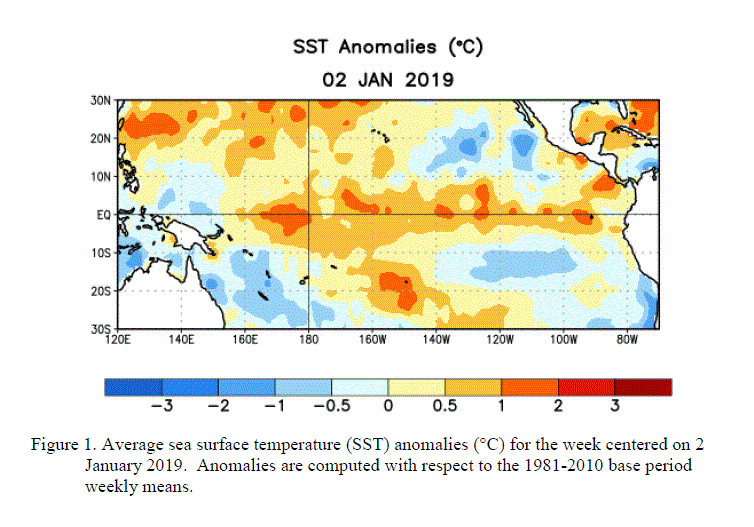
ENSO-neutral continued during April 2014, but with above-average sea surface temperatures (SST) developing over much of the eastern tropical Pacific as well as persisting near the International Date Line (Fig. 1).

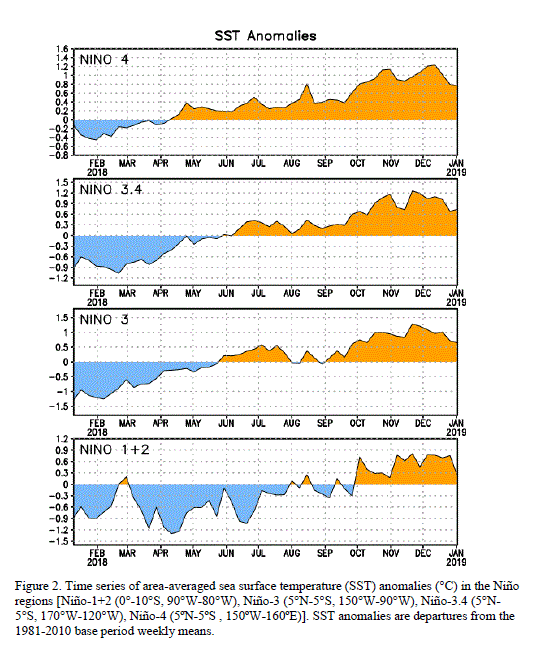
The weekly SST indices were near to slightly above average and increasing in the Niño1+2, Niño3 and Niño3.4 regions, and above average in the Niño4 region (Fig. 2).

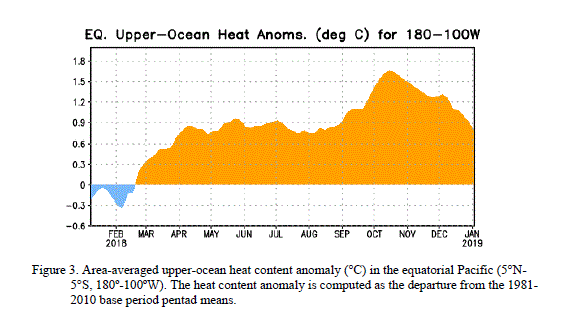
The downwelling phase of a strong oceanic Kelvin wave that began in January greatly increased the oceanic heat content during March and April (Fig. 3),

and produced large positive subsurface temperature anomalies across the central and eastern Pacific (Fig. 4).
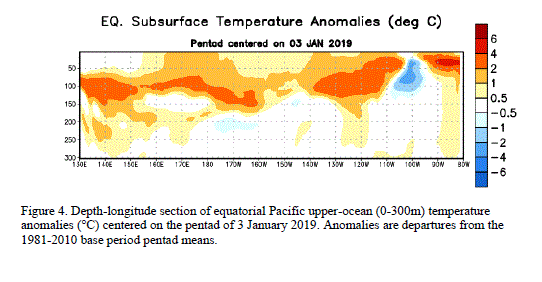

The upper portion of these subsurface anomalies reached the sea surface, warming the waters east of 125oW longitude. Also during April, weak low-level westerly wind anomalies were observed over the far western Pacific, while upper-level easterly anomalies occurred over much of the Pacific. Convection was enhanced over the west-central equatorial Pacific (Fig. 5).
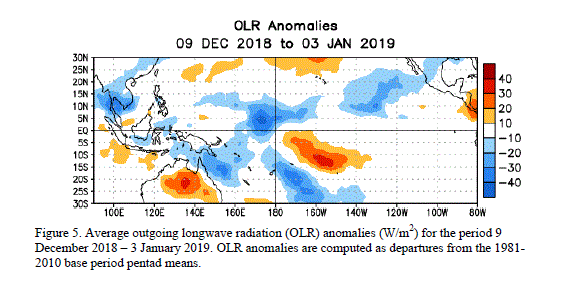

These atmospheric and oceanic conditions collectively indicate a continued evolution toward El Niño.
The model predictions of ENSO for this summer and beyond are indicating an increased likelihood of El Niño compared with those from last month. Most of the models indicate that ENSO-neutral (Niño-3.4 index between -0.5oC and 0.5oC) will persist through part of the remainder of the Northern Hemisphere spring 2014 (Fig. 6),
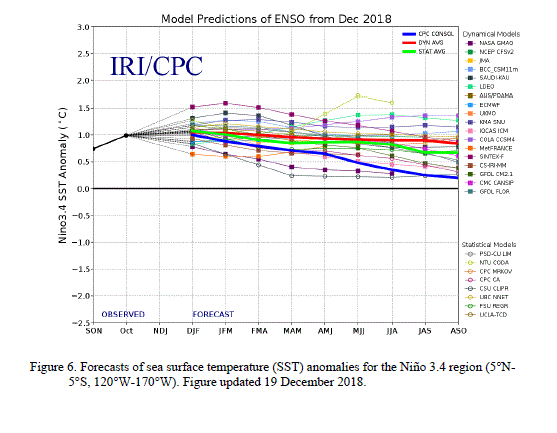

most likely transitioning to El Niño during the summer. There remains uncertainty as to exactly when El Niño will develop and an even greater uncertainty as to how strong it may become. This uncertainty is related to the inherently lower forecast skill of the models for forecasts made in the spring. While ENSO-neutral is favored for Northern Hemisphere spring, the chance of El Niño increases during the remainder of the year, exceeding 65% during the summer (click CPC/IRI consensus forecast for the chance of each outcome).
This discussion is a consolidated effort of the National Oceanic and Atmospheric Administration (NOAA), NOAA’s National Weather Service, and their funded institutions. Oceanic and atmospheric conditions are updated weekly on the Climate Prediction Center web site (El Niño/La Niña Current Conditions and Expert Discussions). Forecasts for the evolution of El Niño/La Niña are updated monthly in the Forecast Forum section of CPC’s Climate Diagnostics Bulletin. The next ENSO Diagnostics Discussion is scheduled for 5 June 2014.
Looks like the El Nino is dissipating already… Learning from Joe B, the current climatic conditions make a rather large El Nino almost impossible imho.
Personally i can’t see another el nino ever reaching the heights of 1998. Based on the fact that 1998 was almost the peak of Soar, and the combined warm phase of ALL natural oceanic cycles… I personally think we will struggle to reach those global temperature heights again in most of our lifetimes.
The climate models are nearly all initialized in the 1990’s and i’d hazard a guess that they will continue to fail with their predictions……. due to the fact that all the natural cycles were in their warm mode then.
The next decade will be a busted flush for AGW / CAGW and the natural cooling processes will over run the global temperatures…
As usual, the government has used equivocal language in describing what it is that it is predicting.
I don’t know. Maybe the Krakenino will rise, and devastate the Pause, and bring woe to the unbeliever. But even if it does, I don’t see how that fulfils the Prophecies as laid out by the GCMs.
http://www.bom.gov.au/climate/enso/#tabs=SOI
The Southern Oscillation Index (SOI) currently remains neutral. The latest approximate 30-day SOI value to 4 May 2014 is +5.2.
Sustained positive values of the SOI above +8 may indicate a La Niña event, while sustained negative values below −8 may indicate an El Niño event. Values of between about +8 and −8 generally indicate neutral conditions.
Anthony, I’m almost done with a post about the current status of the El Nino evolution. I’ll try to complete it tonight.
Regards
Thanks, Anthony. We keep observing ENSO and its consequences.
I have updated my climate and meteorology pages.
Some sort of El Niño seems to be coming. How soon? How strong? Lasting for how long?
Sooooo, does anyone think the Weather Channel will name the next El Nino like they are naming every other weather event?
I vote for Gojira!
sarc/
Is it my imagination, or does the bar chart show the CPC/IRI El-Nino consensus faltering?
It looks like the consensus “probabilities” are about twice as high as the climatological probabilities. Do they [say] why the consensus downweights the statistical evidence so much? What exactly they think the liabilities in the statistical evidence are?
oops, “say why” for “way why”!
If you predict an El Nino for long enough, then eventually you’ll be right.
http://wattsupwiththat.com/2014/05/08/el-nino-watch-issued-by-noaa/#comment-1631553
Oh good. We can finally quit using that messy “climate disruption” and go back to good old “global warming”.
JustAnotherPoster says
http://wattsupwiththat.com/2014/05/08/el-nino-watch-issued-by-noaa/#comment-1631553
Henry says
You are so right
We are globally cooling
and we cannot return to warming…..
http://blogs.24.com/henryp/2013/04/29/the-climate-is-changing/
Figure 6 looks like it came from the IPCC. Notice the Mar. Obs and the “Predictions” ! No skill, no sensitivity and no worry.
Ha ha
🙂
Bob Tisdale says
http://wattsupwiththat.com/2014/05/08/el-nino-watch-issued-by-noaa/#comment-1631588
Henry says
let me guess
it is not happening?
ossqss says:
May 8, 2014 at 9:09 am
Sooooo, does anyone think the Weather Channel will name the next El Nino like they are naming every other weather event?
I vote for Gojira!
sarc/
=======================================
I vote for Godzilla ………… or Gamera!!
Not too surprising as ENSO is a harmonic oscillation of ocean water, sloshing back and forth with a period of five years in the equatorial Pacific. External conditions can occasionally stretch or compress this frequency but it always returns to its resonant value, even as far back as the early nineteenth century. The latest disturbance to it was by the super El Nino of 1998 that delivered much more warm water across the ocean than ENSO is normally capable of supplying. The source of that extra warm water has never been determined because there is a lack of understanding of what is going on. Thanks to this extra warm water we got a short step warming in 1999 that raised global temperature by a third of a degree and then stopped. This is the only real warming within the last 34 years. This, and not any greenhouse effect, makes all twenty-first century years warmer than preceding twentieth century was (exception: 1998). As for the coming El Nino, it is pretty much as expected since the last one in the current series happened in 2010. A five year period would put it at 2015 and their water temperature predictions are not far off of that.
Looking forward to Bob Tisdale’s post…
I do not think it will be a strong Nino either..
John Bills says:
May 8, 2014 at 8:32 am
http://www.bom.gov.au/climate/enso/#tabs=SOI
The Southern Oscillation Index (SOI) currently remains neutral. The latest approximate 30-day SOI value to 4 May 2014 is +5.2.
————————-
Looking at the daily numbers it Isn’t going stay positive for much longer. Daily has been negative for the last 10 days and significantly so for the last 5 days. 90 day average is in a negative trend.
http://www.longpaddock.qld.gov.au/seasonalclimateoutlook/southernoscillationindex/30daysoivalues/
Going to be interesting to watch how it develops (or not) from now on.
“Forecasts for the evolution of El Niño/La Niña are updated monthly in the Forecast Forum section of CPC’s Climate Diagnostics Bulletin.”
Question:
How are these forecasts useful? I can presume there maybe some implications derived from the monitoring and forecasting which provide some assistance to some policy making or decisions somewhere but is that really the case or not?
Call me a cynic because I wonder if it is merely interesting and nice to know but falls short of any application.
Re Green Sand and John Bills, The SOI as you probably know is an index; a rather complicated formula using the pressure differential between Tahiti and Darwin. The general idea though is to see how much of a push to the west the prevailing trades have; so with that only in mind a simple look at the two barometric pressures will help. By mid May weather models (not climate) show a weak Low over Darwin and a ridge over Tahiti; with the pressures higher over Tahiti than Darwin. In fact by the end of next week the trades will be fresh in that latitude band, with a mean wind of about 20kts from the East. Now this could happen even if the two barometric pressures are equal because it’s very common to have a polar dip in the isobars just east of Australia which would create the pressure differential and thus the wind. For that reason the SOI is only one indicator of many. Climatologists are putting a lot of weight on Nino 3.4 or SST in the eastern pacific. In my view that’s wrong; we need to look at ALL the indicators. And pay attention to the oft quoted statement that projections in the austral fall are often faulty; its a transition period.
Some recent animations.
http://www.ospo.noaa.gov/data/sst/anomaly/anomalyws_2m.gif
http://www.cpc.ncep.noaa.gov/products/GODAS/pent_gif/xz/movie.temp.0n.gif
http://www.cpc.ncep.noaa.gov/products/GODAS/pent_gif/xy/movie.h300.gif
Trade Winds looking more El Nino-like now.
http://www.cpc.ncep.noaa.gov/products/analysis_monitoring/enso_update/ua850_c.gif
This is the best predictor in the short-term of where the ENSO is going in the next few months.
http://s14.postimg.org/6681cql8h/Nino3_4_Upper_Ocean_Temps_Apr14.png
How much heat is in each layer as things calm and the warm layer sits on top? And how much of that heat will then be evaporated away and into the thunder-stormed higher atmosphere before the Trade winds begin to blow any left over warm water all back towards the Far East countries?
The first chart – bar chart above Fig 1 – does that not show approx equal chances for El Nino and La Nina ? The red and blue lines are so close.