
By WUWT Regular “Just The Facts”
We are pleased to introduce WUWT’s newest addition, the WUWT Northern Polar Vortex Reference Page. We would like to dedicate this page to NBC News and John Holdren, who both seem to need all the help they can get in understanding Polar Vorticity.
“The stratospheric polar vortex is a large-scale region of air that is contained by a strong west-to-east jet stream that circles the polar region. This jet stream is usually referred to as the polar night jet. The polar vortex extends from the tropopause (the dividing line between the stratosphere and troposphere) through the stratosphere and into the mesosphere (above 50 km). Low values of ozone and cold temperatures are associated with the air inside the vortex.” NASA
“Polar vortices are ubiquitous atmospheric structures. In the Solar System, Earth, Mars, Venus, (Jupiter ), Saturn and its moon Titan are known to have well developed vortices in their polar regions at high altitude. These swirling structures are not always present in the atmosphere of a planetary body at all seasons, but they generally form in the winter hemisphere, when the latitudinal equator-to-pole temperature gradients are the strongest. For Earth, Mars, Saturn and Titan, therefore, the axial tilt determines the presence and seasonal variability of their polar vortices. This can be observed, for instance, by looking at the seasonality of the maximum speed of the circumpolar jets (see [6] for examples related to the Earth and Mars). Venus has a negligible axial tilt; therefore one would expect that the seasonality of its polar vortices is absent. Nonetheless, their seasonality seems to be induced by a dynamical phenomenon, linked to the presence of a quasi-bidiurnal oscillation at mid-latitudes, and extending to high latitudes, rather than by the obliquity of its rotation axis. This oscillation is observed in numerical simulations with global climate models, although its signature depends on the model as well as on model initialisation. A quasi-bidiurnal signal seems also to be present in some analysis of spacecraft data from Venus Express (see for instance [1]), although it has still to be understood whether its nature and origin are common to the oscillation observed in numerical simulations.” European Planetary Science Congress (Links and Jupiter added within)
Polar Vortices are “caused when an area of low pressure sits at the rotation pole of a planet. This causes air to spiral down from higher in the atmosphere, like water going down a drain.” Universe Today
“Long-term vortices are a frequent phenomenon in the atmospheres of fast rotating planets, like Jupiter and Saturn, for example. Venus rotates slowly, yet it has permanent vortices in its atmosphere at both poles. What is more, the rotation speed of the atmosphere is much greater than that of the planet. “We’ve known for a long time that the atmosphere of Venus rotates 60 times faster than the planet itself, but we didn’t know why. The difference is huge; that is why it’s called super-rotation. And we’ve no idea how it started or how it keeps going.
“The permanence of the Venus vortices contrasts with the case of the Earth. “On the Earth there are seasonal effects and temperature differences between the continental zones and the oceans that create suitable conditions for the formation and dispersal of polar vortices. On Venus there are no oceans or seasons, and so the polar atmosphere behaves very differently,” says Garate-Lopez.” Phys.org
“The stratospheric polar vortex shows quite a bit of day-to-day variability. This variability is caused by weather systems or large-scale waves that move upward from the troposphere into the stratosphere. In the left image (9 January 2010), we see some undulations along the edge of the polar vortex, but the vortex is generally centered on the North Pole. Two weeks later (center image on 23 January 2010) we see the center of the polar vortex pushed away from the North Pole. On a constant latitude circle, PV values are high in the eastern hemisphere and low in the western hemisphere. This is referred to as a wave-1 pattern (a wave-2 pattern can be seen in the vortex breakup section below). The wave-1 pattern develops in the troposphere and moves upward (propagates) into the stratosphere.

These stratospheric waves are forced by the large-scale mountain systems and the land-sea contrasts between the continents and oceans. During the northern winter, these waves are continuously forming and moving upward into the stratosphere. The waves can “break”, much like the waves on a beach. These wave-breaking events erode the vortex and keep the polar region warmer and ozone amounts higher. Often, parts of the polar vortex are pulled away from the main vortex. The image on the right (28 January 2010) shows this, where a large piece of the polar vortex was pulled away from the main vortex (green colored material at the bottom of the image). A comparison between the middle and right images also shows a slight contraction of the polar vortex because of these waves.”
“The polar vortex is a winter phenomena. It develops as the sun sets over the polar region and temperatures cool. During the spring, the sun rises and the absorption of solar radiation by ozone begins to heat the polar stratosphere. This heating eventually causes the vortex to disappear along with the polar night jet. However, this process is helped along by planetary-scale waves that propagate up from the troposphere. This wave event that drives the vortex breakup (or final warming) acts to also increase the temperature of the polar region and ozone levels. We mark the day of the vortex breakup when the winds around the vortex edge decrease below a particular value (about 15 m s -1on the 460 K potential temperature surface).”NASA

WUWT Northern Polar Vortex Reference Page offers focused view on the Northern Polar Vortex, whereas the WUWT Polar Vortex Reference Page offers a more broad overview of Global, Northern and Southern Polar Vorticity. When time permits, there will also be a WUWT Southern Polar Vortex Reference Page forthcoming. The following are some observation on recent Northern Polar Vortex activity from the WUWT Polar Vortex Reference Page:
Northern Hemisphere Temperature Analysis at 10 hPa/mb – Approximately 31,000 meters (101,700 feet) shows a high level split within the Stratospheric Polar Vortex on January 11th, 2014:

The split is also visible in Ozone Mixing Ratios at 30 hPa/mb – Approximately 23,700 meters (77,800 feet);

50 hPa/mb Height Analysis at Approximately 20,100 meters (66,000 feet):

70 hPa/mb Height Analysis – Approximately 18,000 meters (59,000 feet);

and 100 hPa/mb Height Analysis – Approximately 15,000 meters (49,000 feet):

Northern Hemisphere Area Where Temperature is Below 195K or -78C shows significant warming in the last few days;

The Vertical Cross Section of Geopotential Height Anomalies shows that the Polar Vortex has weakened significantly and the Arctic Oscillation swung to negative:

“The Arctic Oscillation refers to an opposing pattern of pressure between the Arctic and the northern middle latitudes. Overall, if the atmospheric pressure is high in the Arctic, it tends to be low in the northern middle latitudes, such as northern Europe and North America. If atmospheric pressure is low in the middle latitudes it is often high in the Arctic. When pressure is high in the Arctic and low in mid-latitudes, the Arctic Oscillation is in its negative phase. In the positive phase, the pattern is reversed.
Meteorologists and climatologists who study the Arctic pay attention to the Arctic Oscillation, because its phase has an important effect on weather in northern locations. The positive phase of the Arctic Oscillation brings ocean storms farther north, making the weather wetter in Alaska, Scotland, and Scandinavia and drier in the western United States and the Mediterranean. The positive phase also keeps weather warmer than normal in the eastern United States, but makes Greenland colder than normal.
In the negative phase of the Arctic Oscillation the patterns are reversed. A strongly negative phase of the Arctic Oscillation brings warm weather to high latitudes, and cold, stormy weather to the more temperate regions where people live.” NSIDC

In terms of why the Polar Vortex weakened and split, and the Atlantic Oscillation swung negative, there are likely several factors. the first being Planetary Waves, i.e. “The polar stratosphere and mesosphere are dynamically altered throughout the winter months by planetary wave activity and its interaction with the mean flow. An extreme interaction leads to polar vortex breakdown and a complete alteration in temperature from the lower stratosphere through the upper atmosphere. However, there are more regular disturbances where the dynamical interactions can alter the upper stratosphere and mesosphere without modification to the lower stratosphere; here these disturbances will be designated as Upper Stratospheric Lower Mesospheric (USLM) disturbances.” American Geophysical Union, Greer et al.
“The polar winter middle atmosphere is a dynamically active region that is driven primarily by wave activity. Planetary waves intermittently disturbed the region at different levels and the most spectacular type of disturbance is a major Sudden Stratospheric Warming (SSW). However, other types of extreme disturbances occur on a more frequent, intraseasonal basis. One such disturbances are synoptic-scale “weather events” observed in lidar and rocket soundings, soundings from the TIMED/SABER instrument and UK Meteorological Office (MetO) assimilated data. These disturbances are most easily identified near 42 km where temperatures are elevated over baseline conditions by a remarkable 50 K and an associated cooling is observed near 75 km. As these disturbances have a coupled vertical structure extending into the lower mesosphere, they are termed Upper Stratospheric/Lower Mesospheric (USLM) disturbances.”American Meteorological Society Conference, Greer et al. 2013
Recent Planetary Wave activity can be see on this Zonal Wave #1 Amplitude Jan, Feb, March Time Series;

Zonal Wave #2 Amplitude Jan, Feb, March Time Series;

and Zonal Wave #3 Amplitude Jan, Feb, March Time Series:

Another likely factor that weakened and split the Polar Vortex is Eddy Heat, i.e. “strong negative fluxes indicate poleward flux of heat via eddies. Multiple strong poleward episodes will result in a smaller polar vortex, Sudden Stratospheric Warmings and an earlier transition from winter to summer circulations. Relatively small flux amplitudes will result in a more stable polar vortex and will extend the winter circulation well into the Spring” NOAA
Here you can see that 10 day Averaged Eddy Heat Flux Towards The North Pole At 100mb neared a record daily maximum in early January:

A third potential factor in Polar Vortex behavior that has been proposed is that “geomagnetic activity (used as a measure of solar wind parameters)” plays a role in the “variability of large-scale climate patterns and on changes in the global temperature. We have found positive statistically significant correlations between global temperature and the distribution of surface temperature over Eurasia, the East and Equatorial Pacific and over the North Atlantic for the period 1966-2009 correspond to large-scale climate patterns defined by climate indices. We found very similar positive correlations between geomagnetic activity and the distribution of surface temperature in the mentioned regions. As an effect of geomagnetic storms, energetic particles penetrate from the magnetosphere into the region of the stratospheric polar vortex. The increase of temperature and pressure can be observed over northern Canada. The vortex shifts towards Europe, rotates counter-clockwise and the wind blows from the polar region over Greenland southwards. It diverts the warm flow proceeding northward over the Atlantic, eastward along the deep Icelandic low extending as far as the Barents Sea and takes part in warming Eurasia. The strengthened zonal flow from Siberia cools the western Pacific with the impact on the warming of the equatorial and eastern Pacific when also a distinct 1976-78 climate shift occurred. Processes in the Atlantic and Pacific play a significant role and a time delay (wind forcing over the previous 1-4 yr) appears to be the most important for the relocation of the oceanic gyres. Results showing statistically significant relations between time series for geomagnetic activity, for the sum of climate indices and for the global temperature help to verify findings concerning the chain of processes from the magnetosphere to the troposphere.” Studia Geophysica & Geodaetica, Bucha 2012
A Coronal Mass Ejection (CME); hit Earth around January 1st:
Ensemble WSA-ENLIL+Cone Model Evolution Movie for Median CME Input Parameters – Dynamic Pressure:

and the Magnetosphere was rocking and rolling:

However, there is limited evidence to support the influence of Solar activity on Polar Vorticity and in the past Leif has been dismissive of the potential that Solar influences on the upper atmosphere could influence Earth’s climate, i.e.:
Leif Svalgaard says: March 6, 2011 at 12:13 pm
Just The Facts says: March 6, 2011 at 11:03 am
indicate that the causative mechanism behind proton aurora precipitation during high dynamic pressure is connected to the compression of the magnetosphere, which is directly related to the solar wind dynamic pressure. [and other quotes]
“You keep bringing up influences on the upper atmosphere [which are not disputed – but makes for good fill-material that looks like science], but all of these things are either not related to climate at all or, at best, only marginally and unconvincing.
Again, your bar is much too low [to be generous].”
Regardless of the causes, it appears that the result is that an Upper Stratospheric/Lower Mesospheric (USLM) disturbance occurred, i.e. “USLM Disturbance criteria are established, based on stratopause warmings at the 2 hPa level, to create climatologies in both hemispheres that delineate their timing, frequency, and geographic location. USLM disturbances occur on average 2.3 times per winter in the Northern Hemisphere (NH)(November through March) and 1.6 times per winter in the Southern Hemisphere (SH)(May through September), persist on average for 8 days in the NH and only 4 days in the SH, occur most frequently in December (July) in the Northern (Southern) Hemisphere, and are predominantly located in the longitude sector between 0oE and 90oE in both hemispheres. This is the first work to show that all major Sudden Stratospheric Warmings (SSWs) over the 20.5 year data record are preceded by USLM disturbances. One third of USLM disturbances evolve into a major SSW; only 22% of minor SSWs evolve into a major SSW. USLM disturbances and minor SSWs illustrate, at times, similar occurrence statistics, but the minor warming criteria seem to include a more diverse range of dynamical conditions. USLM disturbances are more specific in their dynamical construct with strong baroclinicity being a necessary condition. Potential vorticity analysis indicates that all USLM events occur with planetary wave breaking and that subsequent baroclinic instability may lead to the development of USLM disturbances. A climatology of polar winter stratopause warmings and associated planetary wave breaking”. Greer et al. 2013
“The typical thermal structure of USLM disturbances is dipolar in nature at 2.0 hPa with strong thermal gradients across the polar vortex. From the assimilated data, we find that the geographic preference of the anomalously warm temperatures at 2.0 hPa are located on the East side of the polar low, while there is a related cool pool of air located on the West side. These geographic preferences and observed amplification in temperature help to support the proposed dynamical process of baroclinic instability. Indirect circulations are induced, and to preserve continuity, cells of ageostrophic and vertical motions occur well into the mesosphere, and potentially into the thermosphere. We find that the average frequency of USLM events is 1.63 events per season in the Northern Hemisphere. In addition, the assimilated data indicates that all Sudden Stratospheric Warmings (SSWs) are preceded by USLM events; SSW events occur with a frequency of 0.84 events per season (Northern Hemisphere). USLM disturbances persist from three to ten days and tend to precede SSW events by several days, although there may be multiple USLM disturbances prior to an SSW event occurring. Lastly we exhibit how USLM disturbances differ between the Northern and Southern poles, including differences in frequency and intensity. An open question is whether these frequent USLM polar winter disturbances impact the thermosphere and ionosphere. American Geophysical Union, Greer et al.
“Analysis of planetary wave breaking and EP-flux of individual and composite USLM events indicate an increase in breaking near the 0.1 hPa level, approximately 10 km above the extreme thermal anomaly at the stratopause in the days leading up to the peak of the event. Vertical coupling of the atmosphere during this event is illustrated in the progression of these events and their impact on the thermal structure, zonal mean wind, polar vortex and conditions that have the potential to support a secondary baroclinic instability (including the Charney-Stern criteria for instability the role of baroclinic/barotropic instabilities). In addition, USLM disturbances appear to have front-like behavior analogous to the troposphere. Broader impacts of these disturbances and the dynamics associated with them influence gravity wave generation/propagation, vertical air motion, chemical tracer transport, precondition of the atmosphere for SSWs and the potential to couple with the thermosphere through tides. American Meteorological Society Conference, Greer et al. 2013
The Upper Stratosphere Lower Mesosphere (USLM) Disturbance can be seen on this Jan, Feb, March Zonal Temperature Anomaly Time Series;

and the impact of the USLM can be seen in the rapid increase in 10-hPa/mb Height Temperature Anomalies – Atmospheric Temperature Anomalies At Approximately 31,000 meters (101,700 feet) over East Asia:

You can see more on current Northern Polar Vortex conditions on the new WUWT Northern Polar Vortex Reference Page. I addition, if you have not had the opportunity to review WUWT’s other Reference Pages it is highly recommended:
- Atmosphere Page
- Atmospheric Oscillation Page
- ENSO (El Nino/La Nina Southern Oscillation) Page
- “Extreme Weather” Page
- Geomagnetism Page
- Global Climate Page
- Global Temperature Page
- Ocean Page
- Oceanic Oscillation Page
- Polar Vortex Page
- Paleoclimate Page
- Potential Climatic Variables Page
- WUWT Northern Polar Vortex Reference Page.
- Northern Regional Sea Ice Page
- Sea Ice Page
- Solar Page
- Spencer and Braswell Papers
- Tornado Page
- Tropical Cyclone Page
- US Climatic History Page
- US Weather Page
Please note that WUWT cannot vouch for the accuracy of the data within the Reference Pages, as WUWT is simply an aggregator. All of the data is linked from third party sources. If you have doubts about the accuracy of any of the graphs on the WUWT Reference Pages, or have any suggested additions or improvements to any of the pages, please let us know in comments below.
Solar activity decreases. Grows cosmic rays. Winter will be long ..
http://cosmicrays.oulu.fi/webform/monitor.gif
AO clearly declining.
http://www.cpc.ncep.noaa.gov/products/precip/CWlink/daily_ao_index/ao.obs.gif
Are there any good 3 dimensional representations of air flow to and from the poles?
It seems to me that if there is sufficient cold air to move south from the arctic, warm air must have been transported there to begin with, right?
The amount of air on the planet does not vary much, it just seems to move around a lot and as it moves it displaces air.
Nice work!! I hope it’s not all in vain. This morning, ABC News called the latest outbreak of cold air the “POLAR PLUNGE!” To her credit, Ginger Zee, the meterologist/reporter, seemed to be a bit embarassed at the “new” terminology.
Can be seen how air inflow up from the the pole over the North America.
http://earth.nullschool.net/jp/#current/wind/isobaric/10hPa/orthographic=-355.55,93.41,319
========================================================================
Maybe the “Polar Plunge” will be the plunger the public needs for all the CAGW BS that has plugged up the system.
Nature seems to know a hexagon. Here’s a photo of Saturn’s Polar Vortex.
Snowflakes are all hexagons too:
http://www.natureworldnews.com/articles/5197/20131205/saturns-unique-hexagon-jet-stream-captured-gifs-nasas-cassini-probe.htm
No two snowflakes are alike, but they are all hexagons. Haven’t seen one yet that’s a pentagon. Anyone here know (have a scientific reason) why Saturn’s polar vortex is in the shape of a hexagon??? Maybe God likes hexagons…
ren says: January 18, 2014 at 11:45 pm University of Oulu – Sodankyla Geophysical Observatory – Click the pic to view at source[/caption]
 NOAA – National Weather Service – Climate Prediction Center – Click the pic to view at source[/caption]
http://geo.phys.spbu.ru/materials_of_a_conference_2012/STP2012/Veretenenko_%20et_all_Geocosmos2012proceedings.pdf
Interesting, i.e. THE POLAR VORTEX EVOLUTION AS A POSSIBLE REASON FOR THE TEMPORAL VARIABILITY OF SOLAR ACTIVITY EFFECTS ON THE LOWER ATMOSPHERE CIRCULATION S.V. Veretenenko:
“It was revealed that the detected earlier ~60-year oscillations of the amplitude and sign of SA/GCR effects on the troposphere pressure at high and middle latitudes are closely related to the state of a cyclonic vortex forming in the polar stratosphere. A roughly 60- year periodicity was found in the vortex strength affecting the evolution of the large-scale atmospheric circulation and the character of SA/GCR effects. It was shown that the sign reversalsof the correlations between tropospheric pressure and SA/GCR variations coincide well with the transitions between the different states of the vortex. Most pronounced SA/GCR influence on the development of extratropical baric systems is observed when the vortex is strong. The resultsobtained suggest that the evolution of the stratospheric polar vortex plays an important part in the mechanism of solar-atmospheric links.”
“We can see that the temperature in the vortex center decreases with the increase of height and reaches its minimum at the levels 30-50 hPa (20-25 km). The temperature gradients at the vortex edges increase with height in the stratosphere starting from the level 150 hPa, their maximum being observed at the levels 50-10 hPa (20-30 km). In the troposphere temperature gradients are maximal near surface corresponding to Arctic fronts separating the Arctic air from warmer air of middle latitudes. Thus, the vortex is most pronounced at the 50-30 hPa levels where the minimum of stratospheric temperatures and the maximum of temperature gradients at its edges are observed. We can see that the highest values of ion production rate due to GCR are observed in the lower part of the vortex (10-15 km) where temperature gradients start increasing. On the other hand, the 11-year modulation of GCR fluxes is strongest at the heights 20-25 km [Bazilevskaya et al., 2008] where the vortex is most pronounced. Hence, the vortex location seems to be favorable for the mechanisms of solar activity influence on the atmosphere circulation involving GCR variations. It is also favorable for the mechanisms involving solar UV variations, as at these heights (15-25 km) in the polar stratosphere the maximum ozone content is observed. The evolution of the vortex is known to be determined by dynamic coupling between the troposphere and stratosphere via planetary wave propagation, as well as by radiation processes in the stratosphere. So, we can suggest that the mechanism of SA/GCR influence on the troposphere circulation involves changes of the vortex strength associated with changes of the heat-radiation balance in the stratosphere. These changes may be caused by variations of atmosphere transparency in visible and infrared range associated with the effects of ionization and atmospheric electricity variations on cloudy and aerosol particle characteristics [Tinsley, 2008]. Indeed, a considerable increase of aerosol concentration at high latitudes which was most pronounced at the heights 10-12 km and accompanied by the temperature decrease in overlying stratospheric layers was detected during a series of powerful solar proton events on January 15-20, 2005 [Veretenenko et al., 2008]. In turn, the increase of the vortex strength intensifies temperature gradients at its edges (see Fig.4). At the stages of a strong vortex this increase of temperature gradients may be transferred to the troposphere via planetary waves and contribute to the increase of temperature contrasts in tropospheric frontal zones and the intensification of extratropical cyclogenesis.”
5. Conclusions
The results of this study showed that the evolution of the stratospheric polar vortex plays an important part in the mechanism of solar-climatic links. The vortex strength reveals a roughly 60-year periodicity influencing the large-scale atmospheric circulation and the sign of SA/GCR effects on the development of baric systems at middle and high latitudes. The vortex location is favorable for the mechanisms of solar activity influence on the troposphere circulation involving variations of different agents (GCR intensity, UV fluxes). In the periods of a strong vortex changes of the vortex intensity associated with solar activity phenomena seem to affect temperature contrasts in tropospheric frontal zones and the development of extratropical cyclogenesis.”
ren says: January 19, 2014 at 11:39 pm
Solar activity decreases. Grows cosmic rays. Winter will be long ..
http://cosmicrays.oulu.fi/webform/monitor.gif
Added to the WUWT Solar Reference Page and the WUWT Atmosphere Page:
Cosmic Rays
Oulu Neutron Monitor
[caption id="" align="alignnone" width="620"]
However, not yet added to the WUWT Polar Vortex Reference Pages, as I am not yet convinced that there’s a relationship.
ren says: January 20, 2014 at 6:13 am
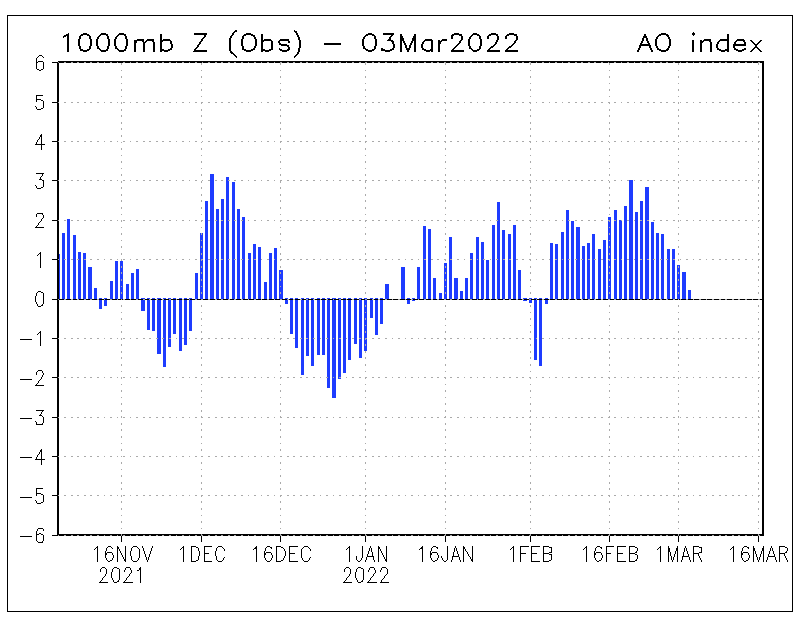
AO clearly declining.
http://www.cpc.ncep.noaa.gov/products/precip/CWlink/daily_ao_index/ao.obs.gif
Added to the WUWT Atmospheric Oscillation page, there’s a version under the Normalized Geopotential Height (GPH) Anomaly image, but the one you provided has better resolution, i.e.:
Arctic Oscillation (AO) Index – 4 Months Prior
[caption id="" align="alignnone" width="578"]
Thank you for your input and contribution. Additional potential content for the WUWT Reference pages, or in support of the relationship between Cosmic Ray and Polar Vorticity, is most welcome.
Thank you. There are other scientific evidence.
http://icrc2009.uni.lodz.pl/proc/pdf/icrc0228.pdf
Ionizing radiation also depends on the pressure, which can be seen on the monitor. Ozone can be reduced by rapid electrons GCR.
http://terra2.spacenvironment.net/~raps_ops/current_files/rtimg/dose.15km.png
Strength of cosmic rays GCR is opposite to the Earth’s magnetosphere activity (Ap) and depends on the Earth’s magnetic field. Is strongest at the poles.
I have a theory based on my observation that if cosmic rays are high for many years, as now, since 2005, the changes in ozone zone cumulative, by going in the high parts of the stratosphere with one pole of the Earth to the other.
Thanks Justthefacts, good presentation.
ren’s input is valuable here too, IMO. Something we should be keeping an eye on.
“The association between stratospheric weak polar vortex events and cold air outbreaks in the Northern Hemisphere” Kolstad et al. 2010 The association between stratospheric weak polar vortex events and cold air outbreaks in the Northern Hemisphere, Kolstad et al. 2010 – Click the pic to view at source[/caption]
“Previous studies have identified an association between temperature anomalies in the Northern Hemisphere and the strength of stratospheric polar westerlies. Large regions in northern Asia, Europe and North America have been found to cool during the mature and late stages of weak vortex events in the stratosphere. A substantial part of the temperature changes are associated with changes in the Northern Annular Mode (NAM) and North Atlantic Oscillation (NAO) pressure patterns in the troposphere. The apparent coupling between the stratosphere and the troposphere may be of relevance for weather forecasting, but only if the temporal and spatial nature of the coupling is known.Using51wintersofre-analysisdata, we show that the development of the lower-tropospheric temperature relative to stratospheric weak polar vortex events goes through a series of well-defined stages, including the formation of geographically distinct cold air outbreaks. At the inception of weak vortex events, a precursor signal in the form of a strong high-pressure anomaly over north west Eurasia is associated with long-lived and robust cold anomalies over Asia and Europe. A few weeks later, near the mature stage of the weak vortex events,a shorter-lived cold anomaly emerges off the east coast of North America. The probability of cold air outbreaks increases by more than 50% in one or more of these regions during all phases of the weak vortex events.This shows that the stratospheric polar vortex contains information that can be used to enhance forecasts of cold air outbreaks. As large changes in the frequency of extremes are involved, this process is important for the medium-range and seasonal prediction of extreme cold winter days. Three-hundred-year pre-industrial control simulations by 13 coupled climate models corroborate our results.”
“Cold air outbreaks (CAOs) are departures of cold airmasses into warmer regions. Over land, these events can lead to deaths and damage (Mercer, 2003; Barnett et al., 2005; Pinto et al., 2007). Over the ocean, CAOs are important for a number of reasons: they give rise to mesoscale weather phenomena such as polar lows (Bracegirdle and Gray, 2008), they lead to enhanced heat and momentum fluxes from the ocean to the air (Renfrew and Moore, 1999) and may therefore influence the ocean circulation (Pickart et al., 2003), and they cause rapid formation of sea ice in marginal ice zones (Skogseth et al., 2004). In recent years it has emerged that anomalies in the stratospheric circulation can be associated with tropospheric CAOs (Thompson et al., 2002; Cai and Ren, 2007; Scaife et al., 2008). Normally, the extratropical stratosphere is characterised by a strong westerly circumpolar flow. In winter, planetary waves of tropospheric origin propagate continuously into the stratosphere (Charney and Drazin, 1961), where they break and exert a drag on the zonal flow (McIntyre and Palmer, 1983; Polvani and Waugh, 2004). This violates the geostrophic balance and induces a poleward drift of air masses. At high latitudes, the air converges, sinks and warms adiabatically. If there is severe wave-breaking, the stratospheric zonal flow reverses, giving rise to stratospheric sudden warmings (SSWs: Matsuno, 1971), which may last for days to weeks (Limpasuvan and Hartmann, 1999). After their first appearance in the upper stratosphere, circulation anomalies are occasionally found at successively lower levels (Matsuno, 1970; Lorenz and Hartmann, 2003). After reaching the tropopause, the anomalies may impact the troposphere through an interaction with synoptic-scale eddies (Song and Robinson, 2004), ormore directly through induced meridional circulations. As a result, a negative Northern Annular Mode (NAM: Thompson and Wallace, 2001) and North Atlantic Oscillation (NAO: Hurrell et al. 2003) pattern may occur near the surface some weeks after the first warming signal in the upper stratosphere (Baldwin and Dunkerton, 2001; Baldwin et al., 2003; Limpasuvan et al., 2004).
Negative NAM and NAO regimes in the troposphere have a profound influence on the weather in large and widespread regions of the Northern Hemisphere (NH) (Kenyon and Hegerl, 2008).Atlantic and Pacific storm tracks shift latitudinally (Hurrell and Van Loon, 1997; Baldwin and Dunkerton, 2001), Greenland and Newfoundland warm (Thompson et al., 2002), and the frequency and severity of CAOs increase over large parts of east Asia (Chen et al., 2005; Jeong and Ho, 2005), northern Eurasia (Scaife et al., 2008) and eastern North America (Thompson and Wallace, 2001; Walsh et al., 2001; Cellitti et al., 2006). Over the ocean, negative phases of the NAO, and positive height anomalies over Greenland in particular, are associated with marine CAOs over the Nordic Seas (Kolstad et al., 2009). Motivated by the link that has been observed between anomalous stratospheric events and the tropospheric climate, we aim to provide a detailed description of tropospheric cold anomalies in relation to such events. Thompson et al. (2002) investigated the mean temperature response during the first 60 days after the onset dates of stratospheric anomalous vortex conditions. Here, we extend their work by assessing the temperature development and changes in the probability of CAOs at different stages of stratospheric weak vortex events. We find that the tropospheric temperature development goes through several distinct and well-defined stages of stratospheric weak vortex events and we identify CAOs over both continental and oceanic regions. These results are corroborated by data from 300-year time slices of 13 coupled model simulations.”
“Our analysis is centred on composites of days and months for which the stratospheric vortex is weak. We define Weak vortex days (WVDs) in the NNR as the days for which the daily VSI falls below its overall wintertime (December–March) 10th percentile. An alternative to this method would be to remove the seasonal cycle (by using the date-wise climatological 10th percentile as a threshold instead), but this would have forced the WVDs to be equally distributed among the wintermonths. Cold days are defined as days with an 850 hPa temperature below its date-wise climatological 10th percentile. When identifying cold days we did remove the seasonal cycle, as the purpose of defining cold days is to assess whether a given day is colder than ‘normal’. Weak vortex months (WVMs) and Cold months in the models are defined with respect to the overall 10th percentiles of the monthly mean anomalies.”
“In Figure 1(a), a matrix of VSI values for each day in the analysis period is shown. The values were grouped with respect to deciles. The blue days are the WVDs as defined above. The SSW central dates are shown using crosses. As mentioned earlier, due to the way they were computed, the density of WVDs is higher in midwinter than in early and late winter. Figure 1(a) shows that this complies well with the seasonal distribution of the SSW central dates. An advantage of CP07’s approach is that all their events are independent, and the study of lead/lag processes is therefore free of the effects of artificial smoothing.”
[caption id="" align="alignnone" width="600"]
“The relationship between stratospheric weak vortex events and tropospheric developments, and cold air outbreaks (CAOs) in particular, were investigated using 51 winters of re-analysis data and a set of coupled climate models. We found large increases in the frequency of cold air outbreaks (Figure 3) that coincide geographically with the regions of mean temperature change (Figure 2). The probability of CAOs was found to increase: (1) by 75% or more in some regions of northern Asia throughout the life cycle of weak vortex events (from the Precursor phase to the Decay phase), (2) by 50% or more in some regions of Europe (from the Onset phase to the Decline phase), and (3) by 50% or more in the Peak phase off the east coast of North America. Changes in the frequency of cold air outbreaks associated with the stratosphere are therefore large compared to the climatological incidence of CAOs. Such substantial changes make this signal important for the long-range forecasting of the likelihood of CAOs. If the signal is predictable, then there will be an associated predictability of CAOs. However, if it is unpredictable, then it represents an important limit on the long-range predictability of CAOs.
A potential obstacle to the predictability of CAOs based on the state of the stratospheric vortex is the fact that many of the cold anomalies seen in Figure 3 occurred before the SSW central dates and WVDs. The early CAOs in Europe and Asia were associated with the perhaps clearest precursor of stratospheric weak vortex events, a high pressure anomaly centred over the northwestern edge of Eurasia in the Precursor, Onset and Growth phases. Although its location changed with time, this positive height anomaly persisted for all the phases and was confined to high latitudes in the Atlantic sector. More work is therefore needed to address the chain of cause and effect and to investigate tropospheric precursors of weak vortex events, adding to existing studies of troposphere–stratosphere interactions (Kuroda and Kodera, 1999; Chen et al., 2003; Polvani and Waugh, 2004; Reichler et al., 2005; Scaife et al., 2005; Cohen et al., 2007; Martius et al., 2009; Mukougawa et al., 2009; Garfinkel et al., 2010). We did not directly address the issue of cause and effect of CAOs in this paper, but interestingly, we found a hemisphere-wide pattern of lower-tropospheric temperature signals both before and after weak vortex events. In general, such temperature signals are associated with pressure anomaly dipoles in the form of anomalous ridges upstream (such as the precursory high anomaly over northwest Eurasia) and anomalous troughs downstream of the cold anomalies. Such patterns lead to changes to the flow, and the resulting temperature advections may well act as positive feedback mechanisms, as documented for the negative phase of the surface NAM(Thompson and Wallace, 2000). The association between pressure anomaly dipoles and CAOs is known from previous studies (Konrad, 1996; Walsh et al., 2001; Chen et al., 2005; Takaya and Nakamura, 2005; Cellitti et al., 2006; Kolstad et al., 2009). It is quite possible that some of the regional CAOs identified in this paper are at least partly set up or sustained by cold air advection, as part of the chain of events outlined by Konrad (1996).
Given the strong stratospheric link to many CAOs, it could be that attention needs to be paid to the simulation of the stratosphere in climate models. However, parts of our analysis were repeated with an ensemble of 13 coupled climate models. Somewhat surprisingly, considering that many of these models have low model tops and poorly resolved stratospheres (Cordero and Forster, 2006), the model results corroborated the relationships between the weak vortex events and the cold anomalies listed above. This may indicate that the main aspects of the tropospheric temperature developments during the life cycle of the stratospheric weak vortex events are associated with internal processes in the troposphere and lower stratosphere, as suggested by Polvani and Waugh (2004).”
https://www.academia.edu/223963/The_association_between_stratospheric_weak_polar_vortex_events_and_cold_air_outbreaks_in_the_Northern_hemisphere
“Winter turned fierce in the opening weeks of 2009. A bitter cold snap set in over much of the United States, and temperatures plummeted beyond -30 degrees Celsius (-22 F) in parts of the Upper Midwest. On February 2, portions of Western Europe were doused with heavy snow. England received the brunt of the storm with up to 20 centimeters (8 inches) of snow falling in London. It was the heaviest snowfall southeastern England had seen in nearly 20 years, reported BBC News. So why all the nasty weather? Part of the answer lies in the stratosphere, some 20 kilometers (12 miles) above the Earth’s surface. NASA – Click the pic to view at source[/caption]

 NASA – Click the pic to view at source[/caption]

Starting in January and extending into early February 2009, wind and temperature patterns in the stratosphere changed dramatically. In just a few weeks, temperatures climbed by about 50 degrees Celsius (90 degrees F) on average, with larger spikes in places, and winds flipped direction, changing by nearly 100 meters per second (200 miles per hour). That change influenced weather patterns lower in the atmosphere. These images and the associated animation show how the stratosphere changed and help illustrate why the United States and Europe were in the grip of such odd weather. The globes show temperatures (top) and vorticity (bottom) on January 10 (left) and February 2 (right). (The animation runs from January 10-February 4.) The images are based on assimilated weather observations of the atmosphere from the Goddard Modeling and Assimilation Office at NASA Goddard Space Flight Center.
In the winter, little to no sunlight reaches Earth’s northern extremes. Deprived of energy, the stratosphere over the Arctic grows cold. These were the conditions present on January 10, 2009, as shown in the top left image. The cold air mass creates a low-pressure system in the stratosphere that sits over the Arctic throughout the winter. Farther south, where the Sun is shining, the air is warmer and air pressure is higher in the stratosphere. Air flows away from the high-pressure system towards the low-pressure system. Because the Earth is turning, the air is deflected to the right as it moves north, creating a strong counterclockwise (west to east) current of wind, which scientists call the polar night jet.
The lower pair of images represent the air mass, or polar vortex, that controls the wind pattern. Essentially, the winds are strongest at the edge of the polar vortex (where the pressure difference between the air masses is greatest). The area of red in the lower left image represents polar air that typically sits over the Arctic during January. In general, strong winds circle the red regions, or areas of high vorticity, in a counterclockwise direction. These winds, moving at speeds well above 100 miles per hour, influence winds and weather patterns closer to Earth’s surface. Their influence means that weather in England and Western Europe typically comes from the west. Over England, western winds blow in ocean air warmed by the Atlantic Gulf Stream.
The big change in the Arctic came when the polar vortex ripped apart. A developing weather system in the lower atmosphere traveled upward into the stratosphere. The disturbance nudged into the center of the Arctic air mass, elongating it and eventually splitting it like a cell in mitosis. By February 2, two air masses existed, each with a jet of wind circling it counterclockwise as depicted in the lower right image.
Warm air filled the gap between the two colder air masses, and temperatures high over the North Pole climbed, as shown in the upper right. Now the colder air had shifted farther south over Canada and Siberia. Over North America, this piece of the stratospheric polar vortex had a deep reach into the lower atmosphere (troposphere), which created strong winds from the north that carried cold Arctic air far south into the United States.
In Europe, the split in the air mass actually changed the direction of winds in the lower atmosphere. The second piece of the polar vortex was centered east of Western Europe, as shown in the lower left image, and it too was surrounded by a jet of strong wind moving counterclockwise. Like the segment of the polar vortex over North America, this piece of the polar vortex also had a deep reach into the lower atmosphere. It caused cold continental air to blow in from the east, replacing the warmer air that typically blows in from the west. As the frigid air moved over the North Sea, it picked up moisture, which fell over the United Kingdom and parts of France as heavy snow.”
http://earthobservatory.nasa.gov/IOTD/view.php?id=36972
Stratospheric Temperature
[caption id="" align="alignnone" width="600"]
Stratospheric Vorticity
[caption id="" align="alignnone" width="600"]
Animation of Stratospheric Vorticity:
http://eoimages.gsfc.nasa.gov/images/imagerecords/36000/36972/npole_gmao_200901-02.mov
We must also observe the stratosphere over the South Pole. Worth seeing had happened there in the winter. AAO from August fell to record levels by the end of winter. In animation you can see the waves reach the upper stratosphere.
http://www.cpc.ncep.noaa.gov/products/intraseasonal/temp10anim.gif