
Image Credit: Cryosphere Today – University of Illinois – Polar Research Group
By WUWT Regular Just The Facts
Per the graph above, Antarctic Sea Ice Extent has remained above the 1981 – 2010 “normal” range for much of the last three months and the current positive Antarctic Sea Ice Extent anomaly appears quite large for a planet supposedly on the verge of Dangerous Warming.
Furthermore, in 2013 we had the third most expansive Southern Sea Ice Area measured to date;

and Southern Sea Ice Area has remained above average for most of the last two years;

At the other pole Arctic Sea Ice Extent has remained within the 1981 – 2010 “normal” range for the entirety of 2013;

and Northern Hemisphere Sea Ice Area had it’s smallest decline since 2006;

thus Global Sea Ice Area has remained stubbornly average for the entirety of 2013:

According Michael Oppenheimer, Professor Geo-sciences and International Affairs at Princeton University and IPCC Contributor, the reason for The Pause/Hiatus in Earth’s atmospheric temperature, and apparently associated average Global Sea Ice is that;
“heat tends to hide in the oceans sometimes, but when heat hides in the ocean it later comes out and reappears in the atmosphere and then the warming resumes faster than before. We don’t know this for certain, we’ll find out over the next few years, but it is wrong to say that the IPCC didn’t look at it carefully, it certainly did.” PBS
Reassuring to know that IPCC has figured out Earth’s climate system for us, it’s all just like a big game of hide and go seek, clearly…
To see more information on Sea Ice please visit the WUWT Sea Ice Page and WUWT Northern Regional Sea Ice Page.
John Comeau says:
October 20, 2013 at 12:51 pm
1. “All” of the CAGW religious fear of Arctic sea ice loss is based on (the false and highly exaggerated) fears of a “positive” feedback Arctic sea ice albedo. Supposedly, arctic sea ice has a much higher albedo than the dark ocean water it covers, and, in the usual scheme of things in temperature latitudes, darker things absorb more heat than lighter things when both are exposed to the same amount of sunlight. According to this much-publicized “positive sea ice albedo feedback” theory, when the Arctic sea ice melts, the darker ocean waters absorb more solar energy, get warmer, heat the air above these “new ocean waters” and the surrounding sea ice even more, and thus melt more sea ice, which absorbs more solar energy and heats even Arctic waters even hotter.
Since the much-publicized Arctic sea ice feedback begins with the difference in albedo between sea ice and open ocean waters, the thickness of the sea ice is irrelevant to how much solar energy is reflected or absorbed from a surface. Since “all” of the Antarctic sea ice melts every year (only 1+ million sq km’s remain over the summer season, compared to 16 millions at maximum extent, the thickness doesn’t affect the year-to-year sea ice residuals either. Up north, in the Arctic, where 2-year, 3-year, and 4-year ice make up 1/3 to 1/2 of the total sea ice present, one could argue that thickness matters (thick ice melting slower than thin ice) the loss of ANY arctic sea ice blown away from the high arctic waters into the Atlantic Ocean means ALL of the sea ice “lost” will melt anyway. The ONLY sea ice remaining year-to-year is that which is NOT blown away past Greenland, but which remains above 82-85 north all year. Consider that even a Greenland glacier block 300+ feet thick (100 meter) is completely melted in only weeks. A 1 or 2 meter thin wafer of sea ice has no chance of surviving if the winds blow it south. So, Arctic thickness is a distraction to sea ice area, and it is irrelevant to Antarctic sea ice reflection calc’s as well.
2. The Antarctic land mass is 14,000,000 sq km’s. This land mass has a permanent ice shelf surrounding it of 1.5 million sq km’s. The Antarctic sea ice area minimum – steadily GROWING year-to-year from just at 1.5 million sq km’s a few years ago up to last year’s 2.5 million sq km’s! – surrounds this combination of land ice and permanent ice shelves – which makes a total of 18,000,000 sq km’s AT MINIMUM AREA. If you use “sea ice extents (rather than sea ice area) you get even more “year-round-sea-ice” around the Antarctic pole.
AT ITS MINIMUM, 18 million sq km’s of total Antarctic ice covers a “beanie” around the Antarctic continent from the south pole up to 68.3 latitude. On Hansen’s Mercator projector maps, ALL of the south pole is covered by ice ALL of the time to a point just about the middle of Greenland.
3. But it is even worse than you think: That 18 million sq km’s Antarctic ice cover is the MINIMUM ice area. Each recent winter, the maximum Antarctic sea ice area is setting new records – it was just over 16,000,000 sq km’s a few weeks ago. Antarctic sea ice extents are even higher, and they are increasing as well: They are now averaging over 18,000,000 sq km’s each antarctic winter.
Total Antarctic ice is 14 million (land area) + 1.5 million (ice shelves) + 18 million (sea ice at maximum extents) = 33.5 million sq km’s. This is an area from the Antarctic pole “up” to latitude 60.3 South.
Note: The Drake Passage and Straits of Magellan are only at latitude 56 south. Ship traffic around Cape Horn can expect to be blocked by Antarctic sea ice within 8.5 years to 14 years, depending on which sea ice trend you want to use!
If one considers the linear trend of arctic September ice minimum extent as plotted by NSIDC, here: http://nsidc.org/arcticseaicenews/files/2013/10/Figure3_Sept2013_trend-350×261.png
and projects backwards from their linear trend, the result is that the entire northern hemisphere should have been covered in solid ice all year round as recently as about 938 BC. Admittedly the historical records from that time are sparse, but there are some written historical records from that time period. Oddly enough, I can find no reference in the historical record of the entire known world being covered in solid ice all year round at that time, or any other time in recorded history for that matter.
Hmm…..
Sarcasm aside, what is the official method for determining at what point the linear trend assumption breaks down and what empirical evidence supports said assumption? For that matter, what justifies assuming a linear trend at all, especially for purposes of extrapolating predictions beyond the limits of available data??
“But, but, but, the ice cap volume in western and peninsula of Antarctic is shrinking!”
Seth says: October 20, 2013 at 5:46 pm
“Ice Extent anomaly appears quite large for a planet supposedly on the verge of Dangerous Warming.” – There’s a completely unsupported argument.
Umm, “completely unsupported”? The statement that “Ice Extent anomaly appears quite large” is supported by a National Snow and Ice Data Center graph showing Antarctic Sea Ice Extent to be outside of 2 standard deviations and over 2 million Sq. km. above average:
http://nsidc.org/data/seaice_index/images/daily_images/S_stddev_timeseries.png
“a planet supposedly on the verge of Dangerous Warming.” is supported by a PBS news segment titled “Climate Scientists Warn Opportunity to Prevent Dangerous Warming Is Dwindling” and features an IPCC Contributor, who states that “the window of opportunity to avoid a dangerous warming, which has been labeled by the governments as a warming of a little short of 4 degrees Fahrenheit, that window is closing rapidly”:
http://www.pbs.org/newshour/bb/climate-change/july-dec13/climate2_09-27.html
Seem like it is your argument that is completely unsupported…
There has been some interesting research on Southern Sea Ice lately: http://journals.ametsoc.org/doi/abs/10.1175/JCLI-D-12-00139.1
Jinlun Zhang has a history of contorting himself to try to hide the gaps in the Catastrophic Anthropogenic Global Warming Narrative. For example, in this NASA article/press release it states that:
and in this paper titled “What drove the dramatic retreat of Arctic sea ice during summer 2007?” by Zhang, J., R.W. Lindsay , M. Steele, and A. Schweiger, Geophys. Res. Lett., 35, L11505, doi:10.1029/2008GL034005, 2008, it states that “Arctic sea ice in 2007 was preconditioned to radical changes” and this contributed to “The dramatic decline” . This is not objective science, rather it’s alarmist rhetoric.
Zhang was already looking for an Arctic Sea Ice tipping points in 2005, i.e. the title of this paper paper was “The thinning of arctic sea ice, 1988–2003: have we passed a tipping point?” by Lindsay, R. W. and J. Zhang, J. Climate, 18, 4879–4894, 2005.
In 2006 Zhang co-wrote a paper with Mark “Death Spiral” Serreze and Keith “the lack of warming … is a travesty” Trenberth, titled “The large-scale energy budget of the Arctic” by Serreze, M. C., A. P. Barrett, A. G. Slater, M. Steele, J. Zhang, and K. E. Trenberth, , J. Geophys Res., 112, D11122, doi: 10.1029/2006JD008230, 2007.
Jinlun Zhang is also responsible for the highly suspect “PIOMAS Sea Ice volume model” , i.e.:
As such, PIOMAS uses an erroneous data set, weights heavily when observations didn’t fit the model and then “nudges” the output. Jinlun Zhang is not a credible source of scientific research or data.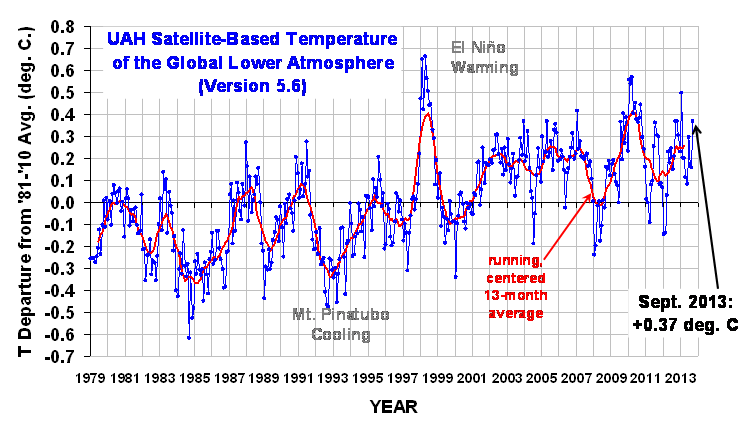 University of Alabama – Huntsville (UAH) – Dr. Roy Spencer – Click the pic to view at source[/caption]
 Remote Sensing Systems (RSS) – Microwave Sounding Units (MSU) – Click the pic to view at source[/caption]
 National Aeronautics and Space Administration (NASA) Goddard Institute for Space Studies (GISS) – Click the pic to view at source[/caption]
 Met Office – Hadley Center – Click the pic to view at source[/caption]
But the existence of that research doesn’t mean that the planet isn’t warming or that it’s not dangerous. It means that the southern sea ice extent is still an interesting field to study.
No, Jinlun Zhang’s “research doesn’t mean that the planet isn’t warming” rather these temperature graphs from UAH, RSS, GISS and the Met Office show that the planet isn’t warming:
UAH Lower Atmosphere Temperature Anomalies – 1979 to Present
[caption id="" align="alignnone" width="578"]
RSS Temperature Lower Troposphere (TLT) – Brightness Temperature Anomaly – 1979 to Present
[caption id="" align="alignnone" width="578"]
Monthly Mean Surface Temperature Anomaly – 1996 to Present
[caption id="" align="alignnone" width="578"]
Annual Global Average Land and Ocean Temperature Anomaly – 1850 to 2012
[caption id="" align="alignnone" width="578"]
The argument that “well, you’ve changed your mind on this one little aspect, therefore your whole thesis is wrong” is used by creationists at lot. Not a group I’d be proud to ape. Congratulations for lowering the bar “justthefactswuwt”.
Hilarious, you and your ilk have lowered the bar so low that an ant can get over it in one step. Try presenting some evidence to support your position, whatever it may be…
I splat coffee all over the place. Thread winner!
Yeah there are good responses to that, but yours was the most appropriate of all.
davidmhoffer says:
October 20, 2013 at 11:45 am
“We should note that Oppenheimer fails to provide an explanation of the physical processes by which this could occur. To my knowledge, neither he, nor anyone else in the alarmascience community has done so, despite the frequency with which they claim that this is a possibility.”
The ancient astronomers would say he’s added an epicycle.
Jeff: “For that matter, what justifies assuming a linear trend at all, especially for purposes of extrapolating predictions beyond the limits of available data??”
When the R^2 you want is no longer above the minimum bar permissible by your discipline, then you start adding exponents. Though, as few things are linear, adding a single term with an exponent in the beginning is always useful. But a linear trend is, essentially, justified on the basis that it takes less pencil lead to deal with. Not much importance nowadays, but there you have it.
As for extrapolation: Every prediction is justified on the same basis that every hypothesis is. That is: Why not? If your prediction model is useful enough to state something less than ‘derp’ at dinner parties, then it’s useful enough. If can slap it on a lab table then you can validate it, and tease out causation, trivially enough. When you can’t, then you have to wait for the future to make its natural progression into the past before anything can be said. Though teasing causation out of such conditions is just this side of impossible. Effectively you need to watch every possible confounder take an up swing and down swing so you can rule it out as possible or primary. When all that’s left is one item tracking both ways, then you’re gold.
Which is to say: You need cycles or quasi-cycles in the data to begin with. Otherwise, it’s back to lab tables.
Tim Groves: “The ancient astronomers would say he’s added an epicycle.”
Hating on epicycles is so medieval. Modern science is all about the epicyclic diversity and fighting against experimental privilege.
Jimbo says:
October 20, 2013 at 1:32 pm
I kept trying to explain to Warmists that most sceptics are fervent proponents of climate change. The climate always changes.
——————
YES! I do the same. It’s amazing how much I get asked “What? You don’t believe in climate change?” And I always respond back, “Climate change is a skeptical position. Of course I believe in climate change. Unprecedented and catastrophic global warming is your side’s position. If it isn’t unprecedented, then it’s happened before (aka climate change) and it’s natural and not catastrophic. Nothing to worry about.”
They always come back baffled and completely confused about their own position. Sometimes they’ll throw a word in about not liking the fact that used “global warming” or some other nonsense. But they never know how to argue against the fact that it can only be climate change if it’s not unprecedented.
Seth says:
October 20, 2013 at 5:46 pm
“Ice Extent anomaly appears quite large for a planet supposedly on the verge of Dangerous Warming.”
– There’s a completely unsupported argument.”
So the argument that, a decade of reductions in Arctic Sea Ice Extent indicates we are on the verge of Dangerous Warming, is unsupported then?
“The argument that “well, you’ve changed your mind on this one little aspect, therefore your whole thesis is wrong” is used by creationists at lot. Not a group I’d be proud to Ape.”
If “creationists” argued that, a decade of reductions in Arctic Sea Ice Extent indicates we are on the verge of Dangerous Warming, would the argument be wrong simply because it was used by creationists?
“Congratulations for lowering the bar…”
Indeed.
justthefactswuwt,
Excellent comment. PIOMAS is nothing but alarmist propaganda. It is a scare tactic.
Good that you are debunking PIOMAS with facts.
Jquip says: “When the R^2 you want is no longer above the minimum bar permissible by your discipline, then you start adding exponents. Though, as few things are linear, adding a single term with an exponent in the beginning is always useful. But a linear trend is, essentially, justified on the basis that it takes less pencil lead to deal with. Not much importance nowadays, but there you have it.”
Yeah, back when I took thermo class in the days of using steam tables, localized linear assumptions for purposes of interpolating between closest available data points made reasonable sense, especially if you wanted to finish your exam in time when pencil lead and a basic calculator was all you had…
But quite silly if extrapolating more than a few percent beyond the ends of your data set.
As for adding exponents, while that will increase the fidelity of interpolations between known data points, when it comes to extrapolation, the only thing increasing the order of your polynomial curve fit will accomplish is to make your lies look fancier given that any polynomial with positive exponents will diverge to infinity. As you said, the data has to by cyclical in order to be plausibly predictable.
Chris B says:
October 20, 2013 at 8:33 pm
True. The false arguments about Arctic amplification – the fears that a continued loss of Arctic sea ice from its current extents is dangerous – ARE unsupported and ARE wrong.
The numbers show that, additional loss of arctic sea from today’s sea ice extents from mid-August through mid-April cause more loss of heat from the newly exposed ocean areas than can be absorbed from the sun. More Arctic ice loss from today’s levels means more cooling in August, September and October. More snow on the land surfaces around the Arctic as well..
On the other hand, the INCREASED Antarctic sea ice at minimum AND maximum extents all year DOES reflect more heat energy and DOES cause increased cooling of the planet.
John Comeau says:
October 20, 2013 at 12:51 pm
where is the part of the graph showing mass of antarctic land ice for comparison?
————————–
The East Antarctic Ice Sheet, which holds most of the land ice on the planet, has been steadily growing while CO2 has risen. It stopped melting at least 3000 years ago, as show by radionuclides in the soil around its edge. Yet Warmunistas keep lying that its mass is disappearing:
http://wattsupwiththat.com/2012/09/10/icesat-data-shows-mass-gains-of-the-antarctic-ice-sheet-exceed-losses/
http://ruby.fgcu.edu/courses/twimberley/EnviroPol/EnviroPhilo/MassBalance.pdf
http://www.sciencemag.org/content/308/5730/1898.short
Published Online May 19 2005
Science 24 June 2005:
Vol. 308 no. 5730 pp. 1898-1901
DOI: 10.1126/science.1110662
Report
Snowfall-Driven Growth in East Antarctic Ice Sheet Mitigates Recent Sea-Level Rise
Curt H. Davis1,*,
Yonghong Li1,
Joseph R. McConnell2,
Markus M. Frey3,
Edward Hanna4
+ Author Affiliations
1 Department of Electrical and Computer Engineering, University of Missouri–Columbia, Columbia, MO 65211, USA.
2 Desert Research Institute, University and Community College System of Nevada, Reno, NV 89512, USA.
3 Department of Hydrology and Water Resources, University of Arizona, Tucson, AZ 85721, USA.
4 Department of Geography, University of Sheffield, Sheffield S10 2TN, UK.
↵* To whom correspondence should be addressed. E-mail: davisch@missouri.edu
Abstract
Satellite radar altimetry measurements indicate that the East Antarctic ice-sheet interior north of 81.6°S increased in mass by 45 ± 7 billion metric tons per year from 1992 to 2003. Comparisons with contemporaneous meteorological model snowfall estimates suggest that the gain in mass was associated with increased precipitation. A gain of this magnitude is enough to slow sea-level rise by 0.12 ± 0.02 millimeters per year.
Funny how the Warmastrologists want to change what was actually predicted when this all came to the forefront. When things didn’t work out as predicted, they simply make it up as they go along. The “greenhouse effect” was all the rage back then. Today they’d just wish it would go away because it just ain’t happening the way we were told it would.
Popular Science 1989
http://is.gd/pZdujx
Jeff: “… make your lies look fancier given that any polynomial with positive exponents will diverge to infinity.”
No question on that one. The solutions to which are all largely the same as that for the Ultraviolet Catastrophe. But it’s hardly fun to deal with discrete problems. And all the heady theorizing happens at the infinite limits anyways.
To say that extra heat is hiding in the oceans is to admit that all the climate models are wrong. After all, no climate model specifically includes heat moving into and out of the oceans (as far as I know.)
Why is there suddenly an increase in Antarctic sea ice for all months of the year? Why is there suddenly an increase in Arctic sea ice? Sudden cooling at both poles requires a physical explanation. The warmist theory proposed to explain the increase in Antarctic sea ice was increased melting of the sea ice creates pools of fresh water that freeze quicker. That explanation fails however as there is now increased sea ice for all months of the year. There is in addition to record Antarctic sea ice, cooling of the Antarctic ocean. If it walks like a duck, if it looks like a duke, if it quacks, it is likely a duck. It appears we are observing a reversal of the warming that the AGW paradigm pushers have told us over and over again is due 100% to the increase in atmosphere CO2. Unequivocal cooling of the planet is only possible if a significant portion of the warming in the last 150 years was due to something else besides the increase in atmospheric CO2. (The amount of cooling will of course indicate how much of the warming was due to atmospheric CO2 Vs the alternative hypothesis solar magnetic cycle changes.)
There are cycles of warming with a periodicity of roughly 1500 years in the paleo record. The cycles of warming correlate with solar magnetic cycle changes. The regions of the planet that warmed in the past are the same regions of the planet that warmed in the last 150 years. (High latitude regions.) The cycles of warming were in every case followed by cooling events, sometimes rapid, large cooling events. There has been a sudden unexplained change to the solar magnetic cycle. This might be a good time for the warmists scientists to start to look for a way out.
William:
There is a very specific prediction that the Arctic will cool.
http://www.hindawi.com/journals/amet/aip/543146.pdf
Solar activity and Svalbard temperatures
….These models can be applied as forecasting models. We predict an annual mean temperature decrease for Svalbard of 3.5C +/- 2C from solar cycle 23 to solar cycle 24 (2009 to 20) and a decrease in the winter temperature of ≈6 C.
William:
There are hundreds of peer reviewed papers that discuss past cyclic climate change. I am curious how the public will react that to the fact that the warming has reversed.
ABRUPT CHANGE IN EARTH’S CLIMATE SYSTEM
“The earliest Holocene abrupt climate changes occurred at 12,800, 8200, 5200, and 4200 B.P. . . .” The 8200 B.P. event, “lasted four hundred years (6400-6000 B.C.) and, like the Younger Dryas, generated abrupt aridification and cooling in the North Atlantic and North America, Africa, and Asia (Alley et al. 1997; Barber et al. 1999; Hu et al. 1999; Street-Perrot and Perrot 1990).
http://www.geo.arizona.edu/palynology/geos462/8200yrevent.html
The 8200-year Climate Event
This figure shows snow accumulation and isotopically inferred temperature records in the Greenland GISP2 ice core and a temperature record derived from oxygen isotope measurements of fossil shells in the sediments of Lake Ammersee, southern Germany. These records all show a major climatic instability event which occurred around 8200 years ago, during the Holocene (William: Holocene is the name of the current interglacial period we are living in). The event was large both in magnitude, as reflected by a temperature signal in Greenland of order 5 C, and in its geographical extent, as indicated by the close correlation of the signal in these two locations. The dramatic event is also seen in the methane record from Greenland (not shown here) indicating possible major shifts in hydrology and land cover in lower latitudes. source: Von Grafenstein et al (1998) Climate Dynamics, 14, 73-81.
http://www.agu.org/pubs/crossref/2002/2000PA000571.shtml
On the 1470-year pacing of Dansgaard-Oeschger warm events
The oxygen isotope record from the Greenland Ice Sheet Project 2 (GISP2) ice core was reanalyzed in the frequency and time domains. The prominent 1470-year spectral peak, which has been associated with the occurrence of Dansgaard-Oeschger interstadial events, is solely caused by Dansgaard-Oeschger events 5, 6, and 7. This result emphasizes the nonstationary character of the oxygen isotope time series. Nevertheless, a fundamental pacing period of ∼1470 years seems to control the timing of the onset of the Dansgaard-Oeschger events. A trapezoidal time series model is introduced which provides a template for the pacing of the Dansgaard-Oeschger events. Statistical analysis indicates only a ≤3% probability that the number of matches between observed and template-derived onsets of Dansgaard-Oeschger events between 13 and 46 kyr B.P. resulted by chance. During this interval the spacing of the Dansgaard-Oeschger onsets varied by ±20% around the fundamental 1470-year period and multiples thereof. The pacing seems unaffected by variations in the strength of North Atlantic Deep Water formation, suggesting that the thermohaline circulation was not the primary controlling factor of the pacing period.
Algae embedded in melting sea ice is a critical food source for krill, and krill are a critical food source for everything else. I wonder what the effect will be on life in the area.
Wayne d says:
October 20, 2013 at 1:08 pm
“Question I have been wanting to ask for a very long time. Mars has water ice caps on both poles often covered by frozen carbon dioxide and studies show Mars has experienced ice ages. Wouldn’t this suggest a cosmic relationship with climate change and why does no one ever talk about the similarities in variation between climate cycles on earth to solar system wide or cosmic events? http://www.daviddarling.info/archive/2005/archiveFeb05_1.html#250205_2 “
Likely you’re just essentially noting how nobody who gets highly-funded publicity talks about such. Others do, though. For example, as a Russian paper (Dergachev et al 2004) remarks:
“In this study we analyzed different periods of time, namely, the last millennium, the Holocene epoch (up to 10-12 thousand years ago), and the time interval of 10-50 thousand years ago. Our analysis suggested that the variations of the cosmic ray fluxes seemed to be the most effective factor responsible for long-term climate variations.”
http://elpub.wdcb.ru/journals/rjes/v06/tje04163/tje04163.htm
Cosmic ray flux reaching Earth’s atmosphere is modulated by variation in solar activity affecting the interplanetary magnetic field and solar wind, for how much deflected, as well as somewhat by Earth’s geomagnetic field. On far longer timespans, movement of the solar system around the galaxy also matters.
On short time scales, deflection of cosmic ray flux reaching Earth mainly varies in step with solar activity, so essentially it is like an amplifier of solar variation. Within the solar system, the cloud-seeding mechanism of cosmic ray variation is practically specific to Earth (since other planets lack Earth’s hydrosphere), but variation in other metrics of solar activity, like TSI, affects other planets as well.
In the case of Martian ice ages, those appear to be from relative wobbling of the tilt of Mars over the eons, as in such that they would occur even if the sun itself was instead perfectly constant, but much else is caused by solar variation, including as the predominate factor in recent centuries of terrestrial climate history.
A large assortment of illustrations, condensed into a single image for conciseness, are in http://img176.imagevenue.com/img.php?image=81829_expanded_overview_122_424lo.jpg
Less concisely but providing more reading, there is a collection of many cosmic ray and solar related papers at http://www.populartechnology.net/2009/10/peer-reviewed-papers-supporting.html#Cosmic
The world is continuing to freeze, instead of melt. while in Britain Mr Freeze is soon to take over Parliament. While his policies stop Britain from smelting. ….. It’s snow joking matter!
http://fenbeagleblog.wordpress.com/
Regarding PIOMAS Arctic sea ice volume,
It doesn’t make sense that the sea ice area (km^2), has only fallen 15%, but the sea ice volume (Km^3), has fallen by nearly 50%. Chart comparing Piomas volume with Cryosphere Today ice area.
http://s21.postimg.org/6dhqtgkif/Piomas_Volume_vs_Area_2013.png
And the reason for lack of logic in that is that Piomas has the average sea ice thickness declining by impossible amounts. In fact, the trends are such that there will be no summer sea ice thickness as early as 2020 (7 years from now) and even no winter sea ice thickness in the six months of darkness and -35C temperatures by as early as 2024 (just 15 years from now).
http://s17.postimg.org/lf720ysnz/Piomas_Ice_Thickness_2013.png
The math of the model is such that the sea surface temperatures are rising more in the middle of the ice pack (or let’s say 4 metres down) than they are at the edge of the pack ice. The central ice thickness has to have declined by 2 metres in thickness while the edge has only declined by 1 metre. Sorry, there is no physical reason for that. It is just made-up.
A simulation of the Arctic sea ice basin as a cross-section in the Piomas model in 1980 and 2013. Maybe it doesn’t exactly look like this, but it does match the actual numbers of volume and area.
http://s12.postimg.org/hahfghpi5/Sim_Piomas_Ice_Cross_section_1980_2013.png
Save these charts and post them up whenever pro-warmers start spouting on Arctic ice volume.
davidmhoffer says:
October 20, 2013 at 11:45 am
“heat tends to hide in the oceans sometimes, but when heat hides in the ocean it later comes out and reappears in the atmosphere and then the warming resumes faster than before.
We should note that Oppenheimer fails to provide an explanation of the physical processes by which this could occur. To my knowledge, neither he, nor anyone else in the alarmascience community has done so, despite the frequency with which they claim that this is a possibility.
No such mechanism exists. For “heat” to “come out of” the oceans and into the atmosphere requires that the oceans be warmer than the atmosphere. . . .
The ocean temperature is higher than the air temperature for most of the year in the polar regions. In the Arctic in particular, the North Atlantic Current comes into the Barents Sea region. I have no idea if climate scientists consider this a significant driver to the decadal trend of ice loss and general warming in the Arctic, but “heat coming out of the ocean” and the flow of the North Atlantic Current is consistent with the pattern of minimum ice extent diminishing most rapidly on the eastern side and along the Siberian coast as well as Arctic warming.
I rather hope the ice does not stick around. If we get a big ice anomaly year then that puts up the average ice cover that all subsequent years will have to match. The sceptics get one chance to thumb their noses at the catastrophists and then have to pay for ever more.
Gracious, catastrophists is spelled correctly? I thought I just made it up!
Hmmm, has anyone conferred with the great man known as Suzuki about this?