PRESS RELEASE
New Paper Proposes Cost-Effective Climate Policy That Gets Around Key Scientific Uncertainties
London: A new paper, published today by the Global Warming Policy Foundation, proposes a radical new climate policy approach that offers to be the most cost-effective means of curbing CO2 emissions, while automatically adjusting the stringency of the policy to the severity of the problem.
The paper‘An Evidence-Based Approach To Pricing CO2 Emissions’ written by Professor Ross McKitrick (University of Guelph, Canada) proposes to link the level of a tax on CO2 emissions to temperatures in the tropical troposphere, and to create a 30-year futures market for tax-exemption certificates. Investors would then have long term certainty about the carbon price, and the future tax rates would incorporate all known evidence of the likely path of global warming.
If started at a low level and used to pay for income tax reductions, McKitrick’s carbon tax will be economically beneficial even if enacted unilaterally.
“If the climate models are correct, the carbon tax will rise significantly as CO2 levels rise; but if the temperatures remain stagnant or low, then the tax and its economic cost will remain low too,” said Professor McKitrick. “Either way we get the right outcome, and the market will reward industries and investors who make the most objective use of available science in forming long term plans.”
“The temperature-based procedure that McKitrick outlines in his paper would provide a strong incentive for more thorough and objective analysis of possible future developments in the climate system. It thus offers a blueprint for an evidence-based low-cost emissions policy that would also promote the cause of better understanding,” Professor David Henderson writes in the foreword to the GWPF paper.
Full paper is available here
UPDATE: Ross McKitrick writes in via email.
There was an article in the UK Register and a blog post by Marcel Crok. The comment threads at Bishop Hill and Watts Up revealed a lot of confusion about what I was talking about, so I have prepared a detailed response.
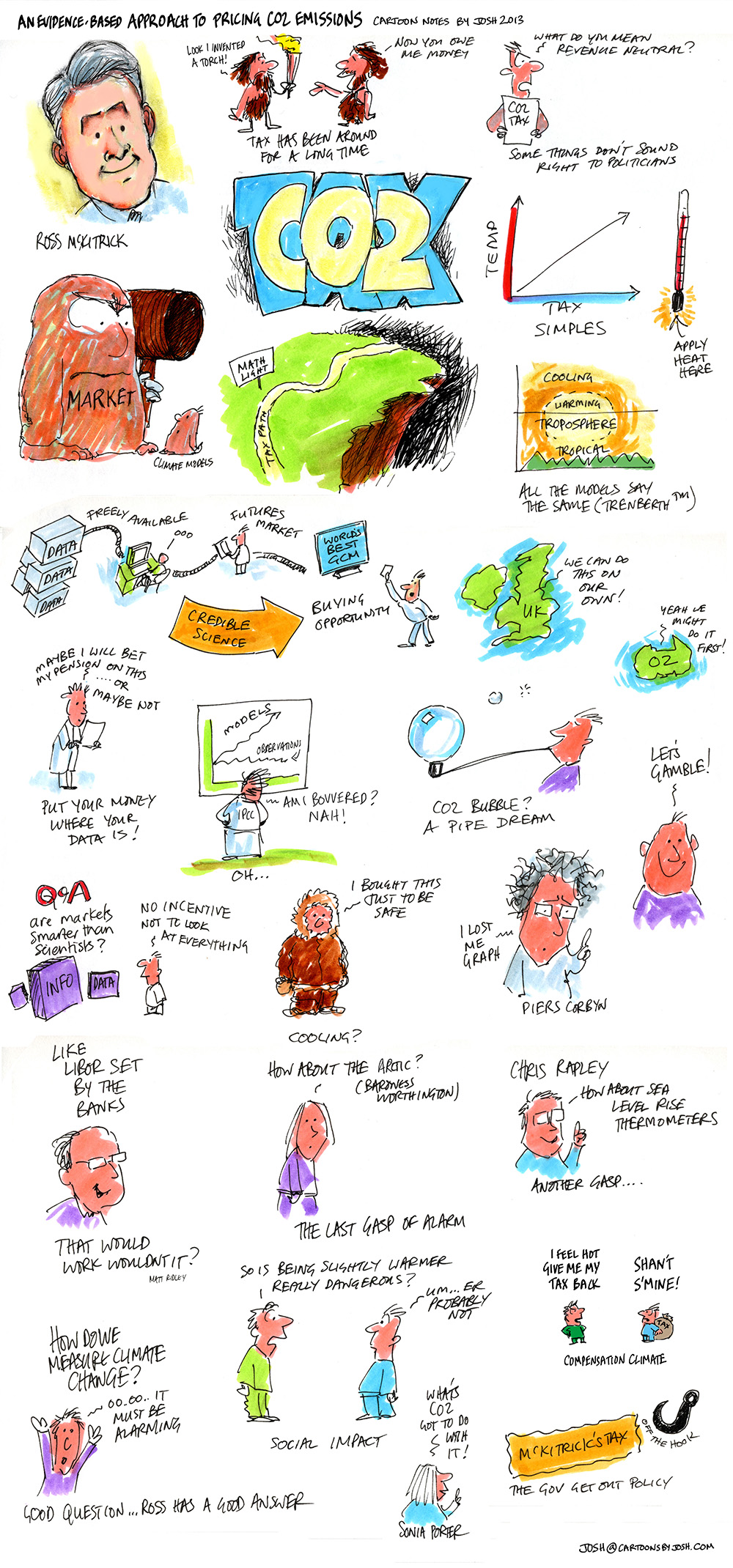
Also, a cartoonist in the audience (Josh) made a fun set of visual notes of my talk.
Discover more from Watts Up With That?
Subscribe to get the latest posts sent to your email.
Jim F.. Thanks, I stand corrected. Also shame on an old man for relying on memory, and not checking on the facts.
I gave this idea a cursory approval because of the source, again shame on me.
I would again like to emphasize all the positive and meaningful work R. M. has done. However, although I believe that the reason for the proposal is well intended, one has to agree with the assessment of Willis Eschenbach.
An excellent idea and one I’ve been in favour of for years. Relating carbon price to actual temperatures puts the debate about model forecasts back with the academics. If the world warms we have a high tax, if it doesn’t we have a low tax.
What has been the result so far? Global mean temperature has gone up steepish since 1980. Co2 has been above the ‘safe’ level of 350ppm for some time now. Where is the evidence of damage? Worse weather? No. Worse tornadoes? No. Hurricane killers? No. It’s no all the way down.
Worse climate? No. How about benefits?
Sadly Ross seems to have ignored the real purpose of carbon taxation: to extort money for government spending. Evidence is irrelevant. If evidence mattered then all anti-carbon legislation and taxation would have been abolished already. The models have, without exception, failed to predict climate. The policy demonstrably harms the poor, destroys the industry and economic activity that creates prosperity and keeps the developing world from developing and improving the lives of billions.
It is pathetically naive to assume that the pro-tax faction has any integrity, honesty, reasonableness, susceptibility to reason/evidence or would allow their income streams to be shut down. They’ve already demonstrated they are blind ideologues who will happily keep on manipulating data and policy to suit themselves even when they’re repeatedly caught committing this fraud.
We shouldn’t be looking at this tax. We should be abolishing all the existing policy mistakes, putting nothing in their place and working out ways to prosecute those responsible for this gigantic fraud. It’s not ok for companies or individuals in the private sector to manipulate markets for their benefit. We have laws against such behaviour for very good reasons. Why should it be ok for governments to manipulate markets like this?
Willis: Well said, sir. Excellent analysis.
RE: “… it actually makes sense for the tax rate to be higher if there is has been an increase in the temperature measure even if it was due to natural warming:”
So another Super El Nino and the tax would what? Double? Quadruple? I’m with Willy E here. The idea is stupid at best and dangerous at worst.
-barn
I think this is interesting. Its betting the temps, which if as alot of us think, cooling is occurring, there is no tax at all. Very interesting. Perhaps its my natural competitive mode, but if we are right and temps go down, then we force their hand. Interesting.. though i dont think we should tax
it, but it would be a nice way to drive them from the field.. if we are right
If people are carrying out an activity that is extremely dangerous to millions of people, then the activity is outlawed and anyone continuing the activity is imprisoned. They are not told there is a tax to pay but if you pay that tax you can carry on! If I started building a nuclear weapon in my backyard I would be prevented from continuing – I wouldn’t be told to pay a tax and then it would be alright. The CAGW case is that if CO2 emissions continue then the existence of the human race is in peril from catastrophic changes to the climate. But if you want to you can carry on emissions at the same level as long as you pay taxes to the politicians?? It is the very notion of a so called ‘carbon tax’ or ‘carbon credits’ that shows that the politicians do not believe there is a threat from catastrophic climate change.
The most cost effective method of reducing CO2 emissions is providing and developing energy sources that are like … you know … more cost effective. Injecting government – world government, no less – into the atmosphere, tends not to be so cost effective while producing intended consequences that are not admitted and often, if not always, counterproductive. It is good that warmists should at least try to avoid negative consequences and it might even be intellectually teasing to discuss the details of McCittrick’s proposal, but … No.
So we tie the cost of energy to tropical warming and cooling even if it is a natural factor beyond our control that causes those changes?
Madness.
The following ‘Taxes’ apply just to the UK. Of course, there will be similarities with other countries taxation systems. My argument is that, like most taxes, if a CO2 tax is introduced (a penalty for adding about 4% CO2 to the existing 1/320,000th of our atmospheric gas with no noticeable effect whatsoever on our weather) the tax should be applied universally with few exemptions. Allow me to explain . . . .
When tax is applied to alcohol (excise duty & VAT), no beer, cider, wine, fortified wine, spirit or liqueur is exempt. Only if you make your own wine or beer at home (not from a kit), you are exempt.
Tobacco tax applies to all cigarettes. No cigars, pipe tobacco or hand rolling tobacco is exempt. Neither is it legal to grow your own tobacco without paying HM Revenue & Customs.
Fuel duty applies to all fuel; stamp duty to all property and Corporation Tax applies to all Limited Companies. You are, however, exempt from inheritance tax if your estate is worth less than £325K (approx 18% of UK homes or if you pass your estate to your spouse). You are also exempt from paying VAT on certain zero-rated commodities such as most foods, all books and children’s clothes. On the whole, most other taxes are universally applied.
So, by comparison, a carbon tax should apply fairly (with few exemptions) to most things where an amount of man-made CO2 adds to the naturally occurring existing levels in the atmosphere.
Carbonated drinks, Welding Gas, PCB Laser cutting, Modified Air Processing (MAP), Refrigerants (incl. air conditioning), Propellants (extinguishers & life jackets), Dry Ice Pellets (sandblasting), Calcification treatments, Water Purifiers, Yeast Fermentation Products (bread, beer, wine), Yeast Extract, Bicarbonate of Soda (cakes, snack foods, biscuits), Man-made Compost Heaps, Domestic Wood Burners, Incinerators, Limescale Removal Products, and much more besides . . . .
Ironically, most ‘tree-huggers’ who, on one hand, remain convinced that their Emperor is still wearing the finest suit of clothes (CO2 induced armageddon) probably also use all of the above man-made CO2 emitting products or processes. I hope they feel guilty.
As a vouch skeptic, I do not believe in hypocrisy, so can I qualify for Carbon Tax Exemptions if I can prove I do not believe in CAGW?
Now, where’s that can of ‘flat’ Coke. Yum.
GeeJam
This is simply crazy. Governments never relinquish revenue once they realize it. If this were instituted, once we were taxed at any level, no government on earth would ever lower that tax rate if the trigger mechanism were reached. We all know it. They would use all sorts of excuses for it, but they would never actually lower the rates. Governments are simply incapable of spending less.
Look at what happened with the Sequester where the government was simply forced to reduce the rate at which it was supposed to increase spending? Look at what is going on in those states where the gasoline tax is finally forcing people to actually drive less or buy the fuel efficient cars they wanted us to or both – they’re floating the idea of taxing us for miles driven using a government imposed GPS in our cars to make up for that revenue they’re losing.
Willis succinctly sums up all that is wrong-headed about Prof. McKitrick’s new carbon tax. If you haven’t read it, go up-thread and please do so, right away.
As far as I’m concerned, (a) warmer is better; (b) given the Earth’s climatic history, some kind of catastrophic warming is extremely unlikely, maybe impossible; (c) even if warming were bad, CO2 has not been shown to measurably cause any of it, so what’s the point of taxing ‘carbon’? (d) what the people of the Earth need is vast amounts of cheap energy—a tax will not help make that possible.
Trying to play the ideologues and fanatics at their own game will never work. All the schemes for testing women for witchcraft are complicated and uncertain. So let’s devise a simple one: any old crone with a hook nose will be defined as a ‘witch’ and dispatched summarily. Simpler is better, right?
/Mr Lynn
Is this July 5th or April 1st?
I think I understand the idea of an “externality.” I can see why, if certain individuals or groups are harmed by effects of economic activities – such as CO2 emissions – there is a good case for making those who caused the harm compensate those they harmed.
In that case, the way forward is to identify the specific individuals and groups who have been the victims of warming caused by CO2 emissions, and to make the perpetrators compensate them.
But taxes cannot be a solution to such a problem. Taxes don’t compensate victims; they merely take away wealth from honest productive people and give it to the corrupt political class. So this idea, for me, has failed as soon as it mentions tax.
Dear Ross, why don’t you look at the question: Who, specifically, would be damaged by x degrees of putative warming, and how much?
Under the guideline that nobody expects Canadians to be funny ( a little cross-border humor from Seattle) and that I missed a /snarc tag or wink, I revisited RM’s proposal above and also his rebuttal to the comments on this and Bishop Hill’s page. I retain my earlier impression – RM is proposing a classic tax/spend solution managed by “Big Government” and which is a transfer of wealth into the hands of people who are not very well respected for the way they’ve handled the wealth we’ve already transferred to them. Not very different at all from what Al Gore might suggest. This is disappointing.
Willis Eschenbach: But truly, Ross, this is industrial strength stupidity.
Good sledge-hammer blows in your post. My thought was “sophomoric” — something a clever guy thinks up about 2am the day an essay is due.
Ross,
Your proposal appears to me to be well considered and probably the best policy we could expect to have any chance of implementation. If most of the critics would carefully read and understand your response, they might change their minds. Usually I agree with Willis, but here I think he does not understand the economics.
markx says:
“Behind it all is a huge non-productive business of commissions and accumulated trading profits, which lands primarily in the hands of big business.”
I agree there are commissions and they can be excessive compared to the value received. I invest most of my money in low cost index funds. I am not sure what to say about their trading profits. I might suggest they tend to zero over the long run. While admitting this idea will probably suffer from a lack of traction, I thought about what do established future markets include? Expectations of dought, lower and higher temperatures (Heating and running AC) and rainfall. Even Frost (Trading Places OJ futures) and Lumber production. So the situation might be a number of players are currently predicting the future weather, in so far as it effects either their Cost of Goods or sale the commodities they produce. To model these existing futures markets and then exclude all non-weather related factors would perhaps show us what the money is saying in regards to expectations of future weather. I once heard a great remark. In the middle of a flow chart there was a box that said, ‘Insert Miracle Here’, I understand I’ve a lot of wishful thinking here, in the face of many problems to overcome. There already is some incentive for a better understanding of futures markets, money for instance, and there are some shall we say, energy companies already concerned with global warming and who may be using futures markets today.
Willis,
It’s strange that you make a posting condemning the insane costs of bad climate policy, then write a diatribe against an alternative that, had it been pursued instead, would now cost nothing and would have left electricity prices at their undistorted, competitive level.
In my UK presentation I showed a graph of the tax rates that would have resulted if my policy had been implemented in Canada in 2002 at a starting charge of $15/tonne, which at the time was the Canadian government’s proposed upper limit on what they thought industry should pay for abatement. As of last year the tax would have been down to -$5.81 per tonne. Yet the upshot of your two postings is that you actually prefer the insane renewables-and-regulation approach because at least it’s not a “tax”.
If your top preference is the “do nothing at all” option, then don’t just blast away at improvements to the current mess, explain how we get to your utopia. It is conceivable (albeit low probability) that people worried about climate change would agree to swap the current, costly policy regime for my emissions tax, since they would recognize that if they are right about warming, it will turn into an aggressive emissions control measure over time. But it is not conceivable that they would simply dismantle the current policies in favour of nothing at all. So you won’t get enough agreement among decision-makers on the zero option to make it politically viable. So it’s a utopian ideal, i.e. irrelevant. Consequently your knee-jerk reaction against a possible alternative is a tacit endorsement of the status quo.
I don’t detect any “thinking” at all in your post. Suppose there is half a degree warming per century for another 300 years. And suppose your choice is (a) my tax, that would start low enough not to be noticeable and drift up so slowly that after 300 years you’d still hardly know it was there, or (b) the California madness writ large, spreading everywhere, amplified by whatever Obama comes up with in the years ahead. And there is no utopian third option of (c), nothing at all, unless your magic unicorn can take you there and show the rest of us the way. You’re having difficulty seeing why (a) would be a good idea relative to (b)?
Well let me help you out. First, it has become rather obvious that politicians perceive a lot of pressure to keep warmists happy by implementing GHG abatement policies. My proposal has a chance at obtaining majority support since everyone expects to get the outcome they prefer. Instead of all the interventionist energy policies we’ve actually seen over the past decade, my proposal would have left us with undistorted energy markets and a carbon tax below zero. Still having difficulty seeing the advantage?
That’s not all. the accompanying futures market (which you didn’t comment on in your screed, making me suspect you didn’t actually read the underlying paper) would yield an objective 30 year set of predictions about global warming, and in one stroke depoliticize the climate modeling/prediction field. Tell me how your unicorn-ride-to-the-zero-option-fantasyland strategy solves that problem.
The tax is on emissions. The only way to equate the tax on emissions with a “tax on warming” is if you assume that emissions = warming! If that’s your view, there’s a prima facie case for having policies in place in case the changes are net harmful. Otherwise it sounds like you don’t like the policy because you don’t think emissions affect the climate, but you also think emissions do affect the climate, but you think the effects are beneficial. Which is it? If the latter, it’s all very well to assume all the changes are beneficial, but you can’t expect the world’s policymakers to base their decisions on your assumptions, even if you are correct. (Well, except for all the policymakers in your unicorn fantasy-land. But they don’t seem to have a lot of clout in the real world.)
Ah the poor. These would be the ones who are benefiting so much from the status quo approach to energy & climate policy, and who would be so devastated if that policy apparatus were eliminated and replaced with a carbon tax that starts low enough not to have much effect on prices, lately goes below zero and won’t ever go up as long as warming fails to materialize. No, what’s hard to understand is your apparent preference for the status quo.
As for the convexity issue, I spelled out the assumptions about the damage function in my Energy Economics paper. While I assume it is convex, I also impose the assumption that the longer the time lags between emissions and changes to the state variable, the less the curvature of the damages function. This imposes, among other things, local linearity in the neighbourhood of the current value of the damage function, with a window that widens, the longer the lag structure of the state variable. If you had bothered to read any of the background work on this tax mechanism you’d see your knee-jerk objections about the convexity assumption are simply off base and you don’t know what you are talking about.
So now it’s not a tax on warming, it’s an insurance scheme. Can’t you keep your inflammatory misrepresentations consistent from one paragraph to the next? This is not an insurance policy against possible effects of warming. Insurance policies require an upfront payment in exchange for a promise of compensation in the event of a specified peril. I’m not proposing a compensation mechanism, nor am I proposing to “tax the planet”. So you think global warming is beneficial—good for you. Generally speaking so do I. It’s global warming policy I worry about, as well as the politicization of the science. To fix those things you need to have something to say to the people who think warming could be harmful. My proposal is a way to fix both problems while appealing to the folks who are worried. If you’ve got an alternative that doesn’t involve unicorn rides to utopia, I’m all ears.
In my response paper I wrote: “Computing the marginal social damage of a tonne of CO2 emissions is not only highly complex, but in all likelihood a fool’s errand. There are far too many arbitrary assumptions involved, and the range of estimates that have been published is so wide as to simply amount to a confession of complete ignorance. It may be negative, it may be zero, it may be positive; it likely isn’t large, but who knows? Not me.”
You notice the word “negative” in there? Do I need to spell out what that implies? Oh okay. The marginal damages calculations are done net of benefits. They’re already in there. You could have inferred that from what was written, or looked it up, but I suppose it’s much more fun to blast away at perceived intellectual laziness in others.
More to the point, do I sound like I’m endorsing these calculations? I’m proposing a way that gets around the necessity of doing them. Again, if you’ve got a better idea, let’s hear it. Since president Obama has just enshrined a giant “social cost of carbon” into federal rulemaking, your unthinking attack on an alternative that could do away with the need for it baffles me.
Talk about moving the goalposts. I don’t know if any state variable will be constant for 300 years, but who cares? The one I propose has been relatively stable for 30 years, which is long enough for the purpose of this policy. And I also suggest applying a slight smoother to it, such as a 3-year moving average, to suppress irrelevant weather-related volatility. The IPCC insists (by implication) that in the absence of GHG forcing the tropical mid-troposphere measure would have been pretty stable over the entire 20th century. Whether that’s true or not, what matters is the people who endorse IPCC models would be obliged to accept the premise. Got a better candidate? You need a state variable that is reasonably stable against natural changes and yet is expected to respond quickly to changes in GHG levels in such a way as to capture the magnitude of any global warming effect. Feel free to name a few.
This is a non-sequitur. Do you know what the term “cost-effective” means? In basic economics texts, it means that it satisfies the equimarginal condition, in other words it distributes the compliance burden in such a way as to equate marginal abatement costs across emission sources, thereby minimizing the overall costs of achieving the given policy target. And by recycling the revenue into alternative tax reductions, it minimizes the macroeconomic cost as well. Revenue-neutral emission taxes have these features, and the reasons have long been established in the economic literature. I wrote a whole textbook on this if you want to look it up. These are properties of the policy itself and are not contingent in any way on the alternatives it replaces. I don’t spell all this out in every piece of writing on the subject because at a certain point you have to expect that people will do a bit of elementary reading for themselves.
What’s pathetic is when an ordinarily intelligent commentator lets superficial, reactionary emotions get the better of him, leading him to launch an error-filled diatribe that has the effect of endorsing the status quo he elsewhere condemns, while ridiculing an option for change that he ought to have realized gives him him the very outcome he wants.
The ideas proposed by this paper is so naïve, one wonders if Professor McKitrick hasn’t perhaps been commissioned by some government to write it.
Ross, thank you for your response.
Ross McKitrick says:
July 5, 2013 at 2:00 pm
I truly don’t understand this argument, that your energy tax is less bad than what California has. I know that, there are many things not as bad as California’s energy policy … and?
Yes, and if the temperature had gone up since 2002 the tax would have gone up, and in neither case are humans known to be the cause … and yet you want to tax it.
Also, I don’t understand when you say the tax “would have been down to -$5.81 a tonne”. Is that a negative tax, minus $5 per tonne? What is a negative tax?
If you are asking is your energy tax better than the existing Canadian energy tax, sure, I’d take yours any day. But I’d likely take a host of ugly things over the existing energy tax.
But yours is still an tax, and all energy taxes hurt the poor.
As to your question of how to get there, I can tell you how NOT to get there. That is to agree with the idea than an energy tax is something worth having, and claim that the only real question is “Solving the dynamic rate-setting problem”.
The dangerous part is where you agree that an energy tax is something worth having. It is not. Taxing energy is not just non-productive regarding temperatures. It is actively destructive to both the poor and to the environment, no matter whether the size of the tax is set by Parliament, by lottery, or by tropospheric temperature.
I’m sorry that you’re so depressed about the state of the world. Me, I’ve seen lots of change in the support for that kind of policy madness, particularly in the last few years. People are getting fed up with sacrificing and being taxed for two hundredths of a degree of cooling in a century.
Gosh, my mistake, I must have left it out accidentally.
I would pick a) over b) any time. But nobody has just that choice. To start with, most states in the US have no CO2-based energy taxes at all.
So suppose your choice is (a) your tax, or (c), nothing at all, which is the condition not only in most of the US but in most of the world … to quote a friend of mine, “you’re having difficulty seeing why (a) would be a disastrous idea compared to (c) no energy tax?
Google “the nose of the camel” if my meaning is obscure. You are making the same stale argument “mine is better than that abomination”. Yes, it is … but yours is also an abomination, justa a smaller one.
Same argument, “but Daddy, he did worse”. I’m not buying it.
Why on earth would I want “an objective 30 year set of predictions about global warming” from a bunch of businessmen, when “an objective 30 year set of predictions about global warming” from specialists in the field is meaningless?
No, that’s not my view. If you propose a tax that increases when it gets warm, in common English that’s called a tax on warming no matter where the tax is applied. I can call it a “tax whose dynamic rate-setting is based on warming” if you’d prefer … and it still doesn’t make sense.
No. Those are the ones who are being impoverished and disenfrachised by the mad global rush to tax energy. They are the ones hurt when the World Bank stops giving loans for cheap energy. Your attempt to sneer at them is pathetic.
Would they like your tax instead of something much worse? Yes, they would, you’ve made that point again and again … so what? Everyone would like to be screwed less, but that doesn’t mean they want you to screw them.
Call it what you will, Ross, I don’t care, it’s a way to tax carbon energy.
Most of the world doesn’t have an energy tax applied to carbon. You propose one. That is not “a way to fix both problems”. It is not a way to fix any problem
You don’t seem to get it. For most of the world, your proposal is a NEW TAX ON CARBON ENERGY, energy which has not been taxed before, which will have the predictable effects on the poor, the economy, and the environment.
Sure, it’s better than the Canadian crap, but so what? For most of the world, including the US as a whole, we have no special CO2 based taxes on carbon fuel. So stop with the “It’s better than Canada and California”, that means nothing to the US as a whole or most of the world for that matter.
Ross, you say that the “tax mechanism provides a computable approximation to the unobservable marginal social damage path”. In other words, the temperature (which is the mechanism you propose) somehow provides an approximation to the damage.
But you’ve already decided that up is bad! You’ve already determined that the net costs exceed the net benefits as temperatures rise, so that the tax has to rise as a result. And I haven’t a clue how you decided that, but clearly you didn’t include all of the external benefits. CO2 fertilization alone is worth $300 billion per year … did you include that? How about increased growing season length … included in the mix to determine that warmer is bad, taxes go up?
Obama would agree to your tax plan, say “Thanks very much”, and still keep the federal rulemaking in place … and your argument that “my plan is better than Plan X” is getting old.
Huh? What does “relatively stable” mean? In fact, the tropical tropospheric temperatures have increased over the last thirty years, not by much but they are increasing.
The IPCC insists (by implication) that in the absence of GHG forcing the global average surface temperature would have been pretty stable over the entire 20th century … so what? The climate system in general is not stationary, including the tropical tropospheric temperatures, on ANY scale from minute to millennia. So no, I can’t think of anything that is stationary, but I can think of lot of measures the IPCC would claim would be stationary.
Well, I’m glad to know that, and I’ll keep it in mind next time I’m called on to satisfy an equmarginal condition.
To the portion of the planet who aren’t economists, on the other hand, “cost-effective” means that you get some bang for your buck. “Cost-effective” means that at the end of the maze you get enough cheese to justify running the maze.
But with your plan to increase energy costs, we get no cheese. There’s no measurable reduction of temperature. There’s no benefit to society. Instead, it’s all loss, with the poor and the environment hit hardest. We’re being taxed and we’re not getting a damn thing in return … and here in the real world we call that “not cost-effective”
I’m also glad to hear that, and I’m sorry to be contrary … but I’m of the opinion that any scheme such as yours which merely redistributes wealth and does not create any wealth is not what is needed at the moment … yes, you might minimize the cost, but that’s just another “my plan is better than X” argument.
Here’s the bottom line. Taxing energy slows development, reduces the wealth of a country, slows the economy, and is the most regressive tax known to man because the poorer you are, the more it costs you. Plus, since environmental care is linked to development, taxing energy damages the environment.
Now, I’m willing to accept such a tax if there is a corresponding benefit. But because of the regressive nature of the tax, and the resultant damage to the poor and the environment, it would have to have a large benefit to be worth it.
So … where is the huge benefit in your plan that would make it would adopting as an alternative to having no carbon tax?
Dang … take a deep breath there, you’ll feel better. Everyone agrees with me most of the time, tells me how insightful I am … except when I’m talking about them, then it’s all just an “error-filled diatribe”. Funny how that works.
But truly, Ross, “my plan is better than some alternative pile of garbage” is a MEANINGLESS ARGUMENT when for most of the world (including most of the US) the alternative is no carbon tax at all … and even if not it’s still a logical error. Yeah, I’d rather be in the county jail than in the Colorado Supermax, but that doesn’t make either one a good plan as you repeatedly have insisted in your comment. That’s the argument I don’t want to be in the same room with, that because your plan is not as barking mad as those of the alarmists, it is worthy of consideration. That dog won’t hunt.
And again, thanks for the length and detailed quality of your reply.Here’s the takehome question.
If a country/state has no carbon based tax, would they be better off with your tax or no tax? And if the answer is your tax, why?
I suspect you think the answer is “No Tax” … and if so you could have saved a lot of trouble by stating so from the get-go. However, that’s a guess, you might think the answer is “Your Tax” … and I suspect that’s what has people agitated, including myself.
w.
My solution is a bit different; address the core of the problem.
An exponential decrease in funding and salaries for all alarmist climatologists in line with the average difference between T predictions of their models and lower troposphere T. Only models predicting more than 0.1 deg C per decade will be accepted.
If a country/state has no carbon tax, and no command-and-control anti-energy policies, including subsidies for renewables, wind energy mandates, biofuels policies, upward-ramping energy efficiency standards, bans on incandescent lightbulbs, etc etc, and no constituency pushing for any of these things or any other climate policies now or in the future, then they would have no reason to support my tax proposal except insofar as a switch from payroll to energy taxes might be a welfare-improving tax reform. I can’t think of any jurisdiction described by the foregoing. I can think of a lot of places, including the US, that have much worse policies, that would be better off under my plan. You are making an unattainable ideal the enemy of an attainable good.
For all my own skepticism, it remains the case that we are adding a lot of CO2 to the air and it is an infrared absorbing gas, and it’s perfectly legitimate for people to worry that there might be negative long term consequences. It is not legitimate to assume that we already know they are catastrophic and we should aggressively scale back global energy use, but that idea is already out there. If your policy plan is simply to declare with serene confidence that CO2 is no problem, nobody is going to listen to you. My proposal implies: if it really isn’t a problem, the policy remains relatively small and harmless, but if the alarmists are right, it builds an increasing financial penalty into carbon-intensive energy use. Everyone expects to get their preferred policy path, and the atmosphere will decide who is right, rather than politics and mob rule.
The point of the futures market is that the tax path is revealed long in advance and it integrates all available scientific information, as well as weeding out all the bad climate models (or rendering them irrelevant for policy purposes).
Because unlike scientists, markets have billions of dollars at stake in getting accurate forecasts and investors will ruthlessly sift through the noise to find the models that are able to produce the most accurate forecasts. Under the current system, incentives favour models that generate the most alarming forecasts, and systematic errors year after year are ignored because there is no penalty for being constantly wrong. Under my proposal, investors will have no incentive to accept systematically exaggerated (or understated) tax path forecasts since errors in either direction are costly. GCMs might simply be abandoned altogether in favour of simple empirical forecasting models if they do a better job.
Ross McKitrick says:
July 5, 2013 at 7:16 pm
Many, perhaps most developing countries have no bans on incandescent lightbulbs, or biofuel policies, or any of the crap you mention. You should get out more. Most of them can’t afford that kind of lunacy. If they do have them, they’re just for show, and not enforced. Show me, for example, the energy efficiency standards or wind energy mandates of Haiti or Lesotho or the Solomon Islands …
Also, it sounds like you are claiming that your plan “as a switch from payroll to energy taxes might be a welfare-improving tax reform” …
Yeah, that’s the ticket. Don’t tax businesses, tax energy because that screws the poor, that’ll improve welfare …
Ross, it is “perfectly legitimate” to worry about anything you want to worry about. That’s your inalienable right, to sweat bullets about whatever you might choose.
For the worry to be grounded in reality, however, we need more than unconfirmed theory—we need evidence that CO2 is something to worry about. And that I’ve never seen.
Indeed the idea is out there, that is true. There’s lots of crazy ideas out there. Heck, I’ve heard that something like a third of Americans think the planet is only 6,000 years old … should we take that seriously as well, and plan taxes around the expected date of the resurrection?
My “policy plan” is to tell the truth, that any kind of energy tax harms the poor, until the idea sinks in. It’s a new idea, there’s not a lot of folks pushing it yet, but they’re increasing every day. I’ll tell you something funny. The most popular post I’ve ever written, most read and most reposted, was “We have met the 1% and he is us“. That post was about nothing but the madness of energy taxes because of how they harm the poor.
My other “policy plan” is to continue to research the real nature of the climate and its vagaries, and to oppose bad science wherever I find it. Despite your despair, we’re winning that battle. Yes, it’s far from over, but now is not the time to compromise and say “energy taxes are OK, the only dispute is how to set the rates”. No, energy taxes are not OK. They harm the poor and the environment, and absent a really large benefit, why would we even entertain the thought?
So despite your dark despair about anyone listening to me regarding energy taxes, you’ve already been proven wrong—people have paid more attention to that message than any other I’ve ever posted.
Moving on to your plan and the warming world, the world has been warming in fits and starts for 300 years, and obviously not from CO2. This warming hasn’t been a problem.
Under your plan, depending on the size of your escalator clause, which of course the politicians will jack up as soon as the tax is passed, a continuation of that natural process will cost me either some more or a lot more money. In other words, you are going to charge me because of a process that’s been going on for 300 years … and exactly why should I pay extra because the earth is doing what it’s done for centuries?
You keep claiming that your whiz-bang tax on energy will somehow miraculously stop that 300-year-old warming from occurring … perhaps you could explain how that will happen.
You assume that there are “models that are able to produce the most accurate forecasts” of the next 30 years of climate … and despite that, as an economist I doubt greatly that you believe that there are “models that are able to produce the most accurate forecasts” of the stock market … but the climate is even more unpredictable.
Your statement is equivalent to saying that you trust the players at the craps table to predict whether the player will crap out or not more than the scientifically calculated odds, because the players have money at stake in an getting an accurate forecast. Sorry, but even having billions of dollars at stake doesn’t make you any better at saying whether it will be warmer or cooler in thirty years.
As a result, no, neither scientistis nor people with “billions at stake” have any clue whether the climate will be warmer or cooler. You are deluding yourself badly if you believe that in the arena of prediction of chaotic systems, money will make you better at guessing the future. If that were true, wealthy folks would always beat the stock market … you see that happening?
Ross, I appreciate that what you are trying to craft is a fairer way for people to get screwed by an energy tax than the California or Canada taxes … but you’ll have to forgive me if I don’t see the logic in that.
My main question is, where’s the beef? Where’s the benefit? If we do everything you suggest, what do we get out of it? That’s the part that bothers me, because so far the only guaranteed results I see from your plan, the only thing we can be sure will happen, are the poor get screwed (except less than if the plan were crazier), and the environment gets damaged (except less that under the more draconian proposals). Great plan you’ve got there …
So … where’s the beef?
Again, thanks for your detailed response. And I do apologize that at times my passion overwhelms my politeness, and I tell ugly truths bluntly … but I am passionate about both the poor and the environment. I’ve spent a good part of my life fighting for both, and now the environmental organizations I used to support are doing their best to undo my life’s work, to keep the poor in poverty. It does rankle. Pointman put it very eloquently:
So when you want to join the environmental organizations in causing damage and misery, when you blithely plan to harm the poor and the environment with no visible benefits, yes, Ross, my blood does get angrified … mea maxima culpa. And you saying “but I’m hurting them less than California does”, that doesn’t help, the poor are assuredly not impressed by that pathetic excuse …
My best regards to you,
w.
Willis, the big advantage of McKitrick’s scheme is that it calls the bluff of the alarmist industry and provides politicians with a credible weapon in response. Once implemented the rational investment sector will soon cut through alarmist nonsense and the futures market will give an uncompromising verdict. Your “bunch of businessmen” can hire all the “specialists in the field” they need in order to do so. They would certainly hire McIntyre rather than Mann.
McKitrick’s scheme could do harm if temperatures rise from factors other than CO2. That risk needs close monitoring.
Alan Wilkinson says:
July 5, 2013 at 8:57 pm
Thanks, Alan. Since the temperature of the earth has been rising in fits and starts for about 300 years, and it is clearly not from CO2, that is not a “risk”. It is a very probable outcome.
Also, despite Ross’s claims that I’m somehow naive, he makes a couple of incredibly naive assumptions.
The first is that his plan will be adopted in exclusion to all other carbon taxes. Riiight … when has that ever happened? Taxes are always “in addition to”, not “in lieu of”.
The second is that the size of the tax will be small. I remember my father, who was born in 1903, railing about the income tax, saying “They swore when they implemented it that the top rate would never be more than 7% of income.” And despite him only being ten years old when the tax was voted in, it would not surprise me a bit if that were true, because no tax has ever ended up as small as it started. Plus he was a very smart and observant person, even as a kid.
So once the politicians had the McKitrick Tax in place that would automatically give them revenue if the temperature went up, they’d immediately up the tax rate as soon as the temperature started to rise.
And of course, if the temperature fell, they’d just do what Obama’s doing with Obamacare, granting waivers against lowering the tax, and autocratically changing the rates to not lose as much when the temperature fell.
So I find his earnest assurances that this wouldn’t cost money unless temperatures rise, and even then a small rise will bring a small tax, to be about as reassuring as the US Government’s reassurances that income tax would never be more than 7% … we know how that turned out.
Look, I’m not an “anti-tax” guy. Taxes can be both necessary and proper, although we can debate which ones and where.
But a tax which goes up if a 300 year old trend continues, a tax which has no benefits and is wildly regressive?
Sorry, I’ll pass.
w.