
UPDATE: New table added below.
While searching for something else, I came across this entertaining collection of grand predictive failures related to resources and climate change, along with some of the biggest predictive failures of Paul Ehrlich. I thought it worth sharing.
Exhaustion of Resources
“Indeed it is certain, it is clear to see, that the earth itself is currently more cultivated and developed than in earlier times. Now all places are accessible, all are documented, all are full of business. The most charming farms obliterate empty places, ploughed fields vanquish forests, herds drive out wild beasts, sandy places are planted with crops, stones are fixed, swamps drained, and there are such great cities where formerly hardly a hut… everywhere there is a dwelling, everywhere a multitude, everywhere a government, everywhere there is life. The greatest evidence of the large number of people: we are burdensome to the world, the resources are scarcely adequate to us; and our needs straiten us and complaints are everywhere while already nature does not sustain us.”
- In 1865, Stanley Jevons (one of the most recognized 19th century economists) predicted that England would run out of coal by 1900, and that England’s factories would grind to a standstill.
- In 1885, the US Geological Survey announced that there was “little or no chance” of oil being discovered in California.
- In 1891, it said the same thing about Kansas and Texas. (See Osterfeld, David. Prosperity Versus Planning : How Government Stifles Economic Growth. New York : Oxford University Press, 1992.)
- In 1939 the US Department of the Interior said that American oil supplies would last only another 13 years.
- 1944 federal government review predicted that by now the US would have exhausted its reserves of 21 of 41 commodities it examined. Among them were tin, nickel, zinc, lead and manganese.
- In 1949 the Secretary of the Interior announced that the end of US oil was in sight.
Claim: In 1952 the US President’s Materials Policy Commission concluded that by the mid-1970s copper production in the US could not exceed 800,000 tons and that lead production would be at most 300,000 tons per year.
Data: But copper production in 1973 was 1.6 million tons, and by 1974 lead production had reached 614,000 tons – 100% higher than predicted.
Claims: In 1968, Paul R. Ehrlich wrote The Population Bomb and declared that the battle to feed humanity had been lost and that there would be a major food shortage in the US. “In the 1970s … hundreds of millions are going to starve to death,” and by the 1980s most of the world’s important resources would be depleted. He forecast that 65 million Americans would die of starvation between 1980-1989 and that by 1999, the US population would decline to 22.6 million. The problems in the US would be relatively minor compared to those in the rest of the world. (Ehrlich, Paul R. The Population Bomb. New York, Ballantine Books, 1968.) New Scientist magazine underscored his speech in an editorial titled “In Praise of Prophets.”
Claim: “By the year 2000 the United Kingdom will be simply a small group of impoverished islands, inhabited by some 70 million hungry people … If I were a gambler, I would take even money that England will not exist in the year 2000.” Paul Ehrlich, Speech at British Institute For Biology, September 1971.
Claim: Ehrlich wrote in 1968, “I have yet to meet anyone familiar with the situation who thinks India will be self-sufficient in food by 1971, if ever.”
Data: Yet in a only few years India was exporting food and significantly changed its food production capacity. Ehrlich must have noted this because in the 1971 version of his book this comment is deleted (Julian Simon, The Ultimate Resource, Princeton: Princeton Univesity Press, 1981, p. 64).
The Limits to Growth (1972) – projected the world would run out of gold by 1981, mercury and silver by 1985, tin by 1987, zinc by 1990, petroleum by 1992, and copper, lead and natural gas by 1993. It also stated that the world had only 33-49 years of aluminum resources left, which means we should run out sometime between 2005-2021. (See Donella Meadows et al., The Limits to Growth: A Report for the Club of Rome’s Project on the Predicament of Mankind. New York: New American Library, 1972.
Claim: In 1974, the US Geological Survey announced “at 1974 technology and 1974 price” the US had only a 10-year supply of natural gas.
Data: The American Gas Association said that gas supplies were sufficient for the next 1,000-2,500 years. (Julian Simon, Population Matters. New Jersey: Transaction Publications, 1990): p. 90.
Population and Poverty
In the mid 1970s the US government sponsored a travelling exhibit for schoolchildren titled, “Population: The Problem is Us.” (Jacqueline Kasun, The War Against Population, San Francisco: CA, Ignatius, 1988, p. 21.)
In 1973, Supreme Court Justice Potter Stewart’s vote in Roe v. Wade was influenced by this idea, according to Bob Woodward and Scott Armstrong: “As Stewart saw it, abortion was becoming one reasonable solution to population control” (quoted in Newsweek of September 14, 1987, p. 33.).
In 1989, when the US Supreme Court was hearing the Webster case, Justice Sandra Day O’Connor brought the idea of overpopulation into a hypothetical question she asked of Charles Fried, former solicitor-general, “Do you think that the state has the right to, if in a future century we had a serious overpopulation problem, has a right to require women to have abortions after so many children?”
World Bank president Barber Conable calls for population control because “poverty and rapid population growth reinforce each other” (Washington Post, July 16, 1990, p. A13)
Prince Philip advises us that “It must be obvious by now that further population growth in any country is undesirable” (Washington Post, May 8, 1990, p. A26)
37 Senators wrote President Bush in support of funding for population control (Washington Post, April 1, 1990, p. H1)
The Trilateral Commission and the American Assembly call for reduction in population growth (U. S. News and World Report, May 7, 1990)
Newsweek‘s year-ending cover story concluded that “Foremost of the new realities is the world’s population problem” (December 25, 1990, p.44)
The president of NOW warns that continued population growth would be a “catastrophe” (Nat Hentoff in the Washington Post, July 29, 1989, p. A17)
Ted Turner (Atlanta Journal Constitution, Wed. Dec. 2, 1998) in an address to the Society of Environmental Journalists in Chattanooga – blamed Christianity for overpopulation and environmental degradation, and argued that the people who disagree with him are “dummies.” He stated in part, “The Judeo-Christian religion says man was given dominion over everything, and his salvation was that he was to go out and increase and multiply. Well, we have done that … to the point where in Calcutta, it’s a hellhole. So it’s not an environmentally friendly religion.”
Ellen Goodman laments “People Pollution” (Washington Post, March 3, 1990, p. A25)
Herblock cartoon shows that the U. S. neglecting the “world population explosion” (Washington Post, July 19, 1990, p. A22)
Hobart Rowen likens population growth to “the pond weed [which] grows in huge leaps” (Washington Post, April 1, 1990, p. H8).
A Newsweek “My Turn” suggests giving every teen-age girl a check for up to $1200 each year that she does not have a baby “in order to stop the relentless increase of humanity” (Noel Perrin. “A Nonbearing Account”, April 2, 1990, p. 9).
Climate Change
Claim Jan. 1970: “By 1985, air pollution will have reduced the amount of sunlight reaching earth by one half.” Life Magazine, January 1970. Life Magazine also noted that some people disagree, “but scientists have solid experimental and historical evidence to support each of the predictions.”
Data: Air quality has actually improved since 1970. Studies find that sunlight reaching the Earth fell by somewhere between 3 and 5 percent over the period in question.
Claim April 1970: “If present trends continue, the world will be … eleven degrees colder by the year 2000. This is about twice what it would take to put us in an ice age.” Kenneth E.F. Watt, in Earth Day, 1970.
Data: According to NASA, global temperature has increased by about 1 degree Fahrenheit since 1970.

Claim 1970: “In ten years all important animal life in the sea will be extinct. Large areas of coastline will have to be evacuated because of the stench of dead fish.” Paul Ehrlich, speech during Earth Day, 1970.
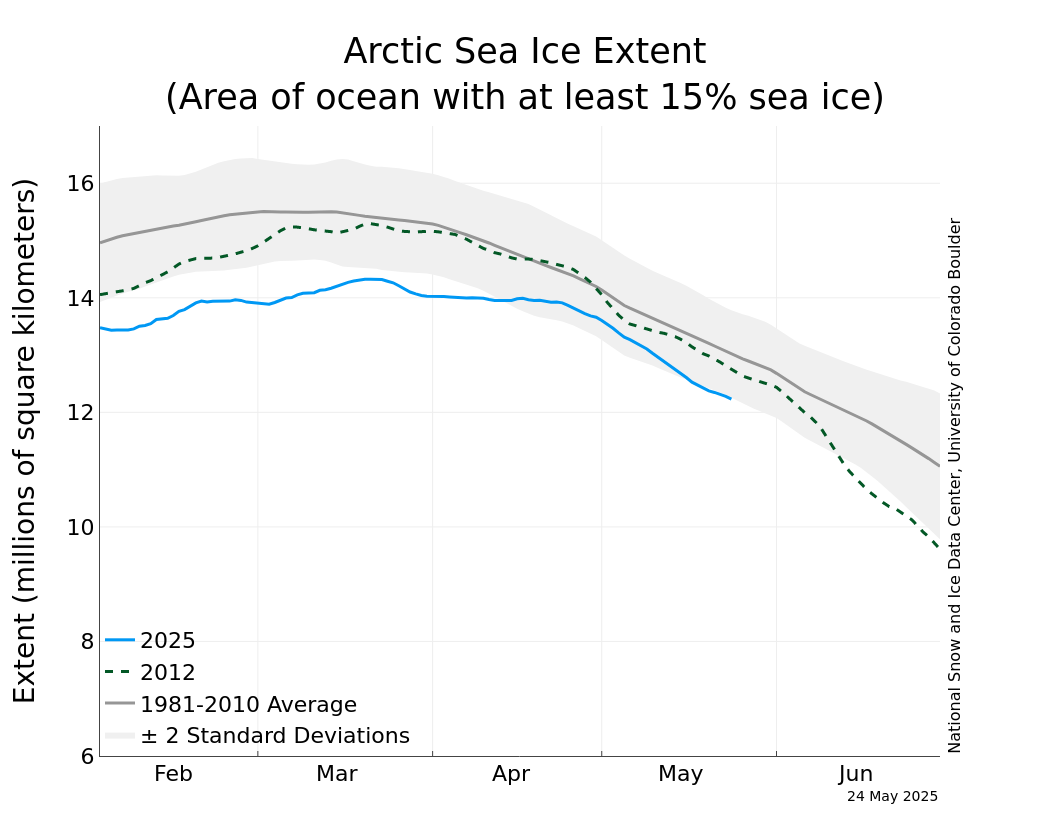
Claim 1972: “Artic specialist Bernt Balchen says a general warming trend over the North Pole is melting the polar ice cap and may produce an ice-free Arctic Ocean by the year 2000.” Christian Science Monitor, June 8, 1972.
Data: Ice coverage has fallen, though as of last month, the Arctic Ocean had 3.82 million square miles of ice cover — an area larger than the continental United States — according to The National Snow and Ice Data Center.
Claims 1974: “… when metereologists take an average of temperatures around the globe they find the atmosphere has been growing gradually cooler for the past three decades. The trend shows no indication of reversing. Climatological Cassandras are becoming increasingly apprehensive, for the weather aberrations they are studying may be the harbinger of another ice age. Telltale signs are everywhere–from the unexpected persistence and thickness of pack ice int eh waters around Iceland to the southward migration of a warmth-loving creature like the armadillo from the Midwest. When Climatologist George J. Kukla of Columbia University’s Lamont-Doherty Geological Observatory and his wife Helena analyzed satellite weather data fro the Northern Hemisphere, they found that the area of ice and snow cover had suddenly increased by 12% in 1971 and the increase has persisted ever since. Areas of Baffin Island in the Canadia Arctic, for example, were once totally free of any snow in summer; now they are covered year round.”
Later in the article, “Whatever the cause of the cooling trend, its effects could be extremely serious, if not catastrophic. Scientists figure that only a 1% decrease in the amount of sunlight hitting the earth’s surface could tip teh climatic balance, and cool the planet enough to send it sliding down the road to another ice age within only a few hundred years.”
Source: “Another Ice Age,” Time Magazine, June 24, 1974.
Claim 1989: “Using computer models, researchers concluded that global warming would raise average annual temperatures nationwide two degrees by 2010.” Associated Press, May 15, 1989.
Data: According to NASA, global temperature has increased by about 0.7 degrees Fahrenheit since 1989. And U.S. temperature has increased even less over the same period.

Claims: “Britain’s winter ends tomorrow with further indications of a striking environmental change: snow is starting to disappear from our lives.”
“Sledges, snowmen, snowballs and … are all a rapidly diminishing part of Britain’s culture, as warmer winters–which scientists are attributing to global climate change–produce not only fewer white Christmases, but fewer white Januaries and Februaries.”
“London’s last substantial snowfall was in February 1991.” “Global warming, the heating of the atmosphere by increased amounts of industrial gases, is now accepted as a reality by the international community.”
According to Dr. David Viner, a senior research scientist at the climatic research unit (CRU) of the University of East Anglia, within a few years “children just aren’t going to know what snow is” and winter snowfall will be “a very rare and exciting event.” Interviewed by the UK Independent, March 20, 2000.
“David Parker, at the Hadley Centre for Climate Prediction and Research in Berkshire, says ultimately, British children could have only virtual experience of snow.”
See “Snowfalls are now just a thing of the past.” The Independent. March 20, 2000.
Data: “Coldest December Since records began as temperatures plummet to minus 10 C bringing travel chaos across Britain.” Mailonline. Dec. 18, 2010.
Claim: “[By] 1995, the greenhouse effect would be desolating the heartlands of North America and Eurasia with horrific drought, causing crop failures and food riots … [By 1996] The Platte River of Nebraska would be dry, while a continent-wide black blizzard of prairie topsoil will stop traffic on interstates, strip paint from houses and shut down computers.” Michel Oppenheimer and Robert H. Boyle, Dead Heat, St. Martin’s Press, 1990. Oppenheimer is the Albert G. Milbank Professor of Geosciences and International Affairs in the Woodrow Wilson School and the Department of Geosciences at Princeton University. He is the Director of the Program in Science, Technology, and Environmental Policy at the Wilson School. He was formerly a senior scientist with the Environmental Defense Fund, the largest non-governmental organization in the U.S. that examines problems and solutions to greenhouse gases.
Data: When asked about these old predictions Oppenheimer stated, “On the whole I would stand by these predictions — not predictions, sorry, scenarios — as having at least in a general way actually come true,” he said. “There’s been extensive drought, devastating drought, in significant parts of the world. The fraction of the world that’s in drought has increased over that period.”
However, that claim is not obviously true. Data from NASA’s Goddard Space Flight Center show that precipitation — rain and snow — has increased slightly over the century.
—
How could scientists have made such off-base claims? Dr. Paul Ehrlich, author of “The Population Bomb” and president of Stanford University’s Center for Conservation Biology, told FoxNews.com that ideas about climate science changed a great deal in the the ’70s and ’80s.
Ehrlich told FoxNews.com that the consequences of future warming could be dire.
=============================================================
Source: University of Georgia, Terry College of Business. Economics 2200, Economic Development of the US, David B. Mustard
http://www.terry.uga.edu/~mustard/courses/e2200/pop.htm
UPDATE: reader Dennis Wingo writes in with this table:
Great article. I went into this myself in my book “Moonrush“, I took all of the predictions for the depletion of resources from the book and marked in red the deadlines that had already passed. All of the predictions failed.

A very sweet little article, somewhat naive. Would you have taken that much effort to debunk Harold Camping? Off the top of my head I can’t remember the name of this fallacy but it’s in the “straw man” genre. Find someone totally ridiculous you can disprove, and therefore, ergo, QED, all predictions are wrong, unless they agree with your world view.
In my country, land shortage was already a factor in the 1830’s, leading to the famous “Difeqane” or Threshing with Shaka, Mzilikazi, Shepstone and Retief the chief participants. In the USA, land pressure gave rise to similar events, the genocide of Native Americans. Mark Twain is reported as saying, “Buy land, they’re not making it anymore.” We could even go back as far as the 12th century and Genghis Khan. But I would be guilty of a fallacy myself if I advanced land as being one easily proven example of a resource with a limit. Instead of lateral thinking, for a change we can go vertical, and create high-rise slums. I for one would dearly love to live on the 2044th floor of a condominium tower and to get my recreation I wouldn’t go mountain-biking in the no-longer-existing forests, I’d ride my bike up and down the stairs. Huh.
I’m anti-abortion on moral grounds, but happily admit that the 40-million-plus abortion deaths since Roe vs Wade have made a huge economic difference. Job-wise, America is overpopulated by about a tenth, with no improvement expected. Without abortion, Erlich’s predicted mass starvation may very well have come to pass. So perhaps there are some limits.
Well, a topic that has been a focus of mine since the ’70s and I’m late to the party…
Per “Peak Oil”: What Willis said.
couple of specifics. Oil has been claimed to have 50 year to bone dry since about 1919 ( I have a nice Eng book from then with the claim.) Same in ’70s. ’80s. ’90s. Now…
Per King H.: Notice that the discussion is now put in terms of conventional oil due to us being awash in ‘other’ oil, so best not to count that in judging him wrong due to all the total oil…
IIRC it was Standard Oil found found oil at an ‘impossible depth’ in the Gulf of Mexico. (Theory said it was too hot, so oil was not possible.) That means there is now an entire shell of depth that has never been drilled yet to explore.
“Empty” oil fields in the USA had 50% of the oil still in them. New methods now recover more. Folks are going back to ‘depleted’ oil fields and producing new oil… Lots of it.
The one not mentioned much lately is the “Energy Return on energy invested” argument ( likely due to it being shown dumb). The FORM of the energy matters. So using nuclear electricity to produce oil is still valuable if you want fuel and chemical feed stock and have excess nuclear power.
The global supply of nuclear power runs out when the mountains are no longer eroding into the sea. The Japanese system uses a polymer to extract Uranium from sea water. It works, and with very low costs. Just not as low as land source U for now.
Per “Limits”:
The Club Of Rome is also behind AGW.
“Limits” changed their ‘projections’ claims in later editions / rewrites. Beware of “flexible history” when folks say they did not predict (Oh, pardon, they use the ‘projection’ lie…) project running out. They did. Each resource, exact dates. First edition. ALL wrong. Also originated the “computer modeled disaster” method…
Most significant issues:
Exponential growth of people and use. Actual growth is S shaped.
Price insensitive consumption. Real consumption price sensitive.
Price insensitive production. Real production is price sensitive.
Use of “reserves” instead of ultimately recoverable resource.
Ignores resource substitution (aluminum for copper for example).
Ignores tech change (cell phone vs land line. LED display instead of 18 lbs lead CRT)
Ignores that resource does not leave the planet. (Where is the ‘away’ that Cu goes when it goes ‘away’?)
Ignores that nature still operates. (Geology is still sorting Cu and Gold out of magma. Diatoms still becoming limestone. Etc.)
Ignores that what is a resource changes over time. (Zeolite was just a rock, now it is an important chemical catalyst. Platinum is no longer needed for car cat converters. We can make zeolites.)
Ignores that people are creative. Rentech now makes oil from trash. I think we will not have a shortage of trash any time soon.
Those are the ‘big lumps’…
http://chiefio.wordpress.com/2013/01/11/grains-and-why-food-will-stay-plentiful/
http://chiefio.wordpress.com/2009/05/29/ulum-ultra-large-uranium-miner-ship/
http://chiefio.wordpress.com/2009/05/08/there-is-no-shortage-of-stuff/
http://chiefio.wordpress.com/2009/03/20/there-is-no-energy-shortage/
Everyone on the planet can have a US suburban home (4 / house) and fit in Texas and Oklahoma. With enough land to have a nice garden. Total food production in gross calories takes about the same area. Food can also be grown (currently in production in several areas on a few continents) in solar salt water greenhouses.
http://www.seawatergreenhouse.com/
A home can be built that will collect all its own energy and water, even in an environment as dry as New Mexico, made largely from trash (old tires, bottles, rammed dirt) plus minor additions. It processes its own wastes and grows food. Look up the “Earthship”.
https://en.wikipedia.org/wiki/Earthship
So, when do we run out of sand to make glass, dirt, and trash? One mans trash is another mans fully integrated self sustaining resource neutral home. Or “What is a resource is only limited by imagination”. Unfortunately, some folks have very limited imaginations.
I just wrote a bit about Jevons and light bulb bans
http://www.ecnmag.com/blogs/2013/01/us-energy-usage-and-jevons-paradox
– – – – – – – –
Climate Ace,
Nothing special in the circumstances of modern man’s path from the pre-conceptual era to an era of an integrated fully conceptual knowledge base that is fully accessible to a many billions more human brains.
The reasonable view of the future is based on the fully integrated conceptual understanding of what ‘is’ (reality) and understanding individual human nature driven by individually unique ‘oughts’ in a free society.
Climate Ace, it looks like independent reasoning individuals can and are just being consistent with their rational human capacity. No predictions . . . Just the expectation of business as it usually should be.
Stand back, the future is stampeding past the static mentalities of those claiming there are fixed present or inevitable future limits to human beings. Those static thinkers self-limited themselves and I do not feel pity for them.
John
When I feel sick I go to a doctor. Based on quite a few hundreds of billions of dollars of research into various diseases, the doctor collects some data, makes a prognosis and prescribes some medicine.
So, what do I do? Based on the failure of numerous predictions, I ingore him, of course.
You know it makes sense.
I believe your doctor prescribed bleeding and you followed his advice despite the obvious decline in mental capacity that loss of significant amounts of blood causes.
You prescription for the rest of us (bleeding) will lead to similar results for those that follow your advice.
And then there is Polywell Fusion – if it works. But there are limits. Only about 100,000 years of B11 in known deposits. Not counting the oceans and the asteroid belt. If it works Polywell will open the mining of space. Earth to Mars (near conjunction) in two weeks.
Luís says:
January 19, 2013 at 9:40 am
“Readers interested on a scientific account of the relationship between resource depletion and climate change are advised to watch this lecture:”
Big words. The person holding the talk repeatedly points to unsolved misteries in the data he uses, e.g. the fact that CO2 follows temperatures with a 800 year delay, then glosses it over by saying, anyway, I’ll use the standard explanation (of CO2AGW science) (but there’s something to look at here…)
He shows a correlation between SST and log(CO2) yet he doesn’t mention the natural carbon cycle (temperature dependant ocean outgassing – maybe he has not heard of it.)
So, that’s a guy who does a lot of correlations and “hubbert linearizations” while not really caring for how the variables depend on each other. The result must be a superstitious interpretation of reality. (When you don’t know and don’t care for the causations, and just count the numbers of black cats crossing the street in front of you and correlate it with the number of deaths in your village, you might get all kinds of interpretations.)
oldfossil says:
January 20, 2013 at 2:56 am
“I’m anti-abortion on moral grounds, but happily admit that the 40-million-plus abortion deaths since Roe vs Wade have made a huge economic difference. Job-wise, America is overpopulated by about a tenth, with no improvement expected. Without abortion, Erlich’s predicted mass starvation may very well have come to pass. So perhaps there are some limits.”
If those 40 million had not been killed there would be 40 million more consumers, therefore there would be more need for products and services, therefore there would be more jobs.
Please try to think beyond stage 1.
As to the reason for why, say, 10% of a population is unemployed: Every time the minimum wage gets increased the jobs with the lowest productivity disappear – the employers can’t afford to employ somebody anymore. Same when you increase the unemployment benefits – the comparative advantage of spending 160 hours a month at a low paid job become so unattractive that persons decline to do such jobs.
Want more employment? Cut the benefits, remove the minimum wage, remove the forced unionization. We did that in 2003 in germany (and never had forced unionization) and employment has been climbing ever since.
Ironically it was a social-democrat who did that; Schroeder; he was obviously in the wrong party. His party hated him.
Re: abortion,
Jews take an entirely different approach to abortion. That approach may (or may not) have something to do with the fact that it is not mentioned in the New Testament.
For Jews the health of the mother is paramount. And that includes the mental health. In fact abortion is REQUIRED if in the opinion of competent authorities carrying the baby to term will impair the mental health of the mother.
To be sure abortion was discouraged. But it was never considered the taking of life. Life started when the head exited from the mother or half the body (breech birth). If the person to be was killed while still inside the mother the offense was on the order of breaking an arm.
A study of the Talmud is instructive. Esp the section on torts. Lots of discussion of oxen and goring. “Al” in Hebrew means “the”. (for your amusement)
“By making things last longer will take the presure of the enviroments natural resources”
Actually we will be stuck with a lot of outmoded crap. i.e. 640K RAM computers with dual floppies and CRT screens.
Sporting predictions:
‘Man Utd 6 Southampton 1’, Bobby Charlton on the BBC prior to the 1976 FA Cup Final. Well, he got half of it right…….
Ladbrokes: England 500-1 to win Test Cricket Match vs Australia, Leeds 1981. Two Australian titans took the bet and collected. They weren’t very pleased about losing though……
Political Predictions:
1992 General Election campaign: Labour Party celebrate in Sheffield a week before polling day. Conservative John Major polled the highest number of votes ever in a UK General Election.
Too many doomsday scenarios to list concerning the UK and the Exchange Rate Mechanism. The only true one was that 15% inside wouldn’t shore up the pound but before I had to make another mortgage payment, rates were back down to normal outside it.
One I got right:
My sister on the phone in London to me in snowless Switzerland in January 1990: ‘When should I come out?’ Me: ‘probably the middle of April’. Never was a better flippant, off the cuff prediction validated more superbly……powder snow every day up top, snow down to the valley each night.
No science involved of course. An intuitive, gut feel based on a lot of weekends in winter mountains the previous 3 years……..
“I can’t see where immaculate conception ever occurred except in one case.”
And that so called case was due to a mistranslation. And thus an industry was born. Quite profitable too. “The man is a walking miracle. His mother was a virgin.” Well I do admit he may have been a walking miracle, but it had nothing to do with a virgin mother. I must say that a certain church has done quite well off that mistranslation and the credulity of humanity.
And I’m no atheist. Why should I be? I have personally experienced The Force or what ever you may choose to call it. Or perhaps it is just my mild schizophrenia. But from time to time I do hear voices. And the advice has been universally good. I do pity those who haven’t had the experience. They must take the experience on faith.
But I do due diligence. One must cross check.
I think the failed president Jimmy Carter claimed we were at peak oil or something like that.
“Maybe Robbie can list personal experiences on the bloody cutting edge of technology. Waiting . . .”
Well I have one. I designed the I/O board that went into the world’s first BBS. S100 Bus/Z80. Ask Randy and Ward about it. The whole BBS thing was one of the threads that led to the Internet for those of you too young to know. That was back when being a hacker was still a good thing and there were about 10,000 personal computer geeks in the whole world. Almost all of them in the US. “Support the Revolution, Buy a Computer” was my motto back then. I was deathly afraid the US Government would figure out what was going on and put a stop to it before it could cause them trouble. In fact they had no clue or were happy for the prospects. (I did a LOT of work in defense back then)
Tertullian – http://en.wikipedia.org/wiki/Credo_quia_absurdum
“The Son of God was crucified: there is no shame, because it is shameful.
And the Son of God died: it is wholly credible, because it is unsuitable.
And, buried, He rose again: it is certain, because impossible.”
“And who predicted that invading Iraq would turn into a blood bath and cost thousands of lives.”
Or that 90% of the killing would be done by the coreligionists of the Iraqis? In fact in an offhand way Wm. Burroughs predicted it in Naked Lunch (around 1950). See the section entitled “Islam Inc.”
Climate Ace says:
January 20, 2013 at 2:23 am
Hear are some prediction that you all appear to be addicted to, although you do not appear to want to confront these predictions:
Infinite economic growth is necessary, desirable and possible and inevitable.
The environment is infinite source and infinite sump.
Human ingenuity will alwaystriumph over nature.
BAU will make things better and better for everyone all the time.
——————–
Economic growth is necessary? Well, to improve quality of life and standard of living, sure. Desirable? I guess for those who value a higher quality of life and standard of living. Possible? I hope so. Inevitable? No, wouldn’t that be nice.
The environment is all we have to work with, by definition. Unless you’ve discovered the secret of creating stuff magically from the void or sending stuff magically into oblivion. So what? Are you really trying to say that since it’s not infinite, we should defer to your judgement on how to utilize resources and dispose of waste? One of the lessons that this blog post clearly illustrates is that large numbers of motivated people often find ways to get around the apparent limitations imposed by finite resources. If you were in charge, do you think YOU would have come up with these advances?
‘Human ingenuity will always triumph over nature.’ You’re smuggling a false premise in with this statement, that human ingenuity somehow inevitably opposes nature. Does a farmer who plants and harvests a crop ‘triumph over nature’? To the degree that you want to call those things (diseases, erosion, natural disasters, etc.) that degrade our quality of life and standard of living ‘nature’, I certainly hope we triumph. While there is no guarantee that human ingenuity will win out, our intelligence is the main asset our species possesses; do you propose that we rely on our thick wooly coats and sharp claws? Maybe we should forget our
intelligence and build altars and pray to Gaea, do you think?
‘Business As Usual will make things better and better for everyone all the time.’ You’ve made your contempt for status quo activites plain since you’ve been posting here. It’s relatively easy to sit in an armchair and criticize Business As Usual. What specifically do you propose to change that ‘will make things better and better for everyone all the time’, and what on earth makes you believe that you’re qualified to determine what ‘better and better for everyone’ even means?
All this aside, I’m sick of being demonized as some sort of anti-environmental monster by people who’ve apparently watched too many ‘Captain Planet’ cartoon episodes. Framing the discussion that way is the worst sort of strawman, it’s juvenile, and all it does is obscure the issues. Do you care about the environment? Great; stop focusing on the CO2 CAGW boogeyman as the end-all be-all of environmentalism and allocate your efforts and money on REAL environmental problems where JUST MAYBE they could be of real benefit.
denniswingo,
January 19, 2013 at 11:07 pm
—————————————-
Great post. The idea that anti-growth Luddites are a breed of harmless do-gooders who mean well is palpably false.
Here’s the wiki in the Julian Simon-Paul Ehrlich wager of 1980:
http://en.wikipedia.org/wiki/Simon%E2%80%93Ehrlich_wager
Note that one of the wagerers on Ehrlich’s side was John Holdren, now and adviser to Obama on science and technology.
The future is not the present extrapolated.
Can anyone cite an example of a precious resource that has actually run out, causing some limitation or restriction on human activity or endeavour? In general the use of one resource is simply superceded by another, often associated with a change in technology.
“By the year 2000 the United Kingdom will be simply a small group of impoverished islands, inhabited by some 70 million hungry people …”
this appears to be the only prediction that turned out to be even partially correct,
As well as the rest of the article, I particularly like the highlighting of the table, for reminding of how they claimed the same BS about aluminum and iron as everything else in it. Aluminum and iron amount to about 13% by mass of the average rock in Earth’s 3E19 ton crust, which contains about 4000 quadrillion tons of aluminum and iron. That’s 4 billion billion tons. At present rates, mankind wouldn’t run out in a billion years (not that it really vanishes when used but that another topic), yet they claimed decades to a century or two — a classic illustration of their typical levels of (non)intelligence, (dis)honesty, and (in)accuracy, masked to the naive by a formal writing style and appeal to superficial sophistication by a GIGO model but BS at heart, being style without valid substance.
If those metals were used at vastly higher than present rates, correspondingly vastly higher industrial capabilities and economic output would be implied, which includes capabilities for space colonization (and there is more than enough material in and around the solar system to make a million times Earth’s land area in artificial worlds, space habitats, not overnight but not needing to be overnight — such as http://en.wikipedia.org/wiki/StarTram + http://neofuel.com/ + etc. = such as http://space.mike-combs.com/ and
http://settlement.arc.nasa.gov/75SummerStudy/Table_of_Contents1.html etc).
Around 100+ trillion tons of thorium exist in Earth’s crust. Even common granite rock with 13 ppm thorium concentration (just twice the crustal average, along with 4 ppm uranium) contains potential nuclear energy equivalent to 50 times the entire rock’s mass in coal, although there is no incentive to resort to such very low-grade deposits when other sources are available (like loads of Conway granite with 56 ppm thorium, of which most is readily leachable, and other sources higher still).
After spending about their whole lives in the approximately 1.3% or 1.5% of Earth’s land area which consists of urban areas, people often underestimate just how much land there is, quadrillions of tons of water (affordably desalinated for a few hundred dollars per acre-foot now if needed), and quadrillions of tons of material.
On average, overall, only 0.16 tons/hectare annually of grains and rice (about 2.4 billion tons/year) are produced today relative to Earth’s land area, yet farm yields range from such as < 1 to 2 tons/hectare in African farms to 7 tons/hectare average in American farms.
For instance, average yields on U.S. corn farms have gone from around 1.6 tons / hectare prior to the 1940s, to exceed 4.5 tons/hectare in the 1960s, then to reach 8 tons/hectare in the 1990s, and 9 tons/hectare now. Current biotech test plots have a yield of around 19 tons/hectare.
Hydrocarbons, including plastics as well as fuels, can be synthesized by Fischer-Tropsch methods using any hydrogen source, any carbon source, and any energy source, for a cost at most only slightly above the conventional competition (though the amount of fossil fuels is vastly more than common false claims imply anyway).
One possible typo in my prior post in a way: As someone else pointed out earlier, the practice of referring to hydrocarbon fuels as just fossil fuels may not necessarily be valid. It isn’t something I’ve personally focused on investigating, but it would be strange and curious, at least, if Earth has never had large amounts of hydrocarbons from abiotic sources, when extraterrestrially they range from the lakes of Titan to trillions of tons of oil shale kerogen in inactive comets ( http://neofuel.com/ ).
Gynecological discussions and decisions belong in the medical exam room between you and your physician. Period. And there is no sexist bent here. I have no more input or vote on male genitological issues as they do of my gynecological and genitological issues. If a man wants a baby, great! It is his responsibility to find a female who will carry one to term for him. However, it is also his risk that she may choose to end that pregnancy for whatever reason.
The issue I do have is this: climate change debate does not belong in the discussion of female reproduction decisions (and visa versa). Therefore when these separate issues get mixed together, it detracts from reasoned discourse. Not to mention the weird ways female medical decisions get twisted into political opinions, nonsensical “comebacks”, and sad to say, laws.
I would hazard a guess that if prying eyes were as focused on men and their “pants down” exams and issues, gravied up with political opinions, nonsensical “comebacks”, and sad to say, laws, we would have an uproar of equal volume.
Infinite economic growth is necessary, desirable and possible and inevitable.
The environment is infinite source and infinite sump.
Human ingenuity will alwaystriumph over nature.
BAU will make things better and better for everyone all the time.
Encompassed in your statement is the gulf between technological optimists and the Luddite, of which you are whether you understand it or not. The term “luddite” comes from the followers of Ned Lud, who when the starvation and privation of the coldest parts of the Little Ice age were ongoing, encouraged his fellows to smash the machines of the early industrial revolution. This same mindset is encompassed by your green movement, which is just a recasting of the luddite meme to judge only technologies that you claim are sustainable as those that are appropriate for mankind. From Meadows follow on to Limits to Growth called “Beyond the Limits”
The human world is beyond its limits. The present way of doing things is unsustainable. The future, to be viable at all, must be one of drawing back, easing down, healing. Poverty cannot be ended by indefinite material growth; it will have to be addressed while the material human economy contracts. Like everyone else, we didn’t want to come to these conclusions…
……Even with the most effective technologies and the greatest economic resilience we can believe possible, if those are the only changes, the model generates scenarios of collapse.
Whether or not you understand your own position, this is what you are saying.
Here is what St. Al Gore had to say, which is barely beyond plagerization of Meadows from his book Earth in the Balance:
We have also fallen victim to a kind of technological hubris, which tempts us to believe that our new powers may be unlimited. We dare to imagine that we will find technological solutions for every technologically induced problem. It is as if civilization stands in awe of its own technological prowess, entranced by the wondrous and unfamiliar power it never dreamed would be accessible to mortal man. In a modern version of the Greek myth, our hubris tempts us to appropriate for ourselves—not from the gods but from science and technology—awesome powers and to demand from nature godlike privileges to indulge our Olympian appetite for more.
What has always fascinated me about these pronouncements, which are to be taken as axioms of nature and immutable facts of life, is how wrong they truly are. Al Gore is a failed seminary student and Meadows and his crew are also for the most part not physicists and engineers.
While infinite technological progress is not inevitable (mostly because of luddites like you who are in power), it is possible. We have the choice today between a civilization and society as described in the television series Star Trek (all of its various incarnations), and a society as envisioned in more dystopian movies such as Mad Max and other of its ilk.
In my book, that Anthony kindly linked to above, I go into this in some detail. I also recently wrote and article about the fateful decision to end the Apollo program and its terrible effects that resonate to this day. You can read it here if you like.
http://denniswingo.wordpress.com/2013/01/08/reclaiming-our-future-in-space/
The government in 1967 and 1968 did what your ilk wanted to do, which is to turn away from the future and give the money for social programs. How’s that working out for you?
Here is my academic treatise on how the economic development of the solar system as a facet of national power development.
http://www.ndu.edu/press/space-Ch8.html
So you see Climate ace what all of this boils down to politically is that the AGW movement is a means to use science in order to legitimize the goals of the philosophy embedded in the Limits to Growth and and Al Gore’s Earth in the Balance. This philosophy is also embedded in another environmental pantheon called the Georgia Guidestones.
What you don’t understand Climate Ace is that your entire philosophy is based upon a failed response to the industrial revolution 2 centuries ago and that if your ilk actually succeed it will result in the deaths of billions of your fellow global citizens as it is not possible to maintain a global civilization of 9 billion people based upon the way that you want to organize society.