
UPDATE: New table added below.
While searching for something else, I came across this entertaining collection of grand predictive failures related to resources and climate change, along with some of the biggest predictive failures of Paul Ehrlich. I thought it worth sharing.
Exhaustion of Resources
“Indeed it is certain, it is clear to see, that the earth itself is currently more cultivated and developed than in earlier times. Now all places are accessible, all are documented, all are full of business. The most charming farms obliterate empty places, ploughed fields vanquish forests, herds drive out wild beasts, sandy places are planted with crops, stones are fixed, swamps drained, and there are such great cities where formerly hardly a hut… everywhere there is a dwelling, everywhere a multitude, everywhere a government, everywhere there is life. The greatest evidence of the large number of people: we are burdensome to the world, the resources are scarcely adequate to us; and our needs straiten us and complaints are everywhere while already nature does not sustain us.”
- In 1865, Stanley Jevons (one of the most recognized 19th century economists) predicted that England would run out of coal by 1900, and that England’s factories would grind to a standstill.
- In 1885, the US Geological Survey announced that there was “little or no chance” of oil being discovered in California.
- In 1891, it said the same thing about Kansas and Texas. (See Osterfeld, David. Prosperity Versus Planning : How Government Stifles Economic Growth. New York : Oxford University Press, 1992.)
- In 1939 the US Department of the Interior said that American oil supplies would last only another 13 years.
- 1944 federal government review predicted that by now the US would have exhausted its reserves of 21 of 41 commodities it examined. Among them were tin, nickel, zinc, lead and manganese.
- In 1949 the Secretary of the Interior announced that the end of US oil was in sight.
Claim: In 1952 the US President’s Materials Policy Commission concluded that by the mid-1970s copper production in the US could not exceed 800,000 tons and that lead production would be at most 300,000 tons per year.
Data: But copper production in 1973 was 1.6 million tons, and by 1974 lead production had reached 614,000 tons – 100% higher than predicted.
Claims: In 1968, Paul R. Ehrlich wrote The Population Bomb and declared that the battle to feed humanity had been lost and that there would be a major food shortage in the US. “In the 1970s … hundreds of millions are going to starve to death,” and by the 1980s most of the world’s important resources would be depleted. He forecast that 65 million Americans would die of starvation between 1980-1989 and that by 1999, the US population would decline to 22.6 million. The problems in the US would be relatively minor compared to those in the rest of the world. (Ehrlich, Paul R. The Population Bomb. New York, Ballantine Books, 1968.) New Scientist magazine underscored his speech in an editorial titled “In Praise of Prophets.”
Claim: “By the year 2000 the United Kingdom will be simply a small group of impoverished islands, inhabited by some 70 million hungry people … If I were a gambler, I would take even money that England will not exist in the year 2000.” Paul Ehrlich, Speech at British Institute For Biology, September 1971.
Claim: Ehrlich wrote in 1968, “I have yet to meet anyone familiar with the situation who thinks India will be self-sufficient in food by 1971, if ever.”
Data: Yet in a only few years India was exporting food and significantly changed its food production capacity. Ehrlich must have noted this because in the 1971 version of his book this comment is deleted (Julian Simon, The Ultimate Resource, Princeton: Princeton Univesity Press, 1981, p. 64).
The Limits to Growth (1972) – projected the world would run out of gold by 1981, mercury and silver by 1985, tin by 1987, zinc by 1990, petroleum by 1992, and copper, lead and natural gas by 1993. It also stated that the world had only 33-49 years of aluminum resources left, which means we should run out sometime between 2005-2021. (See Donella Meadows et al., The Limits to Growth: A Report for the Club of Rome’s Project on the Predicament of Mankind. New York: New American Library, 1972.
Claim: In 1974, the US Geological Survey announced “at 1974 technology and 1974 price” the US had only a 10-year supply of natural gas.
Data: The American Gas Association said that gas supplies were sufficient for the next 1,000-2,500 years. (Julian Simon, Population Matters. New Jersey: Transaction Publications, 1990): p. 90.
Population and Poverty
In the mid 1970s the US government sponsored a travelling exhibit for schoolchildren titled, “Population: The Problem is Us.” (Jacqueline Kasun, The War Against Population, San Francisco: CA, Ignatius, 1988, p. 21.)
In 1973, Supreme Court Justice Potter Stewart’s vote in Roe v. Wade was influenced by this idea, according to Bob Woodward and Scott Armstrong: “As Stewart saw it, abortion was becoming one reasonable solution to population control” (quoted in Newsweek of September 14, 1987, p. 33.).
In 1989, when the US Supreme Court was hearing the Webster case, Justice Sandra Day O’Connor brought the idea of overpopulation into a hypothetical question she asked of Charles Fried, former solicitor-general, “Do you think that the state has the right to, if in a future century we had a serious overpopulation problem, has a right to require women to have abortions after so many children?”
World Bank president Barber Conable calls for population control because “poverty and rapid population growth reinforce each other” (Washington Post, July 16, 1990, p. A13)
Prince Philip advises us that “It must be obvious by now that further population growth in any country is undesirable” (Washington Post, May 8, 1990, p. A26)
37 Senators wrote President Bush in support of funding for population control (Washington Post, April 1, 1990, p. H1)
The Trilateral Commission and the American Assembly call for reduction in population growth (U. S. News and World Report, May 7, 1990)
Newsweek‘s year-ending cover story concluded that “Foremost of the new realities is the world’s population problem” (December 25, 1990, p.44)
The president of NOW warns that continued population growth would be a “catastrophe” (Nat Hentoff in the Washington Post, July 29, 1989, p. A17)
Ted Turner (Atlanta Journal Constitution, Wed. Dec. 2, 1998) in an address to the Society of Environmental Journalists in Chattanooga – blamed Christianity for overpopulation and environmental degradation, and argued that the people who disagree with him are “dummies.” He stated in part, “The Judeo-Christian religion says man was given dominion over everything, and his salvation was that he was to go out and increase and multiply. Well, we have done that … to the point where in Calcutta, it’s a hellhole. So it’s not an environmentally friendly religion.”
Ellen Goodman laments “People Pollution” (Washington Post, March 3, 1990, p. A25)
Herblock cartoon shows that the U. S. neglecting the “world population explosion” (Washington Post, July 19, 1990, p. A22)
Hobart Rowen likens population growth to “the pond weed [which] grows in huge leaps” (Washington Post, April 1, 1990, p. H8).
A Newsweek “My Turn” suggests giving every teen-age girl a check for up to $1200 each year that she does not have a baby “in order to stop the relentless increase of humanity” (Noel Perrin. “A Nonbearing Account”, April 2, 1990, p. 9).
Climate Change
Claim Jan. 1970: “By 1985, air pollution will have reduced the amount of sunlight reaching earth by one half.” Life Magazine, January 1970. Life Magazine also noted that some people disagree, “but scientists have solid experimental and historical evidence to support each of the predictions.”
Data: Air quality has actually improved since 1970. Studies find that sunlight reaching the Earth fell by somewhere between 3 and 5 percent over the period in question.
Claim April 1970: “If present trends continue, the world will be … eleven degrees colder by the year 2000. This is about twice what it would take to put us in an ice age.” Kenneth E.F. Watt, in Earth Day, 1970.
Data: According to NASA, global temperature has increased by about 1 degree Fahrenheit since 1970.

Claim 1970: “In ten years all important animal life in the sea will be extinct. Large areas of coastline will have to be evacuated because of the stench of dead fish.” Paul Ehrlich, speech during Earth Day, 1970.
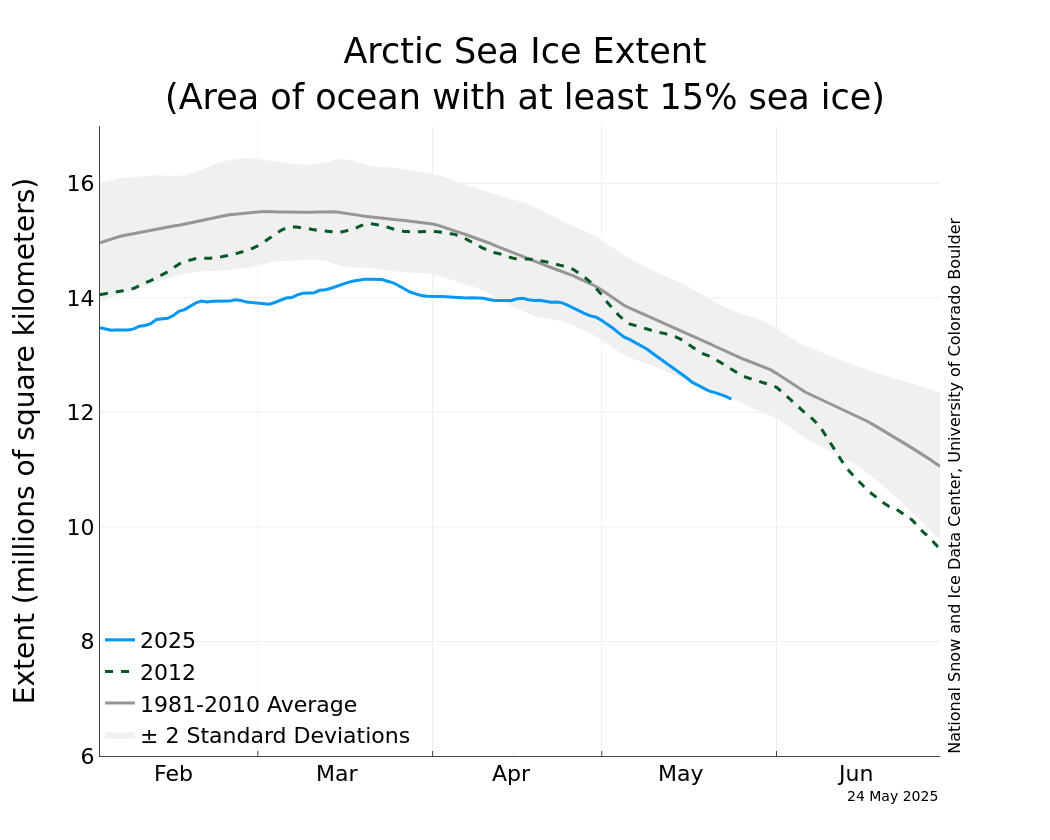
Claim 1972: “Artic specialist Bernt Balchen says a general warming trend over the North Pole is melting the polar ice cap and may produce an ice-free Arctic Ocean by the year 2000.” Christian Science Monitor, June 8, 1972.
Data: Ice coverage has fallen, though as of last month, the Arctic Ocean had 3.82 million square miles of ice cover — an area larger than the continental United States — according to The National Snow and Ice Data Center.
Claims 1974: “… when metereologists take an average of temperatures around the globe they find the atmosphere has been growing gradually cooler for the past three decades. The trend shows no indication of reversing. Climatological Cassandras are becoming increasingly apprehensive, for the weather aberrations they are studying may be the harbinger of another ice age. Telltale signs are everywhere–from the unexpected persistence and thickness of pack ice int eh waters around Iceland to the southward migration of a warmth-loving creature like the armadillo from the Midwest. When Climatologist George J. Kukla of Columbia University’s Lamont-Doherty Geological Observatory and his wife Helena analyzed satellite weather data fro the Northern Hemisphere, they found that the area of ice and snow cover had suddenly increased by 12% in 1971 and the increase has persisted ever since. Areas of Baffin Island in the Canadia Arctic, for example, were once totally free of any snow in summer; now they are covered year round.”
Later in the article, “Whatever the cause of the cooling trend, its effects could be extremely serious, if not catastrophic. Scientists figure that only a 1% decrease in the amount of sunlight hitting the earth’s surface could tip teh climatic balance, and cool the planet enough to send it sliding down the road to another ice age within only a few hundred years.”
Source: “Another Ice Age,” Time Magazine, June 24, 1974.
Claim 1989: “Using computer models, researchers concluded that global warming would raise average annual temperatures nationwide two degrees by 2010.” Associated Press, May 15, 1989.
Data: According to NASA, global temperature has increased by about 0.7 degrees Fahrenheit since 1989. And U.S. temperature has increased even less over the same period.

Claims: “Britain’s winter ends tomorrow with further indications of a striking environmental change: snow is starting to disappear from our lives.”
“Sledges, snowmen, snowballs and … are all a rapidly diminishing part of Britain’s culture, as warmer winters–which scientists are attributing to global climate change–produce not only fewer white Christmases, but fewer white Januaries and Februaries.”
“London’s last substantial snowfall was in February 1991.” “Global warming, the heating of the atmosphere by increased amounts of industrial gases, is now accepted as a reality by the international community.”
According to Dr. David Viner, a senior research scientist at the climatic research unit (CRU) of the University of East Anglia, within a few years “children just aren’t going to know what snow is” and winter snowfall will be “a very rare and exciting event.” Interviewed by the UK Independent, March 20, 2000.
“David Parker, at the Hadley Centre for Climate Prediction and Research in Berkshire, says ultimately, British children could have only virtual experience of snow.”
See “Snowfalls are now just a thing of the past.” The Independent. March 20, 2000.
Data: “Coldest December Since records began as temperatures plummet to minus 10 C bringing travel chaos across Britain.” Mailonline. Dec. 18, 2010.
Claim: “[By] 1995, the greenhouse effect would be desolating the heartlands of North America and Eurasia with horrific drought, causing crop failures and food riots … [By 1996] The Platte River of Nebraska would be dry, while a continent-wide black blizzard of prairie topsoil will stop traffic on interstates, strip paint from houses and shut down computers.” Michel Oppenheimer and Robert H. Boyle, Dead Heat, St. Martin’s Press, 1990. Oppenheimer is the Albert G. Milbank Professor of Geosciences and International Affairs in the Woodrow Wilson School and the Department of Geosciences at Princeton University. He is the Director of the Program in Science, Technology, and Environmental Policy at the Wilson School. He was formerly a senior scientist with the Environmental Defense Fund, the largest non-governmental organization in the U.S. that examines problems and solutions to greenhouse gases.
Data: When asked about these old predictions Oppenheimer stated, “On the whole I would stand by these predictions — not predictions, sorry, scenarios — as having at least in a general way actually come true,” he said. “There’s been extensive drought, devastating drought, in significant parts of the world. The fraction of the world that’s in drought has increased over that period.”
However, that claim is not obviously true. Data from NASA’s Goddard Space Flight Center show that precipitation — rain and snow — has increased slightly over the century.
—
How could scientists have made such off-base claims? Dr. Paul Ehrlich, author of “The Population Bomb” and president of Stanford University’s Center for Conservation Biology, told FoxNews.com that ideas about climate science changed a great deal in the the ’70s and ’80s.
Ehrlich told FoxNews.com that the consequences of future warming could be dire.
=============================================================
Source: University of Georgia, Terry College of Business. Economics 2200, Economic Development of the US, David B. Mustard
http://www.terry.uga.edu/~mustard/courses/e2200/pop.htm
UPDATE: reader Dennis Wingo writes in with this table:
Great article. I went into this myself in my book “Moonrush“, I took all of the predictions for the depletion of resources from the book and marked in red the deadlines that had already passed. All of the predictions failed.

Pamela: You seem perfectly content to dehumanize males to nothing but sperm providers. I see no difference between that the ridiculous claim of feminists that women were only worthwhile when barefoot and pregnant. Women did not want equality–they wanted to be selfish people who ruled the world and stomped on men. I’m not sure how this got into climate change–or even incorrect predictions–but once a comment is out there, expect responses. Maybe women and warmists look much alike in their agenda?
Alice, I am as male as one ever gets, and I do not feel dehumanised by anything Pamela wrote in this thread. She has expressed a valid point of view, and it is, in fact, very close to biological reality. Which is that human and many other males do not really get to choose their mates. In most sexually reproducing animals, the female makes the choice and so rejection (at any level) is the norm.
Biologically, in primates in particular, males are little more than sperm carriers.
Addendum….
Lest anyone make the claim that my copies of the statements from Meadow and Gore are not representative of mainline global political thinking, I give you this from the 2012 UN sponsored conference, Planet Under Pressure….
From my book’s 2012 update…
In a Rio + 20 policy brief, “A Green Economy For a Planet Under Pressure” from the Planet Under Pressure conference elements right out of the limits to growth and its like continue to be developed. The following is the guiding policy statement:
Humanity is at a crossroads. Social, economic and environmental crises that have played out in recent years offer a unique opportunity for a step change in the way humanity does business. Although the concept of the ‘green economy’ was introduced to address today’s challenges, its continued dependence on traditional – and questionable – trickle-down economic growth theory has rendered it inadequate. A fast-growing population, rapidly diminishing resources and planetary boundaries are forcing humanity to find innovative ways to use resources more efficiently, to work within the limits of the Earth’s natural capital, and to make fundamental changes to our economic systems. This policy brief sets out the guidelines for the social and technological transformations needed for a new economic system, as well as the new ways in which we will need to measure and monitor this system.
Auto says:
January 19, 2013 at 12:49 pm
Fine distinction here. The underground is 150 years old.
The tube which is the tunnelled network is younger.
DaveE.
Omnologos says:
“Does anybody know of a collection of predictions that turned out right?”
Well, yes, but not relevant to this thread.
Pamela Gray says:
January 20, 2013 at 12:34 pm
I agree. Technology has made the female control most abortion foes desire obsolete. i.e. unworkable. Just as technology is making gun control an unworkable proposition.
It is funny. Despite the many failures of prohibitions of all kinds, both major parties still have their favorites and their oppositions. It is a wonder.
=====================
How do you convince a woman who doesn’t want to take care of a child to do so? If you can do that you don’t need a law. If you can’t do that the law won’t work.
“In most sexually reproducing animals, the female makes the choice and so rejection (at any level) is the norm.”
It is worse than that. If a new male primate takes over the reproductive unit he will kill all the very young offspring of the previous male. Humans have toned that down some. But the new male has a propensity to sexually molest the children of the previous male. That tends to drive them out of the family – if they can escape.
The guy who said 2,000 years ago divorce is a great evil may have been on to something.
“trickle-down economic growth theory”
In fact works. You might want to look up “the digital divide” which was all the rage when computers were new and going mainstream 30 years ago. The fear was that only the “rich” would have access to the new digital world. For practical purposes in America computers are free if you are willing to work with a 6 or 8 year old model. Or rather low cost if you can use a hand held. And then there is the “One Laptop Per Child” group.
The trouble with the anti-trickle down folks is that they have no patience. And their prescriptions (theft, murder) generally lead to worse outcomes than the trickle-down societies get. The USSR was no mass technology powerhouse.
Re Y2K not being a problem: tell that to the programmers who worked on it…
Paul Erlich should have stuck with butterflies……
denniswingo says:
January 20, 2013 at 12:50 pm
“The government in 1967 and 1968 did what your ilk wanted to do, which is to turn away from the future and give the money for social programs. How’s that working out for you?”
To the governmentophile, failure is never a result of being wrong, but of not going far enough with the prescribed policy, no matter the self-evident flaws by which it is fundamentally doomed.
Excellent column here, too. To Mrs. Dorothy Reynolds, I would have liked to have asked, “do you want to feed them money?” Because money isn’t food, and allocating resources to NASA did not reduce the amount of food available.
The average lay person is hobbled by the illusion that money has intrinsic value, rather than being merely a medium for commerce. Like electrons. Money facilitates the flow of commerce, just as electrons facilitate the flow of energy. But, there is never an actual shortage of electrons, just as there is never any real shortage of money. There is only ever a shortage of production, and the bottleneck in production lies in human initiative in envisioning, organizing, and implementing it.
…oh to be skeptical. 🙂
Alice, you make assumptions about me not supported by my comments. But you offer a very revealing reason why this discussion should be a private one between the woman (with her partner if she chooses to) and her physician. Those outside this very private discussion can and often do make unsupported assumptions.
Let’s not forget some of the events still on our horizon:
Dual planetary rifts (the 30 -120 day variety)
Our planets magnetic field reversal (100 year dead zone)
Plate slipping/undersea avalanches (600′ tsunamis)
Super volcanoes
Carrington type events ( no replacement step-down transformers for 20 months or more)
Massive earthquakes
War (not going away, as mankind’s mind hasn’t changed at all in the past 30,000 years), but our senses (5 or 6) have eroded some.
And many more auto-correcting events!!!
All things come to an end (CAGW, ice-ages, inter-glacial periods, you name it).
denniswingo
I am so not a Luddite. There are two broad bets available. The first is that humanity can safely ignore nature going forward for the next umpteen millenla.
The other is that, at some stage or another in say, the next ten thousand years, it can’t.
You guys want to bet that she’ll be right for infinity or until the Milky Way and Andromeda galaxies collide.
I have this tendency to think, hey mate, let’s just slow it down a bit and look at this a bit more carefully. Maybe we are not Masters of the Universe.
Luddite as a pejorative is IMHO and in any case, a bit irrelevant in my case.
I love all our our new machines. I support GMO, nanotechnology and nuclear energy.
Mark Bofill
It is good to get the implied predictions, assumptions and beliefs of the BAU boosters out in the open isn’t it?
Are infinite economic growth and infinite population growth good things? If not, how do we stop? Where does the merry-go-round run out of bearings, cheap energy and materials? Never, ever?
Wow. It is just like God.
I note that certain folk are preparing to have a froth at the mouth of Malthus. Not me. I think that the infinity merchants have more of a difficulty with Malthus than I do, even if most folk get him dead wrong.
Predict the future state of any production can take place based on previous indicators. Predict climate change and determine their characteristics, is nothing more than a fortune-telling skills, such as Grandma fortune teller looking into a ball for divination. So today most used p c, as a ball for divination, making it a mathematical model, which later believed. It would not be a problem with those models that do not dumbing down many ignorant people and prosecute them if they believe in a miracle.
Forecast climate change, without knowing the true cause of these phenomena is unscientific and not really natural and normal.
Climate change is caused by the interaction of the planets and the Sun, which is reflected in the behavior of the Sun in the form of changes magnetism and sunspot cycle and the reconnection of magnetic poles sun.
Such a picture of behavior, enable learning, at all times, and climatic and other changes.
Climate Ace says:
January 20, 2013 at 11:14 pm
denniswingo
…
I have this tendency to think, hey mate, let’s just slow it down a bit and look at this a bit more carefully. Maybe we are not Masters of the Universe.
…
Climate Ace says:
January 20, 2013 at 11:27 pm
Mark Bofill
It is good to get the implied predictions, assumptions and beliefs of the BAU boosters out in the open isn’t it?
Are infinite economic growth and infinite population growth good things? If not, how do we stop?
…
—————————————————————————
Buddy, this is pure arrogance. Who are you to say ‘let’s just slow it down a bit?’ Were you elected emperor, or do you propose to rule by right of your limitless genius? Who are you to determine what is good for humanity (without even troubling to define your standard of ‘good’, might I add)? AND WHY IS THIS YOUR PRIORITY?
See, I ask this, because what you appear to advocate fits a pattern of justifying tyranny. Reach out to vague, nebulous concepts like ‘the good of humanity’ to justify taking control of what people do or don’t do. Pardon me for expressing my skepticism of your altruistic motives, but this looks like the plain vanilla sophistry of a guy who wants to rule for the sake of ruling.
No thanks, I’ll go with the human ingenuity thing.
The malevolent benevolence of the AGW position on mitigation is so easy to uncover, even Kenji can do it.
I’ve read the quotes from Dr. Viner, “snowfall thing of the past” etc before but thought they were made pre 1990, so couldn’t understand when the articles referenced above all showed the date 2000.
The reason for this is that my favourite band – Marillion – recorded an album in 1989 called “Seasons End” which contains lyrics with striking similarities to the words of Dr Viner in the article published ten years later – “Getting close to seasons end, I heard somebody say, that it might never snow again In England” – “Snow flakes in a newborn fist, Sledging on a hill, Are these things we’ll never see In England”.
I thought the band / John Helmer had seen the article then written the song, but obviously not.
Which begs the question – is Dr David a Marillion fan? , ‘cos if so I might see him at the Marillion Weekend in Port Zeeland, Holland on the 8th – 11th March.
ps. Please don’t knock Marillion over the song – they are VERY, VERY GOOD and probably listened to some ‘expert opinion’.
Easter and King of Sunset Town also excellent. You cannot blame the guys for taking climate change on board. It was hip and cool and vague.
I think that Hogarth and the boys would be quite interested to hear the truth first hand.
Either mankind uses a substantial fraction of the 5000+ quadrillion tons of metals in Earth’s crust or doesn’t. In the latter case, there is much left untapped. In the former case, orders of magnitude greater industrial capabilities and economic output than now are implied, compared to which advancing to the next level of being a space civilization is relatively easy.
Either way, available materials are not a showstopper.
If advancing to that next level, then in turn either future mankind utilizes a substantial fraction of the power available to such a solar system civilization advancing towards a Dyson Swarm (trillions of trillions of watts) or doesn’t. Again, in the latter case, there is much left untapped. In the former case, even the energy requirements of mass interstellar flight are far less, while there are so many billions of stars in the galaxy (though actually surprisingly many in the void between galaxies too) that the soonest probable end for such a civilization reaching new ones would be approximately the end of the universe itself under many cosmological and/or religious assumptions.
Again, either way, available energy and materials are not a showstopper limiting the general order of magnitude involved, not unless “potential inability to outlast the universe itself” is considered one, hardly an argument against such in context (and, if there is any way to go beyond the known universe, that would be the kind of civilization with the greatest chance of finding it).
What can be devastating, though, not on the timescale of billions of years but far sooner, as in right this century if not stopped, is governance by hyper-dishonest mathematically-illiterate ideologues seeking power for poor reasons, in results all but indistinguishable from being misanthropic. As in prior generations, mankind’s own governments are among its greatest threats unless prevented from being such.
If the likes of today’s dishonest ideologues had full power eons ago, all of mankind would still be a few villages, without any of the richness of civilization that came from greater growth (until dying out like the dinosaurs did from lack of a space program).
Climate Ace Says….
Are infinite economic growth and infinite population growth good things? If not, how do we stop? Where does the merry-go-round run out of bearings, cheap energy and materials? Never, ever?
Wow. It is just like God.
Mmmmmm….. Sounds just like Albert Gore Jr. From “Earth in the Balance”.
We have also fallen victim to a kind of technological hubris, which tempts us to believe that our new powers may be unlimited. We dare to imagine that we will find technological solutions for every technologically induced problem. It is as if civilization stands in awe of its own technological prowess, entranced by the wondrous and unfamiliar power it never dreamed would be accessible to mortal man. In a modern version of the Greek myth, our hubris tempts us to appropriate for ourselves—not from the gods but from science and technology—awesome powers and to demand from nature godlike privileges to indulge our Olympian appetite for more.
You have to be kidding me. Just in the last couple of weeks we have had an announcement from NASA that there are about 17 billion Earth like planets in our galaxy alone, and there are over 100 billion galaxies.
We live on one tiny little mudball called Earth in a solar system teaming with resources. Read the book “Mining the Sky” for a bit of information on just how vast our own solar system’s resources are. We now have the technology (and I state this as a professional opinion as someone acknowledged as an expert in the field), to develop these resources and to develop an economy that spans our solar system. The limiting factor in all of this is energy. As a planetary society we are woefully energy poverty stricken. I am in favor of getting off of fossil fuels for a completely different reason, they are very low forms of energy. You state that that you are in favor of nuclear energy, so am I. However, most of our national investment has been in low energy multiple technologies like solar, wind, and biomass. These technologies lock us into an energy poverty situation where we are always fighting between food and fuel. This is stupid.
The goal of the technological optimist is not to bring the west down to a third world energy level and then control mankind until all the energy finally gives out, but to take the opposite approach of creating wealth, through the economic development of the solar system. This will make our planetary civilization of 9 billion people more wealthy than all previous societies put together in history. It is a clear fact of reproduction in advanced societies that birthrates decline and population actually falls when wealth reaches a certain level. This is true in Europe, Japan, and the United States and coming soon to China.
You have this weird claim (and so does Gore) that just because we understand the ability of technology and science that we want to be Gods? How absurd. What a limited viewpoint. That viewpoint is that of a Luddite, and yes it is a pejorative and is meant to be so. Luddites smashed the machines of the early industrial age for the same reason that you want to stop progress now, and thus by your own words are you convicted.
Climate Ace says:
January 20, 2013 at 11:27 pm
Ya gotta love ol’ Ace. He puts up the most inventive straw men. For example, he wants people to think that the critical issue is, is infinite population growth a good thing? He claims that that’s what the BAU people believe in, “infinite population growth”. One presumes that by “infinite population growth” he means population growth that continues until humans completely fill all of the space in the known universe … and then keeps expanding. Although Ace might have invented a new meaning for “infinite”, you never know.
Ace wants to know if entirely filling the total space of the known universe with humans through infinite population growth sounds like a good thing. He doesn’t believe me, so it’s no use me saying it doesn’t sound like a good thing, maybe someone else could point out that infinite population growth is neither desirable nor possible …
You see, Ace is trying to make fun of people who point out that business as usual (BAU) so far has lifted much of the world out of poverty, and is moving the rest upwards. Acey don’t like that, I don’t know why, poor people moving out of poverty seems to make him lose his cool, but he can hardly deny it … so he makes the ridiculous claim that BAU folks think “infinite population growth” is a good thing, and then sets about demolishing that carefully constructed straw man.
See Ace demolish the straw man.
Demolish, Ace, demolish.
See the straw man fall.
Fall, straw man, fall. Ace has conquered you.
Thus endeth our child’s garden adverse us …
w.
PS—yeah, I know it’s obscure, it’s a play on the RLS book title “A Child’s Garden of Verses” …
Re: Willis/Ace
A couple of years ago we had a discussion here regarding the total volume of humanity on Earth. Turns out that you could put every person on Earth into a one kilometre sphere, with room to spare.
We have a long way to go before we reach infinite population growth. We’ve hardly even started.
Gene–You just equated yourself to animals, not humans.
Pamela–When men have NO part whatsoever, including providing sperm, then women get all the say. Until then, women do NOT get all the say even if they presume to. You cannot reproduce on your own so there is no reason why you–the woman–should get all the say. I really don’t care if you carry the baby or not. You DID NOT make it by yourself. You do not own it. You demand men pay for it, even though it was your choice alone, according to you. Again, unless men have NO part–no sperm, no child support, etc–it is not your decision alone.
Alice says:
> Gene–You just equated yourself to animals, not humans.
I didn’t equate myself to animals; I fully realise I am one of them. And so are you. “One of” is not the same as “equal”. I can’t be equal to a set of things, but I can be one of them.
We are all cousins, with a common ancestor. If you bother to tabulate commonalities and differences between, let’s say, any mammal of your choice and a human, just focusing on behaviour, you will find that there are really not too many differences to speak of. If, however, you only live among humans and do not spend time looking around, you’ll be excused for thinking we are special. But then you’ll be likely to misinterpret our behaviour in bizarre ways and to keep finding mysteries where there are none.
We are indeed a little bizarre, compared to most of our cousins, but in a very limited number of ways. I can name one: we don’t have a mating season. That has some implications on how we organise our life. Another thing to note — a conjecture, although one I wouldn’t dismiss without a good argument — is that humans somehow managed to halt their development at a juvenile stage. We can reproduce without reaching maturity, and somehow that brings about a few evolutionary advantages, and that’s it. Just look at a 10-year-old chimp: we never reach such an unbelievable level of maturity. When Richard Dawkins calls us “juvenile apes”, I think he’s on to something.
We are a little weird, but we are apes all right. We are driven by the same programs, unless we consciously suppress them for one reason or another. We almost don’t have any new programs compared to others.
I will say this one more time, the post included references to abortion as a part of the conversation on climate change. It has no place there. That some have included it into the conversation, as exposed by the post, begs many questions, especially the motives behind such a maneuver. I do not consider those motives pure in the least and highly distracting to the central tenants of climate change. The conversation is a private medical one (along with whomever the pregnant woman wants to include- the law of the land like it or not) and belongs only there. It smacks of using human shields between adversarial climate change opponents on either side. I hope you Alice, find that maneuver disgusting and fraught with unsupported assumptions. I do.