
By WUWT regular “Just The Facts”
Recently there have been increased efforts to link “Climate Change” and “Extreme Weather” e.g., NOAA links extreme weather to climate change CBS – July 10, 2012, “NASA scientist links climate change, extreme weather” CNN – August 6, 2012 and Get used to ‘extreme’ weather, it’s the new normal The Guardian – September 19, 2012. Per the Guardian article, “Scientists have been warning us for years that a warmer planet would lead to more extreme weather, and now it’s arrived”. These “Extreme Weather” efforts have shifted into high gear with Sandy. Yesterday United Nations Secretary-General Ban Ki-moon said that “one of the lessons from Superstorm Sandy is the need for global action to deal with future climate shocks.” “He told the U.N. General Assembly on Friday that it is difficult to attribute any single storm to climate change, but the world already knows that “extreme weather due to climate change is the new normal.” U.N. leader: Sandy a lesson in climate change CBS – November 9, 2012
All of these claims and “extreme weather” rhetoric seems to be predicated on the assumption that “Earth’s Temperature” has increased recently, thus causing “extreme weather” to arrive and become the “new normal”. However, does the observational data support this assumption? Let’s take a look…
Global Surface Temperatures:
Generally, when referring to Earth’s “climate” warming, proponents of the Catastrophic Anthropogenic Global Warming (CAGW) narrative refer to Earth’s Surface Temperature, e.g. “Global warming is the unusually rapid increase in Earth’s average surface temperature over the past century primarily due to the greenhouse gases released by people burning fossil fuels.” NASA Earth Observatory
As such, here’s NASA’s Goddard Institute for Space Studies (GISS) Global Monthly Mean Surface Temperature Anomaly – 1996 to Present:
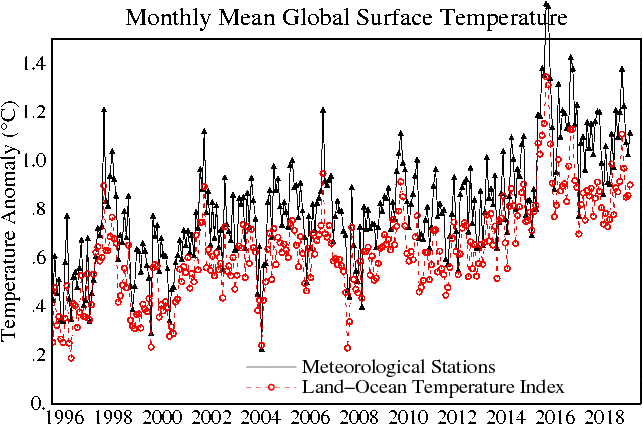
Looking across the last 16 years, Global Surface Temperature do not appear to have increased much at all.
For a longer term view, UK Met Office’s – Hadley Center – Climate Research Unit (CRU) Annual Global Average Land Temperature Anomaly – 1850 to 2011;

and the UK Met Office – Hadley Center – Climate Research Unit (CRU) Monthly Global Average Land Temperature – 1850 to 2011

Unless the arrival of “extreme weather” occurred in 1997-1998 with the well documented “very strong El Niño”, and the media is just realizing it, there does not seem to be a basis for the “extreme weather” claims in Earth’s recent Land and Surface Temperature record. There does not appear to be much recent change, and if anything the trend is down in the last few years. However, the surface temperature record is burdened with issues of questionable siting, changes in siting, changes in equipment, changes in the number of measurement locations, modeling to fill in gaps in measurement locations, corrections to account for missing, erroneous or biased measurements, and the urban heat island effect. Thus to see the big picture on the temperature “Earth’s Temperature”, it also helps to look up.
Atmospheric Temperatures:
Since 1979 Earth’s “temperature” has also been measured via satellite. “The temperature measurements from space are verified by two direct and independent methods. The first involves actual in-situ measurements of the lower atmosphere made by balloon-borne observations around the world. The second uses intercalibration and comparison among identical experiments on different orbiting platforms. The result is that the satellite temperature measurements are accurate to within three one-hundredths of a degree Centigrade (0.03 C) when compared to ground-launched balloons taking measurements of the same region of the atmosphere at the same time.” NASA
Here is RSS Global Temperature Lower Troposphere (TLT) – Brightness Temperature Anomaly- 1979 to Present;


and this is the University of Alabama – Hunstville (UAH) Global Lower Atmosphere Temperature Anomalies – 1979 to Present:

Note: Per John Christy, RSS and UAH anomalies are not comparable because they use different base periods, i.e., “RSS only uses 1979-1998 (20 years) while UAH uses the WMO standard of 1981-2010.”
The September UAH Lower Atmosphere Temperature Anomaly was .33 degrees C above the 30 year average and RSS Global Global Lower Troposphere shows a .133 degrees C increase per decade. “Earth’s Temperature” varies naturally by numerous degrees and has been significantly warmer than it is today:

Are we to believe that 3 or 4 tenths of a degree C warming over the last 30 years has brought us to the precipice of “extreme weather”? Seems implausible. Maybe there are significant regional variations that portended the arrival of “extreme weather”?
Looking at the RSS Northern Hemisphere Temperature Lower Troposphere (TLT) Brightness Temperature Anomaly;

and RSS Southern Hemisphere Temperature Lower Troposphere (TLT) Brightness Temperature Anomaly;

neither seem indicative of warming that would have caused “extreme weather” to arrive.
Furthermore, RSS Southern Polar Temperature Lower Troposphere (TLT) Brightness Temperature Anomaly;

is currently negative and shows a .013 K/C per decade decrease. Should we assume that Antarctica is experiencing less “extreme weather” at the moment?…
To this point we’ve only addressed the Lower Troposphere Temperatures, but one never knows where this “extreme weather” might be coming from, the following Temperature Anomaly plots from RSS will increase in altitude as is illustrated here:
Here is RSS Temperature Middle Troposphere (TMT)- Brightness Temperature Anomaly- 1979 to Present;

According to Remote Sensing Systems, “For Channel (TLT) (Lower Troposphere) and Channel (TMT) (Middle Troposphere), the anomaly time series is dominated by ENSO events and slow tropospheric warming. The three primary El Niños during the past 20 years are clearly evident as peaks in the time series occurring during 1982-83, 1987-88, and 1997-98, with the most recent one being the largest.” RSS
Middle Tropospheric temperatures appear to show slow warming overlaid with the El Niño/La Niña Southern Oscillation (ENSO) cycle, including several comparatively large El Niño events. Middle Tropospheric temperatures appear to have flattened since the large El Niño in 1998 and offer no indication of a recent change in Earth’s Temperature that could cause “extreme weather” to become the “new normal.
Moving higher in the atmosphere, RSS Temperature Troposphere / Stratosphere (TTS) – Brightness Temperature Anomaly- 1987 to Present;

has been flat since 1987, with a trend of just -.008 K/C per decade. Perhaps this is the “new normal”?…
The 1997-98 and 2009 – 10 El Niño events are still readily apparent in the Troposphere / Stratosphere plot above, as is a spike from the 1991 eruption of Mt. Pinatubo. Note that the effect of Mt. Pinatubo is the opposite in the Lower and Middle Troposphere versus the Troposphere / Stratosphere (TTS), i.e. “Large volcanic eruptions inject sulfur gases into the stratosphere; the gases convert into submicron particles (aerosol) with an e-folding time scale of about 1 year. The climate response to large eruptions (in historical times) lasts for several (2-3) years. The aerosol cloud causes cooling at the Earth’s surface, warming in stratosphere.”
Ellen Thomas, PHD Wesleyan University
It is interesting that, incorporating the impact of three significant surface driven warming events, Troposphere / Stratosphere Temperatures (TTS) have been quite stable, however there is a bit of regional variation here, e.g.:
RSS Northern Hemisphere Temperature Troposphere / Stratosphere (TTS) – Brightness Temperature Anomaly- 1987 to Present;

has been increasing by .044 K/C per decade, whereas the RSS Southern Hemisphere Temperature Troposphere / Stratosphere (TTS) – Brightness Temperature Anomaly- 1987 to Present;

has been decreasing by -.061 K/C per decade. However, Southern Hemisphere Troposphere / Stratosphere Temperature does show a significant increase in 2012, perhaps it is this increase that caused “extreme weather” to arrive? Or maybe not…
Moving higher still in the atmosphere, the RSS Temperature Lower Stratosphere (TLS) – Brightness Temperature Anomaly – 1979 to Present;

“is dominated by stratospheric cooling, punctuated by dramatic warming events caused by the eruptions of El Chichon (1982) and Mt Pinatubo (1991).” RSS
The eruptions of El Chichon and Mt Pinatubo are readily apparent in the Apparent Atmospheric Transmission of Solar Radiation at Mauna Loa, Hawaii:

“The stratosphere” … “in contrast to the troposphere, is heated, as the result of near infrared absorption of solar energy at the top of the aerosol cloud, and increased infra-red absorption of long-wave radiation from the Earth’s surface.”
“The stratospheric warming in the region of the stratospheric cloud increases the latitudinal temperature gradient after an eruption at low latitudes, disturbing the stratospheric-troposphere circulation, increasing the difference in height of the troposphere between high and low latitudes, and increasing the strength of the jet stream (polar vortex, especially in the northern hemisphere). This leads to warming during the northern hemisphere winter following a tropical eruption, and this warming effect tends to be larger than the cooling effect described above.” Ellen Thomas, PHD Wesleyan University
The Lower Stratosphere experienced “dramatic warming events caused by the eruptions of El Chichon (1982) and Mt Pinatubo (1991).” RSS “The long-term, global-mean cooling of the lower stratosphere stems from two downward steps in temperature, both of which are coincident with the cessation of transient warming after the volcanic eruptions of El Chichon and Mt. Pinatubo.” … “Here we provide observational analyses that yield new insight into three key aspects of recent stratospheric climate change. First, we provide evidence that the unusual step-like behavior of global-mean stratospheric temperatures is dependent not only upon the trend but also on the temporal variability in global-mean ozone immediately following volcanic eruptions. Second, we argue that the warming/cooling pattern in global-mean temperatures following major volcanic eruptions is consistent with the competing radiative and chemical effects of volcanic eruptions on stratospheric temperature and ozone. Third, we reveal the contrasting latitudinal structures of recent stratospheric temperature and ozone trends are consistent with large-scale increases in the stratospheric overturning Brewer-Dobson circulation” David W. J. Thompson Colorado State University
Above the Stratosphere we have the Mesosphere and Thermosphere, neither of which have I identified current temperature time series for, but of note is that on “July 15, 2010” “A Puzzling Collapse of Earth’s Upper Atmosphere” occurred when “high above Earth’s surface where the atmosphere meets space, a rarefied layer of gas called “the thermosphere” recently collapsed and now is rebounding again.”

“This is the biggest contraction of the thermosphere in at least 43 years,” says John Emmert of the Naval Research Lab, lead author of a paper announcing the finding in the June 19th issue of the Geophysical Research Letters (GRL). “It’s a Space Age record.”
The collapse happened during the deep solar minimum of 2008-2009—a fact which comes as little surprise to researchers. The thermosphere always cools and contracts when solar activity is low. In this case, however, the magnitude of the collapse was two to three times greater than low solar activity could explain.
“Something is going on that we do not understand,” says Emmert.
The thermosphere ranges in altitude from 90 km to 600+ km. It is a realm of meteors, auroras and satellites, which skim through the thermosphere as they circle Earth. It is also where solar radiation makes first contact with our planet. The thermosphere intercepts extreme ultraviolet (EUV) photons from the sun before they can reach the ground. When solar activity is high, solar EUV warms the thermosphere, causing it to puff up like a marshmallow held over a camp fire. (This heating can raise temperatures as high as 1400 K—hence the name thermosphere.) When solar activity is low, the opposite happens.” NASA
In summary, Earth’s Lower and Middle Troposphere appear to have warmed slowly, overlaid with the El Niño/La Niña Southern Oscillation (ENSO) cycle, including four comparatively large El Niño events, and tempered by the cooling effects of the eruption of El Chichon (1982) and Mt Pinatubo (1991). Lower and Middle Tropospheric temperatures appear to have flattened since the large El Niño in 1998 and offer no indication of changes that could be causing “extreme weather”. Tropospheric / Stratospheric temperatures appear to have been influenced by at least three significant surface driven warming events, the 1997-98 El Niño, and the eruptions of El Chichon in 1982 and Mt Pinatubo in 1991, but have maintained a stable overall trajectory. Stratospheric temperatures appear to have experienced two “dramatic warming events caused by the eruptions of El Chichon (1982) and Mt Pinatubo (1991).”, and “unusual step-like behavior of global-mean stratospheric temperatures” which has resulted in a significant stratospheric cooling during the last 30 years. Lastly, “during deep solar minimum of 2008-2009” “the biggest contraction of the thermosphere in at least 43 years” occurred and “The magnitude of the collapse was two to three times greater than low solar activity could explain.” Unless someone can demonstrate a causative relationship between “Climate Change”, the collapse of the thermosphere and “Extreme Weather”, there does not seem to be any support with the atmospheric temperature records for “extreme weather” arrival and “new normal” rhetoric.
Ocean Temperatures:
“The oceans can hold much more heat than the atmosphere. Just the top 3.2 metres of ocean holds as much heat as all the world’s air.” Commonwealth of Australia – Bureau of Meteorology
As such, changes in Ocean Heat Content are important in understanding “Earth’s Temperature”. Here is NOAA’s NODC Global Ocean Heat Content from 0-700 Meters – 1955 to Present;

and here is the same from Ole Humlum’s valuable climate data site Climate4you.com, NODC Global Ocean Heat Content – 0-700 Meters – 1979 to Present:

It seems apparent from the plots above that Global Ocean Heat has increased over the last several decades, however Global Ocean Heat does not appear to show a recent increase that could lead to “extreme weather”. Furthermore, in his recent article Bob Tisdale demonstrated that “sea surface temperatures for Sandy’s path haven’t warmed in 70+ years” WUWT.
Sea Level:
“Global sea level is currently rising as a result of both ocean thermal expansion and glacier melt, with each accounting for about half of the observed sea level rise, and each caused by recent increases in global mean temperature. For the period 1961-2003, the observed sea level rise due to thermal expansion was 0.42 millimeters per year and 0.69 millimeters per year due to total glacier melt (small glaciers, ice caps, ice sheets) (IPCC 2007). Between 1993 and 2003, the contribution to sea level rise increased for both sources to 1.60 millimeters per year and 1.19 millimeters per year respectively (IPCC 2007).” Source NSIDC
Global Mean Sea Level Change – 1993 to Present:

Global Mean Sea Level Change Map with a “Correction” of 0.3 mm/year added May, 5th 2011, due to a “Glacial Isostatic Adjustment (GIA)” – 1993 to Present:

It seems doubtful that “extreme weather” arrived because of the 5.5 Centimeter increase in Sea Level since 1993. Sandy’s storm surge topped “out at 14 feet (4.3 meters)” Huffington Post, would Sandy have been less extreme if the surge had only been 4.245 meters?…
Snow and Ice:
A proxy often cited when measuring “Earth’s Temperature” is amount of Snow and Ice on Earth. According to the United States Geological Survey (USGS), “The vast majority, almost 90 percent, of Earth’s ice mass is in Antarctica, while the Greenland ice cap contains 10 percent of the total global ice mass.” Source USGA
However, there is currently no generally accepted measure of ice volume, as Cryosat is still in validation and the accuracy of measurements from Grace are still being challenged. Sea Ice Area and Extent are cited as proxies for “Earth’s Temperature”, however there is significant evidence that the primary influences on Sea Ice Area and Extent are in fact wind and Atmospheric Oscillations. With this said, here are
Global, Arctic & Antarctic Sea Ice Area from 1979 to Present;

Global Sea Ice Area Anomaly – 1979 to Present:

Northern Hemisphere Sea Ice Area Anomaly, 1979 to Present;

Southern Hemisphere Sea Ice Area Anomaly, 1979 to Present;

Arctic Sea Ice Extent – 15% or greater

Antarctic Sea Ice Extent – 15% or Greater

There appears to have been a negative trend in Northern Hemisphere Sea Ice Area and Extent and a positive trend in Southern Hemisphere Sea Ice Area and Extent, thus the resultant Global Sea Ice Area trend appears to be slightly negative.
In terms of land based data, here is 20 Year Northern Hemisphere Snow Cover with 1995 – 2009 Climatology from NCEP/NCAR;

Northern Hemisphere Snow Cover Anomalies 1966 – Present from NCEP/NCAR;

Northern Hemisphere Winter Snow Extent – 1967 to Present from Rutgers University;

Northern Hemisphere Spring Snow Extent – 1967 to Present:

Northern Hemisphere Fall Snow Extent – 1967 to Present:

While none of the Snow plots offers a global perspective, when looking at the Northern Hemisphere, there appears to have been a slight increase in Snowcover and Winter Snow Extent, a decrease in Spring Snow Extent and no change in Fall Snow Extent over the historical record.
Based on the limited Global Ice and Snow measurements available, and noting the questionable value of Sea Ice Area and Extent as a proxy for temperature, not much inference can currently be drawn from Earth’s Ice and Snow measurements. However, there does not appear to be any evidence of change in Earth’s Ice and Snow measurements indicative of the arrival of “Extreme Weather”.
Conclusion:
There is no evidence of a recent increase in “Earth’s Temperature” due to “Climate Change,” which could have caused “Extreme Weather” to arrive and become the “new normal”. Claims and rhetoric that recent “Extreme Weather” is caused by or associated with “Climate Change” are not supported by the observational data.
Additional information on “Earth’s Temperature” can be found in the WUWT Reference Pages, including the Global Temperature Page and Global Climatic History Page
Please note that WUWT cannot vouch for the accuracy of the data/graphics within this article, nor influence the format or form of any of the graphics, as they are all linked from third party sources and WUWT is simply an aggregator. You can view each graphic at its source by simply clicking on it.
Volker Doormann says: November 11, 2012 at 3:19 pm
You are talking nonsense, because ‘no evidence’ is nothing, zero, no_thing. NO_thing is not still there, it is NOT.
We can play semantics with the word “recent”, but in the last 10 to 15 years there is “nothing, zero, no_thing” warming, thus there is “no evidence of a recent increase in ‘Earth’s Temperature'” “which could have caused “Extreme Weather” to arrive and become the “new normal”.
No Sir.
Then what are you arguing?
Yes,30+ public copy pasted data. But that is not the point. The point is that you claim a ‘conclusion’ without making the three stages: premises, inference, and conclusion.
Seriously, did you read the article?
I have shown to you an alternative to this copy paste stuff.
Funny, I didn’t know that there was an alternate to the empirical evidence, but I think I’ll stick with the real stuff…
I’m off.
On this we can agree…
Gail Combs
As it happens I have made a study of rates of change of temperatures. I consider it necessary to eliminate the effect of the superimposed 60 year cycle first. When you do this, and consider data from around the period 1880 or 1900 to the present, it is possible to detect the rate of change in the long-term ~1,000 year cycle. As it is approaching a maximum (perhaps 50 to 200 years from now) it is not surprising to find that the rate of change was about 0.06 K/decade around 1900, but has decreased to about 0.05 K/decade in recent times. The first plot in this post is helpful.
David Jones says: November 11, 2012 at 2:44 pm
I hope you’re not holding you breath jtf. We wouldn’t want anything bad to happen to you.
Yes, it is quite sad that whenever we ask for facts from the Warmists we end up blue in the face. If what Secretary-General Ban Ki-moon said is true, and “the world already knows that ‘extreme weather due to climate change is the new normal.'” then why can’t any of them provide evidence in support their “Extreme Weather” hypotheses? There are teams of scientists working for Global Warming Inc. and yet I can’t find any credible evidence that support an increase of “Extreme Weather”.
Another recent article on the Extreme Weather front:
Scientific America – September 30, 2012 – Is There a Strong Link between Extreme Weather Events and Climate Change?
I am not sure how we will be able to validate if “Climate Change” is “messing with ocean currents”. Perhaps someone can offer an objective measure of how messy ocean currents are?…
Gail Combs says:
November 11, 2012 at 4:57 pm
Volker Doormann says:
November 11, 2012 at 4:03 am
….That says nothing.
There is evidence that the present (last ten years) global temperatures are on a high level in respect to temperatures thirty, hundred or four hundred years ago….
_________________________
ERRRrrr, I am afraid you are wrong.
This is the big lie, that the earth is “warming” when in actual fact we are in an overall cooling trend with a bit of noise added in. (+/- 1C is noise and in most cases the error is that great or greater despite what the Climastrologist want us to believe.)
graph and this graph from John Daly’s website link
“Ignoratio elenchi / Irrelevant conclusion: The fallacy of Irrelevant Conclusion consists of claiming that an argument supports a particular conclusion when it is actually logically nothing to do with that conclusion.”
I have argued on a temperature difference of the present (last ten years) minus the temperatures four hundred years ago.
Your term “overall cooling trend” using GISP2 data is a polynom 3rd grade of a time interval of 10000 years, but the truth is that your linked graph show in a red line the temperatures after the Little Ice Age ~four hundred years ago is rising +2.0° C from -32° C. to -30° C. to the year 1950 AD.
Is that true? Yes or Yes?
Your “overall cooling trend” suggests that it is a scientific fact, but it is not. It is a mathematical polynom for entertainment for dummies. It ignores the real measured data. The real measured data in the sense of science or engineering are not noise. Noise suggests, that the data are superimposed by thermal resistance noise created in the detector, like in a microphone. But that is not the case here.
You are arguing with a big lie in this blog as an authority. People belief in your competence, but the truth is that your reply is not helpful to understand the physical causes of the global temperature spectra in high resolution of month, because it leads people to bias because it is easier to argue lies than strong scientific arguments.
V.
Reblogged this on planetvoice and commented:
Huge, complete and very interesting article by WUWT on the temperature rising and data anomalies on climate and weather expressions.
Box of Rocks:
My reply to you (at November 11, 2012 at 2:35 pm) said I thought your problem may be that you were asking about quantum effects when you were really interested in bulk effects that davidmhoffer had addressed in this thread.
You had been asking about interactions of individual molecules with individual photons and I tried to answer that. From your response to my attempt to answer your questions it was not – and still is not – clear to me what you wanted to know. I gained the impression that you were trying to understand how the atmosphere interacts with radiative energy from the Earth’s surface, so I suggested you read David’s comments about that. But it seems I was wrong because you have again asked about interactions of individual molecules with individual photons.
Your post at November 11, 2012 at 6:18 pm indicates that I deflected your questions about quantum effects from me on to davidmhoffer. That was not my intention and, therefore, I apologise to him and to you for that.
I write in attempt to provide answers for you to questions which you ask at November 11, 2012 at 6:18 pm: i.e.
It is a philosophical question as to whether a photon “exists”.
A photon is a quantum of energy in the form of electromagnetic radiation.
Energy cannot be created or destroyed. It was all formed at the ‘Big Bang’. However, energy exists in various forms and can be converted from one of its forms to another or others. (Think of a piece of modelling clay. The clay can have many shapes – a car, a tree, a pot, etc.- but it is the same piece of clay).
When a photon is absorbed by a molecule then the electromagnetic energy becomes vibrational or rotational energy within the molecule. No energy is “lost”: the energy converts from one form to another.
Similarly, when the molecule returns to its ground state by emitting a photon then no energy is “lost”: the energy converts from one form to another (i.e. from vibrational or rotational energy to electromagnetic energy).
Energy can be lost to the universe by becoming trapped in a Black Hole, but (fortunately) there is no Black Hole near the Earth so energy in the Earth’s atmosphere cannot enter one and “get lost”.
Let me try an (imperfect) analogy.
1.
Think of a quantum of energy as being like the ball in a pin ball machine.
2.
The pin ball machine launches the ball on its way
(as the Earth’s surface emits a quantum of energy – a photon – on its way).
2.
The ball interacts with many things on its path around the surface of the machine so bounces about
(as the quantum of energy interacts with many molecules on its path through the atmosphere so ‘bounces’ about).
3.
Eventually the ball escapes down a hole and is ‘gone’ from the surface of the machine
(as eventually the quantum of energy escapes to space and is ‘gone’ from the atmosphere).
I hope this clarifies things for you. I repeat, I am trying to help and my failure is not from lack of effort.
Richard
Volker Doormann:
Your post at November 12, 2012 at 12:03 am concludes by saying
That is the only statement in your post that I agree. Indeed, your post demonstrates its truth.
Please be so kind as to start providing posts which present scientific information and/or scientific arguments.
Richard
http://www.disastercenter.com/disaster/TOP100K.html
This is a list of the worst disasters of the 20th century … One will note the trend is not for more but fewer and with less and less consequences. One will see that it is NOT since the introduction of massive co2 that natural disasters started nor is the increase of co2 related to increases in droughts or floods. It is unclear when agw enthusiasts speak of increasing extreme events is this what they are referring to? I am pretty sure that the 20th century is not unique in natural disasters. There were never comments in the 20th century that these disasters were more frequent that I am aware of. So I am confused. Given the millions and millions that died before our massive production of co2 which was accompanied by rising living standards worldwide the consequences of extreme events were quite severe. Now it seems if 10 or 15 people die because of bad preparedness we are supposed to freak out and run around that the heavens are falling down.
I think it is safe to assume that additional improvements in living standards, technology, warning and general preparedness would essentially make any extreme event wether they happen more or less frequently essentially irrelevant in the scope of things. In just the us 40,000/year die from car accidents and 400,000 from cancer. If NYC and New Jersey got storms like this year with any frequency wouldn’t it be fairly straightforward to essentially reduce the consequences of the storms to less and less? This just seems like a non-problem. Sure we should be better prepared. The consequences of being better prepared even a little would totally outweigh any increase in frequency that anyone is worried about so it just seems like something we should do anyway is be better prepared no tater what so this is simply irrelevant. Where am I wrong here?
The pinball analogy is fine if you consider all the collisions to be inelastic.
Where does the energy go or what form does it take?
What happens when you have a lot of pinballs and nothing to bounce off of i.e. a thunderstorm?
Box of Rocks:
re your post at November 12, 2012 at 6:51 am.
Please read my posts addressed to you and ponder what they say. They answer your recent questions.
Richard
Box of Rocks says:
November 12, 2012 at 6:51 am
>>>>>>>>>>>>>>
Your questions are actually answered in this thread already, as Richard has indicated. My suggestion is if you want to understand these matters in greater detail, that you read through some entry level physics text books on radiative physics. We can discuss science here, but teaching a physics course is not something this medium is suited for.
A lot of confusion for one post. Try going over to “Tamino” for some graphs of ‘extreme weather.” If the question is really: Is extreme weather increasing?” Then you need ways that have already been developed by scientists for summarizing “extreme weather.” For those of you who have lost faith in US and international science, try reading some of the actual original scientific papers and try learning enough to understand what they are saying. Talking about second, third and fourth hand commentary is really confusing, I definitely agree with that. However, the conclusions of the original scientific papers are well-supported by evidence and data..
BillD says: November 12, 2012 at 12:08 pm
Try going over to “Tamino” for some graphs of ‘extreme weather.”
Yes, funny stuff going on over there. Tamino wrote a reply to this article here:
http://tamino.wordpress.com/2012/11/11/extreme-denial/
In it he claims a “dramatic increase in weather-related catastrophes worldwide” and then all he have to offer is a graph from an insurance company and three from the US, which represents less than 2% of Earth’s surface area. Very compelling…
I’ve started compiling “Extreme Weather” observations in this thread here;
http://wattsupwiththat.com/2012/11/10/a-big-picture-look-at-earths-temperature-extreme-weather-update/#comment-1143238
and here:
http://wattsupwiththat.com/2012/11/10/a-big-picture-look-at-earths-temperature-extreme-weather-update/#comment-1143249
If you can offer any “original scientific papers” on Extreme Weather that “are well-supported by evidence and data”, they are most welcome.
This is a very angry column full of a lot of invective, numerous mixed topics and a lot of confusion about what is being said. I believe that the reason denialist are gaining credibility is because of simple facts. Yes I know temperatures are going up but not fast enough over any time period you pick that includes the present to justify a prediction of 3C by 2100. It’s just unbelievable how you get there. I’ve been told by PBS programs, science articles of all types that sea level will be rising 3-6 ft by 2100 and I’ve looked at the numbers and no matter how you cut it sea level is not rising any faster than about 1/12th that amount. You can argue all you want about what is and what isn’t extreme weather but on a scale of 1 to 10 in the worlds problems I don’t think it’s a 10 (the bottom). These extreme weather events have an impact but worldwide they are decreasing at a phenomenal rate in death. Just check out the worst disasters of the 20th century to get a perspective. This “extreme weather” thing is a losing argument. If this all you have then mitigation is the answer. It’s very cheap, we need to do it anyway. The French heat wave of 2003 killed 15,000. First that was rather dumb of them. An embarrassment frankly. 3 years later they had another heat wave as bad and 15 people died. That’s 99.9% mitigation in 3 years at almost no cost. Some fans, telling people what to do. Maybe a little ice. I see your statistics and agree yes there appears to be a trend but the answer to that problem is mitigation not changing our energy sources and way of life. The way we mitigated a lot of these disasters impact over the last century (98% decrease in loss of life) was because of our lifestyle. The cost of changing our lifestyle and our energy is much much more than simply mitigating. Much of this will be done anyway no matter whether the incidence of natural / extreme weather was going up or down. Much of it happens naturally as we improve our science, our technology, our engineering. Much happens as part of normal upgrades and rebuilding after natural disasters and lots of it is helped by the improvement in living standards worldwide. So the question is if temperatures are going up as we all agree but at a slow rate and sea levels aren’t rising fast and extreme weather is something we are mitigating anyway what’s left to do? What do you want to do about 1C by 2100? What would you be willing to do or spend on that or trying to lower the seas so we don’t get the 6″ expected. I’m serious. You can’t tell me 6′ and not explain when and how we get a discontinuous massive acceleration and show me that is proved by any scientifically established means. The same goes for all this. The reason the skeptic community is growing and winning is because frankly it looks like much ado about nothing.
@- richardscourtney
There seems to be some confusion over whether a dipolar molecule can transfer a higher energy state created by absorbing upwelling LWR as vibrational modes in the bond linkages to other atmospheric molecules as thermal energy.
Obviously this must happen otherwise water vapour molecules could not transfer their energy to the oxygen and nitrogen they collide with and condense into clouds.
The existence of clouds is proof positive that molecules exchange energy in this way in the atmosphere.
Izen:
In my simplistic explanation for ‘Box Of Rocks’ at November 11, 2012 at 8:18 am I wrote
In that same post I also wrote
But at November 13, 2012 at 3:24 am you have written in total
I am at a loss to understand what you are disputing in what I wrote because your post agrees it.
It seems the only “confusion” is that which you are deliberately trying to create in the minds of onlookers.
Richard
”
izen says:
November 13, 2012 at 3:24 am
@- richardscourtney
There seems to be some confusion over whether a dipolar molecule can transfer a higher energy state created by absorbing upwelling LWR as vibrational modes in the bond linkages to other atmospheric molecules as thermal energy.
Obviously this must happen otherwise water vapour molecules could not transfer their energy to the oxygen and nitrogen they collide with and condense into clouds.
The existence of clouds is proof positive that molecules exchange energy in this way in the atmosphere.”
I thought clouds were merely an manifestation of 100% relative humidity.
And does it not make more sense to say – “There seems to be some confusion over whether the energy from a dipolar molecule at a higher energy state, created by absorbing upwelling LWR, can transfer that excess energy to the oxygen, nitrogen and to it’s surrounding environment.. ?
So what happens to the vibrational energy when the bipolar molecule (CO2) along with the nitrogen and oxygen are all losing energy? Aren’t there several types of energy present?
If the CO2 molecules gives up energy and it’s environment is losing energy too, then what happens?
Is all energy created equal and useable? (NO!)
This is not a physics class . I have yet to get a good explanation from an AGW believer of energy pathway from the earth’s surface to space.
Gail Combs says: November 11, 2012 at 4:27 pm
………..The world population is expected to peak and then decline IF we manage to drag the
backward countries on the top of the list into the 21 Century………
My concern with population growth is the ever increasing pollution of the oceans and the
destruction of habitat for native fauna and flora. The indications so far are that there will soon
be very little of this left in its original evolved state of a century or more ago.
Amongst mankind there are some people who have the most amazing relationship with and
understanding of plants and animals. I am in awe of their abilities but I worry that mankind is in
the process of losing these connections with nature and thereby losing part of our humanity. The signs to date are that, when confined to giant cities out of touch with nature, the populace is becoming greedy, inconsiderate and plain nasty with self-interest taking priority.
Bevan:
At November 13, 2012 at 5:52 pm you say
“The indications so far are that there will soon be very little of this left in its original evolved state of a century or more ago.”
Really!?
There are “indications” of that? What “indications” are those? Please say.
Richard
richardscourtney says: November 14, 2012 at 12:34 am
……………What “indications” are those? Please say……..
Certainly Richard. I read reports of vast gyres in the world’s oceans topped by a thick layer of micro-chips of plastic. I see Internet video of beaches in Hawaii where they dig through a thick layer of micro-chips of plastic to view the underlying beach sand. Surely this will cause ocean wave action to be moderated, result in decreased evaporation from the sea surface giving higher sea surface temperatures.
I read reports of pharmaceuticals, particularly birth control hormones, from human sewerage causing distortions to the reproductive systems of fishes. Then there is the collapse of some fish populations due to over-fishing, for example, the cod banks in the North Atlantic.
I walk along remote beaches and see all manner of flotsam and jetsam of human origin. I have walked, driven and flown over Kalimantan, Borneo, and seen vast areas of waste land that once was rain forest. I have walked through forest in Sarawak believing that I was in a rain forest. That was, until I realised that all of the trees were in rows. I was in a rubber plantation that was no longer harvested for its rubber because so many plantations had been created that the price for latex had collapsed. Since then the old plantations and surrounds have been destroyed to make way for palm oil plantations.
I read of the demise of the world’s tiger, rhinoceros and elephant populations due to human greed and ancient superstitions, basically ignorance.
This is the situation when the human population is about 7 billion people. Some say that they care for the environment but the litter in streets, country-side, oceans and beaches show us the real extent of their environmental concern. How much worse will it be when the population reaches 10 billion, the vast majority of whom will live in giant cities with little or no contact with nature?
Bevan,
Everything you describe is either outside the U.S., or comes from sources outside the U.S.
America [and pretty much all of Europe & the UK] has cleaned up 99%+ of their own pollution.
So, are you protesting in front of the Indian, Chinese, Russian, and Indonesian embassies?
Didn’t think so.
You have been spoon-fed so much enviro propaganda that you no longer think clearly. You just regurgitate Greenpeace talking points.
“””””……richardscourtney says:
November 13, 2012 at 4:45 am
Izen:
In my simplistic explanation for ‘Box Of Rocks’ at November 11, 2012 at 8:18 am I wrote
Most molecules in the atmosphere are nitrogen (N2) and oxygen (O2). Hence, a CO2 molecule which collides with another molecule is very likely to collide with an N2 or O2 molecule. And N2 and O2 are not greenhouse gases so (simplistically) they do not absorb IR photons and do not have excitation states. Therefore, a CO2 molecule which returns to its ground state by collision with an N2 or O2 molecule adds kinetic energy to the N2 or O2 molecule and, thus, warms the atmosphere. Additionally, it should be noted that a CO2 molecule (or any other greenhouse gas molecule) can accept energy from a collision and, thus, become excited without absorbing a photon. However, (again, simplistically) only greenhouse gas molecules absorb IR photons and, therefore, on average the greenhouse gas molecules will have more energy than N2 or O2 molecules so the net effect of collisions is to warm the N2 and O2 molecules……”””””
Homo-diatomic molecules such as H2, N2, O2 in free flight remain symmetrical in their center of mass space, so they have no net electric dipole moment, by means of which to radiate electromagnetic waves per Maxwell’equations, or the Hertz or Heavyside variants thereof. But they do have chemical bonds, of known elasticity, so they are perfectly capable of internal oscillations, for example in a bond stretch mode. So such molecules do have excited states, with calculable resonance frequencies. Since each atom of the pair does have separated positive and negative charges, they can have a dipole moment, if the electron “cloud” is not in a spherical symmetry shape (izzat an ‘s’ state ?). So the pair of atoms could also have a quadrupole moment, which may not always be zero.
I seem to recall that quadrupole radiation decays faster than 1 d^2, being basically a difference between two dipoles.
When such molecules (which are physically huge structures, in the general scheme of things) are in collisions as a result of the local gas Temperature, then the atoms and molecules distort during the collision, and as a result both non-zero quadrupole and dipole electric moments can occur during the collision, which is also an eternity, in the time scale of things.
So Homo-diatomic molecules can and do emit and absorb electromagnetic Radiation, directly attributable to the acceleration of electric charges ,during collisions, which is the equivalent of a varying electric current in an antenna; same way radio and TV EM propagation works. But that is a continuum spectrum dependent on the Temperature, and not a set of molecular resonance frequencies.
I noticed quite a few people in this thread, invoking the Stefan-Boltzmann ‘law’ to explain EM radiation from the Earth surface.
The S-B formula is simply the integral of the Planck Black Body radiation formula.
A Black body is of course a complete fictional artifice, and Planck’s equation is obtained quite independently of the physical properties, such as electron energy states, of ANY real actual material.
Moreover no physical material known can meet the conditions for a Black Body. No Physical real material has a characteristic impedance of 377 Ohms (120 PI) at all EM frequencies from down to but not including zero, and up to but not including infinity, so any real material has a refractive index at some frequencies, that is greater than unity, and hence it must have a Fresnel polarized reflection coefficient that is greater than zero.
r = ((N-1) / (N+1))^2 at normal incidence.
So Black Bodies don’t exist, and by inference no real material radiates or absorbs according to the Stefan-Boltzmann law. Fortunately, we can make fairly good ersatz Black Body look alikes over some frequency ranges, such as anechoic cavities, so SB and Planck assumptions are often good starting assumptions; but we must always be aware that they aren’t real. A BB radiates 98% of its total energy between half the spectral peak wavelength and eight times the peak wavelength, so high absorption over that limited wavelength range, is sufficient to give close to black body characteristics.
So rumors of the demise of Hertz / Maxwell / Heaviside electromagnetic wave radiation in this quantum era are somewhat premature. I’m not aware of anything in quantum mechanics that has an exact value; well they borrow c I guess.
Incidently 377 Ohms = 120 PI is sqrt (mu nought / epsilon nought). Mu nought and Epsilon nought are with (c) the only fundamental Physical constants with exact values. Well I guess I should also say they are the permeability and permitivity of free space respectively, and yield (c) as 1 / 2pi sqrt (mu nought x epsilon nought).
That of course should be 1 / d^2 for the decay rate of EM intensity with distance for a radiating electric dipole.
I can’t remember whether quadrupole radiation goes down as 1/ d^3 or faster. I haven’t needed to know for over half a century.
Speaking of capturing photons; does anybody know what the radius of a photon is, or for example what would be the CO2 molecule capture crossection for a 15 micron ( about 80 meV) photon ??
Seems like an electron doesn’t have any finite radius, or at least QM says it can occupy all of space, so why should a photon have some finite size. They do seem to get captured quite readily.
The associated EM wave must be of some finite wave train length commensurate with the uncertainty in the photon energy, so maybe photons are smeared ou all over the place, and can’t help but run into a molecule.
George,
It seems the radius of a photon would be at least as wide as the slits in the double slit experiment, since they have to decide which slit to go through if an observer is present. But what do I know? It also seems that a photon experiences zero elapsed time between emission and absorption, even if it travels billions of light years across the observable universe, because of time dilation. Photons are strange critters.