
By WUWT regular “Just The Facts”
Recently there have been increased efforts to link “Climate Change” and “Extreme Weather” e.g., NOAA links extreme weather to climate change CBS – July 10, 2012, “NASA scientist links climate change, extreme weather” CNN – August 6, 2012 and Get used to ‘extreme’ weather, it’s the new normal The Guardian – September 19, 2012. Per the Guardian article, “Scientists have been warning us for years that a warmer planet would lead to more extreme weather, and now it’s arrived”. These “Extreme Weather” efforts have shifted into high gear with Sandy. Yesterday United Nations Secretary-General Ban Ki-moon said that “one of the lessons from Superstorm Sandy is the need for global action to deal with future climate shocks.” “He told the U.N. General Assembly on Friday that it is difficult to attribute any single storm to climate change, but the world already knows that “extreme weather due to climate change is the new normal.” U.N. leader: Sandy a lesson in climate change CBS – November 9, 2012
All of these claims and “extreme weather” rhetoric seems to be predicated on the assumption that “Earth’s Temperature” has increased recently, thus causing “extreme weather” to arrive and become the “new normal”. However, does the observational data support this assumption? Let’s take a look…
Global Surface Temperatures:
Generally, when referring to Earth’s “climate” warming, proponents of the Catastrophic Anthropogenic Global Warming (CAGW) narrative refer to Earth’s Surface Temperature, e.g. “Global warming is the unusually rapid increase in Earth’s average surface temperature over the past century primarily due to the greenhouse gases released by people burning fossil fuels.” NASA Earth Observatory
As such, here’s NASA’s Goddard Institute for Space Studies (GISS) Global Monthly Mean Surface Temperature Anomaly – 1996 to Present:
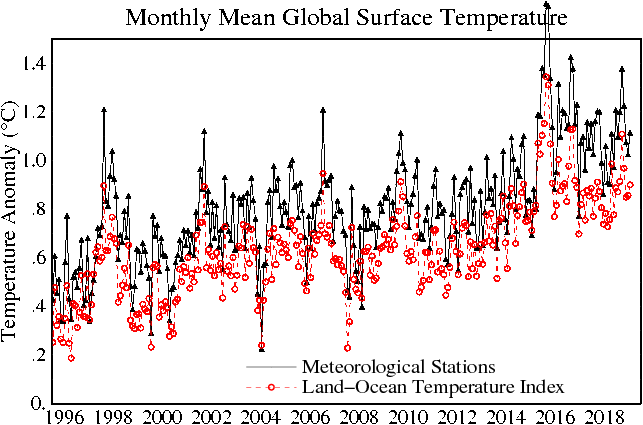
Looking across the last 16 years, Global Surface Temperature do not appear to have increased much at all.
For a longer term view, UK Met Office’s – Hadley Center – Climate Research Unit (CRU) Annual Global Average Land Temperature Anomaly – 1850 to 2011;

and the UK Met Office – Hadley Center – Climate Research Unit (CRU) Monthly Global Average Land Temperature – 1850 to 2011

Unless the arrival of “extreme weather” occurred in 1997-1998 with the well documented “very strong El Niño”, and the media is just realizing it, there does not seem to be a basis for the “extreme weather” claims in Earth’s recent Land and Surface Temperature record. There does not appear to be much recent change, and if anything the trend is down in the last few years. However, the surface temperature record is burdened with issues of questionable siting, changes in siting, changes in equipment, changes in the number of measurement locations, modeling to fill in gaps in measurement locations, corrections to account for missing, erroneous or biased measurements, and the urban heat island effect. Thus to see the big picture on the temperature “Earth’s Temperature”, it also helps to look up.
Atmospheric Temperatures:
Since 1979 Earth’s “temperature” has also been measured via satellite. “The temperature measurements from space are verified by two direct and independent methods. The first involves actual in-situ measurements of the lower atmosphere made by balloon-borne observations around the world. The second uses intercalibration and comparison among identical experiments on different orbiting platforms. The result is that the satellite temperature measurements are accurate to within three one-hundredths of a degree Centigrade (0.03 C) when compared to ground-launched balloons taking measurements of the same region of the atmosphere at the same time.” NASA
Here is RSS Global Temperature Lower Troposphere (TLT) – Brightness Temperature Anomaly- 1979 to Present;


and this is the University of Alabama – Hunstville (UAH) Global Lower Atmosphere Temperature Anomalies – 1979 to Present:

Note: Per John Christy, RSS and UAH anomalies are not comparable because they use different base periods, i.e., “RSS only uses 1979-1998 (20 years) while UAH uses the WMO standard of 1981-2010.”
The September UAH Lower Atmosphere Temperature Anomaly was .33 degrees C above the 30 year average and RSS Global Global Lower Troposphere shows a .133 degrees C increase per decade. “Earth’s Temperature” varies naturally by numerous degrees and has been significantly warmer than it is today:

Are we to believe that 3 or 4 tenths of a degree C warming over the last 30 years has brought us to the precipice of “extreme weather”? Seems implausible. Maybe there are significant regional variations that portended the arrival of “extreme weather”?
Looking at the RSS Northern Hemisphere Temperature Lower Troposphere (TLT) Brightness Temperature Anomaly;

and RSS Southern Hemisphere Temperature Lower Troposphere (TLT) Brightness Temperature Anomaly;

neither seem indicative of warming that would have caused “extreme weather” to arrive.
Furthermore, RSS Southern Polar Temperature Lower Troposphere (TLT) Brightness Temperature Anomaly;

is currently negative and shows a .013 K/C per decade decrease. Should we assume that Antarctica is experiencing less “extreme weather” at the moment?…
To this point we’ve only addressed the Lower Troposphere Temperatures, but one never knows where this “extreme weather” might be coming from, the following Temperature Anomaly plots from RSS will increase in altitude as is illustrated here:
Here is RSS Temperature Middle Troposphere (TMT)- Brightness Temperature Anomaly- 1979 to Present;

According to Remote Sensing Systems, “For Channel (TLT) (Lower Troposphere) and Channel (TMT) (Middle Troposphere), the anomaly time series is dominated by ENSO events and slow tropospheric warming. The three primary El Niños during the past 20 years are clearly evident as peaks in the time series occurring during 1982-83, 1987-88, and 1997-98, with the most recent one being the largest.” RSS
Middle Tropospheric temperatures appear to show slow warming overlaid with the El Niño/La Niña Southern Oscillation (ENSO) cycle, including several comparatively large El Niño events. Middle Tropospheric temperatures appear to have flattened since the large El Niño in 1998 and offer no indication of a recent change in Earth’s Temperature that could cause “extreme weather” to become the “new normal.
Moving higher in the atmosphere, RSS Temperature Troposphere / Stratosphere (TTS) – Brightness Temperature Anomaly- 1987 to Present;

has been flat since 1987, with a trend of just -.008 K/C per decade. Perhaps this is the “new normal”?…
The 1997-98 and 2009 – 10 El Niño events are still readily apparent in the Troposphere / Stratosphere plot above, as is a spike from the 1991 eruption of Mt. Pinatubo. Note that the effect of Mt. Pinatubo is the opposite in the Lower and Middle Troposphere versus the Troposphere / Stratosphere (TTS), i.e. “Large volcanic eruptions inject sulfur gases into the stratosphere; the gases convert into submicron particles (aerosol) with an e-folding time scale of about 1 year. The climate response to large eruptions (in historical times) lasts for several (2-3) years. The aerosol cloud causes cooling at the Earth’s surface, warming in stratosphere.”
Ellen Thomas, PHD Wesleyan University
It is interesting that, incorporating the impact of three significant surface driven warming events, Troposphere / Stratosphere Temperatures (TTS) have been quite stable, however there is a bit of regional variation here, e.g.:
RSS Northern Hemisphere Temperature Troposphere / Stratosphere (TTS) – Brightness Temperature Anomaly- 1987 to Present;

has been increasing by .044 K/C per decade, whereas the RSS Southern Hemisphere Temperature Troposphere / Stratosphere (TTS) – Brightness Temperature Anomaly- 1987 to Present;

has been decreasing by -.061 K/C per decade. However, Southern Hemisphere Troposphere / Stratosphere Temperature does show a significant increase in 2012, perhaps it is this increase that caused “extreme weather” to arrive? Or maybe not…
Moving higher still in the atmosphere, the RSS Temperature Lower Stratosphere (TLS) – Brightness Temperature Anomaly – 1979 to Present;

“is dominated by stratospheric cooling, punctuated by dramatic warming events caused by the eruptions of El Chichon (1982) and Mt Pinatubo (1991).” RSS
The eruptions of El Chichon and Mt Pinatubo are readily apparent in the Apparent Atmospheric Transmission of Solar Radiation at Mauna Loa, Hawaii:

“The stratosphere” … “in contrast to the troposphere, is heated, as the result of near infrared absorption of solar energy at the top of the aerosol cloud, and increased infra-red absorption of long-wave radiation from the Earth’s surface.”
“The stratospheric warming in the region of the stratospheric cloud increases the latitudinal temperature gradient after an eruption at low latitudes, disturbing the stratospheric-troposphere circulation, increasing the difference in height of the troposphere between high and low latitudes, and increasing the strength of the jet stream (polar vortex, especially in the northern hemisphere). This leads to warming during the northern hemisphere winter following a tropical eruption, and this warming effect tends to be larger than the cooling effect described above.” Ellen Thomas, PHD Wesleyan University
The Lower Stratosphere experienced “dramatic warming events caused by the eruptions of El Chichon (1982) and Mt Pinatubo (1991).” RSS “The long-term, global-mean cooling of the lower stratosphere stems from two downward steps in temperature, both of which are coincident with the cessation of transient warming after the volcanic eruptions of El Chichon and Mt. Pinatubo.” … “Here we provide observational analyses that yield new insight into three key aspects of recent stratospheric climate change. First, we provide evidence that the unusual step-like behavior of global-mean stratospheric temperatures is dependent not only upon the trend but also on the temporal variability in global-mean ozone immediately following volcanic eruptions. Second, we argue that the warming/cooling pattern in global-mean temperatures following major volcanic eruptions is consistent with the competing radiative and chemical effects of volcanic eruptions on stratospheric temperature and ozone. Third, we reveal the contrasting latitudinal structures of recent stratospheric temperature and ozone trends are consistent with large-scale increases in the stratospheric overturning Brewer-Dobson circulation” David W. J. Thompson Colorado State University
Above the Stratosphere we have the Mesosphere and Thermosphere, neither of which have I identified current temperature time series for, but of note is that on “July 15, 2010” “A Puzzling Collapse of Earth’s Upper Atmosphere” occurred when “high above Earth’s surface where the atmosphere meets space, a rarefied layer of gas called “the thermosphere” recently collapsed and now is rebounding again.”

“This is the biggest contraction of the thermosphere in at least 43 years,” says John Emmert of the Naval Research Lab, lead author of a paper announcing the finding in the June 19th issue of the Geophysical Research Letters (GRL). “It’s a Space Age record.”
The collapse happened during the deep solar minimum of 2008-2009—a fact which comes as little surprise to researchers. The thermosphere always cools and contracts when solar activity is low. In this case, however, the magnitude of the collapse was two to three times greater than low solar activity could explain.
“Something is going on that we do not understand,” says Emmert.
The thermosphere ranges in altitude from 90 km to 600+ km. It is a realm of meteors, auroras and satellites, which skim through the thermosphere as they circle Earth. It is also where solar radiation makes first contact with our planet. The thermosphere intercepts extreme ultraviolet (EUV) photons from the sun before they can reach the ground. When solar activity is high, solar EUV warms the thermosphere, causing it to puff up like a marshmallow held over a camp fire. (This heating can raise temperatures as high as 1400 K—hence the name thermosphere.) When solar activity is low, the opposite happens.” NASA
In summary, Earth’s Lower and Middle Troposphere appear to have warmed slowly, overlaid with the El Niño/La Niña Southern Oscillation (ENSO) cycle, including four comparatively large El Niño events, and tempered by the cooling effects of the eruption of El Chichon (1982) and Mt Pinatubo (1991). Lower and Middle Tropospheric temperatures appear to have flattened since the large El Niño in 1998 and offer no indication of changes that could be causing “extreme weather”. Tropospheric / Stratospheric temperatures appear to have been influenced by at least three significant surface driven warming events, the 1997-98 El Niño, and the eruptions of El Chichon in 1982 and Mt Pinatubo in 1991, but have maintained a stable overall trajectory. Stratospheric temperatures appear to have experienced two “dramatic warming events caused by the eruptions of El Chichon (1982) and Mt Pinatubo (1991).”, and “unusual step-like behavior of global-mean stratospheric temperatures” which has resulted in a significant stratospheric cooling during the last 30 years. Lastly, “during deep solar minimum of 2008-2009” “the biggest contraction of the thermosphere in at least 43 years” occurred and “The magnitude of the collapse was two to three times greater than low solar activity could explain.” Unless someone can demonstrate a causative relationship between “Climate Change”, the collapse of the thermosphere and “Extreme Weather”, there does not seem to be any support with the atmospheric temperature records for “extreme weather” arrival and “new normal” rhetoric.
Ocean Temperatures:
“The oceans can hold much more heat than the atmosphere. Just the top 3.2 metres of ocean holds as much heat as all the world’s air.” Commonwealth of Australia – Bureau of Meteorology
As such, changes in Ocean Heat Content are important in understanding “Earth’s Temperature”. Here is NOAA’s NODC Global Ocean Heat Content from 0-700 Meters – 1955 to Present;

and here is the same from Ole Humlum’s valuable climate data site Climate4you.com, NODC Global Ocean Heat Content – 0-700 Meters – 1979 to Present:

It seems apparent from the plots above that Global Ocean Heat has increased over the last several decades, however Global Ocean Heat does not appear to show a recent increase that could lead to “extreme weather”. Furthermore, in his recent article Bob Tisdale demonstrated that “sea surface temperatures for Sandy’s path haven’t warmed in 70+ years” WUWT.
Sea Level:
“Global sea level is currently rising as a result of both ocean thermal expansion and glacier melt, with each accounting for about half of the observed sea level rise, and each caused by recent increases in global mean temperature. For the period 1961-2003, the observed sea level rise due to thermal expansion was 0.42 millimeters per year and 0.69 millimeters per year due to total glacier melt (small glaciers, ice caps, ice sheets) (IPCC 2007). Between 1993 and 2003, the contribution to sea level rise increased for both sources to 1.60 millimeters per year and 1.19 millimeters per year respectively (IPCC 2007).” Source NSIDC
Global Mean Sea Level Change – 1993 to Present:

Global Mean Sea Level Change Map with a “Correction” of 0.3 mm/year added May, 5th 2011, due to a “Glacial Isostatic Adjustment (GIA)” – 1993 to Present:

It seems doubtful that “extreme weather” arrived because of the 5.5 Centimeter increase in Sea Level since 1993. Sandy’s storm surge topped “out at 14 feet (4.3 meters)” Huffington Post, would Sandy have been less extreme if the surge had only been 4.245 meters?…
Snow and Ice:
A proxy often cited when measuring “Earth’s Temperature” is amount of Snow and Ice on Earth. According to the United States Geological Survey (USGS), “The vast majority, almost 90 percent, of Earth’s ice mass is in Antarctica, while the Greenland ice cap contains 10 percent of the total global ice mass.” Source USGA
However, there is currently no generally accepted measure of ice volume, as Cryosat is still in validation and the accuracy of measurements from Grace are still being challenged. Sea Ice Area and Extent are cited as proxies for “Earth’s Temperature”, however there is significant evidence that the primary influences on Sea Ice Area and Extent are in fact wind and Atmospheric Oscillations. With this said, here are
Global, Arctic & Antarctic Sea Ice Area from 1979 to Present;

Global Sea Ice Area Anomaly – 1979 to Present:

Northern Hemisphere Sea Ice Area Anomaly, 1979 to Present;

Southern Hemisphere Sea Ice Area Anomaly, 1979 to Present;

Arctic Sea Ice Extent – 15% or greater

Antarctic Sea Ice Extent – 15% or Greater

There appears to have been a negative trend in Northern Hemisphere Sea Ice Area and Extent and a positive trend in Southern Hemisphere Sea Ice Area and Extent, thus the resultant Global Sea Ice Area trend appears to be slightly negative.
In terms of land based data, here is 20 Year Northern Hemisphere Snow Cover with 1995 – 2009 Climatology from NCEP/NCAR;

Northern Hemisphere Snow Cover Anomalies 1966 – Present from NCEP/NCAR;

Northern Hemisphere Winter Snow Extent – 1967 to Present from Rutgers University;

Northern Hemisphere Spring Snow Extent – 1967 to Present:

Northern Hemisphere Fall Snow Extent – 1967 to Present:

While none of the Snow plots offers a global perspective, when looking at the Northern Hemisphere, there appears to have been a slight increase in Snowcover and Winter Snow Extent, a decrease in Spring Snow Extent and no change in Fall Snow Extent over the historical record.
Based on the limited Global Ice and Snow measurements available, and noting the questionable value of Sea Ice Area and Extent as a proxy for temperature, not much inference can currently be drawn from Earth’s Ice and Snow measurements. However, there does not appear to be any evidence of change in Earth’s Ice and Snow measurements indicative of the arrival of “Extreme Weather”.
Conclusion:
There is no evidence of a recent increase in “Earth’s Temperature” due to “Climate Change,” which could have caused “Extreme Weather” to arrive and become the “new normal”. Claims and rhetoric that recent “Extreme Weather” is caused by or associated with “Climate Change” are not supported by the observational data.
Additional information on “Earth’s Temperature” can be found in the WUWT Reference Pages, including the Global Temperature Page and Global Climatic History Page
Please note that WUWT cannot vouch for the accuracy of the data/graphics within this article, nor influence the format or form of any of the graphics, as they are all linked from third party sources and WUWT is simply an aggregator. You can view each graphic at its source by simply clicking on it.
Extreme weather itself is not scientific either, me thinks. How do you measure extreme? Where is the cut?
Scott Supak (@ssupak) says: November 11, 2012 at 7:20 am
What a shame that people like Justthefactswuwt don’t go to Intrade and take the warmists’ money by betting on these things… I hear there are some really smug liberals there who refuse to face “the facts” as you have laid them out here!
https://www.intrade.com/v4/markets/?eventClassId=20
Seem like suckers bets to me, Earth’s climate system is ridiculously complex and we have a rudimentary understanding of it:
http://wattsupwiththat.com/2012/02/19/crowdsourced-climate-complexity-compiling-the-wuwt-potential-climatic-variables-reference-page/
“Earth’s Temperature” could increase, could decrease or could stay the same. “Prediction is very difficult, especially about the future.” – Niels Bohr
Mughal says: November 11, 2012 at 9:45 am
This is a very poorly reasoned post, certainly by WUWT standards. Looking at a graph and saying “it doesn’t look like” there’s extreme weather is completely unscientific. I’ve come to expect better from here.
Perhaps if you read the article you might have a different opinion… BTW, ‘“it doesn’t look like” there’s extreme weather’, doesn’t appear anywhere in the article. Building ’em straw-men and then knocking ’em down, very impressive…
Don’t see how intelligent people can consider global temperature an important issue with the world winding down to the end. (this should be obvious to everybody with common sense)
Mughal says:
November 11, 2012 at 9:45 am
This is a very poorly reasoned post, certainly by WUWT standards. Looking at a graph and saying “it doesn’t look like” there’s extreme weather is completely unscientific. I’ve come to expect better from here.
———–
I have seen this wording a number of times here on different threads. Another is “I thought this is a science blog”. Are these limp insults cut and paste from a climatist WUWT troll resource manual? They seem to be written by the same person. Are the true believers required to bear witness before the sinners one day per month like JW’s? Lazy was on duty yesterday.
(I do respect freedom of religion. Warmies not so much.)
I red the book STATE OF FEAR of MICHAEL CRICHTON in 2005. Yes it is a sciencefiction book, but so is GLOBAL WARMING.
“No, a rise of the global temperature of 2 or 5 degrees in 100 years will not convince people” said the marketing consultant to Greenpeace. “You must use the EXTREME WEATHER EVENTS, these happen every year and people have a bad memory . That will convince the market”.
So they did, especially now the temperature does not rise ar all.
So have there been more extreme weather events in recent years than historically? It doesn’t seem so to me, but this paper did not appear to mention anything about this.
RichardSCourtney gives a detailed explanation in this post explaining how there may be slight net warming of oxygen and nitrogen molecules resulting from prior absorption of IR by carbon dioxide molecules. Clearly he agrees that the effect is only slight.
But what then happens to the additional kinetic energy in the oxygen and nitrogen molecules? Well, firstly, assuming they are cooler than the surface below, the thermal energy cannot be transferred back to the surface by non-radiative processes. One way or another it must eventually escape to space.
But why to space? Don’t the energy diagrams show (more than) half being returned to the warmer surface by radiation? This is where the biggest misunderstand occurs. Radiation from a cooler source can do one and only one thing when it strikes a warmer surface. It slows the rate of that portion of surface cooling which is due to radiation. It does not do this by transferring heat to the surface. Because there is no heat transfer, there can be no slowing of non-radiative cooling processes. In fact, these processes can and do accelerate to compensate for the slower radiative cooling. What happens is that the energy in the radiation from the cooler atmosphere can only be used to supply equivalent energy to the surface which can only be used for the purpose of creating equivalent upwelling radiation with the same frequencies and intensities. This energy is thus used by the surface (instead of some of its own thermal energy) to meet some of its Planck “quota” of radiation. Its own Planck curve always fully contains the Planck curve of the radiation from the cooler atmosphere. But the radiation corresponding to the area above the ccoler Planck curve, but under the warmer one will transfer heat. This is an empirically confirmed result, demonstrated over and over again. The area between the Planck curves represents the one-way heat transfer from the warmer body to the cooler one. There is no physical heat transfer the other way. The radiation from the cooler body is immediately re-radiated without any of its electro-magnetic energy ever being converted to thermal energy in the target.
Hence most of the observed (or calculated) upwelling radiation from the surface is not actually transferring heat from the surface. Rather it is merely sending back the energy that was in the backradiation. The whole process is very-similar energy-wise to diffuse reflection.
What then are the consequences of this discussion? Well, firstly the heat that is transferred from the surface to the atmosphere is mostly transferred by non-radiative physical processes such as molecular collisions which may be called conduction or diffusion. Using K-T energy diagrams, and remembering that that the amount of backradiation should be deducted from the upwelling radiation from the surface (because this amount is not transferring energy from the surface) then we can calculate that less than 15% of all energy transferring from the surface to the atmosphere does so by radiation.
Now we start to see the role of carbon dioxide in perspective. For a start it probably has less than 1% the effect of all the water vapor which radiates with far more spectral lines and thus slows radiative cooling much more effectively. (Yes, low clouds do slow radiative cooling noticeably, but that doesn’t mean carbon dioxide’s effect will be noticeable.)
But, more importantly, the non-radiative cooling processes significantly dominate the actual transfer of energy from the surface to the atmosphere. Any slowing of radiative cooling will leave a bigger temperature “step down” between the surface and the adjoining air. So non-radiative cooling processes will simply accelerate (as physics tells us) and have a compensating effect. So there will be absolutely no net overall effect on surface cooling. That is reality.
Box of Rocks:
Thankyou for your comment at November 11, 2012 at 9:55 am in reply to the explanations I tried to provide for you at November 11, 2012 at 8:18 am.
I apologise that my explanation “make no sense”. It was the best I could do to provide a simple explanation in words the quantum effects.
I think the problem may be that you are asking about interaction of IR with an individual CO2 molecule. At least, that is the impression I gain from the question in your comment which asks me
Your equation is for the kinetic energy of a molecule which – as I explained – is not altered by absorbtion of a photon. As I said, the absorbtion raises the molecule to a higher energy state.
If my impression is correct then you may obtain the understanding you want from consideration of the bulk effects of IR absorbtion. As it happens,
davidmhoffer has outlined those issues in this thread in his posts at
November 10, 2012 at 7:08 pm,
November 11, 2012 at 8:47 am and
November 11, 2012 at 9:49 am.
Please read his posts and see if that helps. And please understand that I am trying to help.
Richard
justthefactswuwt says:
November 10, 2012 at 4:52 pm
LazyTeenager says: November 10, 2012 at 4:30 pm (Edit)
“Recently some research has been published that looks at the frequency of storm surges as measured by tidal gauges. The historical record they cover is quite long. Ocean storms are one facet of extreme weather. Guess what the conclusions were!”
Guess is all we can do, because you didn’t provide any evidence to support your assertions. Post links to facts that demonstrate higher temperatures have arrived and caused “Extreme Weather”. We await your evidence with bated breath…
I hope you’re not holding you breath jtf. We wouldn’t want anything bad to happen to you.
NaturalCyclist:
Your post at November 11, 2012 at 2:03 pm begins saying
I write to make clear to others that
(a) I agree your statement that I quote except that my explanation was not “detailed”
but
(b) the subsequent argument in your post is yours – not mine – and I do not agree it although I accept that it may be true.
Richard
Bevan asks-
What has happened to science throughout the world that research institutes, universities, editors and reviewers produce papers and predictions that are on a par with that of any astrologer or tarot card reader?
Well first you have to take control of the overarching paradigm in which new scientists coming through the system will find themselves operating under and on that note I’ll let Andrew Bolt describe exactly how it is in our neck of the woods-
http://blogs.news.com.au/heraldsun/andrewbolt/index.php/heraldsun/comments/how_did_journalism_courses_become_schools_for_the_left/
After a while the old school scientists retire and die off and astrology and tarot card reading becomes the new post normal science. What about your neck of the woods?
Davidmhoffer
I am trying to grips with this, please correct me if I am wrong::
1. The greater the altitude, the greater the forcing effect of rising CO2 levels will be on temperature.
2. The greater the humidity, the lesser the forcing effect will be on temperatures in response to rising CO2 levels.
3. The higher the original temperature, the lesser will be the forcing impact of rising CO2 levels.
4. The forcing effect of rising CO2 levels on temperature at the elevations at which most humans live is negligible when compared with that of water vapour.
And yet we have no idea of the temperature forcing ‘gradients’ in response to rising CO2 levels, or even if they are linear or exponential, of any of these factors in response to varying altitudes and humidity.
Hmm Well, good luck to anyone trying to design a computer model that can accurately model 1, 2 & 3 above.
Then there are the feedback factors, which no one really knows how to quantify or measure, except that that many IPCC authors seem to like to confuse those which are negative with.those which are positive feedbacks.
Obviously, this is all taken account of in the latest IPCC climate models!
PS You are right this does not add further discredit to CAGW theories, but it does indicate current climate models are………hmm, perhaps more than a tad lacking in their relation to reality.
justthefactswuwt says:
November 11, 2012 at 10:03 am
Volker Doormann says: November 11, 2012 at 4:03 am
“Conclusion:
There is no evidence of a recent increase in “Earth’s Temperature” due to “Climate Change,” which could have caused “Extreme Weather” to arrive and become the “new normal”.
Claims and rhetoric that recent “Extreme Weather” is caused by or associated with “Climate Change” are not supported by the observational data.”
That says nothing.
Ummm, it clearly say something. You may disagree with it and you may ignore it, but it is still there…
You are talking nonsense, because ‘no evidence’ is nothing, zero, no_thing. NO_thing is not still there, it is NOT.
There is evidence that the present (last ten years) global temperatures are on a high level in respect to temperatures thirty, hundred or four hundred years ago
.
Are you arguing that “Extreme Weather” kicked in “thirty, hundred or four hundred years ago” and we are just noticing it now?
No Sir.
Because weather is related to the global temperature it is not out of the question that the present greater heat power loading the Earth surface and atmosphere can have greater physical effects on the local weather.
It is also not out of the question that aliens will land on Earth today, but until someone presents some compelling evidence to support either possibility, the prudent course of action is to assume that both are not true.
A.) Irrelevant. Bifurcation, also referred to as the “black and white” fallacy and “false dichotomy,” bifurcation occurs if someone presents a situation as having only two alternatives, where in fact other alternatives exist or can exist. “
B.)“Ignoratio elenchi / Irrelevant conclusion. The fallacy of Irrelevant Conclusion consists of claiming that an argument supports a particular conclusion when it is actually logically nothing to do with that conclusion. Sadly, these kinds of irrelevant arguments are often successful, because they make people to view the supposed conclusion in a more favorable light.”
The claimed conclusion is a claim, but not an argument, because there is no reason argued.
That’s completely incoherent…
No Sir. “An argument is, to quote the Monty Python sketch, “a connected series of statements to establish a definite proposition.”
Many types of argument exist. Deductive arguments are generally viewed as the most precise and the most persuasive; they provide conclusive proof of their conclusion, and are either valid or invalid.”
Incoherence is the case if there is no reason argued which would have a coherence to the claim.
BTW. I have seen all the many graphs a hundred times. What do should tell me 30+ (copy/paste) graphs? I don’t know.
The graphs of current observational data are provided for the edification of our readers.
Yes,30+ public copy pasted data. But that is not the point. The point is that you claim a ‘conclusion’ without making the three stages: premises, inference, and conclusion.
I have shown to you an alternative to this copy paste stuff. You have ignored it.
I’m off.
V.
Here’s an Intrade bet that you won’t win, based on “the facts” so far:
Will Global Average Temperature for 2010-2014 exceed 2005-2009 by 0.1 degree C?
You likely won’t win it even with the last four words lopped off; i.e., even if it were a bet on the last five years (in two years and two months time) exceeding the previous five years by any amount..
Bevan says:
November 11, 2012 at 1:12 am
….That brings us to the crux of the matter, namely, that the rapidly increasing human population is unsustainable under current economic, industrial and political conditions irregardless of what happens to the climate.
>>>>>>>>>>>>>>>>>>>>>>>>>>>>>>>>>>>>>>>>>>>>>>>>>>>>>>>
That is true only if the CAGW/Neo-luddites insist on pushing us back into an era of scare energy resources, sequestering of the plant food called CO2 and government controlled science continues to be used for propaganda instead of increasing the standard of living.. With higher CO2 levels, modern agricultural techniques and nuclear power (especially mini thorium power plants ) the world can feed the increasing population. The USA has pretty much HALVED the amount of land needed to produce a bushel of corn or wheat link getting rid of the idiocy of using crops for bio-fuels would certainly help. link (One of the few times I agree with the NY Times)
A high standard of living/education yields a low to negative population growth. link “…Global fertility rates are in general decline and this trend is most pronounced in industrialized countries, especially Western Europe, where populations are projected to decline dramatically over the next 50 years….” The world population is expected to peak and then decline IF we manage to drag the backward countries on the top of the list into the 21 Century. The best birth control is education and a decent standard of living and it is working. From 360.org of all places – A generation ago, the world fertility rate was around six kids per woman. Today it is 2.6, which is getting close to the level needed just to maintain the current population long-term. Allowing for girls who don’t make it to adulthood, that is around 2.3.
I consider the whole “sustainability craze” another government scam. Sure we should farm in an intelligent manner (grass strips, windbreaks, no-till, overseed for the winter with green manure, rotate crops/livestock) recycle and use stuff wisely but just because mankind uses a material does not mean it “vanishes” Heck the earth is a giant recycling machine with oceanic trenches, subducting slabs and volcanoes.
NaturalCyclist says:
November 11, 2012 at 3:36 am
In this comment I discuss reasons for the above-mentioned cooling since 1998.
__________________________________
Gerard Roe’s recent update on the Milankovitch cycles points out that there has been a trivial mistake.
Now apply the same reasoning to what we are seeing in temperature. Numerous times skeptics have pointed out that the Rate of Change in the temperature increase since the Little Ice age has not changed…. but now it has with 15 years of NO Change in temperature. – Think about it.
Volker Doormann says:
November 11, 2012 at 4:03 am
….That says nothing.
There is evidence that the present (last ten years) global temperatures are on a high level in respect to temperatures thirty, hundred or four hundred years ago….
_________________________
ERRRrrr, I am afraid you are wrong.
This is the big lie, that the earth is “warming” when in actual fact we are in an overall cooling trend with a bit of noise added in. (+/- 1C is noise and in most cases the error is that great or greater despite what the Climastrologist want us to believe.)
graph and this graph from John Daly’s website link
Peter Miller says:
November 11, 2012 at 3:09 pm
Davidmhoffer
I am trying to grips with this, please correct me if I am wrong::
>>>>>>>>>>>>>>>>>>>>>
You’re not wrong per se. The problem is trying to summarize a rather complex issue into brief blog posts.
1. The greater the altitude, the greater the forcing effect of rising CO2 levels will be on temperature.
REPLY – The forcing effect remains the same, but becomes more significant in comparison to water vapour. Think of it as a ratio (I’m making numbers up for illustrative purposes). Suppose at sea level the effects of water vapour are 10,000 and CO2 is 1. Total is 10,001. Big deal. But at high altitude, water vapour is 1 and CO2 is also 1. Total is 2, double water vapour alone. That may sound small, but remember that you also have to take into account the shear scale of the atmospheric air column. A photon travelling upward may have to be absorbed and re-emitted hundreds or thousands of times before it escapes, even considering just that portion above the layer at which water vapour is significant. So, 2 is a lot more than 1, even though 10,001 is pretty much the same as 10,000.
2. The greater the humidity, the lesser the forcing effect will be on temperatures in response to rising CO2 levels.
REPLY – per above, the significance of CO2 at a given humidity is what changes.
3. The higher the original temperature, the lesser will be the forcing impact of rising CO2 levels.
REPLY – the higher the original temperature, the less it will change for a given forcing in w/m2. CO2 forcing in w/m2 isn’t uniform as it has more to work with at higher temps…but then it saturates sooner…and then again CO2’s affects are logarithmic, meaning they are subject to the law of diminishing returns. This is why the IPCC talks about “doubling” without going into a lot of detail as to what that means. CO2 doubling = 3.7 w/m2 = +1 degree. OK, starting from where? Starting from where we are now, about 400, we’d need to get to 800 for +1 degree. But to get to +2 degrees we’d need to get to 1600 ppm and to get to 3 degrees we’d need to get to 3200 ppm. This is a big part of what makes the whole “run away warming” meme nonsense, but the warmists will always counter with feedback discussions (which is a whole other complexity unto itself)
4. The forcing effect of rising CO2 levels on temperature at the elevations at which most humans live is negligible when compared with that of water vapour.
REPLY – I’d agree with that, certainly the data seems to support that. The question is what happens to the system as a whole? The CAGW meme is based on a combination of feedbacks and changes to the lapse rate that they insist result in elevated temperatures at surface. I don’t buy that, the explanations of the physical processes which would result in this don’t make sense to me and the data we ought to be able to measure by now doesn’t seem to be there.
If you want to dig deeper into this stuff, I suggest chapters 2 and 10 of IPCC AR4 WG1. Most certainly a dry read, but if you wade through it, you’ll be rather surprised at how much of this stuff they admit to, but spin into a completely different story to the media.
Peter Miller;
If you read nothing else, read this:
http://www.ipcc.ch/publications_and_data/ar4/wg1/en/ch2s2-9-1.html
The IPCC openly admits that their level of scientific understanding of almost all the factors regarding radiative forcing are either “low” or “very low”. That’s just radiative forcing issues! They also openly admit that they can’t model ENSO or cloud feedback processes. How anyone can claim anything with any certainty regarding surface temps while simultaneously admitting that they don’t know how must of the system as a whole works it beyond me.
“Scientists have been warning us of extreme weather for years” — you really mean since global warming stopped a decade and a half ago. How come they can’t predict anything right “before” it happens, only after then claim that it fits in with CAGW nicely and all the models have shown it to be. TOTAL BS
davidmhoffer says:
November 11, 2012 at 5:17 pm
Peter Miller says:
November 11, 2012 at 3:09 pm
Davidmhoffer
I am trying to grips with this, please correct me if I am wrong::
>>>>>>>>>>>>>>>>>>>>>
You’re not wrong per se. The problem is trying to summarize a rather complex issue into brief blog posts.
1. The greater the altitude, the greater the forcing effect of rising CO2 levels will be on temperature.
REPLY – The forcing effect remains the same, but becomes more significant in comparison to water vapour. Think of it as a ratio (I’m making numbers up for illustrative purposes). Suppose at sea level the effects of water vapour are 10,000 and CO2 is 1. Total is 10,001. Big deal. But at high altitude, water vapour is 1 and CO2 is also 1. Total is 2, double water vapour alone. That may sound small, but remember that you also have to take into account the shear scale of the atmospheric air column. A photon travelling upward may have to be absorbed and re-emitted hundreds or thousands of times before it escapes, even considering just that portion above the layer at which water vapour is significant. So, 2 is a lot more than 1, even though 10,001 is pretty much the same as 10,000.
A couple of mopre questions….
Is it the same photon that gets absorbs and re-emitted or is it the just the same quanta of energy?
Seems to me that once the photon is absorbed, it is no longer a photon.
Also, is the process of absorption/remittance a 100% efficient? If it is not, what happens to the energy? I kinda of thinking of a ‘friction’ type thing going on…
What happens if the a quanta of energy does not make it to space and just goes into a big ‘black hole’ and is lost. How do you account for that?
I really dislike the use of “anomaly” implying a deviation from “normal”. Why not just say “variation” from some baseline, such as the value at some arbitrary date, or the average over a certain period. Similar issue with “forcing” to describe one of many inputs to a very complex system.
If I’m analyzing an electronic circuit, I don’t call the power supply voltage or the ambient temperature a “forcing”
may=many
Box of Rocks
A couple of more questions….
>>>>>>>>>>>>>>>
richardscourtney ~ over to you