
By WUWT regular “Just The Facts”
Recently there have been increased efforts to link “Climate Change” and “Extreme Weather” e.g., NOAA links extreme weather to climate change CBS – July 10, 2012, “NASA scientist links climate change, extreme weather” CNN – August 6, 2012 and Get used to ‘extreme’ weather, it’s the new normal The Guardian – September 19, 2012. Per the Guardian article, “Scientists have been warning us for years that a warmer planet would lead to more extreme weather, and now it’s arrived”. These “Extreme Weather” efforts have shifted into high gear with Sandy. Yesterday United Nations Secretary-General Ban Ki-moon said that “one of the lessons from Superstorm Sandy is the need for global action to deal with future climate shocks.” “He told the U.N. General Assembly on Friday that it is difficult to attribute any single storm to climate change, but the world already knows that “extreme weather due to climate change is the new normal.” U.N. leader: Sandy a lesson in climate change CBS – November 9, 2012
All of these claims and “extreme weather” rhetoric seems to be predicated on the assumption that “Earth’s Temperature” has increased recently, thus causing “extreme weather” to arrive and become the “new normal”. However, does the observational data support this assumption? Let’s take a look…
Global Surface Temperatures:
Generally, when referring to Earth’s “climate” warming, proponents of the Catastrophic Anthropogenic Global Warming (CAGW) narrative refer to Earth’s Surface Temperature, e.g. “Global warming is the unusually rapid increase in Earth’s average surface temperature over the past century primarily due to the greenhouse gases released by people burning fossil fuels.” NASA Earth Observatory
As such, here’s NASA’s Goddard Institute for Space Studies (GISS) Global Monthly Mean Surface Temperature Anomaly – 1996 to Present:
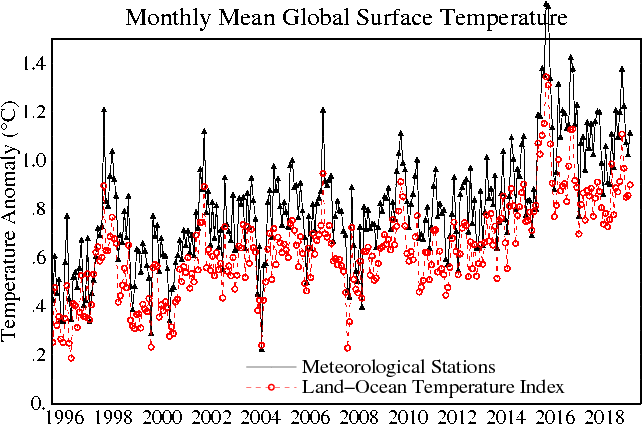
Looking across the last 16 years, Global Surface Temperature do not appear to have increased much at all.
For a longer term view, UK Met Office’s – Hadley Center – Climate Research Unit (CRU) Annual Global Average Land Temperature Anomaly – 1850 to 2011;

and the UK Met Office – Hadley Center – Climate Research Unit (CRU) Monthly Global Average Land Temperature – 1850 to 2011

Unless the arrival of “extreme weather” occurred in 1997-1998 with the well documented “very strong El Niño”, and the media is just realizing it, there does not seem to be a basis for the “extreme weather” claims in Earth’s recent Land and Surface Temperature record. There does not appear to be much recent change, and if anything the trend is down in the last few years. However, the surface temperature record is burdened with issues of questionable siting, changes in siting, changes in equipment, changes in the number of measurement locations, modeling to fill in gaps in measurement locations, corrections to account for missing, erroneous or biased measurements, and the urban heat island effect. Thus to see the big picture on the temperature “Earth’s Temperature”, it also helps to look up.
Atmospheric Temperatures:
Since 1979 Earth’s “temperature” has also been measured via satellite. “The temperature measurements from space are verified by two direct and independent methods. The first involves actual in-situ measurements of the lower atmosphere made by balloon-borne observations around the world. The second uses intercalibration and comparison among identical experiments on different orbiting platforms. The result is that the satellite temperature measurements are accurate to within three one-hundredths of a degree Centigrade (0.03 C) when compared to ground-launched balloons taking measurements of the same region of the atmosphere at the same time.” NASA
Here is RSS Global Temperature Lower Troposphere (TLT) – Brightness Temperature Anomaly- 1979 to Present;


and this is the University of Alabama – Hunstville (UAH) Global Lower Atmosphere Temperature Anomalies – 1979 to Present:

Note: Per John Christy, RSS and UAH anomalies are not comparable because they use different base periods, i.e., “RSS only uses 1979-1998 (20 years) while UAH uses the WMO standard of 1981-2010.”
The September UAH Lower Atmosphere Temperature Anomaly was .33 degrees C above the 30 year average and RSS Global Global Lower Troposphere shows a .133 degrees C increase per decade. “Earth’s Temperature” varies naturally by numerous degrees and has been significantly warmer than it is today:

Are we to believe that 3 or 4 tenths of a degree C warming over the last 30 years has brought us to the precipice of “extreme weather”? Seems implausible. Maybe there are significant regional variations that portended the arrival of “extreme weather”?
Looking at the RSS Northern Hemisphere Temperature Lower Troposphere (TLT) Brightness Temperature Anomaly;

and RSS Southern Hemisphere Temperature Lower Troposphere (TLT) Brightness Temperature Anomaly;

neither seem indicative of warming that would have caused “extreme weather” to arrive.
Furthermore, RSS Southern Polar Temperature Lower Troposphere (TLT) Brightness Temperature Anomaly;

is currently negative and shows a .013 K/C per decade decrease. Should we assume that Antarctica is experiencing less “extreme weather” at the moment?…
To this point we’ve only addressed the Lower Troposphere Temperatures, but one never knows where this “extreme weather” might be coming from, the following Temperature Anomaly plots from RSS will increase in altitude as is illustrated here:
Here is RSS Temperature Middle Troposphere (TMT)- Brightness Temperature Anomaly- 1979 to Present;

According to Remote Sensing Systems, “For Channel (TLT) (Lower Troposphere) and Channel (TMT) (Middle Troposphere), the anomaly time series is dominated by ENSO events and slow tropospheric warming. The three primary El Niños during the past 20 years are clearly evident as peaks in the time series occurring during 1982-83, 1987-88, and 1997-98, with the most recent one being the largest.” RSS
Middle Tropospheric temperatures appear to show slow warming overlaid with the El Niño/La Niña Southern Oscillation (ENSO) cycle, including several comparatively large El Niño events. Middle Tropospheric temperatures appear to have flattened since the large El Niño in 1998 and offer no indication of a recent change in Earth’s Temperature that could cause “extreme weather” to become the “new normal.
Moving higher in the atmosphere, RSS Temperature Troposphere / Stratosphere (TTS) – Brightness Temperature Anomaly- 1987 to Present;

has been flat since 1987, with a trend of just -.008 K/C per decade. Perhaps this is the “new normal”?…
The 1997-98 and 2009 – 10 El Niño events are still readily apparent in the Troposphere / Stratosphere plot above, as is a spike from the 1991 eruption of Mt. Pinatubo. Note that the effect of Mt. Pinatubo is the opposite in the Lower and Middle Troposphere versus the Troposphere / Stratosphere (TTS), i.e. “Large volcanic eruptions inject sulfur gases into the stratosphere; the gases convert into submicron particles (aerosol) with an e-folding time scale of about 1 year. The climate response to large eruptions (in historical times) lasts for several (2-3) years. The aerosol cloud causes cooling at the Earth’s surface, warming in stratosphere.”
Ellen Thomas, PHD Wesleyan University
It is interesting that, incorporating the impact of three significant surface driven warming events, Troposphere / Stratosphere Temperatures (TTS) have been quite stable, however there is a bit of regional variation here, e.g.:
RSS Northern Hemisphere Temperature Troposphere / Stratosphere (TTS) – Brightness Temperature Anomaly- 1987 to Present;

has been increasing by .044 K/C per decade, whereas the RSS Southern Hemisphere Temperature Troposphere / Stratosphere (TTS) – Brightness Temperature Anomaly- 1987 to Present;

has been decreasing by -.061 K/C per decade. However, Southern Hemisphere Troposphere / Stratosphere Temperature does show a significant increase in 2012, perhaps it is this increase that caused “extreme weather” to arrive? Or maybe not…
Moving higher still in the atmosphere, the RSS Temperature Lower Stratosphere (TLS) – Brightness Temperature Anomaly – 1979 to Present;

“is dominated by stratospheric cooling, punctuated by dramatic warming events caused by the eruptions of El Chichon (1982) and Mt Pinatubo (1991).” RSS
The eruptions of El Chichon and Mt Pinatubo are readily apparent in the Apparent Atmospheric Transmission of Solar Radiation at Mauna Loa, Hawaii:

“The stratosphere” … “in contrast to the troposphere, is heated, as the result of near infrared absorption of solar energy at the top of the aerosol cloud, and increased infra-red absorption of long-wave radiation from the Earth’s surface.”
“The stratospheric warming in the region of the stratospheric cloud increases the latitudinal temperature gradient after an eruption at low latitudes, disturbing the stratospheric-troposphere circulation, increasing the difference in height of the troposphere between high and low latitudes, and increasing the strength of the jet stream (polar vortex, especially in the northern hemisphere). This leads to warming during the northern hemisphere winter following a tropical eruption, and this warming effect tends to be larger than the cooling effect described above.” Ellen Thomas, PHD Wesleyan University
The Lower Stratosphere experienced “dramatic warming events caused by the eruptions of El Chichon (1982) and Mt Pinatubo (1991).” RSS “The long-term, global-mean cooling of the lower stratosphere stems from two downward steps in temperature, both of which are coincident with the cessation of transient warming after the volcanic eruptions of El Chichon and Mt. Pinatubo.” … “Here we provide observational analyses that yield new insight into three key aspects of recent stratospheric climate change. First, we provide evidence that the unusual step-like behavior of global-mean stratospheric temperatures is dependent not only upon the trend but also on the temporal variability in global-mean ozone immediately following volcanic eruptions. Second, we argue that the warming/cooling pattern in global-mean temperatures following major volcanic eruptions is consistent with the competing radiative and chemical effects of volcanic eruptions on stratospheric temperature and ozone. Third, we reveal the contrasting latitudinal structures of recent stratospheric temperature and ozone trends are consistent with large-scale increases in the stratospheric overturning Brewer-Dobson circulation” David W. J. Thompson Colorado State University
Above the Stratosphere we have the Mesosphere and Thermosphere, neither of which have I identified current temperature time series for, but of note is that on “July 15, 2010” “A Puzzling Collapse of Earth’s Upper Atmosphere” occurred when “high above Earth’s surface where the atmosphere meets space, a rarefied layer of gas called “the thermosphere” recently collapsed and now is rebounding again.”

“This is the biggest contraction of the thermosphere in at least 43 years,” says John Emmert of the Naval Research Lab, lead author of a paper announcing the finding in the June 19th issue of the Geophysical Research Letters (GRL). “It’s a Space Age record.”
The collapse happened during the deep solar minimum of 2008-2009—a fact which comes as little surprise to researchers. The thermosphere always cools and contracts when solar activity is low. In this case, however, the magnitude of the collapse was two to three times greater than low solar activity could explain.
“Something is going on that we do not understand,” says Emmert.
The thermosphere ranges in altitude from 90 km to 600+ km. It is a realm of meteors, auroras and satellites, which skim through the thermosphere as they circle Earth. It is also where solar radiation makes first contact with our planet. The thermosphere intercepts extreme ultraviolet (EUV) photons from the sun before they can reach the ground. When solar activity is high, solar EUV warms the thermosphere, causing it to puff up like a marshmallow held over a camp fire. (This heating can raise temperatures as high as 1400 K—hence the name thermosphere.) When solar activity is low, the opposite happens.” NASA
In summary, Earth’s Lower and Middle Troposphere appear to have warmed slowly, overlaid with the El Niño/La Niña Southern Oscillation (ENSO) cycle, including four comparatively large El Niño events, and tempered by the cooling effects of the eruption of El Chichon (1982) and Mt Pinatubo (1991). Lower and Middle Tropospheric temperatures appear to have flattened since the large El Niño in 1998 and offer no indication of changes that could be causing “extreme weather”. Tropospheric / Stratospheric temperatures appear to have been influenced by at least three significant surface driven warming events, the 1997-98 El Niño, and the eruptions of El Chichon in 1982 and Mt Pinatubo in 1991, but have maintained a stable overall trajectory. Stratospheric temperatures appear to have experienced two “dramatic warming events caused by the eruptions of El Chichon (1982) and Mt Pinatubo (1991).”, and “unusual step-like behavior of global-mean stratospheric temperatures” which has resulted in a significant stratospheric cooling during the last 30 years. Lastly, “during deep solar minimum of 2008-2009” “the biggest contraction of the thermosphere in at least 43 years” occurred and “The magnitude of the collapse was two to three times greater than low solar activity could explain.” Unless someone can demonstrate a causative relationship between “Climate Change”, the collapse of the thermosphere and “Extreme Weather”, there does not seem to be any support with the atmospheric temperature records for “extreme weather” arrival and “new normal” rhetoric.
Ocean Temperatures:
“The oceans can hold much more heat than the atmosphere. Just the top 3.2 metres of ocean holds as much heat as all the world’s air.” Commonwealth of Australia – Bureau of Meteorology
As such, changes in Ocean Heat Content are important in understanding “Earth’s Temperature”. Here is NOAA’s NODC Global Ocean Heat Content from 0-700 Meters – 1955 to Present;

and here is the same from Ole Humlum’s valuable climate data site Climate4you.com, NODC Global Ocean Heat Content – 0-700 Meters – 1979 to Present:

It seems apparent from the plots above that Global Ocean Heat has increased over the last several decades, however Global Ocean Heat does not appear to show a recent increase that could lead to “extreme weather”. Furthermore, in his recent article Bob Tisdale demonstrated that “sea surface temperatures for Sandy’s path haven’t warmed in 70+ years” WUWT.
Sea Level:
“Global sea level is currently rising as a result of both ocean thermal expansion and glacier melt, with each accounting for about half of the observed sea level rise, and each caused by recent increases in global mean temperature. For the period 1961-2003, the observed sea level rise due to thermal expansion was 0.42 millimeters per year and 0.69 millimeters per year due to total glacier melt (small glaciers, ice caps, ice sheets) (IPCC 2007). Between 1993 and 2003, the contribution to sea level rise increased for both sources to 1.60 millimeters per year and 1.19 millimeters per year respectively (IPCC 2007).” Source NSIDC
Global Mean Sea Level Change – 1993 to Present:

Global Mean Sea Level Change Map with a “Correction” of 0.3 mm/year added May, 5th 2011, due to a “Glacial Isostatic Adjustment (GIA)” – 1993 to Present:

It seems doubtful that “extreme weather” arrived because of the 5.5 Centimeter increase in Sea Level since 1993. Sandy’s storm surge topped “out at 14 feet (4.3 meters)” Huffington Post, would Sandy have been less extreme if the surge had only been 4.245 meters?…
Snow and Ice:
A proxy often cited when measuring “Earth’s Temperature” is amount of Snow and Ice on Earth. According to the United States Geological Survey (USGS), “The vast majority, almost 90 percent, of Earth’s ice mass is in Antarctica, while the Greenland ice cap contains 10 percent of the total global ice mass.” Source USGA
However, there is currently no generally accepted measure of ice volume, as Cryosat is still in validation and the accuracy of measurements from Grace are still being challenged. Sea Ice Area and Extent are cited as proxies for “Earth’s Temperature”, however there is significant evidence that the primary influences on Sea Ice Area and Extent are in fact wind and Atmospheric Oscillations. With this said, here are
Global, Arctic & Antarctic Sea Ice Area from 1979 to Present;

Global Sea Ice Area Anomaly – 1979 to Present:

Northern Hemisphere Sea Ice Area Anomaly, 1979 to Present;

Southern Hemisphere Sea Ice Area Anomaly, 1979 to Present;

Arctic Sea Ice Extent – 15% or greater

Antarctic Sea Ice Extent – 15% or Greater

There appears to have been a negative trend in Northern Hemisphere Sea Ice Area and Extent and a positive trend in Southern Hemisphere Sea Ice Area and Extent, thus the resultant Global Sea Ice Area trend appears to be slightly negative.
In terms of land based data, here is 20 Year Northern Hemisphere Snow Cover with 1995 – 2009 Climatology from NCEP/NCAR;

Northern Hemisphere Snow Cover Anomalies 1966 – Present from NCEP/NCAR;

Northern Hemisphere Winter Snow Extent – 1967 to Present from Rutgers University;

Northern Hemisphere Spring Snow Extent – 1967 to Present:

Northern Hemisphere Fall Snow Extent – 1967 to Present:

While none of the Snow plots offers a global perspective, when looking at the Northern Hemisphere, there appears to have been a slight increase in Snowcover and Winter Snow Extent, a decrease in Spring Snow Extent and no change in Fall Snow Extent over the historical record.
Based on the limited Global Ice and Snow measurements available, and noting the questionable value of Sea Ice Area and Extent as a proxy for temperature, not much inference can currently be drawn from Earth’s Ice and Snow measurements. However, there does not appear to be any evidence of change in Earth’s Ice and Snow measurements indicative of the arrival of “Extreme Weather”.
Conclusion:
There is no evidence of a recent increase in “Earth’s Temperature” due to “Climate Change,” which could have caused “Extreme Weather” to arrive and become the “new normal”. Claims and rhetoric that recent “Extreme Weather” is caused by or associated with “Climate Change” are not supported by the observational data.
Additional information on “Earth’s Temperature” can be found in the WUWT Reference Pages, including the Global Temperature Page and Global Climatic History Page
Please note that WUWT cannot vouch for the accuracy of the data/graphics within this article, nor influence the format or form of any of the graphics, as they are all linked from third party sources and WUWT is simply an aggregator. You can view each graphic at its source by simply clicking on it.
Conclusion:
There is no evidence of a recent increase in “Earth’s Temperature” due to “Climate Change,” which could have caused “Extreme Weather” to arrive and become the “new normal”.
Claims and rhetoric that recent “Extreme Weather” is caused by or associated with “Climate Change” are not supported by the observational data.
That says nothing.
There is evidence that the present (last ten years) global temperatures are on a high level in respect to temperatures thirty, hundred or four hundred years ago.
Because weather is related to the global temperature it is not out of the question that the present greater heat power loading the Earth surface and atmosphere can have greater physical effects on the local weather.
However, this does not mean that the present high level is man made.
The claimed conclusion is a claim, but not an argument, because there is no reason argued.
BTW. I have seen all the many graphs a hundred times. What do should tell me 30+ (copy/paste) graphs? I don’t know.
. The term ‘climate’ is a social defined local term and says nothing; same with ‘climate change’.
The causes of the heat power frequencies in the range of 100 ky to 0.1 year and its magnitudes to supply the terrestrial global temperatures are still unknown and not mentioned in all the data, neither explained.
I think it would be great to explain the physical causes of heat power frequencies using one (or two) graph(s). It is evident that a spectrum of solar tide functions of 6, or 11, or 12 synodic couples can explain the terrestrial global temperature function.
http://www.volker-doormann.org/images/hadcrut3_vs_solar_tides.gif
http://www.volker-doormann.org/images/uah_rss_ghi11_r_oct.gif
V.
Needless to say, the real definition of Extreme is as follows:
Extreme weather is weather that strikes Manhattan Island. Normal weather is weather that does not strike Manhattan Island.
Thus the 1938 hurricane, of very similar size to Superstorm Snooki, was Normal Weather because it only hit a glancing blow to Manhattan Island. Agnes, also of similar size, was Normal Weather because it missed Manhattan Island. Superstorm Snooki is Extreme because it hit Manhattan Island hard.
HaroldW says:
November 10, 2012 at 12:02 pm
We must live in the best of all possible worlds, because in 1975 cooling was also anticipated to create more extreme weather.
>>>>>>>>>>>>>>>>>>>>>>>>>>>>>>>>>>>>>>
I am repeating that because it is close to reality and written by climate scientists before they were corrupted. It is also what we see happening today and for the last few years.
I have check the weather at Wunderground just about every day for close to twenty years. This includes the Jet stream which came straight from the Rockies to the Appalachian Mountains until a few years ago. As their animated graph shows the jets are in a “meridional circulation” pattern and have been for the last few years. This explains the Russian Drought, Pakistan Floods, US Midwest Drought and Sandy.
As is shown in this media spin piece the Climastrologists know darn well the Weird Weather is from the changes in the Jet stream but they are not about to fess-up and tell us this indicates the earth is going into a cooling cycle. Russian Drought, Pakistan Floods, Chinese Landslides All Linked To Bizarre Jet Stream Change Mon, 09 Aug 2010 17:45 CDT and for this year Europe Heat Wave Wilting Corn Adds to U.S. Drought Jul 24, 2012 1:32 PM GMT… The jet stream moved north over the U.S. and Canada and south under Europe… NOAA even links the change in the Jets to ENSO
But that does not stop climate scientist, Thomas Karl from the same organization, from pinning the blame on humans when interviewed by a reporter.
omnologos says:
November 10, 2012 at 12:12 pm
There is no scientific definition of “extreme weather”. What are we talking about when nobody knows what we’re talking about?
____________________________________
Actually you get “extreme weather” or stuff you can call “extreme weather” when the Jet Stream changes from polar (straight) to a meridional circulation pattern (loopy and wandering all over the place) A loopy jet means the weather is not as consistent.
When the Jets were polar I could look at the weather map and predict what weather we were going to get with decent accuracy. Witt a loopy Jet I have to look at the Jet stream and GUESS. (I was correct when I told my Saturday and Sunday customers to forget Sandy it would not hit mid North Carolina because of the jets and only one canceled )
I have also noticed the weather forecasts lately have been off more often for the exact same reason, loopy jets. It is a real pain when your business depends on the weather and the accuracy of the weather forecasts.
So we can conclude that the only significant warming is by hot air leaving activists’ mouths and the only extreme thing resulting from it is the height of the heap of bullshit they are stacking. This, however, is the new normal since the media is either complicit or out to lunch instead of calling them on the whole thing.
It referred to the change in Britain from the Julian to the (Pope) Gregorian calendar, which the Catholic countries of Europe had done much earlier. “Impious” probably alluded to following a Catholic standard.
The entire global warming scenario consists of assuming a desired answer and going to any extreme and dishonest convolutions to try and prove the answer correct completely disregarding and bastardizing science along the way.
Green Sand says:
November 10, 2012 at 1:54 pm
michaelspj says:
November 10, 2012 at 2:35 pm
….Solar-only proponents (and Dragon Slayers) have yet to explain the stratospheric cooling. I asked a prominent one (and one of the civil ones) about it and he admitted that he didn’t have an answer.
________________________________
If there was only one factor controlling climate we would have figured it out by now. The fact that we have not indicates climate is controlled by a lot of confounding factors. Changes in the sun energy as it falls on the earth is only one of those factors. Water in all its forms is another biggie as is the configuration of the continents and the geomagnetic field. (Without a magnetic field the earth could not deflect harmful energy and it does change The Gothenburg Magnetic Excursion )
With Climastrologists focused on CO2 as the quickest way to extract cash from taxpayer pockets investigation into the real causes of ‘climate change’ has been ignored or actively blocked.
Here is a stooopid question that I can not seem to find an answer to:
Once the CO2 molecule absorbs energy – what happens? I mean like really does it warm up and stay warm? Or, does it warm up then release energy to cool off? If it cools off and releases energy and warms the surrounding molecules, how much ‘extra’ energy can they absorb before they start to cool. Space is very cold and devoid of energy so the thermo has to kick in sometime. And if that is the path of energy what happens to that energy? What happens if there is more IR radiation available then CO2 molecules?
Is there a limit to how much the atmosphere can absorb? Is there a physical limit to the distance from the earth’s surface at which IR energy becomes ineffective? Is all IR energy available for absorption by GHGs even absorbed?
IS all energy the same? Or, is the energy there and be accounted for, but it just does not have any effect on the temperature?
It just seems to me that the energy pathway for the IR to CO2 to atmosphere is talked about alot yet I fail to find anything real explanation of the pathways.
Tanx!
michaelspj says: November 10, 2012 at 2:35 pm
The point on surface warming is not “whether” but “how much”, which increasingly appears to be “not much” despite the surety of Kevin Trenberth….
____________________________
Unfortunately since you are close to my age you may not live long enough to eat those words but your grandkids will. As this paleotemperature graph above shows the Holocene has been very steady in temperature. However it also shows we are towards the end of the Holocene and even if the TSI from the sun is constant as Dr. Leif Svalgaard keeps insisting, the amount falling on the earth is not as Milankovitch has shown and Gerard Roe has recently reminded us. link Here is the graph showing we are at about the bottom of the decrease in ice.
Another paper:
According to NASA and the Solar Dynamics Observatory Mission News
The Greenland ice core paleotemperature graph (10,000 yrs) and the Vostok ice core paleotemperature graph (10,000 yrs) both show a gradual cooling.
As Dennis Nikols said @ur momisugly November 10, 2012 at 2:03 pm, geologists and most non politicized/dogmatized earth scientists understand time and history.
So yes we had a minor excursion up in the historic temperature record but the general trend is DOWN in the geologic record.
Merovign says:
November 10, 2012 at 3:09 pm
….You know, if we had a press corps even half awake we would not have got this far. Not to mention the cliquish “identity scientists.”
>>>>>>>>>>>>>>>>>>>>>>>>>>>>>>>>>>>>>>>>>>>>>>>>>>>>
The Media was subject to a massive propaganda campaign. Just do a search on the words [“Communicating Climate Change” 2006] and see how many conferences there were to which the press was invited.
The fact we are seen as being a [“well-funded, professional climate deniers”] is utterly laughable but that is the belief being pushed…. Interesting when you start typing [climate deniers] in Google the first thing to pop-up to finish the phrase is [climate deniers mentally ill] SHEESH
The despots of the world have used propaganda, misdirection, and a well spoken puppet whose name currently escapes my lips, but will be up against a formidable opponent next week, to feed the sheep of the world. What these despots ultimate goal is well only they know and what ever it is, it will not bode well for humanity.
Robert says:
November 10, 2012 at 3:49 pm
“We act on behalf of the Global Warming Industry”
Very clever Peter. My favourite group of litigation lawyers is Hotch, Potch, and Balzup,
>>>>>>>>>>>>>>>>>>>>>>>>>
I always likes Dewey, Cheatham and Howe.
What a shame that people like Justthefactswuwt don’t go to Intrade and take the warmists’ money by betting on these things… I hear there are some really smug liberals there who refuse to face “the facts” as you have laid them out here!
https://www.intrade.com/v4/markets/?eventClassId=20
Box of Rocks:
At November 11, 2012 at 5:47 am you ask
Your questions are not “stooopid” and others may be interested so I write to provide brief answers to the vast subject which you raise. I take your questions in turn.
Once the CO2 molecule absorbs energy – what happens?
I am assuming you are asking about an atmospheric CO2 molecule absorbing the energy of an IR photon. In that case, the molecule is raised to a higher energy state; i.e. a ‘bending’ vibration state or a rotational state.
I mean like really does it warm up and stay warm?
It does not change its kinetic energy so it does not warm: it obtains a higher vibrational or rotational energy state and is said to be “excited”. (The temperature of a gas is the average kinetic energy of its molecules.)
Or, does it warm up then release energy to cool off?
The excited molecule usually releases a photon (in a random direction) to lose its excitation (i.e. its vibrational or rotational) energy. This loss of energy returns it to its ground state (i.e. returns it to its not excited state). However, it may be returned to its ground state by collision with another molecule. There is a period of time between its absorbtion of a photon and its release of another photon, and it may collide with another molecule during that time. It may transfer its excitation energy to the other molecule and thus return to its ground state.
If it cools off and releases energy and warms the surrounding molecules, how much ‘extra’ energy can they absorb before they start to cool.
Your question is not clear to me so I will answer what I think you are asking.
Most molecules in the atmosphere are nitrogen (N2) and oxygen (O2). Hence, a CO2 molecule which collides with another molecule is very likely to collide with an N2 or O2 molecule. And N2 and O2 are not greenhouse gases so (simplistically) they do not absorb IR photons and do not have excitation states. Therefore, a CO2 molecule which returns to its ground state by collision with an N2 or O2 molecule adds kinetic energy to the N2 or O2 molecule and, thus, warms the atmosphere. Additionally, it should be noted that a CO2 molecule (or any other greenhouse gas molecule) can accept energy from a collision and, thus, become excited without absorbing a photon. However, (again, simplistically) only greenhouse gas molecules absorb IR photons and, therefore, on average the greenhouse gas molecules will have more energy than N2 or O2 molecules so the net effect of collisions is to warm the N2 and O2 molecules.
Space is very cold and devoid of energy so the thermo has to kick in sometime. And if that is the path of energy what happens to that energy?
The only way significant amounts of energy can be lost to space is by radiation. Photons are quanta of radiation. Photons from CO2 molecules are released in all directions so about half will be released towards space. If not absorbed in the atmosphere then they escape to space.
What happens if there is more IR radiation available then CO2 molecules?
CO2 molecules in the atmosphere only absorb IR in two narrow wave bands around 15 microns and 4 microns. Almost all is absorbed in the 15 micron band. Water vapour (H2O) absorbs across all the IR spectrum including over the bands which CO2 absorbs. Hence, almost all the IR which CO2 can absorb in the atmosphere is absorbed, and this is why additional atmospheric CO2 has no discernible effect on the absorbtion: it is not possible to absorb more than all. Additional atmospheric CO2 induces some band broadening which enables the small additional IR absorbtion (i.e. additional greenhouse effect) of additional CO2.
I think the above answers include answers to your other questions. If not – or if my answers are not clear – then please get back to me.
I hope this helps.
Richard
“What has happened to science throughout the world that research institutes, universities, editors and reviewers produce papers and predictions that are on a par with that of any astrologer or tarot card reader? When are the taxpayers of the world going to wake up to the giant scam that is being perpetrated by the UN/IPCC to the great benefit of the associated bureaucrats who are using the same methods of pending doom to control the populace as did the high priests of ancient Egypt?”
Yup ALL real science will suffer for these charlatans. A taste of the dark ages is soon to come.
As I was writing about this topic in another post on another site, a quip went through my mind for a one line zinger: “The most common sound heard within the empty crania of Global Warmists is the “whooosh” of facts rocketing straight over their heads.” Yeah, Lazy, I’m talkin’ about you…
Peter Miller says:
November 11, 2012 at 2:31 am
Davidmhoffer says:
I did not know this – do you have any references? – as it blows a huge hole in CAGW theory.
>>>>>>>>>>>>
My explanation is just basic physics. Look up Stefan-Boltzmann Law in any physics text book or even in sketchy information resources such as wikipedia.
This doesn’t blow the hole in CAGW theory per se. It is part of the physics that the IPCC accepts. But the manner in which the science is represented by them is rather confusing.
Wow. I guess the 10s of millions of people who died from natural disaster but less “extreme weather” last century before the co2 onslaught would have been much higher if the “extreme weather” we are having now had struck them. I mean just think of the flood that killed 10 million people last century strikes china again this year? What about the droughts that killed millions in Africa last century happen now? Or the hurricanes that killed millions. Jeesh these storms today are so much worse than what people had to deal with in the calm weather of the past. I wonder where these terms like tropical cyclone even came about before global warming because I have the impression that weather in the past was this bucolic lovely thing that was never extreme. Just one lovely day to the next until co2 came into the picture.
This is a very poorly reasoned post, certainly by WUWT standards. Looking at a graph and saying “it doesn’t look like” there’s extreme weather is completely unscientific. I’ve come to expect better from here.
Peter Miller;
Suggest also that you read richardscourtney’s explanation at 8:18AM.
Stefan-Boltzmann Law describes the behaviour of the system as a whole. Since the amount of energy that the earth system as a whole absorbs from the Sun is unchanged by the increase in CO2, then for energy to balance, the amount of energy radiated from the earth system as a whole to space also doesn’t change. What does change is the path any given photon takes from earth surface to space.
richardscourtney’s summarizes this nicely. I think he left out one issue. At sea level in the tropics, water vapour may be as much as 40,000 ppm while CO2 is only 400 ppm. So Richard is quite correct to point out that water vapour’s absorption spectrum not only overlaps CO2’s, but given the relative concentrations, makes CO2 a rounding error.
That said, when we consider higher elevations, things change. At 14,000 feet, even above the tropics, temperatures are more like -20C. Air that cold can hold a few hundred ppm of H2O at most, so at higher elevations, the effects of CO2 absorbing and re-radiating photons rises to a significant percentage in comparison to water vapour. Similarly, high latitudes are cold at any elevation, and hence have little water vapour at any elevation, so CO2’s effects are more pronounced.
All of the above however doesn’t take into account secondary processes. If CO2 intercepts some photons at elevation, re-radiating them so some of them escape to space from a different elevation than they otherwise would have, plus xferring some energy to non-radiating gases such as N2, then there must be follow on effects in terms of changes to convection and so on also. Figuring out those is above my pay grade.
richardscourtney says:
November 11, 2012 at 8:18 am
”
Once the CO2 molecule absorbs energy – what happens?
I am assuming you are asking about an atmospheric CO2 molecule absorbing the energy of an IR photon. In that case, the molecule is raised to a higher energy state; i.e. a ‘bending’ vibration state or a rotational state.
I mean like really does it warm up and stay warm?
It does not change its kinetic energy so it does not warm: it obtains a higher vibrational or rotational energy state and is said to be “excited”. (The temperature of a gas is the average kinetic energy of its molecules.)
”
Yes, I am wondering about atmospheric CO2.
And no, it make no sense. To me, you have described what “happens” i.e. the physics of how how,
So what you are saying that when a N2 molecule collides with a CO2 molecule energy is transferred.
How? How much? is 100% of the ‘excess’ energy transferred all the time or is just some (that varies) transferred some of the time? Is there a mathematical model that one could use to model the system and track the energy?
How does one define the energy of a molecule. It has to be more than just KE = 1/2MV^2, right?
A history of earth’s extreme weather can be found at:
http://books.google.com/books?id=RaFcPgAACAAJ&dq=a+general+chronological+history+of+the+air&hl=en&sa=X&ei=f-SfUKuwOePC0QHx14CIAQ&ved=0CDMQ6AEwAQ
Here’s an interesting entry:
“Was an exessive hot and droughty summer in England, etc. Navigable rivers were so dried up in many places that they might be walked over on foot. Fountains and wells in France were so dried that many laborers died of thirst. From the excessive heat, many towns took fire, and were totally burnt down, as Moguntia, Spira, Glossaria, all the same day. Trithem. Chr. Saxon. Vincent. Martin. Polonus.
From this drought and the inexpressible cruelties and barbarities of King Stephen’s reign, arose a great dearth and famine in England.” Year 1137.
This book (in 2 volumes) is filled with weather and earthquake calamaties starting in Biblical times and ending in the 18th century.
Volker Doormann says: November 11, 2012 at 4:03 am
That says nothing.
Ummm, it clearly say something. You may disagree with it and you may ignore it, but it is still there…
There is evidence that the present (last ten years) global temperatures are on a high level in respect to temperatures thirty, hundred or four hundred years ago.
Are you arguing that “Extreme Weather” kicked in “thirty, hundred or four hundred years ago” and we are just noticing it now?
Because weather is related to the global temperature it is not out of the question that the present greater heat power loading the Earth surface and atmosphere can have greater physical effects on the local weather.
It is also not out of the question that aliens will land on Earth today, but until someone presents some compelling evidence to support either possibility, the prudent course of action is to assume that both are not true.
The claimed conclusion is a claim, but not an argument, because there is no reason argued.
That’s completely incoherent…
BTW. I have seen all the many graphs a hundred times. What do should tell me 30+ (copy/paste) graphs? I don’t know.
The graphs of current observational data are provided for the edification of our readers. If you do not find benefit in keeping apprised of current climatic conditions, I would recommend Skeptical Science, Climate Progress or Real Climate…