I have two major stories out of Germany to report, one on the rise of Climate Skepticism into the mainstream, as Germany’s Top Environmentalist Turns Climate Sceptic, saying
“I couldn’t take it any more. I had to write this book.”
Doubt came two years ago when he was an expert reviewer of an IPCC report on renewable energy. “I discovered numerous errors and asked myself if the other IPCC reports on climate were similarly sloppy.”
….and the other major story is on the failure of solar and wind power in Germany. First, the mainstream skepticism:
Body Blow To German Global Warming Movement! Major Media Outlets Unload On “CO2 Lies!”
Excerpts reposted from NoTricksZone by Pierre Gosselin
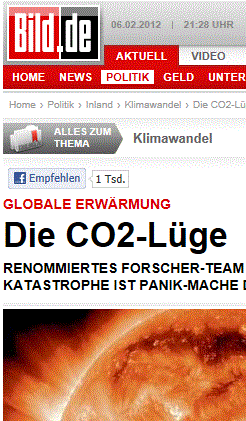 Today Germany’s national tabloid Bild (which has a whopping circulation of 16 million) devoted half of page 2 on an article called:.
“THE CO2 LIES … pure fear-mongering … should we blindly trust the experts?”
That’s what Germany’s leading daily Bild (see photo) wrote in its print and online editions today, on the very day that renowned publisher Hoffmann & Campe officially released a skeptic book – one written by a prominent socialist and environmental figure.
This is huge. More than I ever could have possibly imagined. And more is coming in the days ahead! The Bild piece was just the first of a series.
Mark this as the date that Germany’s global warming movement took a massive body blow.
Today, not one, but two of Germany’s most widely read news media published comprehensive skeptical climate science articles in their print and online editions, coinciding with the release of a major climate skeptical book, Die kalte Sonne (The Cold Sun).
Germany has now plunged into raucous discord on the heated topic of climate change
What has set it all off? One of the fathers of Germany’s modern green movement, Professor Dr. Fritz Vahrenholt, a social democrat and green activist, decided to author a climate science skeptical book together with geologist/paleontologist Dr. Sebastian Lüning. Vahrenholt’s skepticism started when he was asked to review an IPCC report on renewable energy. He found hundreds of errors. When he pointed them out, IPCC officials simply brushed them aside. Stunned, he asked himself, “Is this the way they approached the climate assessment reports?”
Vahrenholt decided to do some digging. His colleague Dr. Lüning also gave him a copy of Andrew Montford’s The Hockey Stick Illusion. He was horrified by the sloppiness and deception he found. Well-connected to Hoffmann & Campe, he and Lüning decided to write the book. Die kalte Sonne cites 800 sources and has over 80 charts and figures. It examines and summarizes the latest science.
Conclusion: climate catastrophe is called off
The science was hyped. The book started hitting the bookshops today and has already hit no. 1 on the Amazon.de list for environment books. Indications show that it will climb very high in the overall bestseller charts. It’s published by a renowned publishing house and is now sending shock waves through the German climate science establishment. The first printing will produce 20,000 copies. I expect they will sell out rather quickly.
Read it all here.
=============================================================
While all that is happening, the wind is going out of the sails in the highly subsidized solar and windfarm business in Germany. Michael Limburg writes from Germany that:
We published this very comprehensive study from our author Dr. Günter Keil titled “ Germany´s Green Energy Supply Transformation Has Already Failed”. (http://www.eike-klima-energie.eu/news-cache/germanys-green-energy-supply-transformation-has-already-failed/)
German version here: http://www.eike-klima-energie.eu/climategate-anzeige/die-energiewende-ist-schon-gescheitert-mit-update-4112/
It has won a lot of attention and was published in all german speaking sceptic blogs and is as well most regarded by our politicians.
Since a lot of green zealots in all countries praise Germany as the wonderland of manageable green miracles it might be helpful to show them the reality
I am therefore proud and happy to tell you that we managed to translate this very valuable piece of information which reveals the blindness and fanaticism of our present politicians which destroys willingly the backbone of our economy. Please make best use of it. I am sure you will welcome this information. The full report and the press release are attached.
Here is the English version:
Germany’s Green Energy Supply Transformation Has Already Failed!
Energy expert Dr. Guenter Keil has closely examined Germany’s energy policy of shifting away from nuclear and fossil fuels and over to renewables. What he finds is a bleak picture. Years ago Germany ambitiously embarked on transforming its energy supply system, and hopes to supply at least 80% of its energy needs through renewable energies by 2050, and thus become a moral leader on environmental responsibility for the rest of the world.
To do this, the former Socialist-Green coalition government, led by Gerhard Schröder, enacted the so-called Renewable Energy Feed-In Act (EEG) in 2000. This Feed-In Act requires electric utilities to buy all renewable energies, such as solar and wind power, from all producers at fixed, exorbitant rates and to feed it into the power grid for a period of 20 years. This has led to a boom as thousands of homeowners, businesses, and investors have installed thousands of megawatts of solar and wind power capacity over the years. The current Conservative-Liberal government, not to be outdone by its predecessor, is also gleefully pushing the Feed-In Act to the limit.
Weather-dependent supply wreaking havoc on the power grid
The problem is that these energy sources are weather-dependent and thus their sporadic supply is starting to wreak havoc on Germany’s power grid and is even now threatening to destabilize power grids all across Europe. The other problem: the power grid needed to distribute the decentrally produced green power is simply not there yet. They forgot to build it! So far, after tens of billions of euros spent on renewable energy systems and higher prices for consumers, not a single coal or gas-fired power plant has been taken offline. To the contrary, old inefficient plants have been brought back into service in an effort to stabilize the grid.
In a panic reaction, Germany shut down 8 nuclear power plants
To make matters worse, in a fit of panic and hysteria, the German government shut down 8 of its older 18 nuclear reactors in the wake of the Fukushima disaster, thus removing a very cheap and stable supply of power and further pushing the grid to the limits. Before the shutdown of the nuclear reactors, Germany had been a net power exporter; today it is a net power importer and is at times severely straining neighboring power grids. To compensate for the missing nuclear power, the government is now heavily promoting even more weather-dependent wind power, which is further destabilizing the German and European power grids. A solution to the problem of storing electricity is still at least a generation away.
The question of course is how could such absurd decisions have been made to begin with? Were there no experts involved in the planning of the new power generation infrastructure? The answer obviously is no. Power executives are viewed as evil, dirty and greedy polluters, and thus were never really consulted. They could not be counted on to give the politically correct solutions. Therefore the decision to shut down the German nuclear power plants and to massively support renewables was done unilaterally by the government, without consulting the power executives or even neighboring countries.
Offshore wind parks, but no transmission lines to industrial regions!
Now that the damage is spreading, Germany’s utilities are now struggling to keep the grid stable and to fill in the power gap left by the shut-down of nuclear reactors. To do this the German government has ordered the installation of large-scale wind parks in the North and Baltic seas, in addition to the re-commissioning of mothballed, inefficient coal-fired plants. This overall energy production transition from nuclear and fossils over to “renewables” is dubbed by German officials as the Energy Supply Transformation. Construction of the offshore wind parks is now progressing rapidly. But there’s just one problem: the huge high voltage power transmission lines needed to bring their power to Germany’s industrial heartland to the south are missing! More than 3000 km of these lines are needed, but are nowhere near in sight. The government forgot about those too!
Activists groups blocking grid expansion
Building the power transmission lines quickly across the landscape will be a virtually impossible task. Activist groups have long since organized and are effectively blocking their approval and construction. So far only a measly 214 km have been built. As a result, surplus wind power cannot be delivered to the markets, and thus either has to be destroyed, dumped on the market at “negative prices”, or wind park owners are simply ordered to stop generating. No problem though – paragraph 12 of Germany’s Energy Feed-In Act requires electric utilities to pay for the electricity that they ask not to have produced! Technically, there is an incentive for wind parks to destabilize the grid.
Eventually all these costs add up and in the end they get passed along to the consumer. Under the bottom line, consumers have to pay more and more, and for a lower and lower quality supply. German industry is getting nervous and surveys show that many are leaving Germany, or are planning to do so. They no longer view Germany’s power supply as reliable.
In a death spiral…”will fail spectacularly”
Dr. Guenter Keil’s report focusses in detail on the amazing absurdities of Germany’s Renewable Energy Feed-In Act and the country’s utopian Energy Transformation. The government, through intrusive meddling and ballooning bureaucracy, has maneuvered Germany’s energy supply system into a vicious death spiral: the more the government intervenes, the greater the mess becomes. And the greater the mess becomes, the more the government intervenes! Dr. Keil concludes:
“Germany’s energy transformation has already failed. For Germans, the outlook is bleak. …the planned mismanagement is heavily damaging the economy and will fail spectacularly some years later because its economic and social costs will have become unbearable. The question remaining open is how many billions of euros will have to be destroyed before a new energy policy (a new energy transformation?) picks up the shattered pieces.”
So it’s no wonder that according to a survey of experts from 21 national committees by the World Energy Council, 0% said they could imagine their own country completely taking over the German political approach. An equal number believe Germany will reach its stated targets.
Germany’s model will serve as a classic lesson on how not to handle energy production and management.
Michael Limburg; with thanks to Pierre Gosselin from notrickszone for excellent translation support
Dr. Guenter Keil was a scientific employee at the Technical University of Munich / Fraunhofer Society, as well as Project Support at the Federal Research Ministry.
For downloading full  report &
  press release here or see files attached (remark: Downloads of .doc pressrelease with SAFARI seems not to work, FIRFOX workfs fine)
RockyRoad says:
Let me expand:
Socialist policy would be to tax the rich and hand the surplus to the poor through welfare and/or subsidised consumer goods. Another socialist policy is nationalisation of companies.
Green policy in Europe is taxation on the prices of consumer goods thus hurting the poor and middle classes, and hand the surplus to the rich via income tax breaks. Furthermore companies in “green” sectores are shunted from market forces and entrepreneurial risk, but the profits go into private pockets.
It’s true that the green movement of the 1970s and 80s used to be associated with the left wing “counter culture”, but those people have now grown old and are leading middle class lives with middle class ideologies.
1. German media do always say their stories. If the government has to follow up the media, then it means the government. is media, this is not true. In Germany nuke is a problem. That’s why the standards are always under precise research and changes are made as much as it’s possible.
2. German nuke plants are different from Japanese and despite Japan there in Germany is no threat of Tsunami. I had no problem on that.
3. The remained plants under operation as you said are deactivated until 2022 partially. To my poor knowledge It is a must.
4. As discussed, the off plants could not comply with standards. Standards would not remain unchanged. The standards are always modified. The new nuke plants generation are quite different not by definition but because of efficiency and design. Mercedes 1968 and what we have now are not the same, how could we say there are no differences.
5. In high tech plants 10 years ago standard is far away from today’s definitions.
6. the most powerful well defined infrastructure in energy sector are fossils and then nuke. Others like Renewables are not yet capable to give us all our demands at all. This is unforgettable.
7. There are weak points in any design. Before Japanese disaster, some of them in Germany could be neglected but after that neither because of politics nor due to media rushes, but only for the people of Germany, the government had to revise its energy production policy. Please let there be even one small place for the conscience of a responsible body in our minds. Germany became the most powerful economy in EU and one of the most progressive in the world, it did not happen accidentally. You conceded it in your comment.
Any miscalculation could never be forgiven by the nation. The problem is greater enough for everyone, the disasters in Japan and Russia showed how big the tragedies were. Therefore you as a GOVERNMENT (example) cannot say “There is no specific risk”, when new standards reject the old ones. Serious conflicts are there between the old and new standards.
8. What was happened in Russia? No Tsunami, no nothing, only technology and standards as a whole were not working.
acckkii says:
There was no such thing. Nuclear shutdown was essentially the Merkel government’s decision in a hasty reaction to the German media who had run an an almost unanimous anti-nuclear campaign after the Fukushima disaster. Apparently the government felt that the media opinion reflected voters’ opinions. There was no new risk that had become apparent, it was really an emotional reaction.
Germany’s electricity bills are rising fast. They are now the second highest in the EU after Denmark’s, who have an even higher portion of subsidised wind power. Some other next door neighbours of Germany have half the electricity prices of Germany, such as Poland (almost exclusively coal) and France (almost exclusively nuclear).
If only. The nuclear shutdown is meant to be permanent. Three days after Fukushima the govermnent announced the shutdown of 8 reactors (out of then 17). The rest are meant to be phased out until 2022. It’s supposed to be permanent.
It is, however, a reversal of a reversal of a reversal of nuclear policy. The red-green government had decided to phase out nuclear in 2000. The conservartive Merkel government had decided to undo this decision in 2010. In 2011 after Fukushima they decided to undo their undo. All bets are open if and when this will be undone again. But so far the decision is to phase out nuclear and to invest into huge offshore wind farms, believe it or not.
There is no specific risk, it was all a reaction to a media campaign. Tsunamis are unheard of in Germany, and German nuclear plants have a different design than Fukushima.
However the cost will be enormous. Assets worth many billions have been dumped over night, and we’ll all be made to pay for the loss. THAT is something a decision maker should avoid. The decision was highly irresponsible economically, regardless if you’re pro or anti nuke.
The main problem seems to be the lack of infrastructure to support these wind and solar farms, not the stuff themselves. Norway gets most of its power from hydropower which is from turbines run by ocean waves and tides and does fine! Oil even if abiotic does not replenish fast enough to meet the growing need, and there are political problems with it. Even if global warming is partly a myth, the actions being taken to correct for it are what are needed anyway.
Fossil is not fuel and source of energy only, it is infrastructure. As long as there is no infrastructure for other sources of energies, yes it is hard to understand it. Italy never involved in in nuke. France, Germany, The UK, Japan and others made it. Now nuke has got an infrastructure, it is not like solar or wind. There are many people supporting the nuke plants to go on production not shutting down, even with the tragedies happened in Japan and Russia.
I don’t look at the sources of energies as green (+/-) or (yes/no). Unfortunately governments tax policies on energy makes problem and change the matters, therefore many things are forgotten. The reason is clear of course; there is nothing around us that is not involved with energy. Some experts don’t believe implementing tax on energy before it is used in production, this makes exponential problems, and they believe tax could be considered after production not on fuel. As we see energy has the meaning of infrastructure everywhere. As we see if we want to continue these subjects, then we have to give up what we were going to discuss.
Science and technology is quite different from policies. GE 1.5MW wind mill touched the 16000th unit recently. Siemens made the first offshore new version which is suitable for the worst climate in sea conditions. These are worthy things. But we know these all cannot be taken as mass production systems, locally yes they are positive. I call the new energies as “baby energies”, to show they are still young to do what are our demands.
The word “SUSTAINABLE” was under big question mark by well-known well-respected scientists that I also believe in them. They said; nothing is “SUSTAINABLE”. Also there was an article that I liked it very much “R/P ratio” published here in WUWT. In this situation, keeping people’s eyes closed is not a good idea. I prefer to see what sort of energy source can be a good substitute for fossil based fuels in future.
And fortunately let’s say the idea of global warming is no longer untenable. This would make the human get much more time to find the best replacement energy source.