One of the most interesting things around here is the hi-tech/low-tech scenery. For example, where else can you see cutting edge weather radar systems juxtaposed with oil rigs pump jacks?
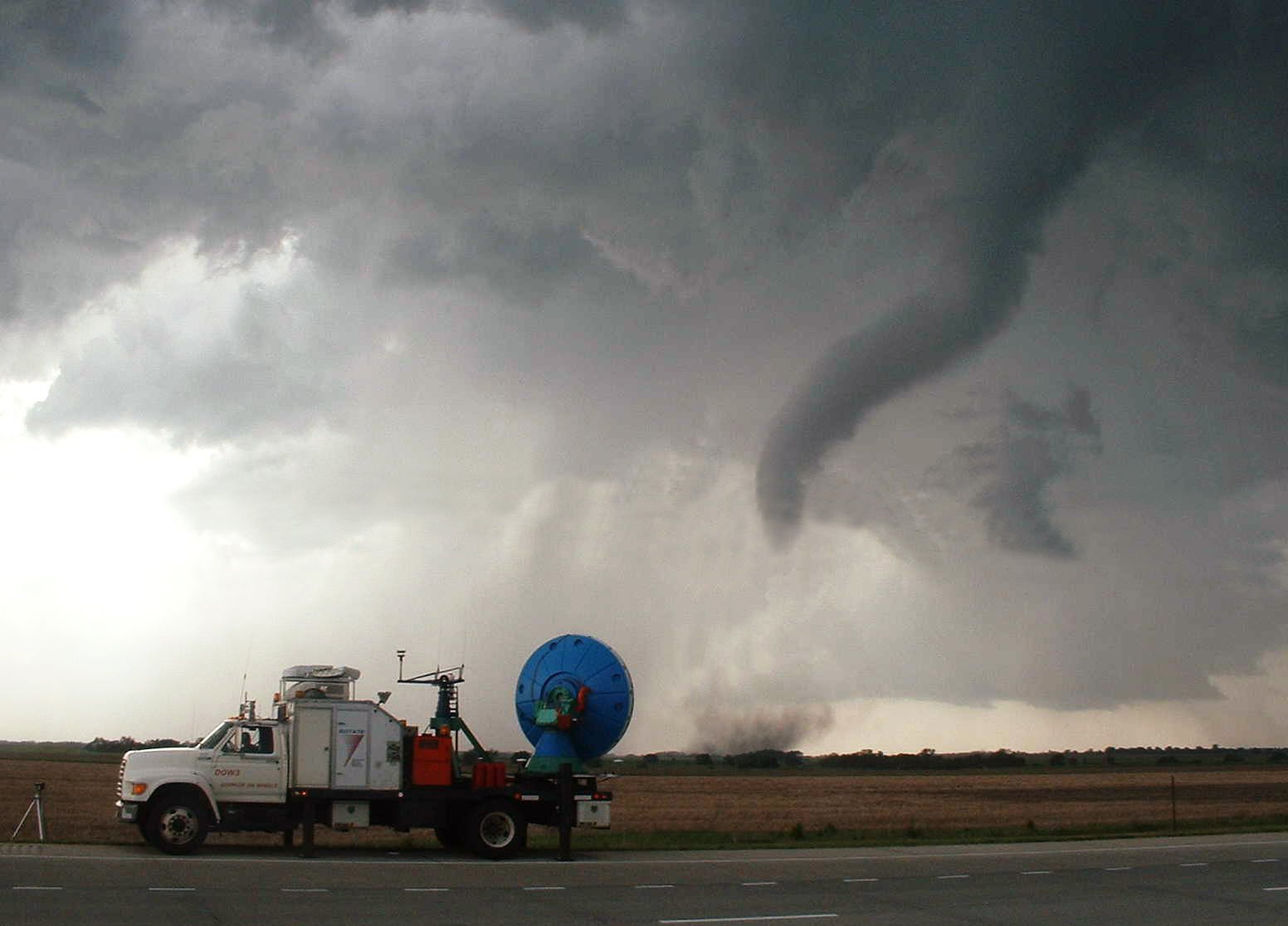
 Getting a bit closer to the blue radome reveals some unintentional comedic signage, probably meant to warn off the DOW (Doppler on Wheels) operators.

In case you are wondering, this is where I am, NOAA’s radar operations center in Norman:
 The blue radome shown above is home to this:
National Weather Radar Testbed
NSSL’s National Weather Radar Testbed (NWRT) is the official facility where phased array technology will be tested and evaluated. PAR has the potential to provide revolutionary improvements in NWS tornado, severe storm, and flash flood warnings. The phased array radar is expected to eventually replace the current network of WSR-88D radars. Scientists at NSSL and across the nation will be able to remotely operate the phased array radar to collect data in support of their research. A new Radar Control Interface (RCI) is being developed to simplify radar control and data collection operations. Hardware and software design and development carried out at NSSL have made the NWRT a world-class research facility.
The SPY-1 Navy radar is being adapted for severe weather tracking. More here


Navy ships originally used AEGIS phased array radar (called SPY-1) technology to protect naval battle groups from missile threats. Researchers believe the same technology has great potential for increasing lead-time for tornado warnings.
In 2000, the U.S. Navy agreed to loan a phased array antenna to NSSL and provided the $10,000,000 in funding to help build the National Weather Radar Testbed (NWRT). The NWRT is a facility focused on developing faster and more accurate warning, analysis and forecast techniques for severe and hazardous weather using phased array and also upgraded WSR-88D radar technology. The National Weather Service provided the transmitter and the additional funding from NOAA, OU, Lockheed Martin, and OSRHE purchased the environmental processor. In addition, the FAA provided initial funding for research, program management and initial upgrades, and the NWS has donated equipment. The NWRT became operational in September 2003, the first data were collected in May, 2004, and data sets were collected during the 2005 storm season.
This is the kind of visual output coming from it, and it is rather stunning:

Click for a much larger image
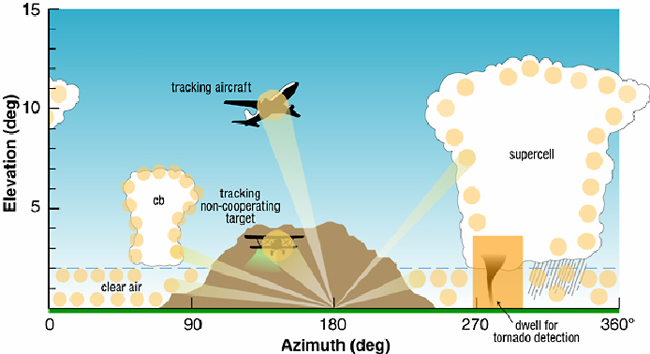
Phased array radar’s rapid scanning ability gives it the potential to be a multi-mission, adaptively scanning radar, meaning it is used for weather, wind profiling, and aircraft tracking and can adaptively change its scans to look at the most important features.
Look for this sort of technology to be the “next big thing” in television weather reports, though it may be just a bit over the heads of the average Joe.
With wars going on in Afghanistan, Iraq, drone attacks into Pakistan, and who knows what will happen with Libya and Egypt – why is $10M coming out of the Defense Department to set up high tech weather radars? Using Aegis radars may be (and definitely looks to be) something useful and something that should and can be done. Also, reuse of the DoD investments for civilian use is great. However, this should be funded by NOAA, not grabbed out of the back of the Navy budget.
Eh, they probably got the one out of the Jersey cornfield.
http://www.barking-moonbat.com/images/uploads/USS_Rancocas_aka_Cornfield_Cruiser.jpg
Just a bit of trivia – phased array radars that are positioned and oriented for use as ICBM early warning systems were prohibited under the 1972 ABM Treaty between the USA and the USSR. Reagan had to do some real sleight of hand along the lines of “it depends on what the definition of ‘is’ is” with regard to treaty language in order to proceed with SDI (Strategic Defense Initiative) also known as Star Wars. The USSR dissolved in 1991 and so there was technically no longer a treaty since one signatory was then a number of separate republics. In 2001 POTUS GW Bush officially withdrew from the ABM treaty.
Phased array radar (which I had to learn about in the military in the 1970’s) was hot new stuff 40 years ago. Its main advantage is the antenna is whole buttload of fixed dipoles (IIRC) and the beam is steered by carefully controlling the phase of the signal to each antenna so destructive interference creates a steerable focal point which can move across its (rather limited) range of azimuth and elevation in a span of microseconds enabling it to simultaneously track hundreds of targets.
What I can’t figure out is how that helps a weather radar (which I also learned about in the military because calibration and repair of same was one my primary system responsibilities) and if it is a big help why it’s still prohibitively expensive. In the old days when we had to use expensive and hard to calibrate analogy electronics it was a very expensive undertaking but I’d think now it would a lot less expensive. Plus a weather radar only needs to be in the range of a half megawatt or so for a range of 200 miles while a good military radar has to be much higher power to track small objects which might even have some stealth features to reduce the radar return even more.
Just as another aside during my last year in the Marine Corps I was TDA (temporary duty assignment) to Norman Oklahoma for 60 days during the peak of tornado season. A team of 3 of us had our portable radiosonde gear set up in a field and were launching hydrogen filled balloons into supercells and tracking them with a big dish antenna with strip chart recorders keeping track of time, elevation, azimuth, temperature, pressure, and humidity. Our client was the National Severe Storms Laboratory (NSSL). At the time (1978) color doppler weather radar was experimental and NSSL had the only one. They were very proud of it and I got a tour of the installation with an engineer talking my ear off about it.
Mark, the DoD budget for 2010 was $685.1 billion. The FY 2011 budget is projected at $708 billion. $10 million is 1.412 e-5, or less than one-thousandth of one percent of the defense budget, using the FY 2011 figure of $708 billion.
For purposes of comparison, the Army spends $7 million a year supporting an Army NASCAR team.
This is chump change.
It is possible with phased array antennas to produce any number of beam shapes. Provide the correct phase relationships to various dipole banks, and you can produce horizontal and vertical fan beams to provide a search function, then switch to multiple pencil beams to spotlight targets of interest. In a weather cell, discontinuities in the doppler returns are indicators of something interesting to look at, so when the fan detects a shift (speed gradient etc.) the control program can shoot a scanning pencil beam to isolate all the doppler shifts in the region to really characterize the feature, while sending other beams out to look at other features. Beam size is only limited by the number of dipoles, dipole spacing, element phase relationships and operating frequency (though the math can get a bit dicey when done by hand! – long story with a military radar instructor and a smart aleck Airman student ->me. ) The plane can be divided to produce multiple simultaneous wider beams or time shared (a few milliseconds per dwell) for more precise beams
If the planar array is mounted on a turntable, one array antenna can provide 360 degree azimuth coverage, and if it is mounted at an angle so that the normal of the face points toward the likely target area (dependent on range and altitude) it can scan the whole height from ground to straight up and have its tightest beam size in the likely target area. Because it can move the beam to the left and right, it can illuminate a single piece of sky for a little under half a rotation period, though it should be limited to a quarter of the rotation if you want the beam to stay near the sweet spot. So if you had one of these babies, you could run it in big circles with fan beams until something interesting appeared, then switch to a staring mode to search one 45 degree square of the sky while focusing on any nice features that appear. It can provide a lot of high resolution data to crunch after the event for cell reconstruction.
PAR on wheels.
This was a fun read. Reminded me of a radar class I took from George Washington University, when still in the Air Force. We were discussing using side-looking radar imaging systems, but I’ve worked with enough radars to understand how weather radar works. A phased array arrangement would greatly increase both the capacity of detection and the resolution of those particular cells that require more intense scrutiny. There are a couple of other radar tricks I’m surprised the Weather Service isn’t using. Maybe they’re still too classified.