
Here is a quote you don’t often see:
Our results provide a rare example of a climate change effect in which a type of extreme weather is likely to decrease, rather than increase.
From USA Today’s Science Fair:
OK, time to prove we’re not all gloom and doom here at Science Fair. Here’s some happy news about global warming, for once.
A new study out Wednesday in the British journal Nature finds that large, powerful North Atlantic ocean storms should actually become less frequent by the end of the century, due to climate change.
Led by Matthias Zahn of the U.K.’s University of Reading, the study used climate models to show that these North Atlantic storms — known as polar lows — may decrease in frequency by as much as 50% by 2100.
“Our results provide a rare example of a climate change effect in which a type of extreme weather is likely to decrease, rather than increase.” Zahn writes in the paper, which was co-authored by Hans von Storch of the University of Hamburg in Germany.
=================================================
Here’s the abstract from Nature
Decreased frequency of North Atlantic polar lows associated with future climate warming
Matthias Zahn & Hans von Storch
Every winter, the high-latitude oceans are struck by severe storms that are considerably smaller than the weather-dominating synoptic depressions. Accompanied by strong winds and heavy precipitation, these often explosively developing mesoscale cyclones—termed polar lows—constitute a threat to offshore activities such as shipping or oil and gas exploitation.
Yet owing to their small scale, polar lows are poorly represented in the observational and global reanalysis data often used for climatological investigations of atmospheric features and cannot be assessed in coarse-resolution global simulations of possible future climates. Here we show that in a future anthropogenically warmed climate, the frequency of polar lows is projected to decline. We used a series of regional climate model simulations to downscale a set of global climate change scenarios from the Intergovernmental Panel of Climate Change.
In this process, we first simulated the formation of polar low systems in the North Atlantic and then counted the individual cases. A previous study using NCEP/NCAR re-analysis data revealed that polar low frequency from 1948 to 2005 did not systematically change.
Now, in projections for the end of the twenty-first century, we found a significantly lower number of polar lows and a northward shift of their mean genesis region in response to elevated atmospheric greenhouse gas concentration. This change can be related to changes in the North Atlantic sea surface temperature and mid-troposphere temperature; the latter is found to rise faster than the former so that the resulting stability is increased, hindering the formation or intensification of polar lows.
Our results provide a rare example of a climate change effect in which a type of extreme weather is likely to decrease, rather than increase.
==============================================
Addendum: Since there’s a lot of whining about use of descriptive nomenclature in the comments, including some who think polar lows are not “strong storms”. I thought I’d point out this description from: Rasmussen, E. A. & Turner, J. (2003), Polar Lows: Mesoscale Weather Systems in the Polar Regions, Cambridge: Cambridge University Press, p. 612, ISBN 0521624304.
Polar lows have been referred to by many other terms, such as polar mesoscale vortex, Arctic hurricane, Arctic low, and cold air depression. Today the term is usually reserved for the more vigorous systems that have near-surface winds of at least 17 m/s (38 mph).
Generally, I think of a storm that has 38mph near surface winds as a “strong storm”. A tropical cyclone that reaches tropical storm status has sustained winds of at least 39 mph, so the use of the description “strong storm” seems appropriate to me. Though, to be truer to the paper than USA today, and to appease the whiners who think I’m on some conspiracy to mislead people, I’ve added the word “polar” to the title.
Here’s an downlooking image of a polar low:
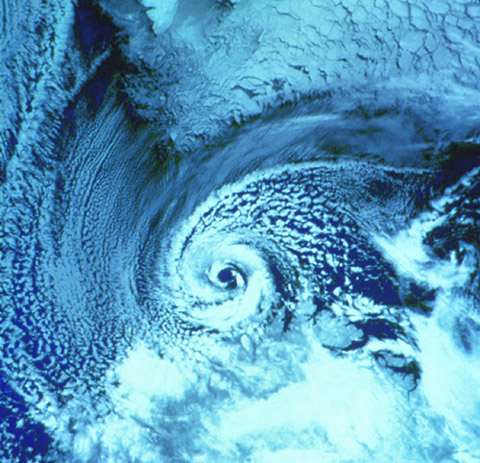
Polar lows were not discovered until after the advent of satellite meteorology, so we have only about 50 years of data on them.
Nature 467, 309-312 (16 September 2010) | doi:10.1038/nature09388; Received 14 August 2009; Accepted 26 July 2010
Open Innovation Challenges
-
Maintaining Fully Differentiated Human Primary Renal Proximal Tubular Epithelial Cells

A validated protocol is required for maintaining and expanding Human Primary Renal Proximal Tubular …
-
Derivatives of Racemic 2-Hydroxy-4-(methylthio)butanoic Acid and 2-Hydroxy-4-(methylthio)butanenitri

This Challenge seeks commercial applications for chemical derivatives of racemic 2-hydroxy-4-(methyl…
- More Challenges
-
Powered by:

nature jobs
-
Tenure Track Assistant Professor Position in Ecology
- University of British Columbia
- British Columbia, Canada
-
Product Support Specialist
- Quintiles Technologies (India) Pvt. Ltd
- Bangalore, Karnataka India
Decreased frequency of North Atlantic polar lows associated with future climate warming
Matthias Zahn1,2 & Hans von Storch2,3
- Environmental Systems Science Centre, University of Reading, 3 Earley Gate, Reading, Berkshire RG6 6AL, UK
- Institute for Coastal Research /System Analysis and Modelling, GKSS-Research Centre, Max-Planck-Strasse 1, D-21502 Geesthacht, Germany
- Meteorological Institute, University of Hamburg, Bundesstrasse 55, D-20146 Hamburg, Germany
Correspondence to: Matthias Zahn1,2 Email: matthias.zahn@gkss.de
Not as many as those who use commas where they’re not needed.
In the old days people read between the lines in the Bible to make a living and scare people. The end of the world was always just around the corner. You could even calculate it down to the day based on actual Bible verses! Now in the twenty-first century we have the same phenomenon but now it’s “scientists” scaring people with computer models. Repent or you doomed! But hurry and fill the collection basket before the end appears.
The bible “end times” garbage is still alive and well.
Here’s a good article on these little buggers. Pulled it off the internet.
http://www.geo-web.org.uk/PolarLow.pdf
Chris
Norfolk, VA, USA
Has anyone noticed how the the “hurricane” hitting Bermuda right now has winds suspiciously at 75 mph (just 1 mile above what is needed to be a hurricane and according to NOAA will be a hurricane all the way out into the north atlantic. Seems more like propaganda then science based forecasting to me. They also thought it was going to me a major hurricane by the time it got to Bermuda, never seems like they err on the low side with these storms (but maybe for safety sake they shouldn’t).
Anyway, just seems suspicous that these storms are so powerful where nobody can see them then when they get near land where other instruments can be used they are much weaker. I think NOAA is full of you know what.
If a warmer world means less polar storms, ergo a cooler world means more?
With the impending cooling of the planet, I predict MORE polar storms. Batten down the hatches.
JamesA says:
September 19, 2010 at 6:25 pm
Anyway, just seems suspicous that these storms are so powerful where nobody can see them then when they get near land where other instruments can be used they are much weaker. I think NOAA is full of you know what.
============================================
That is hyperbole.
There are many very talented scientists at the NHC there trying to do their job.
Bermuda has been recording gusts to near 95 MPH. And sustained at 80.
It could have been a lot worse. This was a powerful and large hurricane…but fortunately when it was at its peak, close to being a CAT 5, it was far far away from any land.
Your perspective here is also rather truncated. You may want to recall Hurricane Ike in 2008.
Even though Ike was only a 2 on the Saffir-Simpson scale, the storm surge it produced was more like a strong 4. And it wiped clean the Bolivar Peninsula.
There are other ways to measure hurricanes besides the Saffir-Simpson, and when they forecast Ike’s Cat 4 surge, even though its “official” Cat was 2, was an example.
The Integrated Kinetic Energy measurement [ironically the the IKE].
Anyways careful on your naive “conspiracy” theme here. Hurricanes are wild WILD beasts.
We have just gotten lucky as of late. My how quickly people forget 2004 and 2005.
And definitely, Bermuda will be spared what could have been worse. Hmm. Interesting.
Perhaps the planet is telegraphing the cooling that some experts say will be coming…
Chris
Norfolk, VA, USA
They occur as south as 52 degrees latitude (The Netherlands), though they are almost always in a dissipating state that far south. Polar lows require very cold air mass to exist, so naturally, when this air moves south, it warms due to exchange with the (sea) surface and horizontal mixing. This effectively ‘kills’ the polar low.
Why the cold air mass? I’m throwing in a rather dull term here: the Rossby radius of deformation (look for the definition in e.g. Holton, Introduction to Dynamic Meteorology). This is the scale at which rotational effect become as important or more important as gravity waves and buoyancy. In the environment in which polar lows develop, this radius is small, because the saturated-adiabatic lapse rate is less steep in cold air (you can calculate this) and the coriolis parameter is very significant at high northern latitudes. Because the radius is small, such small-scale but strong circulations as polar lows can develop.
So, this perfectly explains why polar lows are prone to decrease and/or become less strongin a warming atmosphere. When the atmosphere warms, the saturated-adiabatic lapse rate increases, which effectively increases the Rossby deformation radius. This makes the general dynamical environment, favourable for the development of polar lows, less likely to occur. Hurricanes have a completely different dynamic background, although the primary ‘source’ of their energy is more or less identical: release of latent heat due to convection. Hurricanes are, however, (instinctively) likely to increase in number and activity, because their dynamic background differs and they run on convection that is mostly surface based, instead of maintained through the existence of a strong vertical temperature gradient.
I suggest anyone who wants to know more about polar lows, and their (theoretical) meteorological background, to look at the SatRep (Satellite Report) manual: http://www.zamg.ac.at/docu/Manual/SatManu/main.htm?/docu/Manual/SatManu/CMs/PL/index.htm
– Ben Lankamp
Anthony’s mistake wasn’t too bad, maybe, as polar lows are warm core, circle symmetric convectional disturbances (as opposed to baroclinic) with a somewhat hurricane-like appearance and they are actually sometimes termed ‘Arctic hurricanes’…
If the driver here is the polar amplification effect, (which is only a model prediction anyway), and acts to reduce the temperature differential and therefore vertical shear/ vortex at the polar- hadley boundary… and so on…..
Then why does the south pole show bigger storms and increased vortex strength as the earth has supposedly warmed ?
Hehheh.
Try this, and type you know who in search:
http://tinyurl.com/yehbodc
————–
RESULT: You searched for telford
There were 3 results for the exact phrase telford, see below for more results.
Wednesday, 20 October 2004 12:49:34 : Filename: 1098294574.txt
From: Keith Briffa To: John.Birks@xxxxxxxxx.xxx,masson@xxxxxxxxx.xxx, dirk.verschuren@xxxxxxxxx.xxx,Laurent.Labeyrie@xxxxxxxxx.xxx, juerg.beer@xxxxxxxxx.xxx,A.Lotter@xxxxxxxxx.xxx,k.briffa@xxxxxxxxx.xxx, hufischer@xxxxxxxxx.xxx,dan.charman@xxxxxxxxx.xxx, karin@xxxxxxxxx.xxx,wanner@xxxxxxxxx.xxx, …
Wednesday, 11 May 2005 15:25:11 : Filename: 1115843111.txt
From: “Polychronis Tzedakis” To: “Rainer Zahn” , “Thomas Stocker” , “Atte Korhola” Subject: RE: commission performance alpha 5 Date: Wed, 11 May 2005 16:25:11 +0100 Cc: , , , , , , , , , , Dear all, First of all a big hand for Eystein and all those who put in so much time into this task. Very …
Thursday, 12 May 2005 03:48:04 : Filename: 1115887684.txt
From: Denis-Didier.Rousseau@xxxxxxxxx.xxx To: , Subject: [Fwd: RE: commission performance alpha 5] Date: Thu, 12 May 2005 04:48:04 +0200 (MEST) Dear all IMPRINT colleagues, Being away from Europe, this was a very bad news that I got this morning listening about the rejection of IMPRINT. Eystein …
——————
A Climategate “cc” no less. Surely this can’t be you know who, can it?
Tim Folkerts says:
The plural of ‘anecdote’ is not ‘data’.
dave38 says:
And the plural of ‘datum’ is not ‘proof’!”
I like that one, too. Thanks 🙂
I believe that a serious case can also be made for periods of full employment causing more Global Warming and less strong storms in the Arctic, no wonder so many economists and those among the Super-Rich believe in Global Warming, I’m sorry – Climate Modulation (isn’t that what it’s called this morning?).
Please explain the following quotes and facts.
“A previous study using NCEP/NCAR re-analysis data revealed that polar low frequency from 1948 to 2005 did not systematically change.”
“Polar lows were not discovered until after the advent of satellite meteorology, so we have only about 50 years of data on them.”
“1960: NASA launches the first weather satellite, TIROS-1, from Cape Canaveral, Florida.
TIROS, for Television Infrared Observation Satellite, sent the very first TV images from space to the ground station at Fort Monmouth, New Jersey. The pictures clearly showed the New England coast and Canada’s Maritime Provinces north to the St. Lawrence River. The photos were airlifted pronto to Washington, D.C., to be presented to President Eisenhower.” http://www.wired.com/science/discoveries/news/2008/03/dayintech_0401
And does this mean we will be getting fewer winter blizzards?
A lot of bandwidth has been wasted in attempts to “correct” Anthony’s alleged mis-concenption of mid latitude cyclones. Perhaps, in the future we can just refer to the cyclones as either warm core lows and cold core lows. There is no need to cut and paste testbook definitions. For those of use who practiced operational weather forecasting, such pendantry causes us to browse to the next subject.
The Warmists have already made these very same claims for more snow in the Northern Hemisphere, Antarctic sea ice record caused by Ozone, more rain and less rain, you name it they have it covered. This is fast becoming a comedy of errors. :o)
http://www.numberwatch.co.uk/warmlist.htm
http://www.time.com/time/health/article/0,8599,1962294,00.html
http://www.npr.org/templates/story/story.php?storyId=123671588
http://www.lbl.gov/Science-Articles/Archive/EETD-climate-change.html
http://www.metoffice.gov.uk/corporate/pressoffice/2010/pr20100526.html
http://www.guardian.co.uk/environment/2010/mar/25/uk-homes-climate-change-adaptation
Hands up anyone who can say their climate has significantly changed!
DaveE
So global warming means less drowned polar bears!