
Here is a quote you don’t often see:
Our results provide a rare example of a climate change effect in which a type of extreme weather is likely to decrease, rather than increase.
From USA Today’s Science Fair:
OK, time to prove we’re not all gloom and doom here at Science Fair. Here’s some happy news about global warming, for once.
A new study out Wednesday in the British journal Nature finds that large, powerful North Atlantic ocean storms should actually become less frequent by the end of the century, due to climate change.
Led by Matthias Zahn of the U.K.’s University of Reading, the study used climate models to show that these North Atlantic storms — known as polar lows — may decrease in frequency by as much as 50% by 2100.
“Our results provide a rare example of a climate change effect in which a type of extreme weather is likely to decrease, rather than increase.” Zahn writes in the paper, which was co-authored by Hans von Storch of the University of Hamburg in Germany.
=================================================
Here’s the abstract from Nature
Decreased frequency of North Atlantic polar lows associated with future climate warming
Matthias Zahn & Hans von Storch
Every winter, the high-latitude oceans are struck by severe storms that are considerably smaller than the weather-dominating synoptic depressions. Accompanied by strong winds and heavy precipitation, these often explosively developing mesoscale cyclones—termed polar lows—constitute a threat to offshore activities such as shipping or oil and gas exploitation.
Yet owing to their small scale, polar lows are poorly represented in the observational and global reanalysis data often used for climatological investigations of atmospheric features and cannot be assessed in coarse-resolution global simulations of possible future climates. Here we show that in a future anthropogenically warmed climate, the frequency of polar lows is projected to decline. We used a series of regional climate model simulations to downscale a set of global climate change scenarios from the Intergovernmental Panel of Climate Change.
In this process, we first simulated the formation of polar low systems in the North Atlantic and then counted the individual cases. A previous study using NCEP/NCAR re-analysis data revealed that polar low frequency from 1948 to 2005 did not systematically change.
Now, in projections for the end of the twenty-first century, we found a significantly lower number of polar lows and a northward shift of their mean genesis region in response to elevated atmospheric greenhouse gas concentration. This change can be related to changes in the North Atlantic sea surface temperature and mid-troposphere temperature; the latter is found to rise faster than the former so that the resulting stability is increased, hindering the formation or intensification of polar lows.
Our results provide a rare example of a climate change effect in which a type of extreme weather is likely to decrease, rather than increase.
==============================================
Addendum: Since there’s a lot of whining about use of descriptive nomenclature in the comments, including some who think polar lows are not “strong storms”. I thought I’d point out this description from: Rasmussen, E. A. & Turner, J. (2003), Polar Lows: Mesoscale Weather Systems in the Polar Regions, Cambridge: Cambridge University Press, p. 612, ISBN 0521624304.
Polar lows have been referred to by many other terms, such as polar mesoscale vortex, Arctic hurricane, Arctic low, and cold air depression. Today the term is usually reserved for the more vigorous systems that have near-surface winds of at least 17 m/s (38 mph).
Generally, I think of a storm that has 38mph near surface winds as a “strong storm”. A tropical cyclone that reaches tropical storm status has sustained winds of at least 39 mph, so the use of the description “strong storm” seems appropriate to me. Though, to be truer to the paper than USA today, and to appease the whiners who think I’m on some conspiracy to mislead people, I’ve added the word “polar” to the title.
Here’s an downlooking image of a polar low:
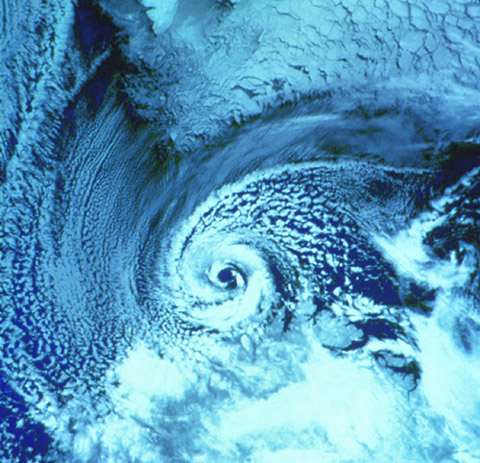
Polar lows were not discovered until after the advent of satellite meteorology, so we have only about 50 years of data on them.
Nature 467, 309-312 (16 September 2010) | doi:10.1038/nature09388; Received 14 August 2009; Accepted 26 July 2010
Open Innovation Challenges
-
Maintaining Fully Differentiated Human Primary Renal Proximal Tubular Epithelial Cells

A validated protocol is required for maintaining and expanding Human Primary Renal Proximal Tubular …
-
Derivatives of Racemic 2-Hydroxy-4-(methylthio)butanoic Acid and 2-Hydroxy-4-(methylthio)butanenitri

This Challenge seeks commercial applications for chemical derivatives of racemic 2-hydroxy-4-(methyl…
- More Challenges
-
Powered by:

nature jobs
-
Tenure Track Assistant Professor Position in Ecology
- University of British Columbia
- British Columbia, Canada
-
Product Support Specialist
- Quintiles Technologies (India) Pvt. Ltd
- Bangalore, Karnataka India
Decreased frequency of North Atlantic polar lows associated with future climate warming
Matthias Zahn1,2 & Hans von Storch2,3
- Environmental Systems Science Centre, University of Reading, 3 Earley Gate, Reading, Berkshire RG6 6AL, UK
- Institute for Coastal Research /System Analysis and Modelling, GKSS-Research Centre, Max-Planck-Strasse 1, D-21502 Geesthacht, Germany
- Meteorological Institute, University of Hamburg, Bundesstrasse 55, D-20146 Hamburg, Germany
Correspondence to: Matthias Zahn1,2 Email: matthias.zahn@gkss.de
Mohib says:
September 19, 2010 at 8:32 am
Maybe fewers storms, but check out the early snow and record lows:
Snow closes part of Going-To-The-Sun road
KRTV – September 17, 2010
The snow in Great Falls and surrounding areas is likely little more than a distraction for most people, but in Glacier National Park, …
Glacier Park gets snow throughout the year, even in the summer. So snow in September is hardly surprising.
The Los Angeles area had more record-low temperatures as the National Weather Service warned of dense fog this morning….
Yes, lets check out those record lows. And lets check out the record highs, as well. Even with overall warming, you would still expect some record lows. But you would expect fewer record lows than record highs.
And that is exactly what is seen.
I don’t know who said it, but I love the quote “the plural of ‘anecdote’ is not ‘data’.” We can give anecdotes all day, but in the end, only careful data will lead to better understanding.
Hey, that’s me under that big cloud over Western Canada on the upper left side of the satellite pic. Freezing my rear off in 4 degree C rain / snow. Don’t you all get it , Global Warming makes fewer AND more strong storms , geez, get with the program people!
Similar crap
http://online.wsj.com/article/SB10001424052748703440604575496261529207620.html?mod=WSJEUROPE_hpp_MIDDLELSMini
While it is clear to me that Anthony does indeed know the difference among various sorts of storms, it is not clear the the commentators here are recognizing that fact. And I feel that the title is indeed misleading to many people. Rather than
Hans von Storch study: Global Warming to make fewer strong storms
it should probably be something more like
Hans von Storch study: Global Warming to make fewer strong north Atlantic polar low storms
Not nearly as dramatic, I know, but much more accurate. Anthony even quotes “Our results provide a rare example of a climate change effect in which a type of extreme weather is likely to decrease, rather than increase.” [Emphasis added]
Readers are saying “…these clowns don’t know WHICH way to go next!! ” and “Further proof that these guys are making it up as they go along.” and “Here’s a few warmest articles to illustrate the flip flop occurring”
There is no contradiction here. There is no change in predictions. Not that I will guarantee that the results of any of the models are correct, but there is no flip flop to say “hurricanes will increase, but polar lows will decrease”. If you say “most types of severe weather will increase, but this one type will decrease,” that does not prove that people are making up the results. When scientists report their results, it shows they DO know which way to go — they publish the results so that other can build on/critique/correct their work. That is the way science works. (Sure, egos and biases get in the way, but IMHO overall “science” does a pretty good job of uncovering and studying new knowledge).
Hans von Storch study: Global Warming to make fewer strong storms…
…IN THE NORTH ATLANTIC
Seriously misleading title! You just want people to interpret this the wrong way.
REPLY: Yeah sure whatever. Read the USA today article.
“Global warming good news: Fewer big ocean storms possible”
Holler at them too. They didn’t even bother to publish the abstract. If I wanted to be “misleading”, why would I publish it where other media outlets do not? Your point fails. -A
In line 2 of the second paragraph: “global reanalysis data”
In line 3 of the third paragraph: “re-analysis data”
As these two examples indicate there is a bit of confusion regarding the use of “re-analysis” and “reanalysis” — not to mention why it is used in the first place. Seems to be in the same class as “proactive” which, by rights, ought to be occasionally countered by “conactive.”
As for the content of the paper presented, Yawn!
I think half of all research time and money ought to be spent on the topic of a cooling Earth. Being of an individualistically egalitarian bent I think this to be only fair.
Any schoolboy should know that if it gets warmer globally then the poles are likely to warm up by a few degrees more than the tropics, which by the way seems to have been the case during the last warming spell. That means that the air movements (winds) from warmer to colder areas will slow down. Less wind strength should mean less storminess in general, but not necessarily in all cases.
But you are right we seldom hear about that.
Hurricanes may have their origin in tropical waters because they among other things need a certain temperature, say 23° C, to develop. But the general public, by now, automatically thinks of hurricanes when scientists talk about stormy weather. Even Anthony did, so maybe they tell us about other storms now as they could be ‘hedging their bets’. If no hurricane make it into the news for all the wrong reasons this year then; ‘we told you so’. – If one of them does, then; ‘we never talked about hurricanes but storms in the northern and polar regions’. And the can show refs.
The Hurricane Seasons have been very quiet since 2006.
Some joker, posing as a climate scientist came on TV here in the UK earlier this year predicting doom and devastation as and when the mighty Earl made landfall. But Earl did what Bill had done a year earlier which was to stay just far enough away from the coast to be felt by some but not close enough to do any real damage. So that “Climate Scientist” made a bit of a silly ass of himself as well as of his science.
I suspect this is a case of “The great Gate valve” called peer review is letting through just a little bit of what may be of help to certain groups in the future. I have never suspected groups and organisations like The IPCC and The Royal Society of being ignorant of what is actually happening with the climate. They just thought the warming spell was going to last much longer.
Hurricanes are not a joking matter and the AGW enthusiasts should leave the forecasts to the experts.
They are doing enough damage by predicting warmer winters when all the signs are telling us quite the opposite could be happening..
Your new title is scarcely less misleading than the previous. You cannot extrapolate from the results of Zahn and von Storch that there will a reduction in strong storms, only that one particular type of storm will become rarer.


Nor have you corrected the errors that Ben Lankamp points out: that polar lows are not “large storms”; and that the depressions in the image are unlikely to be polar lows.
Instead you declare that I “hate” you. I don’t.
REPLY: Well Mr. Telford, you have your opinion of this place and of me, which is always negative, and we have the opinions of others. As for me, I made a silly mistake, admitted it, and corrected it, all in the open. If that’s not good enough for you (because you apparently fear people might not read the article for the details) then I’m sorry, but I’m really not interested in your harping on the matter, especially when titles of some of your own research papers are pretty darned incomplete. For example:
Age-depth modelling [sic] (might want to fix that -A)
“The intercept is a poor estimate of a calibrated radiocarbon age. ”
or this one:
“The secret assumption of transfer functions: problems of spatial autocorrelation in evaluating model performance.”
Now please tell me how one could get all the details from a title like that, especially if it’s a “secret”. You wrote that title knowing full well the title doesn’t give the “Secret”. And what’s an “intercept” related to radiocarbon age? I have no idea, I’ll have to read the details to find out, but it sounds just as misleading and incomplete as you accuse me of being.
The point is, titles are always limited, and don’t give the full story, details are in the body. Your points here are just petty harping because your purpose here is denigration. if it was anything else you would have simply written “Anthony I think you made a mistake in the title, did you mean to say polar lows instead of hurricanes?”. Instead you wrote a demeaning and denigrating comment.
That’s a class act there professor.
– Anthony
Interesting how they keep adjusting the predictions to fit reality. 10 years ago they were saying that global warming would wipe us out from megastorms. So there have been fewer storms and, viola, we have the “prediction” that global warming will fuel FEWER storms. It’s just nuts.
Der Spiegel reported on it as follows:
“Using computer models, that also used the climate prognoses of the United Nations, the scientists have played out the development of the northern seas up to the year 2100.”
Making a projection for the year 2100 with that kind of methodology? Now that’s really bold. I’m doing all I can to rein in the sarcasm here.
More or less storms? It’s all based on crystal ball science.
Tim Folkerts says: at 11:02 am
“only careful data will lead to better understanding”
Many WUWT readers will agree on this, perhaps even to the level of having a consensus. That is why the intent of your comment is acceptable but the reality is that it falls flat. A computer will spit out “it’s a record” even if the difference is found only in the seventh decimal place. WUWT readers know the temperature data are a mess and not collected nor intended to be used at the level of accuracy you imply. Then there is the UHI thing, and the clean atmosphere business, and . . .
Climatism, redoubling misguided efforts.
http://www.americanthinker.com/2010/09/climatism_redoubling_misguided.html
We will need a revolution to stop this.
This is a fairly short post, I don’t understand why people can’t read more than the misleading title. If people read the abstract they’ll see that the paper is about a specific type of storm, “polar lows”, which are small in area, “strong storms” in general, are not covered by the paper.
REPLY:
I don’t understand why people like yourself can’t see how “strong storms” is very clearly stated in the USA Today excerpt. Sheesh. Ever been in a polar low storm? I have once when I visited Aberdeen, Scotland. Once was enough. – Anthony
R. de Haan says:
September 19, 2010 at 12:48 pm
As history shows, it is quite disgusting, but these folks will be stopped, as usual only after suddenly receiving some specially designed and quantized amounts of some heavy metal in their vital organs, or rather and much more energetically, by the action of atomic fusion or fission as from the sky above their stubborn head.
In order to realize how wide and universal is their dangerous influence on our societies, just think that the great majority of governments around the world have had to accept creating Environment Ministeries/secretaries to enforce the binding agreements that have been obliged to sign with the UN, but not satisfied by that, under “trick” of the defense of “human rights” have deprived the peoples of the world to act in legitimate defense against these self designated “Representatives of the Civil Society”called Non Governmental Organizations”
Here, a selected list:
http://www.sinclair.edu/organizations/daymunc/pub/daymunc/2004ngolist.htm
Anthony, you were fair enough to published the abstract rather than just the misleading Science Fair interpretation so I don’t want to be too critical, but if you want to throw quotes at me, try picking them from the abstract.
Tim Folkerts says:
September 19, 2010 at 11:02 am
I don’t know who said it, but I love the quote “the plural of ‘anecdote’ is not ‘data’.”
And the plural of ‘datum’ is not ‘proof’!”
Clearly, the USA Today excerpt has wrongly interpreted the Nature publication. It deals specifically with *polar lows*, not extratropical cyclones (as seen on the satellite picture in the article above, the caption is wrong). It would be appropriate to point out this error on the part of USA Today.
Ben Lankamp
This statement is akin to “absence of evidence is not evidence of absence”.
Also, polar lows are not extreme weather if 56 occur annually. They are common mesoscale storms, just like convective complexes over the Midwest US. If the ingredients come together, the storms form. There is no global warming or low-frequency temperature linkage to this phenomena.
I wish the authors would simply report the findings rather than try to frame the importance into the global warming debate. The quote above is meaningless in my opinion.
“Now, in projections for the end of the twenty-first century, we found a significantly lower number of polar lows and a northward shift of their mean genesis region in response to elevated atmospheric greenhouse gas concentration.”
======================
“elevated atmospheric greenhouse gas concentration.”
How many, will dread having said things like this, when the facade collapses.
But, but but, Al Gore said there would be more.
[snip ] – you failed to read the previous comment, I’m not interested in your harping on the issue further , you’ve had your say, and given your demeanor here, I’m not interested in hearing anything further. My biggest mistake today was trying to manage a blog while trying to manage a social event at home. I made an error, admitted it, and fixed it, you don’t like how I fixed it, you’ve made that clear, so move on. – Anthony
Richard Telford,
Until you convince your pals running most of the climate scare blogs to allow skeptical points of view, you won’t get much sympathy for your whiny complaints here.
Resorting to censorship?
REPLY: Oh please, you’ve had 139 comments on WUWT. No, I’m just telling an obnoxious guest in my home on the Internet to pipe down. Read the policy page. Then take a time-out. Not sure if you teach, but sometimes you just have to tell the student who’s interrupting to “pipe down” and move on. – Anthony
Mainstream media are still pushing the same tired old lies …
http://www.smh.com.au/opinion/politics/torpor-on-emissions-must-end-20100919-15hv5.html
While I confess I sometimes like the smoke and fury of the politics, I really like comments such as those by: Ben Lankamp says: September 19, 2010 at 9:19 am
I’ve heard a bit about these “arctic hurricanes,” but always like learning more.
How far south can they occur?
How early can they occur? Ought the fellows attempting to circle the arctic, making both the Northeast and Northwest passage in one summer, be nervous?
How strong can they get?