
Guest post by Dr. Walt Meier
Steve Goddard has written several contributions on sea ice lately, particularly on the PIPS model, and as expected there has been much discussion about sea ice as we’ve entered another summer melt season. I can’t possibly comment on everything, but I will provide some information on a few points. In this post, I’ll tackle the PIPS and PIOMAS model issues.
In a following post, I’ll address the other three issues. I include several peer-reviewed journal references for completeness and to give a sample of the amount of research that has gone into investigating these issues. Note that as usual, I’m speaking only for myself and not as a representative of the National Snow and Ice Data Center or the University of Colorado at Boulder.
PIPS 2.0 and PIOMAS
When I saw PIPS being mentioned, it brought back fond memories for me. I haven’t worked with PIPS recently, but several years ago, I was a visiting scientist at the U.S. National Ice Center (NIC). NIC is a joint Navy, NOAA, and Coast Guard center whose primary duty is to provide operational support for military and civilian ships in and near ice-covered waters.
NIC is the primary customer of the PIPS model outputs, which they’ve used the operational forecasts to help produce their operational ice analyses. As a researcher at NIC, one of the projects I was involved with a project to evaluate the operational forecasts. I was a co-author on a couple peer-reviewed journal articles (Van Woert et al., 2003; Van Woert et al., 2001), where we found that the operational forecasts showed some skill at predicting ice edge conditions over the following 1-5 days, but the forecasts had difficulty during times of rapid ice growth or melt. (Steve referenced one of the papers – thanks Steve!). So I can perhaps clarify and explain some issues about PIPS and its applicability for studying climate and its appropriateness for studying climate compared to PIOMAS. Here are some relevant points:
1. As mentioned above, PIPS is an operational model. It is run to forecast ice conditions over 1-5 day intervals. The basic model physics is the same for any sea ice model – ice grows when it is cold, melts when temperatures are above freezing, and moves around due to winds and other factors. However, model details and how each type of model is implemented and run differ depending on the application. Similarly, climate and weather models include the same basic underlying physics, but you wouldn’t run a climate model to forecast weather or vice versa.
2. Validation of PIPS (see references above) has been done for sea ice extent, concentration, and motion near the ice edge (an important factor in the day-to-day changes in the ice edge). This is because the ice edge is the area of operational interest – i.e., the focus is on providing guidance for ships to avoid getting trapped in the ice. Very little validation was done for ice thickness estimates, particularly in the middle of the ice pack.
PIOMAS has been specifically validated for ice thickness using submarine and satellite data (http://psc.apl.washington.edu/zhang/IDAO/retro.html). Of course, the PIOMAS model estimates are not perfect, but they appear to capture the main features of the ice cover in response to forcings over seasonal and interannual scales.
3. PIPS 2.0 was first implemented in 1996 using model components developed in the 1970s and 1980s. These components capture the general physics of the ice and ocean well, but are basic by today’s standards. This provides suitable simulations of the ice cover, especially for short-term forecasts (which are most sensitive to the quality of the atmospheric forecast that drives the model). There has been a lot of sea ice model development since the 1980s, which according to a recent abstract for a conference presentation at the Joint Canadian Geophysical Union and Canadian Meteorological and Oceanographic Society 2010 Meeting, will be implemented in the next generation PIPS model, PIPS 3.0. However that is not yet being run operationally and thickness fields on the website are from PIPS 2.0. The primary references for PIPS 2.0 are Hibler (1979), Hibler (1980), Thorndike et al. (1980), and Cox (1984).
PIOMAS includes much more up-to-date model components (developed during the late 1990s early 2000s) with significant improvements in how well the model is able to simulate the growth, melt, and motion of the ice cover. In particular, the model do a much better job at realistically moving the ice around the basin and redistributing the thickness (i.e., rafting, ridging) in response to wind forcing. Thus, the thickness fields are likely to be more realistic than PIPS. The primary references for PIOMAS are: Zhang and Rothrock (2003), Zhang and Rothrock (2001), Winton (2000), Zhang and Hibler (1997), Dukowicz and Smith (1994).
4. The PIPS website has very limited information about the model or the model output products; it contains only image files; there are no raw data files, no documentation, no source code, no citation of peer-reviewed journal articles. A few articles can be found online elsewhere, and there are a few journal articles, but overall the information is quite sparse. This isn’t a big issue for PIPS, and I don’t fault those who run the PIPS model, because it has a small, focused user community who are familiar with the model, its characteristics, and its limitations.
The PIOMAS website contains detailed documentation including several peer-reviewed journal articles describing the model; it also contains model outputs, images, animations, and source code. Of course, the amount of documentation doesn’t say anything about the quality of the model outputs. But I think most people today agree that for climate data being widely-distributed and which is being used to make conclusions about climate change, it is a good idea to have data and code freely available.
So, which model results do I trust more? For operational forecasts, I might use PIPS. And PIPS probably does capture some aspects of the longer-term changes. But for the reasons stated above, I would trust the PIOMAS model results more for seasonal and interannual changes in the ice cover. I very much doubt that anyone familiar with the model details would unequivocally trust PIPS over PIOMAS.
But what about the PIOMAS volume anomaly estimates? How can they be showing a record low volume anomaly when there is less of the thinner first-year ice than in previous years as seen in ice age data? Doesn’t this mean that PIOMAS results are way off? Well, first, it is quite possible that the model may currently be underestimating ice thickness. No model is perfect. However, there is a possible explanation for the low volume and the PIOMAS model may largely be correct.
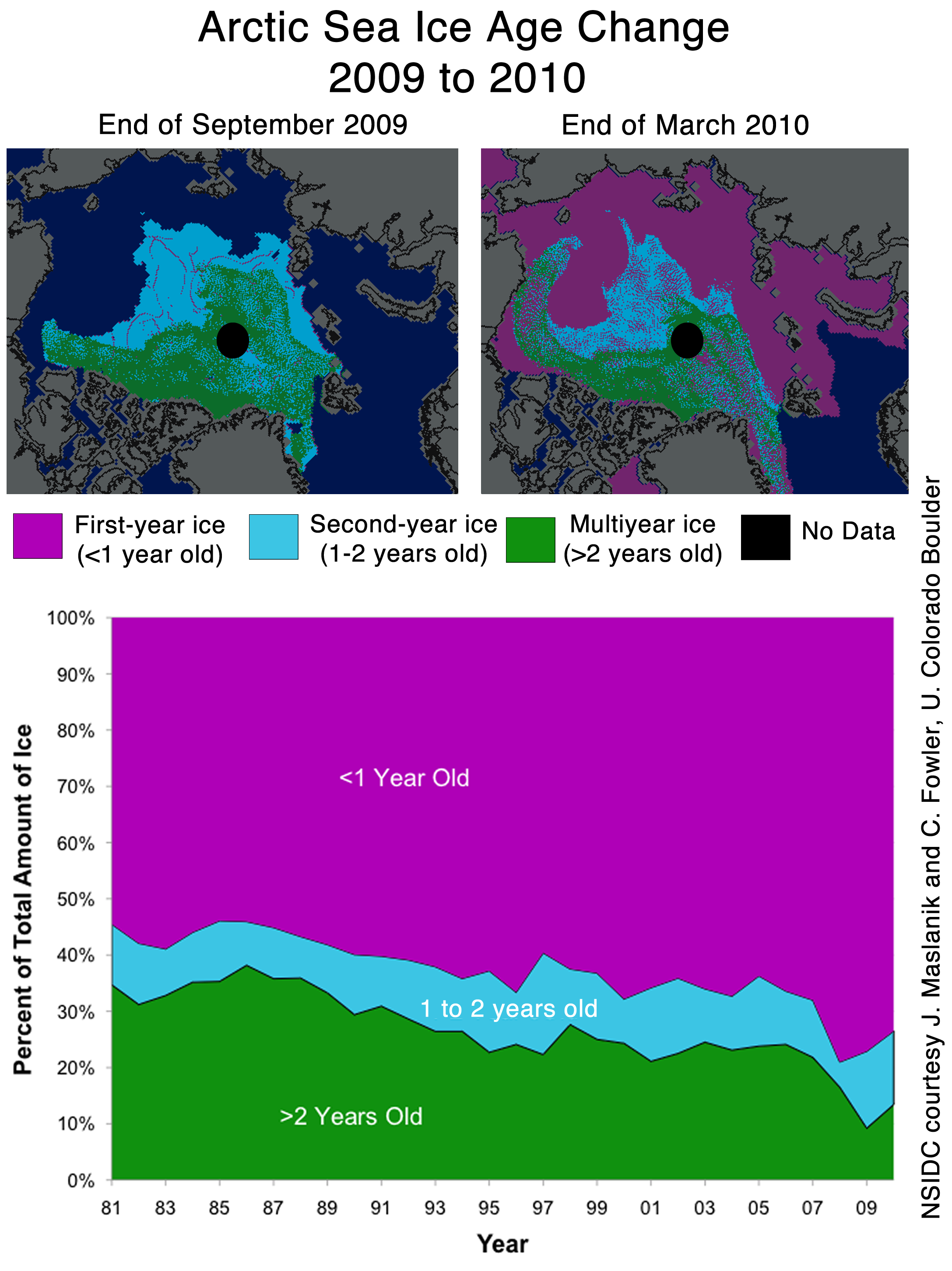
The areas that in recent years have been first-year ice that are now covered by 2nd and 3rd year ice will increase the volume – in those regions. However, compared to the last two years, there is even less of the oldest ice (see images below – I also included 1985 as an example of 1980s ice conditions for comparison). The loss of the oldest, thickest ice may more than offset the gain in volume from the 2nd and 3rd year ice. Also, it’s been a relatively warm winter in the Arctic, so first-year ice is likely a bit thinner than in recent years. Finally, the extent has been less than the last two years for the past couple of months. So the PIOMAS estimate that we are at record low volume anomaly is not implausible.

Early May ice age for: 1985 (top-left), 2008 (top-right), 2009 (bottom-left), and 2010 (bottom-right). OW = open water (no ice); 1 = ice that is 0-1 year old (first-year ice), 2 = ice that is 1-2 years old (2nd year ice), etc. Images courtesy of C. Fowler and J. Maslanik, University of Colorado, Boulder. Updated from Maslanik et al., 2007.
What does this all mean for this year’s minimum? Well, much will depend on the weather for the rest of the summer. As NSIDC states in its most recent post, we’ve expected we may see the rapid decline begin to slow because the melt will soon run into older, thicker ice, which will slow the loss of ice. Steve has said essentially the same thing and indeed we’ve the rate of loss slow over the past few days. Of course, there still a lot of time left in the melt season, and pace of melt continue to be relatively slow or it may speed up again, so we’ll see what happens. Regardless of what happens this summer though, the most important fact is that, despite some areas of the Arctic being a bit thicker this year, the long-term thinning and declining summer ice extent trend continues.
One final note about both PIPS and PIOMAS: Steve has claimed that “everyone agrees that PIPS 2.0 is the best data source of historical ice thickness”. Well, no scientist would even agree that what PIPS 2.0 produces are data! Being a data person myself, this is a bit of a pet peeve, but it’s important to make the distinction that model outputs are not data. Models are tremendously useful for obtaining information where data doesn’t exist (i.e., data sparse regions, historical periods without data), for projecting future changes, and for understanding how physical processes interact with each other (e.g., changes in climate due to changes in forcings).
However, model results are simulations, not observed data. And if there is good data available, I trust data over model estimates. And there is good historical data on ice thickness from submarine and satellite records (Kwok and Rothrock, 2009) and from proxy thickness estimates from ice age data (e.g., Maslanik et al., 2007). These data clearly show a long-term thinning trend. And while 2010 has relatively less of the thinner, first-year ice than the last couple of years, the ice cover is still much thinner than it was in earlier years. And it is clear that the models don’t entirely capture the spatial distribution of thickness correctly. As an example, compare the first-year ice in the ice age figure above with the PIPS 2.0 estimate from the same time period (below). In May, PIPS showed most of the central Arctic covered by ~3+ m ice, all the way to the Siberian coast. This is simply not realistic because the ice age data indicate first-year ice on much of the Siberian side of the Arctic (see images above), which would average at most 2 m. Thus Steve’s comparison of May 2010 and May 2008 with PIPS data is not valid because the model results are capturing observed spatial patterns of thickness.

References
Kwok , R. and D.A. Rothrock, 2009. Decline in Arctic sea ice thickness from submarine and ICESat records: 1958–2008, Geophys. Res. Lett., 36, L15501, doi:10.1029/2009GL039035.
Maslanik, J.A., C. Fowler, J. Stroeve, S. Drobot, J. Zwally, D. Yi, and W. Emery, 2007. A younger, thinner Arctic ice cover: Increased potential for extensive sea-ice loss, Geophys. Res. Lett., 34, L24501, doi:10.1029/2007GL032043.
Key PIPS 2.0 Model references:
Cox, M., 1984. A primitive equation, 3-dimensional model of the ocean, Geophysical Fluid Dynamics Laboratory Ocean Group Technical Report, Princeton, NJ, 1141 pp.
Hibler, W.D. III, 1979. A dynamic thermodynamic sea ice model, J. Phys. Oceanogr., 9(4), 815-846.
Hibler, W.D. III, 1980. Modeling a variable thickness sea ice cover, Mon. Weather Rev., 108(12), 1943-1973.
Thorndike, A.S., D.A. Rothrock, G.A. Maykut, and R. Colony, 1975. The thickness distribution of sea ice, J. Geophys. Res., 80(33), 4501-4513.
Key PIOMAS Model references:
Dukowicz, J.K., and R.D. Smith, 1994. Implicit free-surface method for the Bryan-Cox-Semtner ocean model, J. Geophys. Res., 99, 7791-8014.
Winton, M., 2000. A reformulated three-layer sea ice model, J. Atmos. Oceanic Technol., 17, 525-531.
Zhang J., and W.D. Hibler III, 1997. On an efficient numerical method for modeling sea ice dynamics, J. Geophys. Res., 102, 8691-8702.
Zhang, J., and D.A. Rothrock, 2001. A thickness and enthalpy distribution sea-ice model, J. Phys. Oceanogr., 31, 2986-3001.
Zhang, J., and D.A. Rothrock, 2003. Modeling global sea ice with a thickness and enthalpy distribution model in generalized curvilinear coordinates, Mon. Weather Rev., 131, 845-861.
Note that NSIDC “forecast” the slower ice loss in their July 6 newsletter, about six days after the slowdown had already started.
http://nsidc.org/arcticseaicenews/
By contrast, my PIPS based forecast of July slowdown came in June, with the exact date in the future attached.
http://wattsupwiththat.com/2010/06/28/sea-ice-news-11/#comment-419233
R. Gates says:
July 13, 2010 at 9:42 pm
“Wow! Thanks for taking the time for such an excellent explanation. More than anything, I think we all can look forward to the time that we start getting the real data from CryoSat 2.”
Contain your excitement. I’ve thought that given data will start being generated now, at a time when PIOMAS model extremely low ice volume, there is a possibility that the data moving forward will be showing an upward trend.
It has worried me that the satellite data we’ve been working with since 1979 started at a period when ice was at recent era high and this has contributed to the recent ‘long term trend’. (I hope this isn’t just wishful thinking but relates to the question below)
Dr Meier would you care to comment on Petr Chylek 2010 paper on the arctic-antarctic seesaw which suggests much of the recent arctic warming is due to a natural climate cycle which is likely to reverse in the coming decades?
my PIPS based forecast of July slowdown
Steven, how did your PIPS forecast provide you with the insight the winds would turn drastically?
Günther Kirschbaum
1. You are misquoting me. Strike 1
2. I didn’t say anything about the wind. Strike 2
3. PIPS does forecast future wind conditions. Strike 3
You’re out!
Latimer Alder
Little else lives there? Are you serious?
They may not be many animals that live directly on the ice, but there are plenty that live under and around it – or depend on it for their way of gathering food. Try various whale species such as the Beluga, Orca and Grey. Lots of other mammals such as Seals (various), sea otter and Walrus live on or around the ice and use ice-holes to lure and catch fish.
And of course there are the fish populations that depend on the ice ecosystem.
Not all of these species will die out completely if there is no summer ice, but expect a huge stress on their populations. When I read your post I visualised stuffing a dead Walrus into that biiig yawning gob of yours.
Excuse my anger.
Dear judge, jury and executioner, aka Steven Goddard, don’t you think it a coincidence that the slowdown started when the winds turned drastically? PIPS forecasts future wind conditions only one day in advance.
If the winds would have remained the same (strong Beaufort Gyre) we could have attributed the slowdown to thick ice in the Arctic Basin . Now we’re not sure yet, but perhaps the winds will turn again and provide more information. Do you expect melt rates to remain low if this happens?
I’m glad that Dr Meier has cleared up the much disputed question of which version of PIPS (2.0 or 3.0) is actually used (please take note – R. Gates June 12, 2010 at 12:22 pm on What is PIPS? Posted on June 12, 2010 by charles the moderator ).
Matthew L,
The Arctic has been ice free many times in the past. It is a routine event.
Poor fishies, how do they ever handle the stress?
Mathew L,
Sorry but I fail to see the logic behind your post, are you saying that the industrial world should destroy iteslf on the basis that it might cause a “huge population stress”?
and that based on the theory that AGW does in fact cause the melting of the polar caps which is by no means even a vague possibility.
The problem with your emotional statement is of course that it forgets just how resilient and robust wild animal populations can be when confronted with habitat change.
The planet is not and never has been fond of ‘stasis’ to nature stasis leads nowhere, the evolution of species throughtout earth history has been one of adaption to new circumstances, the natural challenge to animal life is a positive thing for species.
The laudable wish to protect animals should have boundaries based on common sense, I myself would wish to protect animals from wanton cruelty but to rearrange our entire industrial economy because of an emotional response run wild is not my idea of common sense. Please remember that wild animals are one heck of lot tougher and more resilient to change than many realise.
Your anger is understandable because of the fashion to see wild animals as almost helpless infants unable to adapt, please try to see past the emotional response.
Günther Kirschbaum
I predicted a path similar to 2006 over six weeks ago, when your side was bragging about the “fastest melt on record.”
http://wattsupwiththat.com/2010/06/02/the-undeath-spiral/
You can either be a good sport, or a sore loser. Your choice.
Heh, ‘long term’ is for as long as we’ve been carefully observing the Arctic ice with satellites. About 30 years, incidentally, or not, the term for one phase of the PDO. And remind me, was it the warming or cooling phase of the PDO?
======================
Usually I’m a very sore loser. :-p
Another rephrase of the same question (maybe three times is lucky): do you think the thick ice will withstand the winds if they return to June patterns?
Matthew L
How does a paopulation suffer stress?
Since stress is a mental condition, I can understand how an individual might suffer from it. Though judging on my goldfish fishywishys aren’t among the highest forms of intelligence. But how does a population as a whole suffer from it?
I think you mean that ‘as the conditions around the species change then the population as a whole will change accordingly’ – which is hardly new news. But using the term ‘stress’ tends to anthropomorphise the entirely natural effect. Sloppy terminology designed to induce sloppy and fuzzy thinking.
I’ve just had my lunch thanks.. a very nice kipper. So no need for the walrus just yet.
Time for a snooze. Yaaaawnn……
>> Matthew L says:
July 14, 2010 at 3:12 am
Now, we may have only one 30-year climate data point for sea ice, but the HadCrut3 temperature series goes back to 1850, which is 5 full data points if you end with the
most recent full year (2009) and start in 1860. Not much to go on, but the best we
have. <<
Actually, we have the same 1979 start point for temperature. Before the satellite records the 70% of the planet covered by oceans had no accurate temperature measurements. A few occasional passing ships provided temperatures accurate only within several degrees. If you think this lack of ocean coverage is unimportant, then note that the globally warm March 2010 was one of the coldest March's for the very places (USA, Europe, China) that were almost entirely responsible for the pre-1900 temperatures, and a dominant factor in the 1900-1979 'global' temperature. Had we no satellites, winter 2010 would have gone down as one of the coldest in history.
What the Arctic ice will do in the next century is anybody's guess. The historical record of a warm Greenland lasting 200 years suggests that the nearby Arctic was
ice-free in the summer back then, but we have no satellite records from 1100 AD to verify that.
Nice post.
Which is more important for the melting of sea ice – atmospheric air temperature or ocean water temperature?
If we have 30 years of data why does the basis period end in 2000?
Matthew L : “Sea ice conditions in the Arctic are a symptom of changes in temperature so we can use trends in temperature data as a proxy for the prospects for Arctic sea ice.”
I think it is not correct to refer to “the Arctic” as if it is a single unit, as ice conditions and temperatures vary widely in space and time.
From the CRU e-mail: 1213201481.txt
“1981: This looked at statistics of annual/winter/summer
Temperatures for the NH and zones of the NH to see what
signals might you be able to detect. SNR problem really.
Showed that best place to detect was NH annual and
also Tropics in summer. Last place to look was the Arctic
because variability was so high.”
Dr Meier conveniently overlooks the fact that much of the ice that has melted the last thirty years was added from 1955 to 1969 during a negative phase of the NAO.
http://en.wikipedia.org/wiki/File:GISP2_ice_core_eng.svg
Declining ocean heat content and the demise of thirty years of positive NAO points to another round of ice increase.
http://en.wikipedia.org/wiki/File:Winter-NAO-Index.svg
Yet another good quality post.
It is a credit to the site that all views are given a proper hearing.
One thing troubling me however is the statement;
“Regardless of what happens this summer though, the most important fact is that, despite some areas of the Arctic being a bit thicker this year, the long-term thinning and declining summer ice extent trend continues.”
How can the trend continue if the data is going the other way?
I meant to post this link to modeled sea ice volume from 1948 to present
http://psc.apl.washington.edu/zhang/IDAO/retro.html#Satellite_ice
@Phil’s Dad
‘How can the trend continue if the data is going the other way?’
Same way as if its a hot week its climate change and VERY IMPORTANT. But a cold week is just weather and can be ignored.
Aka ‘the having your cake and eating it trick’.
Wow, excellent article with a lot of new aspects worth to discuss.
The Swiss Cheese Foto: (North Pole is close to screen bottom)
http://ice-map.appspot.com/?map=Arc&sat=ter&lvl=8&lat=87.042952&lon=154.697724&yir=2010&day=193
Almost spit the coffee out on that one – LOL.
Congratulations R. Gates, the scientist pretty much agrees with what you’ve been saying for months.
http://www.ijis.iarc.uaf.edu/seaice/extent/AMSRE_Sea_Ice_Area.png
Only the second lowest on record – oh well. Still two months to go, maybe the melt will pick up.
NSIDC people are so nice and folksy since Climategate – nothing has changed in the climate projections, but they aren’t calling it “death spiral” anymore. It’s a kinder, gentler AGW.
…the long-term thinning and declining … trend continues.
It just sounds like the Arctic is losing it’s hair – nothing catastrophic there.
There is an interesting article about the connection between different solarcycles and the extent of the arctiv sea ice;
http://www.eike-klima-energie.eu/
The article is in german, so you have to translate it by google.