
Guest post by Dr. Walt Meier
Steve Goddard has written several contributions on sea ice lately, particularly on the PIPS model, and as expected there has been much discussion about sea ice as we’ve entered another summer melt season. I can’t possibly comment on everything, but I will provide some information on a few points. In this post, I’ll tackle the PIPS and PIOMAS model issues.
In a following post, I’ll address the other three issues. I include several peer-reviewed journal references for completeness and to give a sample of the amount of research that has gone into investigating these issues. Note that as usual, I’m speaking only for myself and not as a representative of the National Snow and Ice Data Center or the University of Colorado at Boulder.
PIPS 2.0 and PIOMAS
When I saw PIPS being mentioned, it brought back fond memories for me. I haven’t worked with PIPS recently, but several years ago, I was a visiting scientist at the U.S. National Ice Center (NIC). NIC is a joint Navy, NOAA, and Coast Guard center whose primary duty is to provide operational support for military and civilian ships in and near ice-covered waters.
NIC is the primary customer of the PIPS model outputs, which they’ve used the operational forecasts to help produce their operational ice analyses. As a researcher at NIC, one of the projects I was involved with a project to evaluate the operational forecasts. I was a co-author on a couple peer-reviewed journal articles (Van Woert et al., 2003; Van Woert et al., 2001), where we found that the operational forecasts showed some skill at predicting ice edge conditions over the following 1-5 days, but the forecasts had difficulty during times of rapid ice growth or melt. (Steve referenced one of the papers – thanks Steve!). So I can perhaps clarify and explain some issues about PIPS and its applicability for studying climate and its appropriateness for studying climate compared to PIOMAS. Here are some relevant points:
1. As mentioned above, PIPS is an operational model. It is run to forecast ice conditions over 1-5 day intervals. The basic model physics is the same for any sea ice model – ice grows when it is cold, melts when temperatures are above freezing, and moves around due to winds and other factors. However, model details and how each type of model is implemented and run differ depending on the application. Similarly, climate and weather models include the same basic underlying physics, but you wouldn’t run a climate model to forecast weather or vice versa.
2. Validation of PIPS (see references above) has been done for sea ice extent, concentration, and motion near the ice edge (an important factor in the day-to-day changes in the ice edge). This is because the ice edge is the area of operational interest – i.e., the focus is on providing guidance for ships to avoid getting trapped in the ice. Very little validation was done for ice thickness estimates, particularly in the middle of the ice pack.
PIOMAS has been specifically validated for ice thickness using submarine and satellite data (http://psc.apl.washington.edu/zhang/IDAO/retro.html). Of course, the PIOMAS model estimates are not perfect, but they appear to capture the main features of the ice cover in response to forcings over seasonal and interannual scales.
3. PIPS 2.0 was first implemented in 1996 using model components developed in the 1970s and 1980s. These components capture the general physics of the ice and ocean well, but are basic by today’s standards. This provides suitable simulations of the ice cover, especially for short-term forecasts (which are most sensitive to the quality of the atmospheric forecast that drives the model). There has been a lot of sea ice model development since the 1980s, which according to a recent abstract for a conference presentation at the Joint Canadian Geophysical Union and Canadian Meteorological and Oceanographic Society 2010 Meeting, will be implemented in the next generation PIPS model, PIPS 3.0. However that is not yet being run operationally and thickness fields on the website are from PIPS 2.0. The primary references for PIPS 2.0 are Hibler (1979), Hibler (1980), Thorndike et al. (1980), and Cox (1984).
PIOMAS includes much more up-to-date model components (developed during the late 1990s early 2000s) with significant improvements in how well the model is able to simulate the growth, melt, and motion of the ice cover. In particular, the model do a much better job at realistically moving the ice around the basin and redistributing the thickness (i.e., rafting, ridging) in response to wind forcing. Thus, the thickness fields are likely to be more realistic than PIPS. The primary references for PIOMAS are: Zhang and Rothrock (2003), Zhang and Rothrock (2001), Winton (2000), Zhang and Hibler (1997), Dukowicz and Smith (1994).
4. The PIPS website has very limited information about the model or the model output products; it contains only image files; there are no raw data files, no documentation, no source code, no citation of peer-reviewed journal articles. A few articles can be found online elsewhere, and there are a few journal articles, but overall the information is quite sparse. This isn’t a big issue for PIPS, and I don’t fault those who run the PIPS model, because it has a small, focused user community who are familiar with the model, its characteristics, and its limitations.
The PIOMAS website contains detailed documentation including several peer-reviewed journal articles describing the model; it also contains model outputs, images, animations, and source code. Of course, the amount of documentation doesn’t say anything about the quality of the model outputs. But I think most people today agree that for climate data being widely-distributed and which is being used to make conclusions about climate change, it is a good idea to have data and code freely available.
So, which model results do I trust more? For operational forecasts, I might use PIPS. And PIPS probably does capture some aspects of the longer-term changes. But for the reasons stated above, I would trust the PIOMAS model results more for seasonal and interannual changes in the ice cover. I very much doubt that anyone familiar with the model details would unequivocally trust PIPS over PIOMAS.
But what about the PIOMAS volume anomaly estimates? How can they be showing a record low volume anomaly when there is less of the thinner first-year ice than in previous years as seen in ice age data? Doesn’t this mean that PIOMAS results are way off? Well, first, it is quite possible that the model may currently be underestimating ice thickness. No model is perfect. However, there is a possible explanation for the low volume and the PIOMAS model may largely be correct.
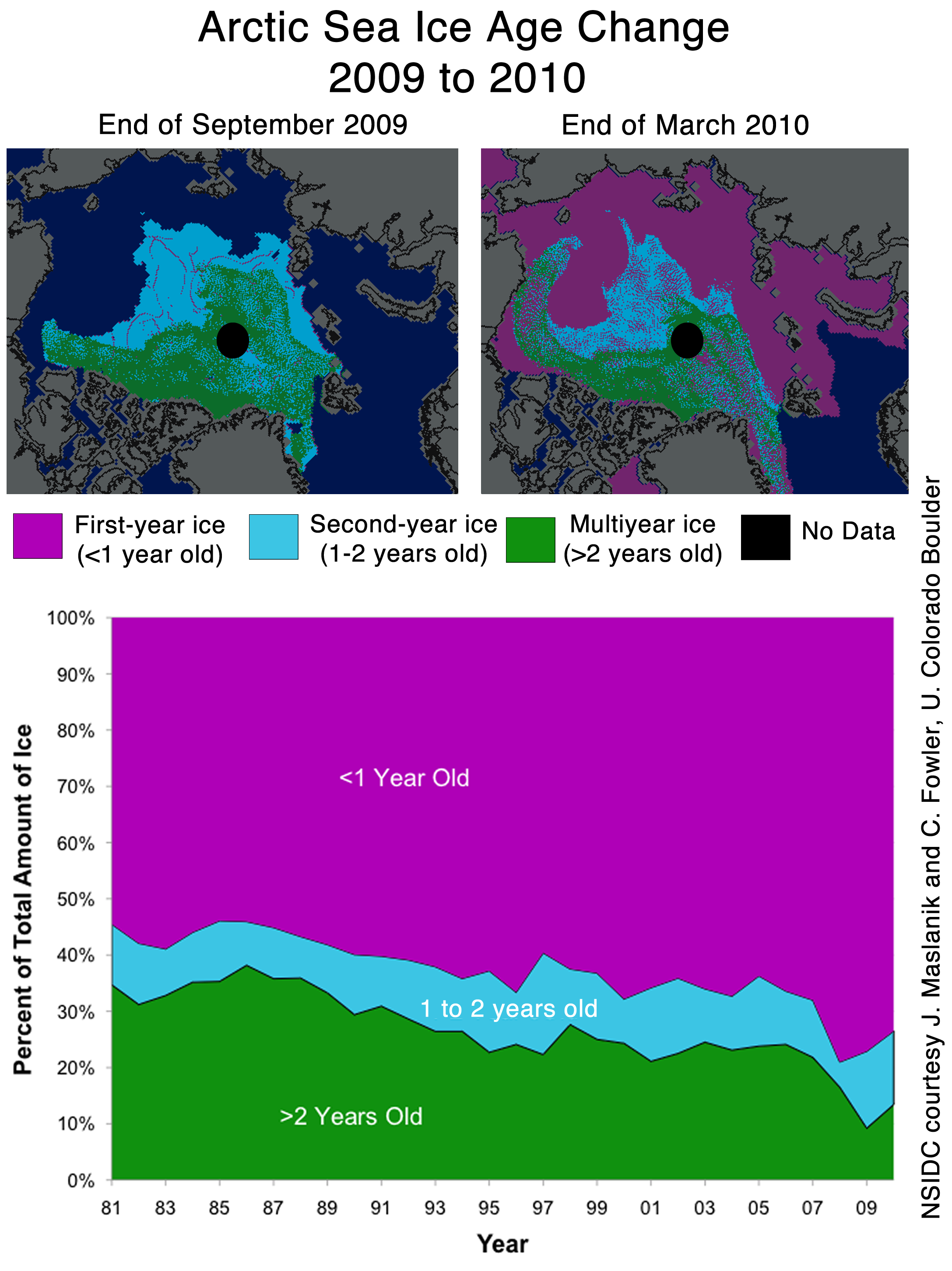
The areas that in recent years have been first-year ice that are now covered by 2nd and 3rd year ice will increase the volume – in those regions. However, compared to the last two years, there is even less of the oldest ice (see images below – I also included 1985 as an example of 1980s ice conditions for comparison). The loss of the oldest, thickest ice may more than offset the gain in volume from the 2nd and 3rd year ice. Also, it’s been a relatively warm winter in the Arctic, so first-year ice is likely a bit thinner than in recent years. Finally, the extent has been less than the last two years for the past couple of months. So the PIOMAS estimate that we are at record low volume anomaly is not implausible.

Early May ice age for: 1985 (top-left), 2008 (top-right), 2009 (bottom-left), and 2010 (bottom-right). OW = open water (no ice); 1 = ice that is 0-1 year old (first-year ice), 2 = ice that is 1-2 years old (2nd year ice), etc. Images courtesy of C. Fowler and J. Maslanik, University of Colorado, Boulder. Updated from Maslanik et al., 2007.
What does this all mean for this year’s minimum? Well, much will depend on the weather for the rest of the summer. As NSIDC states in its most recent post, we’ve expected we may see the rapid decline begin to slow because the melt will soon run into older, thicker ice, which will slow the loss of ice. Steve has said essentially the same thing and indeed we’ve the rate of loss slow over the past few days. Of course, there still a lot of time left in the melt season, and pace of melt continue to be relatively slow or it may speed up again, so we’ll see what happens. Regardless of what happens this summer though, the most important fact is that, despite some areas of the Arctic being a bit thicker this year, the long-term thinning and declining summer ice extent trend continues.
One final note about both PIPS and PIOMAS: Steve has claimed that “everyone agrees that PIPS 2.0 is the best data source of historical ice thickness”. Well, no scientist would even agree that what PIPS 2.0 produces are data! Being a data person myself, this is a bit of a pet peeve, but it’s important to make the distinction that model outputs are not data. Models are tremendously useful for obtaining information where data doesn’t exist (i.e., data sparse regions, historical periods without data), for projecting future changes, and for understanding how physical processes interact with each other (e.g., changes in climate due to changes in forcings).
However, model results are simulations, not observed data. And if there is good data available, I trust data over model estimates. And there is good historical data on ice thickness from submarine and satellite records (Kwok and Rothrock, 2009) and from proxy thickness estimates from ice age data (e.g., Maslanik et al., 2007). These data clearly show a long-term thinning trend. And while 2010 has relatively less of the thinner, first-year ice than the last couple of years, the ice cover is still much thinner than it was in earlier years. And it is clear that the models don’t entirely capture the spatial distribution of thickness correctly. As an example, compare the first-year ice in the ice age figure above with the PIPS 2.0 estimate from the same time period (below). In May, PIPS showed most of the central Arctic covered by ~3+ m ice, all the way to the Siberian coast. This is simply not realistic because the ice age data indicate first-year ice on much of the Siberian side of the Arctic (see images above), which would average at most 2 m. Thus Steve’s comparison of May 2010 and May 2008 with PIPS data is not valid because the model results are capturing observed spatial patterns of thickness.

References
Kwok , R. and D.A. Rothrock, 2009. Decline in Arctic sea ice thickness from submarine and ICESat records: 1958–2008, Geophys. Res. Lett., 36, L15501, doi:10.1029/2009GL039035.
Maslanik, J.A., C. Fowler, J. Stroeve, S. Drobot, J. Zwally, D. Yi, and W. Emery, 2007. A younger, thinner Arctic ice cover: Increased potential for extensive sea-ice loss, Geophys. Res. Lett., 34, L24501, doi:10.1029/2007GL032043.
Key PIPS 2.0 Model references:
Cox, M., 1984. A primitive equation, 3-dimensional model of the ocean, Geophysical Fluid Dynamics Laboratory Ocean Group Technical Report, Princeton, NJ, 1141 pp.
Hibler, W.D. III, 1979. A dynamic thermodynamic sea ice model, J. Phys. Oceanogr., 9(4), 815-846.
Hibler, W.D. III, 1980. Modeling a variable thickness sea ice cover, Mon. Weather Rev., 108(12), 1943-1973.
Thorndike, A.S., D.A. Rothrock, G.A. Maykut, and R. Colony, 1975. The thickness distribution of sea ice, J. Geophys. Res., 80(33), 4501-4513.
Key PIOMAS Model references:
Dukowicz, J.K., and R.D. Smith, 1994. Implicit free-surface method for the Bryan-Cox-Semtner ocean model, J. Geophys. Res., 99, 7791-8014.
Winton, M., 2000. A reformulated three-layer sea ice model, J. Atmos. Oceanic Technol., 17, 525-531.
Zhang J., and W.D. Hibler III, 1997. On an efficient numerical method for modeling sea ice dynamics, J. Geophys. Res., 102, 8691-8702.
Zhang, J., and D.A. Rothrock, 2001. A thickness and enthalpy distribution sea-ice model, J. Phys. Oceanogr., 31, 2986-3001.
Zhang, J., and D.A. Rothrock, 2003. Modeling global sea ice with a thickness and enthalpy distribution model in generalized curvilinear coordinates, Mon. Weather Rev., 131, 845-861.
Latimer Alder, not sure why I am bothering to reply to this codswallop, but I can’t let you get away with this…
You clearly have a very limited vocabulary. Stress is simply an undesirable reaction to change from previously experienced normality. It is usually physical. It can apply to steel girders in a skyscraper during high winds or to the crank shaft of an internal combustion engine forced to rotate at higher than its designed speed.
In the case of animals when I say “population” I mean the numbers of animals. When a population of animals is put under “stress” it means that a change is putting downward pressure on the numbers of animals. For instance in the case of the Arctic the population of, say, Fur Seals is put under stress by:
– cub clubbing for fur
– overfishing of their food source
– polychlorinated biphenols in the food chain
All these factors reduce the numbers of live young and the ability of the females to breed and raise young to mature breeding age.
The population of Fur seals is also put under stress when the ice through which they fish disappears and they have to adapt to open water conditions. It is very likely that this, too, will result in a reduction in their numbers. In other words their population is put under “stress”. Capiche?
Stress is not an “anthropomorphic” term at all – and it certainly is not sloppy or fuzzy thinking. It has a very precise scientific meaning. The above paragraph just reflects your very limited understanding of the word.
Very few of the stresses under which the populations of Arctic mammals are put are “natural”. Almost all are caused directly or indirectly by human beings.
Kippers of course being smoked herring – a fish population put under such enormous stress by over-fishing in the twentieth century that it is all but extinct now in the North Sea. Latest estimates put its population at around 5% of its size in 1900.
You might need that Walrus soon. Oh, sorry, they will have died out as well. Looks like you will have to eat your words instead.
Ah, a sloth, another endangered species.
Walt Meier says:
July 14, 2010 at 8:56 am
“That is why PIOMAS, with improved model physics, is more trustworthy over the long-term.”
2. “Long-term” is a bit ambiguous of a term. Generally I mean decadal to multi-decadal scale.
Are you saying that PIOMAS is “only” more trustworthy over the long-term, therefore PIPS would be better for the “short-term? We have recently seen PIOMAS’s terrible short-term record…
Thanks
Cassandra King
July 14, 2010 at 11:01 am
The main signals that warming of the atmosphere is caused by rising greenhouse gases are as follows:
1. more warming at night than during the day
2. more warming at higher latitudes (Arctic / Antarctic) than lower latitudes (tropics)
3. more warming in the Troposphere than the Stratosphere. In fact the Stratosphere can cool while the troposphere warms rather like increasing the insulation in a roof makes the upper surface of the roof colder and the lower surface of the roof warmer.
All these are happening. So there is a very high likelihood that a significant amount of the warming seen during the late 20th and early 21st Centuries is as a result of the rising proportion of greenhouse gases in the atmosphere.
There are a number of more precise analyses of the spectrum of outgoing radiation demonstrating this.
@4:31 am Matthew L replied to Latimer Alder:
“Not all of these species will die out completely if there is no summer ice, but expect a huge stress on their populations. When I read your post I visualised stuffing a dead Walrus into that biiig yawning gob of yours.”
Matthew’s sole point was the “ice eco-system.”
But now he re-frames his argument to include clubbing baby seals, kippered herring, and polychlorinated biphenols [sic].
That’s how the alarmist crowd handles being wrong; they move the goal posts. Remember that the most basic assumption of the CO2=CAGW conjecture posits that the tiny trace gas carbon dioxide drives the climate. That conjecture has been shown to be nonsense. CO2’s effect is so small that it is unmeasurable [if it were measurable, the question of the climate sensitivity number would be answered].
The original contention by Matthew L was that populations would be put under such stress by melting ice that many species would die out. Of course Matthew can not credibly defend that conjecture, since the Arctic has been ice free many times in the past. Such mass exterminations would have been found in the fossil record.
Rather than admitting that organisms adapt to either an ice covered Arctic or an ice free Arctic, he now says that fishing for herring, and polychlorinated biphenyls are the culprits, instead of his original argument that melting ice will cause species exterminations. Not a very robust argument.☺
Matthew L
Warm nights are a classic symptom of Urban Heat Islands.
Antarctica has not warmed.
Most Arctic warming is attributed to soot.
Smokey says:
July 14, 2010 at 11:48 am
Not my point. These are just other examples showing how an animal populations can be put under “stress” used to refute Mr Adler’s poor understanding of the word.
Falling sea ice cover will put the populations of many animals under “stress”. How that will ultimately affect their ability to survive will of course vary depending on how adaptable the species is. My point is that sea ice loss and global warming are avoidable. These species should be allowed to change and adapt to natural changes in the environment, not forced to change by man-made changes to the environment.
See my reply to Cassandra King regarding the attribution of global warming to greenhouse gases. Not “unmeasurable” at all.
Matthew L:
“My point is that sea ice loss and global warming are avoidable.”
How, exactly?
“Regardless of what happens this summer though, the most important fact is that, despite some areas of the Arctic being a bit thicker this year, the long-term thinning and declining summer ice extent trend continues.”
Unfortunately that is an opinion not supported by fact.
It is based on a trend line through one half of an ocean oscillation period that lasts approximately 60 to 70 years. You can not draw any conclusion for at least another ten to twenty years because you must see if the expected decrease in sea temperature forecast by past trendsin sea temperature effects the “declining summer ice extent trend” Only at that point, with most of the 60+ year cycle documented, would you be justified in making a prediction.
(You were doing real well until you left science and went with the political propaganda.)
Barents Sea temp and AMO:
http://wattsupwiththat.files.wordpress.com/2009/10/barents_sea_temp_with_amo.png
Steve Goddard:
…as well as a classic symptom of greenhouse gas emissions. Obviously you think it is the former whereas climate scientists think they have adjusted the records sufficiently to remove the spurious effect of UHI. This is the whole original point of this blog of course and I don’t intend to repeat all the arguments here.
Parts of Antarctica are warming very strongly. I have a friend who works for the British Antarctic Survey who has spent every one of the last 15 Antarctic summers down there. He has very strong views on the subject and is documenting rapid changes in the fauna of the Western Antarctic Peninsula that have not changed for hundreds of thousands of years. He has been in the press and media recently. A more general paper on the subject here:
http://www.antarctica.ac.uk/bas_research/science/climate/antarctic_peninsula.php
You mean this study:
http://www.nature.com/ngeo/journal/v2/n4/abs/ngeo473.html
Well that is only one study, and the conclusion is that black carbon deposits have made a “substantial contribution” to Arctic warming. That is very different from saying “Most Arctic warming”. What it actually says is that not only is there differential warming in the Arctic caused by greenhouse gases but man is also contributing to the warming through atmospheric pollution by black carbon deposits.
That is hardly helping the argument that most global warming is “natural” is it?
Matthew L says:
July 14, 2010 at 12:43 pm
‘He has very strong views on the subject and is documenting rapid changes in the fauna of the Western Antarctic Peninsula that have not changed for hundreds of thousands of years.’
Which oracle does he use for that?
Excerpts from: Matthew L on July 14, 2010 at 12:43 pm
and
Since you have indicated these examples of increased warming are caused by greenhouse gases, mainly the increased atmospheric CO2 levels per the standard (C)AGW presentation, please cite the work where all other possible explanations have been ruled out.
Hansen on soot :
http://pubs.giss.nasa.gov/docs/2004/2004_Hansen_Nazarenko.pdf
Matthew L
Phoenix is normally 10-15 degrees warmer at night than the desert around it. There must be a massive CO2 bubble over the city.
Global sea ice is above normal. Quite a polar meltdown we are having!
http://arctic.atmos.uiuc.edu/cryosphere/IMAGES/global.daily.ice.area.withtrend.jpg
Matthew L:
“That is hardly helping the argument that most global warming is ‘natural’ is it?”
You have again failed to falsify the null hypothesis: that the observed warming is a result of natural climate variability. You have a lot of company in that regard.
The climate’s sensitivity to CO2 is almost certainly <1°C. In fact, the effect of CO2 is so insignificant that it can be disregarded.
Once it is accepted that the planet is not lying, it is easy to see that the entire “carbon” scam is nothing but a proposed immense transfer of wealth based on a chimera. CO2 is a harmless minor trace gas, beneficial to all life. More is better [within reason, and keeping in mind that CO2 has been almost twenty times higher in the geologic past].
CO2 has nothing measurable to do with Arctic ice extent. If it did, the Antarctic would be on a similar trend.
Unless the climate alarmist advocates can credibly falsify the hypothesis of natural climate variability, their arguments will continue to be debunked by planet Earth.
jakers says:
July 14, 2010 at 10:02 am
I make no assumptions other than the poster’s insistence that temperatures will continue to rise and extents fall in the Arctic, while temperatures continue to ??? while extents rise in the Antarctic.
If the poster does not want to respond to the why of the polar opposites, I have to assume that the question has no answer, and that this whole frenzy over an Ice-free arctic is pure hyperbole.
Warm nights are a classic symptom of Urban Heat Islands.
And humidity, which is water vapor. The diurnals show as much, and sort according to solar cycle length.
There are also natural Heat Islands. I know of two of them.
Matthew L
One little tiny piece of Antarctica was “warming strongly” and it is located on an active volcanic ridge.
stevengoddard says:
July 14, 2010 at 7:56 am
Dr. Meier’s quote was made out of context.
I was referring to “everyone” on WUWT, none of whom were able to produce a single other source of historical thickness data. I also don’t believe that Dr. Meier has mentioned any other source of historical thickness data. So, PIPS is indeed the best source.
____________________________________________________________
Actually PIPS is not the best source.
In your opinion PIPS 2.0 is the ONLY source.
Therefore PIPS 2.0 is both the BEST source and the WORST source, since it is the ONLY source, in YOUR opinion.
PIOMAS was mentioned by Dr. Meier and many others here on WUWT, if one has volume data (PIOMAS), and one has extent (or area) data (JAXA, NSIDC, et. al.), one obviously has thickness data. D’oh!
Perhaps you missed that part of his discussion titled;
NSIDC’s Dr. Walt Meier on PIPS -vs- PIOMAS
@Matthew L
If you choose to use the word ‘stress’ in a way unknown to my dictionary (OED) or even http://www.thefreedictionary.com/STRESS feel free. But don’t get all upset if others don’t agree with your definition. This is not Alice in Wonderland. You are not Humpty Dumpty.
And thanks for letting me know the provenance of a kipper. There was me thinking they were just funny shaped things that grew naturally on the fish counter at Waitrose. Nice, after 50 years of eating them about once a week to be corrected.
So now to global warming. Why should we assume that this should bad for the fishies? Fishies are cold-blooded creatures, so as the sea temperature warms up, they will be able to move around more as their biochemistry speeds up (Arrhenius), and eat more and get bigger quicker and have more babies. And as the nasty walrusses and seals and polar bears aren’t going to be around to stick their paws through the ice and catch them , then the fishies will be more plentiful. so from a fishy perspective, global warming is a super good thing. It will Prolong Active Life in every sense.
And as I like eating kippers more than I imagine I would like eating walrus, I too think that this is all a jolly good idea. Bring it on.
Dr. Meier, it is *always* a pleasure to see you here and dialogue with you. You are a gentleman and a scholar, and I can always respect that combination even where I have areas of disagreement.
A few issues –what the heck is up with PIPS 3.0, and why has it been stuck “in development” missing so many expected release dates? Is there any reason today to prefer/trust PIPS 3.0 outputs if the Navy isn’t willing to rely on them themselves?
How concerned are you about PIOMAS re the scarcity of validating data? A few years vs actual observations from ICESat, and it missed the last one quite badly from what I saw. Do we anticipate that CRYOSAT-2 input is going to be going into that? My problem with PIOMAS is I just don’t see any reason to think there has been enough validation to give it confidence. I do applaud the effort. I also look at one of the prime devlopers of PIOMAS “prediction” for minimum extent last year, which missed very badly, and it does not give me a great deal of confidence in his algorithms in general at this point.
Also, ICESat granularity was very poor (i.e. number of observations per year). We get extent *daily*. Do we know what is expected from CRYOSAT-2 in those regards?
Perhaps daily is too much to expect. But at least monthly should be the goal, and weekly would be much better. Appropriate granularity of measurements is pretty important in my book. It makes the data points add up much, much faster and thus allows confidence in any modelling done from those data points increase much, much faster. To my mind, PIOMAS is woefully weak and unreliable, and that’s the primary reason right there. If they start getting more data more regularly it will no doubt improve.
Jon P says:
July 14, 2010 at 10:35 am
I’m glad to see someone that actually follows the link, and explores the site.
Those minimum sea ice contours are for 50% concentration – the IARC-JAXA figure for minimum summer sea ice extent will be for 15%, but the contours are still interesting. 15%, 50% are both rather arbitrary.
I wonder if 2010 will be the third year in a row that the Northern Sea Route (North East Passage) will be open.
<i.Jon P says:
July 14, 2010 at 10:44 am
Another image to watch, The Prediction.
ftp://ftp-projects.zmaw.de/seaice/prediction/current_estimate.png
Yes, these University of Hamburg guys have an “official” prediction with Arcus:
http://www.arcus.org/search/seaiceoutlook/2010/june (click on the pan-arctic Tab)
Kaleschke and Spreen (University of Hamburg); 4.7 Million Square Kilometers; Statistical
With the additional processing steps, we considerably reduce the observational noise and improve the prediction skill as compared to our last year’s attempts using SSM/I data. The higher spatial resolution of AMSR-E compared to SSM/I allows to better resolve small scale sea ice openings like coastal polynyas.
Their method is simplistic, but easy to recalculate every week, which they seem to be doing:
ftp://ftp-projects.zmaw.de/seaice/prediction/outlook2010.pdf
Of course, an accurate “prediction” for the summer minimum, made the second week of September, is no great accomplishment…
Latimer Alder:
July 14, 2010 at 3:30 pm
Well I am glad you know how to find a web dictionary. Unfortunately you do not appear to have read it. One definition is:
“7. A state of extreme difficulty, pressure, or strain”
which is a pretty good description of what the populations of various Arctic mammals will go through if the summer ice disappears.
As only one of the seven definitions has anything to do with a human mental state, your original accusation that I was anthropomorphising the problem is proven to be poppycock, balderdash, twaddle and blather. Anyway this is all dreadfully OT.
As I am not a marine biologist (and I would hazard a guess that neither are you) I won’t conjecture randomly on what the effect of the loss of summer sea ice will be on the population of various “fishies”. One thing is certain, there will be drastic changes. Sure, some species will thrive and others will decline. I bet you something though, previous sudden changes in environment have shown that many more species will decline than thrive. As we have eaten over 90% of all the big fish in the worlds oceans already it is quite possible that there won’t be any significant populations of edible fish left by then anyway.
From your post I would guess your age at somewhere between 60 and 70. So just be thankful you will be long dead by the time any major consequences of global warming will be seen. Shame the same cannot be said for your (or my) children and grandchildren.
However, there is a good chance there won’t be any more kippered herring for you to eat before you slip off this mortal coil though.
Dr. Meier, thank you for the well-reasoned post. However, I hope this does not now put you on the denier blacklist. I wish you much success in your life and career!
Many thanks to Mathew L for the reply to my questions, I will read up on the details of your reply.
Yours
Cassie K.