By Steven Goddard
The Arctic sun has now passed its peak, and is starting its decline towards the horizon over the next 90 days.

All four (JAXA NSIDC DMI NORSEX) ice extent measurements now show 2010 as below 2007. You can see in the modified NSIDC map below that the regions which are below the 30 year mean (marked in red) are all outside of the Arctic Basin and are normally ice free in September, so it is still too early to make any September forecasts based on extent data.

The modified NSIDC map below shows ice loss (in red) during the last nine days. There has been very little change in the Arctic Basin.

The modified NSIDC map below shows ice loss (in red) since early April. According to JAXA, this is about 5 million km².

The modified NSIDC map below shows ice loss (in red) since early April. According to JAXA, this is about 5 million km².
The modified NSIDC map below shows ice loss (in red) since 2007. According to JAXA, this is about 500,000 km². Areas in green have more ice than 2007.

There has been a strong clockwise rotation of wind in the Beaufort Gyre, which is pulling ice away from the land around the edges of the Beaufort, Chukchi and East Siberian and Laptev Seas.

http://www7320.nrlssc.navy.mil/pips2/archive/mag/2010/mag_2010062200.gif

The video below shows changes in PIPS ice thickness and extent during June. You can see the ice rotating clockwise and concentrating in the center of the Arctic Basin.
During the last 10 days, PIPS shows that Arctic Basin ice volume has dropped close to 2007 and 2009 levels. Volume has increased by about 40% since 2008.

Average ice thickness is now the highest for the date during the last five years. This is due to the compression of the ice towards the interior of the Arctic Basin.

Ice offshore of Barrow, Alaska is showing little signs of melt so far.
 ‘
‘
http://seaice.alaska.edu/gi/observatories/barrow_sealevel/brw2010/BRW_MBS10_overview_complete.png
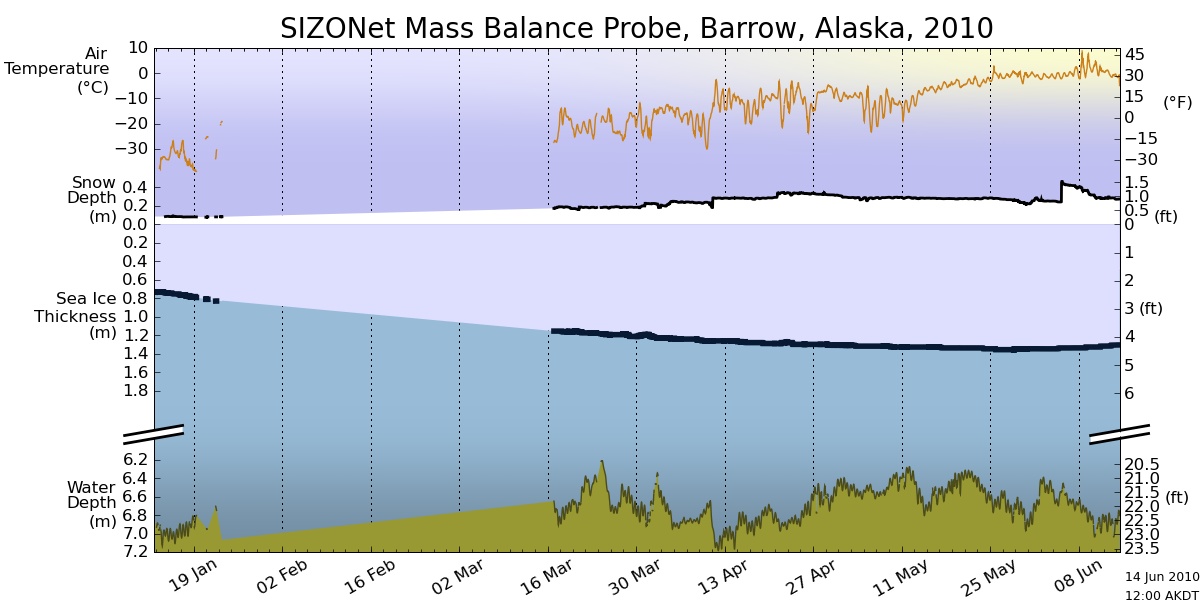
The current break up forecast calls for July 5.

http://seaice.alaska.edu/gi/observatories/barrow_breakup
Temperatures north of 80N have been persistently below normal this summer.

http://ocean.dmi.dk/arctic/plots/meanTarchive/meanT_2010.png
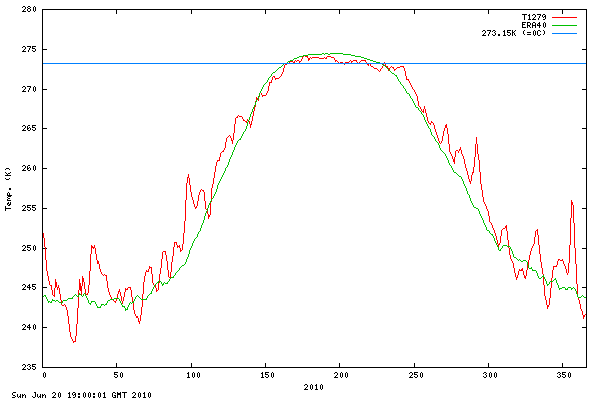
There are still no signs of melt at the North Pole, with temperatures running right at the freezing point – and below normal. Normally there has been surface melting for several weeks already.

http://psc.apl.washington.edu/northpole/webphotos/noaa2-sml.jpg

Arctic Basin ice generally looks healthier than 20 years ago.

I’m forecasting a summer minimum of 5.5 million km², based on JAXA. i.e. higher than 2009, lower than 2006.
Meanwhile down south, Antarctic ice is well above “normal” close to a record maximum for the date.

http://arctic.atmos.uiuc.edu/cryosphere/IMAGES/seaice.recent.antarctic.png

The video below shows the entire NSIDC Antarctic record for the last 30 years.It looks like a heart beating
Steve said:
stevengoddard says:
June 24, 2010 at 10:52 am
Julienne,
“I looked closer at the forecast link, and see that your forecast lines up pretty closely with mine.”
_____________
But you might want to note the important qualification at the end of Julienne’s et. als prediction.
“If the 2010 survival rates are similar to 2007, however, the September 2010 extent will rival what was observed in 2007 (4.31 versus 4.13 million square km).”
And so, if the survival rates are even slightly better than 2007, than the 4.5 million sq. km. prediction I put forth in March is also, quite reasonable I would think.
Just noticed the ARCUS predictions are up for minimum. 6 of the 16 are predicting > 2009 (tho one just barely). Median of the group is at 4.9M km/2. Low 1.0M, high 5.7M. 3 of the group are at Steve’s prediction or higher.
None predicted as high as Anthony, so Anthony will probably turn out right. 😉
I’ll be at least moderately satisfied if my prediction is closer to reality than the median’s delta from reality turns out to be. Since I predicted a range, I’ll take the middle of my range for that purpose, and that would make 5.5M km/2 or greater, and geo wins. Less than 5.5M km/2 and the panel of “experts” win.
Of course I made my prediction in late March, so they have that advantage. But that’s the way it goes, nobody made me do it.
Anthony’s prediction on the other hand was made months before that, so he could really burnish his seer, soothsayer, and sage credentials. We may have to chip in for a Carnac hat for him if 5.8M km/2 hits closeish (say +/- 100K km/2).
Zhang, leading figure in developing the PIOMAS model, is predicting 4.7M km/2. So, that should be an interesting comparison point for the predictive powers of his models, and will add/subtract from PIOMAS credibility as well depending on the closeness of his results.
Oh my Julienne, I hope you must be referring to warmer SST’s, which is entirely the case then in terms of affecting weather pattern variations. But the ONLY thing that can warm (or cool) SST’s is the combination of shortwave infrared radiation and equatorial wind that is not (or is) pealing back that warmed layer to allow colder layers to mix upward.
It follows then that ENSO parameters DO have a lag affect on Arctic atmospheric and oceanic circulation (thus air temps as well), all of which is entirely natural. Some of these parameters have natural oscillations between primarily cool/warm that can last up to 80 years in the recorded data. Since we do not have 100’s of years worth of data, we don’t know if there are Earth bound interglacial oscillations that last longer than that.
A case in point, we had a weather cell over the top of us yesterday that caused temps to plummet from the high 70’s to the low 60’s in about an hour. That weather cell came from a Pacific low. CO2 didn’t have a chance.
Just remember where milk comes from (not cartons but cow teets). Meaning, remember where the data comes from before turned into a trend line. Daily temperatures are a function of weather parameters and are entirely explainable by weather parameters. Take any point in a data set and it can be matched to the weather parameters active at that time and place. The cause does not magically change when the data is trended.
Btw, last year Zhang (PIOMAS devleoper) predicted 4.5M km/2. Oops.
I just noticed an interesting difference between the 2009 panel of experts prediction graphic and the same graphic for 2010.
On the 2009 graphic, there is a line showing where the “Linear Trend” would be. On the 2010 graphic, that line does not appear.
Why not?
Could the reason be that in 2009, that Linear Trend line was safely above all of the predictions of the experts, but for 2010 it would show that two experts are predicting almost right on that Linear Trend, and a third expert is actually predicting a minimum *above* the Linear Trend?
Gee, I wonder. I can imagine the internal discussion about how it would make it that much harder to keep up the “worse than we thought” meme, and sneer at the word “recovery”, if they had to admit that some of their own experts were predicting above the Linear Trend for 2010.
Anothering interesting point from the 2010 ARCUS predictions. Morrison and Untersteiner, who came closest from last year’s panel (just a shade under actual –yes, that’s right, in a group of 14 predictions last year NO ONE predicted higher than the eventual “actual”; that’s really an indictment of our understanding right there), are predicting 5.3M km/2, or in other words, “2009 again”.
Julienne @10.19
As a beginner, I find it difficult to appreciate how long are the lag time associated with the heat of a warmer earth, if it be warmer, affecting the Arctic. If it be true that there has been some warming – whatever the cause – but that it has now levelled off for the last ten years or so,(as seems to be the case) could the “warming signal” mentioned in relation to the Arctic just be a lagged response rather than an indication the warming is still going on? Or don’t we know?
I ak because melting Arctic seems to be a cause celebre, or do I mean poster child? Anyway, a lot of propoganda significance seems to be attached to it!
Myself, I ‘ll take warm over cold anyday. Staying the same isn’t an option I fear!
I believe the lack of a trend line was discussed indirectly in the body of the text on the web site. The site no longer heralds the predictive nature of their modeling endeavors. Instead the various models are now being used (so they say) to discuss/explore the possible causes of ice conditions. So, I think you are correct geo, but I also think these suite of scientists ate a slice of humble pie last year and are becoming more realistic about the power of natural phenomenon.
geo at June 24, 2010 at 12:36 pm
Whoa I don’t get any sense that they’re “hiding the trend”, anyway last year’s graph was extra tall to show a big scary line of what a “normal” ice minimum would be – and we’re not likely to get anywhere near that.
In any case I’m very grateful and impressed that researchers are willing to be so transparent by predicting something that will happen in my lifetime.
Perhaps they’ll accept a prediction from Messrs Watt and Goddard if they’re taking forecasts based on June data again this year.
As Julienne points out, it is all dependent on the weather. And no one can effectively forecast the weather more than a few days out.
Let’s settle this argument once and for all.
Here.
Now.
Does June 23, 2010 sea ice extent;
http://www.ijis.iarc.uaf.edu/cgi-bin/seaice-monitor.cgi?lang=e&mode=img&size=L&date=set&y=2010&m=06&d=23
Look more like June 23. 2006;
http://www.ijis.iarc.uaf.edu/cgi-bin/seaice-monitor.cgi?lang=e&mode=img&size=L&date=set&y=2006&m=6&d=23
Or does June 23, 2010 look more like June 23, 2007;
http://www.ijis.iarc.uaf.edu/cgi-bin/seaice-monitor.cgi?lang=e&mode=img&size=L&date=set&y=2007&m=6&d=23
You decide?
Me?
I’ve already decided that 2010 will set a new record low sea ice extent for the satellite era.
Do you see what I see?
http://psc.apl.washington.edu/northpole/webphotos/noaa1.jpg
NOAA Arctic StarDot NetCam #1 Thu Jun 24 15:02:12 2010 UTC
Exposure: 1/1000 Internal Temp: 12.0C
Image (C) NOAA/PMEL
EFS_Junior
Finally, the person in charge of Arctic ice has posted.
Dave Springer says: June 24, 2010 at 1:08 am
“…pretty much the same story for all global warming consequences – far more upside than downside…”
Hi Dave. For anyone interested on potential consequences of rising global temperature try “Six Degrees” by Mark Lynas. Before gagging at the title, the author does not claim temperatures will rise by six degrees celcius. Rather, the book is organised by what could reasonably be expected to happen if temperatures rose by 1C, 2C, 3C etc, with less certainty in the outcomes as progressively higher temperatures are examined. Given that a doubling of CO2 is associated with rises of around 3C based on numerous lines of paleo-climate evidence it is well worth becoming acquainted with the possibilities. Rapid temperature change leaves little time for adaptation and many of the consequences are far from benign, particularly where they impact agriculture.
EFS_Junior says:
June 24, 2010 at 1:59 pm
Let’s settle this argument once and for all.
___________
:)) If only it were that easy. I love your attempt, but even when the Arctic is seasonally ice free sometime in next few decades, AGW skeptics will claim it is natural variation and show us their pictures of submarines coming up in polynya at the north pole and claim it is evidence the Arctic was ice free in recent past. This isn’t a matter of science, but of belief, so there will never be any “settling it once and for all”.
But to your point, 6-23-2010 is far more similar to 2007 than 2006, and so shall the September minimum for 2010.
Ammonite
CO2 has risen from 280 to 400ppm with a 0.7C increase in temperature. That doesn’t extrapolate out to 3C at 560ppm.
But math isn’t important to the politicians at the IPCC.
Ammonite says:
June 24, 2010 at 2:46 pm
Has anyone done the same for the opposite result?
Since we are dealing with hypothetical outcomes not yet in evidence.
R. Gates says:
June 24, 2010 at 2:49 pm
Are you trying to say that the pictures of the USS Skate at the North Pole in 1959 that I witnessed in print in 1959 are not real?
To my eye, neither 2006 or 2007 looks like 2010. They are both similarities and differences. Like Solar Cycles and Grand Minimums, no two exactly alike.
R. Gates says:
“…even
whenif the Arctic is seasonally ice free sometime in next few decades, AGW skeptics will claim it is natural variation and show us their pictures of submarines coming up in polynya at the north pole and claim it is evidence the Arctic was ice free in recent past.”That is exactly right. As long as what is being observed is a local effect restricted to the Arctic, and the Antarctic is its “polar opposite,” gaining ice, then as much as it bothers the true believers in catastrophic, runaway global warming, what you’re seeing is simply regional climate variability.
When the Antarctic ice cover starts disappearing, wake me.
Pamela Gray says:
June 24, 2010 at 1:08 pm
I believe the lack of a trend line was discussed indirectly in the body of the text on the web site. The site no longer heralds the predictive nature of their modeling endeavors. Instead the various models are now being used (so they say) to discuss/explore the possible causes of ice conditions. So, I think you are correct geo, but I also think these suite of scientists ate a slice of humble pie last year and are becoming more realistic about the power of natural phenomenon.
++++
Morrison and Untersteiner certainly have nothing to be humble about for last year. They essentially nailed it from the perspective of “material difference”. They were just a touch low. Individually, standing by itself, that was a fine prediction. When they saw they were higher than everyone else, they probably had some indigestion over it, so good on them for being essentially right.
It’s when 16 (I said 14 earlier, but I mis-remembered) can’t manage even one OVER the eventual actual that we are entitled to give the group effort the “Groupthink of the Year” award, and make some caustic comments about the value of “consensus science”.
EFS_Junior says: “I’ve already decided that 2010 will set a new record low sea ice extent for the satellite era.”
That’s _kinda_ cute, but experience seems to suggest that it’ll be at least a month before anyone can use utilise current data to forecast the minimum.
Walter Dnes at 2:24 pm up there seems to have the JAXA rankings 100% by the end of August.
It all depends on how the winds blow I guess. The Arctic Oscillation is on its way up but it would have to get strongly positive to have much of an effect on the Beaufort Gyre flywheel that charged up in October, December and January (and defeat the Coriolis force).
The Fram Strait is open, but ice is still being dragged Pacific-ward of there and I believe it’s normally open by mid July anyway. There’s a plume of multiyear ice that has been dragged from Canada towards Siberia which will melt where it is or stay strong and be pushed by the Gyre toward the pole as the intervening newer ice melts and thus survive for another (3?) year(s).
Unless the extremely low Arctic Oscillation has compacted the ice which formed in the Beaufort and Chukchi Seas (very possible since they lagged other years badly during the extreme low AO of October) dateline-wards of the pole then towards Siberia when the basin was too packed to take it [that appears to be PIPS’ 3m basin reasoning]. If that happened then there’s loads of ice, PIOMAS is way off the mark, the globe has (possibly measurably) cooled through the formation of many thousand km^3 of ice under cloudless skies and there’ll be a very healthy minimum.
Sorry if that was too long.
Dig deep within your pockets. Pull out a nickle if you have one.
Place nickle on side and view thickness.
That’s how much the average sea-level rise was last year.
Wow.
rbateman says:
June 24, 2010 at 3:00 pm
R. Gates says:
June 24, 2010 at 2:49 pm
Are you trying to say that the pictures of the USS Skate at the North Pole in 1959 that I witnessed in print in 1959 are not real?
______________
Nope, they probably are real, but a submarine surfacing in a polynya in 1959 doesn’t quite constitute scientific evidence of anything. I think’d we of all known if the Arctic Ocean had been ice free in 1959. The picture is a historical point of interest, not a climatological one.
stevengoddard says:
June 24, 2010 at 5:56 am
There are a couple of people here who seem to believe that the University of Alaska site http://seaice.alaska.edu is a hoax.
Really, I haven’t noticed.
Sometimes it might be a good idea to think things through before posting?
Good advice, you should take it!
Steven Goddard
http://seaice.alaska.edu/gi/observatories/barrow_webcam
Ice offshore of Barrow, Alaska is showing little signs of melt so far.
Phil: That ice is in fact the ‘fast’ ice on shore, the ice offshore of Barrow has in fact gone
http://rapidfire.sci.gsfc.nasa.gov/realtime/single.php?A101712310
stevengoddard says:
June 23, 2010 at 10:01 pm
Phil,
The ice is still present in Barrow, and they are currently forecasting it will break up on July 7.
http://seaice.alaska.edu/gi/observatories/barrow_breakup
Steve has now switched to ‘ice’ as opposed to ‘ice offshore’.
You can see it in the webcam.
http://seaice.alaska.edu/gi/observatories/barrow_webcam
Indeed, the webcam shows that there is ‘fast ice’ on shore, but not ‘offshore ice’.
And if you zoom all the way in here, you can see about a mile of ice offshore.
http://ice-map.appspot.com/
Actually not, what it shows is an off-shore ice front about 20 miles from Barrow which is clearly breaking up, contrary to your “Ice offshore of Barrow, Alaska is showing little signs of melt so far”.
rbateman says:
June 24, 2010 at 3:34 pm
“Dig deep within your pockets. Pull out a nickle if you have one.
Place nickle on side and view thickness.
That’s how much the average sea-level rise was last year.
Wow.”
I wish I had a nickle.
We had the harshest winter in 40 years here. And I’m paying a Carbon tax on my car’s fuel. And I’ll be paying a Carbon tax on heating my home heating come autumn. And I had to pay big on the damage to fix the damage to my Carbon–guzzling-deathmobile because my government didn’t bother ordering any road grit because climatologists told them that harsh winters were a thing of the past.
I pay Global Warming tax on my fuel and there’s no money to repair the roads destroyed by cold.
Go figure.