By Steven Goddard
The Arctic sun has now passed its peak, and is starting its decline towards the horizon over the next 90 days.

All four (JAXA NSIDC DMI NORSEX) ice extent measurements now show 2010 as below 2007. You can see in the modified NSIDC map below that the regions which are below the 30 year mean (marked in red) are all outside of the Arctic Basin and are normally ice free in September, so it is still too early to make any September forecasts based on extent data.

The modified NSIDC map below shows ice loss (in red) during the last nine days. There has been very little change in the Arctic Basin.

The modified NSIDC map below shows ice loss (in red) since early April. According to JAXA, this is about 5 million km².

The modified NSIDC map below shows ice loss (in red) since early April. According to JAXA, this is about 5 million km².
The modified NSIDC map below shows ice loss (in red) since 2007. According to JAXA, this is about 500,000 km². Areas in green have more ice than 2007.

There has been a strong clockwise rotation of wind in the Beaufort Gyre, which is pulling ice away from the land around the edges of the Beaufort, Chukchi and East Siberian and Laptev Seas.

http://www7320.nrlssc.navy.mil/pips2/archive/mag/2010/mag_2010062200.gif

The video below shows changes in PIPS ice thickness and extent during June. You can see the ice rotating clockwise and concentrating in the center of the Arctic Basin.
During the last 10 days, PIPS shows that Arctic Basin ice volume has dropped close to 2007 and 2009 levels. Volume has increased by about 40% since 2008.

Average ice thickness is now the highest for the date during the last five years. This is due to the compression of the ice towards the interior of the Arctic Basin.

Ice offshore of Barrow, Alaska is showing little signs of melt so far.
 ‘
‘
http://seaice.alaska.edu/gi/observatories/barrow_sealevel/brw2010/BRW_MBS10_overview_complete.png
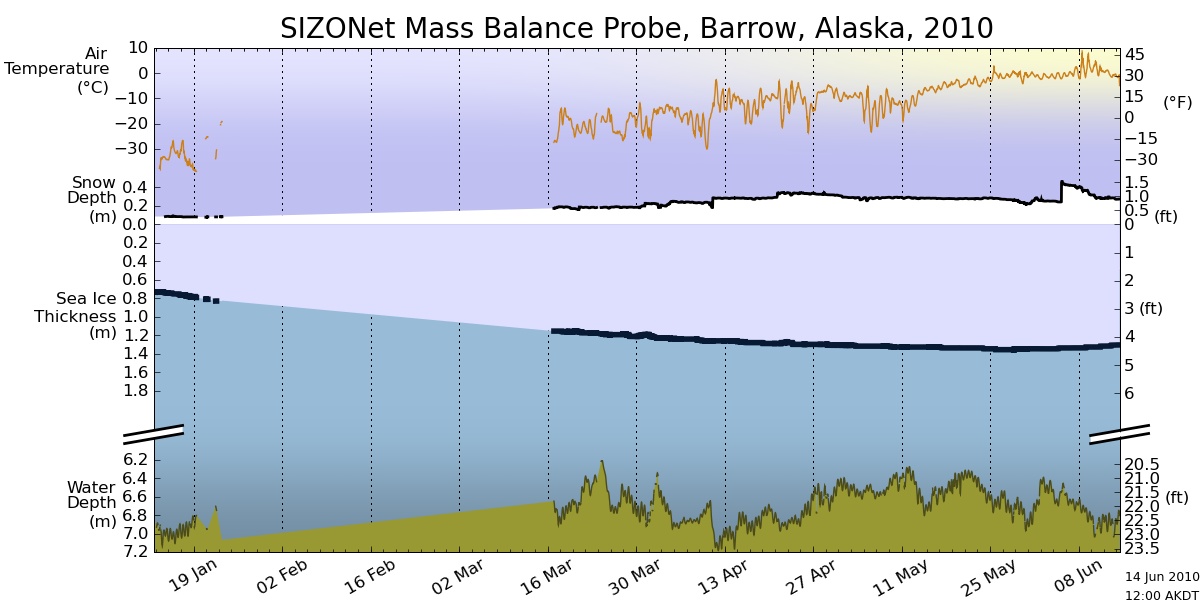
The current break up forecast calls for July 5.

http://seaice.alaska.edu/gi/observatories/barrow_breakup
Temperatures north of 80N have been persistently below normal this summer.

http://ocean.dmi.dk/arctic/plots/meanTarchive/meanT_2010.png
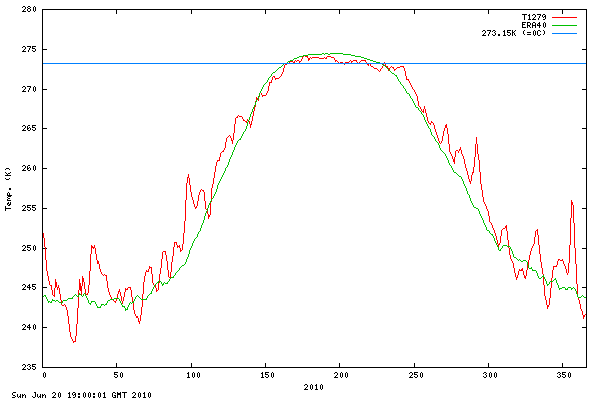
There are still no signs of melt at the North Pole, with temperatures running right at the freezing point – and below normal. Normally there has been surface melting for several weeks already.

http://psc.apl.washington.edu/northpole/webphotos/noaa2-sml.jpg

Arctic Basin ice generally looks healthier than 20 years ago.

I’m forecasting a summer minimum of 5.5 million km², based on JAXA. i.e. higher than 2009, lower than 2006.
Meanwhile down south, Antarctic ice is well above “normal” close to a record maximum for the date.

http://arctic.atmos.uiuc.edu/cryosphere/IMAGES/seaice.recent.antarctic.png

The video below shows the entire NSIDC Antarctic record for the last 30 years.It looks like a heart beating
geo says:
June 24, 2010 at 6:14 am
To the degree there *can* be thick multi-year ice, the Arctic basin is where most of it will be found.
___________
This is definitely NOT the case this year. The thicker multi-year ice is further south, near Siberia (as Julienne et. al pointed out aleady), and as the video presentation I linked to yesterday showed, the central Arctic basin ice is weak and thinner than satellite images alone or PIPS 2.0 modelling would indicate. The PIOMAS model seems to be far more accurate in giving the true volume status of ice in the Arctic right now.
Hi Steven,
excuse me but the mail exactly states that
“It is not proper to use it [PIPS] to study year to year changes. PIPS, is known to be not terribly useful for sea ice other than perhaps motion; definitely not thickness.”
We’re not talking about forecasts here. They basically say that PIPS is absolutely not a relevant model for ice thickness. What do you think? How far can we trust your PIPS thicknesses? Why (in your opinion) do they diverge so strongly from PIOMAS, that NSIDC largely prefers?
I find it highly unlikely that the Navy would be using a model that is good only a few days in advance. Care to guess how expensive those subs are to replace? Care to guess how expensive it would be to plan war games months ahead of when you actually get to play the game and then find out your model sucks when you get there? Care to guess that it is possible that Navies are working very hard to come up with their own forecasts that out forecast each other? Doesn’t take a rocket scientist to figure out that the Navy with the most accurate short AND long term forecast has the advantage. By more than the length of a football field.
I hate to say this because I am an information freedom kind of gal, but it seems reasonable that the real ice forecast model the Navy uses might be held pretty damn close to the chest and away from public knowledge. A tenant of armed forces is to always have two sets of knowledge. Stuff that everybody can know. And stuff that the armed forces needs to win wars is to know.
JB says:
June 24, 2010 at 2:43 am
1990, 1991, 1992, 1993, 1994, 1995, 1996, 1997, 1998, 1999, 2000, 2001, 2002, 2003, 2004, 2005, 2006, 2007, 2008, 2009, 2010=21 years…
Must be the new math…..
January 1, 1990 – January 1, 1991 <— This is one year
Therefore:
1990, 1991 = 1 year
If you like maths, the total number of year when a list of years is given as you gave =
T= n-1
Therefore if you list 1990 through 2010 the list has n=21, therefore the total T=20.
sorry for the old math.
stevengoddard says:
June 24, 2010 at 6:16 am
Steve, yes there is some disagreement between reanalysis data sets. Certain variables are more consistent than others, but the ERA40 does have a discontinuity in its temperatures after 2002 and this was noted by many responses to the Graverson et al. paper in Nature a couple of years ago. The ERA40 Interim should have fixed that problem. I mostly use the NCEP/NCAR reanalysis for quick looks at SLP and 925 mbar air temperatures since it’s a very easy on-line tool for making any type of plots you want (means, anomalies, time-series, etc.). I just looked today at the 925 mbar anomalies from June 1-June 21 and temperatures are anomalously warm over the entire Arctic, ranging from 1.5 to 3.5oC above normal. Mean temperatures show air temperatures remain below freezing north of Greenland and right around 0C near the pole, and over much of the Arctic Ocean.
Pamela Gray says:
“I hate to say this because I am an information freedom kind of gal, but it seems reasonable that the real ice forecast model the Navy uses might be held pretty damn close to the chest and away from public knowledge. A tenant of armed forces is to always have two sets of knowledge. Stuff that everybody can know. And stuff that the armed forces needs to win wars is to know.”
______
Exactly the point I’ve been making for weeks now. There is no way the Navy has its best model out on the web for the whole world (friend and enemy alike) to use. The Arctic is far too strategic an area. PIPS 2.0 is the old model that the Navy is happy to let any one use for any reason and it is essentially discounted by professionals in the business for any serious analysis. It doesn’t even use CICE which is accepted by most as the best sea ice model in the world.
The Navy is not releasing misinformation about Arctic Ice. People depend on the Navy for current information.
R. Gates,
The US Navy should allow their enemies to steal your precious CICE. Since PIOMAS was off on last year’s minimum by 20% it would be a masterstroke of disinformation.
I see that R Gates subscribes to the idea that the Navy is releasing misinformation, and that he also believes the University of Alaska Barrow webcam and ice breakup forecasts are a hoax.
I think some of us might be talking at cross purposes regarding Arctic temps. There are air temps over land and then there are air temps over the Arctic Ocean basin. Maybe if we clarify which we are referring to, it would help.
I pay attention to air temps over the Arctic Ocean basin and SST temps of incoming warm oceanic Arctic currents. The air temps can change quickly as a function of weather system fronts (let alone the condition of the ice). Oceanic SST changes much more slowly as a function of ENSO-lag parameters and solar irradiance (clear sky versus cloud type cover).
These parameters do not affect the Arctic as a whole, because the Arctic environment is not one thing, but is made up of distinct parts. Simply adding the parts up does not accurately reflect the artificial statistical Arctic trend, and the artificial Arctic Trend does not reflect the condition of all its parts.
If you go here: http://www.arcus.org/search/seaiceoutlook/2010/june
you will see the lobe of old ice that was advected into the Beaufort/Chukchi seas this past winter under the negative winter AO phase. Note that this lobe of old ice has not turned back northwards as in a classic Beaufort Gyre pattern, but is being advected across into the E. Siberian Sea (two different techniques are shown that map this old ice, Lagrangian tracking of individual ice parcels from visible, thermal and passive microwave data, and classification using scatterometry data).
From MODIS imagery it’s clear that the first-year ice surrounding that old ice is starting to melt out subjecting that older ice to more lateral and basal melt. It will be interesting to see if that ice can survive the melt season.
And yes Phil, it is interesting that Nares Strait is open this year since it’s another location where the Arctic can lose it’s store of old, thick ice.
I didn’t say it was releasing misinformation. I was simply suggesting that they could be hot on the trail of better and better models, some of which we are not being made aware of, which would include proponents on both sides of this debate (meaning that Gates is likely in the same boat with the rest of us).
Our historical knowledge of armed forces information is filled with released data. The fact that we have this information does not make it “misinformation”. It just means that something better came along that was held back from public scrutiny for a time.
I remain unconvinced that the public models pointing towards a death spiral debated here are correct. Given that my skepticism is from an armchair observer, submariners would reasonably not be putting all their eggs in one modeled basket either. Our military history is filled with misconceptions, poor assumptions, and wrong decisions based on less than accurate information regarding theater conditions. That we would do so now means that we still have not learned to take into account the vagaries of the friend or foe “3rd” force known as “Earth”.
Julienne
Thanks for the forecast link.
Looks like “consensus” agreement that 2010 will be higher than 2008, but split about whether 2010 will be higher than 2009. Hopefully next year WUWT will make the list ;^)
Pamela, I am sorry but I do not understand what you are trying to say. Are you trying to say there is no trend in Arctic sea ice? And what about Arctic temperatures? And melt extent over Greenland, and permafrost temperatures, and “greening” of the Arctic? When you look at the individual parts in the Arctic, you see a clear warming signal and the various components of the Arctic are responding accordingly.
Steve, well at least your values are in the same range as those from the scientists 😉
Julienne,
I looked closer at the forecast link, and see that your forecast lines up pretty closely with mine. Interesting that Mark Serreze is talking about a possible record minimum.
Julienne
How would you define a “scientist?”
Julienne, I beat the drum for real debate behind statistical trends (especially since statistics provide no explanations). Statistics can tell us if what we are seeing is outside the normal range (if you have a large enough random data set- something I don’t think we have). Statistics cannot explain what we see, which is why I refer to trend lines as artificial. The Arctic has MANY natural systems that are quite capable of producing the melt pattern we are seeing right now. Let’s debate that. Do we have a decrease in outgoing LW over the Arctic as a result of an increase in CO2 molecules in the atmosphere there? Or do we have natural weather pattern variations combined with natural current oscillations that have resulted in the melt we see?
We need to be knowledgeable about all such possibilities in order to strengthen our respective opinions.
Julienne says:
June 24, 2010 at 10:19 am
Julienne, would you say a sine-curve is a trend?
stevengoddard says:
June 24, 2010 at 9:27 am
I see that R Gates subscribes to the idea that the Navy is releasing misinformation, and that he also believes the University of Alaska Barrow webcam and ice breakup forecasts are a hoax.
__________________
Steve,
This is by far the worst twisting of my words that I’ve seen here on WUWT, and I’m surprized it came from you.
1) There is a huge difference between allowing an older models data to used on a public site and not releasing your best navigational information to your potential enemies.
2) I never said anything about a “hoax”– those are your words completely. I simply pointed out that it really doesn’t matter what the Barrow data is saying since it’s no longer operational, and the only ice in the area is shore-fast anyway, and so you even mentioning it in your update is irrelevent.
Finally, in your update you failed to mention the fact that EVERY basin the the Arctic, including your much beloved central Arctic is showing a negative anomaly.
Steve, I do believe there could be a possible new record low if the Arctic Dipole pattern persists the entire summer like it did in 2007. That is what Mark is thinking too, but since we can not predict the summer circulation pattern, all we can say is there is a possibility, not that it will happen for sure.
My estimate was based on typical survival rates for ice of different ice age classes. It’s hard to base it on an average from all years because it’s clear that these rates have been changing (as you can see from different estimates I listed based on values from the last 10 years versus values from the last 5 years). I believe survival rates are changing in part because of shifts in atmospheric circulation patterns, changes in SSTs and also changes in the ice thickness vs age relationship. So if we use survival rates observed in 2007, then this September would see a similar value as observed in 2007. But if the ice is thinner than in 2007, we could drop below that value given the same circulation patterns.
As for a definition of a scientist..I suppose I would agree with the definition given by Wikepedia.
R. Gates says:
June 24, 2010 at 7:03 am
This is definitely NOT the case this year. The thicker multi-year ice is further south, near Siberia (as Julienne et. al pointed out aleady), and as the video presentation I linked to yesterday showed, the central Arctic basin ice is weak and thinner than satellite images alone or PIPS 2.0 modelling would indicate. The PIOMAS model seems to be far more accurate in giving the true volume status of ice in the Arctic right now.
++++++
I did not mean to exclude the northern coast of Siberia from my definition of “arctic basin”.
The swirl continues. I expect that ice to be on the other side before all is said and done re minimum this year.
From my handy web dictionary:
But according to some folks, all real scientists have published at least twenty peer reviewed papers.
stevengoddard,
“Hopefully next year WUWT will make the list ;^)”
Why wait until next year – is there something in the rules stopping you from submitting your prediction for inclusion in the next update of the Sea Ice Outlook? I believe the deadline in June 30th.
Pamela Gray says:
June 24, 2010 at 11:06 am
Julienne, I beat the drum for real debate behind statistical trends (especially since statistics provide no explanations). Statistics can tell us if what we are seeing is outside the normal range (if you have a large enough random data set- something I don’t think we have). Statistics cannot explain what we see, which is why I refer to trend lines as artificial. The Arctic has MANY natural systems that are quite capable of producing the melt pattern we are seeing right now. Let’s debate that. Do we have a decrease in outgoing LW over the Arctic as a result of an increase in CO2 molecules in the atmosphere there? Or do we have natural weather pattern variations combined with natural current oscillations that have resulted in the melt we see?
We need to be knowledgeable about all such possibilities in order to strengthen our respective opinions.
————————————–
Pamela, I think we are not understanding each other.
I know that statistics does not prove cause and affect. This is why scientists spend so much time trying to understand the physical mechanisms for any type of correlations between two variables. I will disagree with you that there is no trend in Arctic sea ice, over the period of the most reliable observations (1953-present), the trend is sound, the Arctic sea ice is declining. Any statistical robustness test you apply to this trend reveal that it is sound.
So perhaps you are trying to get at that we don’t have a long enough data set to say the ice is declining? How long do you think it needs to be? Does it need to be as long as humans have existed on the planet (perhaps 3 million years given the oldest fossil that has been found)? Or do you think it needs to extend back further when the continents were in different positions? What about just looking at the sea ice record during the period when human populations went from 1 to nearly 7 billion people and the industrial revolution happened (so the last 150 years)?
As far as CO2 goes, we know that CO2 is a greenhouse gas. We know we have increased the concentrations of CO2 in the atmosphere as a result of human activity. What the issue comes down to is how much of the observed warming is a result of CO2 versus natural variability. What I’m not sure you understand is that warmer temperatures, regardless of what is causing them, causes changes in atmospheric and oceanic circulation, the purpose of which is to transfer heat and energy to the polar regions. So when you say things like CO2 is not causing changes in wind patterns or ocean temperatures, that would imply you believe CO2 has not influenced air temperatures at all. But if you believe that CO2 has warmed the Earth’s atmosphere, then you would have to realize that may have also changed the winds and SSTs in the Arctic which are impacting ice melt. It’s all connected.
I agree that it’s not clear how much of the warming this last century is a direct result of changes in GHGs versus natural variability.
I would like to know what you mean by natural Arctic systems are providing the melt we’re seeing today.