By Steven Goddard
The Arctic sun has now passed its peak, and is starting its decline towards the horizon over the next 90 days.

All four (JAXA NSIDC DMI NORSEX) ice extent measurements now show 2010 as below 2007. You can see in the modified NSIDC map below that the regions which are below the 30 year mean (marked in red) are all outside of the Arctic Basin and are normally ice free in September, so it is still too early to make any September forecasts based on extent data.

The modified NSIDC map below shows ice loss (in red) during the last nine days. There has been very little change in the Arctic Basin.

The modified NSIDC map below shows ice loss (in red) since early April. According to JAXA, this is about 5 million km².

The modified NSIDC map below shows ice loss (in red) since early April. According to JAXA, this is about 5 million km².
The modified NSIDC map below shows ice loss (in red) since 2007. According to JAXA, this is about 500,000 km². Areas in green have more ice than 2007.

There has been a strong clockwise rotation of wind in the Beaufort Gyre, which is pulling ice away from the land around the edges of the Beaufort, Chukchi and East Siberian and Laptev Seas.

http://www7320.nrlssc.navy.mil/pips2/archive/mag/2010/mag_2010062200.gif

The video below shows changes in PIPS ice thickness and extent during June. You can see the ice rotating clockwise and concentrating in the center of the Arctic Basin.
During the last 10 days, PIPS shows that Arctic Basin ice volume has dropped close to 2007 and 2009 levels. Volume has increased by about 40% since 2008.

Average ice thickness is now the highest for the date during the last five years. This is due to the compression of the ice towards the interior of the Arctic Basin.

Ice offshore of Barrow, Alaska is showing little signs of melt so far.
 ‘
‘
http://seaice.alaska.edu/gi/observatories/barrow_sealevel/brw2010/BRW_MBS10_overview_complete.png
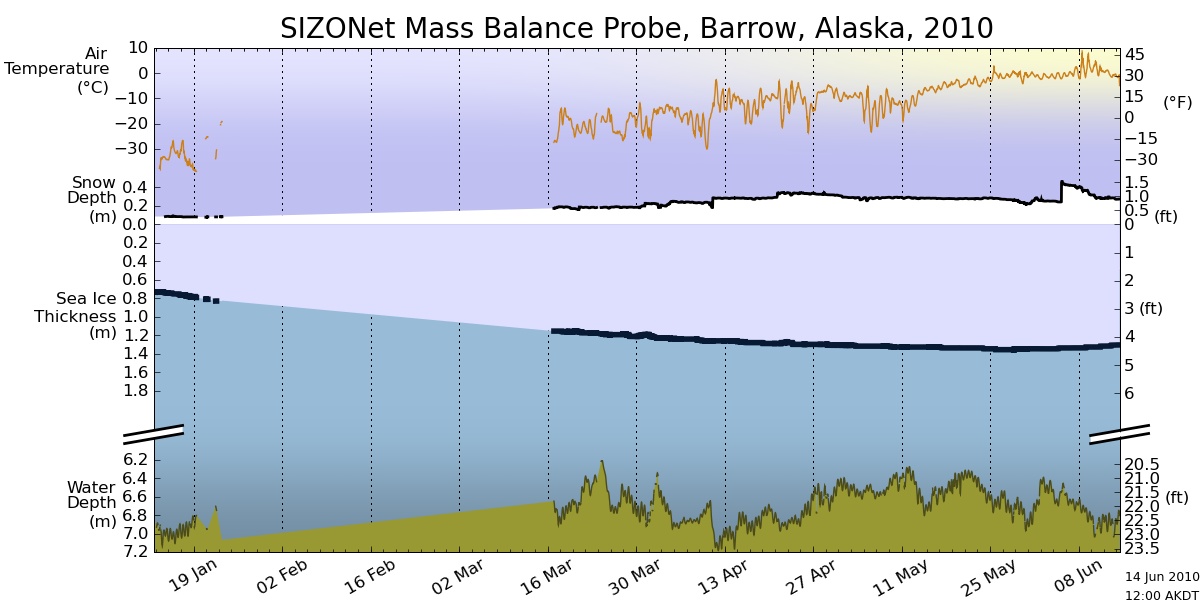
The current break up forecast calls for July 5.

http://seaice.alaska.edu/gi/observatories/barrow_breakup
Temperatures north of 80N have been persistently below normal this summer.

http://ocean.dmi.dk/arctic/plots/meanTarchive/meanT_2010.png
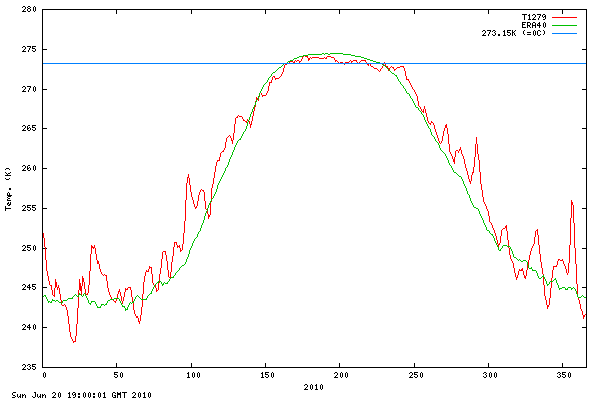
There are still no signs of melt at the North Pole, with temperatures running right at the freezing point – and below normal. Normally there has been surface melting for several weeks already.

http://psc.apl.washington.edu/northpole/webphotos/noaa2-sml.jpg

Arctic Basin ice generally looks healthier than 20 years ago.

I’m forecasting a summer minimum of 5.5 million km², based on JAXA. i.e. higher than 2009, lower than 2006.
Meanwhile down south, Antarctic ice is well above “normal” close to a record maximum for the date.

http://arctic.atmos.uiuc.edu/cryosphere/IMAGES/seaice.recent.antarctic.png

The video below shows the entire NSIDC Antarctic record for the last 30 years.It looks like a heart beating
Smokey writes.
“Actually, the Arctic in 1959, when the North Pole was ice free, doesn’t look much different than now.
But I guess some folks just aren’t happy unless they have something to worry about, even if it’s only natural variation due to wind and currents.”
Some folks take a more analytical approach. For example, Kwok & Rothrock (Geophysical Research Letters, 2009) compared declassified Navy submarine records (1958-2000) with more recent satellite-based measurements:
“Decline in Arctic sea ice thickness from submarine and ICESat records: 1958–2008
The decline of sea ice thickness in the Arctic Ocean from ICESat (2003–2008) is placed in the context of estimates from 42 years of submarine records (1958–2000) described by Rothrock et al. (1999, 2008). While the earlier 1999 work provides a longer historical record of the regional changes, the latter offers a more refined analysis, over a sizable portion of the Arctic Ocean supported by a much stronger and richer data set. Within the data release area (DRA) of declassified submarine sonar measurements (covering ∼38% of the Arctic Ocean), the overall mean winter thickness of 3.64 m in 1980 can be compared to a 1.89 m mean during the last winter of the ICESat record—an astonishing decrease of 1.75 m in thickness. Between 1975 and 2000, the steepest rate of decrease is −0.08 m/yr in 1990 compared to a slightly higher winter/summer rate of −0.10/−0.20 m/yr in the five-year ICESat record (2003–2008). Prior to 1997, ice extent in the DRA was >90% during the summer minimum. This can be contrasted to the gradual decrease in the early 2000s followed by an abrupt drop to <55% during the record setting minimum in 2007. This combined analysis shows a long-term trend of sea ice thinning over submarine and ICESat records that span five decades.”
http://www.agu.org/pubs/crossref/2009/2009GL039035.shtml
Ooo000ooo, Gneiss, that sounds like a nice paper I’ve never seen
All I know is the sub thickness estimates from ~1975 hinting at a sine wave
http://www.arctic.noaa.gov/reportcard/figures/seaice2009fig4.jpg
And a sneaking suspicion that thickness might follow (with a complicated few years of adjustment lag) the AO:
http://digitaldiatribes.files.wordpress.com/2009/09/arctic120200908.png
FergalR says:
June 24, 2010 at 6:29 pm
villabolo June 24, 2010 at 5:55 pm
You’ve got it precisely ass-backwards. The negative Arctic Oscillation that brought cold weather to the Northern Hemisphere also increased ice production in the Arctic. The higher temperatures at the Pole this year were mostly due to the latent heat released when huge amounts of ice froze.
VILLABOLO RESPONDS:
Ah ha. Let’s see. As far as far as your concept of “precision” goes, the following is from the Arctic Sea Ice News put out by the NSIDC January 5th, 2010. Please read it “PRECISELY”:
*************************************************************************
http://nsidc.org/arcticseaicenews/2010/010510.html
Warm air keeps ice extent low
December air temperatures over the Arctic Ocean region, eastern Siberia, and northwestern North America were warmer than normal. In contrast, temperatures in Eurasia, the United States, and southwestern Canada were below average. The strongest anomalies (more than 7 degrees Celsius/13 degrees Fahrenheit) were over the Atlantic side of the Arctic, including Baffin Bay and Davis Strait, where ice extent was below average.
Negative phase of the Arctic Oscillation
These regional contrasts in temperature anomalies resulted from a strongly negative phase of the Arctic Oscillation (AO). The AO is a natural pattern of climate variability. It consists of opposing patterns of atmospheric pressure between the polar regions and middle latitudes. The positive phase of the AO exists when pressures are lower than normal over the Arctic, and higher than normal in middle latitude. In the negative phase, the opposite is true; pressures are higher than normal over the Arctic and lower than normal in middle latitudes. The negative and positive phases of the AO set up opposing temperature patterns. With the AO in its negative phase this season, the Arctic is warmer than average, while parts of the middle latitudes are colder than normal. The phase of the AO also affects patterns of precipitation, especially over Europe.
The phase of the AO is described in terms of an index value. In December 2009 the AO index value was -3.41, the most negative value since at least 1950, according to data from the NOAA Climate Prediction Center.
While a negative AO leads to warmer temperatures over the Arctic, it also tends to reduce the flow of sea ice out of the Arctic by affecting the winds that can export the ice to warmer waters, where it melts. In this way, a negative AO could help retain some the second- and third-year ice through the winter, and potentially rebuild some of the older, multiyear ice that has been lost over the past few years. However, we do not yet know if the strongly negative AO will persist through the winter, or what its net effect will be
**************************************************************************
I’ll also link up to NSIDC’s satellite temperature image.
http://nsidc.org/images/arcticseaicenews/20100105_Figure4.png
**************************************************************************
Just a reminder to those who may not have “precisely” read FergalR’s post to villabolo:
“You’ve got it precisely ass-backwards.”
PLEASE LINK TO THIS ICE THICKNESS IMAGE TO SEE HOW MUCH ICE FORMED IN THE WINTER OF 2009/2010.
http://nsidc.org/images/arcticseaicenews/20100406_Figure6.png
AND NOW, PLEASE LOOK, WITH “PRECISION” FERGALR AT THE ACTUAL ICE BUILD UP THROUGH THE WINTER, YES, I “PRECISELY” SAID WINTER, OF 2009/2010.
LET ME BE VERY “PRECISE” ABOUT THIS FERGIE. THE GREEN ON THE MAP REPRESENTS MULTIYEAR ICE. WHEN YOU LOOK AT IT THROUGH THE HIGH RESOLUTION IMAGE (MOVE CURSOR TO SMALL IMAGE AND IT TURNS INTO A “MAGNIFYING GLASS”).
LOOK AT SEPTEMBER OF 2009 COMPARED TO MARCH OF 2010 AND YOU WILL NOTICE NOT MERELY A LOSS IN SURFACE AREA, BUT MORE IMPORTANTLY, WHAT REMAINS THERE IS RIDDLED LIKE TERMITE HOLES
WITH A LOT OF MUCH THINNER ICE.
IN SEPTEMBER OF 2009 SUBSTANTIAL AREAS OF BLUE COULD BE FOUND IN THE GREEN. THE BLUE IS 2 YEAR ICE WITHIN ICE (GREEN) THAT IS SUPPOSED TO BE 3-10 YEARS!
NOW LOOK AT MARCH OF 2010, THE END OF WINTER, AND PLEASE NOTICE THE DRAMATIC LOSS OF ICE. THERE IS, OVERALL, LESS SURFACE AREA OF WHAT USED TO BE THICK MULTIYEAR ICE (GREEN) . IT IS ALSO SEVERELY RIDDLED WITH 1 YEAR ICE (PURPLE) AS WELL AS 2 YEAR (BLUE).
NOW FERGAL, LOOK AT THE BLUE AREA IN GENERAL THAT REPRESENTS THE 2 YEAR ICE. IT NOT ONLY SHRINKS IN SURFACE AREA AT THE END OF WINTER BUT IT BECOMES EXTENSIVELY RIDDLED WITH 1 YEAR ICE.
THE SOLID PURPLE AROUND THE ICE CAP IS THE SEA ICE EXTENT. I LIKE TO REFER TO IT BY THE VERY “PRECISE” NAME OF “ICE PUFF”. HERE THIS WINTER GONE NEXT SUMMER.
I HOPE FERGALR THAT THIS RESPONSE HAS BEEN “PRECISE” ENOUGH TO STRAIGHTEN SOMEBODY’S POSTERIOR. I WON’T MENTION NAMES.
Gneiss says at 8:28 pm [ … ],
So in other words, the 1959 ice-free North Pole re-froze for the following 50 years due to global warming…
…Ri-i-i-i-i-ght.
I’m not dismissing it, it really did happen. The point is that it isn’t proof of some natural variability that caused the North Pole (or the Arctic for that matter) to be ice-free in the recent past. I believe it was just a submarine that found a lead it could surface in, nothing more, nothing less. The North Pole wasn’t ice-free.
The North Pole was ice free ten years ago in July
“Open Water at Pole Is Not Surprising, Experts Say
By JOHN NOBLE WILFORD
Published: August 29, 2000”
http://www.nytimes.com/2000/08/29/science/open-water-at-pole-is-not-surprising-experts-say.html
Günther,
The operative words in your post are “I believe.”
Disregard the picture of the submarine surfacing at the NORTH POLE in ice-free waters. Alarmist belief trumps observations.
stevengoddard says: June 24, 2010 at 8:17 pm
“The effects of CO2 are logarithmic. Further increases of CO2 have less effect than past increases. Expect the next 120ppm to have less than 0.7C effect.”
The point is that past increases are yet to have their full effect – sometimes referred to as “warming in the pipeline”. Your response once again incorrectly treats 0.7C as if it were the final outcome of present CO2 equivalent levels. The ocean is a big pot of water and it will take some time to heat.
David Gould says:
June 24, 2010 at 8:16 pm
Candor appreciated.
What I am saying is that what we currently know is not definitive either way.
The open areas at the pole in 1959 during a cold period for the N. Hemisphere simply implies a zero-sum game.
We at least know that much actually took place.
Ammonite says:
June 24, 2010 at 8:07 pm
I am skeptical of the IPCC proclaiming that C02 feedsback to H20 vapor in a linear fashion in multiple chain reactions without the empirical evidence to prove it. C02 itself being logarhythmic I do accept.
Computer models & simulations prove nothing.
Let the IPCC bring forth thier empirical tests that can be duplicated and we’ll go from there. Else the IPCC can hit the road, Jack, and take their junkyard dogs with them.
Ammonite
You may have missed it, but your warming pipeline has been constipated for the last 10 years. The Met Office said it might remain plugged for another two or three decades.
http://www.cru.uea.ac.uk/cru/info/warming/
I’ve put the Meat of this up before: The Sub & Icesat Charts Rise & Fall in the 60-year NATURAL Pattern:.
from: http://www.arctic.noaa.gov/reportcard/seaice.html
Their words … TWIST the data.
It’s really just (mostly)
1. the gradual 60-year Rise & decline Cycle
2. the sudden Jumps from El Ninos & drops from Volcanos
Note how they crow about how Gradual a decline it is – – then put the Lie to their own words when describing 2007
(but only if you read past the first words).
OK:
3. Maybe there is SOME Gradual Warming: One is supposed to compare :
Dip – with – Dip and
Peak – to – Peak
… the two cyclic dips are not equal, 2000+ being worse than 1954. AGW is real ! … but …. SMALL.
The Sub Peak is early 1980s – – just when you expect. BEFORE THEN IT DECLINES. Saying 1954 was less than later is meant to trick the reader into thinking there is a Continuous decline when it looks like the rolling Waves of the Sea.
We see that from the Piomas site too: go past the Sub data & see Ice Volume from 1948 : http://psc.apl.washington.edu/zhang/IDAO/retro.html#Submarine_ice.
This is an interesting archive:
http://www.arctic.noaa.gov/npole/index.php?year=2002
One can get as far back as 2002
It seems open cracks with water are evident every summer
Pamela Gray, I think you should take a look at atmospheric dynamics/thermodynamics text books (or even just basic climatology text books) and then come back and discuss atmospheric and oceanic circulation and the redistribution of heat on the planet by these circulation patterns. I’m not sure how you missed that the temperature gradient between the equator and the poles is what drives the planet’s atmospheric and oceanic circulation, the purpose of which is to transport the excess heat the Earth receives at the equator towards the poles. When that temperature gradient is altered, so are the weather patterns and the ocean circulation patterns.
I did my PhD dissertation on the energy balance of the Greenland ice sheet from AVHRR data (so I understand the role of LW and SW energy quite well).
Pamela Gray says:
June 24, 2010 at 12:26 pm
I also have a lot of experience working with all kinds of climate data and actually produce my own data products from satellites. I think you should be careful in your statements about data and you may want to try to remain respectful in your dialogue. I have very much appreciated my dialogue with Steve on his blog posts since we have maintained mutual respect between us and we can both learn from each other.
I notice you never did answer any questions I asked of you in trying to better understand what points you were trying to make. I ask because I do want to understand your point of view.
Steven, so is ‘open water at Pole’ the same as ‘Pole ice-free’? It might be a good idea to define what ice-free actually is.
Is it a lead a submarine can pop up in? Or is it a, I quote from the piece you linked to, “a large body of ice-free water about 10 miles long and 3 miles wide near the pole”? Or is it completely ice-free?
Ammonite says:
June 24, 2010 at 9:36 pm
I’d be very interested in hearing your version of HOW the atmosphere can warm the oceans. By how much and how long it takes.
Whilst you’re at it, tell us how long before this “full effect” takes place? Are the CO2 molecules bouncing radiation around that hasn’t found it’s way to a thermometre yet?
rbateman,
An open area at the pole is one data point. We currently have 30 data points showing a trend downwards in the ice – a trend that we have an explanation for, at least in part.
Phil,
honestly, you are juvenile sometimes
why don’t you just say, “i’m rubber, you’re glue, everything you say bounces off of me and sticks to you”?
On a Totally Different Topic:
. . . I know what Steve’s next Post should highlight & you all should see it :
New Ocean Temp charts are out (a sudden dip),
……… http://www.drroyspencer.com/2010/06/global-average-sea-surface-temperatures-continue-their-plunge/#comment-583
PLUS the “instant” El Nino Rating “ENSO” (“ONI” is a 3 month running Average),
……..http://www.drroyspencer.com/wp-content/uploads/AMSRE-SST-Global-and-Nino34-thru-June-17-2010.gif
Best:
PLUS CLOUDINESS From 2002 to now ! !
http://www.drroyspencer.com/wp-content/uploads/AMSRE-CLW-est-of-CERES-SW-global-60N-60S-thru-June-17-2010.gif
Do note that time Lags are several MONTHS as the Pacific warms — OOPS ! — COOLS ! — the Atlantic, then through the wide & deep connection
past Iceland, then into the Arctic. How long does the Ice have ?
I just superimposed the Piomas Chart & the Piomas vs. ICESAT (why aren’t they to the same scale?) , and got these results:.
.. all units are: cubic km ( “km3” )
P+I = Piomas + Icebridge Laser Measured Thickness
(Much better)
————- ICESAT / PIOMAS (km3)
’06-7 Change: 4000 ——- 2700 P (with no Icebridge, Piomas didn’t “see” the Central Arctic Melt)
2007 Sept. __ 5250 d —– 6550 P
2007 Nov. __ 6000 ——- 7300 P
2009 Sept. —– ? ——— 5800 P+I
..Zero Ice at a -15300 Anomaly ( = km3 different from Average year)
2010 17 Apr. -8700 An.= 6600 P+I
2010 18 June -11700 An.= 3600 P
d = derived from subtracting Piomas Spt-to-Nov gain, from November ICESAT.
ICESAT’s damaged euipment was only turned on in Feb-March & October-Nov. to extend its life.
Yes, the new June 18 Piomas is out: – – Another 3 weeks, another 1000 km3 gone.
= 333/week = 11 weeks to ICE DOOM.
Note these AGW’ers still label the site with 3.4 K km3/decade, ie, they expect a drop of:
340 km3 PER YEAR.
After one 4000 drop-in-a-year, you think they’d Learn.
… of course this is the trend in an ANOMALY, which could reverse at any time. But it has been very steady for 9 weeks & may be a Feedback effect which will only get worse UNLESS WE GET MORE CLOUDS.
this is the: OPEN WATER ABSORBS SUN + HEATS UP = MELTS NEARBY ICE FORM THE UNDERSIDE.
Note both Pips & Mercator are presenting those Open Water zones on the Satellite Pics as THICK ice !
I told you so !
And now the NSIDC says the same: it’s worthless from year to year:
— it’s RELATIVE Concentration & has to be calibrated.
… Both Pips & Mercator use a Microwave Sat which interprets More radiation reaching it AS MORE REFLECTION = MORE ICE..
Mixed Ice & water do not reflect as much.
SO THE MORE THAT OPEN WATER HEATS, THE THICKER IT LOOKS because the Satellite Map interprets a stronger signal as a HIGHER CONCENTRATION OF ICE.
Look at what 2007 did : http://www.arctic.noaa.gov/report08/images/essays/ocean/o2.jpg and http://www.arctic.noaa.gov/reportcard/figures/Fig5c2_2008.jpg
So now the airplanes of Icebridge are gone PIOMAS cannot calibrate itself either ! – – well, outside of the Coastal areas. PS Mercator is really Pips 3.0 — it adds in Ice Drift from Buoy data, but only every 2 weeks, for which delay they keep apologizing. Note the Open water North of New Siberian Islands appears as Ice. It does show why the Navy keeps Pips: Pips is crude BUT it is DAILY & that is what Icebreakers need. You don’t sail a day & then wait 2 weeks for the next Mercator Map or 3 weeks, for Piomas.
PS
Sorry: my previous post should have referenced Gneiss, and his source, Kwok & Rothrock. FergalR was quicker on the keyboard.
Again: GO CLOUDS GO !
There are many comments antagonistic of Steven Goddard, Pamela, me, rbateman, and others of our general* ilk. I know come the middle of September there will be few. And I know that some of the antagonists who do stay will be tap dancing with rationale as to why Arctic ice didn’t decrease as much as they are thinking it will to now.
*-I know all of the ilk are not commenting with the same ideas and demeanor, so I say ‘general’
From stevengoddard and Baa Humbug
SG: “You may have missed it, but your warming pipeline has been constipated for the last 10 years.”
BH: “I’d be very interested in hearing your version of HOW the atmosphere can warm the oceans. By how much and how long it takes.
Whilst you’re at it, tell us how long before this “full effect” takes place? Are the CO2 molecules bouncing radiation around that hasn’t found it’s way to a thermometre yet?”
SG: Global temperatures year on year persist in being amongst the top 10 ever measured with 2010 setting records to date.
BH: The “how long it takes” portion of your question is most interesting to me. Paleo studies showing temp rise with CO2 are numerous with 3C for a doubling the most likely outcome. How long would it take if true? My answer is that I don’t know. Another example; there is evidence that a substantial amount of the Greenland ice sheet will melt at +2C. How long would that take? I don’t think anyone knows. There are areas such as this where the science is not “settled”. They are open areas of research. GCMs are an attempt to address such questions. That it will happen is solid. How long it will take is challenging to determine however the trend in temps since 1970 does not provide much in the way of comfort.
This is the actual picture of the USS Skate at the North Pole in 1959, as the crew scatters the ashes of George H. Wilkins:
http://library.osu.edu/sites/archives/polar/nautilus/images/wilkins35_5_4.jpg
http://library.osu.edu/sites/archives/polar/nautilus/images/wilkins35_5_1.jpg
Some open water.
Lets look at the archives
2003 shows the highest summer extent in JAXA, at 6 million
In DMI it is consistently over the melting point from June
and in the archive pictures it shows rain and rain puddles from June 26.
2007 has the lowest at about 4 million
In DMI it is consistently over the melting point
and in the archive pictures open water appears by July20, not in June
So foreseeing what will happen with ice extent, is like playing Pooh sticks.
The temperature seems irrelevant, the melt to date seems irrelevant.
stevegoddard,
Regg on Accuweather.com forums has stated that the Beaufort Gyre is NOT the reason for all of the melting.
Here’s his explaination:
The Beaufort Gyre is on his anti-cyclonic phase – it’s been like that since the mid 90’s.
It has a cycle between 5 to 10 years, but it has been anti-cyclonic for an exceptionnaly long period (more than 15 years now), compare to the lenght of previous cycle. That might have been cause by the temps raised observed for the past 20-30 years (GW, maybe – a theory is supporting it – source Beaufort Gyre exploration project).
Is it the source or the consequence ?
Melting ice is creating fresh water. That fresh water displacement is influenced by the Beaufort Gyre. This looks to me as a consequence, not the cause. Polynyas is one of the consequence of that deplacement of fresh water.
Still you need melting ice to create the fresh water that will travel with the B.G. . Beaufort Gyre itself does not cause melting of ice, nor warming.
Knowing all that, it becomes a consequence of warming, not the cause. Nice try.
http://forums.accuweather.com/index.php?showtopic=20142&st=140&start=140
stevengoddard, have anything to say?
-G.W.
GettingWarm
Please tell us how you differentiate melting from compaction.