By Steven Goddard
The Arctic sun has now passed its peak, and is starting its decline towards the horizon over the next 90 days.

All four (JAXA NSIDC DMI NORSEX) ice extent measurements now show 2010 as below 2007. You can see in the modified NSIDC map below that the regions which are below the 30 year mean (marked in red) are all outside of the Arctic Basin and are normally ice free in September, so it is still too early to make any September forecasts based on extent data.

The modified NSIDC map below shows ice loss (in red) during the last nine days. There has been very little change in the Arctic Basin.

The modified NSIDC map below shows ice loss (in red) since early April. According to JAXA, this is about 5 million km².

The modified NSIDC map below shows ice loss (in red) since early April. According to JAXA, this is about 5 million km².
The modified NSIDC map below shows ice loss (in red) since 2007. According to JAXA, this is about 500,000 km². Areas in green have more ice than 2007.

There has been a strong clockwise rotation of wind in the Beaufort Gyre, which is pulling ice away from the land around the edges of the Beaufort, Chukchi and East Siberian and Laptev Seas.

http://www7320.nrlssc.navy.mil/pips2/archive/mag/2010/mag_2010062200.gif

The video below shows changes in PIPS ice thickness and extent during June. You can see the ice rotating clockwise and concentrating in the center of the Arctic Basin.
During the last 10 days, PIPS shows that Arctic Basin ice volume has dropped close to 2007 and 2009 levels. Volume has increased by about 40% since 2008.

Average ice thickness is now the highest for the date during the last five years. This is due to the compression of the ice towards the interior of the Arctic Basin.

Ice offshore of Barrow, Alaska is showing little signs of melt so far.
 ‘
‘
http://seaice.alaska.edu/gi/observatories/barrow_sealevel/brw2010/BRW_MBS10_overview_complete.png
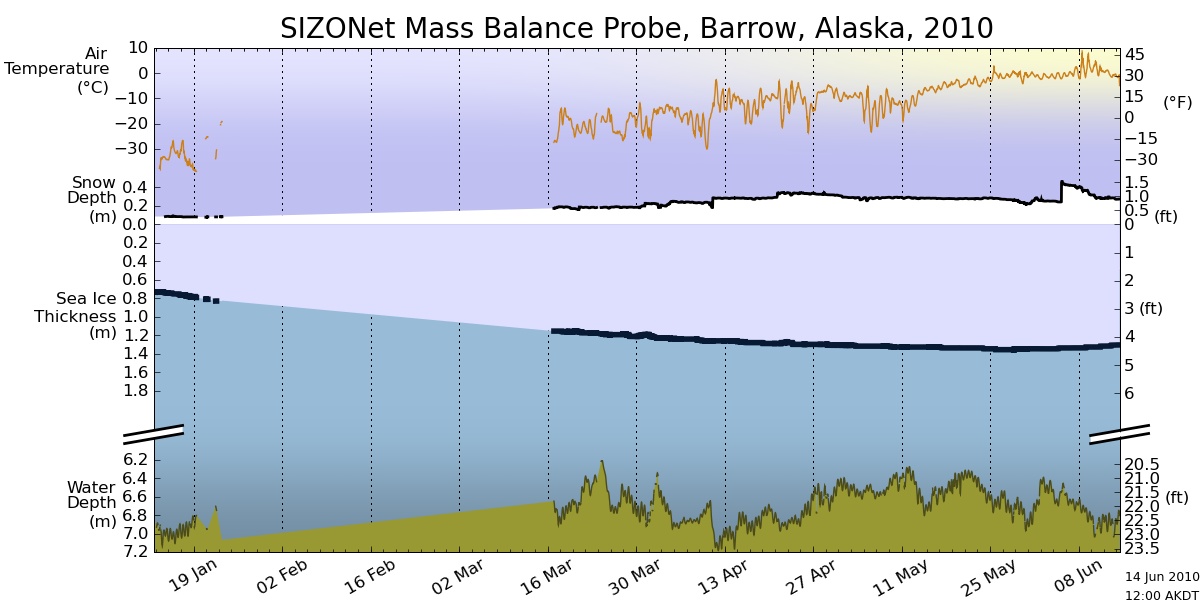
The current break up forecast calls for July 5.

http://seaice.alaska.edu/gi/observatories/barrow_breakup
Temperatures north of 80N have been persistently below normal this summer.

http://ocean.dmi.dk/arctic/plots/meanTarchive/meanT_2010.png
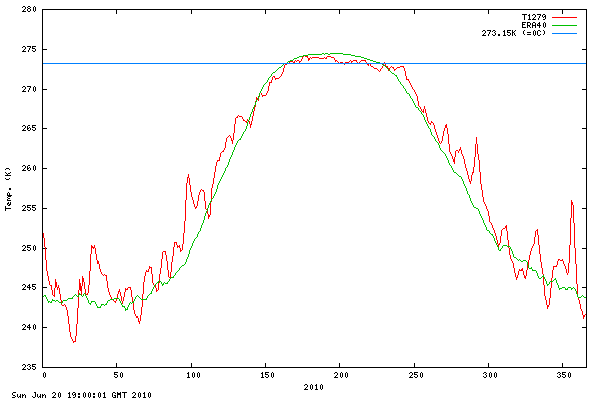
There are still no signs of melt at the North Pole, with temperatures running right at the freezing point – and below normal. Normally there has been surface melting for several weeks already.

http://psc.apl.washington.edu/northpole/webphotos/noaa2-sml.jpg

Arctic Basin ice generally looks healthier than 20 years ago.

I’m forecasting a summer minimum of 5.5 million km², based on JAXA. i.e. higher than 2009, lower than 2006.
Meanwhile down south, Antarctic ice is well above “normal” close to a record maximum for the date.

http://arctic.atmos.uiuc.edu/cryosphere/IMAGES/seaice.recent.antarctic.png

The video below shows the entire NSIDC Antarctic record for the last 30 years.It looks like a heart beating
Phil,
Apparently one of us doesn’t know where Barrow is, and it is you. There are two miles of ice west of Barrow and at least 20 miles to the east.
It should be noted that I am quite happy to be proven wrong regarding this year’s melt. I hope that we do have a recovery. I am sceptical that we will, however.
“””SouthAmericanGirls says:
June 23, 2010 at 10:42 pm
What does PIPS means? WattsUpWithThat has one of the highest traffics in the world, but if you use UNEXPLAINED ACRONYMS you are losing a lot of readers. We normal people cannot go on reading EVERY post and EVERY paper and we cannot go on KNOWING every climate related acronym. You should do posts that any person with a reasonnable understanding of graphics can understand
Apart that, this an excellent post.”””
Perfectly agree with that. Being fairly knowledgeable in most areas of science and reading here constantly I find myself spending wasted time looking up forgotten sequences of letters. I might know what the letters mean but many times can’t remember the exact word.
Case of point: BoM, can’t tell you the exact words, can’t remember what the B is, something of Meteorology, however, I do know it is basically NOAA of Australia, a government agency.
Now if you only read here periodically or aren’t based in science I feel for you. You probably are totally lost and shouldn’t be if someone would just state the complete phrase or name.
Very good point girls down south!
stevengoddard,
I have some questions re the ice volume and ice thickness graphs that you have posted. If the current thickness is higher than 2009, how is volume is lower than 2009? Is this because concentration in the Arctic Basin is much lower today than in 2009? If so, how does this reconcile with the notion that the ice is being compressed into the Arctic Basin? If not, what are other possible explanations? (genuine questions)
Volume = area X thickness. The thickness is greater than 2009, and the area is less than 2009.
http://arctic.atmos.uiuc.edu/cryosphere/NEWIMAGES/arctic.seaice.color.003.png
This image seems to suggest that to the west of Barrow there is not much ice. But to the north and east there is a fair amount.
Amino Acids in Meteorites,
Mid September may be coming soon, but it still seems a long way away. 🙂
Is there any sort of adverse consequence to less arctic ice? I know of a number of upsides including a northwest shipping lane that will drastically reduce intercontinental transit times and fuel requirements as well as making a larger safer area for fishing and additionally there are likely some big underwater oil reserves that’ll become accessible.
The way this is being framed by the greenie weenies you’d think there would be some terrible consequences associated with it but near as I can determine there isn’t a single thing bad about it. That’s pretty much the same story for all global warming consequences – far more upside than downside to it. Snow and ice simply aren’t friendly to life as we know it. The less of it the better.
1990, 1991, 1992, 1993, 1994, 1995, 1996, 1997, 1998, 1999, 2000, 2001, 2002, 2003, 2004, 2005, 2006, 2007, 2008, 2009, 2010=21 years…
Must be the new math…..
Polynyas are now opening north of Canada.
http://ice-map.appspot.com/?map=Arc&sat=ter&lvl=8&lat=81.332756&lon=-104.865508&yir=2010&day=174
stevengoddard,
But weren’t those figures for volume and thickness for the Arctic Basin? As far as I can see – and you were arguing this, I am sure – ice extent in the Arctic Basin is about the same as it was in 2009. The melt has occurred – as it does in every year – at the lower latitudes first. So I am still a little confused. For what part of the Arctic are those volume and thickness figures – the whole Arctic or the Arctic Basin (the charts say ‘Arctic Basin’)? Further, what are the area figures that you are using (the values, I mean)? Thanks.
“The Arctic Basin includes the Arctic Ocean within the average minimum extent of sea ice …”
Taken from Wikipedia, but I am not sure which definition those charts might be using.
Further, according to my examination of those graphs (admittedly, it is a little tricky to be completely accurate) we have around 55,000 for both 2009 and 2010 volume and around 2.5 for 2010 thickness and 2.1 for 2009 thickness.
This indicates that there is 16 per cent less area now than there was in 2009, a pretty huge drop, and an unlikely one. That would be an area difference (assuming that the Arctic Basin is 5 million square kilometres) of some 750,000 square kilometres.
Now, I understand that area is not the same thing as extent. But is the area for 2010 really 750,000 square kilometres less than the area for 2009? That seems a huge loss, given that extent for the total arctic is only 500,000 kilometres lower today than it was at this time in 2009. (Apologies if this has already been covered and I missed it).
Steve:
Perhaps an explanation as to the difference between this
http://arctic.atmos.uiuc.edu/cryosphere/NEWIMAGES/arctic.seaice.color.000.png
and this
http://arctic.atmos.uiuc.edu/cryosphere/IMAGES/ARCHIVE/20100622.jpg
will clear things up a bit.
Dave Springer says:
June 24, 2010 at 1:08 am
Is there any sort of adverse consequence to less arctic ice?
Depends on how it is lost.
Hi there,
I’m sorry to come back with the PIPS 2.0 – PIOMASS thing, I know you’re all tired about this, but anyway I wanted you to know the opinion of people at the NSIDC (which is more than probably THE reference about sea ice). A French blogger asked them about the relevance of these two models, and here is the answer:
“Thank you for contacting NSIDC. Walt Meier, one of our sea ice scientists provided some thoughts which I will sum up along with a few other points from talking with other scientists here at NSIDC:
Unfortunately, there are no continuous, Arctic-wide measurements of sea ice volume/thickness which is why models are used to estimate volume/thickness. Sea ice extent on the other hand is derived from remotely sensed data from satellites.
The PIPS model is an operational model, and is designed to forecast the ice a few days into the future (for navy submarine use, etc). It is not proper to use it to study year to year changes. PIPS, is known to be not terribly useful for sea ice other than perhaps motion; definitely not thickness.
Our assessment at ( http://nsidc.org/arcticseaicenews/) is based on (1) the ice age fields we get from data from our colleagues, Charles Fowler and James Maslanik, Colorado Center for Astrodynamics Research, University of Colorado Boulder, (2) models better suited to tracking thickness year to year, such as the University of Washington, PIOMAS model we’ve discussed in the past couple articles, and (3) consultation with operational ice centers that have very high quality data and human expertise at assessing the state of the sea ice. The PIOMAS model is looking back in time and estimating what the volume was in order to monitor trends. It has the benefit of “hindsight” and can incorporate actual recorded measurements (weather, satellite data etc.) that by nature are not available to make a forecasts. The most recent update of the PIOMAS model looks to be May 30th.
Let me know if you have any more questions or need more information.
Regards,
Kara Gergely
NSIDC User Services”
here is the original blog post
http://www.climat-evolution.com/article-banquise-arctique-pips-piomas-52419993.html
There are a couple of people here who seem to believe that the University of Alaska site http://seaice.alaska.edu is a hoax.
Sometimes it might be a good idea to think things through before posting?
http://seaice.alaska.edu/gi/observatories/barrow_webcam
David Gould says:
June 23, 2010 at 11:51 pm
The ice is melting very fast – the fastest in any recorded year. The question is: do *you* think that thick ice melts faster than thin ice? Ice melting fast would seem to me to equate to the ice being thin – your view may differ, of course.
++++
The problem with generalities about an area covering millions of square kilometers is that they can be very misleading, as is yours above.
The ice that is “melting rapidly” is not the thick ice, it is the thin ice. Steve’s graphics make that clear. What is “the thin ice”, you ask? The thin ice is those areas *that melt every year*. Good year, bad year, medium year –those areas melt. They have no opportunity to achieve “multi-year ice” status.
This is why Steve (and me, for that matter) focus on the arctic basin, rather than, say, the Bering Sea or the areas along the east/west coasts of Greenland (not an exclusive list, just for example). To the degree there *can* be thick multi-year ice, the Arctic basin is where most of it will be found.
Julienne
Thanks for the link. Apparently there is some disagreement between models? Buoy data shows that temperatures have been very close to 0C at the pole.
http://psc.apl.washington.edu/northpole/PAWS_atmos_recent.html
Temperatures in Barrow have been well below normal.
http://www.wunderground.com/history/airport/PABR/2010/6/24/MonthlyHistory.html#calendar
And NCEP is forecasting near freezing temperatures in the Beaufort Sea for the next two weeks.
http://wxmaps.org/pix/temp2.html
Looks like it is going to be decided by what the wind does, like in 2007.
I hope no one is trusting the GISS data set to find what temperatures are in the Arctic
Even if you think it is trustworthy i think it is easy to see it is not the same as other sets from around the world
Rob Vermeulen
The PIPS literature makes it quite clear that they constantly update their forecasts with the latest available information. I am not using PIPS as a predictive tool, because I am only looking at the current day.
As your post stated “The PIPS model is an operational model”
Hi Rob,
Thanks a lot for that useful piece of information.
David Gould
It will be Brett Favre time starting in September too. I’ll also be interested to watch the Jets defense this year. They had #1 defense last year and they added more good players in the off season.
That is if you’re interested in football.
But oh, back on topic. I don’t think Arctic ice is alarmingly thin. I don’t think anything unusual is happening in climate. Everything is carrying on same as it always has.
“JB says:
June 24, 2010 at 2:43 am
1990, 1991, 1992, 1993, 1994, 1995, 1996, 1997, 1998, 1999, 2000, 2001, 2002, 2003, 2004, 2005, 2006, 2007, 2008, 2009, 2010=21 years…
Must be the new math…..”
Let’s do the math….
June 24th 1990 to June 23rd 1991 would you count that as 1 year or 2? By your above math it is two: 1990 & 1991. By most other peoples math it is 1 (365 days = one year).
Phil. says:
June 23, 2010 at 8:37 pm
Sea Ice News #10
Posted on June 23, 2010 by charles the moderator
By Steven Goddard
Ice offshore of Barrow, Alaska is showing little signs of melt so far.
Probably because it stopped recording on June 14th! The little upkick in the snow depth on about the 5th June was caused by a Polar bear ‘playing’ with the equipment, data after that was compromised. That ice is in fact the ‘fast’ ice on shore, the ice offshore of Barrow has in fact gone:
http://rapidfire.sci.gsfc.nasa.gov/realtime/single.php?A101712310
___________
Phil,
I made this point myself to Steve, but it seemed to be ignored. and I think the PIPS 2.0 data is about is as good as the Point Barrow Mass Balance probe that was taken off line a few weeks back…
Ron Broberg says:
June 23, 2010 at 2:48 pm
“Totally agree with Julienne’s point about comparing with a single day 20 (or 21) years ago. It’s all about the trends.”
Actually it’s straight line trends that I find pointless. A 2c/century straight line trend means in some 4000 years the Earth’s average temperature will boil water. IPCCs 6c/century lowers that to ~1300 years. I seem to remember even scarier predictions.