By Steven Goddard
The Arctic sun has now passed its peak, and is starting its decline towards the horizon over the next 90 days.

All four (JAXA NSIDC DMI NORSEX) ice extent measurements now show 2010 as below 2007. You can see in the modified NSIDC map below that the regions which are below the 30 year mean (marked in red) are all outside of the Arctic Basin and are normally ice free in September, so it is still too early to make any September forecasts based on extent data.

The modified NSIDC map below shows ice loss (in red) during the last nine days. There has been very little change in the Arctic Basin.

The modified NSIDC map below shows ice loss (in red) since early April. According to JAXA, this is about 5 million km².

The modified NSIDC map below shows ice loss (in red) since early April. According to JAXA, this is about 5 million km².
The modified NSIDC map below shows ice loss (in red) since 2007. According to JAXA, this is about 500,000 km². Areas in green have more ice than 2007.

There has been a strong clockwise rotation of wind in the Beaufort Gyre, which is pulling ice away from the land around the edges of the Beaufort, Chukchi and East Siberian and Laptev Seas.

http://www7320.nrlssc.navy.mil/pips2/archive/mag/2010/mag_2010062200.gif

The video below shows changes in PIPS ice thickness and extent during June. You can see the ice rotating clockwise and concentrating in the center of the Arctic Basin.
During the last 10 days, PIPS shows that Arctic Basin ice volume has dropped close to 2007 and 2009 levels. Volume has increased by about 40% since 2008.

Average ice thickness is now the highest for the date during the last five years. This is due to the compression of the ice towards the interior of the Arctic Basin.

Ice offshore of Barrow, Alaska is showing little signs of melt so far.
 ‘
‘
http://seaice.alaska.edu/gi/observatories/barrow_sealevel/brw2010/BRW_MBS10_overview_complete.png
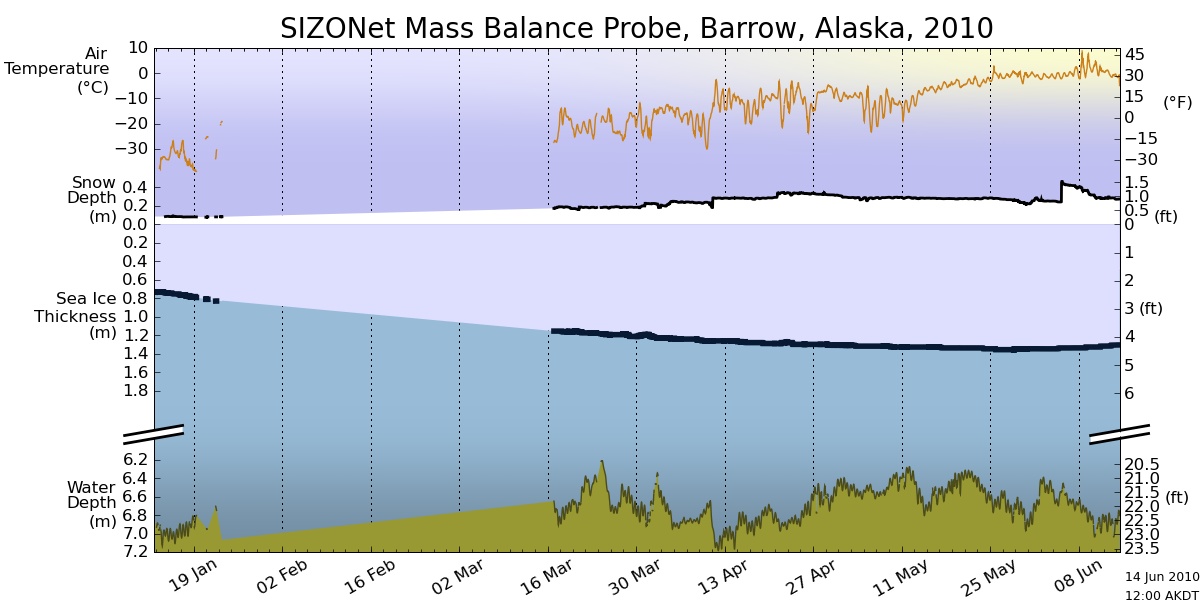
The current break up forecast calls for July 5.

http://seaice.alaska.edu/gi/observatories/barrow_breakup
Temperatures north of 80N have been persistently below normal this summer.

http://ocean.dmi.dk/arctic/plots/meanTarchive/meanT_2010.png
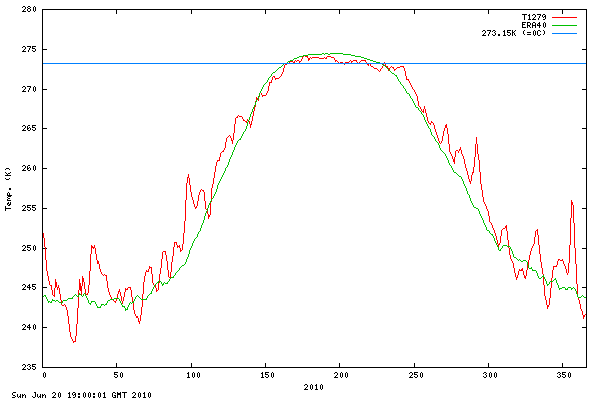
There are still no signs of melt at the North Pole, with temperatures running right at the freezing point – and below normal. Normally there has been surface melting for several weeks already.

http://psc.apl.washington.edu/northpole/webphotos/noaa2-sml.jpg

Arctic Basin ice generally looks healthier than 20 years ago.

I’m forecasting a summer minimum of 5.5 million km², based on JAXA. i.e. higher than 2009, lower than 2006.
Meanwhile down south, Antarctic ice is well above “normal” close to a record maximum for the date.

http://arctic.atmos.uiuc.edu/cryosphere/IMAGES/seaice.recent.antarctic.png

The video below shows the entire NSIDC Antarctic record for the last 30 years.It looks like a heart beating
So…
the ice thickness and volume are now like they were in 2007
the weather patterns are very alike 2007
so, if the 2007-like weather pattern does not change, a new record, or near-record, low sea ice extent-area is likely.
Some are issuing forecasts.
I guess that if (bif if) weather patterns stay the same:
sea ice extent(amsr-e): 4*10^6 km^2
sea ice area(cryosphere today): less than 3*10^6 km^2
I said “I guess that if (bif if) weather patterns stay the same:”
I wanted to say: “I guess that if (big if) weather patterns stay the same:”
EFS_Junior,
There are problems with the cryosphere today comparison images. They are most certainly different than the large daily image that they display. There are a number of possible reasons for this, including differences in resolution, colour differences and the low ice concentration issue. I am not sure that they completely explain it, however. Others have asked cryosphere today this question, but I am not sure that a definitive answer has been provided as yet. Personally, I would not rely on their comparison images. But maybe stevengoddard has more information regarding this than I do.
Don’t know if this has been mentioned, but the current ice extent is not below 2007, it is behind or ahead of 2007, depending on your calendaring logic. Regardless, it is within 2 weeks of 2007 and in the big picture that is not a significant lead or lag period. You know and I know that nobody knows what the norm is for this day of the year or for any other day of the year. We just know that the extent passes through this value about this time each year. The rate of change is also typical for this time of year.
Somebody wake me up if something important happens to the arctic ice.
Sea Ice News #10
Posted on June 23, 2010 by charles the moderator
By Steven Goddard
Ice offshore of Barrow, Alaska is showing little signs of melt so far.
————————————————————————-
Probably because it stopped recording on June 14th! The little upkick in the snow depth on about the 5th June was caused by a Polar bear ‘playing’ with the equipment, data after that was compromised. That ice is in fact the ‘fast’ ice on shore, the ice offshore of Barrow has in fact gone:
http://rapidfire.sci.gsfc.nasa.gov/realtime/single.php?A101712310
———————————————————————-
Confirmed
Sea Ice News #10
Posted on June 23, 2010 by charles the moderator
By Steven Goddard
Ice offshore of Barrow, Alaska is showing little signs of melt so far.
Probably because it stopped recording on June 14th! The little upkick in the snow depth on about the 5th June was caused by a Polar bear ‘playing’ with the equipment, data after that was compromised. That ice is in fact the ‘fast’ ice on shore, the ice offshore of Barrow has in fact gone:
http://rapidfire.sci.gsfc.nasa.gov/realtime/single.php?A101712310
————————————————————————
Myth Confirmed 🙂
http://ice-map.appspot.com/?map=Arc&sat=ter&lvl=7&lat=71.163689&lon=178.113075&yir=2010&day=175
Seriously when will you start showing maps using AMSR-E data. AMSR-E has a *much* higher pixel resolution, 25Km2 compared to 100KM2 for SSM/I. (16 pixels AMSR-E = 1 pixel SSM/I)
SSM/I image
http://nsidc.org/data/seaice_index/images/daily_images/N_daily_extent_hires.png
AMSR-E image
http://www.iup.uni-bremen.de:8084/amsr/arctic_AMSRE_nic.png
I know what image shows an accurate sea ice extent!
As for melting I think this rather nice image shows it well. You can see where the snow cover has been melted off up to about 85N.
http://ice-map.appspot.com/?map=Arc&sat=ter&lvl=7&lat=71.163689&lon=178.113075&yir=2010&day=175
Ewww cut and paste glich sorry
Phil,
The ice is still present in Barrow, and they are currently forecasting it will break up on July 7.
http://seaice.alaska.edu/gi/observatories/barrow_breakup
You can see it in the webcam.
http://seaice.alaska.edu/gi/observatories/barrow_webcam
And if you zoom all the way in here, you can see about a mile of ice offshore.
http://ice-map.appspot.com/
But nice FUD anyway.
Keith Tax,
If you want to get off oil, then stop eating, using electricity or manufactured goods. Turn off all your appliances and heat, don’t ever use any medicine, and don’t access the Internet or read a newspaper. Don’t drive a car or use public transportation. Don’t go to the store, and don’t walk under a streetlight.
David Gould
I’m curious how June ice melt in the Hudson Bay, Baffin Bay, and the Barents Sea affects the summer minimum? Please explain.
David Gould says:
June 23, 2010 at 8:28 pm
this has been the fastest melt season thus far
How much is from shear?
David Gould says:
June 23, 2010 at 8:28 pm
the observations to date
Is this one of the rare times when global warming believers will actually use observation instead of pessimism? Well, looks like it’s pessimism of what the data appears to be saying. But things are not always what they appear to be.
Our Mr R Gates seems unable or unwilling to part from his beloved models and maybe he is correct but the history of models shows us they should be taken with a pinch of salt.
I remember R Gates posting that this year would be “one heck of a melt season” which could mean a high or low minimum.
BTW A team on the ice finding one spot of thin ice and then being “shocked” that the thin ice they looked for actually exists and then extrapolating that tiny spot as being representative of millions of square kilometers seems a little unscientific at best, it could be that if you want to find something and are being finananced to find something and your beliefs dictate that something exists then you will probably ‘find’ what you are looking for.
Of all the methods of measuring ice, sending a few people out on the ice using the easiest route which just happens to be composed of the thinnest ice must represent the worst method yet devised.
Its akin to digging up a grain of dirt in your garden with a sewing needle, not finding a worm and then declaring that worms do not exist.
What does PIPS means? WattsUpWithThat has one of the highest traffics in the world, but if you use UNEXPLAINED ACRONYMS you are losing a lot of readers. We normal people cannot go on reading EVERY post and EVERY paper and we cannot go on KNOWING every climate related acronym. You should do posts that any person with a reasonnable understanding of graphics can understand
Apart that, this an excellent post.
villabolo says: “…Since ice REFLECTS 80-90% of the sunlight while blue ocean ABSORBS 80% it’s (sic) evaporation will increase tremendously and cause a chain reaction of events that will affect the entire Northern Hemisphere.”
At the high zenith angles found at the poles, the reflectance of seawater and ice are very similar. There will be no such chain reaction.
stevengoddard,
Energy is required to melt ice. If I have a smaller amount of ice, then it requires a smaller amount of energy to melt it. So, if at the end of June there is a smaller amount of ice than in previous seasons, the energy that would have been used to melt that ice in July is now available to melt other ice.
We can see this by looking at the correlation between June average ice extent and September average ice extent in the NSIDC data. The r^2 value is .59, which is significant. The lower the average ice in June, the lower the average ice in September.
Amino Acids in Meteorites,
A fair bit, as in every other year. However, weaker ice shears more easily than stronger ice, so if you are arguing that there has been lots of shear this year then you must also be arguing that the ice is weaker this year than in previous years.
As to things not being what they appear, at present the data is not suggesting that the ice is strong. The ice may well be strong. But there is no data available that indicates that.
re average ice extent in June, my estimate is that the average ice extent for this June will be around 10.9 million square kilometres, which – on the trend line – points to an *average* ice extent in September of around 4.9 million square kilometres. An average ice extent in September of 4.9 million square kilometres would mean a minimum of around 4.7 million square kilometres.
Today the curve is perhaps 2 mm below 2006. If it continues to follow 2mm below 2006, it will be close to 5.8. So if Steves other observations is correct in this excellent post, I’d say the changes still are good for 5.8.
But noone can say what will happen in July, right?
Unless you have a crystall ball.
Steve, I have been looking at the NCEP/NCAR reanalysis data (note this is a different reanalysis than what DMI uses). I’m not looking at areas just north of 80N, but at the entire Arctic. You can go to (http://www.esrl.noaa.gov/psd/data/composites/day/) and make your own daily images (spatially, temporally, means, anomalies, etc) and temperatures remain anomalously warm (looking at the data through June 20).
But the temperatures are not as warm as we saw in 2007 (the anomalously low SLP is shifted more over Eurasia than Siberia which reduces the advection of warm, southerly air over the Chukchi and E. Siberian Seas that characterized summer of 2007).
I know folks here keep pointing to the DMI web site to say that temperatures north of 80N are not as warm as climatology, but note the DMI site uses a model as well, and they are using different models to compute the entire time-series (and hence the climatology) which may not be correct. There have been papers that have shown a bias in the ERA40 air temperatures past 2002. Really, if you want to do this assessment of Arctic temperatures you should use a consistent reanalysis data set. If you want to stick with ERA40 then the ERA40 Interim should be used instead since they fixed the problems with the ERA40 data set that the DMI site is using.
middle of september is coming soon. we all will know if the ice really is thin. even though we should already know because we see the data. computer models say it’s alarmingly thin. data says it isn’t. middle of september is soon.
stevengoddard says:
June 23, 2010 at 10:01 pm
Phil,
The ice is still present in Barrow, and they are currently forecasting it will break up on July 7.
http://seaice.alaska.edu/gi/observatories/barrow_breakup
Yea fast ice, not ‘offshore’, fairly early breakup for grounded ice ridges.
You can see it in the webcam.
http://seaice.alaska.edu/gi/observatories/barrow_webcam
And if you zoom all the way in here, you can see about a mile of ice offshore.
http://ice-map.appspot.com/
Are you sure you know where Barrow is?
http://rapidfire.sci.gsfc.nasa.gov/realtime/single.php?2010174/crefl2_143.A2010174140000-2010174140500.500m.jpg
But nice FUD anyway.
Back in April “09 I posted my NSWAG for the summer minimum on JAXA of 5.714285 million km2. I actually thought it would be a little less, but I wanted a number that I could quote to the same totally unrealistic precision they used and still be able to remember it without writing it down somewhere. This Spring I figured the min would probably be be just slightly north of 2008, but going by that same requirement I had to go with 4.285714 Mkm2 for this year. The purely scientific methodology I used to smoothly extract each number from my anal orifice is based on a little recognized numeric phenomenon that used to quite frequently get me free beers from overly calculator dependent engineering types back in the day. I missed on the high side last year and expect to miss a bit on the low side this time.
David Gould
If you read the article, then you know that average ice thickness is greater this year than any of the previous four years.
Do you think that thick ice melts slower or faster than thin ice?
stevengoddard,
Your analysis indeed suggests that average ice thickness is greater this year than any of the previous four years. However, I am my doubts regarding your analysis, particularly that reliant upon the cryosphere today comparions. You should carefully examine the image on the main page and compare it with that used on the comparion page. They do not match.
Phil has also pointed out that your point re Barrow is in error.
The ice is melting very fast – the fastest in any recorded year. The question is: do *you* think that thick ice melts faster than thin ice? Ice melting fast would seem to me to equate to the ice being thin – your view may differ, of course.
Amino Acid in Meteorites,
Which data are you pointing to regarding ice thickness?