
By Steven Goddard
The quest for the Holy Grail.
I have been looking for a reliable early predictor of September area/extent based on June ice data, and have found it – almost. Previously I established that current extent is a useless predictor, prior to August. The reasons for this are :
- Extent tells you nothing about thickness
- Many areas currently covered with ice, will normally have almost none in September (Hudson Bay, Barents Sea, etc.)
I eliminated the second issue by reducing the region of interest to the area shown in white below. That area corresponds approximately to the maximum extent of September ice in the 30 year NSIDC record.

Then I tried three different metrics to compare June 6 ice parameters vs. September extent and area, for the decade 2000-2009.
The first parameter was June 6 ice area. As expected, this correlated very poorly with September extent and area. The rsq value of June 6 ice area rankings vs September extent rankings is 0.02. The rsq value of June 6 ice area rankings vs September area rankings is 0.07.
The next parameter for comparison was June 6 ice volume (calculated from PIPS) vs September extent. This correlated much better. The rsq value of June 6 ice volume rankings vs September extent rankings is 0.22. The rsq value of June 6 ice volume rankings vs September area rankings is 0.37.

The final parameter for comparison was June 6 average ice thickness (calculated from PIPS) vs September extent. This correlated the best. The rsq value of June 6 average ice thickness rankings vs September extent rankings is 0.28. The rsq value of June 6 average ice thickness rankings vs September area rankings is an excellent 0.65.
So it appears that we have found a reliable predictor of September extent based on June ice thickness, which makes sense from a physical point of view. But it isn’t perfect! The graph and table below show the problem.

Average thickness on June 6, 2010 is 2.55 metres. The table below shows the June 6 rankings for the last 11 years. 2010 is in 7th place, behind 2006 and ahead of 2007, 2003, 2009 and 2008. Average thickness is more than half a metre thicker than 2008.
Date            Average Thickness

6/6/2004        2.95

6/6/2005        2.87

6/6/2001        2.86

6/6/2000        2.84

6/6/2002        2.76

6/6/2006        2.68

6/6/2010        2.55

6/6/2007        2.54

6/6/2003        2.5

6/6/2009        2.17

6/6/2008        1.96
Everything in that table makes sense, except for 2007. Ice thickness in the central Arctic on June 6, 2007 was nearly identical to 2010 and the top year – 2003.
Conclusion : Based on current ice thickness, we should expect September extent/area to come in near the top of the JAXA rankings (near 2003 and 2006.) However, unusual weather conditions like those from the summer of 2007 could dramatically change this. There is no guarantee, because weather is very variable.


No doubt some people are wondering how this can be true, given that extent is currently lowest in the record. The reason (again) is that June extent has almost no correlation with September extent. Imagine an ice cube floating in water. It occupies a much smaller area of water than a ground up ice cube. But which one melts faster? The ground up ice cube will of course melt faster. Having a wide extent in June is not necessarily a good thing, unless the ice is also thick.
Sea surface temperatures continue to run cold in the Northern Pacific. They also are cooling down some in Atlantic.

http://weather.unisys.com/surface/sst_anom.html
Arctic temperatures have been running cold for the last week or so.
From: http://www.esrl.noaa.gov/psd/map/images/fnl/sfctmpmer_01a.fnl.anim.html

http://ocean.dmi.dk/arctic/meant80n.uk.php
There is no indication of melt in the ice off Barrow, with ongoing cold temperatures and the deepest snow of the winter.

http://seaice.alaska.edu/gi/observatories/barrow_sealevel/brw2010/BRW_MBS10_overview_complete.png
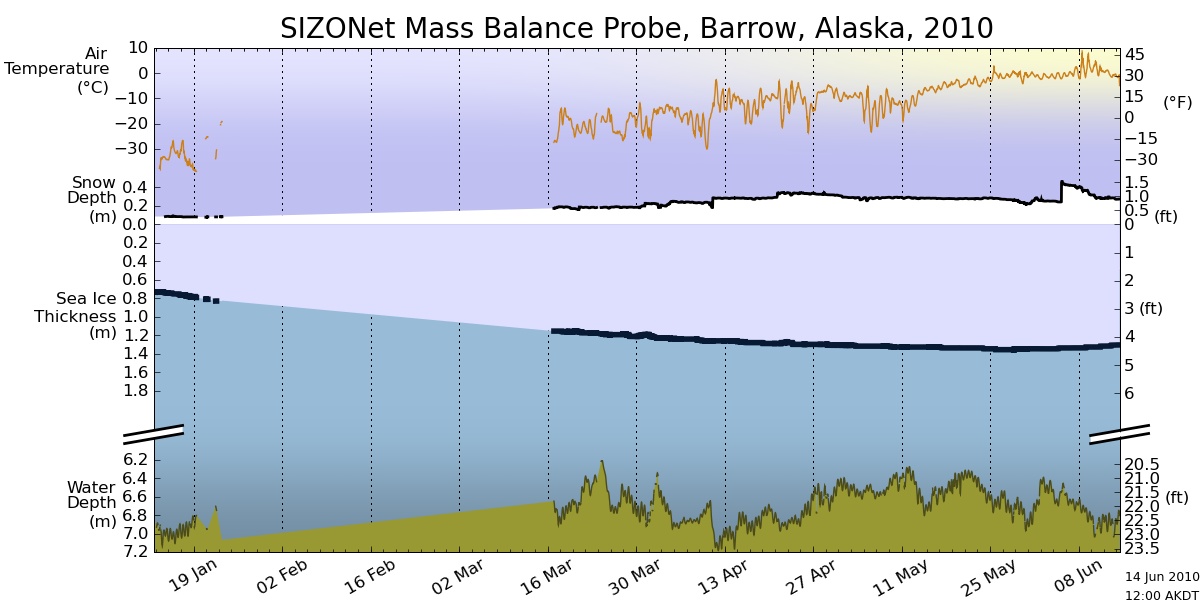
Ice continues to look very concentrated in the Arctic Basin, as seen in this enhanced satellite photo.

http://ice-map.appspot.com/?map=Arc&sat=ter&lvl=7&lat=67.940426&lon=-168.991006&yir=2010&day=149
——————————————–
The disparity between ice indices continues to widen.DMI has 2010 ahead of 2007 and 2008. Other indices have 2010 lower. Given the analysis above, these numbers are relativelymeaningless this early in the summer.

The modified NSIDC graph below shows a comparison of 2010 ice extent vs. 2007. Areas in green have more ice than 2007. Areas in red have less ice.

The modified NSIDC map below shows ice loss since April 5, in red.

The modified NSIDC map shows changes in Arctic ice over the last week, using the same colour scheme.

The modified NSIDC image below shows the current anomaly. Areas in red have less ice than the 30 year mean, and areas in green have more ice.

Julienne ,
Thanks for the information. Are you aware of any better data set than PIPS 2 which is available with daily ice thickness numbers?
Also, do you have any reason to believe that PIPS 2 numbers are (relatively) inconsistent from year to year? I understand that the absolute thicknesses may not be precise.
Steve
For your reference, this Pentagon report might be of interest;
http://www.stormingmedia.us/40/4062/A406204.html
and per the links above and below, Pamela Posey seems like she might be a good person to reach out to, as she led the, “Software Users Manual for the Polar Ice Prediction System Version 2.0” and participated in the, “Validation Test Report for a Navy Sea Ice Forecast System: The Polar Ice Prediction System 2.0”
http://www.stormingmedia.us/authors/Posey_Pamela_G_.html
Pamela’s contact info can be found here:
https://www1.cmos.ca/Amsoft%20Web%20Data/upload/abstracts115/7052archive.html
Here is what the Navy says about PIPS:
http://www.nrl.navy.mil/content_images/09_Ocean_Posey.pdf
Just The Facts
Thanks for the link. Hopefully this will end the stream of inaccurate comments:
https://www1.cmos.ca/Amsoft%20Web%20Data/upload/abstracts115/7052archive.html
Steve,
You were recently very keen on the Navy’s PIPS 2.0 dataset. Why now rather than use the concentrations maps from PIPS 2.0 are you resorting to eyeballing the Cryosphere today maps? If there is some glitch with running your code on your supercomputer, why don’t you just use ImageJ to get out some proper numbers from the PIPS 2.0 dataset as I showed earlier?
PIPS 2.0 does show 2008 as the lowest ice volume of the last three years, while PIOMAS shows 2009. Both, though, show lower ice minima for these two years compared to 2007 and, as I’ve shown, very similar decadal trends.
If you would like to think there has been a recovery in ice volume since 2007, you’re best off ignoring both PIOMAS and PIPS 2.0.
Julienne ,
This video makes it clear where PIPS thinks the thick ice came from, in late summer 2007.
stevengoddard
June 7, 2010 at 2:05 pm
Tom P has a penchant for ignoring what’s happened in Arctic ice since 2007.
Julienne says:
June 7, 2010 at 12:53 pm
When you look at survival rates of FYI versus MYI during summer you find that on average 60% of the FYI melts out and 20% of the MYI.
What time frame was used to determine these percentages?
A few things:
A big thanks to Steve for keeping this interesting topic open and all those who have provided very insightful comments. It seems that though Steve might be putting credance into PIPS 2.0 volume data than should be, his general approach is quite sound and has provided lively debate.
I’ve emailed a few experts with the following questions, which I think would provide some much needed clarity on some of the issues we’ve raised here:
a) Could you give a brief overview on the accuracy and differences between the PIPS 2.0, PIPS 3.0, CICE, and PIOMAS models.
b) Do you see PIPS 2.0 (a non-CICE model as being abandoned in favor of PIPS 3.0, (CICE based model)? Also, For example, lately it seems PIOMAS and PIPS 2.0 are diverging greatly in their estimate of the arctic sea ice volume, so which is more likely to be accurately reflecting the current state of affairs in the arctic?
c) I’d be curious how PIPS 3.0/HYCOM might compare to what PIOMAS is saying (if PIPS 3.0 model data can be released or is even available in any form for non-military uses).
4. Perhaps you offer a general thought about how the data we hope to be getting soon from CryroSat 2 will help with the models?
_______
I suspect now that we have a few true Ph.D level ice experts who’ve joined this discussion, and they might be able to answer these questions quite readily…
Nigel Harris :
June 7, 2010 at 9:20 am
Your information does not say PIPS 2.0 has been dropped for ice thickness. You are talking about CICE forecasting into the future beyond 120 hours. For example, CICE has a forecast of summer ice free Arctic by 2040. I was not talking about long term climate modelling. I am talking about thickness of Arctic ice now.
see here:
http://wattsupwiththat.com/2010/06/06/wuwt-arctic-sea-ice-news-8/#comment-404362
here:
http://wattsupwiththat.com/2010/06/06/wuwt-arctic-sea-ice-news-8/#comment-404570
and here:
http://wattsupwiththat.com/2010/06/06/wuwt-arctic-sea-ice-news-8/#comment-404575
You are being like Tom P and R. Gates both who reply something that isn’t an answer to what was asked.
So up until now none of you have provided and proof that the Navy has dropped PIPS 2.0 for current ice thickness. You’ve talked about other things I’m not even asking about. And I don’t know how I could have made what I was talking about clearer. I just sit back and shake my head at how sloppy things are sometimes.
jeff brown
Thanks for your reply. It was polite—and thanks for that too.
I’m glad you talked to someone who actually works at the National Ice Center. And I appreciate his insight! My brother was in the Navy for five years. He was always out in submarines on long missions. I had a mind to call him and talk to him about Arctic ice. But I can see enough from the web sites I’m going to that current ice thickness from PIPS 2.0 is still used by the Navy. And I’m sure the best data we could have for Arctic ice thickness is from the Navy since they have submarines there on location.
But my comments about PIPS is only about current ice thickness and not forecasts of ice thickness into the future. The volume data we can derive from PIPS 2.0 is probably the most accurate available in the United States. And it’s clearly better than PIOMAS.
R. Gates
do you know the difference between current data and model forecasting? You seem to have trouble with that.
Amino Acids in Meteorites says:
June 7, 2010 at 5:07 pm
R. Gates
do you know the difference between current data and model forecasting? You seem to have trouble with that.
_________
Hmmm…let’s see, a model would say what something “might be” now, or in the future, based on a variety of different factors being put into some series of very complicated equations…and current data would say what something actually is based on a direct measurement of it…would that approximately the case?
And as well all know…there currently is no actual data that can tell us what the thickness of the sea ice across the entire arctic at this moment…and everything out there is a model…from PIPS 2.0 or 3.o to CICE to PIOMAS. For if we had actual data…there would be no need for CryoSat 2 right?
But, the big issue is..which model is taking in the right factors, in the right proportions, in the right equations, and coming the closest to spitting out a model that is closest to describing what is actually happening right now in, and on, and under the vast expanse of very dynamic Arctic sea ice, and more importantly, what model will be best to tell us what is likely to happen in the future as well.
I know from personal communication with at least one model maker (Dr. Zhang with his PIOMAS model) that they await eagerly await data from CryoSat 2 in order to continue with refinement and validation of the model, and I would assume this is true for the others as well.
The error by many is assuming that PIPS 2.0 is actual valid measurement, and not model data.
fred wrote,
“Just a few weeks ago Watts Up With That was empasizing sea ice extent, I guess because that was going up. Now you are emphasizing sea ice volume, based on the PIPS2.0 model, I guess because sea ice extent has turned so much downwards?”
I think the April bump in ice extent was the whole inspiration for this series of blogs about Arctic ice, which has turned into a dramatic contrast between the WUWT way of knowing vs. that of Arctic science.
The PIPS stuff came in as a fallback, apparently with no effort to verify, because when their website images were analyzed by certain methods they appeared to give more pleasing results, whereas all the other Arctic indicators do not.
R. Gates says:
June 7, 2010 at 5:45 pm
The error by many is assuming that PIPS 2.0 is actual valid measurement, and not model data.
Ok great brilliant one. Get in touch with the Navy since they are the ones your inept mind has a problem with.
Gneiss says:
June 7, 2010 at 6:19 pm
The PIPS stuff came in as a fallback….
This is what your opinion of the data is. The data is your enemy, isn’t it little huckleberry?
no wonder some people believe in global warming—they think data itself is a model. nothing is real to them
Using The Cryosphere Today website, I just did a comparison of Arctic sea ice @ur momisugly June 6 2007 against June 6 2010.
It seems quite clear from this comparison that the 2010 Arctic sea ice concentration appears much higher than it was at this point in 2007 (and higher than June 6 2008). Its just a shame that June 6 2009 was unavailable.
Looking at this, unless conditions become increasingly unfavourable into September I would doubt we will Arctic Sea Ice concentrations below either 2007 or 2008 levels.
R. Gates
you still have not provided proof that the Navy has stopped using PIPS 2.0 in the ice thickness measurements. It is apparent you never will because you would have done so by now to save yourself this repeated embarrassment. The fact is is you made that up. The fact is is you don’t know what you are doing. The fact is you and your ilk are desperate. You are losing and you know it. Nothing is saving you. And you can feel that. So you fight dirty thinking that will help you win. But it is beautiful that you are doing that because you expose even more of your your crowd is all about,
~huckleberry.
stevengoddard says:
June 7, 2010 at 2:05 pm
Tom P,
What is clear is that the PIOMAS record anomaly is incorrect.
There was considerably more thick ice on June 1, 2010 than there was on June 1, 2008
http://www7320.nrlssc.navy.mil/pips2/archive/pips2_thick/2010/pips2_thick.2010060100.gif
I don’t buy it, compare that image with the JAXA image, the accumulation of thick ice on the asian coast on the PIPS map coincides with a shoreline lead near Wrangel island and an emerging polynya on the Greenland coast on the edge of the Fram strait.
David W
June 7, 2010 at 6:57 pm
It seems quite clear from this comparison that the 2010 Arctic sea ice concentration appears much higher than it was at this point in 2007 (and higher than June 6 2008)
It would appear you are right. The reason there is an argument over that in these type of threads is the global warming crowd doesn’t want you to believe what you see. They want you to look at their smoke and mirrors.
R. Gates says:
June 7, 2010 at 5:45 pm
I know from personal communication with at least one model maker (Dr. Zhang with his PIOMAS model)
Why don’t you have Dr. Zhang drop in here and make his PIOMAS prediction for September?
David W says:
June 7, 2010 at 6:57 pm
Using The Cryosphere Today website, I just did a comparison of Arctic sea ice @ur momisugly June 6 2007 against June 6 2010.
It seems quite clear from this comparison that the 2010 Arctic sea ice concentration appears much higher than it was at this point in 2007 (and higher than June 6 2008). Its just a shame that June 6 2009 was unavailable.
Try this comparison:
http://iup.physik.uni-bremen.de:8084/amsr/arctic_AMSRE_nic.png
http://iup.physik.uni-bremen.de:8084/amsredata/asi_daygrid_swath/l1a/n6250/2007/jun/asi-n6250-20070607-v5_nic.png
Phil. says:
June 7, 2010 at 7:08 pm
I don’t buy it
So you guys have gone from attacking scientists to attacking PIPS and any other data that won’t show your rotted ice and your rotted ‘science’.
rbateman says:
June 7, 2010 at 1:16 am
@Fred
The only reason why the extent was put on the front burner is to demonstrate that these things are cyclic.
What really takes the cake is not volume or extent of the Arctic, but rather the hard correlation between the Arctic and Antartic Sea Ice. Like this: http://www.robertb.darkhorizons.org/seaice.anomaly.Ant_arctic.jpg
And before that there was this: http://www.robertb.darkhorizons.org/0857806.jpg
Just so you know, and can’t say nobody told you so, what you see going on in the Antarctic right now is highly probable to be happening in the Arctic and N. Hemisphere come December. Given the last 2 years of Winter ‘top this’ hopscotch that Nature has been gaming on Planet Earth, it’s a good bet that those of us in the N. Hemisphere will be feeling December a lot more than we will be feeling a melted Arctic in September. And that is IF we manage to escape the regional threat of a Year without a Summer, being 3.5 yrs. into the penalty box and another week of lackluster Solar Activity breathing down the literary pipeline. Rotted crops not included in offer.
No, I’m not worried about the melt in the Arctic.
Are you?
========================
Well said and worth re-posting which is what I am doing here.
Chris
Norfolk, VA, USA