
By Steven Goddard
The quest for the Holy Grail.
I have been looking for a reliable early predictor of September area/extent based on June ice data, and have found it – almost. Previously I established that current extent is a useless predictor, prior to August. The reasons for this are :
- Extent tells you nothing about thickness
- Many areas currently covered with ice, will normally have almost none in September (Hudson Bay, Barents Sea, etc.)
I eliminated the second issue by reducing the region of interest to the area shown in white below. That area corresponds approximately to the maximum extent of September ice in the 30 year NSIDC record.

Then I tried three different metrics to compare June 6 ice parameters vs. September extent and area, for the decade 2000-2009.
The first parameter was June 6 ice area. As expected, this correlated very poorly with September extent and area. The rsq value of June 6 ice area rankings vs September extent rankings is 0.02. The rsq value of June 6 ice area rankings vs September area rankings is 0.07.
The next parameter for comparison was June 6 ice volume (calculated from PIPS) vs September extent. This correlated much better. The rsq value of June 6 ice volume rankings vs September extent rankings is 0.22. The rsq value of June 6 ice volume rankings vs September area rankings is 0.37.

The final parameter for comparison was June 6 average ice thickness (calculated from PIPS) vs September extent. This correlated the best. The rsq value of June 6 average ice thickness rankings vs September extent rankings is 0.28. The rsq value of June 6 average ice thickness rankings vs September area rankings is an excellent 0.65.
So it appears that we have found a reliable predictor of September extent based on June ice thickness, which makes sense from a physical point of view. But it isn’t perfect! The graph and table below show the problem.

Average thickness on June 6, 2010 is 2.55 metres. The table below shows the June 6 rankings for the last 11 years. 2010 is in 7th place, behind 2006 and ahead of 2007, 2003, 2009 and 2008. Average thickness is more than half a metre thicker than 2008.
Date            Average Thickness

6/6/2004        2.95

6/6/2005        2.87

6/6/2001        2.86

6/6/2000        2.84

6/6/2002        2.76

6/6/2006        2.68

6/6/2010        2.55

6/6/2007        2.54

6/6/2003        2.5

6/6/2009        2.17

6/6/2008        1.96
Everything in that table makes sense, except for 2007. Ice thickness in the central Arctic on June 6, 2007 was nearly identical to 2010 and the top year – 2003.
Conclusion : Based on current ice thickness, we should expect September extent/area to come in near the top of the JAXA rankings (near 2003 and 2006.) However, unusual weather conditions like those from the summer of 2007 could dramatically change this. There is no guarantee, because weather is very variable.


No doubt some people are wondering how this can be true, given that extent is currently lowest in the record. The reason (again) is that June extent has almost no correlation with September extent. Imagine an ice cube floating in water. It occupies a much smaller area of water than a ground up ice cube. But which one melts faster? The ground up ice cube will of course melt faster. Having a wide extent in June is not necessarily a good thing, unless the ice is also thick.
Sea surface temperatures continue to run cold in the Northern Pacific. They also are cooling down some in Atlantic.

http://weather.unisys.com/surface/sst_anom.html
Arctic temperatures have been running cold for the last week or so.
From: http://www.esrl.noaa.gov/psd/map/images/fnl/sfctmpmer_01a.fnl.anim.html

http://ocean.dmi.dk/arctic/meant80n.uk.php
There is no indication of melt in the ice off Barrow, with ongoing cold temperatures and the deepest snow of the winter.

http://seaice.alaska.edu/gi/observatories/barrow_sealevel/brw2010/BRW_MBS10_overview_complete.png
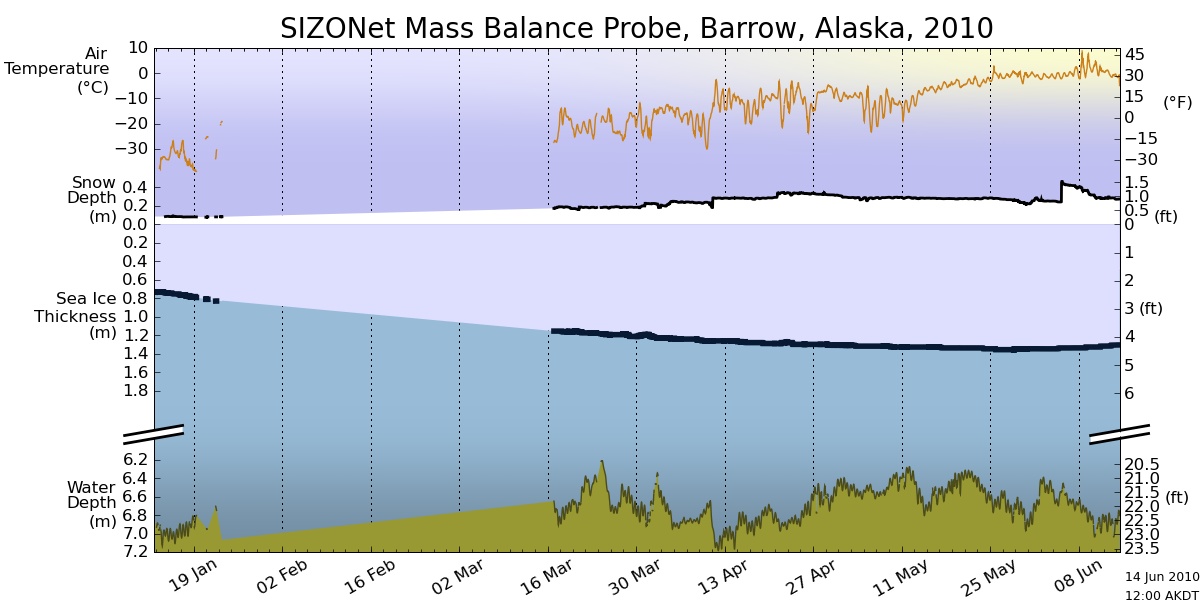
Ice continues to look very concentrated in the Arctic Basin, as seen in this enhanced satellite photo.

http://ice-map.appspot.com/?map=Arc&sat=ter&lvl=7&lat=67.940426&lon=-168.991006&yir=2010&day=149
——————————————–
The disparity between ice indices continues to widen.DMI has 2010 ahead of 2007 and 2008. Other indices have 2010 lower. Given the analysis above, these numbers are relativelymeaningless this early in the summer.

The modified NSIDC graph below shows a comparison of 2010 ice extent vs. 2007. Areas in green have more ice than 2007. Areas in red have less ice.

The modified NSIDC map below shows ice loss since April 5, in red.

The modified NSIDC map shows changes in Arctic ice over the last week, using the same colour scheme.

The modified NSIDC image below shows the current anomaly. Areas in red have less ice than the 30 year mean, and areas in green have more ice.

Julienne
One thing I have learned from this exercise is that correlations between ice age and thickness are not what they are cracked up to be. Much of the thick ice is the result of compression, rather than age.
stevengoddard says:
June 7, 2010 at 10:21 am
AndyW,
The rotation which is producing the polynyas has continued. Temperatures have been too cold in the Arctic Basin for any significant melt.
It’s not rotation (shear) that causes the polynyas it’s the offshore winds (normal stress) as I’ve told you before.
According to the source linked to here the daily mean temperature north of 80ºN is ~-2ºC, the melting point of sea ice, so it’s certainly warm enough to melt. Also half of the Arctic Basin is south of 80ºN (the part where the melting is occurring)
John B (TX) says:
June 7, 2010 at 10:34 am
Maybe I missed it. What is the difference between AMSR-E Sea Ice Extent (10.6 million km2) and NORSEX SSM/I extent (around 11.6 million km2)?
For one thing resolution, AMSR-E has higher res. also ever since the SSM/I satellite sensor had problems a year ago NORSEX has been out of line with all the other sites.
http://www.ijis.iarc.uaf.edu/en/home/seaice_extent.htm
http://arctic-roos.org/observations/satellite-data/sea-ice/ice-area-and-extent-in-arctic
stevengoddard says:
June 7, 2010 at 10:10 am
Lots of ridiculous FUD being posted here.
Fear, Uncertainty, Doubt.
I don’t see it – are you Afraid of the Arctic sea ice not recovering ? I see competing predictions, but no Fear in these comments.
September is only a few weeks away, and it will become obvious who is correct.
Yes.
Yes it will.
(about 15 weeks from now)
Tom P.
You have been answered: Your previous objection to Steve’s analysis suggested that the product (his result) of x = pixelarea*pixelheight was incorrect and needed a further term thusly: x = pixelarea*pixelheight*pixelconcentration. Steve said ice concentration is close to 100%
Therefore, his product and yours would differ by the term pixelconcentration. Can you please show your pixelconcentration term (numerically, here) that correlates your result to the published amount? And your justification?
Phil.
You can see the in the PIPS maps the ice is getting thicker on the windward side of islands and shearing off the leeward sides.
stevengoddard says:
June 7, 2010 at 10:57 am
R. Gates
Meteorological summer is June-August. June 21 is often considered mid-summer, because the sun is at it’s peak.
http://heritage-key.com/blogs/ann/stonehenge-summer-solstice-2009
____________
Your qualifications always amuse me. We’ve got most of June, all of July and August and part of September until the minimum, or at least 12 weeks of summer melt season ahead, and I don’t consider that to be a “few”. But your Sea Ice Updates are one of the highlights of my week (shows you how boring my life must be), so keep them coming!
Anu
What troubles me is people who come here with an agenda and waste everybody’s time.
R. Gates,
FYI, a “few” = more than a “couple”; less than “many”. There are 4.3 weeks in a month. You say 12 weeks to go.
Do the math.
The current AMSR-E 2010 ice curve is tracking close to the 2006 curve – at the bottom of the group. The 2006 curve stayed bottom of the class till July, at which point it started cutting across the other years. At the September minimum it ended second highest in the last decade – perhaps 2010 will do something similar?
Smokey says:
June 7, 2010 at 11:50 am
R. Gates,
FYI, a “few” = more than a “couple”; less than “many”. There are 4.3 weeks in a month. You say 12 weeks to go.
Do the math.
___________
Computing…stand by please…
Result: 12 is more than a few.
phlogiston says:
June 7, 2010 at 11:50 am
The current AMSR-E 2010 ice curve is tracking close to the 2006 curve – at the bottom of the group.
Excellent observation. Yes, the sine is on the low side now, like 2006, and when Sept. rolls around the highest probability is for the sine to be on the high side. Which was the entire point of the April extent being on the high side of the sine.
Unfortunately, the natural sine is totally lost on the warmists, who proclaim only straight lines which nature abhors.
The Ice Melt Alarmists are in full swing, and the reason could not be more obvious than the current headline for which
the Senate is now going to vote on. Statistical Charades are the order of the day. How else are the Warmist Lobbyists to justify ceding Congressional power to the EPA?
Gates, wake up! You were responding to Steve Goddard’s statement about ‘June-August’.
Sheesh, no wonder you’re confused about this whole subject. Going from months to weeks because it’s a convenient argument is exactly what you’re accusing Steven of doing: “Your qualifications always amuse me.”
OK, by the numbers:
1: Part of June
2: July
3. August
4. Part of September
3+ months, see? A few months.
stevengoddard says:
June 7, 2010 at 11:46 am
Anu
What troubles me is people who come here with an agenda and waste everybody’s time.
Your agenda doesn’t trouble me, Steven.
You lay out your thoughts logically, and you tackle interesting topics. Even if I don’t agree with all of your conclusions, I enjoy the data sources you and other commenters find on the Internet, the papers, the quotes from knowledgeable people, the questions, the predictions, the explanations, etc.
I think the Internet doesn’t yet allow “the public” to follow all aspects of an interesting science (textbooks are not free and searchable, many scientific papers are behind paywalls, organizations are not setup to be transparent in the work they do, a lot of knowledge is located “in heads” and not yet in textbook form, etc) but I think it is at a point where it is now interesting to try and follow what they are doing. And I think what becomes “publicly available” will continue to improve.
Have you seen the KMZ files for things like animating Arctic sea ice changes in Google Earth ?
http://nsidc.org/data/google_earth/
I think this reflects Science’s new respect for intelligent amateurs who are interested in following along with developments, and the game-changing nature of the Internet and powerful personal computers – organizations can’t change overnight, but I think sites like WUWT are encouraging many scientific organizations to put more of their work on the Internet, in an easier to digest format.
(Of course, developments like the Virginia AG trying to sue a University for “scientific fraud” will slow down these developments, and make organizations more cautious about releasing works in progress to the Public, possibly consulting with lawyers at every step, but I think the overall trend is towards more engagement with a curious Public).
The Comments which are a waste of time, I just skim and skip over.
stevengoddard says:
“What troubles me is people who come here with an agenda and waste everybody’s time.”
I’m finding the Smokey/R.Gates parsing of what a “few” is to be very tedious. Maybe I’m missing it, but the point is, we’ll see soon enough so why not wait the short time until September to see how predictive this is.
While a few of the exteme AGW supporters have thrown out prediction like an ice free north pole back in 2008 (now that’s funny!) most do like this:
http://climateprogress.org/2009/05/13/thin-ice-free-arctic/
“North Pole poised to be largely ice-free by 2020”
They get the shock value of a ridiculous prediciton today, and no one will remember it in 2020 when it fails to appear. In this case, September will be here soon enough. Let’s wait and see.
stevengoddard says:
June 7, 2010 at 11:03 am
Julienne
One thing I have learned from this exercise is that correlations between ice age and thickness are not what they are cracked up to be. Much of the thick ice is the result of compression, rather than age.
——————————
Unfortunately we do not have a long time-series of ice thickness to run any statistical analysis with. Thus, fractions of first-year ice versus multiyear ice are the best proxy information on ice thickness out there. It is true that thinner ice compresses more, so the relationship between ice age and thickness is not perfect: we would expect areas of more heavily ridged/rafted ice as the Arctic Ocean becomes more dominated by first-year ice. This is basically the situation we have today. Back in the 1980s, 46% of the Arctic basin consisted of FYI during March, and 54% was MYI, whereas during the 2000s, 69% of the Arctic basin was FYI and 31 was MYI during the same time in March. Since FYI tends to grow to be about 1.5 m thick, this would imply a thinner ice pack today than 20 years ago, but I would expect to see regions of thicker, deformed FYI.
When you look at survival rates of FYI versus MYI during summer you find that on average 60% of the FYI melts out and 20% of the MYI. So certainly having an Arctic Ocean dominated by more FYI sets the system to be more vulnerable to summer ice loss. But as 2009 clearly showed, summer circulation remains as (or more important) in defining the end of summer ice cover. The system does not appear yet to have reached a state where it is too vulnerable to survive summer regardless of the summer circulation pattern. This is why it remains very difficult to do forecasting…
Smokey says:
June 7, 2010 at 12:34 pm
Gates, wake up! You were responding to Steve Goddard’s statement about ‘June-August’.
_________
Yes I was Smokey, and Steve said, “September is only a few WEEKS away…”
I don’t consider 12 weeks as a few…but thanks for making weeks into months…
Julienne
Thanks for your comments.
In 2008 the North Pole started out with first year ice, and it was a warm summer at the pole. Yet it didn’t melt out. This implies to me that an ice free Arctic may be impossible under current climatic conditions.
2007 Was the “GREAT MELT OFF” seethe HUGE areas of HOT water well above 80 degrees North: 2007 vs 2008:
http://www.arctic.noaa.gov/reportcard/ocean.html
You have 2008 as thinner. By a LOT.
So Your Model is DISPROVEN.
Last time I heard, SCIENCE still has to check Theory with REALITY.
Piomas is ONLY concentration — that is why it has 5 meters near alaska !
Julienne
I have measured from PIPS 2007 maps that 4+ metre thick ice tripled in area between August 1 and Sept. 15. How would you explain this?
jeff brown says: June 7, 2010 at 8:00 am and AndyW agrees: June 7, 2010 at 10:01 am
“There are many good papers that have been published in recent years discussion the Antarctic sea ice trends and why the Ross Sea is showing such a large increase in extent (note the increase is dominated by changes in the Ross Sea).”
Did you look at those “many good papers” with the same skeptical eye that you look at Mr. Goddard’s work?
“Strong winds push the ice away from the coast in the Ross Sea, allowing new ice formation in the open water areas. The only place that shows strong decreases in Antarctic sea ice is the Bellinghausen/Admudsen Seas where there has been a strong warming signal. ”
Interesting, the facts seem to indicate the exact opposite. If you look at these Antarctic Concentration images from June 7th 2007 and today;
http://arctic.atmos.uiuc.edu/cryosphere/IMAGES/ANT-ARCHIVE/antarctic.0.2007060710.jpg
http://arctic.atmos.uiuc.edu/cryosphere/IMAGES/antarctic.jpg
you’ll note that the largest increase in sea ice area and concentration appears to have occurred in the Bellingshausen/Amundsen Seas (spelled correctly), the ice around the most of the rest of Antarctica seems to have increased in both area and concentration, except in the Ross Sea where area seems to shrunk a little bit though is more concentrated.
So what do you find more compelling, verifiable facts, or “many good papers” that seem to contradict the facts?
Buffoon,
The ice concentration tells how much ice coverage there is in a pixel. Hence the volume of ice in the pixel is the multiple of the average thickness in that pixel, the concentration in that pixel and the pixel area. There is therefore no single concentration factor, but a value for each pixel. I have shown how to derive the total ice volume using ImageJ in the “undeath spiral” thread.
Here is a plot of the volume calculated both with and without including the PIPS concentration maps for the minimum ice volumes of the three most recent ice minima published by Posey.
http://img686.imageshack.us/img686/6757/compvolposeym.png
It is obvious that by including the concentration in these calculations, there is very good correlation between the published and calculated values. If you ignore the concentration values, as Steve does, you are no longer calculating a number directly related to the ice volume.
Gates
Dictionary definition:
One: A case of being singular, not plural
Few: More than one but not many
Many: Constituting a large number
Assuming: 1=1, few = x, many = y
We conclude: One < Few < Many is equivalent to the statement 1 < x < y
You two are arguing over your opinions, you are amused by Steve's completely valid use of language, and we can define that x < 12 for you in particular, but not necessarily the rest of the world, and that you will persuasively argue that point.
Tom P,
What is clear is that the PIOMAS record anomaly is incorrect.
There was considerably more thick ice on June 1, 2010 than there was on June 1, 2008
http://www7320.nrlssc.navy.mil/pips2/archive/pips2_thick/2010/pips2_thick.2010060100.gif
http://www7320.nrlssc.navy.mil/pips2/archive/pips2_thick/2008/pips2_thick.2008060100.gif
And the concentration in 2010 is also higher than 2008.
http://igloo.atmos.uiuc.edu/cgi-bin/test/print.sh?fm=06&fd=01&fy=2008&sm=06&sd=01&sy=2010
stevengoddard says:
June 7, 2010 at 1:40 pm
Julienne
I have measured from PIPS 2007 maps that 4+ metre thick ice tripled in area between August 1 and Sept. 15. How would you explain this?
_______________________________
Steve, given the strong winds that persisted most of the summer of 2007 that pushed the ice away from the coasts towards the pole, I would expect there to have been more ridged ice, but not necessarily occupying a large spatial region. I suppose the question would be how thick that ice already was (since it was mostly MYI at that point) and how much it could have ridged/rafted under those winds. I don’t believe anyone has actually looked at that yet, but it would be an interesting project.
My understanding in the scientific community is that the PIPS2.0 model is not very accurate, so I wouldn’t put a lot of stock in the actual values of thickness coming from it. You can go to http://rkwok.jpl.nasa.gov/icesat/index.html and look at the ICESat thickness values during Feb/March and September and you don’t see evidence of large regions of 4m ice at the end of summer of 2007. But you do see some regionally thicker ice in the Beaufort that may have been a result of more ridging.
Concentration Is NOT thickness. It’s just the proportion of ice-covered, versus open water in an area.
Planes and Satellites read thickness by measuring height above sea level. Subs read thickness by draft below sea level. Ships & shore stations measure it.
Piomas incorporates plane, ship & shore data.
Pips does not. They say so.
Piomas — which was made in order that MANY researchers could “plug in” their differing expectations so ought to have only the GIGO bias e.g.
Planes only risk flying far from Shore when Satellites are not up, so it should underestimate if the Center area melt off — yesit should UNDER estimate the Melt (the opposite of what AGW wants) —
check it versus ICESAT: a near perfect match, save LESS of a melt than ICESAT at 2007’s minimum.
http://psc.apl.washington.edu/ArcticSeaiceVolume/images/IceVolAnomaly19792010.MarNov2.png
… “Logic” that Pips MUST include Sub data shows you do not “Think Navy”.
What, you want to give out a MAP to where the Subs are ?
Make a First-Strike Nuclear War Winnable ?
They’d be cashiered for a Security violation.