
By Steven Goddard
The quest for the Holy Grail.
I have been looking for a reliable early predictor of September area/extent based on June ice data, and have found it – almost. Previously I established that current extent is a useless predictor, prior to August. The reasons for this are :
- Extent tells you nothing about thickness
- Many areas currently covered with ice, will normally have almost none in September (Hudson Bay, Barents Sea, etc.)
I eliminated the second issue by reducing the region of interest to the area shown in white below. That area corresponds approximately to the maximum extent of September ice in the 30 year NSIDC record.

Then I tried three different metrics to compare June 6 ice parameters vs. September extent and area, for the decade 2000-2009.
The first parameter was June 6 ice area. As expected, this correlated very poorly with September extent and area. The rsq value of June 6 ice area rankings vs September extent rankings is 0.02. The rsq value of June 6 ice area rankings vs September area rankings is 0.07.
The next parameter for comparison was June 6 ice volume (calculated from PIPS) vs September extent. This correlated much better. The rsq value of June 6 ice volume rankings vs September extent rankings is 0.22. The rsq value of June 6 ice volume rankings vs September area rankings is 0.37.

The final parameter for comparison was June 6 average ice thickness (calculated from PIPS) vs September extent. This correlated the best. The rsq value of June 6 average ice thickness rankings vs September extent rankings is 0.28. The rsq value of June 6 average ice thickness rankings vs September area rankings is an excellent 0.65.
So it appears that we have found a reliable predictor of September extent based on June ice thickness, which makes sense from a physical point of view. But it isn’t perfect! The graph and table below show the problem.

Average thickness on June 6, 2010 is 2.55 metres. The table below shows the June 6 rankings for the last 11 years. 2010 is in 7th place, behind 2006 and ahead of 2007, 2003, 2009 and 2008. Average thickness is more than half a metre thicker than 2008.
Date            Average Thickness

6/6/2004        2.95

6/6/2005        2.87

6/6/2001        2.86

6/6/2000        2.84

6/6/2002        2.76

6/6/2006        2.68

6/6/2010        2.55

6/6/2007        2.54

6/6/2003        2.5

6/6/2009        2.17

6/6/2008        1.96
Everything in that table makes sense, except for 2007. Ice thickness in the central Arctic on June 6, 2007 was nearly identical to 2010 and the top year – 2003.
Conclusion : Based on current ice thickness, we should expect September extent/area to come in near the top of the JAXA rankings (near 2003 and 2006.) However, unusual weather conditions like those from the summer of 2007 could dramatically change this. There is no guarantee, because weather is very variable.


No doubt some people are wondering how this can be true, given that extent is currently lowest in the record. The reason (again) is that June extent has almost no correlation with September extent. Imagine an ice cube floating in water. It occupies a much smaller area of water than a ground up ice cube. But which one melts faster? The ground up ice cube will of course melt faster. Having a wide extent in June is not necessarily a good thing, unless the ice is also thick.
Sea surface temperatures continue to run cold in the Northern Pacific. They also are cooling down some in Atlantic.

http://weather.unisys.com/surface/sst_anom.html
Arctic temperatures have been running cold for the last week or so.
From: http://www.esrl.noaa.gov/psd/map/images/fnl/sfctmpmer_01a.fnl.anim.html

http://ocean.dmi.dk/arctic/meant80n.uk.php
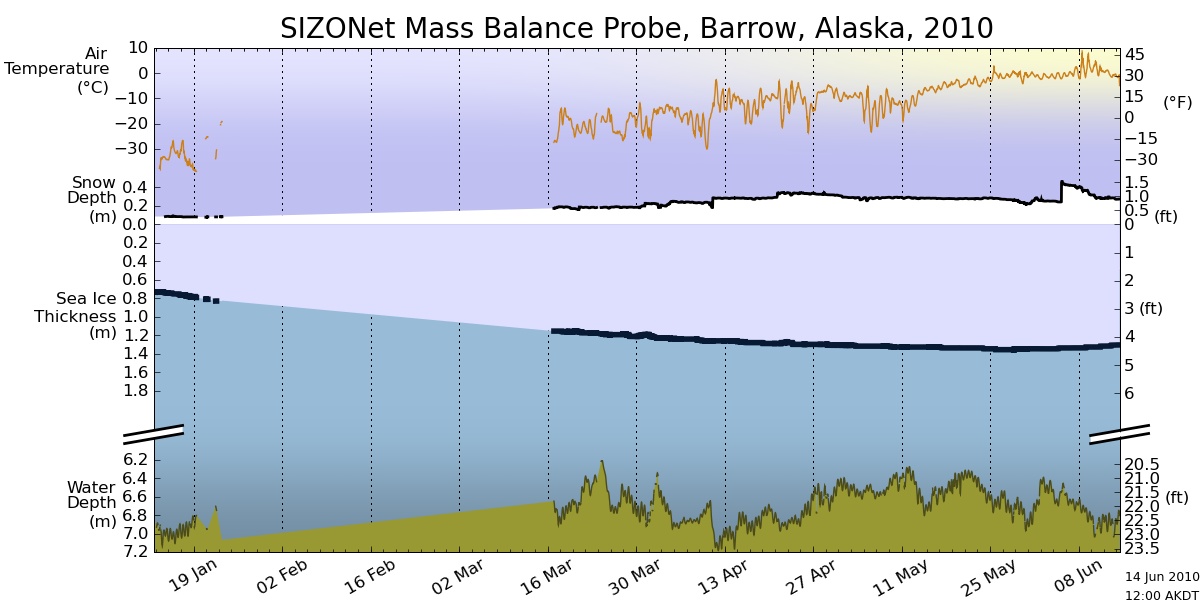
There is no indication of melt in the ice off Barrow, with ongoing cold temperatures and the deepest snow of the winter.

http://seaice.alaska.edu/gi/observatories/barrow_sealevel/brw2010/BRW_MBS10_overview_complete.png
Ice continues to look very concentrated in the Arctic Basin, as seen in this enhanced satellite photo.

http://ice-map.appspot.com/?map=Arc&sat=ter&lvl=7&lat=67.940426&lon=-168.991006&yir=2010&day=149
——————————————–
The disparity between ice indices continues to widen.DMI has 2010 ahead of 2007 and 2008. Other indices have 2010 lower. Given the analysis above, these numbers are relativelymeaningless this early in the summer.

The modified NSIDC graph below shows a comparison of 2010 ice extent vs. 2007. Areas in green have more ice than 2007. Areas in red have less ice.

The modified NSIDC map below shows ice loss since April 5, in red.

The modified NSIDC map shows changes in Arctic ice over the last week, using the same colour scheme.

The modified NSIDC image below shows the current anomaly. Areas in red have less ice than the 30 year mean, and areas in green have more ice.

Amino Acids in Meteorites cites
http://www7320.nrlssc.navy.mil/pips2/ and says:
This page has a link “info on the future PIPS 3.0”. If you follow that link, you find a page saying
When were these pages posted? Apart from the fact that the most recent publications referenced by them are dated 1999, there is little clue. However, if you use “view page source”, to look at the underlying HTML you find that there is an extra, final half-sentence on the page about PIPS 3.0, which has been commented out. This reads:
I think you need to find a better citation than this one!
Anu,
Thanks for all those links on EXTENT, especially when the whole point of this article was that EXTENT on June 6th is a TERRIBLE predictor of what things are going to be like in September.
Fabulous links though….
Buffoon
1. Concentration in the Arctic Basin has been almost 100% this year, so the term wouldn’t make any difference.
2. PIPS undoubtedly already figures concentration in to the average thickness of a grid cell.
His argument is a straw man intended to spread Fear Uncertainty and Doubt
Steve,
So reproducing the results from PIPS 2.0 that the Navy has published, which you have had a little difficulty achieving, is now seen as generating FUD? And I’ve already indicated the change in ice volumes since 2008, although you must have been too busy generating your spurious calculations that ignore ice concentration to notice.
Here are the figures after 2007. I calculate the minimum ice volume for 2008 was 22% below the 2007 value, in excellent agreement with Posey’s published values based on PIPS 2.0. The corresponding average thickness dropped by 32%. In 2009 the minimum volume was 6% lower than 2007, with the thickness down 22%.
Might I suggest you try to understand how to properly calculate ice volumes and average thicknesses from PIPS before publishing further on this topic?
Steve, have you detrended the thickness and extent data before computing your correlation? Naturally, since both the thickness data and the extent data are dominated by trends, you will need to first detrend before doing the correlation. For example, if I correlate March first-year ice fraction with September ice extent I get a correlation of R=-0.70. This correlation however is driven primarily by the strong linear trends in both time-series. De-trended data show no correlation (R=0.06).
What we find is that while there is memory between September and March in the ice cover, this half-year memory is erased during summer (as reflected in the above poor correlation and the near 0 autocorrelation between Septembers). Thus, summer circulation remains important. If the summer pattern continues a negative AO pattern (which at this point it is), then we can expect ice loss like the last few years.
BTW, Jeff Brown is correct that NIC does not rely on the PIPS2.0 model for their forecasts. The reason being the models poor performance.
Steve,
PIPS concentrations have hardly been almost 100%. Here is the latest map: http://www7320.nrlssc.navy.mil/pips2/icon.html
You may be mistakenly looking at the SSM/I maps, but as PIPS archive cautions: “SSM/I plots are mainly used to check the validity of the ice edge of the PIPS 2.0 forecasts. Thus, the central polar regions on the SSM/I plots generally have significant variations from actual conditions.” It is those actual conditions that PIPS is trying to reflect in the concentration maps.
You say “PIPS undoubtedly already figures concentration in to the average thickness of a grid cell.” Undoubtedly not, which is why my ice volumes which use the concentration maps give a correlation of 0.99999 to the published data while your volumes that ignore concentration give a value of -0.6.
There are certain people that comment on this site whom I am going to have immense fun laughing at if the predictions of global cooling over the next 30-40 years are indeed accurate.
Of course, I personally hope that global cooling does NOT happen! Warm weather creates abundant crops, ideal conditions for life as we know it, and general prosperity. Cooler temperatures mean shorter growing seasons, more diseases, and lots of people being basically miserable.
On the whole, although I would enjoy laughing uproariously at the AGW crowd during a 30-year cold snap, I would prefer warmth, comfort, and prosperity. Of course if it stays warm, various governments in the world might do whatever they can to kill off any resulting comfort and prosperity, so what is a sane person to do?
Tom P,
Good Work. Nice to see Goddard have to admit his mistake. Perhaps you could provide some base literature for him to read so he can better understand how to perform sea ice analysis?
Tom P
Nice FUD again. I never calculated the minimum volumes.
If you want to check my work, try using the same dates and locations. It is really annoying arguing with someone who is engaging in intellectual dishonesty.
jeff brown said: June 7, 2010 at 8:00 am
“There are many good papers that have been published in recent years discussion the Antarctic sea ice trends and why the Ross Sea is showing such a large increase in extent (note the increase is dominated by changes in the Ross Sea). It has to do with strengthening of the circumpolar vortex around Antarctic in part a response to the ozone hole. Strong winds push the ice away from the coast in the Ross Sea, allowing new ice formation in the open water areas. The only place that shows strong decreases in Antarctic sea ice is the Bellinghausen/Admudsen Seas where there has been a strong warming signal”
Good summary, and I’d like to add that the geography of Antarctica means the increases in the Ross sea outweighs the decreases in the smaller seas undergoing less ice increase hence why there is always a positive anomaly on the ice increase before it tops out at the maxima.
What shows this is not temperatures getting colder down there is the fact that the melt doesn’t happen slower as you would expect.
Andy
I’ve never understood why anyone would hold on to a belief system which requires that they are dishonest with themselves and others.
Julienne
I’m not interested in the ability of PIPS to forecast into the future. What I use is their short term maps which are constantly updated with real time data. The error is undoubtedly quite small in those maps.
Lots of ridiculous FUD being posted here. September is only a few weeks away, and it will become obvious who is correct.
stevengoddard said June 7, 2010 at 9:28 am
1. Concentration in the Arctic Basin has been almost 100% this year,
Except for the “shear” polynyas you pointed out before. They seem to be getting bigger which I guess means they are not due to shear at all, see here.
http://www.iup.physik.uni-bremen.de:8084/amsr/arctic_AMSRE_nic.png
unless the shear seems to be increasing?
Andy
Steve,
You said “If you want to check my work, try using the same dates and locations. ”
You really haven’t been paying attention. The poor correlation of -0.6 between your figures and Posey’s published data was for comparable May volumes since 2000 as I showed a week ago: http://img413.imageshack.us/img413/2313/pipsvsgoddard.png
These figures are for the arctic. What location did you have in mind?
hosearodragass says:
June 6, 2010 at 11:07 pm
Very interesting data posted. I wish I could trust the sources. Are not ALL scientists funded in some way by “you know who”. Does any of this data come from any source that is not funded by government? I ask again, whom do I trust for accurate information? NASA? Funded by, you got it, Gubment.
Where do you think the Navy gets its funding ?
Bake sales ?
Conquering third world countries ?
Meanwhile, Remote Sensing Systems (the group that redid the UAH data analysis for satellite temperatures) is a private sector research company headquartered in Santa Rosa, CA – as non-Governmental as Boeing or Halliburton:
http://www.ssmi.com/about_rss/about_rss.html
http://www.akama.com/company/Remote_Sensing_Systems_a16f6401376.html
AndyW,
The rotation which is producing the polynyas has continued. Temperatures have been too cold in the Arctic Basin for any significant melt.
Maybe I missed it. What is the difference between AMSR-E Sea Ice Extent (10.6 million km2) and NORSEX SSM/I extent (around 11.6 million km2)?
http://www.ijis.iarc.uaf.edu/en/home/seaice_extent.htm
http://arctic-roos.org/observations/satellite-data/sea-ice/ice-area-and-extent-in-arctic
Steven Goddard in his own words:
“I have been looking for a reliable early predictor of September area/extent based on June ice data…”
Less than 24 hours later:
“I’m not interested in the ability of PIPS to forecast into the future.”
And finally:
“I’ve never understood why anyone would hold on to a belief system which requires that they are dishonest with themselves and others.”
stevengoddard says:
June 7, 2010 at 10:07 am
Julienne
I’m not interested in the ability of PIPS to forecast into the future. What I use is their short term maps which are constantly updated with real time data. The error is undoubtedly quite small in those maps.
Steve, then I would suggest evaluating the accuracy of their short-term maps. There is radar altimetry data available that give indication of ice thickness for part of the Arctic Basin that you could compare with, though I don’t know off hand if the researchers working with that data have made it accessible for anyone to work with it. But simply looking at the age distribution of the ice in the Arctic basin and comparing that with the PIPS2.0 model, it does appear that the model is overestimating the ice thickness. I agree with you though that the ice is likely thicker this May than in May of 2008.
Steve Goddard said:
“September is only a few weeks away…”
Hmmm…since it is not even officially summer yet (which begins June 21) and the sea ice minimum will occur around mid-Sept, which is the end of summer, I’d say that we have more than a “few” weeks to September…LIKE THE WHOLE SUMMER!
stevengoddard said
June 7, 2010 at 10:21 am
“AndyW, The rotation which is producing the polynyas has continued. Temperatures have been too cold in the Arctic Basin for any significant melt.”
You could be right however two things I’d say against that are
a) The biggest open sea ares is to the west of Victoria Island which would protect the ice in that region from any shear going on in the main, land free, Arctic basin.
b) These shear created areas of open water are appearing now in the early summer months, as they tend to do each year, that cannot be a coincidence. You don’t get them in mid winter.
My explanation would be that the warm temps, and the temps do seem to be warmer than the freezing point of sea water for both air and sea at the moment, makes the ice more mobile as it melts and the currents and wind do the rest. So I’d go for a combination of factors including increasing temperatures.
If you decide to throw out temps for some reason then you end up with something along the lines of 2007 where Anthony said it was winds causing it to all be blown out of the periphery of the Arctic basin and so melting at more southerly lattitudes whilst you said it was wind blowing it towards the north where it got thicker ! In this case you are at polar opposites, pardon the pun. I’d say it blew it to the north so making the extent smaller but also the winds were warm and the ambient temps were high so some of it got melted.
There is an aversion with some folk on admitting any loss of ice in the Arctic basin is due to melting, I wonder why? I think it leads you guys astray. Though I am glad you are opening up for discussion.
As you say though, roll on September!
Andy
R. Gates
Meteorological summer is June-August. June 21 is often considered mid-summer, because the sun is at it’s peak.
http://heritage-key.com/blogs/ann/stonehenge-summer-solstice-2009
PeterB in Indianapolis says:
June 7, 2010 at 9:25 am
Anu,
Thanks for all those links on EXTENT, especially when the whole point of this article was that EXTENT on June 6th is a TERRIBLE predictor of what things are going to be like in September.
Yes, if all we had was the EXTENT data from June 6, 2010, I would agree – a prediction would not be very good.
But since we have context for all this data with satellite measurements back to 1972 and models predicting the expected results of CO² buildup, I am not making my prediction based solely on June 6th, 2010 extent data, as my previous Comments make clear.
I do enjoy how “skeptics” are so sure of themselves, though 🙂
It will make future befuddlement all the more amusing.
Fabulous links though….
Why thank you.
stevengoddard says:
June 7, 2010 at 10:04 am
I’ve never understood why anyone would hold on to a belief system which requires that they are dishonest with themselves and others.
Likewise, so it should be easy to demonstrate the fidelity of your calculation method and remove all doubt, replicate the past calculations of Posey as Tom P suggests.
stevengoddard said June 7, 2010 at 9:28 am
1. Concentration in the Arctic Basin has been almost 100% this year,
Over the area you selected at the start of this thread it’s about 90%, so that’s a difference in thickness of about 0.25m.
Imagine an ice cube floating in water. It occupies a much smaller area of water than a ground up ice cube. But which one melts faster? The ground up ice cube will of course melt faster.
Click on the url for the image you posted: http://ice-map.appspot.com/?map=Arc&sat=ter&lvl=7&lat=67.940426&lon=-168.991006&yir=2010&day=149
Look at it at full magnification by the Bering strait, looks like a ground up cube to me!