
By Steven Goddard
The quest for the Holy Grail.
I have been looking for a reliable early predictor of September area/extent based on June ice data, and have found it – almost. Previously I established that current extent is a useless predictor, prior to August. The reasons for this are :
- Extent tells you nothing about thickness
- Many areas currently covered with ice, will normally have almost none in September (Hudson Bay, Barents Sea, etc.)
I eliminated the second issue by reducing the region of interest to the area shown in white below. That area corresponds approximately to the maximum extent of September ice in the 30 year NSIDC record.

Then I tried three different metrics to compare June 6 ice parameters vs. September extent and area, for the decade 2000-2009.
The first parameter was June 6 ice area. As expected, this correlated very poorly with September extent and area. The rsq value of June 6 ice area rankings vs September extent rankings is 0.02. The rsq value of June 6 ice area rankings vs September area rankings is 0.07.
The next parameter for comparison was June 6 ice volume (calculated from PIPS) vs September extent. This correlated much better. The rsq value of June 6 ice volume rankings vs September extent rankings is 0.22. The rsq value of June 6 ice volume rankings vs September area rankings is 0.37.

The final parameter for comparison was June 6 average ice thickness (calculated from PIPS) vs September extent. This correlated the best. The rsq value of June 6 average ice thickness rankings vs September extent rankings is 0.28. The rsq value of June 6 average ice thickness rankings vs September area rankings is an excellent 0.65.
So it appears that we have found a reliable predictor of September extent based on June ice thickness, which makes sense from a physical point of view. But it isn’t perfect! The graph and table below show the problem.

Average thickness on June 6, 2010 is 2.55 metres. The table below shows the June 6 rankings for the last 11 years. 2010 is in 7th place, behind 2006 and ahead of 2007, 2003, 2009 and 2008. Average thickness is more than half a metre thicker than 2008.
Date            Average Thickness

6/6/2004        2.95

6/6/2005        2.87

6/6/2001        2.86

6/6/2000        2.84

6/6/2002        2.76

6/6/2006        2.68

6/6/2010        2.55

6/6/2007        2.54

6/6/2003        2.5

6/6/2009        2.17

6/6/2008        1.96
Everything in that table makes sense, except for 2007. Ice thickness in the central Arctic on June 6, 2007 was nearly identical to 2010 and the top year – 2003.
Conclusion : Based on current ice thickness, we should expect September extent/area to come in near the top of the JAXA rankings (near 2003 and 2006.) However, unusual weather conditions like those from the summer of 2007 could dramatically change this. There is no guarantee, because weather is very variable.


No doubt some people are wondering how this can be true, given that extent is currently lowest in the record. The reason (again) is that June extent has almost no correlation with September extent. Imagine an ice cube floating in water. It occupies a much smaller area of water than a ground up ice cube. But which one melts faster? The ground up ice cube will of course melt faster. Having a wide extent in June is not necessarily a good thing, unless the ice is also thick.
Sea surface temperatures continue to run cold in the Northern Pacific. They also are cooling down some in Atlantic.

http://weather.unisys.com/surface/sst_anom.html
Arctic temperatures have been running cold for the last week or so.
From: http://www.esrl.noaa.gov/psd/map/images/fnl/sfctmpmer_01a.fnl.anim.html

http://ocean.dmi.dk/arctic/meant80n.uk.php
There is no indication of melt in the ice off Barrow, with ongoing cold temperatures and the deepest snow of the winter.

http://seaice.alaska.edu/gi/observatories/barrow_sealevel/brw2010/BRW_MBS10_overview_complete.png
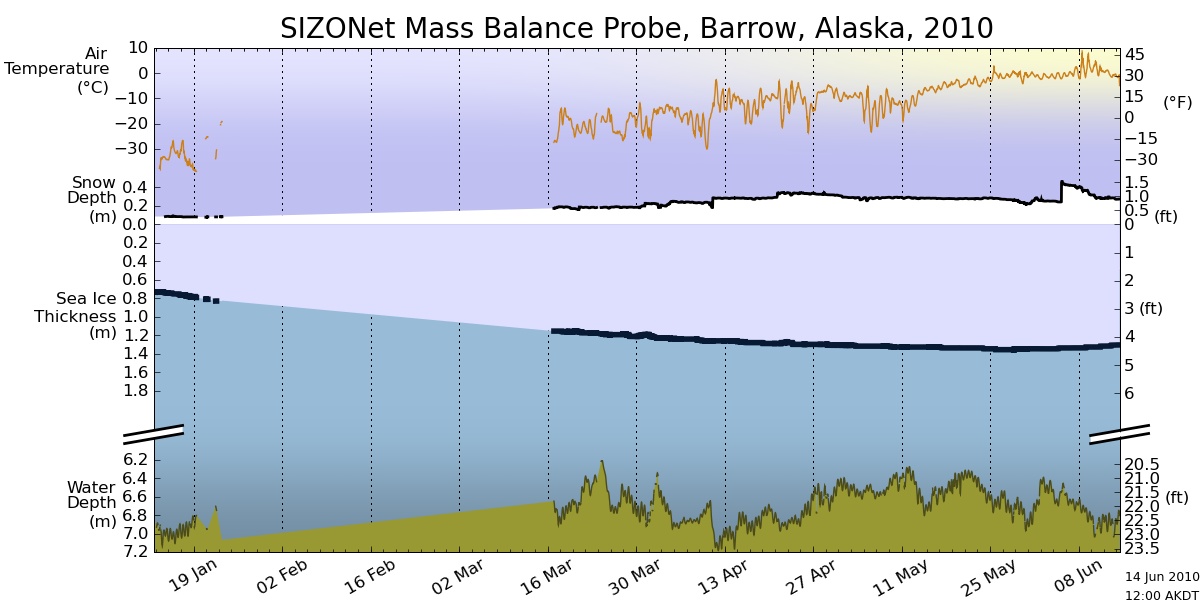
Ice continues to look very concentrated in the Arctic Basin, as seen in this enhanced satellite photo.

http://ice-map.appspot.com/?map=Arc&sat=ter&lvl=7&lat=67.940426&lon=-168.991006&yir=2010&day=149
——————————————–
The disparity between ice indices continues to widen.DMI has 2010 ahead of 2007 and 2008. Other indices have 2010 lower. Given the analysis above, these numbers are relativelymeaningless this early in the summer.

The modified NSIDC graph below shows a comparison of 2010 ice extent vs. 2007. Areas in green have more ice than 2007. Areas in red have less ice.

The modified NSIDC map below shows ice loss since April 5, in red.

The modified NSIDC map shows changes in Arctic ice over the last week, using the same colour scheme.

The modified NSIDC image below shows the current anomaly. Areas in red have less ice than the 30 year mean, and areas in green have more ice.

Charles Wilson says:
June 8, 2010 at 4:52 pm
Does your model show the great 2007 Melt-off ?
2007 was a great melt? Or were other factors involved? I think there was wind and currents involved.
Amino writes,
“But I think everyone can agree there is no ‘death spiral’ taking place in Arctic ice.”
If you listen only to people who agree with you, then it must seem that everyone can agree. On the other hand if you read or listen to the real Arctic research, you’ll find that quite a few of the people who know the Arctic system best believe that it’s wobbling toward seasonally (almost) ice-free conditions, within the next few decades.
Wouldn’t they have said so toward the end of previous arctic warming cycles?
PS: How much is due to soot?
A simple linear trend – which all the Hansen or his ilk ever project – will always either go to zero or go towards massive catastrophic warming. Regardless of what the real world is doing on a 60 year 1/2 of one degree cycle added to a 800 year cycle 1 degree cycle.
Then put both of those cyclic trends on a 8000 year linear decline …. And you get “Ice Age.” The death of billions.
Just The Facts said June 8, 2010 at 4:41 pm
_____
“It shows that jeff brown’s statement that, “Strong winds push the ice away from the coast in the Ross Sea, allowing new ice formation in the open water areas. The only place that shows strong decreases in Antarctic sea ice is the Bellinghausen/Admudsen Seas where there has been a strong warming signal. ” appears inaccurate because,
as compared to two years ago, the largest increase in sea ice area and concentration appears to have occurred in the Bellingshausen/Amundsen Seas (where there’s supposed to be a strong warming signal) whereas sea ice area seems to shrunk a little in the Ross Sea (where strong winds are supposed to be facilitating the creation of additional sea ice). Thus the reason for the current very high Antarctic Sea Ice Extent”
No the argument for this is a long term trend in those areas, you can have fluctuations within that time and the theory is still valid ( or not, but you’d have to show it to be not, and to show it to be not then you’d need more than 2 years data).
Just the Facts said-
“The facts are that sea ice area has been increasing more rapidly in recent years, and that the Ozone hole/Ross Sea ice explanation does not appear to be supported by the current data. The logical explanation is that something else is probably causing the increase in Antarctic sea ice area and extent, possibly that it’s getting colder…
Are you open to the possibility that the current very high Antarctic sea ice extent and area might not be the result of the hypothesized Ozone hole/Ross Sea ice process?”
Not if it is down to the Antarctic getting colder which you are suggesting. If it was getting colder then the rate of decline of ice extent from the maximum would be slowed, which it is not, or else you would have to say it is getting colder part of the year only, which I would not say is likely. Also I’d expect the maxima to get greater if it was colder but they tend to fluctuate.
Until someone comes up with a better explanation I am happy with it.
Andy
Amino Acids in Meteorites said June 8, 2010 at 5:01 pm
“I suppose that from reading the reasons given by some of how there is no recovery taking place some may come to the conclusion there is no recovery since the minimum of 2007. But I think everyone can agree there is no ‘death spiral’ taking place in Arctic ice. Also, from looking at the data, and images, of Arctic ice and comparing them year by year it’s hard to come to the conclusion there is no recovery taking place. Any explanation that says no recovery is happening after looking at those data and images sounds like just ‘so many words’—after all, you can make data say anything.But again, I can see from these explanations how someone may say there is no recovery happening—especially if that’s the conclusion they’d like to come to.”
It’s too early yet to say if it is a recovery or actually a rebound from 2007.
Andy
As a further exercise I looked at daily fluctuations in the IARC-JAXA data for the period 2003-2010.
In particular I compared the years 2003, 2007, 2009 and 2010. It seems to show that the greatest variation in ice loss on a 30 day moving average occurs consistently during July. Peak ice loss also appears to occur within this period.
By August, the differences in terms of ice loss for the 4 years mentioned above are far less pronounced. You see this in particular in 2007, where the highest discrepancy is during July.
Incidentally, whilst the 30 day moving average for this year had shown a sharp decline in volume loss per day during the month of May this trend appears to have halted and the degree of ice loss per day is actually decrease by a small amount.
When I get more time, I’ll chart the other years from 2003 to 2010 and see if the trends I’ve seen for the 4 years I looked hold.
AndyW
For you it’s too early. But anyone that looks at the graphs will see recovery. You can stay they way you are. It’s ok. I would suppose there could be even more growth over the next three years, with the prediction of an ice free Arctic in 2013 shown wrong because Arctic ice had been in a growing trend every year since the minimum in 2007, and some people will still say it is too soon to say there has been recovery.
Amino Acid in Meterorites,
If you look at the downward trend for the last 30 years then a recovery would be this trend reversing, or starting to reverse, but considering 2007 was an exceptional year we have to go past the rebound from that low point to get to a point where we can then say if the trend is still down or there is a recovery. If the summer minima is, as suggested by Anthony and Steve, about 500 000 km ^2 more than last year we will be at that point and can see which way it goes. We should know better by 2015 or so. One thing for sure is there will be no ice free Arctic by 2013 I agree.
Andy
stevengoddard says:
June 8, 2010 at 1:52 pm
Julienne
Thanks much for your comments.
Would you be willing to do a Q&A article, along the lines of the ones that Walt Meier posted here?
—————–
Steve, I just now saw this (didn’t have time to look yesterday). Yes, I would be interested in a Q&A article, would just need to find the time to fit it in…
REPLY: I welcome such an article, please leave a note in comments to the attention of a moderator when you are ready. Thanks for your consideration. – Anthony Watts
Amino Acids in Meteorites says:
June 7, 2010 at 9:44 pm
julienne:
June 7, 2010 at 9:33 pm
But 20% MYI ice loss was the average?
———————————————–
Yes, here are the actual numbers (the average is 19% from 1985 to 2009).
I could update for earlier years, but I haven’t because I’ve been focusing on
different ice age classes (not just MYI) so I let the ice age algorithm run for a few
years so that the ice ages several years). Note also that this analysis is limited to
the Arctic Basin so it ignores MYI in the Canadian Archipelago and the E. Greenland
Sea:
% MYI lost
1985 12.8105039
1986 14.30199812
1987 10.46114288
1988 10.19337114
1989 15.02136187
1990 17.73519557
1991 15.5931418
1992 13.1896963
1993 23.41461499
1994 19.50301864
1995 20.09187722
1996 17.15417283
1997 16.50369111
1998 25.11130899
1999 21.60541983
2000 19.23207118
2001 23.07242202
2002 19.39927634
2003 23.25106534
2004 17.24944044
2005 19.61811885
2006 13.29363077
2007 29.3133386
2008 39.45054945
2009 19.02376784
Amino Acids in Meteorites says:
June 7, 2010 at 9:44 pm
julienne:
June 7, 2010 at 9:33 pm
But 20% MYI ice loss was the average?
———————————————–
From 1985-2009 the average MYI ice loss is 19% to be exact.
Amino Acids in Meteorites says:
June 8, 2010 at 4:52 pm
Julienne says:
June 8, 2010 at 8:15 am
Had there been less ice at the beginning of the melt season, 2008 may have broken the record seasonal minimum of September 2007
If there had been less then I could see how you could say there is no recovery taking place. But there wasn’t. So isn’t that an indication of recovery taking place?
————————————————
I wouldn’t say that more winter ice extent in a single year signifies a recovery. We don’t expect much changes in the winter ice cover since air temperatures will still get cold enough for a long time to come for the ice to reform in winter (and we certainly don’t see large changes in the winter ice cover during the satellite data record, even though the small trend is statistically significant).
Certainly warmer SSTs and winter air temperatures will impact on the southerly extent of the winter ice cover so if these temperatures continue to warm, then yes, more changes in the winter ice extent are expected, especially as it starts to impact on the length of the melt (and growth) season. Winds too can sometimes play a large factor, such as this winter in the Bering Sea.
I do find it interesting that the total ice loss in 2008 was actually greater than in 2007, but since more southerly winter ice is likely thin, first-year ice, it would melt out anyway (though it may delay the lateral and basal melt of the ice further north, since it first needs to be removed)
For those interested, here is also the percentage of FYI lost (again, it’s limited to the Arctic Basin). Note the little FYI lost in 1996 and the large amount lost in 2007.
% FYI lost
1985 63.13
1986 55.29
1987 67.75
1988 57.58
1989 57.82
1990 68.56
1991 62.28
1992 51.26
1993 61.53
1994 46.07
1995 56.15
1996 34.51
1997 52.78
1998 55.73
1999 68.16
2000 54.66
2001 49.10
2002 68.84
2003 63.69
2004 60.02
2005 71.89
2006 64.82
2007 83.84
2008 63.72
2009 60.00
AndyW says: June 8, 2010 at 10:17 pm
“No the argument for this is a long term trend in those areas, you can have fluctuations within that time and the theory is still valid ( or not, but you’d have to show it to be not, and to show it to be not then you’d need more than 2 years data).”
But I’m not arguing the long term trend, I am arguing the recent change (3 months) and current situation. Antarctic sea ice area and extent are currently well above average and the Ross Sea ice hypothesis does not seem to explanation. My question is what is the cause of the recent rapid increase in Antarctic Sea Ice Area and Extent and current very large anomaly?
“Not if it is down to the Antarctic getting colder which you are suggesting. If it was getting colder then the rate of decline of ice extent from the maximum would be slowed, which it is not, or else you would have to say it is getting colder part of the year only, which I would not say is likely. Also I’d expect the maxima to get greater if it was colder but they tend to fluctuate.”
But the PDO only switched to its (approximately 30 year) cool phase in the last couple years;
http://wattsupwiththat.com/2008/04/29/nasa-pdo-flip-to-cool-phase-confirmed-cooler-times-ahead/
and we’ve seen a swing from El Nino to La Nina in the last couple months;
http://wattsupwiththat.com/2010/05/13/r-i-p-el-nino/
thus this is the first time we’ve got a cool PDO and a La Nina, since we’ve been able to reasonably effectively measure Antarctic sea ice area and extent. One wouldn’t expect to see the impact of this combination on recent years’ maximums and the rate of decline from such, as this combination did not exist until the last few months. If you look at this NSIDC chart;
http://nsidc.org/data/seaice_index/images/daily_images/S_stddev_timeseries.png
you’ll note that Antarctic Sea Ice Extent did a strange wiggle in March, and then spiked like a rocket. At present it appears that Antarctic Sea Ice Extent exceeds 2 standard deviations (admittedly narrow due to NSIDC’s choice to exclude 2001 – 2010 in order to make their Arctic chart look scarier/abnormal).
“Until someone comes up with a better explanation I am happy with it.”
Accepting that it might be incorrect, would you agree that my hypothesis above offers a better explanation for the recent (last 3 months) significant increase in Antarctic Sea Ice Anomaly than does the Ross Sea ice hypothesis?
Julienne says:
June 9, 2010 at 11:44 am
I wouldn’t say that more winter ice extent in a single year signifies a recovery.
I can see we are thinking in different terms. I am looking at it in the years since 2007 to now. And I do see a recovery. You are thinking in long term. So you are not ready to say there is or is not a recovery.
So you are saying it comes down to whether you think global warming is happening or not? Or something else?
Amino Acids in Meteorites says:
June 9, 2010 at 6:43 pm
Julienne says:
June 9, 2010 at 11:44 am
I wouldn’t say that more winter ice extent in a single year signifies a recovery.
I can see we are thinking in different terms. I am looking at it in the years since 2007 to now. And I do see a recovery. You are thinking in long term. So you are not ready to say there is or is not a recovery.
So you are saying it comes down to whether you think global warming is happening or not? Or something else?
—————————
Yes, I do think of it terms of the long term trend rather than year to year variability. There was a lot of emphasis placed on 2007, which is probably in part that it took everyone by surprise (including myself). But just looking at the 30 year satellite record, while the drop from 2006 and 2007 was dramatic, the increase from 1995 to 1996 was just as dramatic and highlights that an anomalous summer weather pattern can have a large impact on the ice cover, despite the trend. Since the trend actually increased further after 2009 I wouldn’t argue that there is a recovery yet, just like I wouldn’t have said that 2007 meant the Arctic would be ice free in the next few years.
Amino Acids in Meteorites says:
June 9, 2010 at 6:43 pm
Julienne says:
June 9, 2010 at 11:44 am
I wouldn’t say that more winter ice extent in a single year signifies a recovery.
I can see we are thinking in different terms. I am looking at it in the years since 2007 to now. And I do see a recovery. You are thinking in long term. So you are not ready to say there is or is not a recovery.
So you are saying it comes down to whether you think global warming is happening or not? Or something else?
—————————-
Oh and I don’t think it comes down to whether or not someone thinks that global warming is happening or not. I do believe the planet is in a warming phase and that is having an impact on the sea ice. But there are so many feedbacks in the climate system that can either enhance the ice loss or slow it down, and given the uncertainties in understanding and modeling some of these feedbacks, especially cloud cover and precipitation, I think no one can say with any certainty what the future holds. I would only say that if the planet continues to warm, the Arctic will transition towards a seasonal ice cover. But along this trajectory there will be ups and downs. I look at it this way: when natural variability is in phase with the background warming signal, large drops in the ice cover will occur (such as what happened in 2007). When natural variability is in the opposite phase, some recovery can happen for a year or longer (and may slow the downward trend). But eventually natural variability will once again be in phase with the background warming signal and large ice loss will once again occur.
Just The Facts said June 9, 2010 at 3:41 pm
“But I’m not arguing the long term trend, I am arguing the recent change (3 months) and current situation. Antarctic sea ice area and extent are currently well above average and the Ross Sea ice hypothesis does not seem to explanation. My question is what is the cause of the recent rapid increase in Antarctic Sea Ice Area and Extent and current very large anomaly?”
But the anomaly is compared to a long term trend, if you compared current ice at this time in the Antarctic to the last 3 or 4 years the anomaly will be near zero! The trend has been for ice to be increasing more rapidly in recent years compared to the long term trend, hence the positive deviation from the graph. That’s why I am saying you can’t just do a snapshot between recent years.
Your thoughts on the maxima and the decline from it are interesting, we will have to see if the maxima is bigger and the decline slower than normal come September / October.
Andy
Julienne
I won’t ask any more and take your time. I’ll just wait until you have the Q & A post. It will be interesting to read it and then follow all the comments from you and everyone else in the thread. 🙂
AndyW says: June 9, 2010 at 10:32 pm
“But the anomaly is compared to a long term trend, if you compared current ice at this time in the Antarctic to the last 3 or 4 years the anomaly will be near zero! The trend has been for ice to be increasing more rapidly in recent years compared to the long term trend, hence the positive deviation from the graph. That’s why I am saying you can’t just do a snapshot between recent years.
Your thoughts on the maxima and the decline from it are interesting, we will have to see if the maxima is bigger and the decline slower than normal come September / October.”
Andy, we may have a problem here, because I pretty much agree with you. My point to jeff brown above was specific to the current area and extent, and jeff’s assertion that it was explained away by the Ross Sea ice hypothesis, which does not appear to be the case thus far this year. From a bigger picture/longer term perspective I completely agree, two points in time are completely meaningless. I would go further to say that when working with 30 years of sea ice data on a 4.5 billion year old planet we have just begun the process of understanding this aspect of Earth’s climate system and any predictions we make at present are at best educated guesses.
I appreciate your reasoned and amicable approach to this discussion, hope to continue it in forthcoming threads and look forward to seeing how the world unfolds…
Whole lot of -snip- going on here, isn’t there.
The decline of arctic ice mass/thickness since 1980 is well established.
http://nsidc.org/images/arcticseaicenews/20100608_Figure5.png
The interesting thing is that in recent years the rate of decline of mass/thickness increased.
You do remember the “tipping point” that was predicted, don’t you?
What’s Up with the AMSR-E updates?