
By Steven Goddard
The quest for the Holy Grail.
I have been looking for a reliable early predictor of September area/extent based on June ice data, and have found it – almost. Previously I established that current extent is a useless predictor, prior to August. The reasons for this are :
- Extent tells you nothing about thickness
- Many areas currently covered with ice, will normally have almost none in September (Hudson Bay, Barents Sea, etc.)
I eliminated the second issue by reducing the region of interest to the area shown in white below. That area corresponds approximately to the maximum extent of September ice in the 30 year NSIDC record.

Then I tried three different metrics to compare June 6 ice parameters vs. September extent and area, for the decade 2000-2009.
The first parameter was June 6 ice area. As expected, this correlated very poorly with September extent and area. The rsq value of June 6 ice area rankings vs September extent rankings is 0.02. The rsq value of June 6 ice area rankings vs September area rankings is 0.07.
The next parameter for comparison was June 6 ice volume (calculated from PIPS) vs September extent. This correlated much better. The rsq value of June 6 ice volume rankings vs September extent rankings is 0.22. The rsq value of June 6 ice volume rankings vs September area rankings is 0.37.

The final parameter for comparison was June 6 average ice thickness (calculated from PIPS) vs September extent. This correlated the best. The rsq value of June 6 average ice thickness rankings vs September extent rankings is 0.28. The rsq value of June 6 average ice thickness rankings vs September area rankings is an excellent 0.65.
So it appears that we have found a reliable predictor of September extent based on June ice thickness, which makes sense from a physical point of view. But it isn’t perfect! The graph and table below show the problem.

Average thickness on June 6, 2010 is 2.55 metres. The table below shows the June 6 rankings for the last 11 years. 2010 is in 7th place, behind 2006 and ahead of 2007, 2003, 2009 and 2008. Average thickness is more than half a metre thicker than 2008.
Date            Average Thickness

6/6/2004        2.95

6/6/2005        2.87

6/6/2001        2.86

6/6/2000        2.84

6/6/2002        2.76

6/6/2006        2.68

6/6/2010        2.55

6/6/2007        2.54

6/6/2003        2.5

6/6/2009        2.17

6/6/2008        1.96
Everything in that table makes sense, except for 2007. Ice thickness in the central Arctic on June 6, 2007 was nearly identical to 2010 and the top year – 2003.
Conclusion : Based on current ice thickness, we should expect September extent/area to come in near the top of the JAXA rankings (near 2003 and 2006.) However, unusual weather conditions like those from the summer of 2007 could dramatically change this. There is no guarantee, because weather is very variable.


No doubt some people are wondering how this can be true, given that extent is currently lowest in the record. The reason (again) is that June extent has almost no correlation with September extent. Imagine an ice cube floating in water. It occupies a much smaller area of water than a ground up ice cube. But which one melts faster? The ground up ice cube will of course melt faster. Having a wide extent in June is not necessarily a good thing, unless the ice is also thick.
Sea surface temperatures continue to run cold in the Northern Pacific. They also are cooling down some in Atlantic.

http://weather.unisys.com/surface/sst_anom.html
Arctic temperatures have been running cold for the last week or so.
From: http://www.esrl.noaa.gov/psd/map/images/fnl/sfctmpmer_01a.fnl.anim.html

http://ocean.dmi.dk/arctic/meant80n.uk.php
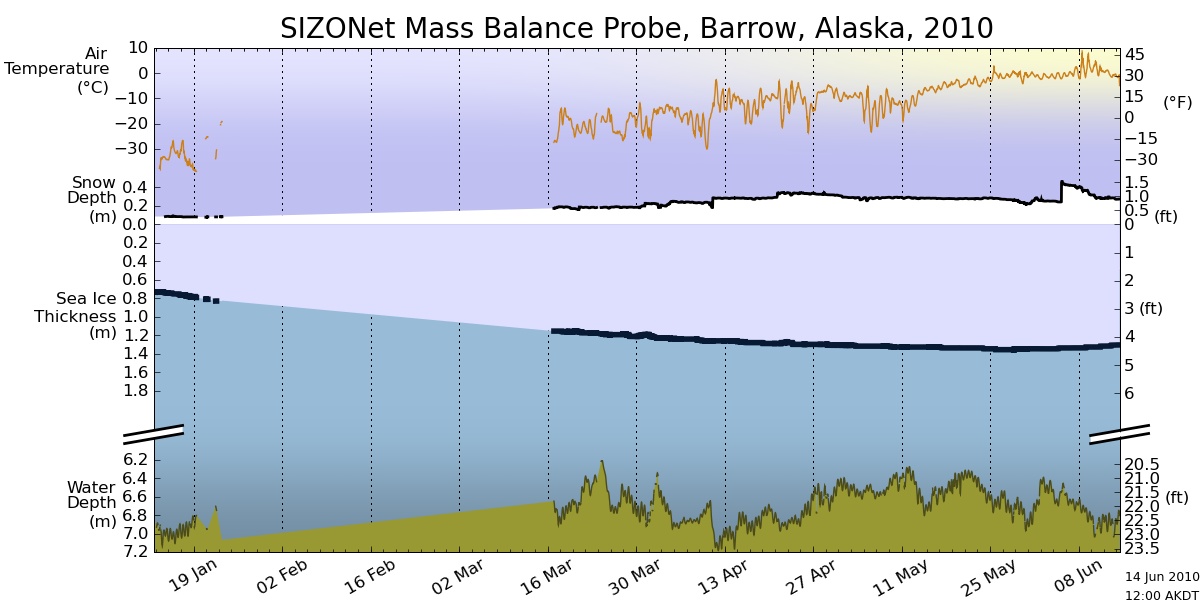
There is no indication of melt in the ice off Barrow, with ongoing cold temperatures and the deepest snow of the winter.

http://seaice.alaska.edu/gi/observatories/barrow_sealevel/brw2010/BRW_MBS10_overview_complete.png
Ice continues to look very concentrated in the Arctic Basin, as seen in this enhanced satellite photo.

http://ice-map.appspot.com/?map=Arc&sat=ter&lvl=7&lat=67.940426&lon=-168.991006&yir=2010&day=149
——————————————–
The disparity between ice indices continues to widen.DMI has 2010 ahead of 2007 and 2008. Other indices have 2010 lower. Given the analysis above, these numbers are relativelymeaningless this early in the summer.

The modified NSIDC graph below shows a comparison of 2010 ice extent vs. 2007. Areas in green have more ice than 2007. Areas in red have less ice.

The modified NSIDC map below shows ice loss since April 5, in red.

The modified NSIDC map shows changes in Arctic ice over the last week, using the same colour scheme.

The modified NSIDC image below shows the current anomaly. Areas in red have less ice than the 30 year mean, and areas in green have more ice.

fred,
“Just a few weeks ago” you must have not bothered to read this article:
http://wattsupwiththat.com/2010/05/15/sea-ice-graphs-have-limited-predictive-value/
Nor the one you are commenting on.
fred says:
June 6, 2010 at 10:59 pm
Just a few weeks ago Watts Up With That was empasizing sea ice extent, I guess because that was going up. Now you are emphasizing sea ice volume, based on the PIPS2.0 model, I guess because sea ice extent has turned so much downwards?
The only reason why the extent was put on the front burner is to demonstrate that these things are cyclic.
What really takes the cake is not volume or extent of the Arctic, but rather the hard correlation between the Arctic and Antartic Sea Ice. Like this: http://www.robertb.darkhorizons.org/seaice.anomaly.Ant_arctic.jpg
And before that there was this: http://www.robertb.darkhorizons.org/0857806.jpg
Just so you know, and can’t say nobody told you so, what you see going on in the Antarctic right now is highly probable to be happening in the Arctic and N. Hemisphere come December. Given the last 2 years of Winter ‘top this’ hopscotch that Nature has been gaming on Planet Earth, it’s a good bet that those of us in the N. Hemisphere will be feeling December a lot more than we will be feeling a melted Arctic in September. And that is IF we manage to escape the regional threat of a Year without a Summer, being 3.5 yrs. into the penalty box and another week of lackluster Solar Activity breathing down the literary pipeline. Rotted crops not included in offer.
No, I’m not worried about the melt in the Arctic.
Are you?
R. Gates, you wrote (June 6, 2010 at 7:22 pm) in response to a statement that oceans are not warming:
“Incorrect. Ocean heat content has increased. See: http://www.nodc.noaa.gov/OC5/3M_HEAT_CONTENT/ ”
This link however reveals no OHC increase during the last five years or so. Can you explain what you mean?
This thread has deteriorated into the same “my model is better than your model” arguments. However, my reading of this article is simply a view towards predicting September sea ice extent. In other words, it doesn’t matter if the PIPS2.0 model is horrible and not at providing valid sea ice values. As long as whatever if does do correlates with the September extent.
Personally, I think the time frame (10 years) and correlation value are too small to make any real valued judgement.
For those saying PIPS 2.0 is junk.
Please reference Tom P.’s comment from a while back presenting the POSEY 2009 article published in the peer journal. It is primarily based on a comparison of PIPS 2.0 model output to highlight a trend through 2008. Posey chose the minimums. If it is good enough for Posey’s publication, why has PIPS 2.0 suddenly become “junk”.
This analysis uses the same method, it just happens to be a different date.
Keep paddling Steve, I think you’re making headway.
S.E. Hendriksen says:
June 6, 2010 at 2:17 pm
The Arctic temperature, especially North of 80 degrees North, will drop when the melting starting, all the heat is sucked out of the atmosphere… because of the heavy melting… the opposite happend when the ice starts freezing, heat energy is released to the atmisphere.
see http://ocean.dmi.dk/arctic/meant80n.php
How can you talk about melting in the Central Arctic Basin (80-90°N) while local temparatures are still below the melting point of sea ice (-1.8°c) ? Think again.
Amino Acids in Meteorites says:
June 6, 2010 at 11:23 pm
R Gates
would you provide your source(s) that shows CICE is used to determine thickness of Arctic ice? I am looking at their web site and it does not say they use it for that. I see only sea surface information:
http://www7320.nrlssc.navy.mil/global_ncom/
It is late now (11:20pm) or I’d look farther into it. But you must have already done that. You must have already determined that CICE is used for Arctic ice thickness since you say the Navy has stopped using PIPS for that purpose and is now using CICE for it. So would you provide link(s) to where you found that?
_______________
Good questions as there are so many links if you just google PIPS 3.0 and CICE together, but here is one good beginning overview:
http://research.iarc.uaf.edu/presentations/ASM_08/presentations/CICE_ASM.pdf
Google it and do your own research. PIPS 2.0 is no longer used, and PIPS 3.0 is integrated with CICE, and PIOMAS usses CICE as well…
Sorry, trolling… Why is an ice-free artic a bad thing again?
Hold on, wait.
PIPS2.0 sucks, nobody that should be using it uses it, everybody “in the know” agrees that it is crap.. So where are the up to date pretty pictures coming from?
Steven Goddard,
When you wrote “The disparity between ice indices continues to widen.DMI has 2010 ahead of 2007 and 2008. Other indices have 2010 lower. Given the analysis above, these numbers are relativelymeaningless this early in the summer.” what precisely did you mean? When I look at the sea ice extent chart on the DMI web site (at http://ocean.dmi.dk/arctic/icecover.uk.php), the picture recently basically looks similar to the JAXA sea ice extent charts – they both show current sea ice extent lower than for the same date in 2007 or 2008 and have done so for at least several days into the past. What DMI ice index were you referring to?
Arctic Sea Ice News #8
..”The quest for the Holy Grail. I have been looking for a reliable early predictor of September area/extent based on June ice data, and have found it – almost.”
_______________________
Steve, very interesting. Let’s see how it plays out. KUTGW – Keep up the great work!
PS: General Observation on Comments-
Some were right on, some were right off, some were left field, some were out of the park.
Anu
the source that was not supplied but I looked up for myself as i usually have to do, did not say that the Navy dropped PIPS.
So it looks like you trolls made that up.
Crashex,
“If it is good enough for Posey’s publication, why has PIPS 2.0 suddenly become “junk”. This analysis uses the same method, it just happens to be a different date.”
Steve’s analysis does not use the same method as he ignores the PIPS ice-concentration maps necessary to calculate the ice volumes correctly. Although he is understandably reluctant to admit it, Steve’s figures disagree with Posey’s published numbers . The correct calculations from PIPS 2.0 show that minimum ice volumes have dropped since 2007, contrary to the figures Steve continues to present here.
Tom P
again Tom I see you will not talk about what has happened since 2007.
wilt,
you will find that R Gates is propagandizing. either that or he just doesn’t know what he’s doing. everything he is doing half baked, at best.
R. Gates :
June 7, 2010 at 6:57 am
you did not answer my question.
Where did you find that the Navy stopped using PIPS to determine thickness and is instead now using CICE?
PIPS is:
The Polar Ice Prediction System (PIPS 2.0) is the operational model run by the Naval Oceanographic Office (NAVO) for sea ice forecasting….. The PIPS 2.0 makes a 120-hour forecast each day of ice displacement, ice thickness, and ice concentration…… This is an Official U.S. Navy Web Site
http://www7320.nrlssc.navy.mil/pips2/
You see? —i provide sources.
All of you saying that the Navy has dropped PIPS still have not proven what you say
Amino Acids in Meteorites says:
June 6, 2010 at 10:39 pm
Here is the mission statement for the National Ice Center:
“The National Ice Center (NIC) is a multi-agency operational center operated by the United States Navy, the National Oceanic and Atmospheric Administration, and the United States Coast Guard. Our mission is to provide the highest quality, timely, accurate, and relevant snow and ice products and services to meet the strategic, operations, and tactical requirements of the United States interests across the global area of responsibility.”
I happen to know someone who works for the National Ice Center and asked him recently about the PIPS2.0 model. He informed me the model doesn’t provide accurate forecasts, wasn’t even able to get ice motion correctly. Not sure what part of the data assimilation in the model is causing the bad results, but the bottom line is they don’t use it for their forecasts because it’s not reliable. I don’t know how much NIC responds to user’s questions, but if you want to check it for yourself, you could try contacting them.
I wonder why Steve doesn’t show their data/outlooks? I would think they have the most accurate information on ice conditions in the Arctic since they assimilate many data sources, not just the passive microwave satellite record.
jcrabb: June 7, 2010 at 12:03 am
The greatest Navy on the planet expects the Arctic to be summer ice free between 2013 and 2019.
Maslowski is a simulations guy, and the .pdf you linked appears to be from a 2007 article in Computer magazine, with a new title and date.
http://www.computer.org/portal/web/csdl/doi/10.1109/MCSE.2007.125
He’s also the — *ahem* — prophet who, in 2007, declared that “Arctic summers will be ice-free by 2013″…
http://news.bbc.co.uk/2/hi/science/nature/7139797.stm
Just the Facts writes:
That seems like a huge leap of faith, based on very limited data. What are your thoughts on why Antarctic Sea Ice Area and Extent is currently well above average;
http://arctic.atmos.uiuc.edu/cryosphere/IMAGES/global.daily.ice.area.withtrend.jpg
http://nsidc.org/data/seaice_index/images/daily_images/S_stddev_timeseries.png
and Global Sea Ice Area is currently above average?
http://arctic.atmos.uiuc.edu/cryosphere/IMAGES/global.daily.ice.area.withtrend.jpg
There are many good papers that have been published in recent years discussion the Antarctic sea ice trends and why the Ross Sea is showing such a large increase in extent (note the increase is dominated by changes in the Ross Sea). It has to do with strengthening of the circumpolar vortex around Antarctic in part a response to the ozone hole. Strong winds push the ice away from the coast in the Ross Sea, allowing new ice formation in the open water areas. The only place that shows strong decreases in Antarctic sea ice is the Bellinghausen/Admudsen Seas where there has been a strong warming signal. The reality though is that sea ice in the Antarctic is seasonal (forms in winter, melts out in summer). This is the direction the Arctic ice cover is heading towards.
If PIPS 2 is so poor and compromised by low resolution (no evidence or figures are given for this) then it is curious indeed that the June thickness predicted by PIPS for the last decade or two correlates with September minimum with an Rsq of 0.65 as Steve shows. If PIPS is not accurately measuring thickness than what other component of the PIPS prediction is causing this correlation with the September minimum? It must be some other PIPS 2.0 parameter, maybe number of pdf manuals or powerpoint presentations published per year?
@ur momisugly Steve Goddard,
Tom P. has raised a valid point. He added a “concentration term” in and got better agreement with ice volume estimates for PIPS2.0 and a different result than yours from the same data set (last post.)
I do not understand how, for a variable composition, you can have an ice concentration constant by which to convert, however, his agreement with published volume conclusions is closer than yours.
Can you address Tom P’s observation directly?
Buffoon
Tom P is generating FUD. He is talking about trends prior to 2008, and I am talking about what has happened since then.
Steve,
I don’t understand FUD, it means what?
Also, if he pointed out a *missing term* (concentration) in your calculation, it is missing for future (and current) iterations of your analysis, not just pre-2008.
jeff brown says:
June 7, 2010 at 7:52 am
I happen to know someone who works for the National Ice Center and asked him recently about the PIPS2.0 model.
Objection: Hearsay. Referred expert testimony is not in evidence.
Sustained.