
By Steven Goddard
The quest for the Holy Grail.
I have been looking for a reliable early predictor of September area/extent based on June ice data, and have found it – almost. Previously I established that current extent is a useless predictor, prior to August. The reasons for this are :
- Extent tells you nothing about thickness
- Many areas currently covered with ice, will normally have almost none in September (Hudson Bay, Barents Sea, etc.)
I eliminated the second issue by reducing the region of interest to the area shown in white below. That area corresponds approximately to the maximum extent of September ice in the 30 year NSIDC record.

Then I tried three different metrics to compare June 6 ice parameters vs. September extent and area, for the decade 2000-2009.
The first parameter was June 6 ice area. As expected, this correlated very poorly with September extent and area. The rsq value of June 6 ice area rankings vs September extent rankings is 0.02. The rsq value of June 6 ice area rankings vs September area rankings is 0.07.
The next parameter for comparison was June 6 ice volume (calculated from PIPS) vs September extent. This correlated much better. The rsq value of June 6 ice volume rankings vs September extent rankings is 0.22. The rsq value of June 6 ice volume rankings vs September area rankings is 0.37.

The final parameter for comparison was June 6 average ice thickness (calculated from PIPS) vs September extent. This correlated the best. The rsq value of June 6 average ice thickness rankings vs September extent rankings is 0.28. The rsq value of June 6 average ice thickness rankings vs September area rankings is an excellent 0.65.
So it appears that we have found a reliable predictor of September extent based on June ice thickness, which makes sense from a physical point of view. But it isn’t perfect! The graph and table below show the problem.

Average thickness on June 6, 2010 is 2.55 metres. The table below shows the June 6 rankings for the last 11 years. 2010 is in 7th place, behind 2006 and ahead of 2007, 2003, 2009 and 2008. Average thickness is more than half a metre thicker than 2008.
Date            Average Thickness

6/6/2004        2.95

6/6/2005        2.87

6/6/2001        2.86

6/6/2000        2.84

6/6/2002        2.76

6/6/2006        2.68

6/6/2010        2.55

6/6/2007        2.54

6/6/2003        2.5

6/6/2009        2.17

6/6/2008        1.96
Everything in that table makes sense, except for 2007. Ice thickness in the central Arctic on June 6, 2007 was nearly identical to 2010 and the top year – 2003.
Conclusion : Based on current ice thickness, we should expect September extent/area to come in near the top of the JAXA rankings (near 2003 and 2006.) However, unusual weather conditions like those from the summer of 2007 could dramatically change this. There is no guarantee, because weather is very variable.


No doubt some people are wondering how this can be true, given that extent is currently lowest in the record. The reason (again) is that June extent has almost no correlation with September extent. Imagine an ice cube floating in water. It occupies a much smaller area of water than a ground up ice cube. But which one melts faster? The ground up ice cube will of course melt faster. Having a wide extent in June is not necessarily a good thing, unless the ice is also thick.
Sea surface temperatures continue to run cold in the Northern Pacific. They also are cooling down some in Atlantic.

http://weather.unisys.com/surface/sst_anom.html
Arctic temperatures have been running cold for the last week or so.
From: http://www.esrl.noaa.gov/psd/map/images/fnl/sfctmpmer_01a.fnl.anim.html

http://ocean.dmi.dk/arctic/meant80n.uk.php
There is no indication of melt in the ice off Barrow, with ongoing cold temperatures and the deepest snow of the winter.

http://seaice.alaska.edu/gi/observatories/barrow_sealevel/brw2010/BRW_MBS10_overview_complete.png
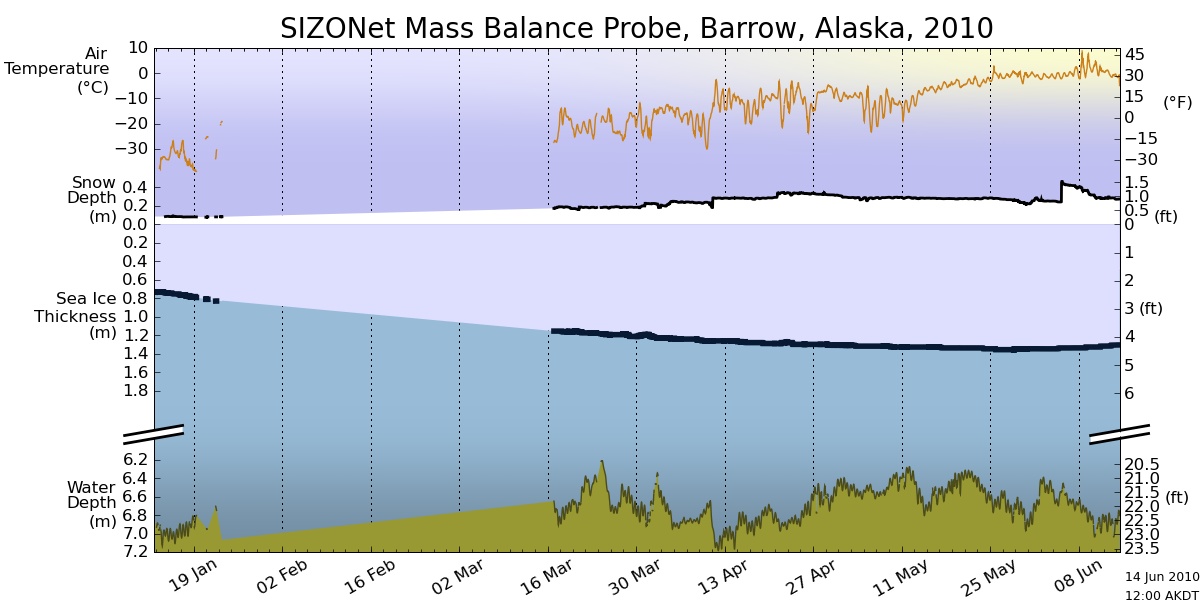
Ice continues to look very concentrated in the Arctic Basin, as seen in this enhanced satellite photo.

http://ice-map.appspot.com/?map=Arc&sat=ter&lvl=7&lat=67.940426&lon=-168.991006&yir=2010&day=149
——————————————–
The disparity between ice indices continues to widen.DMI has 2010 ahead of 2007 and 2008. Other indices have 2010 lower. Given the analysis above, these numbers are relativelymeaningless this early in the summer.

The modified NSIDC graph below shows a comparison of 2010 ice extent vs. 2007. Areas in green have more ice than 2007. Areas in red have less ice.

The modified NSIDC map below shows ice loss since April 5, in red.

The modified NSIDC map shows changes in Arctic ice over the last week, using the same colour scheme.

The modified NSIDC image below shows the current anomaly. Areas in red have less ice than the 30 year mean, and areas in green have more ice.

Steven Goddard,
As always….GREAT presentation here. I really appreciate the dedication to logic and evidence and clarity of presentation…without any spin.
Chris
Norfolk, VA, USA
Y’know, I don’t recall that being a popular argument around here in early April.
John B (TX) says:
June 6, 2010 at 2:57 pm
Anu says:
“Dropping. Like. A. Rock.”
You make Steve’s point. The current extent is on par with 2006–on target to be one of the highest minimums come September–and yet you are talking about the raw numbers.
“on par” ? Is that what you call 2010 dropping down at the fastest rate in the satellite record, and blowing by 2006, now at 222,032km² below 2006 ?
http://www.ijis.iarc.uaf.edu/seaice/extent/plot.csv
Not sure what you mean by ‘raw’ numbers – do you mean the plot of daily sea ice extent such as this:
http://www.ijis.iarc.uaf.edu/seaice/extent/AMSRE_Sea_Ice_Extent_L.png
or, the ‘raw’ data of minimum average monthly September sea ice extent like this ?
http://nsidc.org/images/arcticseaicenews/20091005_Figure3.png
I hope you are still around then and wonder what your explanation is going to be.
Sure, I’ll be around in September.
I look forward to hearing all the spin about how dropping below 2009 was no big deal, that the Arctic ice is still “recovering”, but it’s just weather, hey, bad winds, nobody saw those currents coming, see – we can’t even predict the weather, the remaining ice ridge is 200 feet tall according to a classified Navy report, uh, normal variation, ok, it’s a downward trend, maybe the ocean oscillation is 90 years long, not 70, but no death spiral…
http://nsidc.org/images/arcticseaicenews/20091005_Figure3.png
I’m easily amused, I’m sure there will be some good “explanations” come September.
Steven has a good start on the spin:
Ah yes, the unusual weather, decade after decade after decade after decade.
That is unusual.
http://iup.physik.uni-bremen.de:8084/amsr/ice_ext_n.png
Amino Acids in Meteorites says:
June 6, 2010 at 8:41 pm
@ur momisugly R Gates
The Navy has submarines in the Arctic. They are there all the time. They know the thickness of the ice because they can measure it on location in the Arctic itself. There can be no better method than the one they use.
On the other hand, the climate model you are promoting is created by modellors working in under global warming funding. Their work must show that global warming is real because those providing the funding want such results. Also, their models do not use up to date measurements like the Navy does.
============================================
Damn good light shed on the subject!
Also, for the US Navy…..it is a matter of life and death, not somebody’s comfortably well-stocked, well-funded modelling office.
And a little gloating needs to be applied here: It REMAINS the mightiest Navy in the entire world. World events have been altered for the good, thanks the them.
Chris
Norfolk, VA, USA [The geographic center of the mightiest Navy in the known universe]
jeff brown
sources?
jeff brown says:
June 6, 2010 at 9:54 pm
“Curious, why questioning the assumptions that Steve puts forth is worrisome to you.”
Worrisome? Anu, R Gates and company provide an invaluable service to this site by fact checking, providing alternative viewpoints and keeping contributors and commenters honest. This openness to critical input is why skeptics are making strides while the Warmists are wallowing in their own deceit. My response to Mike June 6, 2010 at 8:15 pm was simply pointing out a factual inaccuracy/logical fallacy in Mike’s comment.
“It is natural and wise to question Steve’s reasoning”
I agree. If you replaced Steve’s name with the names of every other climate scientist in the world, you’d be a skeptic too…
“A good example of a mistake that he has made repeatedly is the use of the PIPS2.0 model. ”
Your opinion. I doubt the US Navy used a crappy model to predict where their nuclear subs could safely surface and launch their weapons in the Arctic until 2005, but time and research will tell how accurate the PIPS2.0 model is.
“In terms of Arctic sea ice being an important indicator of climate change, it wouldn’t by itself, but the fact that all environmental variables in the Arctic are showing similar responses to warming, it is pretty obvious that the Arctic has warmed and continues to warm.”
Temps in the Arctic seem quite average to me:
http://ocean.dmi.dk/arctic/meant80n.uk.php
“There really is no denying it.”
Don’t mind if I’m skeptical of your assertion…
“The more important thing to focus on is what is causing the warming in the Arctic and what are the implications if the Arctic Ocean becomes ice free.”
That seems like a huge leap of faith, based on very limited data. What are your thoughts on why Antarctic Sea Ice Area and Extent is currently well above average;
http://arctic.atmos.uiuc.edu/cryosphere/IMAGES/global.daily.ice.area.withtrend.jpg
http://nsidc.org/data/seaice_index/images/daily_images/S_stddev_timeseries.png
and Global Sea Ice Area is currently above average?
http://arctic.atmos.uiuc.edu/cryosphere/IMAGES/global.daily.ice.area.withtrend.jpg
jeff brown
You are telling me the Navy rejected it?
R. Gates
supply sources please
I look forward to hearing all the spin about how dropping below 2009 was no big deal, that the Arctic ice is still “recovering”, but it’s just weather, hey, bad winds, nobody saw those currents coming, see – we can’t even predict the weather, the remaining ice ridge is 200 feet tall according to a classified Navy report, uh, normal variation, ok, it’s a downward trend, maybe the ocean oscillation is 90 years long, not 70, but no death spiral…
================================
Nice to hear that defensive self-confession. Keep it coming.
Definitely no death spiral.
The only “death spiral” is that of the emo, chicken-little church of the AGW, which will lose its international parish in the next 5 years.
Chris
Norfolk, VA, USA
rbateman says:
June 6, 2010 at 10:20 pm
So, PIPs2.0 is unreliable, and the PIPs3.0 is classified.
I’m wondering what their sources are. It’s not the Navy I see.
007 says:
June 6, 2010 at 6:09 pm
Please clarify Anu.
Extent, Volume, or Both?
Extent.
I’ll go with IARC-JAXA, but NSIDC will probably be close enough for yearly rankings to match JAXA.
I’m expecting 2010 Arctic sea ice extent minimum to be less than in 2009.
I would say volume too, if Cryosat-2 were delivering data, but I hear they will be taking 6 months for testing and calibration before “real” data is returned.
It was launched April 8, 2010 so it probably won’t have data for the summer minimum. I’m also not sure how hard it is to calibrate Cryosat-2 data to Icesat data- I know sometimes it is controversial to match a new satellite with new instruments to an old dataset (e.g. TSI measurements) – but I know they are doing a lot of ‘ground truth’ tests already, comparing Cryosat-2 data to airplane flyovers, drill sites, etc. The question then becomes how accurate Icesat and other earlier estimates were. Plus, a lot of Icesat data (2008, 2009) hasn’t been analyzed and published yet, at least when I spent 20 minutes looking for it a few weeks ago…
The trolls are out swarming late tonight. They’ve told us in the past that short term climate occurrences don’t mean anything. BUT THEY SURE ARE MAKING A LOT OUT OF MAY ARCTIC ICE TOTALS AND UAH TEMPERATURES FOR JANUARY TO APRIL THIS YEAR!!
They are confused. ClimateGate hit them hard on the head. All they can say now is “PIOMAS……. 14,000 feet….. hottest year on record……. volume…….”
Must suck to be them.
Amino Acids in Meteorites says:
June 6, 2010 at 8:06 pm
R Gates
Would you supply the names of the modellors that created the Los Alamos CICE model?
Amino Acids in Meteorites says:
June 6, 2010 at 8:09 pm
R Gates
I looked it up myself:
There you go !
Now you’re getting the hang of this Internet thing…
Just a few weeks ago Watts Up With That was empasizing sea ice extent, I guess because that was going up. Now you are emphasizing sea ice volume, based on the PIPS2.0 model, I guess because sea ice extent has turned so much downwards?
Save the Sharks,
Both the Navy’s PIPS 2 model and PIOMAS give similar decadal rates of ice-volume decline. The only reason Steve prefers PIPS is that his faulty calculations of ice thickness and volume are based on their data. I have pointed out exactly where Steve is going wrong and how to calculate numbers which agree precisely with the values published by the Navy.
Steve can of course choose to ignore his mistakes and continue to base his faulty conclusions on his incorrect calculations, but there should be no reason for his readership to do likewise.
savethesharks says:
June 6, 2010 at 10:18 pm
The funny thing is…that the gauntlet has been thrown down…but nobody really cares to be there to pick it up.
Are you speaking for all sharkmen, or just yourself ?
Read: There IS no challenge.
Sounds like a prediction to me, sts.
But my prediction is better.
For chicken-littleists, the world is coming to an end because of CO2.
It’s all about the animals for you people, isn’t it…
That glove will be trampled and buried in the mud by the horses.
Horses.
Again with the animals.
Big bl**dy deal….2010 might be a “record”. 30 years is a drop in the bucket of geologic time.
Yeah, and WWII was a drop in the bucket of History.
What’s your point ? That nothing really matters ?
What gauntlet?
Try to keep up.
Very interesting data posted. I wish I could trust the sources. Are not ALL scientists funded in some way by “you know who”. Does any of this data come from any source that is not funded by government? I ask again, whom do I trust for accurate information? NASA? Funded by, you got it, Gubment. I see phony data all the time! For example the story about the “Sea of Plastic” floating somewhere in the Pacific. The photo supplied as proof run with this article, a stunning shot of 1 floating plastic soda bottle. Or what about WHO trying to scare everyone on earth to rush out and pay for flu shots? You know they’ll be trying that one again! Misinformation and disinformation are known tools of social manipulation and used by con-artists and politicians all the time. All we can do at this point is trust OUR OWN judgment. One can quickly calculate the affects of a large volcano spewing poisonous gases into the atmosphere and simply come to the conclusion the we humans could NEVER have that kind of impact on the earth even if we tried to burn all the oil at once. My answer to the globalists who think we can somehow manipulate conditions on this planet is that they have themselves frozen for a few thousand years. We may have come far enough by then to terraform a small out of the way planet where they can go to spend their days living in caves and eating bugs and roots.
R Gates
would you provide your source(s) that shows CICE is used to determine thickness of Arctic ice? I am looking at their web site and it does not say they use it for that. I see only sea surface information:
http://www7320.nrlssc.navy.mil/global_ncom/
It is late now (11:20pm) or I’d look farther into it. But you must have already done that. You must have already determined that CICE is used for Arctic ice thickness since you say the Navy has stopped using PIPS for that purpose and is now using CICE for it. So would you provide link(s) to where you found that?
…………………………………………………………………………………………………………………..
I do see where the Navy uses PIPS:
The Polar Ice Prediction System (PIPS 2.0) is the operational model run by the Naval Oceanographic Office (NAVO) for sea ice forecasting……….. This is an Official U.S. Navy Web Site
http://www7320.nrlssc.navy.mil/pips2/
correction
I left this line out from the PIPS Navy web site in my last post:
The PIPS 2.0 makes a 120-hour forecast each day of ice displacement, ice thickness, and ice concentration.
http://www7320.nrlssc.navy.mil/pips2/
R Gates –
The heat content trend, 0,4 10^22 J / year can be translated to 0,004 centigrades/year
(700 m)
Should we worry? Maybe.
Do we have bigger problems? Probably.
The greatest Navy on the planet expects the Arctic to be summer ice free between 2013 and 2019.
http://soa.arcus.org/sites/soa.arcus.org/files/sessions/1-1-advances-understanding-arctic-system-components/pdf/1-1-7-maslowski-wieslaw.pdf
..maybe that PIPS3 dosn’t have very good news about Arctic volume.
NASA told us in 2006 quite categorically that “the rapid decline in winter perennial ice the past two years was caused by unusual winds”.
See http://www.nasa.gov/vision/earth/lookingatearth/quikscat-20071001.html
With regard to sea temperature, the weaknesses an discrepancies in the data are discussed by Trenberth in Nature 20 May 2010 p304 where he admits “the results reveal that all curves flatten out after 2003” and “the slowdown since 2003 is at odds with top-of-atmosphere radiation measurements. This discrepancy suggests that further problems may be hidden within the ocean observations and their processing.”
Just shows how shaky all these conclusions are, and how poorly climate is understood.
hosearodragass:
… and doing what with the money? Get real.
I’d suggest that given that 2007’s poor showing was due to winds driving ice out of the basin and into warmer waters, that a forecast of the wind patterns would help you the most.
There is a lot of discussion about PIPS in this thread. Why don’t Steven Goddard or Anthony Watts send a short email to the PIPS guys and ask if they think that PIPS 2.0 is a good model for studying arctic ice trends, especially as opposed to PIOMAS? I could send the e-mail myself, but I think that the chances of an answer is better if this website is behind it.
It’s the navy, and they might not tell us the whole truth, but a simple “yes, we think that the PIPS 2.0 model would be excellent for that purpose, it’s at least as good as PIOMAS” or alternatively “no, don’t even think about using it” would be quite useful, and probably within the limits of what they are allowed to tell us.