
By Steven Goddard
The quest for the Holy Grail.
I have been looking for a reliable early predictor of September area/extent based on June ice data, and have found it – almost. Previously I established that current extent is a useless predictor, prior to August. The reasons for this are :
- Extent tells you nothing about thickness
- Many areas currently covered with ice, will normally have almost none in September (Hudson Bay, Barents Sea, etc.)
I eliminated the second issue by reducing the region of interest to the area shown in white below. That area corresponds approximately to the maximum extent of September ice in the 30 year NSIDC record.

Then I tried three different metrics to compare June 6 ice parameters vs. September extent and area, for the decade 2000-2009.
The first parameter was June 6 ice area. As expected, this correlated very poorly with September extent and area. The rsq value of June 6 ice area rankings vs September extent rankings is 0.02. The rsq value of June 6 ice area rankings vs September area rankings is 0.07.
The next parameter for comparison was June 6 ice volume (calculated from PIPS) vs September extent. This correlated much better. The rsq value of June 6 ice volume rankings vs September extent rankings is 0.22. The rsq value of June 6 ice volume rankings vs September area rankings is 0.37.

The final parameter for comparison was June 6 average ice thickness (calculated from PIPS) vs September extent. This correlated the best. The rsq value of June 6 average ice thickness rankings vs September extent rankings is 0.28. The rsq value of June 6 average ice thickness rankings vs September area rankings is an excellent 0.65.
So it appears that we have found a reliable predictor of September extent based on June ice thickness, which makes sense from a physical point of view. But it isn’t perfect! The graph and table below show the problem.

Average thickness on June 6, 2010 is 2.55 metres. The table below shows the June 6 rankings for the last 11 years. 2010 is in 7th place, behind 2006 and ahead of 2007, 2003, 2009 and 2008. Average thickness is more than half a metre thicker than 2008.
Date            Average Thickness

6/6/2004        2.95

6/6/2005        2.87

6/6/2001        2.86

6/6/2000        2.84

6/6/2002        2.76

6/6/2006        2.68

6/6/2010        2.55

6/6/2007        2.54

6/6/2003        2.5

6/6/2009        2.17

6/6/2008        1.96
Everything in that table makes sense, except for 2007. Ice thickness in the central Arctic on June 6, 2007 was nearly identical to 2010 and the top year – 2003.
Conclusion : Based on current ice thickness, we should expect September extent/area to come in near the top of the JAXA rankings (near 2003 and 2006.) However, unusual weather conditions like those from the summer of 2007 could dramatically change this. There is no guarantee, because weather is very variable.


No doubt some people are wondering how this can be true, given that extent is currently lowest in the record. The reason (again) is that June extent has almost no correlation with September extent. Imagine an ice cube floating in water. It occupies a much smaller area of water than a ground up ice cube. But which one melts faster? The ground up ice cube will of course melt faster. Having a wide extent in June is not necessarily a good thing, unless the ice is also thick.
Sea surface temperatures continue to run cold in the Northern Pacific. They also are cooling down some in Atlantic.

http://weather.unisys.com/surface/sst_anom.html
Arctic temperatures have been running cold for the last week or so.
From: http://www.esrl.noaa.gov/psd/map/images/fnl/sfctmpmer_01a.fnl.anim.html

http://ocean.dmi.dk/arctic/meant80n.uk.php
There is no indication of melt in the ice off Barrow, with ongoing cold temperatures and the deepest snow of the winter.

http://seaice.alaska.edu/gi/observatories/barrow_sealevel/brw2010/BRW_MBS10_overview_complete.png
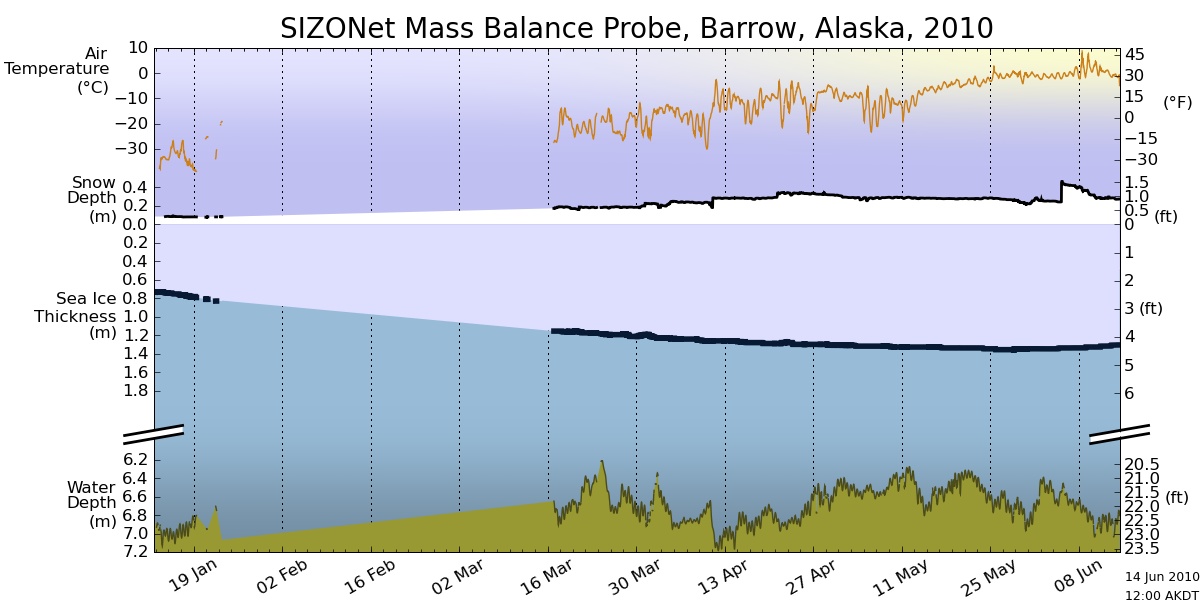
Ice continues to look very concentrated in the Arctic Basin, as seen in this enhanced satellite photo.

http://ice-map.appspot.com/?map=Arc&sat=ter&lvl=7&lat=67.940426&lon=-168.991006&yir=2010&day=149
——————————————–
The disparity between ice indices continues to widen.DMI has 2010 ahead of 2007 and 2008. Other indices have 2010 lower. Given the analysis above, these numbers are relativelymeaningless this early in the summer.

The modified NSIDC graph below shows a comparison of 2010 ice extent vs. 2007. Areas in green have more ice than 2007. Areas in red have less ice.

The modified NSIDC map below shows ice loss since April 5, in red.

The modified NSIDC map shows changes in Arctic ice over the last week, using the same colour scheme.

The modified NSIDC image below shows the current anomaly. Areas in red have less ice than the 30 year mean, and areas in green have more ice.

The DMI polar temp is almost completely irrelevant because it is for north of 80N only, whereas most of the ice that melts is between 70 and 80 degrees north…
R Gates
Would you supply the names of the modellors that created the Los Alamos CICE model?
R Gates
I looked it up myself:
Los Alamos–based computer models project that by 2040 the Arctic Ocean may be ice-free
Of course this is the model you would use!
http://www.lanl.gov/news/index.php/fuseaction/1663.article/d/200711/id/11863
Anu says:
A gauntlet, or Mrs. Daisy’s driving glove?
2009? Not 2007?
I also think the PIPS model is highly outdated. If you look back to August 2006, it is still showing ice over a meter thick just a few days before the large polynya in the Beaufort Sea begins to open up, which doesn’t seem physically plausible…
So Steve, are you suggesting the sun shines all year round in the Arctic? That’s an interesting point of view, to say the least.
R Gates
For some bizarre reason you say PIPS is not as reliable as a computer model created by a computer programmer sitting in an office.
PIPS is a product of the Navy.
The Polar Ice Prediction System (PIPS 2.0) is the operational model run by the Naval Oceanographic Office (NAVO) for sea ice forecasting.
http://www7320.nrlssc.navy.mil/pips2/index.html
&
http://www.navo.hpc.mil/
The Navy has submarines in the Arctic. They are there all the time. They know the thickness of the ice because they can measure it on location in the Arctic itself. There can be no better method than the one they use.
On the other hand, the climate model you are promoting is created by modellors working in under global warming funding. Their work must show that global warming is real because those providing the funding want such results. Also, their models do not use up to date measurements like the Navy does.
It is incomprehensible that you would say a climate model made in a office is more reliable than one made by those out in the real world, and beyond that, by the Navy!
Mike says:
June 6, 2010 at 8:15 pm
Mark.R
Good luck finding shade in the Arctic!
So Steve, are you suggesting the sun shines all year round in the Arctic? That’s an interesting point of view, to say the least.
Ya moron, that’s what he’s saying.
Boy, this thread is crawling with trolls. They really come out for this topic which “isn’t worth blogging about”.
Nightvid Cole says:
which doesn’t seem physically plausible…
———————————————————————————
Have you contacted the Navy with your concerns?
The first link on page 1 gives me a “404 not found.”
http://climateinsiders.wordpress.com/2010/06/06/wuwt-arctic-sea-ice-news-8/established%20that%20current%20extent%20is%20a%20completely%20useless%20predictor%20prior%20to%20August
Mike says:
June 6, 2010 at 8:15 pm
Mark.R
Good luck finding shade in the Arctic!
“So Steve, are you suggesting the sun shines all year round in the Arctic? That’s an interesting point of view, to say the least.”
Pay attention. They are discussing current temperatures, hence no shade.
What about Volcanic Ash?we’ve had a fair amount of activity in the high NH and
that coupled with that black soot from Asia (China /India) wouldn’t the Albedo
get a bit dark? Increasing melt?
I am curious about a feature of Arctic temperatures as measured by http://ocean.dmi.dk/arctic/meant80n.uk.php
For at least the last ten years, the current year temperature has approached the crossing of 0 degrees C and the 1958-2002 average from below. In other words, the red line (current year temps) approaches the intersection of the blue line (freezing point) and the green line (1958-2002) average from below, never from above. That intersection apparently occurs around Day 162. Looks like that pattern will be repeated in 2010.
RE: “I believe that the minus 8C is taken in the shade?. ”
“A Stevenson screen or instrument shelter is an enclosure to shield meteorological instruments against precipitation and direct heat radiation from outside sources, while still allowing air to circulate freely around them”
Therefore the temperature taken is Alway in the Shade.
Is La Nina forming?
animation
http://www7320.nrlssc.navy.mil/GLBhycom1-12/navo/equpacsst_nowcast_anim30d.gif
Mike says: June 6, 2010 at 8:15 pm
stevengoddard says: June 6, 2010 at 6:08 pm
“Good luck finding shade in the Arctic!”
“So Steve, are you suggesting the sun shines all year round in the Arctic? That’s an interesting point of view, to say the least.”
Shade is defined as “1 a : comparative darkness or obscurity owing to interception of the rays of light
2 a : shelter (as by foliage) from the heat and glare of sunlight b : a place sheltered from the sun”
http://www.merriam-webster.com/dictionary/shade
Hence, by definition, “finding shade in the Arctic” during the months when the sun doesn’t shine in the Arctic is essentially impossible, unless you would like to try to define nighttime as shady.
Amino Acids in Meteorites says:
June 6, 2010 at 8:47 pm
“Boy, this thread is crawling with trolls. They really come out for this topic which “isn’t worth blogging about”.”
Yep. The Warmists know that sea ice is one of the weakest links in the impressively flimsy catastrophic anthropogenic global warming narrative. We can expect them to circle the wagons and toss the kitchen sink in the coming months to try to obscure the fact that Earth’s sea ice is currently average and shows no signs of melting due to the claimed rapid global warming. It is much easier to fake temperature records than it is to effectively falsify the extent, area and volume of sea ice on Earth, as our Warmist friends are discovering…
Just The Facts says:
June 6, 2010 at 9:33 pm
Curious, why questioning the assumptions that Steve puts forth is worrisome to you. It is natural and wise to question Steve’s reasoning, since he is not a sea ice expert and he has an agenda. A good example of a mistake that he has made repeatedly is the use of the PIPS2.0 model. The model was designed in part for use by the National Ice Center, but they ended up not using the model for their forecasts because of the poor performance of the model (it couldn’t even get the direction of ice motion right). And it certainly isn’t getting the ice thickness correct…just look at the the distribution of thickness values in excess of 2.5 m, in locations that is first-year sea ice (first-year sea ice grows to about 1.5m thick, 2.m thick at the most).
Nevertheless, it is reasonable to expect the ice is thicker than it was the year following the 2007 minimum since more of the Arctic consisted of first-year ice that year than any other year, and first-year ice is thinner. So let’s say you have ice thickness this year at the values around the start of the 2007 melt season. That would mean that if you have a summer circulation pattern such as observed in 2007, then it is likely the sea ice would drop dramatically again this summer. If you have a different circulation pattern, it is likely the ice won’t drop quite as much. But if the ice is thinner than in 2007, then who knows.
The reality is that scientists know that June ice concentration/extent/thickness/volume is not a good predictor for September ice extent because weather remains important in defining the end of summer ice extent. So what Steve just talked about in this post if nothing new, and in fact he should have referenced papers that have already discussed this. There are many out there, especially after the 2007 event.
In terms of Arctic sea ice being an important indicator of climate change, it wouldn’t by itself, but the fact that all environmental variables in the Arctic are showing similar responses to warming, it is pretty obvious that the Arctic has warmed and continues to warm. There really is no denying it. The more important thing to focus on is what is causing the warming in the Arctic and what are the implications if the Arctic Ocean becomes ice free. Whether or not 2010 sees a new record low in sea ice is not really all that significant. Weather will always result in ups and downs superimposed on a trend. It is the long-term trend that is of interest, and there is nothing showing that the trend is changing.
Amino Acids in Meteorites says:
June 6, 2010 at 8:41 pm
The PIPS2.0 model is not reliable. Just ask the folks at the National Ice Center (NIC) who provide forecasts of ice conditions for operational purposes. PIPS2.0 was designed for their use, but they found the data from the model was junk. It is not being used, time to get your facts straight. Just because it was made by the Navy doesn’t mean it actually works. BTW…in case you don’t know, the NIC provides ice forecasts for the government and people working operationally in the Arctic. The fact that they rejected PIPS2.0 should tell you all you need to know about the model’s accuracy…
How do we stop advancing glaciers in the next few years?
You get yourself a cardinal, do lots of praying and remember to keep your things handy for a quick departure.
Amino Acids in Meteorites says:
June 6, 2010 at 4:16 pm
==================
Nice post!
crosspatch said on June 6, 2010 at 2:10 pm
“I am just not convinced of the value of Arctic “ice extent” as it seems to me to be more if a wind proxy than anything else. Antarctic ice extent would seem to me to be more of a temperature proxy than Arctic extent is.”
I get the feeling you would like the Antartic to be temp related and the Arctic wind driven to match a held conviction crosspatch. Looking at the scientific thoughts on Antarctica it seems that is the one mainly connected to the wind, –
“Using satellite images of sea ice and computer models the scientists discovered that the ozone hole has strengthened surface winds around Antarctica and deepened the storms in the South Pacific area of the Southern Ocean that surrounds the continent. This resulted in greater flow of cold air over the Ross Sea (West Antarctica) leading to more ice production in this region. ”
http://www.antarctica.ac.uk/press/press_releases/press_release.php?id=838
Andy
Anu says:
Less than 2009 – the gauntlet is thrown down.
====================================
The funny thing is…that the gauntlet has been thrown down…but nobody really cares to be there to pick it up.
Read: There IS no challenge.
For chicken-littleists, the world is coming to an end because of CO2. For others, its science business as usual.
That glove will be trampled and buried in the mud by the horses. Big bl**dy deal….2010 might be a “record”. 30 years is a drop in the bucket of geologic time.
What gauntlet?
Chris
Norfolk, VA, USa
jeff brown says:
June 6, 2010 at 9:58 pm
So, PIPs2.0 is unreliable, and the PIPs3.0 is classified.
I certainly hope NOAA isn’t getting it’s inverted forecasts out of 3.0, like they did last winter.
And one would hope that the forecast of continued El Nino weather that the models had wrongly forecast (oops) as Joe Bastardi pointed out, didn’t come from this hush-hush PIPs3.0 “if I told you I’ll have to kill you” model.
Because right now, given the gov. forecast track record, I’d have to say they couldn’t predict their way out of a paper bag.
stevengoddard says:
June 6, 2010 at 7:50 pm
R. Gates
The PIPS 2 data seems to correlate very nicely with past behaviour. Why are you so frantic to demonstrate otherwise?
_____________________
Steve, I am hardly frantic. I simply wish to make sure that readers on this blog understand that the “data” you are making so much projection on is not data, but an outdated model. One poster here even suggested that it incorporated Naval submarine data on ice thickness and therefore had to be official. PIPS 2.0 is a model, no less than PIOMAS is a model, except for the fact that it is no longer in use by the Navy as they moved on to much more accurate and up to date models that use the far more sophisticated CICE model from Los Alamos. It is s long way to September, and I enjoy your updates…but no one should think your projections are based on data…